Radio talk-show callers demand slaughter of whites and cops ( caution – language ) – T.P.
o o o
o o o
The Key To Disaster Survival? Friends And Neighbors – G.G.
o o o
Start Your Spring Garden – D.S.
o o o

Radio talk-show callers demand slaughter of whites and cops ( caution – language ) – T.P.
o o o
o o o
The Key To Disaster Survival? Friends And Neighbors – G.G.
o o o
Start Your Spring Garden – D.S.
o o o
“A nation can survive its fools, and even the ambitious. But it cannot survive treason from within. An enemy at the gates is less formidable, for he is known and carries his banner openly. But the traitor moves amongst those within the gate freely, his sly whispers rustling through all the alleys, heard in the very halls of government itself. For the traitor appears not a traitor; he speaks in accents familiar to his victims, and he wears their face and their arguments, he appeals to the baseness that lies deep in the hearts of all men. He rots the soul of a nation, he works secretly and unknown in the night to undermine the pillars of the city, he infects the body politic so that it can no longer resist. A murderer is less to fear. The traitor is the plague.” – Marcus Tullius Cicero
“For where your treasure is, there will your heart be also.”
August 30, 2014 is the 95th birthday of Joachim Rønneberg, a hero of the Norwegian resistance during World War II. His exploits earned him the War Cross Wtth Sword, Norway’s highest military honor. In April 2013, Rønneberg was presented with a Union Jack during a ceremony at the Special Operations Executive (SOE) monument in London to mark 70 years since the successful Gunnerside heavy water plant sabotage mission.
o o o
Today, we present another entry for Round 60 of the SurvivalBlog non-fiction writing contest. The $10,000 worth of prizes for this round include:
First Prize:
Second Prize:
Third Prize:
Round 60 ends on September 30th, so get busy writing and e-mail us your entry. Remember that there is a 1,500-word minimum, and that articles on practical “how to” skills for survival have an advantage in the judging.
There is another category of crisis that can be forecast in a sense, and that is the “unfolding disaster”.
Some crises don’t just strike out of the blue one day; they begin and gather steam. Keeping an eye on national and global news, we can spot events that are clearly going to worsen and spread. We won’t be able to predict the exact day of the turning point or the milestones as they unfold, but it becomes obvious that something bad is dead ahead and there’s no getting out of it. Others may be in denial and frozen up by normalcy bias, but the studious prepper sees what is happening.
Hurricanes are a good example. We watch the news. We see one forming in the ocean. We know it might come our way, or it might not. We get ready for a hurricane, implementing the more disruptive protective measures only once it looks like it’s going to go through the neighborhood. When we first see the news, we might check our water and gasoline supply, and by the time it’s about to come ashore we’ve nailed the plywood over our windows. The closer it gets, the clearer the danger becomes.
Another example of this is our now-collapsing national economy. Simple mathematics says that accumulating enormous debts can’t go on forever. (“If something cannot go on forever, it will stop,” Herbert Stein’s Law) Some trends are unsustainable. Some can continue for far longer than anyone ever dreamed possible.
Sooner or later, so it seems, a turning point will be reached beyond which our economy will cease to function. That will be bad. We can see it coming. We just don’t really know when. However, the closer it gets, the clearer the danger will become, and the more specific our protective measures will be.
It doesn’t take a rocket surgeon to see that undermining Constitutional government, the rule of law, and Biblical morality will eventually turn our country into a third-world powder keg of crises and breakdowns, ending in martial law or Civil War, unless of course some Black Swan event (or divine intervention) turns things in an unforeseen direction.
You and I know well that our country cannot murder 50,000,000+ babies, approve and promote sodomite rights and perversions (LGBTQXYZ… whatever…), and endanger Israel, empower and support their enemies, and attempt to divide the land and Jerusalem without incurring some divine judgment. This is an unfolding disaster and something bad is plainly coming.
Just this week I saw a headline that said if there were to be a huge solar EMP, we Earthlings might have as little as 12 hours’ notice to brace for impact.It makes me wonder how long a warning message might wend its way through the bowels of our federal bureaucracies before depositing a tepid warning before the American people? Regardless, I check on solar activity regularly and get email alerts. So, if something pops off, I’ve got a huge head start on the sheeple, time to circle the wagons, gas everything up, and gather the family.
This is a special case of the unfolding disaster. It’s one where you can see the avalanche has been triggered and you know you have just seconds before the snow arrives. It’s a Black Swan whose impact is delayed enough to give you a useful amount of time. The prepper here has a critical advantage: We learn something has popped off and, unlike most of the American population, we leap into knowledgeable, focused, functional action. We don’t freeze. We don’t panic. We don’t flail or stampede or pout. We have a plan for situations like this, and we coolly put that plan into action.
You’ve seen photos of refugees wading through floodwater, balancing a case of beer on something that floats or carrying off a pillowcase full of photos and memorabilia. That’s not going to be us!
To make use of the short interval provided by this type of incident, we need to keep a “weather eye” on the events of the day. We need to have most of our preps ready and done (so we’re generally ready for whatever may come). We need to have a clear, written step-by-step plan that everyone involved knows about. The more chaotic the situation, the more structured your plan must be.
We can not predict the future. Black Swans can take us by surprise. But, still, we have some hopeful and helpful strategies.
Is there anything else we can do? Yes. Definitely, yes!
“Trust in the Lord with all thine heart; and lean not unto thine own understanding. In all thy ways acknowledge him, and he shall direct thy paths.” – Proverbs 3:5-6
“In all thy ways acknowledge Him…” (Proverbs 3:5-6) means consulting God, including God, inviting God into every decision and every part of our lives as each day unfolds, “practicing the presence of God” as advocated by Brother Lawrence.
The corresponding promise of God is that when we include God in our day, not just once a day but in “all (our) ways”, He will “direct our path”. Think of it; the only person who actually knows in detail what is going to happen today, tomorrow, next month, and next year is offering to guide us through the maze of choices and challenges ahead. His providential hand will even anticipate our inevitable failures, bad choices, and shortcomings as He guides us from behind the scenes, if we will trust Him completely.
It doesn’t mean that nothing hard or bad will happen. We might still suffer and struggle, but God will be with us and guide us, and He will use it for good.
“And we know that all things work together for good to them that love God, to them who are the called according to his purpose. ” (Romans 8:28) and
“Nay, in all these things we are more than conquerors through him that loved us. For I am persuaded, that neither death, nor life, nor angels, nor principalities, nor powers, nor things present, nor things to come, nor height, nor depth, nor any other creature, shall be able to separate us from the love of God, which is in Christ Jesus our Lord.” (Romans 8:37-39)
Certainly we must do what is wise; we must do our part to anticipate what seems likely, what seems needed, but we also seek and trust the hand of God more than own wisdom. (“…lean not on your own understanding…”) Its humility time; God knows best!
He wants us to de-stress, to focus on Him, to rest, to find our calm center of the storm in Him. We can be prepared and should be working diligently toward becoming better prepared, but it must happen at the same time we are trusting God. If you’ve never yet begun a relationship with Jesus, now’s the time! He loved you enough to die your death on the cross so that you could be reconciled to God. Trust him! Read Colossians 1:19-22 and John 3:16.
Preparations do not protect. Practically everything we’ve collected can disappear in a house fire or a brazen theft. A decade of prepping can be undone in a heartbeat, literally. A dozen things could steal our health without warning. We do have our part to do. We are responsible to make reasonable and wise preparations, and to build resilience into our lives. However, we cannot and should not depend on those provisions.
The only sane approach is this: trust God, and be prepared. They’re not mutually exclusive, you know. Believe me; keeping our eyes on Jesus is the harder of the two tasks, and it is the most important. We can have all the stuff, skills, and community, but if our minds and marriages and relationship with God fall apart we will be forfeiting the most valuable survival asset of all!
So diligently make your preparations, build resiliency, and flexibility and depth to your resources. The times are bad. There’s no denying that, and September bears watching, but how will it affect you? No one knows! However, there is One who does know, and He is making you an amazing offer– to guide you through.
You’d be crazy to pass up an offer like that! Trust God. Be Prepared. We can do both.
“…for we have no might against this great company that cometh against us; neither know we what to do: but our eyes are upon thee.” – 2 Chronicles 20:12
Good morning, Hugh,
In reading Scot’s excellent review of the Burris 2-7X Extended Eye Relief rifle scope he mentioned using a ballistics program to determine a 200 yard zero which would also allow hits within four inches of point of aim at 250 yards. Inadvertently, I think, Scot broached the topic of Point Blank Range with that sentence.
If one watches movies and television dramas, one probably believes Point Blank Range to be several inches to a few feet in front of a firearm’s muzzle. It is not. The definition of Point Blank Range is:
“The maximum distance at which a center sighting hold on a target of specified size will produce a strike on that target from the muzzle to that maximum distance.”
It is, of course, dependent upon bullet trajectory and will vary based on the firearm and/or ammunition employed and the target. Determining point blank range is simple using ballistics software, an ammunition manufacturer’s trajectory chart, or it can be determined by actual measurement on the range.
Regarding trajectory, here’s a question: If a rifleman is standing on a perfectly flat plane not subject to curvature of the earth holding a firearm parallel to that flat plane, accompanied by an observer who holds a bullet at muzzle height identical to the one being fired, and the observer releases the bullet at the same instant the fired bullet exits the muzzle, which bullet strikes the ground first?
They will both strike the ground simultaneously because gravity is a constant and acts on both bullets identically. The only difference is one bullet contacts the earth at the observer’s feet and the other at a distance down range. Where the fired bullet strikes the ground is determined solely by velocity – gravity begins acting on it immediately after it leaves the muzzle, dragging it downward at an acceleration rate of 32 feet per second for each second it falls, and it will continue to accelerate downward until it either reaches terminal velocity (gravitational acceleration is balanced out by air resistance) or it reaches the ground and stops falling. The faster the bullet moves , velocity allows bullet to travel horizontally farther before the downward acceleration of gravity brings it into contact with the ground; it’s completely a function of horizontal distance traveled per unit of time because gravity is a constant force exerted over time.
To move point of impact farther away than several hundred feet requires the firearm’s muzzle be elevated to release the bullet at an upward angle to counteract the effect of gravity. Since gravity is a constant force it still begins acting on the bullet as soon as it leaves the muzzle, so the upward angle of the bullet’s path soon begins to turn downward, eventually reaching the ground. The path is usually depicted as an arc, but with one significant difference: past the trajectory midpoint – the highest point of the bullet’s arc– the downward arc steepens because bullets slow due to air resistance the farther they travel, requiring more time to cover a particular distance, and gravity is a constant force. The slower the bullet travels the steeper the downward trajectory curve.
For my example I’ll use a common 8.5X11.0 inch sheet of copy or printer paper as a target, which allows shots 5.5 inches high or low to strike the paper, and generic 5.56X45 ammunition. With 55 grain projectiles and a 20 inch barrel length, published velocity from one ammunition manufacturer is 3240 feet per second. Bullets have a ballistic coefficient – labeled “BC” in the trajectory tables – which references the shape of each particular bullet and the associated air resistance, necessary for precise trajectory computation but for now we can ignore it.
According to the manufacturer’s data tables, this bullet and velocity allows the convenience of a “dual zero”, in this particular case a point-of-aim zero at 40 yards produces another point-of-aim zero at 200 yards, with a trajectory midpoint of 1.4 inches above the point-of-aim zero point occuring at 125 yards. The usual “line of sight above bore distance” for iron sights or scopes is about 1.5 inches, so we’ll use that. A 1.4 inch midpoint height means the bullet not quite reaches line of sight at its trajectory midpoint.
Using the same ballistic data and our 8.5X11.0 inch paper as a target, a 310 yard point-of-aim zero produces a midpoint high of 5.2 inches above point-of-aim zero, which occurs at 175 yards. At 370 yards the bullet is 5.5 inches below point-of-aim zero. That means if this rifle and ammunition combination is zeroed at 310 yards and aimed at the center of our 11-inch high paper the bullet will strike somewhere on the paper at any distance from the muzzle to 370 yards, so 370 yards is the Point Blank Range for this particular rifle/ammunition combination. To hit a target 11 inches in height at any distance from the muzzle out to 370 yards with this rifle/ammunition combination one needs only to aim at the center of the 11 inch target.
Given the energy level of 55 grain projectiles, and the effect of crosswind, 370 yards is probably a bit too far. Most users of 5.56X45 ammunition would select a 250 yard point-of-aim zero, which produces a point blank range of 320 yards on our 11 inch paper target, and a trajectory midpoint of just under 3 inches above point-of-aim. At 300 yards this combination is 3.6 inches below point-of-aim, which shows how quickly the trajectory drops as the bullet slows – in the 20 yards between 300 and 320 it falls just over two inches, and that two inches puts it at the very bottom edge of the 11-inch paper target.
Another point – many misunderstand the mechanics of shooting uphill or downhill. It is often assumed that a rifle zeroed at a horizontal distance needs to be aimed higher if the target is uphill, or lower if it’s downhill. Remember, gravity is a constant – what matters most is not the distance uphill or downhill but the horizontal distance the bullet travels. An uphill target 300 yards away by rangefinder and 100 yards higher in elevation is only 282 yards distant horizontally, meaning gravity acts on the bullet for 282 yards, not 300; “holding over” to compensate for “shooting uphill” will result in a miss. To score a center hit one would need to aim slightly lower. The same gravity rules apply when shooting downhill. (On mild inclines and/or at close distances the effect is negligible, but on smaller targets or at greater distances the difference is enough to determine whether your dinner plate is full or empty).
Selecting a target size different from our 8.5X11.0 inch paper would result in a different point blank range, and requiring a different point-of-aim zero distance as well. With deer, for example, a common game animal, the vital area in which to place a heart/lung shot is usually described as an 8-inch circle. This would require a point-of-aim zero at a closer distance since the radius of an 8-inch circle is 4 inches; using the same rifle/ammunition combination as above (not that 55 grain 5.56 ammunition is suitable for deer), a 230 yard POA zero produces a 288 yard point blank range with a trajectory midpoint of 2.3 inches occuring at 140 yards. Allowing for normal error would suggest a closer point blank range – approximately 265 yards would produce a drop below point-of-aim of about 2.4 inches, nearly matching the trajectory high point of 2.3 inches, keeping all shots well within the critical 8-inch circle all the way out to 265 yards.
Point blank range works the same on every firearm/ammunition combination, from .22 rimfires to cannons. The advantage of knowing the point blank range of one’s firearm and ammunition combination allows successful shooting at unknown range targets without guessing at distance or the “hold over” required to score a hit. Competitive shooters compute the trajectory of their loads precisely because points scores are at stake, and winners are often decided by small fractions of an inch. Those of us who go afield don’t need that level of precision, but knowing where your bullets will strike at distance could be the difference between meat for the pot and opening another can of beans.
N.K.
‘Production Versus Plunder’ Part 22 – The Code of Production
o o o
A nap a day could save your life, research suggests – D.S.
o o o
Smith & Wesson investors are celebrating today – D.S.
How is it that S&W can be doing so well and Colt is in bankruptcy?
o o o
Though the author of this piece isn’t as resourceful as many preppers I know: Food items you should never buy in bulk – K.C.
o o o
“And Pilate, when he had called together the chief priests and the rulers and the people, said unto them, Ye have brought this man unto me, as one that perverteth the people: and, behold, I, having examined him before you, have found no fault in this man touching those things whereof ye accuse him:” Luke 23:13-14 (KJV)
August 29th is a mournful day, as we remember the anniversary of the death of “The voice of him that crieth in the wilderness, Prepare ye the way of the LORD, make straight in the desert a highway for our God.” – Isaiah 40:3. John, the Baptist, who heralded the first coming of our Lord and stood true to his belief in the face of death, was beheaded on this day in 29AD.
In 1862, the Battle of Bull Run in Virginia began, along with the U.S. Bureau of Engraving and Printing.
o o o
Today, we present another entry for Round 60 of the SurvivalBlog non-fiction writing contest. The $10,000 worth of prizes for this round include:
First Prize:
Second Prize:
Third Prize:
Round 60 ends on September 30th, so get busy writing and e-mail us your entry. Remember that there is a 1,500-word minimum, and that articles on practical “how to” skills for survival have an advantage in the judging.
Have you heard? There’s a lot of speculation lately that we might see downright apocalyptic events in mid-to-late September. I have to admit; it’s an impressive list of events, prophecies, and trends, and I’ve been encouraging my family and friends to top off their preparations in anticipation of what might happen. My “threat level” assessment is high.
However, this is also an opportunity to revisit this whole idea of “projecting” trends and “forecasting” events, so that we are not tripped up or misled by the limitations of that process. Rather, we should focus on what truly is important, especially if we think something dramatic really is about to happen. Let’s take a look.
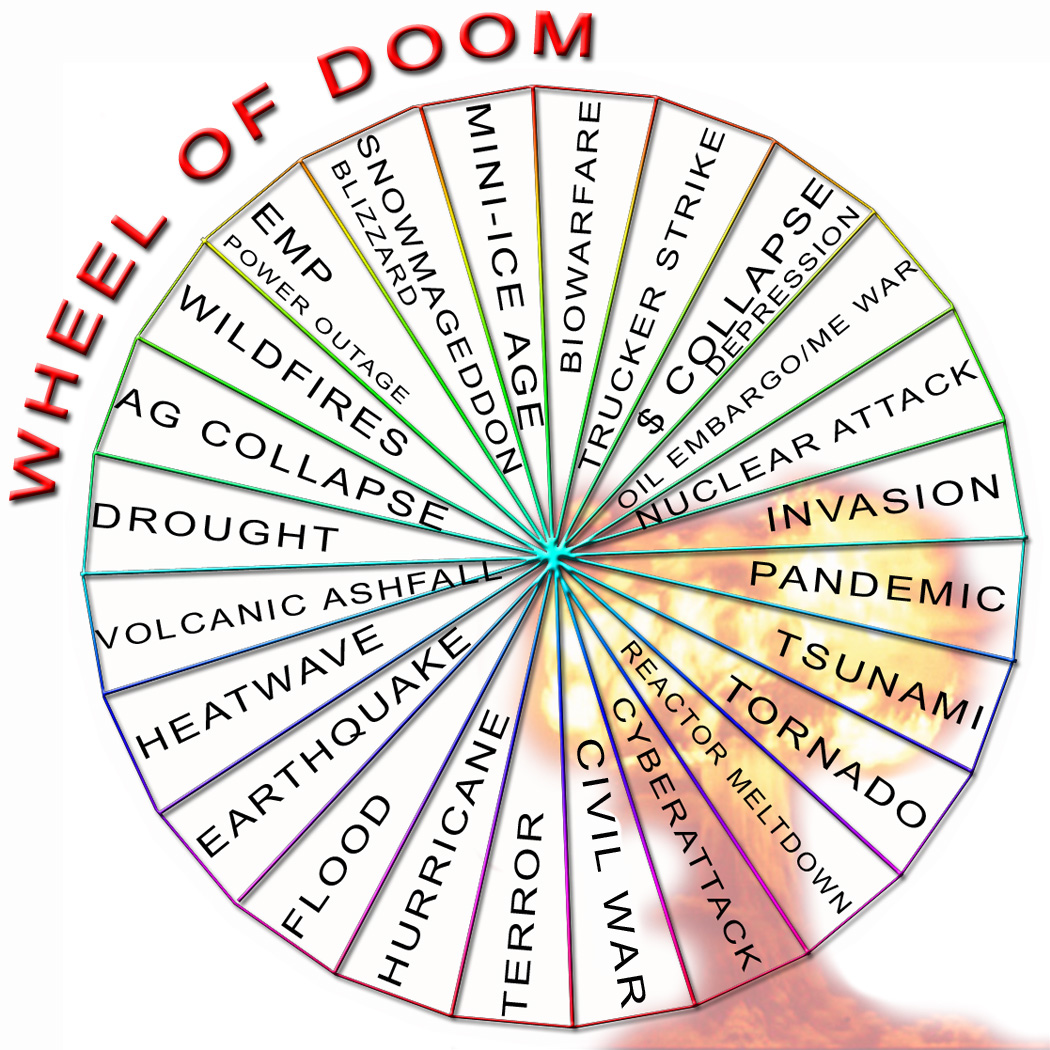
Disasters are, by very definition, events that catastrophically impact one or more of the four basic categories of provision– security, shelter, water, and food. We are highly motivated to predict them. Depending on the event, it could be critical to have an hour’s notice, a day’s notice, or a year’s heads-up that something very bad is about to happen.
Regardless, no matter how much we study and analyze, our ability to actually “foresee” the future is pretty much zero. We can’t see even one second into the future, much less one week or one year. I’ve been prepping for 15+ years, and in those years I have seen many very disturbing predictions come and go, most of them based on patterns of events, or convergences of events, or trends, or political threats and warnings.
NONE of those things came to pass, thank God! (So, I’ve had many more years to be prepared for the huge crises that I’m p-r-e-t-t-y sure are coming, I just don’t know when.) Well, what went wrong?
Why aren’t we more successful in predicting disasters or crises in the U.S.? How is it that “Black Swans” (the term popularized by Nassim Taleb in his book and articles) keep catching us by surprise?
A trend may look influential, but for it to affect our country is a huge undertaking.
The Law of Unforeseen Consequences is produced by factors such as:
The limitations of humanity include the following:
Our incomplete understanding, especially about the initial conditions and physical processes of weather, tectonics, volcanism, ecosystem dynamics, solar processes, human mass psychology, economics and more, prevent us from having the ability to forecast future behavior. Yes, even after all these years, science doesn’t know everything. What disasters/crises do we think are impossible? Are they really impossible? (“All things are possible until they are proved impossible – and even the impossible may only be so, as of now.” – Pearl S. Buck)
I’m sorry, but there really is an evil plan to destroy the world. The plan encompasses diverse persons and organizations, many of whom are completely unaware they are being co-opted in a demonic conspiracy, unaware of the invisible connections coordinating their actions.
Our sovereign God will have the last say and always gets His way. Remember that. Few are the prepper novels, disaster movies, and survival reality shows that ever include or anticipate that God has a plan for our individual lives and the course of human history. I call it the “God Factor”; it’s an idea we espoused during our college Risk board game marathons that referred to the unpredictable, uncontrollable, unstoppable intervention of the only living, sovereign, almighty Creator God of the Bible.
Evil people will make their little plans with grandiose expectations for world government, a world economy, and the suppression of human freedom. They can plan all they want, but God gets the last word. (We should never fear the machinations of the world, no matter how dark the day.) This is vital to remember.
So, sure, we try hard to get a glimpse of what’s coming, but it seems we can only recognize “precursor events” in retrospect. (Hindsight is 20/20.) To our frustration, mankind gets blindsided again and again.
These “precursor” events and apparently significant “convergences” are happening all the time in our highly complex, mobile, and violent world. Coincidences happen. What they mean is the big question. After many years of seeing coincidences and convergences come and go, some of them quite dramatic, I can say they clearly don’t always imply disaster is imminent!
However, instead of accurately foretelling a disaster’s character and timing, we’ve been able to do something nearly as useful! By playing out the scenarios for the myriad different disasters, we have come to an encouraging and useful conclusion: the preparations for one scenario have a lot of overlap with the preparations for other disasters. Being prepared for the factors that overlap gives us a good foundation for virtually any foreseeable event. This is the basic premise behind prepping.
Prepping is simply a practical, wise response to the uncertainties and contingencies of life. We can imagine which scenarios are possible or even likely (i.e., the “Wheel of Doom”). Also, we can accumulate supplies and knowledge to cover those. We are prepping based on extrapolations of our current knowledge, trends, historical record, and our knowledge of basic human needs. Unless we receive a divine heads up, we’re not going to know about an impending Black Swan, but we can use the general principles of prepping to be reasonably prepared.
Short of having an angel with a flaming sword suddenly appear at the foot of our bed and deliver a prophetic message from God (and there may actually be some authentic divine warnings relevant to this very September that I mentioned), we have huge limitations on knowing what’s going to happen next.
Read on about the disaster and what we can do in Part 2.
HJL,
Regarding your question regarding cooking oil that doesn’t stand out like sunflowers, I researched oil seeds for producing biodiesel. Canola rapeseed oil was the highest yielding and some varieties are grown for cooking oil. Some are genetically engineered so you need to find the right variety, but it grows well in Washington and British Columbia. It’s a brassicus with a yellow blossom so can be mistaken for wild mustard by passersby. – M.W.
Bank system outage This will be interesting when the system really is closed, won’t it ? – A.S.
o o o
Fed Up Investors Yank Cash From Almost Everything Just Like 2008 – JBG
o o o
Eliminating Physical Currency Necessary To Give Central Banks More Power
o o o
Why Stocks Could Fall 50% If The Fed Makes The Wrong Move
Items from Mr. Econocobas:
Fed Up Investors Yank Cash From Almost Everything Just Like 2008
The Financial Times Demands End Of Cash, Calls It A “Barbarous Relic”
Mexico warns Texas not to refuse its immigrants’ babies U.S. birth certificates Why is it that the descendants of Southern European, imperialist, colonialist, slave-owning, conquistadors who settled in the southern half of North America, after enslaving, raping, pillaging, murdering, and effectively exterminating much of the indigenous peoples of that land area have such a hatred for the descendants of Northern European, protestant Pilgrims who built the northern half of the North American land mass into the most prosperous, democratic, freedom-loving and defending, ethnically and religiously diverse, God fearing nation on earth, without whom much of the free world would now be enslaved by Nazi-ism, Communism, Dictatorships, or tribal and ethnic warfare? Sadly, the Protestant work ethic never had a chance to take root in Mexico– a statist, corporatist, imperial dictatorship for much of its life and now a narco state. How is it that the leaders of a failed, foreign-dominated state have anything at all to say to the world’s greatest protector of freedom? How is it that Mexico, whose so called “border guards” on its southern border frequently rob, beat, rape, and murder central and southern indigenous peoples trying to cross Mexico to reach these United States, lectures us on anything at all. – M.N.
o o o
An interesting way to teach your kids preparedness: Playful Preparedness – J.R.
o o o
DEA: Mexican Cartel influence in the U.S. 2015 – B.B.
o o o
SurvivalBlog reader J.C. wanted us to remind people – Now is a good time to stock up on seeds for next year. He just bought seed packets from Dollar General for two cents (originally 4 for $1.00). It’s hard to beat that price, even if some don’t germinate. Look for places liquidating their stock in preparation for the holiday sales.
o o o
Secretary of State John Kerry Signs United Nations Gun Ban Treaty Against Wishes of U.S. Senate – B.B.
“When the host goeth forth against thine enemies, then keep thee from every wicked thing.” – Deuteronomy 22:9 (KJV)
August 28, 1883 is the anniversary of the abolishment of slavery throughout the British Empire.
o o o
Today, we present another entry for Round 60 of the SurvivalBlog non-fiction writing contest. The $10,000 worth of prizes for this round include:
First Prize:
Second Prize:
Third Prize:
Round 60 ends on September 30th, so get busy writing and e-mail us your entry. Remember that there is a 1,500-word minimum, and that articles on practical “how to” skills for survival have an advantage in the judging.