Letter: Fishing Pliers

Dear SurvivalBlog,

After searching every nook and cranny of the Internet I have had no luck in finding a decent (in quality and price) pair of needle nose “fishing specific’ pliers. How about taking on the challenge? – JLN

Pat Cascio responds: I love to fish, and there is a pond just 50 yards from my front door on my neighbor’s property, and I can fish there all I want. I’m a sport angler; I catch and release most of the time. I’ve been fishing since I was about 10 years old. I started out using a bamboo fishing pole.

Fish

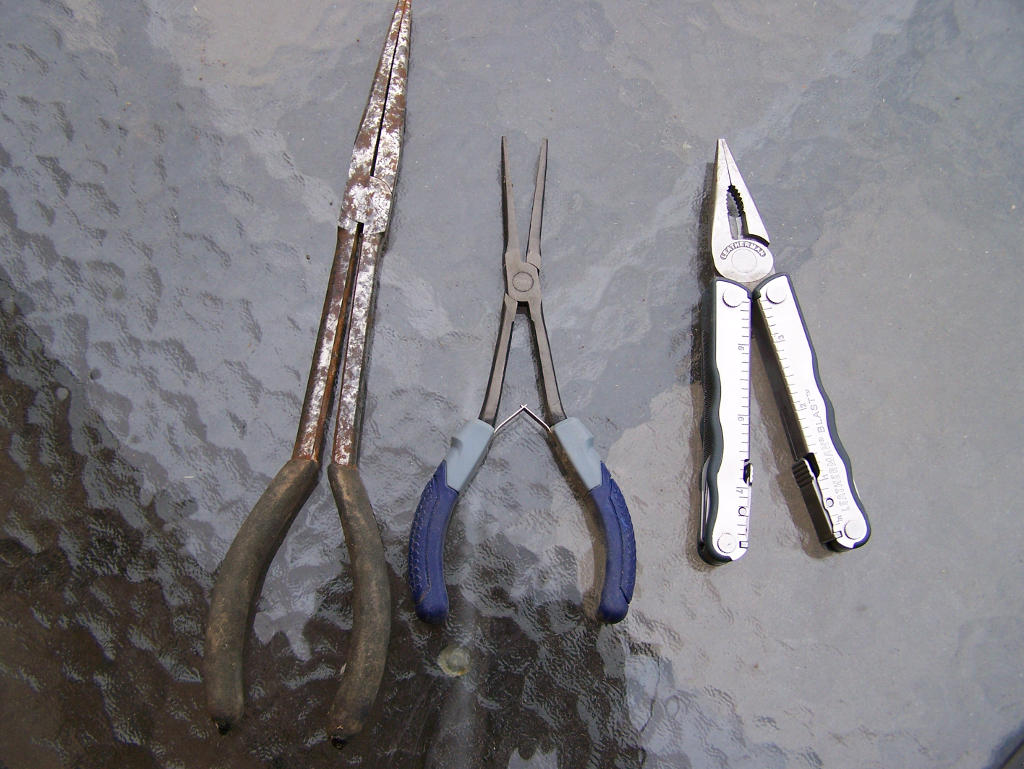
Attached is a picture with a few of my pliers. The first, long pair of fishing specific pliers were purchased at K-Mart many years ago for under ten bucks if I recall. The middle pliers are from a set of various pliers given to me by my local gun shop. The last is my Leatherman Blast multi-tool with needle nose pliers. As you can see, the fishing specific pliers are rusted. They spend most of the time in the bottom of my fishing tackle box and rarely get used. The middle pliers are just an example of what is out there. You don’t have to purchase fishing specific needle nose pliers. The Leatherman multi-tool is what I use 98% of the time to dislodge a hook from my fish. It works wonderfully for me, and my wife and daughters also use multi-tools to dislodge a hook.

In the past, I have used surgical forceps to remove hooks. They are convenient in that you can lock them onto the hook, and they come in different sizes and lengths. They work quite well, and you can find them for under five bucks. However, when it is all said and done, the Leatherman multi-tool works best for me. It’s always in the pouch on my belt and it only takes a few seconds to get it out and put it to work. Yes, you can go to any sporting goods or big box store and find fishing specific long needle nose pliers, and they work well. However, for my money, it is hard to beat a multi-tool with needle nose pliers for dislodging a hook.


Odds ‘n Sods:

Even more reason to home school. Public schools are GOVERNMENT schools and we know what kind of government– federal, state, and local– we NOW have! It’s our own fault for being asleep for DECADES! School Officials Used Young Girl as “Bait” in Rape Sting, She Was Raped and they Covered it Up – H.L.

o o o

Pistol-whipped detective says he didn’t shoot attacker because of headlines – T.P.

o o o

Want ‘sustained happiness’? Get religion, study suggests – D.S.

o o o

Before the death panels…limb panels? – Mike Williamson, SurvivalBlog’s Editor At Large

o o o

Reciprocity Alert – Minnesota No Longer Honoring Utah CCW Permits – K.C.


Notes for Friday – August 14, 2015

14 August 1945 V-J Day

o o o

Today, we present another entry for Round 60 of the SurvivalBlog non-fiction writing contest. The $10,000 worth of prizes for this round include:

First Prize:

  1. A Gunsite Academy Three Day Course Certificate, good for any one, two, or three day course (a $1,195 value),
  2. A course certificate from onPoint Tactical. This certificate will be for the prize winner’s choice of three-day civilian courses. (Excluding those restricted for military or government teams.) Three day onPoint courses normally cost $795,
  3. DRD Tactical is providing a 5.56 NATO QD Billet upper with a hammer forged, chromlined barrel and a hard case to go with your own AR lower. It will allow any standard AR type rifle to have quick change barrel, which can be assembled in less than one minute without the use of any tools, and a compact carry capability in a hard case or 3-day pack (an $1,100 value),
  4. Gun Mag Warehouse is providing 20 Magpul pmags 30rd Magazines (a value of $300) and a Gun Mag Warehouse T-Shirt. (An equivalent prize will be awarded for residents in states with magazine restrictions.),
  5. Two cases of Mountain House freeze dried assorted entrees in #10 cans, courtesy of Ready Made Resources (a $350 value),
  6. A Model 120 Series Solar Generator provided by Quantum Harvest LLC (a $340 value),
  7. A $250 gift certificate from Sunflower Ammo,
  8. KellyKettleUSA.com is donating both an AquaBrick water filtration kit and a Stainless Medium Scout Kelly Kettle Complete Kit with a combined retail value of $304,
  9. TexasgiBrass.com is providing a $300 gift certificate, and
  10. Two cases of meals, Ready to Eat (MREs), courtesy of CampingSurvival.com (a $180 value).

Second Prize:

  1. A Glock form factor SIRT laser training pistol and a SIRT AR-15/M4 Laser Training Bolt, courtesy of Next Level Training, which have a combined retail value of $589,
  2. A FloJak EarthStraw “Code Red” 100-foot well pump system (a $500 value), courtesy of FloJak.com,
  3. The Ark Institute is donating a non-GMO, non-hybrid vegetable seed package–enough for two families of four, seed storage materials, a CD-ROM of Geri Guidetti’s book “Build Your Ark! How to Prepare for Self Reliance in Uncertain Times”, and two bottles of Potassium Iodate– a $325 retail value,
  4. A $300 gift certificate from Freeze Dry Guy,
  5. A $250 gift card from Emergency Essentials,
  6. Twenty Five books, of the winners choice, of any books published by PrepperPress.com (a $270 value),
  7. A pre-selected assortment of military surplus gear from CJL Enterprize (a $300 value),
  8. TexasgiBrass.com is providing a $150 gift certificate,
  9. RepackBox is providing a $300 gift certificate to their site, and
  10. Safecastle is providing a package of 10 Lifestraws (a $200 value).

Third Prize:

  1. A Royal Berkey water filter, courtesy of Directive 21 (a $275 value),
  2. A large handmade clothes drying rack, a washboard, and a Homesteading for Beginners DVD, all courtesy of The Homestead Store, with a combined value of $206,
  3. Expanded sets of both washable feminine pads and liners, donated by Naturally Cozy (a $185 retail value),
  4. Two Super Survival Pack seed collections, a $150 value, courtesy of Seed for Security, LLC,
  5. Mayflower Trading is donating a $200 gift certificate for homesteading appliances,
  6. APEX Gun Parts is donating a $250 purchase credit,
  7. Montie Gear is donating a Precision Rest (a $249 value), and
  8. Two 1,000-foot spools of full mil-spec U.S.-made 750 paracord (in-stock colors only) from www.TOUGHGRID.com (a $240 value).

Round 60 ends on September 30th, so get busy writing and e-mail us your entry. Remember that there is a 1,500-word minimum, and that articles on practical “how to” skills for survival have an advantage in the judging.


Traversing the Hinterlands – Part 3, by Iowa Farm Boy

Dangerous Areas

It will be extremely difficult to cross this region while avoiding some major cities. For example, Cedar Rapids and Iowa City are very close together. You all know as well as I do what happens when people get desperate. How far away from the cities this will effect the countryside, I don’t know. Cities to avoid specifically are the ones with major prisons, like Fort Madison or Anamosa. There are several prisons or minimum security facilities across the region, and someone coming through Iowa needs to do their research and avoid them, if possible.

I have spent the last 35 years, until recently, living in Marshalltown. I believe this town was also mentioned in one of JWR’s books. During the time I lived there, I watched the dynamics change. The packing house closed then reopened, and it renamed itself to get the union out; at least, that is my opinion. It then expanded and started hiring migrant workers, and dare I say, illegals. The crime rate went up and the neighborhood where I lived went downhill. Marshalltown was and may still be considered the meth capital of the Midwest. I have heard that they had at least two members of every major gang in the country represented there, including MS13. There have been several murders in the last couple of years, including one drug deal gone bad involving mutilation of the body. All I am saying is that if I was traversing the countryside, I would avoid Marshalltown by a big margin.

People

There is also the Meskwaki Indian settlement close to Marshalltown. Whether that is good or bad depends on them and you. Other than their annual Pow-Wow, they have mostly abandoned their traditional ways of living. There is also a large casino there.

Other bloggers have mentioned the Amish or Mennonites. There are several communities of them in Iowa. The biggest is called the Amana Colonies near Iowa City, although they aren‘t necessarily Amish. I believe they will be the most prepared and able to survive, but I don’t know how they will react to strangers after the SHTF. Is it just a coincidence that they have chosen a way of life that will be ideal in a TEOTWAWKI situation?

The people of Iowa are a good and kind people, for the most part, especially in the small towns and the farming community. Growing up on a farm you see the best come out in people. Especially in the days before a lot of the processes became mechanized, we helped each other. In the past, it was thrashing, and more recently I remember the days we shelled corn. All the area farmers would get together for the day to help. For lunch, the women would throw a huge meal together for the men. Sexist or not, that’s the way it was, and nobody complained. Everyone did their part to bring in the harvest. When I was too young or in school, my mother was driving the tractor in the fields right along with my dad. As soon as I was able to carry a bucket of oats, I helped with the chores. My sisters would gather the eggs. We would all pitch in weeding the garden. Was it child abuse? No, it was life lessons. When a farmer was sick or somehow laid up, the neighborhood farmers will come to help with the field work and chores. Our neighbors still plow us out with their tractors from the snow without being asked. Many of us all go to the same schools, churches, stores, and bars and have known each other all our lives. My own example was that I went to church in one town, went to school in another, and had relatives I pretty much grew up with in a different town. We had friends and relatives in each town. All these towns were less than ten miles apart. Everybody knowing everybody’s business can be bad and good. Having people around a 10 mile square area of the countryside that have known you and your family for literally generations has to be an advantage. I am certainly counting on this when the SHTF.

Directions

Obviously, the further west you go, there will be fewer towns, roads, and wooded areas. Northwest Iowa is probably the least populated. If you get well into Iowa, I would head northwest. It isn’t long after you cross the Missouri river that the vegetation gets scarce. Half way across South Dakota or Nebraska, and you’re in pretty much desert. Watch your maps for lakes and rivers and plan accordingly. If you are angling for the Redoubt, you will be crossing huge regions of nothing but desert. The Badlands are in this region and are easily seen from space. The Black Hills are also on the way. Some of these same areas were traveled by the Mormons. I can’t imagine how they did it with just a wagon train. You can still see the ruts their wheels left in some places. I know of one bowl-shaped area in Wyoming that is 100 miles in diameter with no water. Consider how long it took to cross that area when a wagon train only progressed about 14 miles a day. Even if you have a vehicle, the distances between towns are great. You don’t realize how big this country is until you have traveled it, and I don’t mean by flying. Once you get to the foothills approaching the Jackson hole area, you will have more food and water available as well as shelter. Here, it is going to be difficult to avoid the major highways, because there are only so many places to get through the mountains. The roads between Rock Springs and Jackson, Wyoming, for example, travel through steep valleys and/or ravines with cold rivers. Unless you want to get deep into the mountains to avoid the roads, you can’t help but be visible at some points. Taking a short cut through a random valley may lead to a dead end.

Preppers

I know of several places in Iowa where people are getting together and doing what they can to get ready. There are also people forming groups and small “Redoubts”, and I may join one, depending on circumstances with my parents. Just about all farmers are hunters and/or have guns, but are they truly prepared for the worst? Only with the varied skills of the local farmers as a whole can a few of us here survive a true TEOTWAWKI. We are used to being miles away from a city and having to “make do“, but a full scale collapse is another story.

My Story

I have read the first 20 or so of The Survivalist series books back when they first came out [in the 1980s.] I couldn’t wait for the next one. They have always been in the back of my mind as the years went by. Then in late 2008, I suddenly woke up again and found myself and some friends putting together some of the first Tea Party groups in Iowa, hoping we could head off what was coming. We spoke our minds and did our thing and got involved. At the same time, I started to realize that even though we did make a difference, it wouldn’t be enough. I have seen nothing that makes me believe we will stop what is coming. One day in the past two years, I was in a book store. I was walking down the aisles of books when the cover of one jumped out at me. I wasn’t even looking in that book section, but passing through to get to another section when I saw it. It was Patriots by James Wesley, Rawles. I think I read it in two days. I have read them all now and recently finished Liberators. I highly recommend them to everyone for help, as a reference book and just a good read. If I may offer one critique. Although they are very helpful in describing people traveling across the “hinterlands”, the one thing that keeps making me think is the weather. I feel a greater emphasis should have been made in them for the potential for very bad weather. It is so unpredictable and the effects can be terrible in many ways. Imagine if Joshua, Megan, and Malorie, and the boys were pushing their deer carts through Ogalalla, Nebraska when that rain I described above hit. That’s what I’m talking about here. You can plan or train for just about every scenario, but unexpected weather situations can throw it all out the window. Gardens can be ruined by hail or too much rain, or simply several bad winds from big storms passing through the area.

Hints

  1. By all means, grow a garden, but do not depend on it for all your food. As stated above, in some way, your garden can be ruined by a variety of issues. Weather, blight, insects, and animals can all wreck havoc on a garden. Have a supply of canned food stored or double the amount of production in your garden in case of bad years. Do you know what to do to prevent blight in your tomatoes? Do you know what to do if it is already present? What about weed control? You either need to build up a supply of herbicides and/or insecticides and/or fungicides or take your chances of not getting much of a crop. Do you know how to properly save and store seeds?
  2. Keep your eyes open for good deals. Some stores have shelves with inexpensive items right when you walk in the door or next to cash registers. Lighters, soap, safety pins, toothpaste are inexpensive items often on sale. Look in stores’ weekly ads for special prices and deals. I recently purchased 12 bars of soap for $5. Browse through the clearance racks or aisles. Consider trial sizes in quantity, and go to garage sales, auctions, and estate sales. Driving between two small towns the other day, I saw a blue water barrel with a sign saying it was free. It was used for a dog house, and after cleaning it, screening the one end, and putting a spigot in it, I had a rain barrel that was full in two days. The cost to me was less than $15.

I hope this was helpful to people. I wish I could go with you. I cannot afford to move to the Redoubt, and I have my elderly parents to take care of here. I will probably try to “bug out in place”. Although I live within ten miles of one of the major cities in Iowa, I’m hoping it is just hidden enough that it will be passed by. Most of my neighbors are relatives and friends, and we may be able to secure the area enough to protect ourselves, depending on the severity of the collapse. Even though I grew up on a farm and worked in my parents’ garden, I know very little. This year is my third year of gardening, and it is a steep learning curve. If your parents gardened and canned and are still around, they may be able to help you with little tidbits of knowledge. My mother has been helping me learn to garden and can. She is 85. Otherwise, I am stockpiling what I can afford and doing what I can to be self-sustainable. Even if I can hide here, and hopefully let the worst wash over us, I know that I tried. If I don’t survive, nobody can ever say I did nothing or didn’t somehow prepare.

I wish to thank Mr. Rawles for your website, although there is no way I can read it all. It feels like drinking water from a fire hose. I’m all by myself, because my sisters are in far away towns, and even if they agreed with me, they would never get here in time. I’ve known all of my life that I was going to be around for what’s coming but only the last few years have I been preparing. Good luck to all. BTW, not all farmers think an AR-15 is a space gun. 😉 I have one other critique of books and prepper info.– let’s not forget our sense of humor. I realize we are talking about some drastic events, but if we don’t keep humor in our lives and smile and laugh, we will certainly lose our humanity.


Letter Re: Our Experience Growing and Storing Our Own Food- Part 1

Dear Survival Blog:

I share Tennessean’s love of pole beans (and second the nomination of Rattlesnake as a wonderful variety), but up here in NY, where you have to wait for the soil to warm up before planting, bush beans will produce something edible 7-10 days faster than pole beans. So, in a must-eat situation, that may be important. The fastest maturing pole bean variety I have grown is Golden Gate.

If using horse fence as a trellis is out of your price range, take a look at Herrick Kimball’s bicycle tire trellis. Go to his Gardening Ideas Book page and scroll down for a picture on the right hand side. – E.F.

HJL Adds: Another low cost alternative that we like to use here is often called “the three sisters”. It is simply planting pole beans and corn together so that the beans have something to climb and then a third, low-growing vegetable, like squash as a ground cover. This works especially well in areas like the Southwest where water conservation is important. This method does require some timing in your planting though as the beans will sprout long before the corn does. There are several SurvivalBlog advertisers that have prepared packages of seeds ready to go for this method of planting, and the best part is that it is completely bio-degradable.


Odds ‘n Sods:

American knife collector “Stilletto” just posted a very positive video review of the Rawles XL Voyager Knife. He compares the knife to the earlier-generation extra large Voyagers, and shows some nice close up views. He also mentions that this limited edition knife with the SurvivalBlog logotype will probably never make it to Cold Steel’s regular catalog or to any stocking dealers. These will probably sell out quickly, so don’t hesitate. As I’ve mentioned before, all profits are going to two Christian charities. – JWR

o o o

Federal Agencies Fight for Warrantless Access to Emails – G.P.

o o o

Because the Dance Must Begin Well Before Midnight…
Large troop contingents being redeployed to Russia’s western regions
And my salute, to all whose sons have opted to join ranks and shoulder rucks, knowing full well that none of this regime have any of their sons anywhere among them – GJM

o o o

Special Ops Soldiers Use Rental Trucks to Infiltrate & Occupy California Town – B.B.

HJL Adds: This is the kind of action I expected to see from JADE HELM 15, though I’m surprised the people bragged about it afterward. The thing to remember about an exercise like this (and the advice goes not just for military/police exercises but all the time) is do not let anyone talk you into doing something that you know is morally wrong or illegal. The alphabet agencies excel at setting up and supplying “terrorists” and then arresting them, claiming to have stopped a dangerous plot (that they probably concocted themselves). You don’t want or need to be that person who was set up because you trusted the wrong person and let them talk you into something you wouldn’t normally do.

o o o

‘Act and kill’: ISIS just released 1,400 Americans’ private info online – D.S.

o o o

Flamethrowers, given up by military, are now being sold to the public – JBG


Hugh’s Quote of the Day:

“Freedom is dangerous; tyranny is worse. Helpless dependence upon humanity is bondage. Helpless dependence upon Christ is freedom, for He is our source of ability.” C.F.


Notes for Thursday – August 13, 2015

Ready Made Resources is letting SurvivalBlog readers know that FLIR is offering a factory rebate on their thermal units. The FLIR PS-32 has a $500 rebate and the RS rifle scope series has up to $1000 rebate.

o o o

Camping Survival now has “gently evaporated” eggs back in stock. (They’ve been on back order for quite a while due to the bird flu.) It sounds silly to call them “gently evaporated”, but they taste excellent.

o o o

Don’t forget about the Survival Cave Food meat sale at Safecastle. As the political season starts ramping up, you may need a good stash to weather the debates and commercials in style.

o o o

Today, we present another entry for Round 60 of the SurvivalBlog non-fiction writing contest. The $10,000 worth of prizes for this round include:

First Prize:

  1. A Gunsite Academy Three Day Course Certificate, good for any one, two, or three day course (a $1,195 value),
  2. A course certificate from onPoint Tactical. This certificate will be for the prize winner’s choice of three-day civilian courses. (Excluding those restricted for military or government teams.) Three day onPoint courses normally cost $795,
  3. DRD Tactical is providing a 5.56 NATO QD Billet upper with a hammer forged, chromlined barrel and a hard case to go with your own AR lower. It will allow any standard AR type rifle to have quick change barrel, which can be assembled in less than one minute without the use of any tools, and a compact carry capability in a hard case or 3-day pack (an $1,100 value),
  4. Gun Mag Warehouse is providing 20 Magpul pmags 30rd Magazines (a value of $300) and a Gun Mag Warehouse T-Shirt. (An equivalent prize will be awarded for residents in states with magazine restrictions.),
  5. Two cases of Mountain House freeze dried assorted entrees in #10 cans, courtesy of Ready Made Resources (a $350 value),
  6. A Model 120 Series Solar Generator provided by Quantum Harvest LLC (a $340 value),
  7. A $250 gift certificate from Sunflower Ammo,
  8. KellyKettleUSA.com is donating both an AquaBrick water filtration kit and a Stainless Medium Scout Kelly Kettle Complete Kit with a combined retail value of $304,
  9. TexasgiBrass.com is providing a $300 gift certificate, and
  10. Two cases of meals, Ready to Eat (MREs), courtesy of CampingSurvival.com (a $180 value).

Second Prize:

  1. A Glock form factor SIRT laser training pistol and a SIRT AR-15/M4 Laser Training Bolt, courtesy of Next Level Training, which have a combined retail value of $589,
  2. A FloJak EarthStraw “Code Red” 100-foot well pump system (a $500 value), courtesy of FloJak.com,
  3. The Ark Institute is donating a non-GMO, non-hybrid vegetable seed package–enough for two families of four, seed storage materials, a CD-ROM of Geri Guidetti’s book “Build Your Ark! How to Prepare for Self Reliance in Uncertain Times”, and two bottles of Potassium Iodate– a $325 retail value,
  4. A $300 gift certificate from Freeze Dry Guy,
  5. A $250 gift card from Emergency Essentials,
  6. Twenty Five books, of the winners choice, of any books published by PrepperPress.com (a $270 value),
  7. A pre-selected assortment of military surplus gear from CJL Enterprize (a $300 value),
  8. TexasgiBrass.com is providing a $150 gift certificate,
  9. RepackBox is providing a $300 gift certificate to their site, and
  10. Safecastle is providing a package of 10 Lifestraws (a $200 value).

Third Prize:

  1. A Royal Berkey water filter, courtesy of Directive 21 (a $275 value),
  2. A large handmade clothes drying rack, a washboard, and a Homesteading for Beginners DVD, all courtesy of The Homestead Store, with a combined value of $206,
  3. Expanded sets of both washable feminine pads and liners, donated by Naturally Cozy (a $185 retail value),
  4. Two Super Survival Pack seed collections, a $150 value, courtesy of Seed for Security, LLC,
  5. Mayflower Trading is donating a $200 gift certificate for homesteading appliances,
  6. APEX Gun Parts is donating a $250 purchase credit,
  7. Montie Gear is donating a Precision Rest (a $249 value), and
  8. Two 1,000-foot spools of full mil-spec U.S.-made 750 paracord (in-stock colors only) from www.TOUGHGRID.com (a $240 value).

Round 60 ends on September 30th, so get busy writing and e-mail us your entry. Remember that there is a 1,500-word minimum, and that articles on practical “how to” skills for survival have an advantage in the judging.


SurvivalBlog’s 10th Anniversary!

This month marks the 10th anniversary of SurvivalBlog. The blog was propitiously launched just a few weeks before the well-remembered Hurricane Katrina struck the Gulf Coast. Since August of 2005 we’ve only missed a few days of daily posting. (Those were immediately following the untimely death of my first wife.)

Rawles_apoc

The blog’s archives of articles and letters are now amazingly deep, and we’ve kept them all fully accessible to everyone, free of charge. The blog now has more than 320,000 unique visitors per week, and has logged nearly 76 million unique visits.

My sincere thanks to our many loyal readers, advertisers, and writing contest prize sponsors for making SurvivalBlog such a tremendous success, and such a great resource for preppers around the world. (The blog has logged readers in 228 countries.)

Our 10th Anniversary coincides with the launch of a SurvivalBlog Limited Edition Voyager XL pocketknife, from Cold Steel. All profits from the sales of these knives are going to Christian charities.

There are still a few preppers who have not yet heard about SurvivalBlog. Please help spread the word by including a link to SurvivalBlog in your web page, blog, or e-mail footer.

Many Thanks! – Jim Rawles, Senior Editor


Traversing the Hinterlands – Part 2, by Iowa Farm Boy

Weather

As with all situations, it depends on how long it has been since the SHTF. If it is Spring when you set out or Fall, you will be in pretty good shape temperature wise, although Spring can be quite windy at times. In the heat of the summer with high humidity, I’d suggest traveling at night. You will bake out in the open on a day with no wind. Even if there is a strong wind, it may hit you like a blast furnace. The night may not necessarily bring respite. The heat will become oppressive at times, and you will not want to even be outside. May through July are the most likely times for the strongest storms. Tornados and hail are common. Watch the sky for any signs of approaching weather. I have seen storms pop up out of nowhere. I have had storms that seem like they circled around and hit us again. Consider a portable barometer/ altimeter/ pressure/ thermometer device. This is not a product recommendation, as I have not used it, but it’s an example of what you can do to help predict the weather.

My favorite story is of the time I stayed at a campground in Ogallala, Nebraska in July 2002. The storm woke us up about 4 in the morning. We were in a motor home, and we could watch the storm on TV and see the radar. The storm was not moving, but sitting right over us. We decided to go, and when I stepped out to unhook us, there was already six inches of water on the ground. There was massive flooding already going on, and we just got out of there in time. That storm sat over Ogallala for six hours and washed out bridges on the highway. A semi driver was killed when he ran into a place where the road had washed out at the bridge on Interstate 80. This was in the middle of summer. Look at the pictures on the link of this storm above to see the devastation. Needless to say, this would greatly change your course. Just about a year ago, we got five inches here in two hours. The bottom line is that you must keep an eye on the sky. Watch for possible shelter while you travel. Seek high ground in case of flooding or flash flooding. Even though we had several tornadoes within just a few miles of my home this last summer, in my almost 60 years, I have personally never seen a tornado. If you suddenly find yourself in the path of a tornado, seek shelter in the basement of any buildings nearby or crawl into a ditch and cover your head. Overpasses are not necessarily good places to hide. They create a wind tunnel effect. The same is true with storm drains. There is a lot of stuff flying around at high velocity. You don’t want to make it worse by sitting in an area that funnels the wind even faster. Trees aren’t good, unless you are deep into a wooded area. Standing under a lone tree is like standing next to a lightening rod. A woman was killed when struck by lightning walking from one campsite to another just a couple of weeks ago. Also, hail can be bad in this area, although it’s worse in the Southern plains. We get pea- to dime-size hail and even up to quarter-size hail, and it’s not unheard of to see golf-ball size. Further south there have been baseball- to softball-size hail. Even small hail can be devastating. Whole fields of corn can be wiped out, and the siding and windows of buildings can be destroyed. I’ve seen whole fields of corn completely stripped, except for the small stalks that are left. Those who are depending on their gardens may lose a year’s harvest. Strong winds for a few days in a row can also harm your garden crops, if you don’t have a wind break. There is also something called a Derecho. We had one come through here a few years back. It is worse than a tornado, because of the straight line winds. The one here was about five miles wide and several hundred miles long. The winds were clocked up to 125 mph. Corn fields were knocked down flat for miles. I have never seen so wide an area of trees and homes damaged.

Winter can be like living in Antarctica. You don’t want to be caught out in the open in a rain storm anymore than you want to be caught in the open in the winter. The best thing to do here is to find someplace to ride out the winter. As the last few winters can prove, it is possible to get down to -25 degrees even without the wind. Remember the “Polar Vortex”? Time your travels, if possible, to avoid this time of year. This may be about the only time people in the country will feel safe, because nobody in their right mind would be out there in the open for too long.

Wildlife

The wildlife in this region has changed since I was a kid. We never had coyotes in my area when I was growing up on the farm. Now, they are common place. It is not unusual to hear them howling at night. The pheasant and deer population has suffered because of it. My neighbor loses new lambs almost every year. He has lost five so far this year. Another neighbor lost a pair of chickens by a mink. There have also been sightings of mountain lions. Recently, there was a report of a black bear in Iowa. There have even been the occasional moose sighting. Otherwise, there are mostly what you would expect for this part of the country– red and brown fox, turkey, deer, raccoon, opossum, badger, the occasional bobcat, and other small game. I wouldn’t get anywhere near a badger. It is obvious to anyone with any common sense which animals to avoid, and they will mostly stay away from you. I suppose that some of these may also be a chance for food, but it depends on how desperate you are and the quantities of other available game in the area. It is currently nothing for me to travel across the countryside and see deer grazing in a field even close to big cities. Some towns have expanded hunting season in urban areas to reduce the population. This will change quickly the hungrier people get in any given location. Keep in mind also the chance of an animal having rabies, so watch their behavior. If they are not acting normal, stay away and/or shoot it! For example: A raccoon strolling around and acting erratic in broad daylight out in the open is not normal. Also, don’t forget about the snakes.

Pests

For me, it is mosquito season. Even with a bug repellent spray of some sort, they are hard to keep away. There are some home remedies out there with a little research, but it may be necessary to avoid outdoors, if possible. You can cover yourself in repellent and within a few minutes, you could still be surrounded by a cloud of mosquitoes. Working in the garden or whatever outside, your sweat may dilute whatever repellent you are using, and it won’t take long before the mosquitoes will drive you crazy, literally! For whatever reason, they tend to go for your ears. Your supplies at your retreat will need to have some kind of repellent. I cannot imagine traveling across the country or through the brush and wooded areas this time of year. It seems like you would need to pack several cans of repellent for each person. The old saying is that there were so many mosquitoes, they would carry you away. Well, maybe not, but in Minnesota they say the mosquitoes are the size of Piper Cubs. I do know they can get so big you can count the stripes on their wings. Don’t forget about the West Nile Virus, so it makes sense to do anything you can to avoid these critters. People should also be aware of spiders. The further along summer is, the more you will notice them. While only a few in Iowa are venomous, I try to avoid them all, although not always successfully. This time of year their webs start filling-in the spaces between structures and vegetation. The brown recluse is the worst and may be present in this area. Be aware of this when digging through wood piles or other debris. There are * websites and resources to help you identify IOWA spiders. You should also know how to treat any bites. Don’t forget wasps and bees.

Rivers and Bridges

The biggest obstacles while traveling from the Chicago area to points west will be the bridges. I would suspect it won’t be long after the SHTF that bridges will be an issue. They could be washed out or have an ambush waiting or people asking for a toll. Small streams and creeks are easily crossed, but unless you plan on carrying a boat with you, you either need to cross that bridge when you get to it or find a way around it. It could take you miles out of your way. Again, maps and compasses are essential. There are several rivers and creeks between Chicago and points west, but the first major river is the Mississippi. Just about every bridge across it is right at a major city. These bridges are huge! This is just a sample of one of the bridges in the Quad Cities, Iowa. If you moved fast, maybe you’ll get through there before the bridge is compromised. It will take awhile to cross on foot, and you will be exposed the whole time. You also need to hope it wasn’t a wet spring season and there was flooding. Flooding can take over many acres of land in the flood plains. Swimming across the river is probably not a good option. The current is very swift in places. I’m not really sure I would do it next to any bridge supports or locks. Not only are there pollution concerns, but there are stories of very large catfish in these waters, very large ones. The bottom is also very muddy. If you don’t cross the Mississippi before the bridges are compromised, you may not get across the river at all. You could find a boat somewhere or possibly someone nice enough to ferry you across the river, but I have doubts about a raft. The only other idea is to go to where the river locks and dams are located and cross there. There is one just north of the Quad Cities and another alot further north at the small town of Guttenburg. There is a major lock there where you may be able to cross. I say may because I haven’t done it; however, just looking at it via satellite, it should be possible. This is at a small town and hopefully a friendly town after the SHTF. It is surrounded on three sides with steep bluffs and would make an ideal strategic location. There are several lock and dams the length of Iowa. Of course, you can only cross if the locks are in the closed position. There are very few places where there aren’t some people living along the river. The Missouri river isn’t as big, but there aren’t locks that I know of and are fewer bridges. It is also less populated along its length, except at the major cities.

Grain Storage Buildings

Caution! Do not crawl into a grain bin, elevator, or silo that still has grain in it! Every year we have people get sucked down into air pockets, and they suffocate. Standing on grain is like standing in quicksand, except it is quicker. It is seldom that people are rescued from sinking. Only by quick action are they saved and only by cutting into the side in several places, so the grain can pour out. When the SHTF, there will be nobody to rescue you. While there are quite a few grain bin deaths each year, this does not mean you can’t use an elevator as a place to hunker down. Some of the smaller towns still have these huge grain storage buildings. If you could get to the top of one of these and block off the possibility of someone coming up behind you, you can have a good place to shelter for a period of time. You will also have an incredible view of the countryside. You might also be trapped up there. I can see two from my residence, with one ten miles away. The view from the top must be amazing.

I have read JWR’s book where he describes the couple that sheltered next to a pile of corn. I cannot recommend it. First, whether shelled corn or still on the cob, if piled outside it forms a cone. The wind or weather will flow around the cone. It is nearly impossible to dig a shelter into the side of this cone because of the way the corn flows. It’s like trying to dig a shelter into a pile of sand. Also, from having grown up on a farm and riding in many wagons of corn, it seemed to me in the cold of Winter that the corn would suck the heat right out of you. I remember riding in a wagon of shelled corn thinking it would be warmer if I stuck my feet into the corn. By the time we got home, I thought I was going to have frost bite in my toes. Corn can also be used as source of fuel.


Letter Re: Regarding the Tails for Mac Users article

HJL,

Almost every “Mac” made since around 2006 has been Intel-based. From a name perspective, the products were renamed with the shift.

Earlier product names included PowerMac, iBook, and PowerBook.

Intel-based product names include: Mac Pro, MacBook, MacBook Pro, MacBook Air, etc

The only two devices that didn’t get a name shift were the Mac Mini and the iMac. You can see full details at these wikipedia links, and to figure out which mac you have, you can go under the Apple Menu to “About this Mac” and it will tell you both the model as well as the processor type. – JMA