
What We Lack In Training Can Be An Advantage- Part 2, by R.W.

Unfortunately, when we talk about FM and defense, we are probably going to wind up taking it up a notch to talk about guns and, of course, which guns are best for a WROL situation. Tons of articles abound about this topic, but suffice it to say I believe it is our duty to have a weapon or weapons and be people who are trained and proficient at using them effectively. Though the adage says “He who runs away will live to play another day,” that may not always be an option; if confrontation can be avoided and if use of deadly force is not necessary, then it should be perused at every opportunity. I believe that each person at a bugout or bugin location should be armed once they can be safely trained and that if possible a uniform attire presented for the people who would be seen in a negotiation situation.

As the head of the household or group of people hunkered down together, I feel that knowing about and how to use and care for guns is one of my key responsibilities. I also feel that in a group setting I should be surrounded by people who, when the chips are down, will have my back– people who would take a round for me just as I would for them. The Bible teaches us, “No greater gift can a man give than to lay down his life for a friend”, but I hope I can put up a strong resistance before this becomes necessary. I would much rather have the other guy dying for his friends than me dying for mine. Of course, that is why we are having this discussion in the first place.

One of more overlooked FM is to have body armor (BPV) for anyone who will go armed and is trying to defend their home or camp. It is quite unrealistic to not think someone we are shooting at will not shoot back. For about the price of a good pistol, a BPV is a great investment and a FM that is legal in most every state for a citizen to own at the time of this writing. There are various levels of protection for each type of materials used, from hardened steel or lighter products, like ceramic plates or Kevlar. I will not go into great detail here, but the better educated you become about them you become the better you will be able to decide what works for you and yours. Learning to move, defend, and evade while wearing your vest will take some getting used to. I will often wear my vest on days when I go to the outdoor, public gun range just to get used to it. I try not to go to the range on the weekends, just because of the higher volumes of novices at the public ranges, but if I do I will usually dawn my vest, due to the novice who may be in training and not understand barrel discipline.

Another FM that I recommend is a military-grade gas mask with the replaceable canisters. While they may not be popular or of a great help in a firefight, unless your attackers are using chemical or biological warfare, they may certainly be of great value in a mob setting where tear gas is used or in a nuclear event should you be caught out in the open. If possible have one available for all those in your home or group. Alternatives are few, but a dive mask or other airtight goggles and a chemical-proof, civilian respirator (the plastic cartridge type used for spray painting) will help, if nothing else is available to combat against tear gas, until a hasty retreat or wind change removes the exposure.

No discussion on FMs would be complete without mentioning trip wires/early warning alarms. Much has been written about these, and as long as there are no lethal devices attached to the warning signals, lights, noise makers, smoke bombs, or the like, they should pose no legal objections during times of peace or to local LE, should they come calling with a search warrant. I will not go into techniques here, as this is a summary article not a “how to” manual.

A sentry or guard equipped with spy glasses, telescopes, or binoculars are a great FM device and will alert you to activities in your vicinity long before your dog or trip wire will let you know there is something amiss in your general proximity. An even better form of optics for night time would be a Gen 1 or newer monocular or pair of night vision goggles for your perimeter defense after the sun goes down. Most of these items are rather portable and easy to carry or have in your defense or go bag. Most of the optics using gen 1 devices have become relatively affordable, especially those made in Russia or even in China. These do require batteries, but then again so does your flashlight red dot or laser for your weapons.

Another possible FM could be legal or “tolerated” fireworks. If you live in a rural setting, these may or may not be legal in your neck of the woods (rarely are fireworks allowed in the city limits). Any device you can have on hand with a controlled descent, fire ball (flare, parachute) is desirable, and the higher they go and the longer they stay illuminated, the better. These floating flares will give you an element of surprise as well as much needed illumination in large open areas that an aggressor force may be approaching from under the cover of darkness. Any form of flare gun with non-lethal pyro techniques, such as flares, smoke, bird banger (flash bang) would probably be legal to own and come in quite handy if your position was in jeopardy of being overrun. I recommend researching the 37MM flair launchers that are available on the market, as well as the legalities of owning them. (A word of caution should be used here in that anyone wearing or using most forms of night vision, at least the older generation devices, will be temporarily blinded by such illumination devices.) Tactical lighting or lasers may also be in order but are notorious for giving away your position, once you engage a target even inside of your home. I also recommend flash suppressors on all main long arms, should they be available. In some states sound suppressors are legal with the Proper ATF documentation and “Tax Stamp”; these are not legal in my state, so please research on your own. I have read that the sound of the report/blast is still present but can be greatly reduced by such devices.

When thinking about FM, it is very important to include additional means of personal, long range communications. If you are able to communicate with each member of your team in real time, this is always an advantage, as the field of engagement is always organic and changes by the moment. Hand-held, two-way radios are a huge help, but ear buds and miniature mics mounted on the label attached to our radio can be even more effective at allowing you full mobility as well as hands-free operations. These are topics for a complete article or even a book but are just mentioned here for the uninitiated.

While very controversial, due to the alarmist mature of the left-leaning masses, tactical gear, such as camo, bandoliers, tool belts, ammo belts, loadouts, packs, and pouches would be of great help, if your position is compromised and you had to defend it from intruders. Know your gear and practice with as much of it as you can at the gun range, BLM, public or private property, or even in the fields or woods where you hunt, during non-hunting seasons and where legal, of course. It is advisable not to do team tactics that could be viewed as a public threat or nuisance, so as not to alarm the locals. Also, try not to look too para-military, should you be observed. I have found that Mossy Oak is a lot less threatening than military style camo, when dressing for success in training for a tactical environment; it’s less scary. Bug repellent (Cat Nip preferred over Deet and is just as effective, according to recent studies by Iowa State University) and mosquito netting are great additions to summer maneuvers when deep in the woods. Training would be best if not accompanied by firearms or practiced with air-soft or paintball weapons, in order to keep the locals from believing they are being invaded by a fanatical group of terrorists. (Just a suggestion.) Even a walking stick and hiking in the woods in hunting gear during mushroom season (Midwest and eastern) are better than no training in outdoor settings at all. (Never venture in the woods during hunting season, unless you are wearing blaze orange, and even then I would find a better time to train due to possibly being mistaken for game.)

If practical, practice concealment, finding cover, group maneuvers, hand signals, radio codes, and have meetings with trusted, like-minded people who are not afraid to think out of the box. Invest in defensive, tactical training with all of your primary weapons of choice, and encourage family members, friends, or posse members to do likewise.

Additional items you may want to keep on hand that should be perfectly legal but of great value to have on your property are: barbed wire, empty sand bags, bags of pit run gravel stored in a shed, spare lumber, plywood, hardware, and the always-necessary hand tools to dig and plant a garden, even if you do not have a plot. (Most small arm fire is effectively stopped by a wall of 2 x 4’s , 1/2-inch plywood, filled with 3-1/2 inches of pit run gravel). Landscape timbers, stones, or even retaining wall blocks or pavers stacked outside of your home to come up to the midway or all possible shooting positions should the need arise.

I pray we never have to use legal Force Multipliers to protect our home or positions from raiders or marauders, but it is a good idea to practice maneuvers, communications, and to role play or run scenarios though your mind about what you would do in various locations and situations. Be alert and attentive, walk softly, blend in by being the gray man, or better yet be the gray “sheep dog” who is calm on the exterior but acutely alert and attentive to our surroundings at all times. Educate yourself in as many forms of FM as you can.

I hope I have spurred your imagination and not your ire, as I have just touched on a few of the many FMs that can be assembled using legal and available means of improving on your circumstances, should the time arise, if and when you are called upon to defend yourself, your group, or your love ones.


Letter: Sassafras FDA info incorrect

HJL,

The information from G.G. that referenced Sloan Kettering’s info on FDA banning Sassafras, is incorrect . In fact, Sassafras is used in food and can be purchased as a tea online from Pappy’s in Ohio. The food safe version is Safrole free; it is the oil that is carcinogenic. – Annie in Amish country

Sassafras

Still brewed the old fashion way from sassafras root bark (Sassafras albidum). Pappy’s Sassafras Tea is also very healthy for you as it is Safrole Free, Caffeine Free, Sugar Free, contains 0 Carbohydrates and Less than 1 Calorie per serving!

From Pubchem:

PubChem CID: 5144

Chemical Names: Safrole; Safrol; 5-Allyl-1,3-benzodioxole; Shikimole; 94-59-7; Sassafras; More…

Molecular Formula: C10H10O2

Molecular Weight: 162.1852 g/mol

InChI Key: ZMQAAUBTXCXRIC-UHFFFAOYSA-N

UNII: RSB34337V9

Safety Summary: Laboratory Chemical Safety Summary (LCSS)

Modify Date: 2015-10-17

Create Date: 2005-03-25

Safrole is a member of the BENZODIOXOLES that is a constituent of several VOLATILE OILS, notably SASSAFRAS oil. It is a precursor in the synthesis of the insecticide PIPERONYL BUTOXIDE and the drug N-methyl-3,4-methylenedioxyamphetamine (MDMA).

Safrole is a naturally-occurring, colorless to slightly yellow liquid that is soluble in ethanol, ether, and chloroform. Safrole is no longer used in the United States. Minimal exposure to safrole may occur through the use of edible spices, including nutmeg and mace, which contain low levels of this compound. It is reasonably anticipated to be a human carcinogen. (NCI05)

Safrole is a clear colorless or slightly yellow liquid with the odor of sassafras. Denser than water (density 1.09 g / cm3) and insoluble in water. Hence it sinks in water. Obtained from oil of sassafras or oil of camphor.


Economics and Investing:

Sent in by T.P. Bank’s severance deal requires IT workers to be “on call” for two years Then, of course, the question becomes “how do you enforce the terms of the deal?”

o o o

SurvivalBlog reader B.B. sent in this article showing a comparison of age/savings/expectations: Confusion, Delusions & Illusions

o o o

Items from the Economics Team:

52 Ways to Save $100 Per Year (Money Saving Mom) Hint: Scroll Down and You’ll Discover Links for the Weekly Installment Articles

Governor of the Bank of Italy Investigated for Fraud and Corruption (Business Insider)

Writing is on the Wall for Big Banks: It’s Not Pretty (Business Insider) Hint: You’re going to see lay offs from the big banks!

10 Space Savings Tips and Tricks Courtesy of Tiny Homes (Huffington Post)

Is your pension safe? These are the next funds to fail (CNN)


Odds ‘n Sods:

SurvivalBlog reader T.P. sent in an excellent article on The Men Who Won The Battle Of King’s Mountain (Captains Journal) The article is well worth the read and asks the question “Do such men exist today?” Thought provoking.

o o o

Reader K wonders about the motto “To Protect and Serve” when it is found that the NYPD is using mobile X rays on unknown targets. (The Atlantic)

o o o

A concealed handgun license is no longer needed in Maine (USA Carry)- Sent in by D.S.

o o o

The Rutherford Institute has an article showing that if you have conservative political views, you are now promoted to the top of the government’s terrorism watch list. – Sent in by B.B.

o o o

Sent in by T.P. Chapel Hill police to ticket residents for good, lawful behavior Good intentions or not, this is an incredibly bad idea. Most citizens do NOT want to interact with police at random. It’s stress that NOBODY wants or needs. It’s also one more excuse for a “fishing expedition” when there is no probable cause to stop you.


Jim’s Quote of the Day:

“People had more than they needed. We had no idea what was precious and what wasn’t. We threw away things people kill each other for now.” – Denzel Washington as Eli, in “The Book of Eli”. (Screenplay by Gary Whitta.)


Notes for Wednesday – October 21, 2015

Safecastle is currently having a Future Essentials sale with up to 38% off dozens of long-term canned varieties, from Strawberry Banana Smoothie Mix and Costa Rican Green Coffee Beans to LuRPs and Pilot Bread Crackers. The sale runs one week only.

o o o

Today, we present another entry for Round 61 of the SurvivalBlog non-fiction writing contest. The nearly $12,000 worth of prizes for this round include:

First Prize:

  1. A Tactical Self-Contained 2-Series Solar Power Generator system from Always Empowered. This compact starter power system is packaged in a wheeled O.D. green EMP-shielded Pelican hard case (a $1,700 value),
  2. A Gunsite Academy Three Day Course Certificate that is good for any one, two, or three day course (a $1,195 value),
  3. A course certificate from onPoint Tactical for the prize winner’s choice of three-day civilian courses, excluding those restricted for military or government teams. Three day onPoint courses normally cost $795,
  4. DRD Tactical is providing a 5.56 NATO QD Billet upper with a hammer forged, chromlined barrel and a hard case to go with your own AR lower. It will allow any standard AR type rifle to have quick change barrel, which can be assembled in less than one minute without the use of any tools and a compact carry capability in a hard case or 3-day pack (an $1,100 value),
  5. Gun Mag Warehouse is providing 20 Magpul pmags 30-rd Magazines (a value of $300) and a Gun Mag Warehouse T-Shirt; (an equivalent prize will be awarded for residents in states with magazine restrictions),
  6. Two cases of Mountain House freeze dried assorted entrees in #10 cans, courtesy of Ready Made Resources (a $350 value),
  7. The Ark Institute is donating a non-GMO, non-hybrid vegetable seed package (enough for two families of four) plus seed storage materials, a CD-ROM of Geri Guidetti’s book “Build Your Ark! How to Prepare for Self Reliance in Uncertain Times”, and two bottles of Potassium Iodate (a $325 retail value),
  8. A $250 gift certificate from Sunflower Ammo,
  9. KellyKettleUSA.com is donating both an AquaBrick water filtration kit and a Stainless Medium Scout Kelly Kettle Complete Kit with a combined retail value of $304, and
  10. Two cases of meals, Ready to Eat (MREs), courtesy of CampingSurvival.com (a $180 value).

Second Prize:

  1. A Glock form factor SIRT laser training pistol and a SIRT AR-15/M4 Laser Training Bolt, courtesy of Next Level Training, which have a combined retail value of $589,
  2. A FloJak EarthStraw “Code Red” 100-foot well pump system (a $500 value), courtesy of FloJak.com,
  3. A transferable certificate for a two-day Ultimate Bug Out Course from Florida Firearms Training (a $400 value),
  4. A Model 120 Series Solar Generator provided by Quantum Harvest LLC (a $340 value),
  5. A $300 gift certificate from Freeze Dry Guy,
  6. A Trekker IV™ Four-Person Emergency Kit from Emergency Essentials (a $250 value),
  7. Twenty-five books, of the winners choice, of any books published by PrepperPress.com (a $270 value),
  8. A pre-selected assortment of military surplus gear from CJL Enterprize (a $300 value),
  9. RepackBox is providing a $300 gift certificate to their site, and
  10. Safecastle is providing a package of 10 Lifestraws (a $200 value)

Third Prize:

  1. A Royal Berkey water filter, courtesy of Directive 21 (a $275 value),
  2. A $245 gift certificate from custom knifemaker Jon Kelly Designs, of Eureka, Montana,
  3. A large handmade clothes drying rack, a washboard, and a Homesteading for Beginners DVD, all courtesy of The Homestead Store, with a combined value of $206,
  4. Expanded sets of both washable feminine pads and liners, donated by Naturally Cozy (a $185 retail value),
  5. Two Super Survival Pack seed collections, a $150 value, courtesy of Seed for Security, LLC,
  6. Mayflower Trading is donating a $200 gift certificate for homesteading appliances,
  7. APEX Gun Parts is donating a $250 purchase credit,
  8. Montie Gear is donating a Precision Rest (a $249 value), and
  9. Two 1,000-foot spools of full mil-spec U.S.-made 750 paracord (in-stock colors only) from www.TOUGHGRID.com (a $240 value).

Round 61 ends on November 30th, so get busy writing and e-mail us your entry. Remember that there is a 1,500-word minimum, and that articles on practical “how to” skills for survival have an advantage in the judging.


What We Lack In Training Can Be An Advantage- Part 1, by R.W.

As the title states, when it comes to having military, practical, or tactical training, many of us may feel at a loss when realizing we have not had any military, LE, or tactical training. For a fair amount of the population this is true. We are basically “every man” average Joes, who may or may not have done some thinking and purchasing as well as planning for home self-defense. Maybe you are fortunate enough to have some formal training in weapons and self defense, but even so I want us to begin thinking both in an out-of-the-box way about how to be equipped for a possible “grid down” or “WROL” situation, where the government may be unwilling or unable to come to our aid.

Even as times are relatively peaceful, we may want to start planning and making adjustments to our personal defense strategies, using the currently available, legal methodology and technology at our disposal. Since many are novices at any organized, defensive training, we may have to understand that what we lack in practical application we may want to make up for in training, learning new skill sets, and letting our imagination run possible scenarios. (By running possible scenarios, I mean thinking, “If this occurs, then my response will then be ___.”) We should at least try and anticipate what may help within our areas of lack in order to offset our first-hand experiences or lack of tactical skill sets. Most of the items discussed here will be low- or no-tech and do not usually require the grid to be functioning for them to work. I have no problem with security cameras, alarms, motion sensors, or even pressure alarms, but most of these will require batteries and/or electricity in order to work, so I have not gone into any detail about their placement or use in this article. I have tried to come up with some legal, usual and unusual, yet practical “force multipliers” (FMs), should your home or group retreat become a potential target for marauders during a WROL event. Some of these items may already be in your preps, but some of these FMs, which may or may not be tactical in nature, must be practical, available, affordable, and beyond a doubt legal to own or have in our possession.

Of course it might help to define what a “force multiplier” is for the true novice at tactics and personal defense and protection. One possible definition of a FM, as I understand it, is “any tool, item, training, experience, strategy, location, or defensive posture that will increase (multiply) you or your group’s chances of survival, if under attack or siege from hostile intruders”.

If you and your family/group needed to make it through the night in a SHTF event, what would you like to have in your “tool kit” of stuff that could aid in your chances of survival until the cavalry shows up, re-enforcements arrive (wishful thinking), or until you bug out of an untenable situation. Most of us have figured out, by now, the chances of a two to four person family surviving a WROL situation for more than a few days, once the masses start going door to door searching for stuff to eat and for things to help them to survive, are not too great. This article may help you think of ways to help and things to do that can help stave off a direct assault on your position.

While your initial situation may be bleak at best, if you are alone, only have a few members of your group or family, or are temporarily separated from your tribe, you need to have an edge or two to help buy your family time if you are forced to go it alone for a brief period. Long term, we understand that going it alone with your immediate family is not going to work (at least not in my wildest imagination or in the scenarios I have run through in my mind).

There is safety in numbers, as long as all things are equal and nothing larger than small arms come into play. Basically, no matter how hardened your home is, it cannot stand up against a large frontal assault powered by the latest military-style technology or devices; so let’s just put this kind of “Rambo” holdout mind set behind us and move forward with what may help if civilians are left out to dry, facing unwelcome, non-government-equipped house guests who are carrying light arms or B&E tools.

I believe first and foremost that the best force multiplier any of us can have is a relationship with the Lord. As it says in the Bible, “The Lord is a strong tower, the righteous run to him and they are safe.” Faith, prayer, and a relationship with the Lord will bring a great comfort to those of us who know his voice and are counted among his flock. This has been a great comfort to me and my family, and I pray that all of you understand how much the Lord cares about you. The knowledge that, “we are not given a spirit of fear but of love, wisdom, and a sound mind. ” Also the promise of, “peace that surpasses all understanding” and a mindset where we are not living in fear but rather living in faith will lend a wonderful sense of calm in a world gone mad. As the Lord says, “Taste and see that I am good”. I believe we should learn to understand that God is a good God and we can trust Him.

Having said that, I also believe the Lord warns His people of impending disasters, and there are plenty of warnings coming from godly people about difficult times in our near future. To not be prepared after receiving ample warning to me is allowing the way of life I hold dear to be placed on the chopping block. I do not want future generations to live a life of servitude and bondage.

I believe one of the next force multipliers of major importance is keeping yourself physically fit, which should probably go without saying, if we are going to have any advantage over those who have not taken care of themselves and now are trying to procure food and provisions outside of their own homes. Those are the ones unwilling or unable or to get ready for difficult times. A beneficial, healthy, and even fun regimen of: walking, jogging, biking, hiking, swimming, weight lifting, or aerobics (just to mention a few) should be part of your lifestyle. Eating right and a diet free of excess processed foods and sweets and a lifestyle with few vices should be embraced for your well being. These practices may allow you to “be there” for your family and group, should the need to protect them ever arise. Your intake of healthy, non-processed, and low salt/low sodium foods can be greatly enhanced by doing your own canning and food preservation without the use of MSG’s, non-natural preservatives, food coloring, pasteurization, and other processes and ingredients that are man-made or heavily modified. I could go on and on, but this is an article to help you think about possibilities and not necessarily a “how to” manual. Please try to remember that the body is the temple of our soul, and the Lord wants us to care for it.

Any sized dog is going to be a loyal friend, a great FM, and early warning device, which will give you years of service as well as comfort and companionship. A dog’s hearing is not much better than ours, but they are much lighter sleepers and seem to be able to come up to speed from a nap a lot quicker than we can. Be advised that it is a fatal mistake to send your dog out to investigate, should you be suspicious of prowlers or intruders, because if the intruders are armed your pet may suffer for it.

Hardening of our home or retreat is another important FM. This has been the topic for many an article on the blog. I will not go into great detail here, but with all of the electronic surveillance and security available, there are many low-tech improvements that do not force us to rely only on electricity to function. Shrubs with thorns, funneling line of sight/access, limited access fencing and barriers, as well as sawhorse-style barricades in entries, driveways, and access points, and even tire strips can be readily assembled with common construction materials and then deployed to limit access to your driveway, street, or even neighborhood, should your sphere of influence allow for it. Low-tech construction or carpentry skills as well as construction materials, acquired during times of calm, should be stored on-hand with the hardware to assemble these devices. This, once again, is just an article to get you thinking about the possibilities and is not intended as an all-inclusive or exhaustive “manual of arms”.

The next possible FM should be some form of self-defense training– learning of martial arts, personal self defense, or hand-to-hand combat. There is a book, Kindle program, DVD, or CD course out there with your name on it, and for the time it takes to watch a season of the Walking Dead on Netflix you can become more proficient than most in some form of non-competitive self- defense skill set. This in itself should help you at least be able to hold your own with any thug who thinks they can have their way with “Joe average”. (Knowing when and how to evade and escape is just as important as any aspect of combative training.)

Another great FM is having first responder, paramedic, or at the very least CPR and first-aid training, along with a well-equipped trauma or medical kit and OTC meds, as well as fish antibiotics. These items and skills will be vitally important to you and your group should SHTF hostilities break out. In addition, having the ability to trade with an opposition, hostile, or superior force that is in need of medical treatment or provisions may allow you to negotiate, buy you time, or help you obtain valuable allies or peace agreements. “Just because every dog has teeth, does not mean every dog is vicious.” Being able to negotiate from a position of strength or bartering for favor may save you and yours from great danger and loss. If there is a way to negotiate a peaceful co-existence, it might be worth having training, provisions, and skills that can be swapped out for favor in a hostile environment. In a time of ongoing quest for turf survival and provisions, not every encounter has to be bloody. Having said this, it is wise to never show them your capabilities, but always appear to be confident in your abilities and try and negotiate from your strengths instead of your weakness. Also, never discuss your manpower and defense capabilities.

The next FM you or your group might want to consider is a far-reaching or advanced means to communicate with those who are trying to enter your camp prior to them getting too close. There are more opportunities to negotiate and keep confrontation and misunderstanding from hampering valuable relationships or allies. One way, of course, is to have a listening/communication/observation station on the outskirts of your main domicile or camp. This station should be equipped with a portable megaphone, or if possible loud speakers, as well as communication with the main camp. The biggest obstacle to a forward observation/listening post is that they can easily be overrun and can cause an unacceptable level of attrition. If all things are equal and your camp is well-manned, this is a great method of communicating at more secure distances. In addition, an air-horn or siren equipped mega phone could warn your own tribe to arm themselves, if you have taken the time to develop codes or SOP for such an advanced warning device. (I recently purchased a portable megaphone at one of the big box hardware stores, and it cost less than $25. The megaphone is equipped with a police style synthesizer that sounds like the standard police siren.)


Letter Re: On the Golden Horde

Good day, Mr Rawles.

It’s been a while since I’ve written to you or submitted anything, almost half a decade, in fact. How time flies.

At any rate, having approached prepping from many angles for near a decade now, I wanted to share an opinion about the much-discussed Golden Horde.

People seem infatuated with the idea of predicting what the uninitiated will do when a civilization-ending calamity occurs. “People will stay put,” says one. “People will flood out of the city,” says another. Bitter arguments ensue, neither recognizing that the very fact that they’re arguing indicates that they’re both right and both wrong.

The fact is that different people are going to do different things. Further to that, there are so many people that it’s reasonable to say that everybody is going to do everything. That’s right, every smart choice will be made and every stupid choice, too.

Some will go it alone. Others will go in groups. Smart choices will run afoul of bad luck; bad choices will sometimes be lucky enough to pay off anyway and vice versa. Every age, race, religion, gender, level of fitness, level of training, and every impossibly complex life detail will result in seemingly random choices multiplied by the number of people who woke up that day wrongly expecting it to be just like the one before it.

Some will die predictably early. Unpredictably, some will die despite having good odds. Some will survive predictably and others will struggle through against all expectations. The only rule is that if you think you’ve got it figured out then you’re only fooling yourself.

On to part two of my observations.

Anyone planning on waiting until the barbarians arrive at the base of their driveway before they make a stand is going to be mince meat. You don’t have to live more than a week on a few acres in the boonies to realize that static location defense by a small number of men, women, and children is fantasy world nonsense, absent serious military training and hardware unavailable to the vast majority of the population.

In my opinion, fortune will favor the country community that acts early and with utter determination, defending its realm ruthlessly as an organization rather than a series of ridiculous “no-trespassing” signs posted one farm gate after the next.

I could save a lot of trouble and simply say that Dan Forstchen’s book One Second After is about as predictive in the matter as any text could hope to be. There are no sure bets, but his characterization of how events could unfold are difficult to fault.

The golden horde turning up on day two may turn out to be a myth, but whether it’s months later or years, you WILL eventually find yourself dealing with large groups of battle-hardened psychopaths who haven’t been sitting around eating MREs while the world burned.

So be ready to support or steer whatever civil defense league pops up in your district, or if necessary gather the courage to start it yourself before the opportunity slips by. When the neighborhood-watch-on-steroids starts up, you will want to get in on the ground floor. Volunteers trump conscripts, and if you think they’re going to let you sit on your butt while they die to protect the district, then not only will you be judged poorly by your maker, but the locals just might think that your supplies may be better served in other hands, and your complaints about whether it’s fair or not will not be a factor.

Rule number one. You will engage or you will be engaged.

Kind regards.

B.Chandler


Economics and Investing:

Items from The Economics Team:

In Latest Humiliation For Illinois, Fitch Downgrades State’s Credit Rating To BBB+ (Zerohedge)

Tennessee County Closes Schools, a Casualty of the Cost of Obamacare (The Tennessean)

People want to spend money, even money they don’t have… (My budget 360)

Robert Shiller is Shilling for Socialism (Mises Institute)

Saudi Arabia Delays Contractor Payments to Preserve Cash (Zero Hedge)

Can Charter Schools and Suburbanites Reverse Chicago’s Economic Woes? (George Will via LenConnect)

o o o

Items from Mr. Econocobas:

Death of a Patriot at the Hands of Corrupt Government – Irwin Schiff

WalMart Suppliers Brace For The Coming Storm: “Now We Know Why They Have Been Pushing So Hard”


Odds ‘n Sods:

It’s All Greek To Me! I just noticed that there is a Greek edition of my Penguin book How To SurvIve The End Of The World As We Know It in print. That seems quite apropos, since the Greek economy is now cratering, and most of the citizenry has resorted to bartering to meet most of their basic needs. See: Odigos epiviosis gia to telos tou kosmou opos ton xeroume. (Folks can put that on the shelf alongside their Bulgarian edition: Kak da otseleem sled kraya na sveta takav, kakavto go poznavame … and Korean – JWR

o o o

Real life Walking Dead…Investigation after crazed man bit passenger on Lisbon to Dublin flight before dying Sent in by P.M.

o o o

More on the immigration mess in Europe: Germany: Migrant Crime Wave, Police Capitulate, sent in by P.M.

o o o

SurvivalBlog reader B.B. sent in this article: “This is No Longer Fiction” – The Era of Automatic Facial Recognition and Surveillance Is Here

o o o

Reader JBG forwarded this story showing the struggle of Israelis in the last few days: Desperate Israelis Fight Palestinian Terrorists with Selfie Sticks


Notes for Tuesday – October 20, 2015

October 20th is the birthday of actor Viggo Mortensen (born 1958.) He lives somewhere in the American Redoubt. On his ranch is his horse-for-life– “TJ”– who is one of the five paint horses used in the filming of the movie Hidalgo.

This is also the birthday of “fast and fancy” shootist Ed McGivern (born 1874, died December 12, 1957). He was born in Nebraska but was a long-time resident of Butte, Montana.

o o o

Today, we present another entry for Round 61 of the SurvivalBlog non-fiction writing contest. The nearly $12,000 worth of prizes for this round include:

First Prize:

  1. A Tactical Self-Contained 2-Series Solar Power Generator system from Always Empowered. This compact starter power system is packaged in a wheeled O.D. green EMP-shielded Pelican hard case (a $1,700 value),
  2. A Gunsite Academy Three Day Course Certificate that is good for any one, two, or three day course (a $1,195 value),
  3. A course certificate from onPoint Tactical for the prize winner’s choice of three-day civilian courses, excluding those restricted for military or government teams. Three day onPoint courses normally cost $795,
  4. DRD Tactical is providing a 5.56 NATO QD Billet upper with a hammer forged, chromlined barrel and a hard case to go with your own AR lower. It will allow any standard AR type rifle to have quick change barrel, which can be assembled in less than one minute without the use of any tools and a compact carry capability in a hard case or 3-day pack (an $1,100 value),
  5. Gun Mag Warehouse is providing 20 Magpul pmags 30-rd Magazines (a value of $300) and a Gun Mag Warehouse T-Shirt; (an equivalent prize will be awarded for residents in states with magazine restrictions),
  6. Two cases of Mountain House freeze dried assorted entrees in #10 cans, courtesy of Ready Made Resources (a $350 value),
  7. The Ark Institute is donating a non-GMO, non-hybrid vegetable seed package (enough for two families of four) plus seed storage materials, a CD-ROM of Geri Guidetti’s book “Build Your Ark! How to Prepare for Self Reliance in Uncertain Times”, and two bottles of Potassium Iodate (a $325 retail value),
  8. A $250 gift certificate from Sunflower Ammo,
  9. KellyKettleUSA.com is donating both an AquaBrick water filtration kit and a Stainless Medium Scout Kelly Kettle Complete Kit with a combined retail value of $304, and
  10. Two cases of meals, Ready to Eat (MREs), courtesy of CampingSurvival.com (a $180 value).

Second Prize:

  1. A Glock form factor SIRT laser training pistol and a SIRT AR-15/M4 Laser Training Bolt, courtesy of Next Level Training, which have a combined retail value of $589,
  2. A FloJak EarthStraw “Code Red” 100-foot well pump system (a $500 value), courtesy of FloJak.com,
  3. A transferable certificate for a two-day Ultimate Bug Out Course from Florida Firearms Training (a $400 value),
  4. A Model 120 Series Solar Generator provided by Quantum Harvest LLC (a $340 value),
  5. A $300 gift certificate from Freeze Dry Guy,
  6. A Trekker IV™ Four-Person Emergency Kit from Emergency Essentials (a $250 value),
  7. Twenty-five books, of the winners choice, of any books published by PrepperPress.com (a $270 value),
  8. A pre-selected assortment of military surplus gear from CJL Enterprize (a $300 value),
  9. RepackBox is providing a $300 gift certificate to their site, and
  10. Safecastle is providing a package of 10 Lifestraws (a $200 value)

Third Prize:

  1. A Royal Berkey water filter, courtesy of Directive 21 (a $275 value),
  2. A $245 gift certificate from custom knifemaker Jon Kelly Designs, of Eureka, Montana,
  3. A large handmade clothes drying rack, a washboard, and a Homesteading for Beginners DVD, all courtesy of The Homestead Store, with a combined value of $206,
  4. Expanded sets of both washable feminine pads and liners, donated by Naturally Cozy (a $185 retail value),
  5. Two Super Survival Pack seed collections, a $150 value, courtesy of Seed for Security, LLC,
  6. Mayflower Trading is donating a $200 gift certificate for homesteading appliances,
  7. APEX Gun Parts is donating a $250 purchase credit,
  8. Montie Gear is donating a Precision Rest (a $249 value), and
  9. Two 1,000-foot spools of full mil-spec U.S.-made 750 paracord (in-stock colors only) from www.TOUGHGRID.com (a $240 value).

Round 61 ends on November 30th, so get busy writing and e-mail us your entry. Remember that there is a 1,500-word minimum, and that articles on practical “how to” skills for survival have an advantage in the judging.


Solar Power Crash Course, by K.K.

First, this article is for entertainment purposes only. I have used all this equipment in the ways I describe, but I am not a licensed electrician. I am professionally trained in off-grid solar electric systems and have installed, consulted on, or maintained hundreds of systems, the most remote of which were in the jungles of Papua New Guinea. I do not advise setting up your own PV system without consulting an experienced and knowledgeable source.

After perusing the survivalblog archives for new ideas and methods in off-grid solar, and finding very little at all in the way of solar power explanations, I decided to add a little to the survivalist community by writing my own article. I figured “it cant be that hard… after all, I have written 1000’s of emails explaining these principles to individual clients.” But what I found is that it IS very difficult to summarize all aspects of solar power in one article, especially with an audience whose background and experience is as varied as this one. I am sorely disappointed in the outcome, but I do hope this article helps enlighten some of you to the possibility of off-grid solar, and saves others of you some costly mistakes. So forgive me for not being able to explain all the details, as that would be a book.

I do want to mention this article from survival blog as I agree with and have tried not to restate most of what was said.

Setup

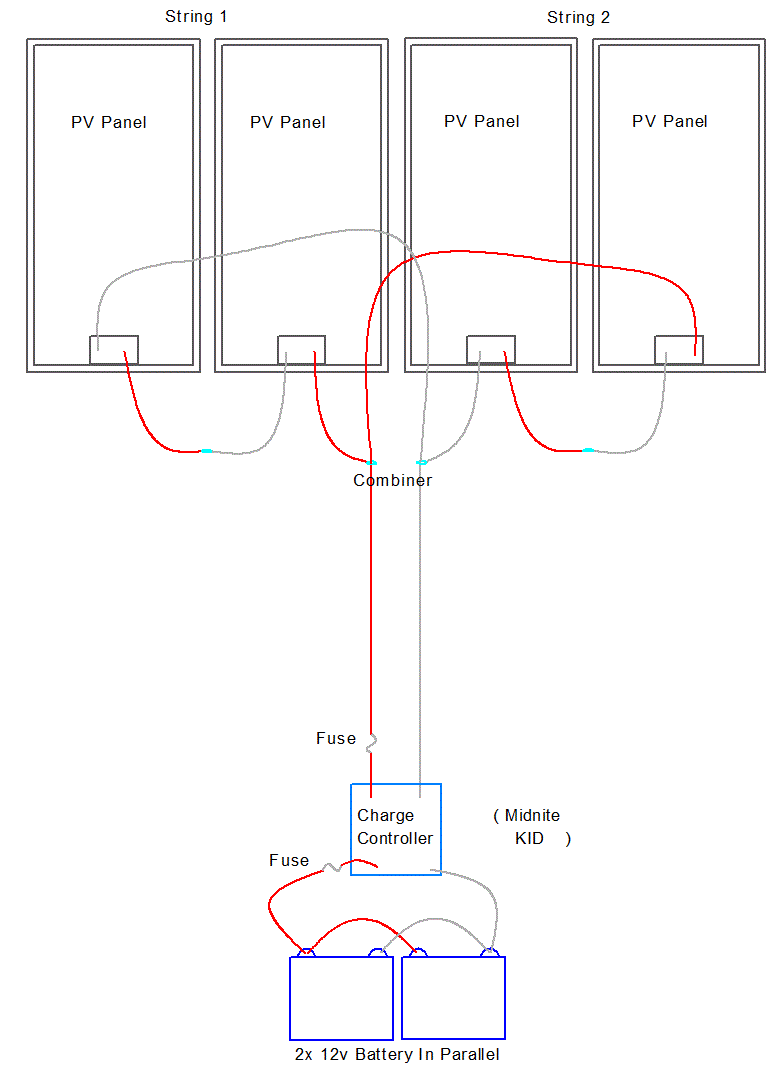
For the sake of simplicity, I will use a specific set of equipment in the scenario described below. Obviously there are hundreds of different panels and charge controllers that can be used, but they are not all compatible with this example. In this example (and what I am currently using), we will use four UNI-SOLAR PVL-136 panels and one Midnite Kid charge controller.

Imagine you have arrived at your bugout or bugin location and have your KID charge controller connected to a 250 Amp Hour battery. You have rolled your flexible panels out on a south facing roof or lawn (provided you are in the northern hemisphere.) Now you will connect the panels. Connect the positive wire from panel 1 to the negative wire of panel 2. You now have one 48v string. Do the same to the other panels for a total of two pairs or “strings”. Connect the negative wires of each string together, along with up to a 30’ length of UV inhibited #10 wire. Do the same for the positive wires of each string. Bring two the #10 wires down to the PV positive and negative inputs on your KID charge controller and connect them (don’t reverse polarity). You’re done! You now have up to 30 amps of power charging your 12v battery.

Using Your System

With this system, you can expect to be able to run about 1.6 kwh. This is equivalent to a small DC freezer, a 12vdc pump for 1 hr, a laptop for 3 hours, a Ham radio for a half hour, and several 12v LED lights for several hours per night. Or you can just run a single super-efficient AC Upright fridge/Freezer (not recommended)!

If you were to upgrade to 6 of these panels, an Outback FM80, and a 500 AH battery bank, you would have the ability to a large (8 CuFt) DC Fridge and a small DC Freezer, 5 hours on a laptop, 2 hrs from a12vdc water pump, a couple hours on the Ham radio, a couple hours of TV/DVD, and several LED lights for several hours per night. This is about 2.9 kwh.

However, you would need larger wires and fuses. The complexity rises some, though it’s far from prohibitive.

All this is obviously dependent on the amount of sun you get, which varies greatly based on your location and time of year. For the above example I used an average of 4.5 hrs of usable sunlight per day. You can find daylight information specific to your location by going here. During the months of November, December, and January when you may only average closer to 3 hours of sunlight per day, you can get by with disconnecting the freezer at night

The Details

PV Panels and why UNI-SOLAR?

The Uni-Solar are lightweight, easy to transport, and much more resistant to breakage. There are lots of other panels out there that will work, but they are heavier, fragile, and hard to transport. Four Uni-Solar panels can be rolled up and stuffed in an oversized duffel. Be careful not to roll them up too tightly as they CAN CRACK! The downside is that Uni-Solar panels are no longer manufactured. They are also amorphous silicon, and therefore take up more space per watt than any other type of panel. There are other Amorphous Silicon Roll-up panels available on the market, but they are generally very expensive.

All panels HATE shade, but the UNI-SOLAR can tolerate it better than most. The output of a monocrystalline or polycrystalline panel will drop by 33% by simply placing a quarter in the middle, while the Uni-Solar will drop by only about 10%.

Charge Controllers and Why the Midnite KID?

PV panels can be directly hooked to a battery… BUT there are LOTS of problems with this. One, without blocking diodes, the batteries will back-feed the panels at night. Two, most panels (30 cell panels are the exception) can quickly overcharge and destroy your batteries. I have connected 24v panels directly to a 12v battery in an emergency, and using a multimeter to constantly monitor the voltage and amperage, was able to charge the battery without a problem. A charge controller does this for you.

The Midnite KID is a robust MPPT charge controller that is competitively priced, made in the USA and appropriately sized for small offgrid applications. If you are using 12v panels with a 12v battery, you can go with cheaper and simpler PWM charge controllers. But the UNI-SOLAR PVL-136 are 24v panels, and I have them hooked up in a 48v string. The KID has so far proven to be a very reliable unit. The KID can be over-paneled with no problems. In other words, you can hook just about as many panels as you want to this little unit (not to exceed 150vdc if wiring in series). But regardless of how many panels you use with a Midnite Kid, it will never output more than 30 amps to the batteries. Six panels (800w) will increase your charging capacity during cloudy weather, and allow you to charge a little more into the afternoons than if using 4 panels (540w). I tried 1480 watts of panels on a KID with a 12v battery bank for 2 months just to test it. The Kid did fine.

Capture

I have also used Steca charge controllers, which seems to do fine, but I find them a bit overpriced. I have used BZ (and other similar Chinese controllers) but they are not reliable enough to recommend. In my opinion, the cream of the crop for an offgrid system is the Outback FM80 or the Midnite Classic, though both will cost you well over $500.

Most MPPT controllers allow you the option to connect to a 12v, 24v, or 48v battery bank. A Midnite Kid on a 12v battery can pass through around 400 watts from the panels to the batteries. When hooked to a 24v battery, it can pass through almost 900 watts. However, I would discourage 24 or 48v battery banks in survival scenarios. If for some reason you need to power a 12vdc device (a likely scenario in a desperate situation), and you tap one of your 12v batteries (that you have hooked in series to make your 24v battery bank), it will become extremely difficult to balance your battery bank and most likely lead to accelerated battery failure. There are ways to power 12v loads from a 24v battery bank, but the simplest answer is just don’t do it.

A word on MPPT. Maximum Power Point Tracking is a more efficient way to transfer energy from the solar panels into your batteries. A MPPT controller constantly monitors the output of the panels and adjust the voltage to facilitate maximum power production. These controllers can take high array voltages (up to 150v in most cases) and convert it down to nominal battery voltages. The “other” kind of controller is PWM, Pulse Width Modulated. They work basically by turning the PV panels on and off until the battery is fully charged. They are typically 20% less efficient and cannot convert voltage down, which necessitates lower array voltages, which leads to higher array currents, which requires much larger wires between the charge controller and the panels.

Wires and Fuses

The Uni-Solar PVL-136 panels come with the older mc3 style connectors (not UL listed). Amazon and Ebay are full of MC3 style connectors. You can find MC3 branch connectors that will combine your pv positive and pv negative wires together. The “right” way to connect PV strings together is with a commercially available combiner box. But these are expensive and not as useful for small offgrid systems. They do incorporate DC breakers for each separate string, which will help to protect your wires and other components. A third option that I have personally used on some of my own smaller systems (shhh, don’t tell anyone) is to make my own “combiner.” I take a 4” section of PVC and drill a hole at both ends. I use 1/4×20 Stainless bolts through the hole and throw a nut on. I now have 2 studs to use to combine all my negatives and all my positive pv wires, as well as the main #10 cables going down to my charge controller. I simply cut the MC3 connectors off the string ends and solder on a suitable ring terminal. This may not be considered a safe practice by some, but it small, lightweight, and works in a pinch. If you use oxide inhibiting grease, the connection will last for several years. If you don’t use a UL listed combiner box, I highly suggest you install a DC breaker (or fuse) between the charge controller and the PV panels. In our example above, we have two strings of panels each capable of producing a short circuit max of 5 amps. A 10 amp DC breaker would be the smallest you could use, while a 30 amp would be the largest (#10 wire can safely handle up to 30amps). Also worth noting: anything over 60vdc can be an electrocution hazard and it is worth taking precautions.

You must install a breaker or fuse on the output of the Charge controller. You will use 10 gauge wire to connect to your battery (keep it under 6ft), and either a 30 amp (continuous duty) DC breaker or 30 amp DC fuse. If you wish to increase your charging ability, you can install a second KID for a max output of 60 amps.

Batteries

I am assuming that you will be using standard Lead-Acid, AGM, or GEL batteries. There are more technologies out there, such as Nickel Iron and LFP, but they require more specific charging parameters. Most car batteries are Lead Acid batteries with liquid electrolyte. They WILL WORK on a solar electric system during an emergency but they are far from ideal. Deep Cycle batteries, such as marine and golf cart batteries, will work better and are still rather easy to come by. AGM and GEL batteries are the ideal choices for offgrid systems, but are more expensive and harder to find in a shtf scenario. All batteries can be permanently damaged without proper care. In my experience, discharging too far is the #1 cause of premature battery failure. High heat and low electrolyte levels are top battery killers as well. I always like to keep my batteries (AGM) over 65% full and ensure they get a full charge at least once a week. Discharging more than 50% can cause premature battery failure. Failing to fully charge at least once per week can cause premature failure. Most lead acid batteries are around 50% charged when they read 12.2 while resting. So if I wake up in the morning to a battery at 12.4 volts, I am happy. If I wake to a battery that says 12.2 volts, I know I need to manage my power use better.

Fridge / Freezer

I haven’t seen a lot of preppers planning to use a freezer long term, but I say why not?! I planned the above system around one to show that it is possible. The most costly part of adding a freezer to your system is the unit itself. Don’t skimp on this! Most of the “Cooler Style” dc freezers are too inefficient to bother with. The only brand I can currently recommend is the Steca chest style freezer, model PF166 and PF240. The Steca uses an ultra-efficient, computer controlled Danfoss DC compressor with a well-insulated cabinet and all aluminum coils. I have seen two kinds of failures with these units. Lightning induced surges will cook the ECU on the compressor. This needs to be well protected with whatever type of surge suppression you can dig up (ferrite?). The electronic thermostat in the handle can short out from water getting in the handle. Don’t set things on top of the fridge to defrost. Sundanzer makes a slightly cheaper alternative, but they use steel for their condenser coils, and this tends to rust out after a few years.

If you have sized your system for a fridge, it is possible to actually run a dehumidifier instead. “why would you do this” you ask? Well, after dumping gallons of water down the drain from my basement dehumidifier, I thought this might be an additional source of drinking water (after running through a filter!) I haven’t tested this long term, so I cant offer specifics.

Customizing Your System

This is where it can get tricky, but I can’t count on the above setup working for everyone. Skip this is your eyelids are feeling heavy, but here are some simple tips to keep in mind if you design your own solar electric system.

Keep your system balanced. Your array size, your loads, and your battery capacity should all be balanced with one another. Having a large array is not the problem it used to be, but having too small of an array is a death sentence for your off-grid electric system. Your array needs to be able to supply a charging amperage of at least the c20 rate (this is ABSOLUTE MINIMUM!). C20 is your battery bank Amp Hour capacity divided by 20. So if you have a 250 AH battery bank, you will need an array capable of producing 12.5 amps. Your power consumption can be about 70% of your array production, or about 20% of your battery size. So a 1000w array (assuming 4.5 hrs of avg insolation ) would theoretically produce about 4500 watt hours per day. So you could plan on using about 3100 watt hours per day. But if you have a 12 volt, 250 AH battery (which yields approximately 3000 watt hours), you should only be using about 600 watt hours from the batteries (at night).

Fuse your wires. Just because it is low voltage doesn’t mean it is safe. You will not get shocked (under 48v anyway) but the likelihood of a fire is extreme. You must fuse all your DC wiring with appropriately sized fuses or DC breakers.

Wire Size. When using low voltage, your wire size will increase dramatically. This is due to “voltage drop” caused by higher electrical currents in the wire. On a 120v AC system, a 1200 watt load is drawing about 10 amps (1200w/120v=10a). The same load on a 12v DC system would draw 100 amps (1200w/12v=100a). The more amps you draw, the larger wire you need. Try to keep all your wires sized to provide less than 0.5 volt drop. There are online calculators you can use to figure this out, but to be safe just stick with #10 wires for your 12v loads under 250 watts, #4 for 12v loads under 500 watts, and #00 for larger loads up to 1500 watts. These sizes assume your total wire length between the battery and said load is under 25’

PV array. Don’t mix your panels if you can help it. There are three main types of PV panel: monocrystalline, polycrystalline, and amorphous silicon. They don’t generally play well with each other. If you have to mix and match panels, make sure they are the same type. You will need to know that hooking up different wattage panels in series will reduce the output of each panel down to the output of the smallest panel. If you connect a 50w and a 100w panel together in series, both will output a max of 50w for a total of 100w. If you must, different size panels of the same type are best hooked in parallel, such as two 12v 50w panels in series, connected in parallel to one 24v 80w panel; effectively putting a 24v 50w in parallel with a 24v 80w for a total of 130watts at 24v. Bottom line: do your best to only use 1 type and size of panel.

What is “Series,” “Parallel,” and all this other vdc, vac, kwh stuff?

Series: connecting the positive of battery #1 to the negative of battery #2. You then get double the voltage between the negative of battery #1 and the positive of battery #2. If you have two 12v batteries in series, you get 24v out. The same is true of solar panels. Two panels, each capable of 12volts and 5 amps, when hooked in series, become a 24v array with a 5 amp output.

Parallel: hooking up the positive of battery #1 to the positive of battery #2 and the negative of battery #1 to the negative of battery #2. You get double the amps. So two 12v 100amp hour batteries in parallel give you a 12v 200 amp hour battery. Two 12v panels capable of putting out 5 amps each, when hooked in parallel, becomes a 12v array capable of putting out 10 amps.

DC: Direct current. Electricity flowing in one direction. Batteries and Solar panels provide DC power. Most DC devices are much more efficient than their AC equivalents.

AC: Alternating current. Electricity flowing back and forth at regular intervals. This is what you get when plugging into the grid or a generator.

Voltage: I like to think of it as the pressure behind the electricity. A high voltage power line is like high pressure water.

Amperage (Amp): I like to think of it as the volume of electricty. A high amperage device requires a very large diameter hose. A fire hose is able to move large amounts of water ( high amperage) at a very high pressure (high voltage). A pressure washer propels water at a very high pressure (high voltage) but doesn’t deliver as much volume (low amperage). Dumping over a 55 gallon drum delivers a very large amount of water (high amperage), but at a low pressure (low voltage).

Watt: without getting overly complicated, a watt can simply be said to be a measurement of electricity use. Watts can be calculated by multiplying Amps * Volts. (10 amps *12 volts = 120watts AND 1 amp * 120volts = 120watts). Power Factor can affect this measurement, but that’s beyond the scope of this article.

Watt hour (Wh): the amount of watts used in one hour. 1 kilowatt hour (Kwh) is 1000watts per hour

Amp Hour (Ah): the amount of amps used in an hour. A 100 amphour (Ah) battery can theoretically deliver 100 amps for 1 hour. It’s not a perfect measurement when sizing a battery. A 100 Amp Hour battery might deliver 120 Ah if its taken out slowly at 1 amp per hour for 120 hrs. There are different ratings like c20, c/10, 20hour, 5 hour, etc. Interested readers can look it up at BatteryUniversity.com

Inverter: Converts DC power from batteries to AC power (like 120vac) found in your home outlets. I didn’t include an inverter in the above example, but you certainly could. PSW (pure sine wave) inverters are a must if powering high efficiency AC fridges, Laser printers, and running power in wires over 75’ long. The outback FX1312 or FX2012 is my choice as it can run ANY 120v AC load, which includes table saws with over 10,000watt startup surge (yes, I have tried this…over and over and over…). But those are transformer based inverters, very reliable but very HEAVY (60lbs)! If you need portability, Samlex makes a decent PSW inverter for a good price. I keep one of these in a duffle with 3 unisolars and a Midnite Kid, with a weight of about 8o lbs. The even cheaper option is the MSW (modified Sine wave inverter). Some people swear by these, but I have had lots of problems. They ARE NOT reliable when used daily… I get about 1 year out of them. They don’t reliably run small motors and water pumps and solenoids. They don’t handle high startup surges. They are GREAT for Laptop charging (the switching power supplies love these things for some reason.)

That’s all folks. I wish I could help each of you individually design the perfect system, but that’s just not possible… May God bless you as go out into the Darkness and shine as Lights.


Letter Re: Rawles Voyager Knife

Mr. Rawles,

I thought I would write a quick thank you to all of you over at SurvivalBlog.com. After reading the reviews and letters concerning the knife, I decided to purchase it. So I went over to the coldsteel.com website and had it in my basket ready to check out and pay for it, but a little nagging thought wouldn’t leave. “I didn’t see if there was another reputable place I could get it.” So, I went back to the review and noticed a link to LTSpecPro, so I clicked and low and behold the knife was $30 less. I was pleasantly surprised. The knife arrived today and boy was I impressed!! First is the size; I didn’t expect it to be quite so big in my hands. Next was the fit and finish, and lastly was how incredibly accurate Pat Cascio’s review was/is. My last thoughts on this is maybe to stress how sharp it is. I was holding it in my right hand, hit the unlock lever with my thumb and the blade swung down. Well, it swung a little farther than I was expecting, and now I have a nice little slice on the top of my ring finger. It’s not bad or anything, but from such little pressure how it could cut. Amazing. If I had the money, I would want to buy another one to either use or to put away in the box in a safe place.

I wish you all the best to you and yours! – Andrew from SW WA (yeah yeah, I know; I’m trying to get back to my birthplace– ID)