Letter: My Take on the U.S. Economy and Politics, and Their Implications for Prepping

HJL:
I’m a both CPCU and CIC chartered senior insurance agent. I have observed that in a normal [business] year there is all sorts of business formation in the first three months.  I know because they ask for insurance quotes for the pro-forma or just come in and buy insurance, to to kick off operations. That activity has declined over the last three years to the point where it just did not happen this year.

In the lead up to Mr. Obama’s election, business activity oriented to expansion practically stopped.  No one wanted to rent a building.  Very few bought equipment.  No one wanted insurance for a new business.  Lots of people thought you were stupid if you bought a building.

The business activity poll in my office this week tells me someone taken to be pro-business is going to be elected in spite of the political polls calling it neck and neck.  Those political elites seem to put their own “rice bowl” ahead of the health and success of the entire country.

I am making a list of talking heads who I have listened to for advice and news reporters who are talking down “the presumptive nominee.”  I don’t exactly love that presumptive nominee but I see the disaster in the alternative. The choice to me is about opting for “New York rude” versus a criminal.  Think about that.  Rude versus criminal.  A parlor rose can hardly stand the rigors of an election process.  You have to be tough and he is.  We need tough to get us out of this mess.

My fellow readers need to pay attention to the early trend and take advantage of opportunities at the same time you are stocking up on .308 ammunition and establishing redundancy in the locker.  He cannot fix it all at once. – R.V.


Economics and Investing:

“Sound as a Pound?” There is now plenty of conjecture about the prospects for UK’s Pound Sterling.  Will the Pound’s post-Brexit plunge in the exchange markets continue?  (As of Friday evening, it had crashed to 1985 levels.) Or will there be a Pound Rebound–making the Pound a “Buy”?  (Some say that the divorce from the EU might eventually put the Pound in the same category as the Swiss Franc.)  In the short term the weak Pound will mean strong exports from the UK. The shares prices of England’s car makers and woolens makers are likely to gallop.  Tourism in the UK is also likely to boom, as American and Continental tourists swoop in for shopping sprees with Pounds that they’ve bought on the cheap. I predict that the tailors of Saville Row are going to build long waiting lists! But in the long term, a strong Pound would be negative for both manufacturing and tourism, but positive for their domestic consumers. As an aside, I do hold some Swiss Francs as a minor hedge. I might consider parlaying part of that into GB Pounds in a few days, if it looks like a bottom has been reached. But regardless, I’m still solidly in the Physical Silver camp! – JWR

o o o

Over at Dr. Housing Bubble: The Mass Exodus of the Middle Class From California

o o o

After Brexit, will the EU crumble?

o o o

In a piece posted at Gold-Eagle, John Rubino asks: Will The European Union Just Dissolve?

o o o

The Brexit fallout — the bloodbath starts with these stocks

SurvivalBlog and its editors are not paid investment counselors or advisers. Please see our Provisos page for details.


Odds ‘n Sods:

Reader T.Z. flagged this: The price of LEDs is falling so fast it’s profitable to farm in a New Jersey nightclub. JWR Adds: We have a couple of 600-watt fan-cooled special plant growth spectrum Growpanel LED units here at the Rawles Ranch that we purchased from Ready Made Resources. These lights do a fantastic job of extending our vegetable growing season.  They can be used indoors, or inside a greenhouse. Just one caveat: The light that these throw is very intense and has an odd purplish-pink tinge, so they can be quite distracting if operated in a bedroom or living room.

o o o

Bad News from a California pro-gun PAC:  California Magazine and Ammunition Ban to Be Decided By Voters in November. Sadly, given the liberal media bias there, it is expected that the initiative will pass into law. (Thanks to regular content contributor D.B. for the link.)

o o o

Federal Court: The Fourth Amendment Does Not Protect Your Home Computer. (A hat tip to reader RLH for the link to the Slashdot article.)

o o o

Max Velocity has announced his upcoming course schedule for July and August. “Max” is a British Army Para Regiment veteran, and his courses are highly recommended.

o o o

“‘EU is failing, EU is dying’: Nigel Farage speech following Brexit vote”>Video: ‘EU is failing, EU is dying’: Nigel Farage speech following Brexit vote

o o o

Anthony Wile: Brexit Is Part of Internet Reformation Building Around the World


Notes for Saturday – June 25, 2016

On June 25th, 1876, Native American forces led by Chiefs Crazy Horse and Sitting Bull defeated the U.S. Army troops of Lieutenant Colonel George Armstrong Custer in a bloody battle near southern Montana’s Little Bighorn River. The
Battle of Little Bighorn–also called Custer’s Last Stand
–marked the most decisive Native American victory and the worst U.S. Army defeat in the long Plains Indian War. While complicated, the generally accepted reason for the battle is that the discovery of gold in South Dakota’s Black Hills in 1875 led to the U.S. government disregarding previous treaty agreements. The gruesome fate of Custer and his men outraged many white Americans and confirmed their image of the Indians as wild and bloodthirsty. Meanwhile, the U.S. government increased its efforts to subdue the tribes. Within five years, almost all of the Sioux and Cheyenne would be confined to reservations. – HJL

o o o

I was pleased to see that the majority of Britons just voted to exit the European Union (EU).  In an indirect way, this successful populist “Brexit” vote bodes well for the proposed rebirth of The Republic of Texas, and for the partition of Eastern Oregon and of Eastern Washington.  (The latter are logical long-term outcomes of The American Redoubt movement.) – JWR

o o o

Yesterday, I was asked about how long I expect the “gun control” (civilian disarmament) “sit-in” event staged by geriatric leftist U.S. Senators will last. My reply:  “It Depends.”
– JWR

o o o

Today, we present another entry for Round 65 of the SurvivalBlog non-fiction writing contest. The nearly $12,000 worth of prizes for this round include:

First Prize:

  1. A Tactical Self-Contained 2-Series Solar Power Generator system from Always Empowered. This compact starter power system is packaged in a wheeled O.D. green EMP-shielded Pelican hard case (a $1,700 value),
  2. A Gunsite Academy Three Day Course Certificate that is good for any one, two, or three day course (a $1,195 value),
  3. A course certificate from onPoint Tactical for the prize winner’s choice of three-day civilian courses, excluding those restricted for military or government teams. Three day onPoint courses normally cost $795,
  4. DRD Tactical is providing a 5.56 NATO QD Billet upper with a hammer forged, chrome-lined barrel and a hard case to go with your own AR lower. It will allow any standard AR-type rifle to have a quick change barrel, which can be assembled in less than one minute without the use of any tools and a compact carry capability in a hard case or 3-day pack (an $1,100 value),
  5. Gun Mag Warehouse is providing 20 Magpul PMAG 30-rd Magazines (a value of $300) and a Gun Mag Warehouse T-Shirt; (an equivalent prize will be awarded for residents in states with magazine restrictions),
  6. Two cases of Mountain House freeze-dried assorted entrees in #10 cans, courtesy of Ready Made Resources (a $350 value),
  7. The Ark Institute is donating a non-GMO, non-hybrid vegetable seed package (enough for two families of four) plus seed storage materials, a CD-ROM of Geri Guidetti’s book “Build Your Ark! How to Prepare for Self Reliance in Uncertain Times”, and two bottles of Potassium Iodate (a $325 retail value),
  8. A $250 gift certificate good for any product from Sunflower Ammo,
  9. KellyKettleUSA.com is donating an AquaBrick water filtration kit with a retail value of $250, and
  10. Two cases of meals, Ready to Eat (MREs), courtesy of CampingSurvival.com (a $180 value).

Second Prize:

  1. A Glock form factor SIRT laser training pistol and a SIRT AR-15/M4 Laser Training Bolt, courtesy of Next Level Training, which have a combined retail value of $589,
  2. A transferable certificate for a two-day Ultimate Bug Out Course from Florida Firearms Training (a $400 value),
  3. A Model 175 Series Solar Generator provided by Quantum Harvest LLC (a $439 value),
  4. A Trekker IV™ Four-Person Emergency Kit from Emergency Essentials (a $250 value),
  5. A $200 gift certificate good towards any books published by PrepperPress.com,
  6. A pre-selected assortment of military surplus gear from CJL Enterprize (a $300 value),
  7. RepackBox is providing a $300 gift certificate to their site, and
  8. American Gunsmithing Institute (AGI) is providing a $300 certificate good towards any of their DVD training courses.

Third Prize:

  1. A Royal Berkey water filter, courtesy of Directive 21 (a $275 value),
  2. A $245 gift certificate from custom knife-maker Jon Kelly Designs, of Eureka, Montana,
  3. A large handmade clothes drying rack, a washboard, and a Homesteading for Beginners DVD, all courtesy of The Homestead Store, with a combined value of $206,
  4. Expanded sets of both washable feminine pads and liners, donated by Naturally Cozy (a $185 retail value),
  5. Two Super Survival Pack seed collections, a $150 value, courtesy of Seed for Security, LLC,
  6. Mayflower Trading is donating a $200 gift certificate for homesteading appliances,
  7. Montie Gear is donating a Precision Rest (a $249 value), and
  8. Two 1,000-foot spools of full mil-spec U.S.-made 750 paracord (in-stock colors only) from www.TOUGHGRID.com (a $240 value).

Round 65 ends on July 31st, so get busy writing and e-mail us your entry. Remember that there is a 1,500-word minimum, and that articles on practical “how to” skills for survival have an advantage in the judging.


The Costs and Benefits of Hunting, by J.B.

I’m a lifelong hunter that has gone from being a kid taken to a hunting club by his father, as an introduction to hunting back in the mid-70’s, to being a self-sufficient property owner, who can hunt year round for the non-game species (hogs) if need be. I’ll be the first to say that hunting for self-sufficiency in today’s world, particularly in the Eastern U.S., would be a short-lived venture during a TEOTWAWKI situation. The reason being is that there would very likely be a mass migration of people from the major metropolitan areas out in the rural areas looking for food. As people become hungry enough, shooting, killing, and butchering of animals will take place without any regard for regulations, since all that will be gone. People may say that these “City Folk” will not have the skill set to hunt. I beg to differ. In the last 20 years, most of the guys I’ve hunted with live in the major city area of Atlanta, GA and have lived most of their lives in this city’s sprawl. That hasn’t stopped them from joining hunting clubs well outside their home area and hunting successfully. I’ve had members come from middle Tennessee down to Middle-Georgia as well as members from Miami, FL up to Middle-Georgia just to hunt in the rural farm areas of the state. During a TEOTWAWKI situation, I imagine there will be groups of refugees fleeing the major city areas looking for safety, food, and shelter. Some groups will be organized enough to have hunting parties that can secure wild game. With groups like this filtering into the rural areas, game will quickly become scarce and eventually over hunted, as was done back in the Market Hunting days of the late 1800’s.

While hunting for self-sufficiency is a great skill set for anyone to add to their survival skills, in today’s society (not a TEOTWAWKI time) the cost does outweigh the return. I’ll throw some rough numbers out to support my statement. First, it is required in most states to have a hunting license. As a resident this usually is not a major cost. In my home state, a big game license is roughly $20 annually. This allows for hunting of both big and small game during the designated hunting season, and in the Southeast the seasons are usually long and liberal. For a non-resident, an annual big game license is usually over $200. I pay for a non-resident license in Georgia, and it costs me close to $400 because I have to get a hunting license, a big game license, and a Wildlife Management Area (WMA) license. Without the WMA, it would be right at $300. Had they offered life-time licenses while I lived there, it would have saved me a lot of money in the long run. That is what I’ve done in my current home state– purchase a life-time license.

As you can see, just the license cost can be substantial if hunting out of state. Other costs can come up too with hunting club dues or leasing property. Sometimes you can get permission to hunt farms or private land at no cost, but this is rare in my opinion. If you own land, there is still the cost of the property, be it mortgage payments, taxes, upkeep, and so on. These costs have a high variance, as it depends on the situation. For instance, my small piece of property is paid for, but I do have annual taxes that I happen to get a break on because it is in a conservation use program designated as farm land. However, I have a clearing project going on with five of the acres (for hunting purposes) and bulldozer work is not cheap.

Acquiring a place to hunt can be costly. In the rural Southeast, or at least my neck of the woods, leased property costs on average about $10 an acre. For me, even though I am a property owner I am a hunter, so I also lease different tracks in multiple states. Personally I do not partake in hunting clubs any longer. There is nothing wrong with them, but I have separated myself from this aspect and focus on what will give me the best chance at harvesting game. I have one 100-acre tract that is for ducks and hogs only. There are deer and other game animals there, but the main focus of this property are these two species. I have another 375 acres that I lease specifically for deer and turkey. I also lease a 178 acre track that is just 10 miles from my home. It is mainly a deer track, but I’ll hunt turkey and some small game, such as squirrel, rabbit, quail, and some hogs from time to time. As you can see, these properties at $10 an acre are costly. I split the cost of the 375 acres with one other friend and the 100 acres with two other friends. The property close to the house, I pay for by myself and hunt by myself. I just let go of a 50 acre track that was ideal for deer, turkey, ducks, and pigs. It was clear cut completely and was along a highway, so I decided to cut some of my costs with leased land. In some areas as little as 10 acres can be hunted successfully, but finding these places is difficult at best. From what I’ve seen, a lot of leased land is 100 acres or more, and the higher the acreage usually means groups, aka hunting clubs, have to lease them. Farmers in the Southeast also know this and lease their farms to hunting clubs too, so the days of going and asking someone if you can hunt their farm are all but gone in my area.

Unless you live on a property that you can hunt without a cost associated with it, you likely will have to drive to a property. This too creates a cost in fuel. There is the round trip fuel consumption cost, and if you haul an ATV the fuel consumption goes up from hauling it. Then there is the added fuel cost of using the ATV. Other fuel consumption factors can build on this too, such as running a generator, chainsaw, tractor, and so on.

As you can see, things are adding up quickly, and we haven’t harvested the first animal yet. Before we get there, we can also look at the cost of attractants. In some states it is legal to put bait out. It may or may not be legal to hunt over it, but in either situation this creates a cost if you decide to do it. Most states and properties allow for food plots. Planting food plots from any size always creates a cost. Most of my food plots are from ¼ to ½ acre in size. On the one 178 acre track, I have six of these plots. Just planting one can cost me between $50 and $60 in seed, fertilizer, fuel, and time. That is doing it myself and not paying someone to do it for me.

Another cost item is the tool you use to harvest game with. Most hunters use a modern hunting rifle. Unless you receive one as a gift, there is the upfront cost of getting one. Rough estimate could be $300. In addition to this you can put a scope on it, buy a case for it, a cleaning kit, and then ammo. Because I am a gun enthusiast, I have many rifles and thousands of rounds of ammo stockpiled. It is an investment on my part, but for someone who is just getting into it I think they could be outfitted for less than $600 and get several seasons from this initial investment.

There is also the idea of additional equipment such as boots, a knife, outdoor garb (camo’s, rain gear, hat, gloves, wool socks), and other items one may need, like binoculars, GPS or compass, bug repellent, etc. Of course depending on what one needs, these costs will vary.

Now what about costs associated with the processing of game? A lot of hunters process their own, and this is a given for most small game. However, for large game, such as deer and hogs, many like to use a processor. The processing of a deer or hog can range from $50 to $100, depending on who you use.

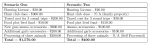
I am sure there is something I’m missing, but given what I’ve covered thus far let’s look at a couple of scenarios of someone who wants to get into hunting and see how much it can cost. We’ll be very conservative too, keeping in mind that someone trying it out likely will not want to put a lot of money into it on chance they decide it is not for them. Scenario One is someone who joins a club over an hour away in distance and has to equip themselves completely to get started. Scenario Two is someone who already has some equipment for hunting and has access to family property. Cost is also cut by having family members that can process the animals as well.
Costs

In Scenario One, the cost heavily outweighs the return. Even if you took out the gun and garb cost for future hunts, you are still close to $800. To me this is inexpensive for a three trip season. I personally put in thousands, but also I hunt everything that is legal to hunt and I am not looking for an immediate physical return. It is my hobby and my passion. In Scenario Two I’d say you are getting close to breaking even by filling a freezer full of meat for $400. If the three harvested animals yields 130 pounds of meet and compared to ground beef or pork chops costing about $3.75/pound, this comes to approximately $488.

I know not every situation falls neatly into these scenarios, but from my forty years of hunting I know there is a cost associated with hunting and I am pretty sure the cost outweighs the return in most situations. The return is a full freezer, and for me the return is also being out in nature, working the land, pitting wits against elusive game animals, and the success of a good day’s hunt. For me putting a price on this is hard, so I just look at it as it makes me happy and I’ll work hard to make the money so I can do what makes me happy. And, should I ever need to rely on hunting to feed myself, I think I have a pretty good foundation to build on for my self-sufficiency.



Letter Re: Sanitation Issues: Understanding Home Septic Systems

Dear SurvivalBlog Readers,
Recently SurvivalBlog has presented several articles on sanitation issues. I’d like to add to those.

Many homes are equipped with septic tanks to perform as a holding tank for waste allowing waste decomposition to occur. Reduction of solid waste through bacterial action works, but is a slow process and often incomplete; additionally, a large number of chemicals we regularly introduce into our septic tanks, such as common soap, dish washing and clothes detergents, bleach, commercial toilet cleaning solutions, etc., are toxic to the bacteria performing the job of decomposition.

Septic tanks are one part of the equation, the other being the leach field. Leach fields are the fluid distribution pipes running from the septic tank into the ground and are intended to operate with clear  liquids only; clear liquids does not refer to their color, but means no solid materials. Solids will fill the spaces between dirt particles and eventually form a sufficient barrier to liquid absorption to cause the leach field to fail. The only fix for this is dig a new leach field in dirt that has not been contaminated by particles, or replace the dirt in the existing field. Either solution will be expensive and quite inconvenient.

Other things which wind up in the septic tank can render the leach field useless, specifically, greases and oils, including those created during cooking. Washing a grease-encrusted broiler pan sends thick animal fats down the drain which will float on the liquid in the septic tank and be the first to be carried out of the tank into the leach field. Better to wipe out greasy cookware with paper towels to be disposed of as trash before sink washing to minimize the amount of grease and oils entering the septic tank.

Harsh chemicals should be avoided in houses with septic systems; soap and detergent use cannot be avoided, but things such as commercially available toilet cleaning chemicals can be replaced with scrubbing with small quantities of isopropyl alcohol, which can be carefully burned off in the toilet bowl.

Since waste decomposition is slow, and usually incomplete, all septic tanks will need to be pumped out periodically to remove the solids. Depending on how many people are in the family and the size of the tank, that period may be as short as three  years or as long as seven. Most residential tanks are 1,000 gallons, but they are commonly available in sizes from about 500 to 3,000 gallon.. I’ve seen a series of three 55 gallon blue plastic barrels used successfully as a septic tank where the quantity of waste is small, or the need is temporary (I doubt those can be pumped out with regular equipment, so they must be replaced periodically).

Most septic tank pumping trucks have 2,000 gallon tanks, so there’s a disadvantage to having a septic tank larger than that; one pumping session won’t completely empty the tank, necessitating a second trip, always at additional expense to the homeowner.

Regardless of how often it’s necessary, more frequent septic tank pumping is recommended. I have my tank pumped every three years, even though I could probably go another two years, or perhaps three, without a problem. Should economic and social conditions deteriorate sufficiently it may be impossible to get a tank pumped at all, and when it’s completely full solids will start entering the leach field, eventually killing it, and could back up into the supply pipe coming from the house preventing use of any of the house’s plumbing fixtures. Knowing that I have a recently pumped tank that could go as long as six years without attention provides a reasonable operational cushion.

If one has the land and money resources, a dual septic system can be a good investment. One tank is connected only to the toilets and becomes the sanitary system; the other handles all other waste water, from sinks, showers, washing machines, etc. This keeps chemicals that are toxic to bacteria out of the sanitary tank, allowing it to perform its decomposition job unaffected. This will extend the required pumping intervals, and the non-sanitary tank should probably never need pumping. Leach field killers such as grease, oils etc., should still be avoided in the non-sanitary system.

Equipping toilets, or at least one toilet, with its own independent water supply (most easily accomplished during construction or major remodel) provides an advantage. In SHTF times, family use shifts to the single toilet equipped with an independent water supply; disconnecting that toilet’s water piping from the whole house system and attaching it to an independent water source allows use of that toilet without using the entire house’s water system. Additionally, non-potable but uncontaminated water can be used for toilet flushing since that independent water delivery system for the one toilet gets disconnected and is separate from the house’s potable water system. Rainwater collected from roofs, after the first 10 minutes of rain cleans the roof, is one good source of toilet-flushing water, and will not require any expensive purification to use in a toilet. He who flushes also pumps becomes the order of the day.

If usage is confined to one toilet, then the water traps in the others will eventually dry out from evaporation allowing sewer gases and insects into the house (the same applies to sinks, tubs and showers not in regular use). Evaporation losses can be reduced by covering the toilet bowl with plastic wrap, but since the DWV (drain-waste-vent) system is connected to vents those are the pipes extending above your house’s roof that allow the plumbing system to drain properly the water in a toilet bowl is still exposed to atmosphere and will eventually evaporate from that. Periodic inspection of unused toilets is necessary, as will be the occasional refilling of the toilet bowls to maintain water seal in the trap. – N.K.


Letter Re: Tracking Dogs

Dear Editor:
I would like to relate my experiences with tracking dogs that are not even trained. We had a beagle who was born mostly blind. She was a pet. She had an incredible sense of smell that I have seen in other trained hounds, but not in a pet.

We would bring her to our children’s high school, which had 2,000 students. I would put her in the front of the multi-building facility and command her to “Find the kids.” She would start off walking making big S-shaped turns as she headed to and between the buildings. All of a sudden the large sweeps would stop, the dog would change her demeanor and now she would head in a straight line with just her head moving side to side. She had the trail. At that point you could just follow her and she would locate my children very quickly. I would not believe that a dog could pick out my two kids trails from among 2,000 stinky students  at the front of the school but she would do it any time we brought her.

Once upon the trail, nothing would distract her and to get her to stop would require her to be physically picked up and restrained. For a dog that usually was super friendly, when on the trail she would appear almost irritated when the other children would want to pet her. On one or two occasions we went on a short tour of the school but when we asked the kids where they had been they confirmed that the dog had just followed the path that they had left. When she tracked animals she would follow the scent onto and across pond water and generally would come out on top of the tracks where the animal came out. On occasions she would loose the scent on the water and swim several tight circles and turn around and come back to where she came in.

My point in all of this is simple. If a good tracking dog (or even no so good) is on your trail, then you are not going to shake it very easily! – P.D.


Economics and Investing:

Brexit triggers huge swings in exchange rates of the GB Pound.  (We witnessed a nearly 9% move in one day!)

o o o

Brexit causes decline in global stock markets

o o o

Gold Bullion Surges 6% In USD As Brexit Creates Global Contagion Risk
o o o

Items from Mr. Econocobas:

Fed Rate Hike Off the Table for Rest of 2016; 12% Chance of a CUT. – What’s amazing is that folks are surprised…

Dow closes down 600 after Brexit surprise; financials post worst day since 2011 – I can’t help but think this is going to resume on Monday.  Don’t quite understand the implications of the Russell 2000 rebalancing day going to have on this either.

Global Banks Hammered by U.K. Vote

o o o

SurvivalBlog and its editors are not paid investment counselors or advisers. Please see our Provisos page for details.


Jim’s Quote of the Day:

“For the vision is yet for an appointed time, but at the end it will surely come, it will not tarry.
Behold, his soul which is lifted up is not upright in him: but the just shall live by his faith.” – Habakkuk 2:3-4 (KJV)


Notes for Friday – June 24, 2016

June 24th is the birthday of rifle-toting abolitionist pastor Henry Ward Beecher (born 1813, died March 8, 1887). He and his adherents from his church smuggled so many Sharps rifles to Bleeding Kansas that the Sharps rifles picked up the nickname Beecher’s Bibles. Wikipedia states: Several of his brothers and sisters became well-known educators and activists, most notably Harriet Beecher Stowe, who achieved worldwide fame with her abolitionist novel Uncle Tom’s Cabin.

o o o

Today, we present another entry for Round 65 of the SurvivalBlog non-fiction writing contest. The nearly $12,000 worth of prizes for this round include:

First Prize:

  1. A Tactical Self-Contained 2-Series Solar Power Generator system from Always Empowered. This compact starter power system is packaged in a wheeled O.D. green EMP-shielded Pelican hard case (a $1,700 value),
  2. A Gunsite Academy Three Day Course Certificate that is good for any one, two, or three day course (a $1,195 value),
  3. A course certificate from onPoint Tactical for the prize winner’s choice of three-day civilian courses, excluding those restricted for military or government teams. Three day onPoint courses normally cost $795,
  4. DRD Tactical is providing a 5.56 NATO QD Billet upper with a hammer forged, chrome-lined barrel and a hard case to go with your own AR lower. It will allow any standard AR-type rifle to have a quick change barrel, which can be assembled in less than one minute without the use of any tools and a compact carry capability in a hard case or 3-day pack (an $1,100 value),
  5. Gun Mag Warehouse is providing 20 Magpul PMAG 30-rd Magazines (a value of $300) and a Gun Mag Warehouse T-Shirt; (an equivalent prize will be awarded for residents in states with magazine restrictions),
  6. Two cases of Mountain House freeze-dried assorted entrees in #10 cans, courtesy of Ready Made Resources (a $350 value),
  7. The Ark Institute is donating a non-GMO, non-hybrid vegetable seed package (enough for two families of four) plus seed storage materials, a CD-ROM of Geri Guidetti’s book “Build Your Ark! How to Prepare for Self Reliance in Uncertain Times”, and two bottles of Potassium Iodate (a $325 retail value),
  8. A $250 gift certificate good for any product from Sunflower Ammo,
  9. KellyKettleUSA.com is donating an AquaBrick water filtration kit with a retail value of $250, and
  10. Two cases of meals, Ready to Eat (MREs), courtesy of CampingSurvival.com (a $180 value).

Second Prize:

  1. A Glock form factor SIRT laser training pistol and a SIRT AR-15/M4 Laser Training Bolt, courtesy of Next Level Training, which have a combined retail value of $589,
  2. A transferable certificate for a two-day Ultimate Bug Out Course from Florida Firearms Training (a $400 value),
  3. A Model 175 Series Solar Generator provided by Quantum Harvest LLC (a $439 value),
  4. A Trekker IV™ Four-Person Emergency Kit from Emergency Essentials (a $250 value),
  5. A $200 gift certificate good towards any books published by PrepperPress.com,
  6. A pre-selected assortment of military surplus gear from CJL Enterprize (a $300 value),
  7. RepackBox is providing a $300 gift certificate to their site, and
  8. American Gunsmithing Institute (AGI) is providing a $300 certificate good towards any of their DVD training courses.

Third Prize:

  1. A Royal Berkey water filter, courtesy of Directive 21 (a $275 value),
  2. A $245 gift certificate from custom knife-maker Jon Kelly Designs, of Eureka, Montana,
  3. A large handmade clothes drying rack, a washboard, and a Homesteading for Beginners DVD, all courtesy of The Homestead Store, with a combined value of $206,
  4. Expanded sets of both washable feminine pads and liners, donated by Naturally Cozy (a $185 retail value),
  5. Two Super Survival Pack seed collections, a $150 value, courtesy of Seed for Security, LLC,
  6. Mayflower Trading is donating a $200 gift certificate for homesteading appliances,
  7. Montie Gear is donating a Precision Rest (a $249 value), and
  8. Two 1,000-foot spools of full mil-spec U.S.-made 750 paracord (in-stock colors only) from www.TOUGHGRID.com (a $240 value).

Round 65 ends on July 31st, so get busy writing and e-mail us your entry. Remember that there is a 1,500-word minimum, and that articles on practical “how to” skills for survival have an advantage in the judging.


Rebalancing Your Gun Collection for the Uncertain Days Ahead

With the upcoming presidential election, American gun owners are facing a time of great uncertainty. If Hitlery Clinton is elected, it is anticipated that she will not only issue a large number of anti-gun executive orders but during her term in office she will also appoint several ultra-liberal Supreme Court justices. That would dramatically alter the balance of the court. These frightening prospects have prompted many gun owners to increase the size of their collections and readjust their composition. As recent gun sales statistics attest, people are definitely stocking up. This news is not evidence of paranoia. It is simply rational self-interest.

By way of conversations at gun shows and with my consulting clients, I am now witnessing some deliberate “rebalancing” of gun collections. Here in The American Redoubt, the rebalancing that I’ve heard described is summarized as follows:

  1. Buying guns “off paper” (using cash, without a paper trail).
  2. Selling off some non-family heirloom guns in obsolete or oddball calibers.
  3. The addition of a few rifles in the most popular civilian hunting calibers, such as .243 Winchester, .270 Winchester, and 6.5 Creedmoor.
  4. Double or treble redundancy in “group standard” calibers.
  5. Selling some previously “papered” guns to Federally licensed dealers, in order to extinguish their paper trail to you.
  6. Buying “Sleeper” bolt action rifles. (I have more on that later.)
  7. Buying some complete guns or dedicated uppers that are compatible with suppressors, with corresponding muzzle adapters.
  8. Buying AR lower receivers (or 80% complete unserialized lower receivers) and parts sets.
  9. Stocking up on handloading components.
  10. Purchasing guns of particular action types and calibers that are legal in the host countries of clients’ offshore retreats.
  11. Buying full-capacity magazines in quantity.
  12. Acquiring caching tubes and desiccants.
  13. Stacking ammunition, deep.
  14. Diversifying ammunition reserves by adding small quantities of some exotic loadings, such as tracer, incendiary, AP, API, APIT, and Raufoss.
  15. Buying limited numbers of Federally exempt pre-1899 “antique” cartridge guns.
  16. Adding night vision equipment and weapons-mounted optics that are specifically compatible with night vision gear.

Planning Multigenerationally

Even if you don’t plan to shift the basic composition of your family firearms battery, then you should at least stock up in quantity with more guns to match what you already have. This is with the best interest of your children and grandchildren in mind. But remember: A gun just by itself is not sufficient. For each gun, you will need: ammunition, magazines, a set of web gear (to carry magazines), a spare optic, and a few spare parts.

Hedging Into Sleepers

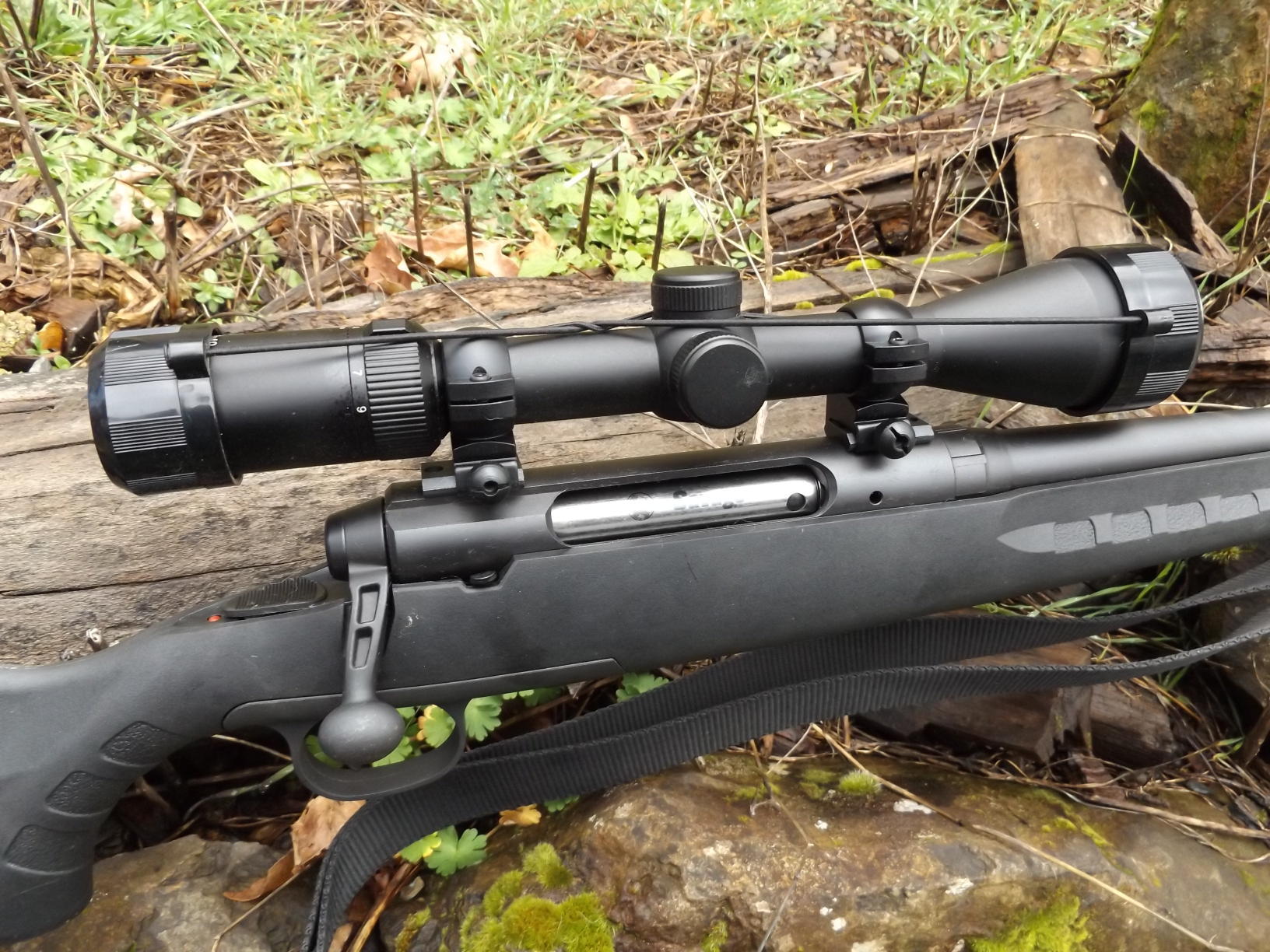
In the automotive world, the term “Sleeper” or “Q Car” refers to a car that has high performance but with an unassuming exterior appearance. In the context of firearms, a Sleeper is a rifle that is highly capable of a counter-sniper role in modern combat, yet it has the outward appearance of a humble “hunting rifle”. Having Sleeper rifles may prove to be important in the years to come. So, I strongly recommend that you buy at least one bolt action rifle that is chambered in .308 Winchester, and:

Note: For muzzle threading a .30 caliber rifle, I prefer to use 5/8×24 right hand (RH) threads, which have become semi-standardized for AR-10 rifles. Hence, there are a large variety of flash hiders and muzzle brakes available to use without any need for modification. And by the way, I DO NOT recommend using 1/2×28 threads on a .30 caliber rifle, since there is not enough steel remaining to safely contain the pressure– rifling deformation, distorted threads, or worse might result. 1/2×28 threads are fine for a .223 caliber rifle but not for a .30 caliber rifle!

Needless to say, spend plenty of time practicing with that rifle. Once it is zeroed, be sure to research and confirm a drop table out to 800 yards for your primary match grade loading. (Bullet drop data is available free at the web sites of major ammunition companies, such as Hornady.com. But you need to confirm that data with testing on the range.) You should attach the confirmed chart to the rifle’s stock, for quick reference.

Some good candidate .308 Sleeper Rifles include:

  • Remington Model 700 (make sure that it is “post-recall”)
  • Winchester Model 70 (get one with a large tab Mauser-style extractor)
  • Ruger Model 77 Mark II
  • Ruger Scout Rifle
  • Savage Scout Rifle
  • Savage Model 10 or 110

I generally prefer to buy stainless steel rifles for their rust-resistant longevity. But if you opt for stainless steel, then be sure to either have it camouflage dipped by a hydrographics shop, or lay in a large supply of removable camouflaging tape.

Hedging Into Lower Receivers

For the past 15 years, the American semi-auto rifle market has been dominated by Stoner Armalite Rifle (AR) pattern rifles. They are popular in part because of their modularity and versatility. An amazing variety of AR parts and accessories are available. Because of their clever “automatic headspacing” design, they can also be assembled at home with a minimum number of tools, even by folks with rudimentary mechanical skills. Both the 5.56mm NATO (AR-15 pattern) and 7.62mm NATO (AR-10 pattern) are now incredibly popular. It is estimated that more than 4 million additional AR pattern rifles have been built during the two terms of the Obama Administration. Dozens of manufacturers are presently cranking out millions of these rifles, of varying quality. One peculiarity of both the AR family design and of U.S. gun laws is that it is the so-called “lower receiver” (trigger group), which that is the serialized part, that constitutes the “firearm”. All of the other requisite parts for building an AR can be purchased by mail order. (This is not the case in most European countries.)

With many new gun restrictions on the horizon, prescient American shooters are stocking up on AR lower receivers for later builds. Although there might eventually be sales restrictions placed on barrels and upper receivers, at least for now buying stripped lowers represents a great window of opportunity to buy “firearms” for less than $70 each. Buy plenty of them. Someday you may be very glad that you did. (Once Clinton gets the Democratic nomination, the price of lowers is expected to jump up to $200+.)

By the way, if you are a member of a retreat group or a circle of friends that intends to buy a sizable number of 80% complete AR-15 lower receivers, then I recommend splitting the cost of a Ghost Gunner 2 automated milling machine. A full review of these amazing little machines will be posted in SurvivalBlog sometime in the next few weeks.

Hedging Into Antiques

As I’ve written several times over the years in SurvivalBlog, one often overlooked category of guns are Pre-1899 Federally “Antique” rifles, revolvers, and shotguns. My current favorites are the Model 1893, 1894, 1895, and 1896 Mauser bolt action rifles. These can be re-barreled or re-chambered to handle many modern loads. They can also be restocked and equipped with modern telescopic sights and have their muzzles threaded, all without affecting their “exempt” status. For more details on pre-1899 antique guns, see the free FAQ that I authored.

Hedging Into PVC

Lastly, consider buying caching supplies, just in case you need to make some guns, ammunition, magazines, and accessories disappear. – JWR


Letter Re: Food Preservation

Good afternoon, Hugh,

Recently SurvivalBlog has presented several articles on food preservation, including extremely informative ones from your wife, Sarah.

I’ve become curious about a few things: Is there a minimum vacuum level necessary for food preservation? (This assumes other factors, such as the lack of heat-based canning procedures are not necessary for preservation.) Are there advantages to purging air from a food container with nitrogen? If so, is there a recommended procedure for that? Does vacuum sealing after nitrogen purging offer additional advantages? You have tested and reported on a commercially available home freeze dryer; how much preservation time is gained, or how great an advantage is there, by high vacuum storage (>20mg Hg) of home freeze dried food? – N.K.

HJL Comments: For food storage that contains moisture, there are only two real methods of safe storage– heat-based canning and freezing. Freezing works by slowing the process of decomposition and bacterial growth down to a negligible level, and heat-based canning works by raising the temperature to the point that bacteria is destroyed. Freezing is the preferred method for short-term storage because the texture of the food is the least changed. Canning is better for long-term storage, but the texture of the food is often changed and many do not like it.

Food that has a low to very low moisture content cannot support the growth of bacteria, so those methods are not necessary. What does matter is the removal of oxygen. The oxygen oxidizes the food, destroying the flavor and nutrients over time. There are a variety of ways to remove the oxygen. Placing oxygen absorbers in the storage containers and replacing the air with nitrogen or carbon dioxide are a few. Pulling a strong vacuum is also an effective method, but this requires a container with some strength or the food will be crushed (though in some foods, like wheat, this really doesn’t matter).

The strength of the vacuum is relatively unimportant though. A strong vacuum will remove more air (and thus more oxygen), but even a medium vacuum will remove enough air to have a significant impact on the storage life. If you are rotating your stocks and eating what you store, you only really need at most a 5 or 6 year shelf life, even if you have a very deep larder. To answer your question though, freeze-dried foods have a storage life in the realm of 5-20 years, depending on the oil content of the food (oils can become rancid) and the oxygen they are exposed to.


Economics and Investing:

Spending it all on rent: 11 million Americans spend half their income on rent. Another 21 million spend over 30 percent of their income on rent, a record high.

o o o

COMEX Registered Silver Now More Leveraged Than Gold

o o o

Potash Price Surge Could Lead To Higher Food Costs For Billions – “As global population surges and arable land decreases, efficiency is the name of the game. And in this environment, the little known commodity potash comes into its own”

o o o

The Stock Crash Of 2016: Stocks Have Already Crashed In 6 Of The World’s 8 Largest Economies

o o o

SurvivalBlog and its editors are not paid investment counselors or advisers. Please see our Provisos page for details.