
“I see nothing wrong with the human trait to desire. In fact, I consider it integral to our success mechanism. Becoming attached to what we desire is what causes the trouble.” – Peter McWilliams
- Ad Elk Creek Company - Federally-Exempt No-Paperwork GunsPre-1899 Antique Cartridge Guns -- No FFL Required. Can be mailed to your doorstep with no Federal paperwork!
- Ad USA Berkey Water Filters - Start Drinking Purified Water Today!#1 Trusted Gravity Water Purification System! Start Drinking Purified Water now with a Berkey water filtration system. Find systems, replacement filters, parts and more here.
Notes for Tuesday – August 30, 2016
August 30, 2014 is the 95th birthday of Joachim Rønneberg, a hero of the Norwegian resistance during World War II. His exploits earned him the War Cross With Sword, Norway’s highest military honor. In April 2013, Rønneberg was presented with a Union Jack during a ceremony at the Special Operations Executive (SOE) monument in London to mark 70 years since the successful Gunnerside heavy water plant sabotage mission.
o o o
Today, we present another entry for Round 66 of the SurvivalBlog non-fiction writing contest. The nearly $12,000 worth of prizes for this round include:
First Prize:
- A Tactical Self-Contained 2-Series Solar Power Generator system from Always Empowered. This compact starter power system is packaged in a wheeled O.D. green EMP-shielded Pelican hard case (a $1,700 value),
- A Gunsite Academy Three Day Course Certificate that is good for any one, two, or three day course (a $1,195 value),
- A course certificate from onPoint Tactical for the prize winner’s choice of three-day civilian courses, excluding those restricted for military or government teams. Three day onPoint courses normally cost $795,
- DRD Tactical is providing a 5.56 NATO QD Billet upper with a hammer forged, chrome-lined barrel and a hard case to go with your own AR lower. It will allow any standard AR-type rifle to have a quick change barrel, which can be assembled in less than one minute without the use of any tools and a compact carry capability in a hard case or 3-day pack (an $1,100 value),
- Gun Mag Warehouse is providing 20 Magpul PMAG 30-rd Magazines (a value of $300) and a Gun Mag Warehouse T-Shirt; (an equivalent prize will be awarded for residents in states with magazine restrictions),
- Two cases of Mountain House freeze-dried assorted entrees in #10 cans, courtesy of Ready Made Resources (a $350 value),
- The Ark Institute is donating a non-GMO, non-hybrid vegetable seed package (enough for two families of four) plus seed storage materials, a CD-ROM of Geri Guidetti’s book “Build Your Ark! How to Prepare for Self Reliance in Uncertain Times”, and two bottles of Potassium Iodate (a $325 retail value),
- A $250 gift certificate good for any product from Sunflower Ammo,
- KellyKettleUSA.com is donating an AquaBrick water filtration kit with a retail value of $250, and
- Two cases of meals, Ready to Eat (MREs), courtesy of CampingSurvival.com (a $180 value).
Second Prize:
- A Glock form factor SIRT laser training pistol and a SIRT AR-15/M4 Laser Training Bolt, courtesy of Next Level Training, which have a combined retail value of $589,
- A transferable certificate for a two-day Ultimate Bug Out Course from Florida Firearms Training (a $400 value),
- A Model 175 Series Solar Generator provided by Quantum Harvest LLC (a $439 value),
- A Trekker IV™ Four-Person Emergency Kit from Emergency Essentials (a $250 value),
- A $200 gift certificate good towards any books published by PrepperPress.com,
- A pre-selected assortment of military surplus gear from CJL Enterprize (a $300 value),
- RepackBox is providing a $300 gift certificate to their site, and
- American Gunsmithing Institute (AGI) is providing a $300 certificate good towards any of their DVD training courses.
Third Prize:
- A Royal Berkey water filter, courtesy of Directive 21 (a $275 value),
- A $245 gift certificate from custom knife-maker Jon Kelly Designs, of Eureka, Montana,
- A large handmade clothes drying rack, a washboard, and a Homesteading for Beginners DVD, all courtesy of The Homestead Store, with a combined value of $206,
- Expanded sets of both washable feminine pads and liners, donated by Naturally Cozy (a $185 retail value),
- Two Super Survival Pack seed collections, a $150 value, courtesy of Seed for Security, LLC,
- Mayflower Trading is donating a $200 gift certificate for homesteading appliances,
- Montie Gear is donating a Precision Rest (a $249 value), and
- Two 1,000-foot spools of full mil-spec U.S.-made 750 paracord (in-stock colors only) from www.TOUGHGRID.com (a $240 value).
Round 66 ends on September 31st, so get busy writing and e-mail us your entry. Remember that there is a 1,500-word minimum, and that articles on practical “how to” skills for survival have an advantage in the judging.
- Ad Click Here --> Civil Defense ManualNOW BACK IN STOCK How to protect, you, your family, friends and neighborhood in coming times of civil unrest… and much more!
- Ad SIEGE belts: The essential go-anywhere GRAY MAN accessory. Solid 5.5-7 oz of persuasive power has saved many on their daily routines & travels. Revered "Thousand-Year Buckles" with stunning hand-crafted finishes. Complements CCW. Lear more..SIEGE STOVES: the ultimate high-performance portable survival stove. SIEGE BELTS: Use code "SBLOG" at checkout for $20 off any belt. Gifts that have saved lives. Be prepared!
The Bride of Christ in An Apocalyptic World- Part 1, by R.B.
“Now learn a parable of the fig tree; When his branch is yet tender, and putteth forth leaves, ye know that summer is nigh: so likewise ye, when ye shall see all these things, know that it is near, even at the doors. Verily I say unto you, This generation shall not pass, till all these things be fulfilled. Heaven and earth shall pass away, but my words shall not pass away.” (Matthew 24:32-35)
Understand the Times
If you have been paying attention to current events, especially to economic news and news related to asymmetrical military preparedness (i.e., cyber warfare and financial warfare), you may have become aware that we live in quite perilous times. Indeed, if you’ve been keeping up with the news in these areas you’ve heard some of the financial figures so many times, they’ve probably lost some of their impact on you.
Just to refresh your memory and to set the stage for the rest of this paper here are a few economic facts that should be kept in mind:
- The national debt will be in excess of $20 trillion dollars by the time President Obama leaves office in January of 2017.
- The 2015 interest paid on the national debt was $229 billion dollars, which will continue to increase as the national debt grows. According to The Heritage Foundation a child born in 2016 will be burdened with his share of the debt to the tune of $42,000 dollars. Interest on the debt is the fastest growing area of federal spending, outstripping Medicare and Social Security. The Fed is already raising interest rates, and this will result in further increases in the monies owed on the interest of the national debt. Forty cents of every dollar the federal government spends is obtained by additional borrowing with much of that debt being held by unfriendly nations, like China and Russia.
- The unfunded liabilities (mostly for entitlement programs) is a staggering and terrifying $225 trillion dollars.
- Economies in Europe, China, and Japan have already instituted negative interest rate policies (NIRP) that essentially charge people (read tax) for keeping their money in the bank, and the U.S. may well follow suit in the not too distant future.
If, for some inexplicable reason, you believe that this level of debt is in any way sustainable, well, I’ve got a bridge in Brooklyn I’d love to sell you! Politicians of both parties have been kicking the proverbial financial “can” down the road respecting the above listed issues for decades. No one has offered a real solution going forward to address these problems.
What could result from this negligent abuse of our national wealth? Many knowledgeable writers concur that the resulting crash of global financial markets could well make the Great Depression of the 1930’s seem like a walk in the park and could possibly result in nothing less than a global economic and possible societal collapse. Many such writers also insist that an economic collapse of the global economy is simply unavoidable at this point.
If the economy isn’t sufficient to get your attention, then consider the work of Dr. Peter Vincent Pry, Executive Director, EMP Task Force on National and Homeland Security and the findings of the Congressional Commission to Assess the Threat to the United States from Electromagnetic Pulse (EMP) Attack, issued in 2004, on the same day that the Congressional 911 report was issued. (This simultaneous release with the 911 report was the reason no one noticed the EMP report.) A second Commission Report affirmed and expanded its findings in a report in 2008.
Both Dr. Pry and the Congressional Commission concluded that a single nuclear device detonated between 200-300 miles above the earth’s surface over the central United States would essentially destroy all electronic devices needed to maintain this nation’s three power grids, render useless all post-1980 automobiles, destroy all cell phones and virtually every unshielded computer and electronic device this society depends on to function as a modern society. The Congressional Commission estimated that up to 90 percent of the U.S. population would die from the resulting starvation, thirst, and violent collapse of our unaware and unprepared society. An economic collapse is a nightmare, but an EMP attack is a true horror show!
Dr. Pry writes:
“Yet the threat of a catastrophic blackout is not merely theoretical, but real:
On April 16, 2013, North Korea flew its KSM-3 satellite on the optimum trajectory and altitude to evade U.S. radars and missile defenses and apparently practiced a surprise nuclear EMP attack on the United States.
On the same day, parties unknown used AK-47s, the favorite assault rifle of rogue states and terrorists, to attack the Metcalf transformer substation that services San Francisco and the Silicon Valley. Jon Wellinghoff, the former chairman of the U.S. agency responsible for grid security, and the U.S. Navy SEALS warn that Metcalf is probably a dry run for a future large-scale attack on the national electric grid.
In July 2013, a North Korean freighter that had transited the Gulf of Mexico was discovered, while undergoing inspection in the Panama Canal for smuggling illegal drugs, to have two nuclear capable SA-2 missiles, mounted on their launchers, hidden in the hold under bags of sugar. Although the missiles were not nuclear armed, the incident demonstrates North Korea’s capability to use a freighter in U.S. coastal waters to launch a nuclear EMP attack anonymously, in order to escape U.S. retaliation. On October 27, 2013, the Knights Templar, a criminal drug cartel, blacked-out Mexico’s Michoacan state and its population of 420,000, so they could terrorize the people and paralyze the police. The Knights, cloaked by the blackout, entered towns and villages and publicly executed leaders opposed to the drug trade.
In July 2014, according to press reports, a Russian cyber-bug called Dragonfly infected 1,000 electric power plants in Western Europe and the United States for purposes unknown, possibly to plant logic bombs in power plant computers to disrupt operations in the future.
On January 25, 2015, terrorist attacked transmission towers and blacked-out 80 percent of Pakistan, a nuclear weapons state.
On March 31, 2015, a mysterious nationwide blackout temporarily plunged into chaos Turkey, a NATO member and important U.S. ally, reportedly from a cyber attack by Iran.
In 2015 the White House issued a draft executive order acknowledging that natural EMP from a geomagnetic super-storm is a potentially catastrophic threat to the nation. A NASA report (July 23, 2014) warns that on July 23, 2012, Earth narrowly missed experiencing a geomagnetic super-storm that could have collapsed electric grids worldwide, and put at risk the lives of billions. NASA estimates that the likelihood of a catastrophic geo-storm happening over the next decade is 12 percent.” (Blackout Wars: State Initiatives to Achieve Preparedness Against An Electromagnetic Pulse (EMP) Catastrophe, Dr. Peter Vincent Pry, Task Force on National and Homeland Security, 2015, pp. 11-12).
Since Dr. Pry’s book was published, North Korea launched and orbited another satellite on February 7, 2016, again in an orbit of optimal position to launch an EMP attack if a nuclear device is on-board. On July 9, 2016, North Korea launched a nuclear capable intermediate range missile from a submarine. The missile failed early in the flight, but clearly this rogue nation desires the capability of carrying out a nuclear strike on a mobile platform, which will make the development of ICBM’s unnecessary.
Hungry people (even your neighbors and fellow church members) do desperate things! The “Just-in-Time” inventory system virtually all grocery stores use to keep inventory low and availability of goods ready for purchase means that virtually all grocery markets only have about a three day supply of products on hand. If trucks cannot deliver the goods, supermarkets will be stripped bare within a day or two of a national disaster and no replacements will be arriving. Electronic device dependent doctors offices and hospitals will be unable to care for patients.
Additionally, a nuclear EMP attack would disable every nuclear power plant in the nation and once the emergency generators, which would operate their cooling equipment run out of fuel, they would all suffer melt-down much like the Chernobyl disaster in the former Soviet Union on April 26, 1986. Moreover, virtually all municipal water and sewer systems would cease to function. One can only imagine the hardship, terror, and disease that such failures would bring to this nation.
Of course, the government keeps telling us everything is just fine with the economy and downplays the threat of an EMP while at the same time doing nothing to harden the grid from such an attack by rogue nations like North Korea, Iran, or a terrorist organization. The failure of our government to act in the face of this existential clear and present danger is, perhaps, the greatest failure to “provide for the common defense” in the history of the world! A power grid failure lasting at least a year is a virtual certainty with respect to an EMP, and it is also possible (although less likely) with a severe economic collapse.
- Ad STRATEGIC RELOCATION REALTYFOR SALE: Self-sustaining Rural Property situated meticulously in serene locales distant from densely populated sanctuary cities. Remember…HISTORY Favors the PREPARED!
- Ad Survival RealtyFind your secure and sustainable home. The leading marketplace for rural, remote, and off-grid properties worldwide. Affordable ads. No commissions are charged!
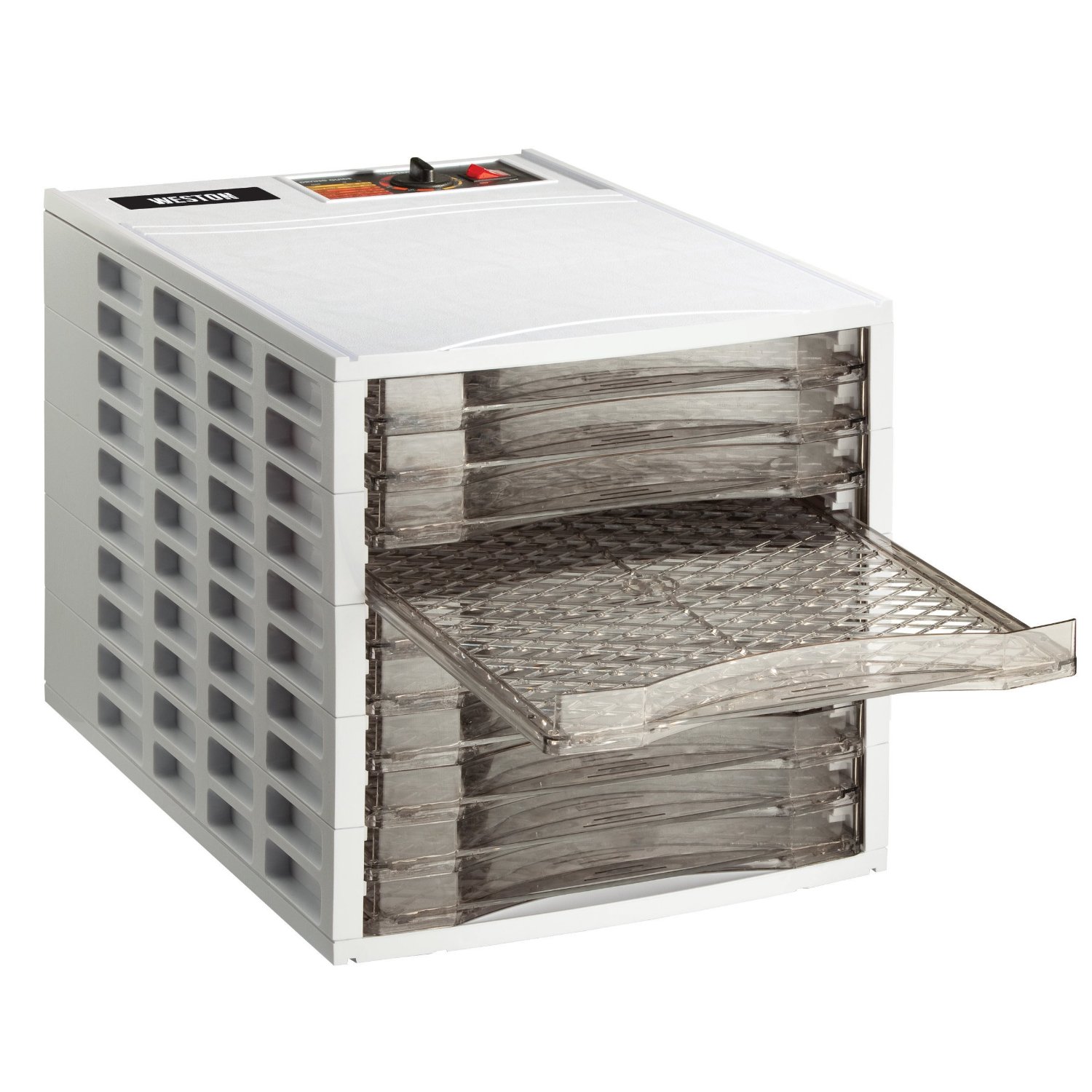
Letter Re: Dehydrator Screens
Greetings.
I come across a lot of people who are looking for a solution to drying smaller items in their dehydrator. Over the years I have tried various solutions over the years while prepping and doing backpacking meals. The solution I finally came up with was to go to the hardware store and buy a roll of stainless steel screen door mesh. I cut it to the size of my trays. The mesh lets the air flow and the little pieces stay on the tray. – Crazyman
o o o
Hugh, I bought some pieces of this stainless steel fabric several years ago and cut them (with metal snips) to fit the trays in our dehydrator. We use them often and have had good success. They allow air flow, but the hole size prevents anything from falling through. They are food grade stainless so no worries about bad things getting into your food and are easily washable. I don’t think ours will ever wear out. McMaster Carr: 85385T44 – J.
- Ad Survival RealtyFind your secure and sustainable home. The leading marketplace for rural, remote, and off-grid properties worldwide. Affordable ads. No commissions are charged!
- Ad Elk Creek Company - Percussion Blackpowder Guns - No FFL Required.Elk Creek Company - Percussion Blackpowder Guns - Pre-1899 Guns - Knives - Bayonets - Magazines - The last bastion of privacy!

- Ad USA Berkey Water Filters - Start Drinking Purified Water Today!#1 Trusted Gravity Water Purification System! Start Drinking Purified Water now with a Berkey water filtration system. Find systems, replacement filters, parts and more here.
- Ad SurvivalRealty.com: Sell Your Remote LandAdvertise your hard-to-sell remote land to eager buters. We specialize in rural, remote, and off-grid properties worldwide. Affordable ads. No commissions are charged!

Economics and Investing:
What Life Will Be Like After An Economic Collapse – G.G.
o o o
How US States Can Pave the Way for Greater Use of Sound Money
o o o
Powers That Be Desperately Trying To Keep Confidence Alive In Failing Fiat System
o o o
Late-August Calm A Breeding Ground For Bullion Bank Shenanigans
o o o
SurvivalBlog and its editors are not paid investment counselors or advisers. Please see our Provisos page for details.
- Ad California Legal Rifles & Pistols!WBT makes all popular rifles compliant for your restrictive state. Choose from a wide range of top brands made compliant for your state.
Odds ‘n Sods:
Massive security breach hits popular web browser’s password manager – DSV
o o o
How To Disappear Completely – The Great Vanishing Act – G.L.
o o o
Hundreds of Aussies sign up for terror survival training. Isn’t the idea to NOT get yourself to be a hostage? So much for being in condition yellow and above! – A.S.
o o o
Video: MSNBC Host – The Borg Queen wanna-be. Your Kids Belong to the Collective
o o o
Controversy Erupts After NFL Quarterback Converts To Islam and Refuses To Stand for National Anthem… – W.C.
Hugh’s Quote of the Day:
“If men are good, you don’t need government; if men are evil or ambivalent, you don’t dare have one.” – Robert LeFevre
Notes for Monday – August 29, 2016
August 29th is a mournful day, as we remember the anniversary of the death of “The voice of him that crieth in the wilderness, Prepare ye the way of the LORD, make straight in the desert a highway for our God.” – Isaiah 40:3. John, the Baptist, who heralded the first coming of our Lord and stood true to his belief in the face of death, was beheaded on this day in 29AD.
In 1862, the Battle of Bull Run in Virginia began, along with the U.S. Bureau of Engraving and Printing.
Pat Cascio’s Product Review: Cold Steel Swift I & II
I’m one of these people who doesn’t sleep much at night. On a good night, I might get three or four hours of sleep. So, I spend a lot of time thinking. I sometimes come up with my best ideas in the middle of the night. I’ve often “written” my articles while in bed and put them down on paper later on. I’ve “designed” many knives while lying in bed wide awake, and then put the idea down on paper, and more often than not I can bring my idea to fruition.
My long-time friend Lynn Thompson, who owns Cold Steel Knives, is one of those gifted people in many areas. He’s gifted not just as a knife designer but he excels in shooting and hunting, with firearms as well as his own cutlery products, plus he is a well-known martial artist. However, I had no idea that Lynn could read minds, especially my feeble mind. Through his efforts and that of custom knife maker Andrew Demko, they produced the Swift I & II folding knives. Without a doubt, they some how got into my mind and stole this design, because this is about as perfect of a folding knife as I could design on my own. So, we can now add mind-reading to the list of skills that Lynn Thompson is superb at.
I have designed many fixed blade knives over the years and had them produced for me by several different custom knife makers, and more often than not they were able to decipher my crude drawings into what I envisioned. I’m no genius when it comes to designing folding knives, however. I presently have one drawing done, and it might come to completion, one of these days. Designing and producing folding knives is a whole different world, compared to a fixed blade knife. There are many intricate and detailed workings of a folding knife. Everything, and I mean everything, has to fit together perfectly in order to have a good folder.
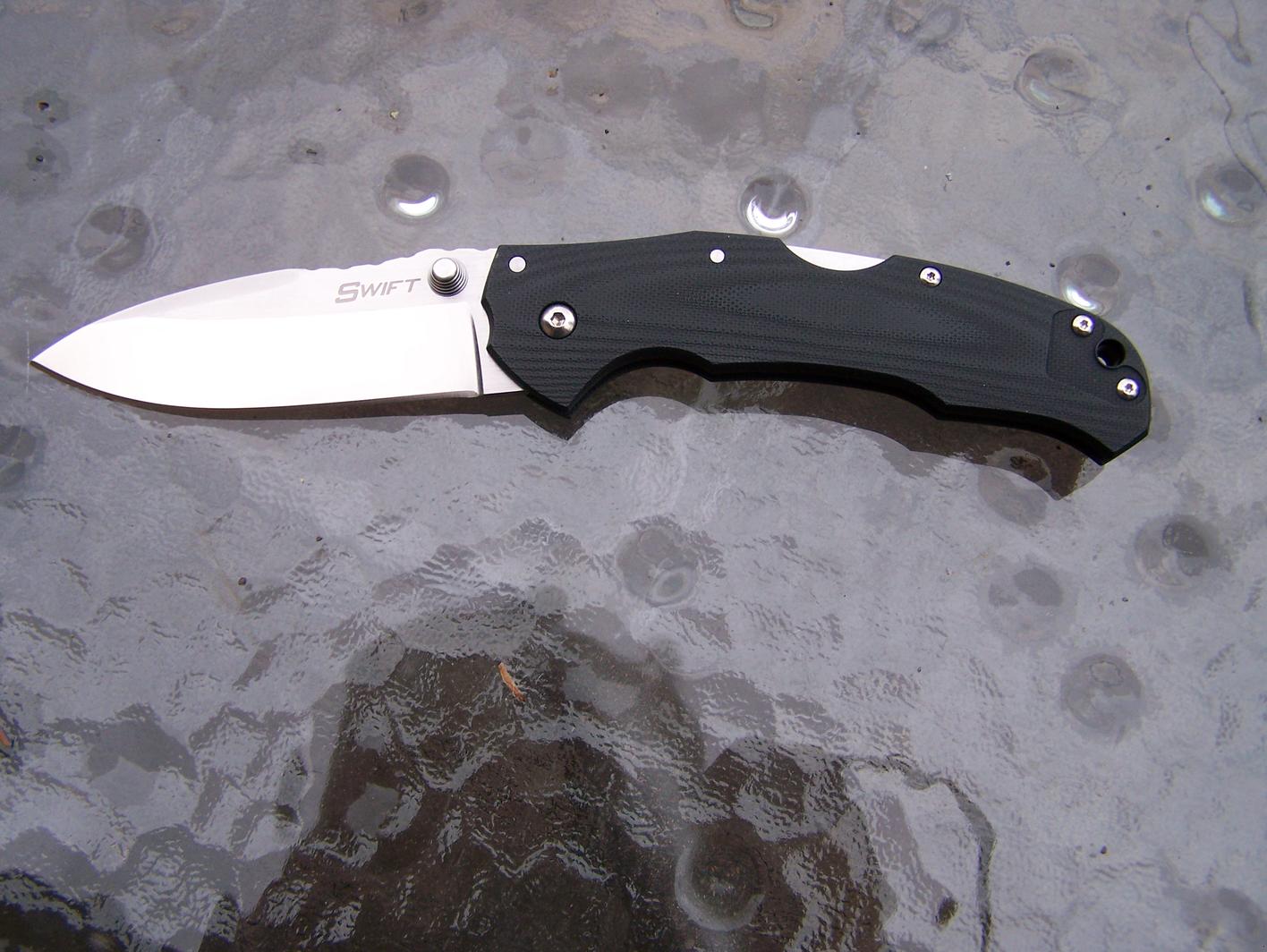
The Cold Steel Swift I & II are just such a folder, perfectly designed. And, to add to the complicated process, Cold Steel made this design into an assisted-opening folding knife, which is just a lot more complicated in the end. A quick look at the specs are in order on the Swift. We have a weight of 4.6 ounces with a blade made out of Carpenter CTS XHP steel. The blade is four inches long, and I’ve found that for my taste a folder should have a blade between 3.5 and 4.0 inches long; they just seem to work better for me. The handle scales are super-tough black G-10. The Swift I is an uncoated satin polished blade, while the Swift II has a DLC black coating for that subdued tactical look. We also have a reversible pocket clip, well sorta. Because of the curvature of the handle, a second pocket clip is included for those who carry in their left front pocket.
The proven Tri-Ad locking system on the Swift is one of the strongest, if not the strongest, in the industry, so there are no worries about the blade closing on you unexpectedly. The blade is a modified spear point design, which is very useful for many applications. The top rear of the blade has “friction” grooves as well as the top front of the handle for sure placement of your thumb in the fencing grip. We also have ambidextrous thumb studs for easy opening. Plus, the handle, as mentioned, has a curvature to it; it dips down and just fits my hand perfectly. The knife just feels perfect in my hand, period! And, as always, the blade is super-sharp, like all Cold Steel blades. They set the Gold Standard for sharp knives. Thompson and Demko also included a lanyard hold in the butt end of the handle, too.

The Flash-Tek assisted-opening design is patent-pending, too. I don’t have a way to measure just how fast any assisted-opening knife, or for that matter, an automatic-opening knife opens. However, I will say this; the Swift might just be the fastest assisted-open folder I’ve ever tested, and it might be faster than an automatic-opening folder is. We are talking fast!!!
To be sure, the Swift is manufactured in Taiwan. If it were made in the USA, the price would be quite a bit more. I’ve said many times that you can get as good of a knife as you want out of Taiwan. You need a cheap 50-cent knife? You can get it. You want a thousand dollar knife? You can get that, too, and it will be worth the cost. So, don’t let being made outside of the USA bother you. I’ve tested thousands of knives over the years, and the quality is as good as you order from Taiwan.
The design of the G-10 handle scales are worth a closer look. While many knives– folders as well as fixed blade– have a “flat” design to them, the Swift has ergonomically CNC machined handles that are ever so slightly rounded, so as to not make holding the knife the least bit uncomfortable. This is important. It’s a small matter but important, at least to me, and it should be to you, too.
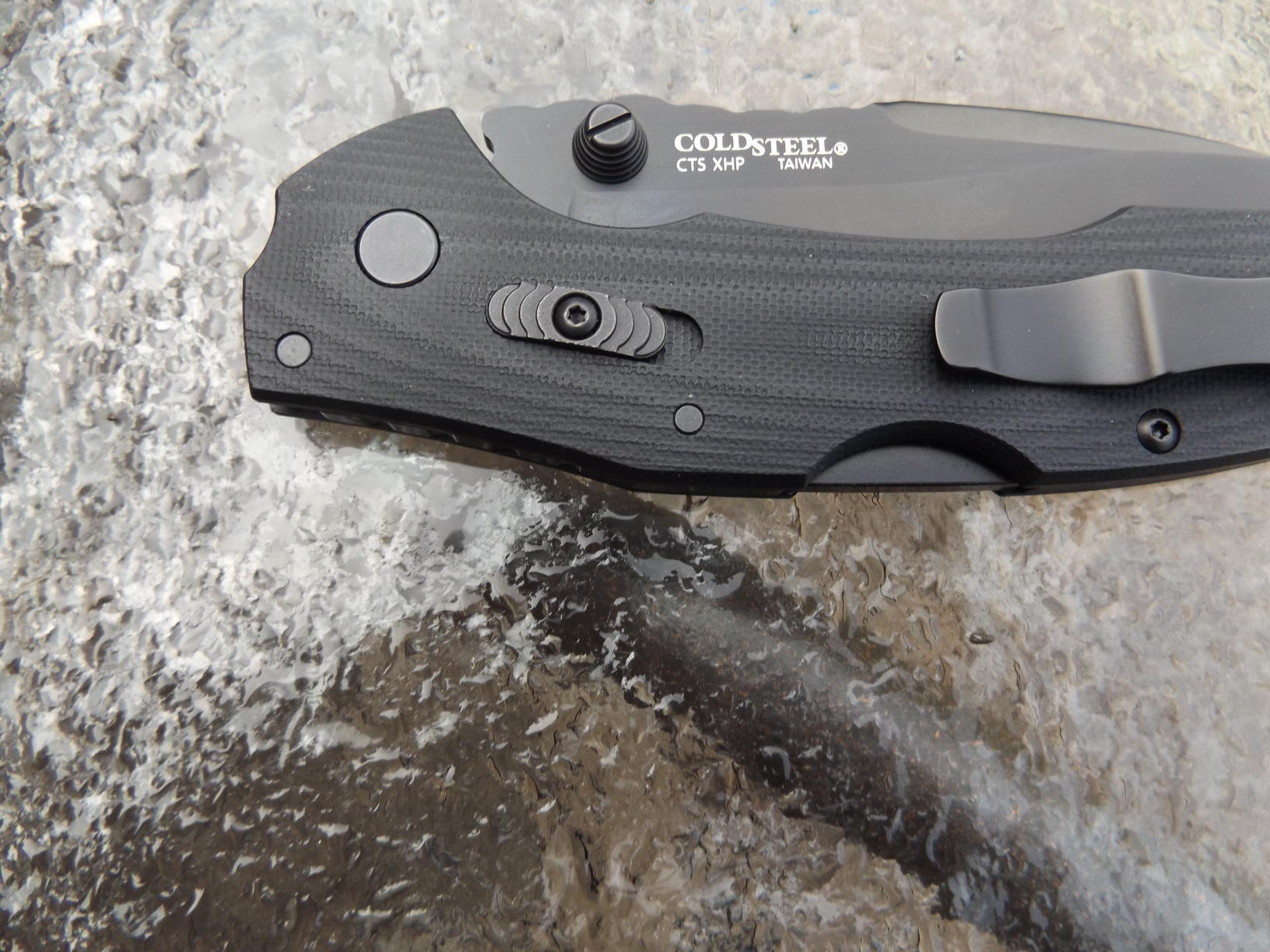
The pictures with this article show two different samples of the Swift. The satin finished uncoated blade is from the first run of knives. The black blade sample is a new and improved design, with the ”XS” (Xtra Safe) safety, that keeps the blade securely locked when closed, as well as locking the blade when it is open. It adds another measure of safety so there are no worries about the blade popping open in your pocket. It’s a great idea! Plus, the sliding “XS” safety is mounted on the side of the handle, not on the top. I can pull the knife out of my pocket and with my index finger release the “XS” safety, and then apply pressure to the thumb stud and the blade flings open, fast! And, if needed, I can apply the “XS” safety to lock the blade in the open position. It’s just another added feature that assures you the blade won’t close accidentally when in use!
Did I happen to mention that the Swift came super-sharp right out of the box? Yeah, I thought I did! However, as part of my testing I still like to put every knife I get through a series of tests, to see just how sharp a blade is. This includes cutting chores in the kitchen, as well as slicking newspaper. Many knives won’t slice newspaper because it is so thin. There were no problems with the Swift. I also cut cardboard, a lot of it, and this material is extremely tough on a knife blade. It will dull a knife is very short order, but I had no problems with the Swift, either of my samples. Cutting poly rope is an extremely good test of how well a knife will cut. Many knives, even though they are sharp, will simply slide right off the poly rope; the Swift had no problems.
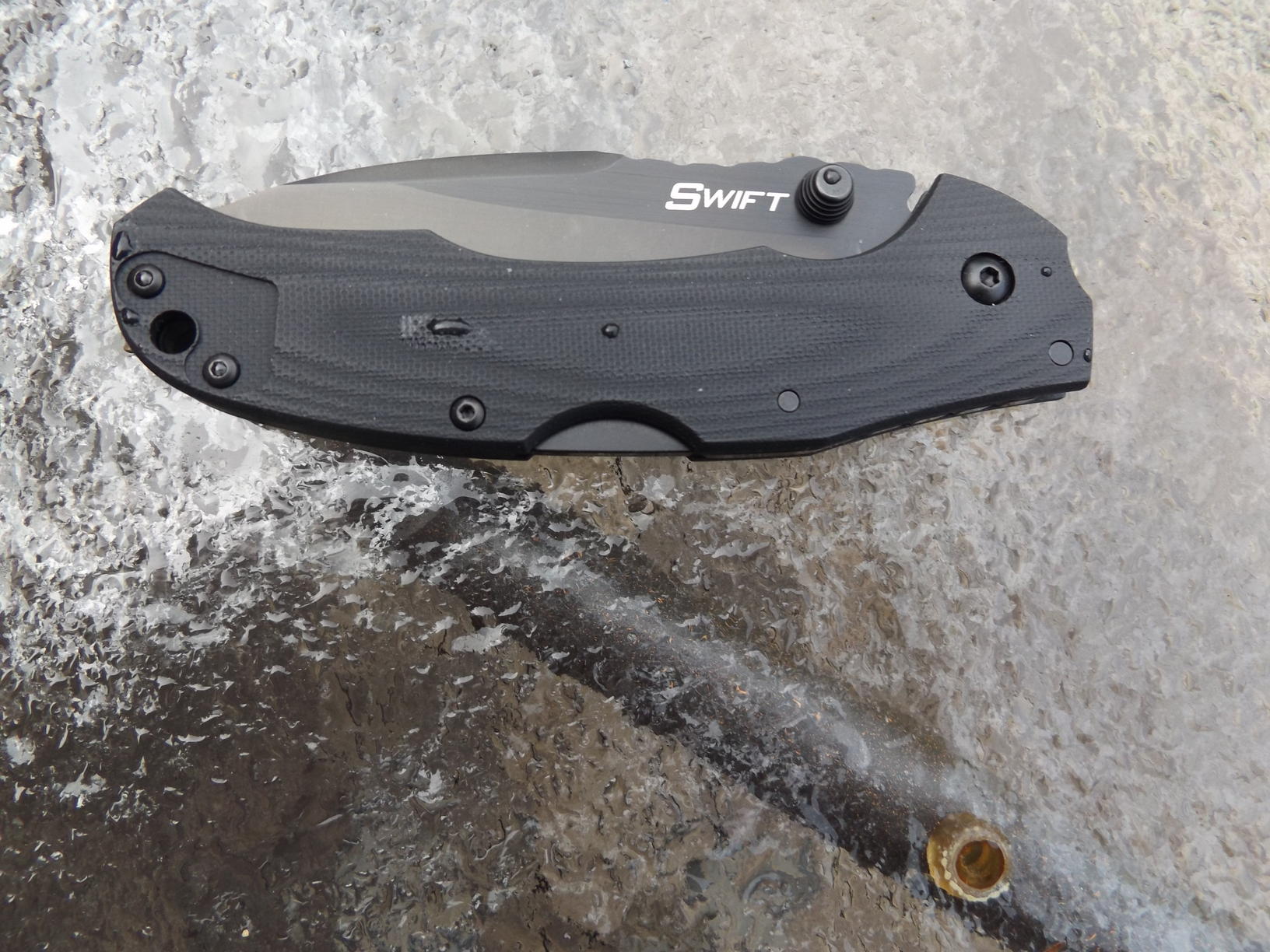
If you’ve followed my knife articles, you know that one tough test is cutting through blackberry vines and we have more than we need in western Oregon. Blackberry vines are wicked, especially the long thorns on them and the vines themselves are tough. I take a single swipe at a vine, and if a knife blade doesn’t cut completely through one of these vines the edge of the blade needs some work. I had no problems with the Swift. Just one clean swipe and the vines were cut into two pieces. During all my testing, over a long period of time, I didn’t need to touch-up the blade. It held the super-sharpness it came with. However, at the end of my test period, I just ran the Swift’s blade over the crock-stix to touch it up.
Some years ago, Cold Steel had a line of custom folders, and they were custom in every way and form. They were made in Japan, and they were expensive. I tested several of them, and they even exceeded the quality of custom folders made by some of the best custom knife makers in the country, bar none. However, they were a little bit on the spendy side, beyond the reach of many consumers. The Swift is as good as any custom folder I’ve tested. Yeah, it is that nicely made!
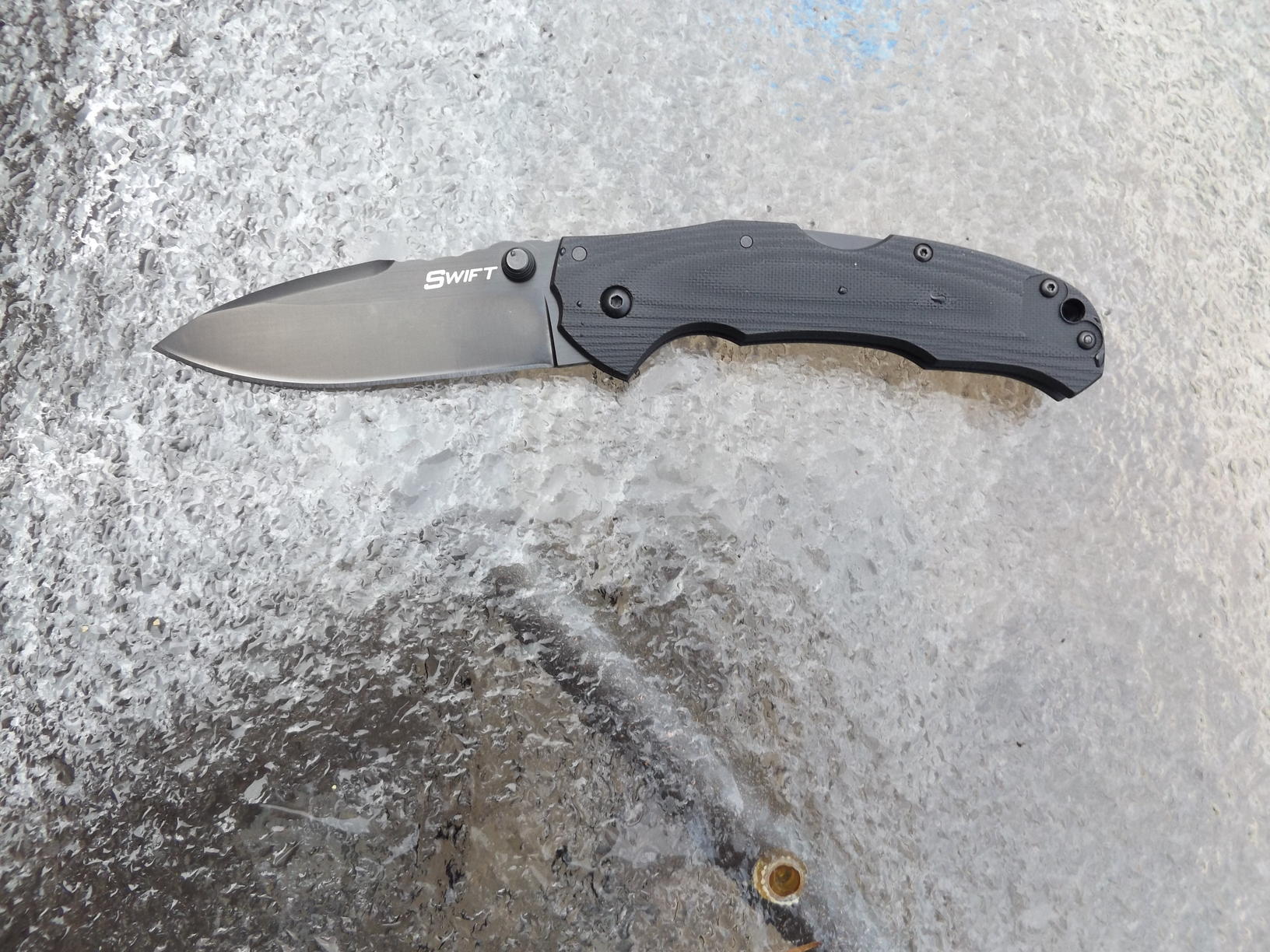
As I always do, I pass knives around to the guys (and girls) at the local gun shop I haunt, and every one of them loves the way the Swift felt in their hand. The manager of the gun shop is very picky when it comes to knives and guns and can usually find something to complain about, but he had no complaints about the Swift, none! I even put on my magnifying gunsmith goggles to take a closer look at the workmanship of the Swift and couldn’t find a thing wrong with the workmanship at all!
In the past, I have disassembled some folding knives– assisted-opening, manual-opening, and even automatic-opening types– and some, I wished I hadn’t taken apart. They were a real bear to put back together. I was very tempted to disassemble the Swift to see what the Flash-Tek assisted-opening design was all about, but I regained my senses. I didn’t want to have to put the parts in a plastic bag and send it back to Lynn Thompson with a plea to put the knife back together for me. I’m dumb but not stupid! LOL!
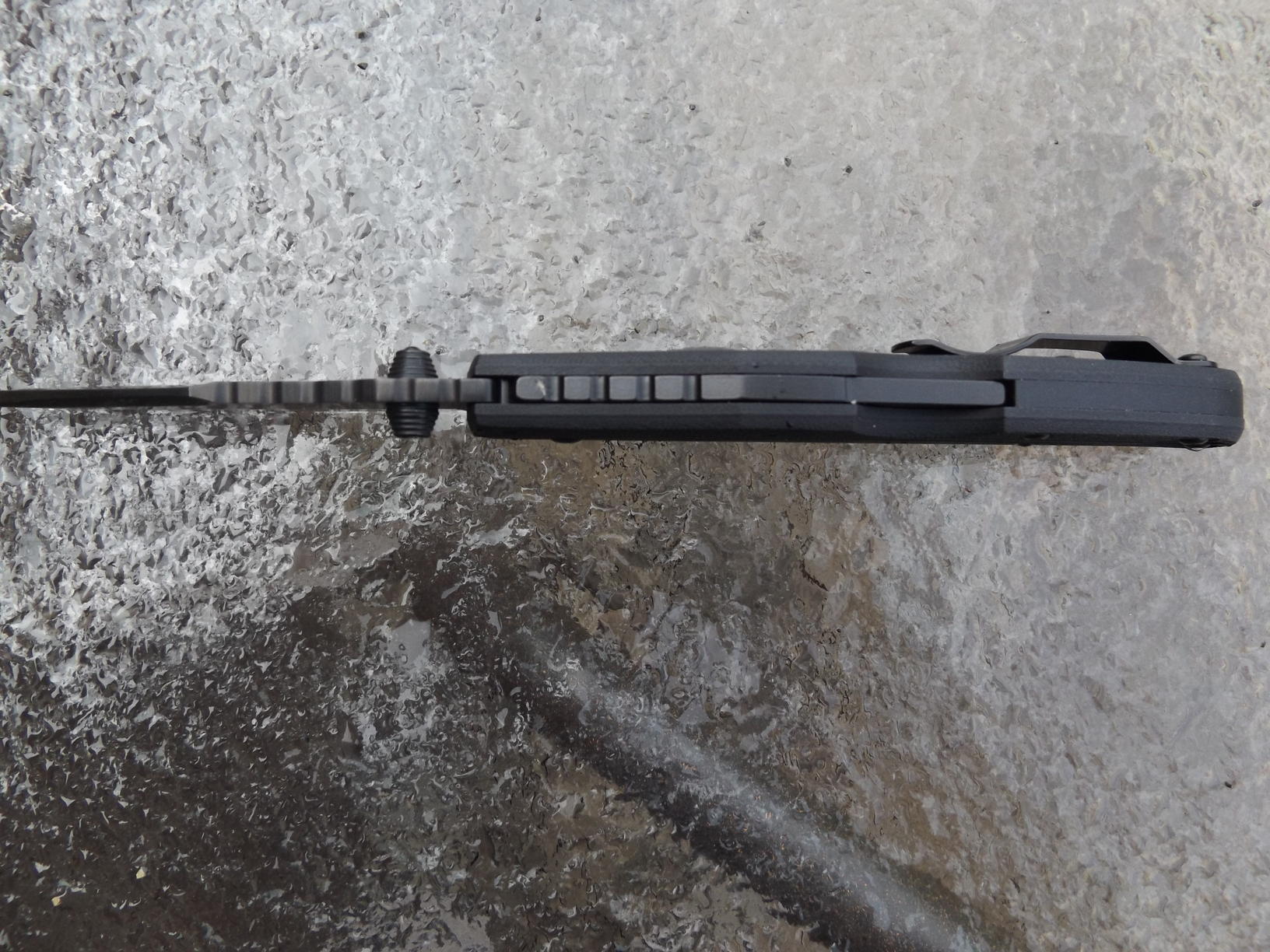
I hope to see the Flash-Tek assisted-opening mechanism on some more of the Cold Steel folders. I like it, a lot! It is fast and smooth, very fast, and very smooth in operation. In the meantime, I’m going to consult with some legal minds and see if I can file suit against Cold Steel for getting inside my head and stealing this design. Gotta be some legal recourse. LOL!
Full retail on the Swift line varies, according to which model you want. However, if I had no other choice but to pay $240 for the Swift I or II, I’d sure pull the ol’ credit card out of my wallet and get one. Its top-notch material, extreme detail to quality, workmanship that’s second to none, fast and smooth opening, what’s not to like? Check one out at your nearest dealer, and you’ll buy it.
– Senior Product Review Editor, Pat Cascio
Recipe of the Week: Old World Sauerbraten, by G.M.
Ingredients:
- 3½ to 4 lbs beef rump or sirloin tip
- 1 cup water
- 1 cup vinegar
- 1 large onion, sliced
- 1 lemon, sliced (unpeeled)
- 10 whole cloves
- 4 bay leaves
- 6 whole peppercorns
- 2 Tbsp salt
- 2 Tbsp sugar
- 12 gingersnaps, crumbled
Directions:
- Place the meat in a deep ceramic or glass bowl.
- Combine water, vinegar, onion, lemon, cloves, bay leaves, pepper, salt, and sugar; then pour it over the meat.
- Cover and refrigerate for 24 to 36 hours, turning the meat several times during marinating.
- Place beef in a slow-cooking pot.
- Pour 1 cup of marinade over the meat.
- Cover and cook on low for 6 to 8 hours.
- Place the meat on a serving platter, then strain the meat juices and return them to the pot. Turn the control to high and stir in gingersnaps.
- Cover and cook on high for 10 to 15 minutes, then pour over meat.
Makes 8 servings.
o o o
Do you have a favorite recipe that would be of interest to SurvivalBlog readers? Please send it via e-mail. Thanks!
Letter Re: Dehydrating Tray Solution
Hugh,
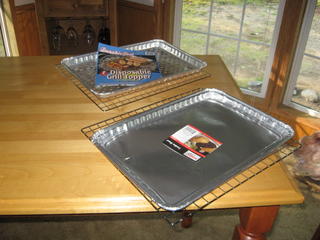
I’ve noticed a couple of letters from people writing in and asking about the problem of smaller veggies falling through the trays with the tier-style hydrators. I wrestled with the same issue in the beginning and started out by using aluminum foil stretched across the racks. That proved to be impractical for long-term usage because each time you moved the rack in or out of the dryer the edges of the foil would catch on the sides and tear, not to mention the trick of getting them into the dryer without everything falling all over the floor. Additionally the veggies would stick to the aluminum foil. It was pretty time consuming just getting the food off without all kinds of little pieces of foil stuck to the food, so that technique ended up being basically a one-time thing, as you had to put new foil on all of the racks with every new batch. After that, I began molding the aluminum foil into cookie sheets. That solved the tearing problem but not the sticking issue. Finally the light went on. 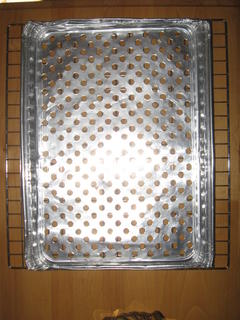 After a good bit of searching I found two styles of what I call throw-away cookie sheets at the dollar store. The perforated pans are actually throw-away pans for grilling veggies on the grill. You get a set of two for $2.00 (a dollar a piece). I have a ten-rack dehydrator so it cost me ten bucks for a set. They work great. There is very little sticking, and they’re heavy enough to be able to scrape stuck-on food without tearing. I use a steel spatula for this, but the sticking issue really only happens with the mixed veggies, peas, carrots, and corn. I use the perforated sheets for better air circulation on things like broccoli, cauliflower, zucchini, squash, diced potatoes, mushrooms, and onions. All of these just slide right off after drying. There’s no sticking whatsoever. The non-perforated pans are used for the frozen mixed veggies from the store, corn off the cob, and peas. One note of caution about either of these styles: Don’t use even the perforated pans for any kind of fruit. The sugar glues the food to the pans. I’m talking Super-Glue! I always put fruit, no matter how small, directly on the racks themselves. Maybe I should have included this as another learning-curve take-away in the article.
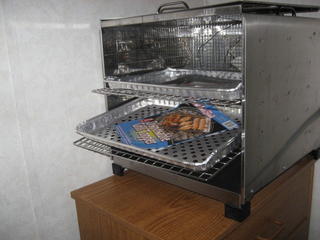
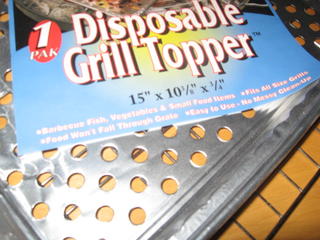
The size of the pans in the pics is ¾” x 10-3/8 x 15”. (Those are inside dimensions.) This was the closest size I found to matching the rack size. Being a little wide as they were for mine, you may have to fold two of the edges up and then squash the corners flat with a pair of pliers for a nice flat fit in the dehydrator. But after that’s done they slide in and out nicely.
After about six or seven uses, they will get a bit of the grunge factor working from the sugar in the veggies. This is what causes the corn and peas to stick. I have cleaned them by both soaking in the bath tub and then washing with soap, and also by using a Brillo pad followed with a soaping. Soaking first works the best. The bits and pieces of food that are stuck rehydrate and just float off. Then all that’s needed is a soaping. They last forever it seems. I have a set of each type in reserve and am currently only on my second set after using this system for years. I really liked the non-stick pads that your wife found. Will definitely be looking into those.
I have always avoided using any kind of vegetable sprays in dehydrating because of the rancidity factor. For shorter-term storage and usage, sprays may not make any noticeable difference at all, but if you’re shooting for maximum long-term storage years I don’t think I would recommend it. I can’t speak with absolute authority here because I haven’t done a side-by-side test of something that has been stored for say five years; one with pans sprayed with oil, the other not. But the reason I shy away from this concept is I remember when I was doing research on dehydrating hamburger, many of the videos and articles stressed over and over again that the better the meat was rinsed of the fat the longer it would store before turning rancid. It was the amount of residual oil that determined shelf-life; oil eventually goes rancid. I have some that has been in storage for a little over a year now so it might be time for a test.
Lastly, if you do have the cash to spend, Excalibur seems to have the market on this problem we’ve been talking about. Their trays are made of a fine screen which cures the fall-through problem. I can’t speak to the sticking problem as I’ve never owned one of these. Their smallest four-tray units start at around $110 and the different models go all the way up to $1,000 for their stainless steel commercial unit, with many of their nine-tray dryers coming in at around $300, give or take depending on the amenities. And they offer a big selection. But again, keep your eye on Craigslist for a great buy on used! – M.P.
Economics and Investing:
The Royal Bank of Scotland becomes the first bank to set negative interest rates. – G.G.
o o o
o o o
Items from Mr. Econocobas:
Global Central Bankers, Stuck at Zero, Unite in Plea for Help from Governments – You have to read between some lines here, but what I read is Helicopter drops of money in some form will be needed and we have to make sure people understand what they have been doing to us is giving us inflation not future taxes. This is a fine line because they can’t have people really understanding monetary policy or even understanding inflation. Central banks NEED inflation in order to operate and besides the debt that has already accumulated cannot be paid off with taxes ever. They know this, and they don’t really want people to understand this, but they need them to have an expectation of inflation without actually understanding where it comes from..
o o o
SurvivalBlog and its editors are not paid investment counselors or advisers. Please see our Provisos page for details.
Odds ‘n Sods:
Grotesquely Incompetent Judge Won’t Suspend Mandatory Vaccination – DSV
o o o
The American Redoubt makes the Washington Post: A fortress Against Fear – M.S.
o o o
American Electorate Loses As Partisan Media Coverage Of Candidate Health Turns Outright Bizarre
o o o
Gun ownership rises to 44% of all home – GJM
o o o
Restoring Your Soil: Advice by an Old School Soil to Health Expert – DSV
Hugh’s Quote of the Day:
“For the gods perceive things in the future, ordinary people things in the present, but the wise perceive things about to happen.” – Philostratus (c. 170/172 – 247/250), called “the Athenian”, a Greek philosopher of the Roman imperial period