
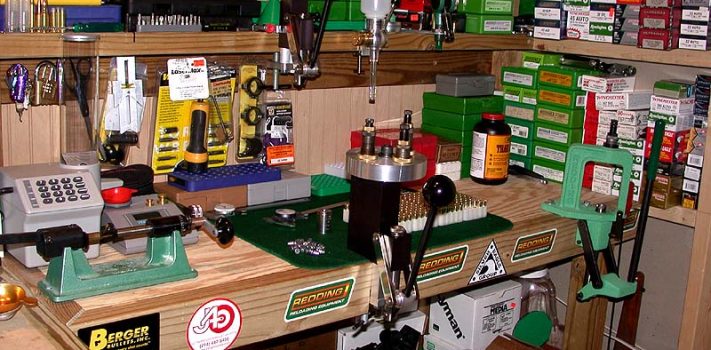
Reloading Ammunition For WTSHF- Part 2, by S.B.

Having removed the spent primer, you now need to insert a new one. There are specialty tools available for this, as well as attachments to do this on your press. How your particular setup will work depends entirely on what equipment you buy, but all methods insert a new primer into the primer pocket in the base of the brass case. Exactly which primer you need depends on your cases. For example, some 45 ACP cases use small pistol primers, and some use large pistol primers. Your specific round formula ca be found in your reloading manual (e.g. standard or magnum primers). Once a new primer is inserted you are ready to charge with propellant.

Charging is accomplished by pouring a measured amount of propellant into your prepared case. Your reloading manual will have charts showing a starting load and a max load for various propellants when used with particular bullet weights and types. Use the chart, and start with the starting load and work your way up until you find a load you are happy with. How you measure the charge depends on your equipment and the type of propellant.

In general, most reloaders either weigh their charges or use a volumetric powder measure. For precision, weighing charges is most accurate. A charge is measured in grains. This is an English measure, wherein there are 7000 grains in one pound. That’s pretty small. I started out weighing my charges for accuracy. Eventually, I set up the volumetric powder drop by making minor adjustments until a dropped charge weighed almost exactly what I wanted it to be for my round. I still spot check while loading, to make sure the measure stays the same during the whole loading process. Consequently, I only use my powder drop for pistol rounds, because that is what I shoot the most. That way I don’t have to readjust every time I change to reload rifle rounds. Some propellants are not well-suited to volumetric measures. Some propellants, including my favorite for .308, are extruded. This means the propellant looks like a bunch of small sticks. These tend not to flow well into some powder drops, including mine, so I prefer to weigh charges when reloading using these propellants.

Once you have a charge measured, you pour it into your case mouth. I use a funnel. Take care to make sure you only have one measured charge in your case. I don’t have to worry too much about this, because for every round that I reload one charge of propellant fills the case well over half-full. It is enough so that a double charge would overflow the case. This is not the case with all propellants, and I still do a visual inspection of every charged case to make sure they all look the same. A double charge is very dangerous and can cause catastrophic failure of your firearm and serious injury. Take all reasonable steps to avoid one.

Once the propellant is in the cases, I don’t like to leave them sitting around for too long. Some people will charge one case, then move immediately to seat a bullet on that case; if that works for you, go for it. It seems more efficient to me to work in batches. I will charge a batch of 100-200 cases, having them all stacked neatly in old factory ammo boxes or reloading trays, and then the whole batch will be ready to seat the bullets.

Your reloading die set will have a seating die. You will want to set this up according to the manufacturer’s instructions and to accommodate the overall length of your completed cartridge, which is found, you guessed it, in your reloading manual. Then it is simply a matter of putting the case, which has been charged with propellant, onto the ram of your press, putting a bullet on top, and guiding it into the die. Many people, myself included, will run a couple of un-charged cases through to seat bullets first, just to make sure that the length adjustment is right on. You also need to use caution when changing any component of your round. I once switched from 55 grain full metal jacket bullets to 55 grain pointed soft point bullets in the middle of a .223 run, because I had run out of FMJs. Despite the bullet similarity, my cartridge length was off by a significant amount until I readjusted my seating die.

After the bullet is seated, there is the question of whether or not to crimp your bullet into the case. Mostly this is done to prevent bullets from getting set-back into the case as a result of a myriad of factors (recoil under fire, rough handling, et cetera). There are several schools of thought here, but it all boils down to what type of firearm you will be using the round in and how you will be storing the round until you use it. I typically put a light taper crimp on my completed rounds, and this is accomplished by adjusting the seating die to crimp at the same time that it seats the bullet. Some others use a separate die for crimping. Please note that revolvers are different, and rounds for revolvers typically have a serious crimp called a roll crimp. I don’t have any revolvers, and thus I have no experience reloading for them, so I will leave that topic to someone who does have that experience.

Now that you have a completed round of ammunition (or several of them), you need to store them. There are many ways to store ammunition, and I won’t pretend that mine is the best, but this is what I do, just as an example.

The place I buy my pistol projectiles ships them in batches of 500 (with space to spare) in fairly sturdy cardboard boxes. Once I had reloaded a bunch of pistol ammunition and determined that I had filled all of my available small containers, I started looking at these cardboard boxes lying about. I can comfortably fit 350 completed rounds in each of these boxes that originally held 500 projectiles. The box weight is close enough that I don’t worry about breaking the box, and they are packed tightly enough that I don’t worry about them rattling around too much. Three hundred and fifty rounds is a good amount of ammo for one or two range sessions for me, so I don’t have a bunch of partial boxes, making it hard for me to keep a handle on my inventory. I do use USGI and plastic ammo cans but not usually for bulk ammunition storage. A USGI ammo can would likely hold over 1200 rounds of 9mm, if packed in bulk. That is too heavy for me to throw in the range bag and go shoot.

My .223/556 ammunition is stored in reused factory boxes of 50, with a few 50 round plastic storage boxes in the mix, and then combined into .50 cal. USGI ammo cans or large plastic ammo cans. I have only recently exhausted my supply of used factory boxes, so now I’ll have to find another option. I am really not a fan of storing pointed rifle rounds loose in bulk boxes, so I suspect that I may buy used stripper clips and store my .223 ammo on those. As a bonus, it makes it quick to reload AR-15 magazines.

My .308s are in used factory boxes of 20 and a couple of plastic storage boxes of 50. The factory boxes combine well into USGI and plastic ammo cans, but the 50 round boxes are a little bulky. So far I still have plenty of used factory boxes, as I don’t go through too much or produce much with a .308 bolt action. However, one of my other hobbies is building ARs, and I envision increasing .308 production once I finish my AR-10 build.

Once you have gotten the hang of reloading, the opportunities to improve your shooting are endless. For example, I once traded for a bolt action rifle that I planned to use for hunting. I got a great deal on it. When I shot it, I discovered why: My group at 100 yards with factory ammo looked like a shotgun pattern. It was terrible. Rather than swearing and throwing the rifle off a bridge, which was my first inclination, I decided to do a ladder test. This is loading three rounds with a starting charge of powder (from the reloading manual), and increasing the powder charge by small steps, like a ladder, to determine if there was a “sweet spot” for this rifle. I fired my first three round group with the starting load, and through the spotting scope it looked as if I had missed the target with two of the three rounds. As I approached the target, I found out that, no, all three rounds had hit in basically the same hole. The guy who traded the rifle to me probably did so because he couldn’t get acceptable groups with factory ammo. It just turns out that the rifle liked a load slightly less hot than most factory loads.

There is something rewarding about being able to produce your own ammunition. The process is not hard, and there are plenty of resources available to help you. I encourage you to evaluate your own circumstances to see if reloading is appropriate for you. If you do take the reloading plunge, I hope that this has shown how reloading can be accomplished without spending a ton of money or having a great deal of space. Also, nothing that I do or described above requires any electricity, so it is perfect for someone who lives off the grid, or for WTSHF. Until that time, keep your powder dry and God bless.




Letter Re: Buying and Selling Rural Land

Hugh,

If you have narrowed down your list to one or two properties, consider chartering an aircraft to do a visual inspection. It might cost you $300-$500 but it allows additional validation of a significant investment. Even at 1,000 feet above ground level (AGL in pilot speak) you can quickly take some pictures, makes some notes, and assess things such as the terrain, trees or vegetation, and even a potential risk if say a neighbor has something on their property that could ultimately contaminate your water supply.

I know some readers will scream “my privacy!”. Here in the USA there is nothing illegal about what I’ve just suggested though – the FAA controls the airspace. – P.S.

HJL Comments: You can also consider a drone to perform the validation.


Economics and Investing:

Germany becomes second G7 nation to issue 10-year bond with negative yield – G.G.

o o o

Video: Fed’s Undercover Bailout of Biggest Banks – Mike Maloney – A.S.

o o o

A New Set of Crises for the EU

o o o

Gold Prices: Headed Higher Into Late Summer

o o o

In 30 Years, U.S. Will Have Highest Debt-To-GDP Ratio In Our History—141%

o o o

SurvivalBlog and its editors are not paid investment counselors or advisers. Please see our Provisos page for details.


Odds ‘n Sods:

Reader F.M. sent in a reminder about the 4th Annual Marion County, WV Preparedness Expo on Saturday, September 17,2016

o o o

A “must have” accessory for every guy: Bullet Resistant Jockstrap – DMS

o o o

Pastor Resigns, Refuses To Bow To Lgbt Agenda In Schools – PLC

o o o

While you drive, your mobile devices chat with government – D.E.

o o o

In a first, U.S. judge throws out cell phone ‘stingray’ evidence – G.G.

o o o

7 Disgusting Things Obama Said While Hijacking Memorial For Slain Dallas Police


Hugh’s Quote of the Day:

Therefore, since the world has still
Much good, but much less good than ill,
And while the sun and moon endure
Luck’s a chance, but trouble’s sure,
I’d face it as a wise man would,
And train for ill and not for good.

– from the poem, ‘Terence, This Is Stupid Stuff‘ by A.E. Housman (1859 – 1936)


Notes for Wednesday – July 13, 2016

On this day in 1787, Congress enacted the Northwest Ordinance structuring settlement of the Northwest Territory and creating a policy for the addition of new states to the nation. The members of Congress knew that if their new confederation were to survive intact, it had to resolve the states’ competing claims to western territory.

o o o

Today, we present another entry for Round 65 of the SurvivalBlog non-fiction writing contest. The nearly $12,000 worth of prizes for this round include:

First Prize:

  1. A Tactical Self-Contained 2-Series Solar Power Generator system from Always Empowered. This compact starter power system is packaged in a wheeled O.D. green EMP-shielded Pelican hard case (a $1,700 value),
  2. A Gunsite Academy Three Day Course Certificate that is good for any one, two, or three day course (a $1,195 value),
  3. A course certificate from onPoint Tactical for the prize winner’s choice of three-day civilian courses, excluding those restricted for military or government teams. Three day onPoint courses normally cost $795,
  4. DRD Tactical is providing a 5.56 NATO QD Billet upper with a hammer forged, chrome-lined barrel and a hard case to go with your own AR lower. It will allow any standard AR-type rifle to have a quick change barrel, which can be assembled in less than one minute without the use of any tools and a compact carry capability in a hard case or 3-day pack (an $1,100 value),
  5. Gun Mag Warehouse is providing 20 Magpul PMAG 30-rd Magazines (a value of $300) and a Gun Mag Warehouse T-Shirt; (an equivalent prize will be awarded for residents in states with magazine restrictions),
  6. Two cases of Mountain House freeze-dried assorted entrees in #10 cans, courtesy of Ready Made Resources (a $350 value),
  7. The Ark Institute is donating a non-GMO, non-hybrid vegetable seed package (enough for two families of four) plus seed storage materials, a CD-ROM of Geri Guidetti’s book “Build Your Ark! How to Prepare for Self Reliance in Uncertain Times”, and two bottles of Potassium Iodate (a $325 retail value),
  8. A $250 gift certificate good for any product from Sunflower Ammo,
  9. KellyKettleUSA.com is donating an AquaBrick water filtration kit with a retail value of $250, and
  10. Two cases of meals, Ready to Eat (MREs), courtesy of CampingSurvival.com (a $180 value).

Second Prize:

  1. A Glock form factor SIRT laser training pistol and a SIRT AR-15/M4 Laser Training Bolt, courtesy of Next Level Training, which have a combined retail value of $589,
  2. A transferable certificate for a two-day Ultimate Bug Out Course from Florida Firearms Training (a $400 value),
  3. A Model 175 Series Solar Generator provided by Quantum Harvest LLC (a $439 value),
  4. A Trekker IV™ Four-Person Emergency Kit from Emergency Essentials (a $250 value),
  5. A $200 gift certificate good towards any books published by PrepperPress.com,
  6. A pre-selected assortment of military surplus gear from CJL Enterprize (a $300 value),
  7. RepackBox is providing a $300 gift certificate to their site, and
  8. American Gunsmithing Institute (AGI) is providing a $300 certificate good towards any of their DVD training courses.

Third Prize:

  1. A Royal Berkey water filter, courtesy of Directive 21 (a $275 value),
  2. A $245 gift certificate from custom knife-maker Jon Kelly Designs, of Eureka, Montana,
  3. A large handmade clothes drying rack, a washboard, and a Homesteading for Beginners DVD, all courtesy of The Homestead Store, with a combined value of $206,
  4. Expanded sets of both washable feminine pads and liners, donated by Naturally Cozy (a $185 retail value),
  5. Two Super Survival Pack seed collections, a $150 value, courtesy of Seed for Security, LLC,
  6. Mayflower Trading is donating a $200 gift certificate for homesteading appliances,
  7. Montie Gear is donating a Precision Rest (a $249 value), and
  8. Two 1,000-foot spools of full mil-spec U.S.-made 750 paracord (in-stock colors only) from www.TOUGHGRID.com (a $240 value).

Round 65 ends on July 31st, so get busy writing and e-mail us your entry. Remember that there is a 1,500-word minimum, and that articles on practical “how to” skills for survival have an advantage in the judging.


Reloading Ammunition For WTSHF- Part 1, by S.B.

First off, let me say that I am very grateful to have SurvivalBlog. Over the years, I have learned so much from the accumulated wisdom of the writers and the administrators. I felt that it was time to give back to this community, so I decided to share what I have learned over many years of reloading my own ammunition for rifle and pistol, while being conscious of both budget and space/OPSEC concerns. Please believe that you don’t need to spend thousands of dollars or have a 1000-square-foot shop dedicated to reloading in order to produce your own high-quality reloads that will serve you as well or better than factory ammunition, which is especially valuable for times when factory ammo may not be available due to another buying frenzy or government action.

Several years ago I purchased my first high powered rifle. One of my first considerations was that it was kind of expensive to feed this rifle, but feed it you must, if you want to become proficient with it. I went for a while buying ammunition and saving my brass until I ultimately decided that it made economic sense to get into reloading. If you look at the economics of reloading, it is certainly less expensive to reload your own ammunition, and in some cases a lot less expensive, if you don’t factor in your time as a “cost”. If I paid myself a “salary” to reload, it wouldn’t make sense, but I reload as a hobby and to get comparatively lower cost and higher quality rounds to shoot. Veteran reloaders will often say, “You don’t save money reloading, but you do shoot more for the same money.” Your mileage may vary.

At its simplest, a round of center fire ammunition has the following components: brass case, primer, propellant, and projectile. The projectile, or bullet, is obviously the part that goes downrange. The propellant, or powder, is what burns to move the projectile, and the primer, or cap, is what is hit by the firing pin and explodes to ignite the propellant. The brass case holds them all together. Reloading is the “art” and “science” of taking these components, replacing what is expended, and combining them into a usable round of ammunition.

Once you have decided to reload your ammunition and are ready to get the equipment, there are a few considerations. First, consider what you primarily shoot (rifle or pistol) and how much you shoot. The type of reloading setup you need, if you shoot 2-3000 9mm rounds a month, is very different from the person who shoots a couple hundred 9mm, a few magazines of .223/5.56, and a couple boxes of .308. I found myself in the latter category. Since my motivation was also partially economic, I decided to go with one of the single stage “kits” from one of the major reloading supply companies. (I went with Lee Precision, but several good-quality manufacturers, including RCBS and Hornady offer similar kits to suit this need.) Typically, these kits contain a reloading press, a scale, a powder measure, and various other odds and ends, depending on the particular kit. Single stage means that since there is only one working point on the press, you can only do one operation at a time.

I decided not to go with one of the progressive presses. These are more or less automatic machines, which make a completed round of ammunition with each pull of the handle, as long as you keep feeding it components (bullets, cases, primers, et cetera). They are a great option for the person above who shoots 2-3000 pistol rounds a month. Progressive presses tend to be fairly costly and can be tricky to set up. I had to be able to move my press around, so I didn’t want to have to set it up again each time I got it out.

Once you have the kit, you also need to purchase caliber-specific reloading dies. These dies de-prime and resize brass and allow the projectile to be seated on the case. There are many companies that make dies, and the dies themselves and the presses are typically universal. That means even if you have a Lee press (as I do), you can still use RCBS or Hornady dies.

When deciding how and where to mount my press, I ran into a problem. I wanted to be able to move my reloading equipment out of the recreation area of my basement whenever my kids had their friends over. There was no sense letting a bunch of teenagers know there were guns and “explosives” in the house. This meant I couldn’t just build a bench and mount the press to it, since it would be difficult and time-consuming to remove, and then I’d still have a workbench in my basement.

One weekend at a yard sale, I found a well-used Black and Decker collapsible clamping workbench that I ultimately picked up for free, just for agreeing to haul it away. The owner had lost most of the clamping attachments, it had some surface rust, and the wood top was water damaged and de-laminating. None of this mattered to me, because I had just found my solution. I took a piece of counter top left from a kitchen remodel, cut it down to fit the top of the collapsible bench, and bolted the two together. Then I sanded the rust spots and used a can of spray paint (left over from another project) to cover. Now I have a reloading bench that folds to about 10 inches high, and allows me to keep my press mounted, as long as I am careful not to beat it against the wall when I store it away.

When I want to do some reloading, it is simple to get the bench out of the storage/gun room, open it up, level it, and commence. The wide legs make for a stable surface, even when resizing bottle necked rifle brass, which does take a certain amount of force. The counter top is a little small, but I was willing to trade some space for portability. I really didn’t need a great deal of space, since I usually don’t load more than 200 rounds at a time. There is plenty of space for the press to stay on the bench and still have room for either the scale, if I’m weighing powder charges, or the powder drop measure, if I am dropping charges. I’ll talk more on this in a moment.

When you decide to start reloading and you have secured the equipment that you need, the next and perhaps most important item is a reloading manual. Most bullet manufacturers publish a manual with a range of loads for all combinations of bullet, weight, powder, primer, et cetera. It is important to follow these directions in order to have a safe finished product. Reloading, like many tasks that we undertake in our daily lives, can be hazardous if not done correctly. Please avoid distractions while reloading, and never consume alcohol or drugs while reloading. By taking appropriate safety precautions, you can have a high quality reload that will function properly in your firearm.

When you are determining which caliber you want to reload, consult your manual to determine what propellant works best with your chosen bullet style, weight, et cetera. As you can imagine, there are many different bullets for many different applications. The specific propellant will depend on the type of bullet and the exact round you are reloading for. Many propellants will work for a range of different rounds, but you may need several different propellants, if you are reloading for many different rounds. Except in very limited circumstances (300 AAC Blackout comes to mind), propellants that are used for pistol rounds are not appropriate for rifle rounds and vice versa.

My first step when starting to reload is to clean my brass cases. When the brass comes out of the firearm, carbon deposits are left on the case, dirt is picked up off the ground, et cetera. These items must be removed or you risk damaging your reloading dies. I take a minimalist approach to cleaning my brass. There are electric tumblers and vibrating cleaners that do a fine job, but they depend on electricity. What if there was no electricity? Shiny brass is pretty but does not have any advantage over “subdued” brass. All you need to do is get the dirt and carbon off the brass. I use a couple of buckets, some water, and a few teaspoons of Dawn dishwashing liquid. Heat the water, pour it over the brass in one bucket until it is completely covered, add the Dawn, and pour the water/brass mixture between the two buckets a few times to agitate. Then let soak for 15-20 minutes and repeat. You can do this a few times. Then, I change out the water and do not add Dawn. I will repeat again a few times and then change the water as needed until no more soap bubbles appear. Finally, I lay the brass out on an old cookie sheet or two to dry. I have placed them in the sun to speed up the process or, if I was really in a hurry, into a 250-300 degree oven for 20-30 minutes.

Pistol cases are now ready to be de-primed and resized. With rifle cases, I run them through a de-priming die that does not resize before I clean them. I think they dry quicker that way. Your sizing die squeezes the case back into factory specifications and makes sure that the case neck is properly sized to seat the bullet in a future step. Most bottlenecked rifle cases require lubrication before sizing, as do pistol cases if you are not using carbide resizing dies. You set up the dies per the manufacturer’s instructions, place the case into the shell-holder that attaches to your press ram, and pull down the handle. The case goes into the die and is returned to factory size, while a pin pops out the old primer. Repeat as necessary until all cases are resized and de-primed.

There could be other steps inserted at this point as necessary. Occasionally the primer pockets, where the old primer was popped out, will need to be cleaned. Sometimes, especially with rifle brass, you will need to trim the brass to the proper length. This is because resizing the cases actually stretches the brass slightly. This is not usually needed with pistol brass. I typically resize all of the cases I have cleaned and case-prepped before moving on to the next step. I keep ammo cans with prepped cases on my storage shelves ready to move on to the next step, which is priming.


Letter Re: Moving to Alaska

Hugh,

When I saw the title “Moving to Alaska”, I thought to myself “WHY?” Although my wife and I have lived in Los Anchorage for over 40 years, yes, it’s getting very blue here. I must echo everything Bryan B. has said and more. About two years ago my wife and I saw the trend coming and worked and paid off our home, and our rental is almost paid off. If needed, it will be our BOL due to its size. We also partially closed our business. We get two ships a week to Anchorage; 85% of our groceries come here from “outside”. In January one of the ships was down for two weeks, and if you knew what to look for you could see the shelves were getting empty. Instead of three or four items “face” on a shelf, there were eight to ten of the same item “face” with nothing behind the cans or jars. Add this kind of thing to earthquakes. We had a big one in January that if it would have been in the lower states would have caused millions of dollars in damage. I keep telling my wife that we should make a trip to Idaho to check things out. I look Redoubt Realty over on a regular basis. Living up here isn’t as easy as many think; there is a short growing season, wildlife isn’t as plentiful as one would imagine; you need a river boat, 4-wheeler or airplane to get to the better places to hunt. We are about to move from an El Niño to a La Niña. That means our winters are going to be normal with 20 to 40 degrees below zero weather and lots of snow again. – C.B.


JWR’s Recommendations of the Week:

Books:

Making the Best of Basics – Family Preparedness Handbook by James Talmage Stevens

Total Resistance by H. von Dach

Movies:

The Bridge on the River Kwai

Saving Private Ryan

Music:

Best of Pure Prairie League

Altan: The First 10 Years: 1986-1995

Video Blog Posts:

SouthernPrepper1: Finding other preppers and joining a group.

Wranglersatr: Bucking & Splitting The Big Wood

Podcasts:

SGT Report

Urban Survival Podcast

Very Useful Gear:

Neiko 36-Inch Heavy Duty Bolt Cutters

Trijicon TR20 AccuPoint 3-9×40 Riflescope with MIL-Dot Crosshair with Green Dot Reticle


Odds ‘n Sods:

Tribunal: No basis for China’s Vast South China Sea Claims

o o o

No Great Surprise Department: NY Times: Liberal Profs Outnumber Conservative Profs 28:1 In New England

o o o

Government sponsored education re-education: Nordic Seniors May Be Forced Back to School Into Adult Education – H.L.

o o o

In less than a week they created the largest tracking data base in history and more. The saddest thing is the sheeple want and are flocking to it! Pokémon Go tracks you – DMS (warning: auto-starting video on page)

o o o

Reporter makes the Mistake of Asking Black Lives Matter Protesters Why they are Blocking the Highway “Let me get this straight. So these people go out to protest in the middle of the highway to get attention towards their cause. And when they finally have the attention, they complain about being asked what they are doing?” – T.P. (Warning: graphic language)


Notes for Tuesday – July 12, 2016

On July 12, 1865, George Washington Carver, the African-American scientist whose numerous discoveries helped to improve agriculture in the South, was born. He died on Jan. 5, 1943.

o o o

Yesterday’s mentioned press reports–attributed to a Dallas Police Department spokesman–incorrectly identified Micah X. Johnson’s rifle as an SKS. (My apologies for repeating that bad intel.) If these photos are to believed, then the rifle was actually a more modern Saiga (a Russian-made AK variant.) Take a close look. What strikes me as quite odd is the presence of the factory gray rubber protective shipping cap on the rifle’s charging handle. How on Earth did that stay in place though all of his training, then a protracted run-and-gun firefight, and then a bomb blast? That seems pretty fishy to me. – JWR

o o o

All of the angst in the media and the protests in the streets about overbearing police officers seem to be missing a key point: Most of the confrontations with police are in states where they do not allow “vehicular carry” of a loaded gun. The mere sight of a gun puts police on high alert, in these states. (In contrast, where I live in the Northern Rockies, nearly every one carries one or more loaded guns in their cars and trucks, and the police don’t seem blink an eye.) For example, the shooting death of Philando Castile in Minnesota would probably have not have occurred if it were not for Minnesota Statutes, section 97B.045, which bans carrying an uncased loaded gun (other than for CCW permit holders). Fully recognizing the Second Amendment by legalizing Open Carry, Constitutional Carry (permitless concealed carry), and Vehicular Carry, both Federally, and in all 50 States would go a long way toward de-escalating these encounters with peace officers. Encouraging that legislation should be part of the Republican party platform. If you know a party delegate or anyone involved with Donald Trump’s campaign, then please contact them, and insist on it! – JWR

o o o

Camping Survival is in the middle of a three day sale on Survival Straws. Now is a good time to pick them up if you’ve been thinking about it.

o o o

For those looking for a little more than just survival, Safecastle has current production freeze-dried Salmon Fillets available – by the can or the case: Farm-raised Atlantic salmon


Document It! The Pressing Need for More Citizen Journalists

The recent tragic police shooting events have made it clear that there is a need to have more citizens of all skin tones document their interactions with the police, federal agents, and all public officials. For your own protection and for the protection of our collective rights, I strongly recommend taking these steps, immediately:

  1. Get press credentials.

    Genuine press credentials with Photo ID are available free of charge and can be printed out immediately at our CFAPA.org blog spinoff web site.

  2. Carry a sign.

    Print and carry a “PRESS” sign to display on your dashboard. (Also available free at the CFAPA.org web site.)

  3. Buy or make a “PRESS” label for the back of your smartphone or tablet.
  4. Buy and use dashcams.

    You need more than just a smartphone. Buy a pair of dash cameras for your car or truck. I recommend pointing one of them forward and one of them angled, facing both the driver and the driver’s side window. And, if you can afford it, buy three cameras, with the third camera facing out the back window. These cameras film a continuing two-hour loop in high definition video with audio. Get in the habit of always plugging them in before you leave your driveway. They might save you a lot of grief in the event of a traffic accident, or they could even save your life or the life of a loved one in the event of a tense encounter with police. (The presence of web cameras tends to put people on their best behavior.) One important proviso: In many states, because of “wiretapping” laws, you must immediately announce: “This conversation is being audio and video recorded, for everyone’s protection.” (If a police officer objects, then ask: “Is your car is equipped with a dashcam?” He will probably answer “yes”. Then ask, “If you can have one, then why can’t I?”, and remind him: “Legally, there is no expectation of privacy in a public place.”

  5. Rehearse it!

    Print out some important reference material, and have all of your family members regularly rehearse exactly what they should and shouldn’t say in the event of an encounter with an official. This way, they will be ready to politely but insistently assert their Constitutional rights.

  6. Speak Up, and Roll Film

    Speak up for the constitutional rights of others. If you see others being oppressed, then speak up about it and document the event. Again, the presence of cameras rolling tends to put people on their best behavior.

  7. Pray and ask for God’s guidance and protection.

    Perhaps I should have listed that as Item #1.

Conclusion

America has entered a time of great turmoil. This is part of what I call the Age of Deception and Betrayal. Our Constitutional rights are now in serious peril, folks. Remember: The First Amendment and Second Amendment reinforce each other. And they both back up the Fourth and Fifth Amendments.

Part of your family preparedness is arming yourself with press credentials and dashcams. Do it today! – JWR.