Getting To Your Children and Keeping Them Safe: Help For An Absentee Parent- Part 1, by J.C.

The United States has nearly 1.2 million divorces* of married couples. There are an estimated 25 million children* living in single parent households, and many parents travel long distances for work, spending nights away from home. Setting aside for a moment the reasons for these situations, the fact is that a large portion of children are away from either one or both parents for extended periods of time. If you are a parent who spends time away from your child, how do you plan to save them in a SHTF moment, or more importantly, get to them in a crisis when time is against you?

If you are a divorced father who only sees your children on the weekends or are a mother who travels for work every day and relies on daycares, schools, or babysitters, you might both have the same problem in an emergency situation. You are miles away from your children and have no idea what to do next. Now is the time to make your plans, put things in order, and prepare to get to your children before an event keeps them from you.

The first step is research and information gathering. Would it surprise you to learn that some parents may not know the address of their child’s school? Even more people don’t know the locations of their children’s friends whom they visit. This occurs even more frequently for parents who don’t live in the same household as their children. Ask yourself if you had to find your child right now without the aid of your phone, GPS, or the other parent, could you do it? Where is their school? Where is the babysitter’s house? Do they stay with extended family, and do you know where those houses are? These are critical details for a parent to have at their fingertips in times of crisis. A perfect place to start is a small pocket notebook or binder that can stay with you in your vehicle, suitcase, or bug out bag.

Items to record:

  1. Each child’s school address, main phone number, and specifically their teacher’s full name and cell phone number will need to be collected. This can be important if the office lines are overloaded with calls. Knowing how to work around the primary phone numbers may be the difference between getting an answer and getting a busy signal. Many principals or school administrators have a direct line, and those numbers would be important to add to the list. The key here is to be able to immediately reach someone who can verify where your child is and that he or she is safe. This also allows you to offer specific instructions about your child directly to their teacher. The usual bus route your child takes can also be helpful information.
  2. Record additional locations your child could be spending time. Family members, friends, and private day cares are a common resource for single parents. Do you know where they all are? Even if they are ex-in-laws due to divorce, do they watch your children? You need that information, including addresses and phone numbers of those in charge.
  3. For older children, you need to gather the details of their friends and other common places they frequent. This can include activity schedules for sports, band, 4-H, church outings, and scout meetings. Get as many phone numbers and addresses as possible. This information is going to be difficult, if not impossible, to gather quickly in a crisis.
  4. Locate hospitals, clinics, doctor offices, and pharmacies. Out of town parents will not be familiar with these, and that information would prove invaluable for medical emergencies.

Once you have all those critical pieces of information, it is time to move onto mapping out these locations. You will need a good (and recent) local map showing street names and landmarks. Be prepared to make multiple copies of this final map when completed. Clearly mark each location, and list what each one represents. Remember, you may not be local, and some parents spend very little time in the town where their children reside. Make sure you print clearly what each location represents in permanent ink.

Once this is complete, the map should show some obvious patterns. Look for major travel routes and secondary access routes to these locations. Include a compass and GPS unit with this map for backup. For the GPS, you can cross reference the locations on Google Earth and record the latitude and longitude coordinates, or if you routinely visit these places they can be saved into the unit while you are there. The most important factor is knowing how to get from one place to the next as quickly as possible. If you are ever put into a situation where you have to search for your children, the time you invest now could save their lives.

The next stage of information gathering is going to relate to the child’s important documents. If you are not the parent who handles doctor visits, paperwork, or permission slips, you might not be aware of certain allergies or smaller medical issues. If you don’t file them on your taxes or sign them up for activities, do you have copies of their birth certificates? How about a copy of any custody arrangements? This is where we will bring up some legal aspects of emergency situations for divorced parents.

Unless there is a full grid down societal collapse going on, you will be expected to follow the normal rules and guidelines of your specific situation. It will be up to you to determine the level of emergency and your response to that emergency. Please remember that the rule of law might be slow to react during a crisis, but you will most assuredly be held accountable for your actions at some point in the future. Be aware of your rights and what you can and cannot do, if you have a legally binding custody agreement with the other parent. Consulting a quality family law attorney beforehand to discuss this would be recommended, if your situation fits this description.

Children’s records you will need:

  1. Up-to-date medical records. Make sure to include allergies, known conditions, blood types, and descriptions of any medications they take regularly. Include contact information for any medical personnel (doctors, specialists, et cetera) that would be relevant. Also include copies of health insurance cards and plan details along with policy numbers and office contact numbers.
  2. Originals (or copies) of birth certificates, social security cards, passports, and other legal paperwork you have for each child. Hard copies are best, but have a secure digital copy available as a convenient back up.

Now that you have collected everything listed so far, it is time to evaluate and make a plan. Keep it simple. Identify strengths and weaknesses. Consider and plan for as many variables as possible.

  1. Assess each child’s maturity and skill level accurately and objectively.
  2. Will you be traveling to them, or are they older children who can travel to a specific location?
  3. Are there multiple children in multiple locations?
  4. Can you set primary and secondary rendezvous sites?
  5. What will you do if there is no communication available?
  6. Is there any special gear needed for the terrain or weather?
  7. What about transportation needs or alternatives, if primary transportation fails?
  8. Who are the family relationships or people you can trust to work with you on getting your children to safety?
  9. Are there local emergency agencies that would be an asset, resource, or hindrance?
  10. Are there any potentially dangerous facilities along the travel routes– chemical plants, nuclear facilities, waste storage locations, et cetera?
  11. What bridges, overpasses, and other infrastructure might be damaged during natural disasters?
  12. Are there dangerous neighborhoods to avoid?

Let’s assess the children first. A good way to look at this is to split them into younger and older categories. This is less about specific ages as it is about their maturity level. Younger children are going to need direct supervision. They won’t be able to travel by themselves and may need special items for their care. Older children may be able to drive, or are capable of traveling to some degree by themselves. The amount of experience and training they have will need to be factored into the plan. Older children should have some level of training in basic outdoor survival. Skills in constructing a temporary shelter, fire building, purifying water, preparing food, and navigation are all important to surviving even a short-term event. First aid and personal protection will be additional topics that could save their lives. If they do not have this basic skill set, then you know what should be first on your list.

Younger children are going to be tougher to plan around. They will be expected to remain wherever they are when the crisis hits. Sheltering in place is going to be the safest option, but going back to the research part of this plan, success depends on each parent knowing exactly where that child is located. Because there are so many potential variables in making a final plan, it will be up to the reader to determine the most appropriate solution. Make sure the plan is simple and easy to follow with several back up options. Be ready to immediately implement the plan and ensure that everyone involved is fully informed.


Two Letters Re: Review of the Sawyer Filter

HJL,

I have seen these filters sold with different components, bells, and whistles and have bought three different types. One package features components that allow you to gravity feed the water from a plastic food grade bucket through the filter and into a storage container. I have this set up ready to go now, if and when it is needed. The narrative on the packaging suggests that if this filter is used on an overseas mission trip it could be left behind for use by the native people. That’s a nice humanitarian touch.

There was no mention that these filters are easy to maintain and come equipped with the syringe to back flush and clean the filter. Also, you can buy additional pouches for clean water, but a hard plastic or stainless steel container would be a better long-term choice.

One thing I have not understood, Sawyer used to say these filters would filter up to 1 million gallons of water, but now they’ve dropped that to 100,000. – S.M.

o o o

Pat,

No mention was made of the sneaky failure mode that the Sawyer filters [and many other other brands of filters] have if they are frozen after use (wet inside). It will continue to pass water as if it is filtering it, but the ice crystals will have wrecked the microscopic tubes that provide the filtering action. Bacteria will pass through. This is a great filter until a freeze happens to your filter in your coat or pack and you can no longer be sure that the filter is working. At $20, they are disposable, so they should be crushed after freezing. Thanks for the review. – K.G.


Economics and Investing:

Bank threatens charges as negative interest rates loom – Note: A login is required to read the full article, but you get the idea just from the title. – G.G.

o o o

Status Of The Social Security And Medicare Programs (ssa.gov) – U.S. Social Security starts to go negative in 2019 – P.S.

o o o

Citigroup, HSBC Jettison Customers as Era of Global Empires Ends. Excerpt: “How does a company lose 69 million customers? Just ask Citigroup Inc.”

o o o

RBS and NatWest consider charging business clients to hold cash. (Note: login required to read article)

o o o

Brexit rewrites UK budget rules as borrowing set for first big rise since 2010

o o o

SurvivalBlog and its editors are not paid investment counselors or advisers. Please see our Provisos page for details.


Readers’ Recommendations of the Week:

Survivalblog reader Patriotman suggested several books:

The Coming Anarchy: Shattering the Dreams of the Post Cold War

Flashpoints: The Emerging Crisis in Europe

Lights Out: A Cyberattack, A Nation Unprepared, Surviving the Aftermath

Connectography: Mapping the Future of Global Civilization

Collapse: How Societies Choose to Fail or Succeed

The Collapse of Complex Societies

o o o

Reader DMS suggested these movies:

Unconditional (the true story of “papa Joe”)

Ring the Bell (my wife is buying a bell)

Hoot (protecting Florida’s wildlife)

Red Dog (true story)


Odds ‘n Sods:

Worlds Made By HandThe Burning Platform compares Jim Kinstler’s World made by Hand dystopian series with the current warped egocentric pre-economic collapsed America.

o o o

In Politically Polarized U.S., State Secession Talk Gains Steam

o o o

Reader BogG suggested this guide to home canning

o o o

Got food? Ol’ Remus reminds us why we do what we do. Thanks to reader P.W. for the link.

o o o

Our advertiser Gun Mag Warehouse had a security breach recently. Unlike most companies that try to hide and cover it up, they were upfront and brought in help to resolve the issue. If you purchased from them between June 6th and July 19th, check your credit card statements for charges that do not belong.


Jim’s Quote of the Day:

“This is no small thing, to restore a republic after it has fallen into corruption. I have studied history for years and I cannot recall it ever happening. It may be that our task is impossible. Yet, if we do not try then how will we know it can’t be done? And if we do not try, it most certainly won’t be done. The Founders’ Republic, and the larger war for western civilization, will be lost.

But I tell you this: We will not go gently into that bloody collectivist good night. Indeed, we will make with our defiance such a sound as ALL history from that day forward will be forced to note, even if they despise us in the writing of it.

And when we are gone, the scattered, free survivors hiding in the ruins of our once-great republic will sing of our deeds in forbidden songs, tending the flickering flame of individual liberty until it bursts forth again, as it must, generations later. We will live forever, like the Spartans at Thermopylae, in sacred memory.” – Mike Vanderboegh, The Lessons of Mumbai: Death Cults, the “Socialism of Imbeciles” and Refusing to Submit, 1 December 2008


Notes for Tuesday – July 26, 2016

Today, we present another entry for Round 65 of the SurvivalBlog non-fiction writing contest. The nearly $12,000 worth of prizes for this round include:

First Prize:

  1. A Tactical Self-Contained 2-Series Solar Power Generator system from Always Empowered. This compact starter power system is packaged in a wheeled O.D. green EMP-shielded Pelican hard case (a $1,700 value),
  2. A Gunsite Academy Three Day Course Certificate that is good for any one, two, or three day course (a $1,195 value),
  3. A course certificate from onPoint Tactical for the prize winner’s choice of three-day civilian courses, excluding those restricted for military or government teams. Three day onPoint courses normally cost $795,
  4. DRD Tactical is providing a 5.56 NATO QD Billet upper with a hammer forged, chrome-lined barrel and a hard case to go with your own AR lower. It will allow any standard AR-type rifle to have a quick change barrel, which can be assembled in less than one minute without the use of any tools and a compact carry capability in a hard case or 3-day pack (an $1,100 value),
  5. Gun Mag Warehouse is providing 20 Magpul PMAG 30-rd Magazines (a value of $300) and a Gun Mag Warehouse T-Shirt; (an equivalent prize will be awarded for residents in states with magazine restrictions),
  6. Two cases of Mountain House freeze-dried assorted entrees in #10 cans, courtesy of Ready Made Resources (a $350 value),
  7. The Ark Institute is donating a non-GMO, non-hybrid vegetable seed package (enough for two families of four) plus seed storage materials, a CD-ROM of Geri Guidetti’s book “Build Your Ark! How to Prepare for Self Reliance in Uncertain Times”, and two bottles of Potassium Iodate (a $325 retail value),
  8. A $250 gift certificate good for any product from Sunflower Ammo,
  9. KellyKettleUSA.com is donating an AquaBrick water filtration kit with a retail value of $250, and
  10. Two cases of meals, Ready to Eat (MREs), courtesy of CampingSurvival.com (a $180 value).

Second Prize:

  1. A Glock form factor SIRT laser training pistol and a SIRT AR-15/M4 Laser Training Bolt, courtesy of Next Level Training, which have a combined retail value of $589,
  2. A transferable certificate for a two-day Ultimate Bug Out Course from Florida Firearms Training (a $400 value),
  3. A Model 175 Series Solar Generator provided by Quantum Harvest LLC (a $439 value),
  4. A Trekker IV™ Four-Person Emergency Kit from Emergency Essentials (a $250 value),
  5. A $200 gift certificate good towards any books published by PrepperPress.com,
  6. A pre-selected assortment of military surplus gear from CJL Enterprize (a $300 value),
  7. RepackBox is providing a $300 gift certificate to their site, and
  8. American Gunsmithing Institute (AGI) is providing a $300 certificate good towards any of their DVD training courses.

Third Prize:

  1. A Royal Berkey water filter, courtesy of Directive 21 (a $275 value),
  2. A $245 gift certificate from custom knife-maker Jon Kelly Designs, of Eureka, Montana,
  3. A large handmade clothes drying rack, a washboard, and a Homesteading for Beginners DVD, all courtesy of The Homestead Store, with a combined value of $206,
  4. Expanded sets of both washable feminine pads and liners, donated by Naturally Cozy (a $185 retail value),
  5. Two Super Survival Pack seed collections, a $150 value, courtesy of Seed for Security, LLC,
  6. Mayflower Trading is donating a $200 gift certificate for homesteading appliances,
  7. Montie Gear is donating a Precision Rest (a $249 value), and
  8. Two 1,000-foot spools of full mil-spec U.S.-made 750 paracord (in-stock colors only) from www.TOUGHGRID.com (a $240 value).

Round 65 ends on July 31st, so get busy writing and e-mail us your entry. Remember that there is a 1,500-word minimum, and that articles on practical “how to” skills for survival have an advantage in the judging.


Lessons From the Oklahoma Ice Storm of 2006, by Dr. Prepper

What I have found most useful from many useful articles on SurvivalBlog are the ones that honestly deal with personal experiences of stressful events, for example, those who have gone through hurricanes, floods, other natural storms, or man-made events. While it is useful from a planning perspective to speculate how things might be in an event that changes the world for us, there is nothing like learning from other’s experiences and what they thought went well and not so well.

My family and I discovered first hand the value of preparation as well as the cost of the lack of it during a particularly severe ice storm in Oklahoma in the winter of 2006. It was about three weeks before Christmas, and we had three of four kids at home, my elderly mom, my elderly father-in-law all living with us, and my oldest daughter’s future husband as a guest for four weeks. I had kept some food and bottled water items in storage in a rather haphazard manner and a 4000-watt generator. We had a water well for our house and two acres with a septic system but no garden. Our heat was a natural gas furnace with an electric blower, but we did have a fireplace with built-in conductive and electric blower air circulator. However, I had only a small amount of stored dry wood.

Sometime during the night of the ice storm, power went out and we woke up to a chilly house. What news we could got from a portable radio indicated very widespread damage to the above ground electrical grid, and we eventually learned that over 600,000 people in Oklahoma were without power. We ran out of wood for our fireplace in 24 hours, and by then there was little to be found in nearby stores. I was able to use my generator to keep us in limited lights and the refrigerator and freezer running. We could use the microwave, if I left the water well pump and lights off. Fortunately, some years previously I had an electrician set up a connection to the house for the generator the kept us isolated from the public grid and allowed me to set only the breaker switches on that we needed.

In past experience, power was usually restored in a matter of hours, so we kept thinking it would be back on anytime. However as we entered a second day reports were in the news that restoring power was going to be slow due to the massive area that was affected. With temperatures remaining in the low 30s for the next week, our elderly parents were struggling to stay warm, not to mention the rest of us, so we decided to attempt to get a room in a local hotel, and I drove my mother to my brother’s home in Kansas. In retrospect we were fortunate to have found a hotel room available the same day so we were able to stay warm for the next three days until power was restored.

What I Learned

  1. Many natural disasters have little to no warning. An ice storm was predicted a few days in advance, but there are too many variables to accurately know the severity and precise locations of any given storm. This may be the case with any natural disaster– earthquake, flood, tornado, et cetera. It is far better to make the best preparations you can in advance. It can and often will happen to anyone.
  2. Having a generator and stable fuel is highly valuable. In many other descriptions I have read, using a generator is often considered a liability due to noise (drawing attention), limits of fuel, and fuel stability requirements. However, it is far more likely you will experience a natural disaster with most services restored in days to weeks than a true TEOTWAWKI. Yes, if possible, having a less noticeable source of power is optimal in case that were to occur, but I believe you are more likely to need a viable source for a few days or weeks from a natural event that is recoverable in a relatively short time. Since this event I have had to use my generator two more times after community power loss to avoid food spoilage and to keep our water flowing. I have since added a second 1800-watt generator, which I actually inherited, and learned you don’t have to run a generator continually to preserve cold or frozen food. You can run it for a couple of hours every 6-8 hours, depending on the size of your generator and the efficiency of your refrigerator/freezer. As local gas stations were also without power, gasoline was unavailable or we had to drive quite a distance to get it. I had been lax in monitoring my fuel for both generator and vehicles, which could have become a significant problem. It is good advice that has been stated multiple times in SurvialBlog that you don’t want your fuel tanks for vehicles to get below half full, and if you are using gasoline for your small engines use non-ethanol gas, a fuel stabilizer, and keep your stored fuel away from the living area.
  3. A source of heat with adequate fuel other than what your utility provides is essential. We were able to maintain fairly comfortable inside temperature in the main living area of our home, until we ran out of my poorly prepared (and unprotected from weather) wood supply. I could use the excuse of not wanting to spend a lot of money on wood, but our two acres was mostly wooded with plenty of dead and dry wood available if I had taken the time and effort to cut it up.
  4. An alternative source for light is extremely helpful. Sure, if you have a generator, you have a light source, but it is not practical to have lights on in every room of the house on a generator. We had a small supply of flashlights and candles, but I had neglected my Coleman lantern so it was of little use. Today there are great options for solar lights that hold their energy for many months and inexpensive portable solar power sources for keeping cell phones and tablets charged as well as rechargeable batteries. Since 2006 I have used all of these options effectively.
  5. In retrospect, I think the best food source in preparation would have been freeze-dried foods. We had dry cereal, some canned fruit and vegetables, peanut butter, and bottled water, but milk for cereal runs out quickly (and stores do as well). With even a small camping stove or grill, you can boil water easily (if you have prepped some fuel), and today there is a wide variety of choices for freeze dried foods. They may have been available 10 years ago, but I had never thought about it and clearly much more is available now. Obviously freeze dried is not adequate for long-term survival, but again term-limited natural disasters are more likely what most of us will experience in the near future. My plans will certainly include other food options, including a garden, but I am building on the freeze dried.
  6. Develop relationships with your neighbors. During this experience, we were aquainted with our neighbors but never really made much contact with them in those powerless days. In recent years, I have made an effort to visit more with my neighbors, especially the elderly to make sure they have my phone number and I theirs. It has lead to conversations about preparedness and better relationships. Although phones may be out, they won’t be surprised when I knock on their door to check on them if an event occurs.
  7. Preparation must include all ages living with you. I had not thought much about the limitations of our elderly parents living with us. Had I spent anytime thinking about it, it would be clear to me that my 89-year-old mom would not be able to tolerate limited heating options. I could have at least given earlier warning to my brother to be sure he could accommodate her with little warning. Fortunately, they were already used to her visits. At the time our youngest child was 16, so we did not have to be concerned about small children, but certainly many folks have to be planning for their young children.
  8. Prep for living rather than live to prep. Prepping can easily become all consuming such that it can dominate your life. We have decided that being prepared is important but not such that it causes my wife and I to neglect our commitment to family and faith. We are blessed that our kids want us to live near them and be involved in their lives and the lives of our grandkids. Therefore, we have opted to uproot ourselves for our comfortable “retreat” to live near our family despite its urban location, big city lifestyle, and “just in time” food sources. I want my grandkids to know me as the grandpa who was taking time to swing them on their swing everyday or chase them around the house rather than always working on my solar panels. Yes, they will help me in the garden, but they need the play time as well.
  9. Even with the best preparation, it may be necessary to leave your home for another safer or more comfortable place. If a hotel room had not been available for us, we would have had serious difficulty. Since that time, we have joined two other trusted families and invested in a second home on a lake (fish!) in another state away from the big city that will serve as our retreat. It is large enough to hold us all if needed. My 4WD pickup is our bug out vehicle, and I keep several 5-gallon cans of stabilized fuel in a storage shed on the property.

The advice of “Beans, Bullets, and Band-Aids” is important for planning for the possibility of TEOTWAWKI, which certainly can happen in the future, but I believe recent history indicates we are more likely to have to deal with a temporary event that we should be prepared for at any time. Once we are prepared for an event that might last from three days to two weeks then begin working on other possibilities. We happen to spend extended time each year in three different locations, due to work and family. These locations vary widely in geography, potential disaster events, and weather. I need to have minimal preparations at each locale in place while continuing to develop long-term preparations and skills. Thanks for reading!


Letter Re: onPoint Tactical Course

Hugh and Jim,

I won the opportunity to attend one of the onPoint Tactical courses through the SurvivalBlog writing contest. However, I knew my 23-year-old son would get a lot more out of it than I, and Kevin Reeve (owner) graciously allowed Luke to attend in my place. He couldn’t have been more grateful for all he learned in the Basic Scout course.

He spent hours telling the rest of the family of all he learned, and we all practiced some of the skills. (Luke has practiced a lot more than the rest of us.) And Luke immediately started making plans to attend the Advanced Scout course, which he would have to pay for himself. This is coming from a full-time student (fortunately on full ride scholarship) who works part time and is also building a tiny house for himself on our property, all without carrying any debt. He doesn’t just pinch his pennies; he has them squealing and begging for mercy.

He just recently completed the Advanced Scout course, and again, he got so much out of it that he is making plans for his next course.

Kevin Reeve is completely professional but also very easygoing and personable. The training he provides is for real world situations we may well find ourselves in. Every family preparing for difficulties ahead in a non-urban environment needs to send at least one family member to these courses. It is worth every penny. – J.R.


Odds ‘n Sods:

The OTC Med. That Can Kill You: New warning admits popular painkiller causes liver damage, death… – K.T.

HJL Comments: This is, of course, nothing new. The dangers of acetaminophen are well known. However, the drug continues to be used because it is one of the most effective at what it does and in the recommended doses, does not cause organ damage. What does need to change is the axiom “if a little is good, then alot must be better.” That is what causes the damage. Do not exceed the recommended doses! An overdose of acetaminophen will surely kill you; it just does it by causing liver failure at a later time. There are many reasons to keep this drug in your preps. Reducing dangerous fever is one of them.

o o o

Several readers sent in this link to the movie Clinton Cash – The Documentary on the Clinton foundation

o o o

“Oh, H*ll No!” Widow Says Democrats Are Exploiting Her Husband’s Death – DSV

o o o

Knife slashing maniac kills 19, wounds at least 45 in Japan Excerpt: “A knifeman was arrested when he confessed to killing at least 19 people and injuring 45 in a stabbing frenzy at a centre for the disabled in Japan. The attacker went into the Tsukui Yamayuri centre in Sagamihara, outside of Tokyo, brandishing a knife at around 2.30am local time.” – Sent in by T.P.

o o o

6,726 Syrian Refugees Admitted to U.S. So Far in FY16–But Only 23 Are Christians – B.B.


Notes for Monday – July 25, 2016

On this day in 1897, Jack London sailed for the Klondike. While in the Klondike, London began submitting stories to magazines. In 1900, his first collection of stories, The Son of the Wolf, was published. Three years later, his story The Call of the Wild made him famous around the country. London continued to write stories of adventure amid the harsh natural elements. During his 17-year career, he wrote 50 fiction and nonfiction books. He settled in northern California about 1911, having already written most of his best work. London, a heavy drinker, died in 1916.


Pat Cascio’s Product Review: Sawyer Mini Water Filter

You Must Have A Source Of Safe Drinking Water. Without It, You Will Die!” I don’t know how many times I said this in my many articles over the past 25+ years, or when speaking to people about survival, but I still can’t drive the point home to some folks. I get questions like “but the water is crystal clear (from a stream or creek), so I know it’s okay to drink.” Many people just refuse to believe that it’s what you can’t see with the naked eye in crystal clear water that will kill you. You can die from a bullet instantly, or you can die a slow and agonizing death from the millions of bugs, bacteria, Protozoa, cysts, and other nasty things that neither the naked eye can see nor your nose smell nor your tongue taste.

We live on a very small rural homestead that is about six miles from one very small rural town and 10 miles from another small rural town that is well off the beaten path. Our water comes from our own well. We have a large filter in the pump house that must be serviced every two years because of iron bacteria. However, we also have water filters in our house, and we filter all of our drinking water before drinking it.

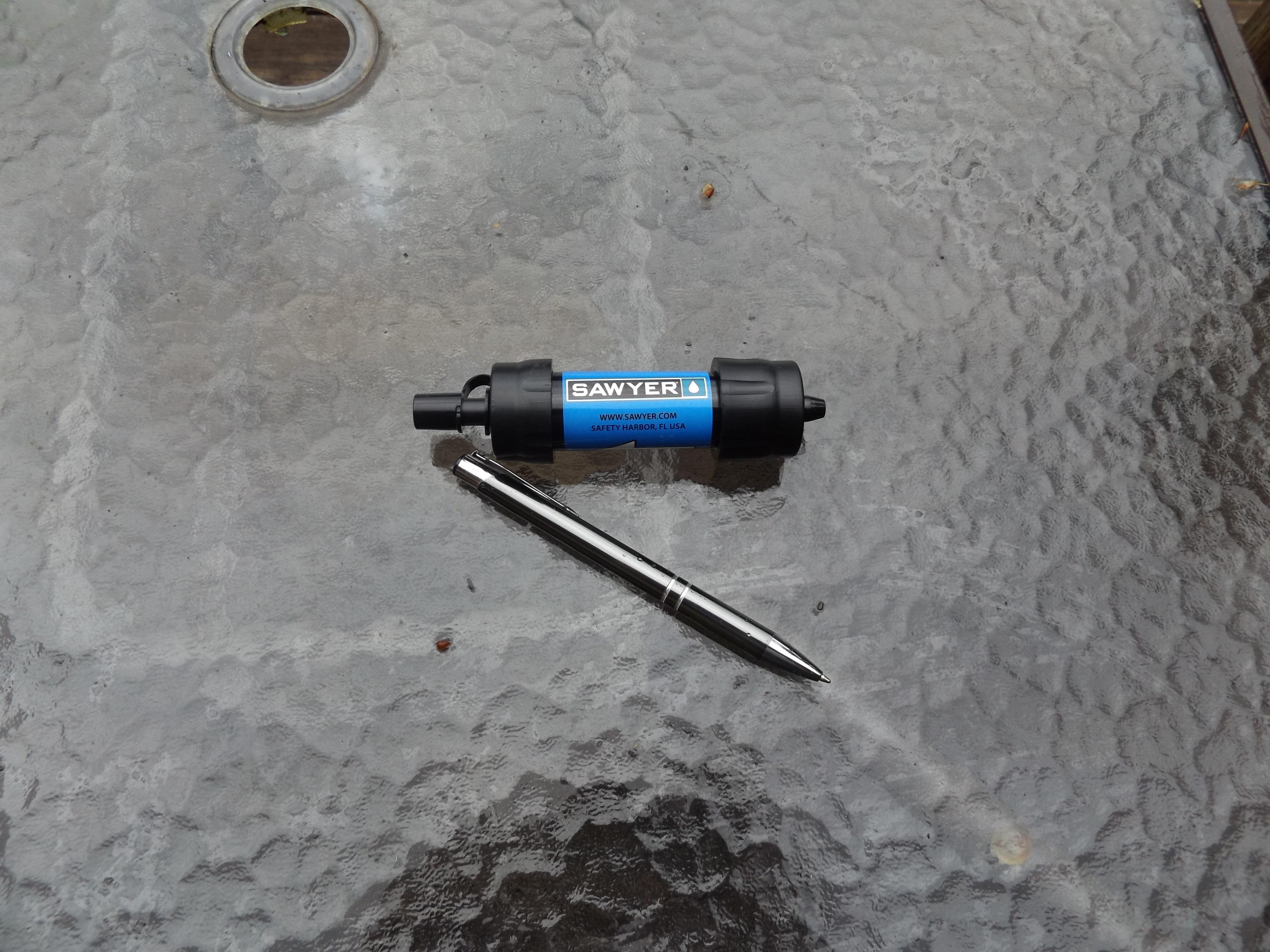
DSCF0364

Our preps consists of many different methods of filtering/purifying our drinking water. We don’t believe in only having one source for access to safe drinking water. One is none, and two is one, and more methods are even better. We take safe drinking water seriously! Many readers who live in the big city, simply take it for granted that they will always have safe drinking water. However, what happens when the flow from the tap stops? Where will your drinking water come from then? And, how will you know it is safe to drink that water?

Like many preppers and gun guys, we are always looking for an excuse to buy more gear and toys (read: guns) for our survival. However, every now and then I run across a product and say, “How can I not buy it?” Such is the case with the Sawyer Mini Water Filter that we all have in our bug out bags. Sawyer is known world wide for providing filters for making water safe to drink. Millions of units have been sold, and they do manufacture many different types of filters. Long time friend and one of my old martial arts students, Rob from Colorado, recently told me about the Sawyer Mini Water Filter. I try to keep up on these things, but I wasn’t aware of this model.

DSCF0365

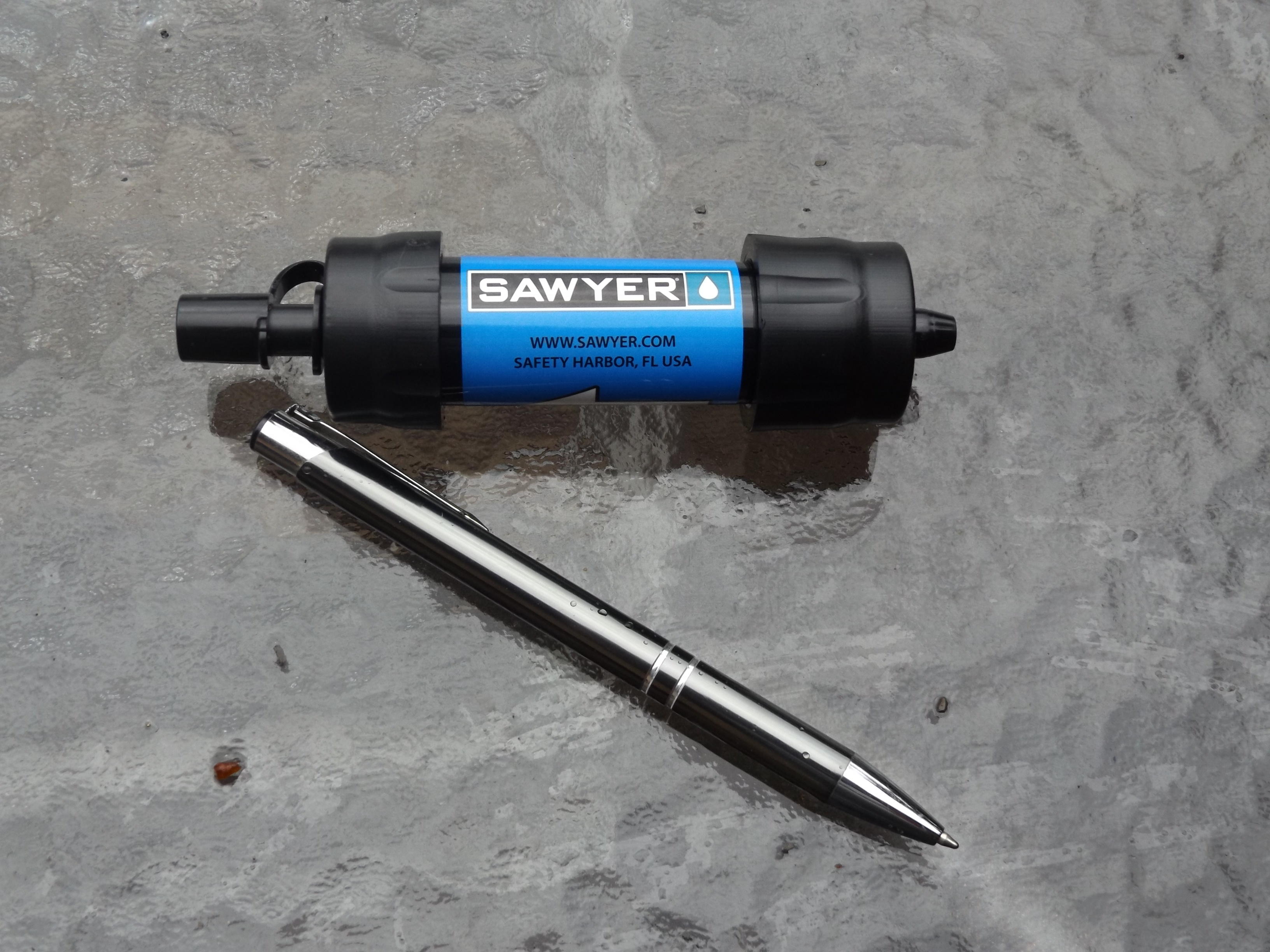
The Sawyer Mini Water Filter is capable of filtering up to 100,000 gallons of water. Huh? What? Yes, you read that correctly. It can filter up to 100,000 gallons of water. This particular filter is meant for filtering water from a fresh water source– a fresh water lake, stream, or creek. It is not designed to filter sewer water or other “dirty” sources of water that may contain viruses. It is a very rare case for fresh water sources to contain a virus. So, please keep this in mind. This filter is for making water safe to drink from a fresh water source.

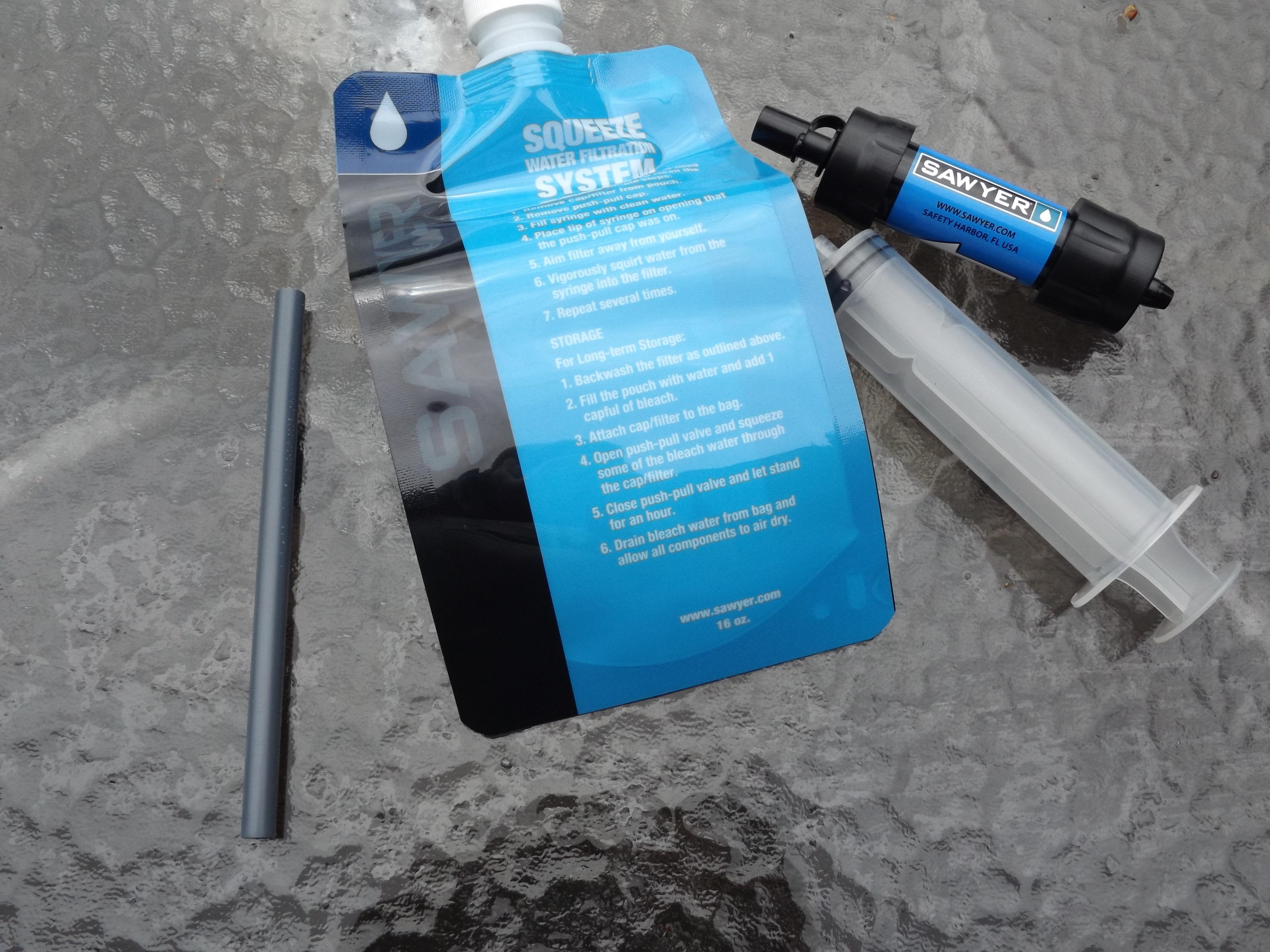
The Sawyer Mini Water Filter is one of the smallest types of water filters you can find. It is easy to store in your bug out bag or the glove box of your vehicle. It weighs only a few ounces. You get the filter itself, a water storage collection bag that holds 16 ounces of water, a straw, and a syringe to back-flush your filter when the flow of drinking water starts to slow down. You can even attach the filter to many sports drinking bottles. It simply screws right on. Make sure you have a bottle that fits the filter.

To use the filter, you simply collect fresh water from a stream, creek, or lake into the collection bag or into your own water bottle, and then sip through the top of the filter. It’s easy as easy can be! If you suspect that the fresh water source is contaminated in any way with a virus, you can add a drop or two of chlorine bleach into the water bottle or collection bag. However, as mentioned, it is a very rare case, where a fresh water source will have a virus. Act accordingly! One can carry a small bottle of water in their bug out bag that has chlorine bleach in it. Again, act accordingly.

DSCF0367

When the water flow from the filter starts to slow, it is easy to clean by back-flushing. Take some of your filtered water, and draw it into the provided syringe, and squirt it through the opening of the filter– the top opening, where your mouth goes to suck water in. Do this a few times, and the filter has been back-flushed, and you are good to go for a long, long time before needing to clean the filter again. Did I happen to mention that this mini water filter can filter up to 100,000 gallons of safe drinking water? Yeah, I thought I did but wanted to mention it again. It is not a typo. It can filter up to 100,000 gallons of water, making it safe to drink.

I’m ready to turn 65 years of age. I never thought I’d live this long or I would have taken better care of myself. However, I’m not a math whiz, and I never have been, but I’m sure I won’t drink another 100,000 gallons of water for as long as I live. That means I won’t have to replace this filter.

I would be hard pressed to draw water from a mud puddle or other source of “dirty” water to drink, and I do have water filters that are capable of making “dirty” water safe and clean to drink. Now, with that said, I would still try to avoid collecting and drinking that source of water if possible. The Sawyer does not make salt water safe to drink, nor does any other similar water filter. That’s an entirely different process called desalinization, and it isn’t practical for everyday survival!

DSCF0368

My family has been very impressed with other Sawyer Water Filters and are even more impressed with their mini water filter. Like most folks, my wife and I live from paycheck to paycheck most months, and we spend our money very carefully, always looking for the best bargains we can find. However, when it comes to survival gear and our safety, we refuse to cut corners. There is no junk for us! You can go into any of the big box stores and find all manner of camping equipment by names that will be familiar to you. However, we avoid most of that stuff. It is meant for weekend camping, and it won’t last you in a survival situation. We look at military surplus or gear designed for the military and for serious survival. We just refuse to cut corners.

The water collection pouch that comes with the Sawyer is not the sturdiest bag, and I can see it ripping if not cared for. So, I would suggest having a sports water bottle, a good one, and using that for collecting your water you want to filter. However, if the provided bag does rip, you can always use duct tape (and you do have duct tape in your bug out bag, right?) to repair it. Or you can use the provided straw and drink directly from the water source. The only drawback to this method is that you can’t carry any extra water with you once you leave that water source, and it might be a while before you run across another fresh water source. Be advised!

DSCF0369

So, we were pleasantly surprised that the Sawyer Mini Water Filter is selling for under $20. Yes, you read that right. It is under $20, if you shop around. How can you not justify buying one of these water filters for each member of your family, and having a few extra on-hand? On Amazon, a single Sawyer Mini Water Filter is selling for a few cents above $20 each with with free 2-day shipping to Prime members. There are deepening discounts for 2-packs and 4-packs, which get the price per unit down to about $18.50.

For those of you who aren’t listening to what I and others have to say about water, I’ll repeat myself once again, and I’m yelling as loud as I can. “You Must Have A Source For Safe Drinking Water. Without It, You Will Die!

– Senior Product Review Editor, Pat Cascio