Notes for Wednesday – August 10, 2016

On October 10th, 1984, Red Dawn, the first PG-13 rated movie, starring Patrick Swayze was released. The movie (the 1984 original, not the 2012 remake) is a favorite of both JWR and HJL, and the characters that the movie is about embody the independent, indomitable spirit that created this country.

o o o

Today, we present another entry for Round 66 of the SurvivalBlog non-fiction writing contest. The nearly $12,000 worth of prizes for this round include:

First Prize:

  1. A Tactical Self-Contained 2-Series Solar Power Generator system from Always Empowered. This compact starter power system is packaged in a wheeled O.D. green EMP-shielded Pelican hard case (a $1,700 value),
  2. A Gunsite Academy Three Day Course Certificate that is good for any one, two, or three day course (a $1,195 value),
  3. A course certificate from onPoint Tactical for the prize winner’s choice of three-day civilian courses, excluding those restricted for military or government teams. Three day onPoint courses normally cost $795,
  4. DRD Tactical is providing a 5.56 NATO QD Billet upper with a hammer forged, chrome-lined barrel and a hard case to go with your own AR lower. It will allow any standard AR-type rifle to have a quick change barrel, which can be assembled in less than one minute without the use of any tools and a compact carry capability in a hard case or 3-day pack (an $1,100 value),
  5. Gun Mag Warehouse is providing 20 Magpul PMAG 30-rd Magazines (a value of $300) and a Gun Mag Warehouse T-Shirt; (an equivalent prize will be awarded for residents in states with magazine restrictions),
  6. Two cases of Mountain House freeze-dried assorted entrees in #10 cans, courtesy of Ready Made Resources (a $350 value),
  7. The Ark Institute is donating a non-GMO, non-hybrid vegetable seed package (enough for two families of four) plus seed storage materials, a CD-ROM of Geri Guidetti’s book “Build Your Ark! How to Prepare for Self Reliance in Uncertain Times”, and two bottles of Potassium Iodate (a $325 retail value),
  8. A $250 gift certificate good for any product from Sunflower Ammo,
  9. KellyKettleUSA.com is donating an AquaBrick water filtration kit with a retail value of $250, and
  10. Two cases of meals, Ready to Eat (MREs), courtesy of CampingSurvival.com (a $180 value).

Second Prize:

  1. A Glock form factor SIRT laser training pistol and a SIRT AR-15/M4 Laser Training Bolt, courtesy of Next Level Training, which have a combined retail value of $589,
  2. A transferable certificate for a two-day Ultimate Bug Out Course from Florida Firearms Training (a $400 value),
  3. A Model 175 Series Solar Generator provided by Quantum Harvest LLC (a $439 value),
  4. A Trekker IV™ Four-Person Emergency Kit from Emergency Essentials (a $250 value),
  5. A $200 gift certificate good towards any books published by PrepperPress.com,
  6. A pre-selected assortment of military surplus gear from CJL Enterprize (a $300 value),
  7. RepackBox is providing a $300 gift certificate to their site, and
  8. American Gunsmithing Institute (AGI) is providing a $300 certificate good towards any of their DVD training courses.

Third Prize:

  1. A Royal Berkey water filter, courtesy of Directive 21 (a $275 value),
  2. A $245 gift certificate from custom knife-maker Jon Kelly Designs, of Eureka, Montana,
  3. A large handmade clothes drying rack, a washboard, and a Homesteading for Beginners DVD, all courtesy of The Homestead Store, with a combined value of $206,
  4. Expanded sets of both washable feminine pads and liners, donated by Naturally Cozy (a $185 retail value),
  5. Two Super Survival Pack seed collections, a $150 value, courtesy of Seed for Security, LLC,
  6. Mayflower Trading is donating a $200 gift certificate for homesteading appliances,
  7. Montie Gear is donating a Precision Rest (a $249 value), and
  8. Two 1,000-foot spools of full mil-spec U.S.-made 750 paracord (in-stock colors only) from www.TOUGHGRID.com (a $240 value).

Round 66 ends on September 31st, so get busy writing and e-mail us your entry. Remember that there is a 1,500-word minimum, and that articles on practical “how to” skills for survival have an advantage in the judging.


“So Tell Me Again…”- Part 2, by M.P.

After a year-and-a-half using the mason jars and oxygen absorbers I did another test. In every category it was like I had dehydrated yesterday. The food had good flavor, nice texture, and little to no recognizable difference between fresh, so the system was clearly working.

Take-away #4. Another valuable lesson was in the rehydrating process. I found that none of the typical recommendations of two, three, or four hours soaking was sufficient to bring vegetables back up to full hydration. Twelve to twenty–four hours gave an almost undetectable difference to their original state. Broccoli oddly enough took the longest, coming in consistently at forty-eight hours. This and cauliflower gave very impressive rehydrated results. I taste-tested these after rehydrating by steaming, topping with melted cheese, and laying over a bed of rice. You couldn’t tell they weren’t fresh. Diced or crushed tomatoes served as the base for many of my test creations, and if you weren’t told the ingredients had once been dehydrated you wouldn’t have a clue. I did do one test batch, which contained a variety of mixed vegetables boiled and eaten plain, like you would a side-dish topped with only salt and butter. There was a hint of toughness recognizable but only a slight, very slight. Green beans and mushrooms are the only two that I couldn’t get great results from. The mushrooms were spongy and green beans rubbery, no matter how long I soaked them. Many recommend freezing green beans before drying in order to break down the cellular wall, which is said to lessen the toughness when rehydrated. That did help to some degree, but I still wasn’t happy with the results and have since switched to canning the beans. The mushrooms I decided to live with the spongy texture. I love their flavor in dishes along with the health benefits, and so continue to add them to my supply. I am thinking of possibly trying my hand at canning those as well in the near future.

Okay, allow me to “bunny-trail’’ briefly with a point that I feel is pertinent to the conversation here. One attitude I stumbled over my first few years, and have since abandoned, is the concept that, “If I can’t do ‘it’ (whatever ‘it’ is) first-rate/top-notch/all out, then I’m not going to do it at all”. It’s an easy pit to fall into, especially reading all the great articles on this website and others of people who have really perfected a particular area of preparedness. I call this attitude a pit, because what I’ve come to conclude is that not only is this thinking not a badge of honor, it’s a huge stumbling block, and “roadblock” may be the more appropriate term. It will bring you to a complete standstill in any area. The vast majority of people involved in preparedness, I would imagine, don’t have gobs of expendable income, so this concept comes into play constantly: “I know what I want to do and I know what the best solution is, but I can’t afford it”. What do you do in these situations? I say, “Something rather than nothing”. Myself for example: I had to capitulate that I couldn’t afford a pimped out twenty-three hundred dollar AR platform. But you know what? I do have a reliable 7.62 x 39 for a third of the cost. Or say we’re talking about an off-grid solar system. Again, I had to concede I just can’t play with the big boys. Were I to even think about putting together one of those set-ups, I would have to neglect scores of other vital areas. However, I am supplied with three different alternative lighting sources and two alternative heating and cooking sources that will see me through two years, if the lights go out. So you have to adjust the “ideal” to match your personal reality in order to get as many bases covered as possible. This goes for dehydrating as well.

Cost of Getting Started Dehydrating

There are many out there that can afford to get started with a new Cadillac or Humvee dehydrator, but for those who can’t, let me break down just what exactly it will cost to get started and what quantities you can expect to store:

Dehydrator

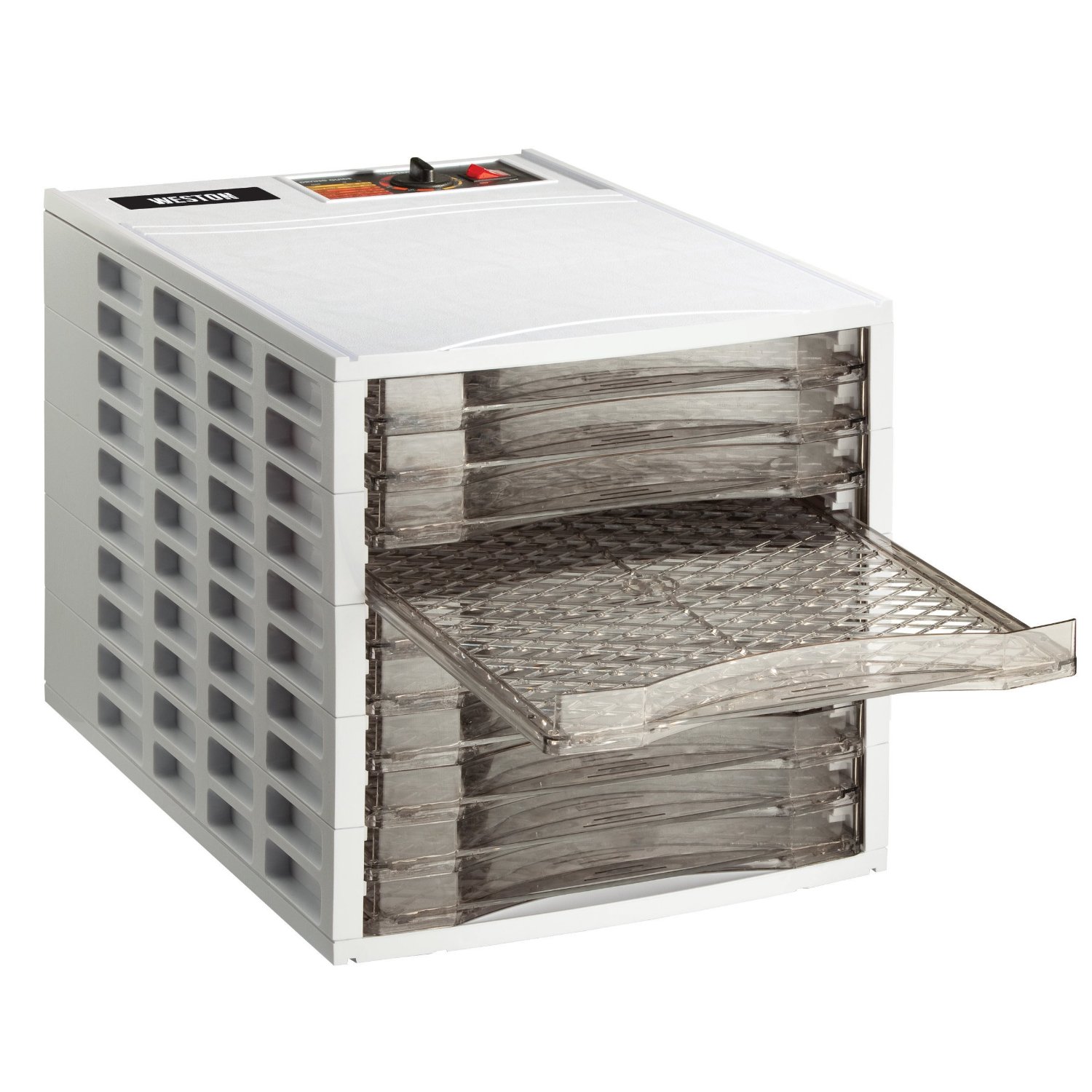
I live outside of a small town and just finished browsing the local Craigslist posting. It serves a fairly small area and thus doesn’t offer the luxury of a big selection for second-hand shopping, as you would have in one of the large metropolises. Here’s what I found: There were seven separate listings for dryers. Two postings for round stackable units, $18 each. Another stackable for $13. Two other postings for stackable styles again at $10 each. A brand name tier style for $80, and one used commercial tier style for $200. So there’s your price range. Pick what you can afford. I started out purchasing a commercial grade unit for $350, (remember that old thinking?) and within a year it took a dump. To add insult to injury, I wasn’t able to get parts to repair it, so it eventually ended up out at the curb. Shopping Craigslist, I was able to pick up a very similar used unit for $125 and it has lasted years. This just goes to show you, you don’t need top-of-the-line here. They simply circulate hot air. Just get the best dehydrator you can afford for where you’re at today, not where you want to be someday. You can always get a good deal on used and upgrade later if you want. From the postings I’ve read, it seems many people who are not into prepping buy a dehydrator thinking it would be “cool” to get into. They’re used a couple of times, if at all, and end up in the garage until the owners finally decide to get rid of them. It is very common to see these advertised as “Like New” or “New-in-the-box”, very common.

Jars

The best price I’ve found for half-gallon Mason jars is $11.44 for a case of six. The average price at any local store is $13. That’s $2.16 each.

Oxygen Absorbers

I buy oxygen absorbers online. For ½ gallon jars, I use 300cc packets, as I have a vacuum sealer to extract the air initially. Cost: Pack of (20) 300cc…$3.99 or 20 cents a piece. But for those that don’t have a vacuum sealer, 500cc’s is plenty and may even be a bit of over-kill. Cost: Pack of (10) 500cc…$2.99 or 30 cents-a-piece. You can see we’re not talking big bucks here.

So in reality you could get started with a dehydrator, jars and oxygen absorbers for as little as $35.00 if need be.

The last two items here are optional and helpful but not must-haves.

Vacuum Sealer (optional)

I already had one from my start-up debacle, but if you don’t currently own one, spend the extra dime and simply use the 500cc oxygen absorbers to get started. They will do exactly what the vacuum sealer does– extract air to preserve product, nothing more. If you do have the monies and want to add this, they range anywhere from $39 all the way into the hundreds, new that is. You will need to buy an additional attachment for attaching to the jars, and this is roughly ten to twenty bucks. But to get started, on a limited budget, skip the vacuum sealer. You’ll do just fine. Remember, the goal here is to simply get started and put food on the shelf!

Mandolin (optional)

For those who don’t know what a mandolin is, it’s a small kitchen appliance that slices veggies to a consistent uniform thickness, like a manual food processor sort of. They’re great to have and speed up prepping time when doing large quantities. We just recently picked up a “Lexus” from a thrift store for a fraction of the original cost. New they range from $19 at any of the big-box stores and go up to $300 dollars. But these are by no means necessary to get started. I went years without one, and everything you read about in this article was done the old-fashion way– slicing and dicing.


Letter Re: Christian Medical Sharing Ministries

Hugh:

In response to a recent contributor’s comments on health care sharing ministries, I want to add my biased take. (Full disclosure, I am a member sponsor for Liberty HealthShare, meaning I make some money by referring people to their programs. However, I do recommend any of the various major health sharing ministries– Liberty, Samaritan, Medi-Share, and Christian Healthcare Ministries. I think most people will have a good experience with any of them, so long as they are properly informed and know what to expect.)

The big concern raised in the recent post was that it might be difficult to find a provider.

Medical cost sharing is NOT health insurance. It doesn’t work the same way. We don’t have coverages or networks, PPOs, HMOs, et cetera. As a faith based community, we share medical expenses based on a set of rules/guidelines that we agree to, not the providers. Medical cost sharing isn’t for everyone. We spend a lot of time educating people about how it’s different from insurance. Based on these differences, you shouldn’t expect to have a network of “coverage in your area”. Please read on to see why I would make that statement.

From here on out my comments are relative to using Liberty HealthShare. Ultimately we are cash payers, so you can go to whatever provider you want so long as the expenses are eligible to be shared. (Our 2016 guidelines contain all the details, but in general we share costs on traditional medical incidents i.e. doctors, hospitals, etc.)

Members of Liberty HealthShare are issued a membership card. The question is “will my doctor take it?” The answer is likely “yes”. The card has an electronic payor ID on the back. Liberty uses the same type of electronic billing procedure that most doctor’s offices are used to. So I recommend that members simply walk into the doctor’s office and present the card with no other explanation. Most of the time they will take it no questions asked. They just want to know where to send the bill. If the office has any questions, they can call the number on the card and work it out on the phone right there. Over 90% of the time, an office will take the card and bill electronically versus the member having to pay cash and be reimbursed later. (I’ll add the caveat that members in the inter-mountain West have recently been having trouble with IHC hospitals, so I recommend avoiding them for the time being.)

The main difficulty is that most doctors’ offices haven’t heard of the concept. And that leaves the member in sort of an ambiguous situation similar to that of the person I’m responding to. I realize that’s not okay for some. Unfortunately, when you ask a doctor’s office whether they take healthcare sharing (or medical cost sharing), then it raises questions and concerns that they don’t have time to deal with. They don’t know what you’re talking about. So they are skeptical. But on the bright side and most importantly, their office staff does understand the electronic billing system. That information on the back of the membership card about where to send the bill is generally all they need. So as a member you do have all the tools necessary for the doctor’s office to take care of you and process your bill without much of a hassle, and most of the time it works out.

In the case of the author of the post, I would recommend that they simply present the card at their preferred doctor’s office the next time they need to go in. Don’t offer any other explanation. It’s possible the doctor might refuse to bill via the card, but it’s unlikely. If they have a significant medical incident occur I do recommend calling the Liberty staff for guidance unless it’s an emergency. In the case of an emergency, go wherever you need to and it can be sorted out later. In any situation, if need be you can always pay cash (or credit card) and get reimbursed (as per the guidelines) so long as the expenses are eligible for sharing. (Also you can always try a different doctor.)

It’s kind of a leap of faith to handle healthcare this way, but with a little education most of our members are able to work out the details to their satisfaction.

Medical Cost Sharing has been a real blessing for my family and many others. My family has used the concept. Our family doctor took the card no questions asked, and we have used it several times. (But the midwives we used for our last childbirth could not take it, so I just paid cash and was reimbursed per the guidelines. It required a little planning.)

In any case, I’m very encouraged that this concept will be helpful to others who are of like mind. I hope this helps clarify the concept.

(By the way, a naturopath was mentioned… Liberty is the only group anywhere that I know of that will share costs for natural and alternative treatments. They have a few conditions that must be met (see the guidelines). But it’s a very positive option if you like alternative medicine. )


Economics and Investing:

The worst place in the world to bank

o o o

Social Security’s looming $32 trillion shortfall – B.B.

o o o

30 Years After The Disaster: Ukraine Plans Huge Solar Farm In Chernobyl – Perhaps the most well-known site of a nuclear disaster in the world, Chernobyl is now the location for an ambitious solar project.

o o o

The Minimum Wage: Taking Away the Right to Work

o o o

SurvivalBlog and its editors are not paid investment counselors or advisers. Please see our Provisos page for details.


Odds ‘n Sods:

Over at Sipsey Street Irregulars:

The venerable Woobie and GI Poncho

JWR Adds: If you can afford a few extra bucks, the Wiggy’s Improved Poncho Liner is pretty close to perfection. And it is American made. (In Colorado.)

o o o

Harvard Study: 6 Million Americans’ Drinking Water Contaminated With Toxins – K.C.

o o o

Lobbying arm for refugee resettlement contractors wants US to take 200,000 refugees in FY2017 – B.B.

o o o

FBI Agent Goaded Garland Shooter To “Tear Up Texas,” Raising New Alarms About Bureau’s Methods – B.F.

o o o

Turkey: Headless Military, Confused Foreign Policy


Notes for Tuesday – August 09, 2016

August 9th, 1831was the birthday of James Paris Lee (August 9, 1831 – February 24, 1904). He was a Scottish-Canadian and later American inventor and arms designer, best known for inventing the bolt action that led to the Lee-Metford and Lee-Enfield series of rifles.

o o o

Today, we present another entry for Round 65 of the SurvivalBlog non-fiction writing contest. The nearly $12,000 worth of prizes for this round include:

First Prize:

  1. A Tactical Self-Contained 2-Series Solar Power Generator system from Always Empowered. This compact starter power system is packaged in a wheeled O.D. green EMP-shielded Pelican hard case (a $1,700 value),
  2. A Gunsite Academy Three Day Course Certificate that is good for any one, two, or three day course (a $1,195 value),
  3. A course certificate from onPoint Tactical for the prize winner’s choice of three-day civilian courses, excluding those restricted for military or government teams. Three day onPoint courses normally cost $795,
  4. DRD Tactical is providing a 5.56 NATO QD Billet upper with a hammer forged, chrome-lined barrel and a hard case to go with your own AR lower. It will allow any standard AR-type rifle to have a quick change barrel, which can be assembled in less than one minute without the use of any tools and a compact carry capability in a hard case or 3-day pack (an $1,100 value),
  5. Gun Mag Warehouse is providing 20 Magpul PMAG 30-rd Magazines (a value of $300) and a Gun Mag Warehouse T-Shirt; (an equivalent prize will be awarded for residents in states with magazine restrictions),
  6. Two cases of Mountain House freeze-dried assorted entrees in #10 cans, courtesy of Ready Made Resources (a $350 value),
  7. The Ark Institute is donating a non-GMO, non-hybrid vegetable seed package (enough for two families of four) plus seed storage materials, a CD-ROM of Geri Guidetti’s book “Build Your Ark! How to Prepare for Self Reliance in Uncertain Times”, and two bottles of Potassium Iodate (a $325 retail value),
  8. A $250 gift certificate good for any product from Sunflower Ammo,
  9. KellyKettleUSA.com is donating an AquaBrick water filtration kit with a retail value of $250, and
  10. Two cases of meals, Ready to Eat (MREs), courtesy of CampingSurvival.com (a $180 value).

Second Prize:

  1. A Glock form factor SIRT laser training pistol and a SIRT AR-15/M4 Laser Training Bolt, courtesy of Next Level Training, which have a combined retail value of $589,
  2. A transferable certificate for a two-day Ultimate Bug Out Course from Florida Firearms Training (a $400 value),
  3. A Model 175 Series Solar Generator provided by Quantum Harvest LLC (a $439 value),
  4. A Trekker IV™ Four-Person Emergency Kit from Emergency Essentials (a $250 value),
  5. A $200 gift certificate good towards any books published by PrepperPress.com,
  6. A pre-selected assortment of military surplus gear from CJL Enterprize (a $300 value),
  7. RepackBox is providing a $300 gift certificate to their site, and
  8. American Gunsmithing Institute (AGI) is providing a $300 certificate good towards any of their DVD training courses.

Third Prize:

  1. A Royal Berkey water filter, courtesy of Directive 21 (a $275 value),
  2. A $245 gift certificate from custom knife-maker Jon Kelly Designs, of Eureka, Montana,
  3. A large handmade clothes drying rack, a washboard, and a Homesteading for Beginners DVD, all courtesy of The Homestead Store, with a combined value of $206,
  4. Expanded sets of both washable feminine pads and liners, donated by Naturally Cozy (a $185 retail value),
  5. Two Super Survival Pack seed collections, a $150 value, courtesy of Seed for Security, LLC,
  6. Mayflower Trading is donating a $200 gift certificate for homesteading appliances,
  7. Montie Gear is donating a Precision Rest (a $249 value), and
  8. Two 1,000-foot spools of full mil-spec U.S.-made 750 paracord (in-stock colors only) from www.TOUGHGRID.com (a $240 value).

Round 65 ends on July 31st, so get busy writing and e-mail us your entry. Remember that there is a 1,500-word minimum, and that articles on practical “how to” skills for survival have an advantage in the judging.


“So Tell Me Again…”- Part 1, by M.P.

During the course of arising out of my slumber these past seven years to the fact that our country has taken a historic and possibly terminal change for the worse, I’ve noticed there seems to be stages of awaking from that long-winters-nap, for those of us fortunate enough to have had such an experience. Personally, as I look back I consider it to be a God thing– where I was, where I am now, and how the journey has transpired. And when I finally started moving on my new-found convictions, I, like most others, felt one of my first priorities was to build a food surplus. After I was satisfied that I had an adequate start there, I turned my focus to other areas of independence envisioning myself one day writing an article on how I had purchased a homestead, successfully mastered that one acre garden that is supplying all my veggies, raised a dozen chickens, a cow, rabbits, maybe a goat or two, got the whole canning thing down, installed my off-grid solar power system, and finally waved, “Sayonara” to the system that I once suckled from.

Well, I haven’t arrived at that place yet…but I’ve left.

As I initially researched the various food storage systems, the one that stood out as being able to serve my personal dietary needs was dehydrating. Alright let’s knock off all the yawning! This could actually turn out to be a really good article! The choice for dehydration centered mainly on the fact that a large portion of my diet consists of both fresh and frozen vegetables and fruits to a varying degree, and back then I didn’t have a lot of money, so purchasing months, let alone years, of freeze-dried stuffs was out of the question. I considered canning, but at that time it seemed too intimidating for some reason, although now that I can on a regular basis it’s so simple that I often wonder how this skill was ever lost in our modern society. Although I’m not a vegetarian by any means, I didn’t always eat healthy like I do now, and were some catastrophic event to occur I just couldn’t see myself going back to a diet void of this key staple. You see, growing up our family was penniless, living in the city, only Dad worked as was normal four decades ago, and so we ate basic survival foods– goulash for din-din, Cheerios topped with sugar for breakfast, peanut-butter and jelly sandwiches for school lunches, and then after its arrival Little Debbie’s became us kid’s drug-of-choice when it came in on Saturdays. However, these “drugs” were kept under close scrutiny, but my siblings and I became pretty creative at the steal-and-stash technique. Long-story-short, after years of eating basic junk into adulthood, I could barely eat anything healthful without experiencing serious stomach issues. So in my late twenty’s I slowly started making changes to my diet until after a couple of decades of conscious effort, I was eating very healthy, and the stomach issues along with the yearly colds and flu had all but disappeared.

The more I read the more I was convinced that dehydrating could supply veggies that would store longer term, retain their nutrition, and obviously aren’t pasteurized to death like store-bought canned goods. Additionally, in keeping with the adage of storing what you eat and eating what you store, this system would ensure my diet remain unchanged, so in the end dehydrating rose to the logical answer for the veggie part of the storage equation.

When I began I was unemployed, so even Mason jars and oxygen absorbers seemed pricey. The solution I came up with to counter that was vacuum sealing. The plastic bags are sold in rolls and cost pennies per bag. Oh, I had read this wasn’t an ideal choice for long-term storage, but being either naive or possibly a little arrogant I felt I could beat conventional wisdom and make it work. My reasoning went something like this: “What difference does it make the kind of material you use as long as the air is kept out; that’s all that matters—just keep the air out, right?” So there I went full steam ahead. I began drying, and a year passes and then another. I’m studying, learning, awakening to other areas, still drying and decide it’s time to test my accomplishments. Yikes! The learning curve sets in, hard. Thank God it came fairly early:

The beautiful strawberries that I had dried and taken to work to show off only two years prior, the ones that everyone raved about, had turned into let’s just say diaper mush, in both color and texture. I can’t speak to their taste, because I couldn’t muster the courage to actually put any of that in my mouth. The only thing that didn’t resemble a diaper changing was the smell, so that was clearly a do-over.

The pears, again after two years in plastic bags and looking similar to the strawberries were somewhat palatable but only if you were in Bosnia during the ’92 year-long lockdown.

Apples looked more like mozzarella cheese sticks, peel and chew, peel and chew. The mushrooms, “Let’s keep it moving folks, nothing to see here.” Zucchini and squash were more cheese sticks.

Now the bags and bags of mixed veggies, my systems’ flagship? Now there was success! Oh yeah, baby! I mean who cares if they had all congealed into one pound blocks that looked like kaleidoscope cheese. All that was needed was a small chipping hammer and you were ready to cook. So what if they tasted like rubberized cardboard; this was survival food. Suck it up! So after weeks of trying to convince myself they were somehow salvageable, I eventually used them to build a three-story mixed-veggie-castle memorial in the middle of my living room floor, complete with surrounding moat and draw-bridge no less.

Fortunately, the waste was limited to my time and roughly a few hundred dollars. The biggest lesson for me in that was, when it comes to prepping, there are areas that absolutely do require creative thinking, but there are other areas that mandate you stick with proven practices. Dehydrating for long-term storage is one of those.

Dehydrator Take-away Lessons Learned

Below are some other learning curve take-a-ways:

Take-away #1. Vacuum-seal bags are valuable in your arsenal but not for any type of food storage outside of the freezer, period. It’s not the right system. It doesn’t work. You can’t get around it.

Take-away #2. For long-term storage of dried goods, you must spend the money for jars, oxygen absorbers, and if you can afford it a simple vacuum sealer. But if only oxygen absorbers are used, you will still get an impressive shelf life. I have read articles of people boasting ten years of storage from this system. One website dedicated to dehydrating lists the shelf life of various dried vegetables and fruits individually and all came in with fifteen years-plus shelf life, many at twenty and a few as high as thirty years. (One of those 30 year foods was apples! Thirty years, who woulda’ thunk? Guess I could have saved my mozzarella apple-sticks.) That’s pretty impressive. It’s almost like freeze dried.

Take-away #3. In dehydrating there’s a reverse-shift in emphasis as to where the money needs to be spent. It’s completely opposite of how we think in other areas. Here’s what I mean: A friend of mine recently saw my collection of rods and reels, which is somewhat sizable as I’ve been a lifelong fisherman, and asked in a bit of an astonished tone how much all that equipment cost. I explained the cost wasn’t that much actually because I don’t buy high-end rods and reels. They are middle-of-the-road stuff but no big bucks there. Why? Those don’t make-or-break putting fish in the boat. However, what I do spend the bucks on is what’s known as terminal tackle. That’s everything from the reel outward– premium line, hooks, connectors, et cetera. It’s the gear in the boxes. That’s the stuff that determines success or failure. If any link in that chain fails, there’s no prize and no food in the freezer. I’ve since transferred this principle over to my prepping in general and dehydrating in particular. I found you don’t need a four hundred dollar dehydrator (the rods and reels) as most might think to put food in the pantry. That doesn’t determine ultimate success or failure. But the mason jars and oxygen absorbers (the terminal tackle) will absolutely make or break you here, like it did me. I did it completely backwards. I delayed starting until I could buy the “best” dehydrator, and then I skimped on the most important pieces. It would be like buying an ultra-sensitive three hundred dollar rod, adding a two hundred dollar reel, and then spooling it with K-mart brand fishing line and tying on no-name hooks. Get it?



Letter: Christian Medical Sharing Ministries

Hello Hugh,

Some time ago I read about Christian medical sharing ministries on SurvivalBlog. (My Experience in Expatriating to Panama, by Chuck Holton)

I am retiring early at 61 due to a medical condition, and not wanting to use Obamacare I thought I had found my solution. I joined Liberty Health Share after researching them. They tell you they will help you establish a connection between them and your doctor. You fill out a form detailing your doctor’s office and send it back to Liberty. They then send correspondence to your doctor’s office. If your doctor does not respond to one correspondence that is the end of Liberty’s efforts.

I called Liberty today to inquire how the correspondence was going. They received no response from my doctor, who is part of a large clinic. I then asked if they could refer me to a doctor who accepts Liberty in my area of 100,000 plus population. Sadly, they had no record of one. I then asked for a referral to the closest metropolitan city (Seattle) of a million plus. They had one– a doctor of Naturopathy.

When doing due diligence on one of these ministries, you must include whether there is coverage in your area as one of the deciding factors! I hope this info might help SB readers. T.J.


News From The American Redoubt:

The Economist (a leftist magazine and web site) did a pretty decent writeup on the American Redoubt featuring JWR. There are a few back-handed compliments, but overall it’s a good article. On the other hand, the comments (367, at last count) are pretty amusing and some are outrageously ill-informed. FYI: No, Idaho is not a “Blue” state. No, JWR has not undergone heart surgery. He is very healthy and active. While not a farmer, he is a rancher, and he most definitely does live inside the American Redoubt. He also coined the term “American Redoubt” in 2011–not “more than 10 years ago”, as one comment alleged.

o o o

Thanks to the Peoples Republic of Oregon, they just made buying bottled products more competitive in border states. So in Idaho you will only pay a 6% on the dollar surcharge (sales tax) for your can of pop, and you do not have to mess around with returning the stinky can/bottle later on. You’ve gotta love those Communists over on the Coast. They are such great micro managers. The truth is that these clowns never met a tax they didn’t fall in love with. – RBS

o o o

Brain-eating amoeba found in popular Grand Teton soak spot

o o o

Wyoming highway exceeds grizzly death cap

o o o

Idaho man discovers rare-mammoth tusk in his yard

o o o

Idaho: Yantis letter-writers sound off on ruling


Odds ‘n Sods:

Hillary seemingly freezes up again causing her personal medic/bodyguard to alarm. – H.L.

o o o

Benghazi families sue Clinton for wrongful death, defamation – B.B.

o o o

Forward Observer has an interesting article on understanding doctrine. When it comes to intelligence and security, this is an important concept.

o o o

An hour long video on emerging infectious disease by S. Hatfill M.D., MSc, M. Med. These are diseases that are emerging which have never been seen before in human populations or in areas where they have never been seen before. – Sent in by S.C.

o o o

Android Security Alert: 900 million devices at risk – DSV


Hugh’s Quote of the Day:

“Government-to-government foreign aid promotes statism, centralized planning, socialism, dependence, pauperization, inefficiency, and waste. It prolongs the poverty it is designed to cure. Voluntary private investment in private enterprise, on the other hand, promotes capitalism, production, independence, and self-reliance.” – Henry Hazlitt


Notes for Monday – August 08, 2016

August 8th is the birthday of Terry Nation (August 8th, 1930 – March 9th, 1997), who was a Welsh television writer and novelist. Nation wrote two series, Survivors and Blake’s 7, in the 1970s. Survivors was re-made a few years ago.

o o o

Last week I received word from Cold Steel that they now have less than 900 Rawles XL Voyager knives knives left on hand. This limited edition folding survival/utility knife of my design is now priced at just $69.99 with free shipping for Amazon Prime members. Remember that ALL of the profits from the sale of these knives are going to charity. Order yours before they sell out! (As with other limited editions, prices are expected to rise, on the secondary market.) – JWR