Odds ‘n Sods:

Here we go again… Stockton, California Mayor Anthony Silva arrested for lewd conduct with minors. And, almost predictably, we learn that Silva is a member of former Mayor Mike Bloomberg’s Mayors Against Illegal Guns (now part of the “Everytown For Gun Safety” group.)

o o o

How to Invest in Guns for Maximum Profit and Diversification: Podcast Interview with JWR

o o o

Meet Chuño, a space worthy food that the Incas made eight centuries ago – P.B.

o o o

DEA regularly mines Americans’ travel records to seize millions in cash – H.L. (Warning: Autoplay video on the page.)

o o o

Why mechanical locks are still better: Hacker Unlocks ‘High Security’ Electronic Safes Without A Trace – T.Z.


Hugh’s Quote of the Day:

“Wash you, make you clean; put away the evil of your doings from before mine eyes; cease to do evil; learn to do well; seek judgment, relieve the oppressed, judge the fatherless, plead for the widow.” Isaiah 1:16-17 (KJV)


Notes for Friday – August 12, 2016

This the birthday of country singer/songwriter Buck Owens (1929–2006). His songs typified what has been called “The Bakersfield Sound”.

o o o

Today, we present another entry for Round 66 of the SurvivalBlog non-fiction writing contest. The nearly $12,000 worth of prizes for this round include:

First Prize:

  1. A Tactical Self-Contained 2-Series Solar Power Generator system from Always Empowered. This compact starter power system is packaged in a wheeled O.D. green EMP-shielded Pelican hard case (a $1,700 value),
  2. A Gunsite Academy Three Day Course Certificate that is good for any one, two, or three day course (a $1,195 value),
  3. A course certificate from onPoint Tactical for the prize winner’s choice of three-day civilian courses, excluding those restricted for military or government teams. Three day onPoint courses normally cost $795,
  4. DRD Tactical is providing a 5.56 NATO QD Billet upper with a hammer forged, chrome-lined barrel and a hard case to go with your own AR lower. It will allow any standard AR-type rifle to have a quick change barrel, which can be assembled in less than one minute without the use of any tools and a compact carry capability in a hard case or 3-day pack (an $1,100 value),
  5. Gun Mag Warehouse is providing 20 Magpul PMAG 30-rd Magazines (a value of $300) and a Gun Mag Warehouse T-Shirt; (an equivalent prize will be awarded for residents in states with magazine restrictions),
  6. Two cases of Mountain House freeze-dried assorted entrees in #10 cans, courtesy of Ready Made Resources (a $350 value),
  7. The Ark Institute is donating a non-GMO, non-hybrid vegetable seed package (enough for two families of four) plus seed storage materials, a CD-ROM of Geri Guidetti’s book “Build Your Ark! How to Prepare for Self Reliance in Uncertain Times”, and two bottles of Potassium Iodate (a $325 retail value),
  8. A $250 gift certificate good for any product from Sunflower Ammo,
  9. KellyKettleUSA.com is donating an AquaBrick water filtration kit with a retail value of $250, and
  10. Two cases of meals, Ready to Eat (MREs), courtesy of CampingSurvival.com (a $180 value).

Second Prize:

  1. A Glock form factor SIRT laser training pistol and a SIRT AR-15/M4 Laser Training Bolt, courtesy of Next Level Training, which have a combined retail value of $589,
  2. A transferable certificate for a two-day Ultimate Bug Out Course from Florida Firearms Training (a $400 value),
  3. A Model 175 Series Solar Generator provided by Quantum Harvest LLC (a $439 value),
  4. A Trekker IV™ Four-Person Emergency Kit from Emergency Essentials (a $250 value),
  5. A $200 gift certificate good towards any books published by PrepperPress.com,
  6. A pre-selected assortment of military surplus gear from CJL Enterprize (a $300 value),
  7. RepackBox is providing a $300 gift certificate to their site, and
  8. American Gunsmithing Institute (AGI) is providing a $300 certificate good towards any of their DVD training courses.

Third Prize:

  1. A Royal Berkey water filter, courtesy of Directive 21 (a $275 value),
  2. A $245 gift certificate from custom knife-maker Jon Kelly Designs, of Eureka, Montana,
  3. A large handmade clothes drying rack, a washboard, and a Homesteading for Beginners DVD, all courtesy of The Homestead Store, with a combined value of $206,
  4. Expanded sets of both washable feminine pads and liners, donated by Naturally Cozy (a $185 retail value),
  5. Two Super Survival Pack seed collections, a $150 value, courtesy of Seed for Security, LLC,
  6. Mayflower Trading is donating a $200 gift certificate for homesteading appliances,
  7. Montie Gear is donating a Precision Rest (a $249 value), and
  8. Two 1,000-foot spools of full mil-spec U.S.-made 750 paracord (in-stock colors only) from www.TOUGHGRID.com (a $240 value).

Round 66 ends on September 31st, so get busy writing and e-mail us your entry. Remember that there is a 1,500-word minimum, and that articles on practical “how to” skills for survival have an advantage in the judging.


“So Tell Me Again…”- Part 4, by M.D.

Test Batches

Whatever you decide to begin with or whenever you switch to a new item, do a small test batch first. This is a bigger deal than you might think, for a number of reasons. Let me give you a couple of personal examples where I did this step right and where I ran amuck. I have been dehydrating for years now and recently decided to add bananas to my repertoire, even though I don’t eat a lot of them; you know the think when the grid’s down and there is the need for potassium. Bananas should be pretty simple, right? Well, as I mentioned previously, I normally like to dry at the lowest temps possible and I don’t care for blanching if I don’t have to. So I went out and bought a small boat load of these and do my thing. Results? Dried at too low a temperature, they case-hardened. Additionally, they weren’t blanched and ended up with a distinct cardboard flavor. Disaster? Well not if your city is being besieged and it’s a matter of case-hardened cardboard bananas or nothing. However, to keep as a long-term storage product, not that batch; I ended up throwing them out. Here’s another example, this time executed like a pro. Oranges, which were available in five different varieties in the market I frequent, so I bought six of each kind and did a test batch. I found out the Valencias have a wonderful tart flavor and the Navels are a superb classic sweet orange, but the others were bland, I mean really bland once dried. So, I settled on the Valencia and Navel oranges. Had I bought a case of the other three and dried without testing, it would have been another train wreck story. Okay, one more example that landed right in the middle, although had it been done properly could have been another bragging piece. I aced the oranges, so I figured tangerines, being their kissing cousin, was a no-brainer and I could just duplicate my preparation and drying temps the same as the oranges. However, tangerines have much more juice, and they ended up with far less “meat” in the finished product. They were “airy”, if you will. They weren’t a bomb by any means and I didn’t throw them away but were very tart and tasty. Had I done a test batch, I would have known to cut them thicker so the end product was meatier. I don’t know if any of you remember the fried pork rinds that used to be and maybe still are sold in convenience stores, but they reminded of those; lots of flavor, but you have to shove an entire handful in your mouth to get anything to actually chew on. So do a test batch. With fruits it’s suicide not to, especially if whatever you’re working on is a favorite and you intend to put away large quantities. I’d say it’s critical. Now, whenever I dry anything new I go through the entire process of dehydrating, rehydrating, and testing before moving forward with large scale stockpiling.

Space Considerations

This point can’t be emphasized enough and just might blow you away, especially if you’re dealing with limited storage space. Dehydrated vegetables (and some fruits) reduce anywhere from one-third to one-sixth their original mass. I do both canning and dehydrating and assure you there’s no comparison to the footprint needed to store the two. My dried goods, for example, are stored in a small two-foot by two-foot coat closet. That closet currently houses, get this, just a tad over one thousand pounds of fruits and veggies! That’s the weight after hydrating or before dehydrating, however you want to look at it. Let me say that a little differently. We’re talking about twenty-four inches square, stacked only neck-high currently with one thousand and thirty pounds of food. Beat that!

Reseal-ability

Another advantage of dried stuffs, maybe a lesser selling point but still valid nonetheless especially in say a grid-down scenario, is the ability to reseal jars once opened. Think about this closer. It’s almost like having a refrigerator that requires no electricity. With no power, obviously, all frozen storage will be toast. We all know that. But even canned goods (meat in particular or anything wet in #10 cans) would need to be eaten in their entirety once opened. Dried foods on the other hand can be resealed by simply dropping in a fresh oxygen absorber if needed, and they quickly revert back to their original storage state.

Miscellaneous Note

As you may have noticed, I have intentionally omitted recommending this or that type of dehydrator. Here’s why. They all just circulate dry air. It’s ankle-deep so don’t get stymied by thinking that you need top-of-the-line in order to get started. You don’t. Yes, granted, some do circulate air better than others, but unless you have the cash to go out and get the best you’re going to end up like me in the beginning, doing nothing. If you can only afford the ten or thirteen dollar units mentioned earlier in the article, get one of those; now you’re up and running. There’s no shame there. The goal is product on the shelf, right? I initially spent good money on a “primo” brand-name dehydrator, and as I said it died in less than a year and yet my second-hand unit (which doesn’t even have a name on it, seriously, and to this day I couldn’t tell you what brand I own. It came with no tags, no model number, no markings, nothing and is still in service and putting excellent quality food in storage. And be honest, when the do-do hits, will anyone, including yourself, really give a rip what the name of your dehydrator is? My unit could be an Acme Dandy Dry for all I know.

So let’s break down the specifics of what a simple example will cost and net you: You’re dirt-poor and picked up one of those units on Craigslist for whatever you could afford. You buy six half-gallon Mason jars at $2.16/each and oxygen absorbers (the 500cc packets, because you don’t have a vacuum sealer) at .30 each. For simplicity, you went to the store in my area and found the bags of mixed vegetables in the frozen section on sale, 10/$10; that’s ten real pounds. I use this example because ten pounds of these fit perfectly into one half-gallon jar. The total cost for ten pounds in the jar on the shelf is…$12.46! For a case of six, or sixty pounds…$74.76 total cost! That’s not bad. Let’s say you’re on a fixed income and after a few months you have managed to store up two cases of these frozen mixed veggies, just two…that’s 120 lbs. at a cost of only $149.52. Shoot, add a hundred pounds of fluffy basmati rice (now you’ve got 220 pounds of food stuffs in the pantry) and you’re eating for a while, and eating well. Put these veggies over your rice and garnish with soy sauce, or maybe cook up in a can of diced tomatoes with some dried onions, celery, and mushrooms thrown in, or switch it up and use a can of cream of chicken/mushroom soup as your base and toss that over rice. Shut up! Get some good seasonings in there, and that’s survival slop gone gourmet! Sit down, now we haven’t even started yet! Let’s factor in those canned meats you have on hand and get some serious creations working here! And oh yeah, you better have some good OPSEC working, because come SHTF starving people aren’t gonna sit congenially by on the sidelines if they get wind those kinds of dishes are being served up at your place! Sorry. I got a little carried away there. Back on point.

Conclusion

Dehydrating is that rare prepping system that doesn’t require a large investment to either start up or maintain, and the initial cost can be arguably one of the least expensive of all categories. Once you have your dryer, you’re simply picking up items while out doing your normal shopping, going home, doing a little chopping, dicing, or opening a few packages. Poof, you’re building surplus. It requires very little effort. I rarely spend more than an hour prepping anything for drying, and in the case of packaged frozen items it’s literally a matter of minutes. The learning curve is minimal– for veggies it’s almost nonexistent, and the price of produce in America today is affordable to even the poorest. Unlike canning, once you start a batch you’re not married to the process for hours on end. It does its thing while you’re out doing life and working other projects. Finally, just to give you a bigger picture of what’s possible, after only two years, I currently have enough fruits and veggies acquired to rehydrate one pound of whatever I want, every single day for three years. And there were many weeks in that two-year period where my unit was just collecting dust. It’s part-time work, and it’s that bountiful.

So whenever I pass by my dehydrator, the door is open, and there it sits empty and idle, almost inevitably I hear this little voice running through my cookie jar asking:

”So tell me again…exactly why isn’t your dehydrator running?”


Letter Re: Christian Healthcare Ministries

Hugh,

Please be aware that if you must cancel membership that all claims must have been paid out first. They say that it takes 60 to 90 days to pay. If membership is canceled prior to payout, they do not pay.

I was left with a $1200 bill when I canceled membership. There is one obscure sentence in their booklet that supports them not paying. – M.N.


Economics and Investing:

Billionaires are holding $1.7 trillion in cash

o o o

The Coming Breakdown Of U.S. & Global Markets Explained… What Most Analysts Miss

o o o

U.S. farmland values drop. The latest U.S. Department of Agriculture report showed a widespread drop in farmland values with the highest losses in the Northern Plains. – W.W.

o o o

Gold Price Surge Seen Cutting India’s Demand This Year, World Gold Council Says

o o o

SurvivalBlog and its editors are not paid investment counselors or advisers. Please see our Provisos page for details.


Odds ‘n Sods:

Some good info for HK rifle fans, over at Commander Zero’s Notes From The Bunker blog: The new PTR-91 rifles

o o o

Like many Mac users, I was fairly complacent about viruses and malware. Traditionally, the vast majority of these were directed at Microsoft OS platforms. But reading some recent headlines prompted me to install two pieces of Mac software: Avast Mac Security and Malwarebytes for Mac. After running some scans, I learned that when I installed a “freeware” song organizer for my iTunes audio files, it also came with a few “free” viruses. Yikes. Be vigilant for virus and malware intrusion, folks. And of course NEVER open a .zip file attachment to an e-mail. – JWR

o o o

In a classic case of PC stupidity, a Seattle judge upheld the ATF’s decision to ban ammo designed for AK-74s. Beyond the ignorance of the judge making the decision, there is also the issue of the BATF making and/or interpreting law rather than just enforcing it. – link sent in by K.T.

o o o

100 million vehicles vulnerable to key cloning – DSV

o o o

Above the law continued: Hillary’s ethics pledge did not apply to her top aides – B.B.


Notes for Thursday – August 11, 2016

With saddened hearts, we have learned that Mike Vanderboegh of Sipsey Street Irregulars passed on yesterday. Mike started as one of “them” and then saw the light. He became a giant among the great leaders of Freedom in our time, establishing the III Percent movement and breaking the “Gunwalker Scandal”. Mike stood strong for liberty and we will miss him. – HJL

o o o

Today, we present another entry for Round 66 of the SurvivalBlog non-fiction writing contest. The nearly $12,000 worth of prizes for this round include:

First Prize:

  1. A Tactical Self-Contained 2-Series Solar Power Generator system from Always Empowered. This compact starter power system is packaged in a wheeled O.D. green EMP-shielded Pelican hard case (a $1,700 value),
  2. A Gunsite Academy Three Day Course Certificate that is good for any one, two, or three day course (a $1,195 value),
  3. A course certificate from onPoint Tactical for the prize winner’s choice of three-day civilian courses, excluding those restricted for military or government teams. Three day onPoint courses normally cost $795,
  4. DRD Tactical is providing a 5.56 NATO QD Billet upper with a hammer forged, chrome-lined barrel and a hard case to go with your own AR lower. It will allow any standard AR-type rifle to have a quick change barrel, which can be assembled in less than one minute without the use of any tools and a compact carry capability in a hard case or 3-day pack (an $1,100 value),
  5. Gun Mag Warehouse is providing 20 Magpul PMAG 30-rd Magazines (a value of $300) and a Gun Mag Warehouse T-Shirt; (an equivalent prize will be awarded for residents in states with magazine restrictions),
  6. Two cases of Mountain House freeze-dried assorted entrees in #10 cans, courtesy of Ready Made Resources (a $350 value),
  7. The Ark Institute is donating a non-GMO, non-hybrid vegetable seed package (enough for two families of four) plus seed storage materials, a CD-ROM of Geri Guidetti’s book “Build Your Ark! How to Prepare for Self Reliance in Uncertain Times”, and two bottles of Potassium Iodate (a $325 retail value),
  8. A $250 gift certificate good for any product from Sunflower Ammo,
  9. KellyKettleUSA.com is donating an AquaBrick water filtration kit with a retail value of $250, and
  10. Two cases of meals, Ready to Eat (MREs), courtesy of CampingSurvival.com (a $180 value).

Second Prize:

  1. A Glock form factor SIRT laser training pistol and a SIRT AR-15/M4 Laser Training Bolt, courtesy of Next Level Training, which have a combined retail value of $589,
  2. A transferable certificate for a two-day Ultimate Bug Out Course from Florida Firearms Training (a $400 value),
  3. A Model 175 Series Solar Generator provided by Quantum Harvest LLC (a $439 value),
  4. A Trekker IV™ Four-Person Emergency Kit from Emergency Essentials (a $250 value),
  5. A $200 gift certificate good towards any books published by PrepperPress.com,
  6. A pre-selected assortment of military surplus gear from CJL Enterprize (a $300 value),
  7. RepackBox is providing a $300 gift certificate to their site, and
  8. American Gunsmithing Institute (AGI) is providing a $300 certificate good towards any of their DVD training courses.

Third Prize:

  1. A Royal Berkey water filter, courtesy of Directive 21 (a $275 value),
  2. A $245 gift certificate from custom knife-maker Jon Kelly Designs, of Eureka, Montana,
  3. A large handmade clothes drying rack, a washboard, and a Homesteading for Beginners DVD, all courtesy of The Homestead Store, with a combined value of $206,
  4. Expanded sets of both washable feminine pads and liners, donated by Naturally Cozy (a $185 retail value),
  5. Two Super Survival Pack seed collections, a $150 value, courtesy of Seed for Security, LLC,
  6. Mayflower Trading is donating a $200 gift certificate for homesteading appliances,
  7. Montie Gear is donating a Precision Rest (a $249 value), and
  8. Two 1,000-foot spools of full mil-spec U.S.-made 750 paracord (in-stock colors only) from www.TOUGHGRID.com (a $240 value).

Round 66 ends on September 30th, so get busy writing and e-mail us your entry. Remember that there is a 1,500-word minimum, and that articles on practical “how to” skills for survival have an advantage in the judging.


“So Tell Me Again…”- Part 3, by M.P.

What Dehydrated Foods Can Be Stored in a Single Half-Gallon Jar

Below I’ve listed some of the quantities of dehydrated foods you can expect to store in a single half-gallon jar. Some may really surprise you, as it did me. Also, I don’t use Mylar for any dehydrated items, because I want to extract the most air possible for the longest shelf-life. With only a couple of exceptions, I use one-half gallon jars exclusively. So here we go:

Mixed Veggies— Frozen from the store, 10 lbs. That’s ten packages of the old 16-ounce bags!

Carrots— Frozen from the store or sliced from fresh, 9 lbs. Unless you catch a great sale on frozen, slicing fresh is always a better buy per pound, even if you go with organic.

Peas— Frozen from the store, 12 lbs.

Kernel Corn— Frozen from the store or off the cob, 12 lbs.

Potatoes— Diced in ½ inch cubes, 8-9 lbs. I don’t slice mine anymore as you get almost twice as much jarred by dicing. When sliced they curl just like potato chips in the drying process and leave a lot of air space in the jar.

Celery— 18 large stalks. This is serious business; that’s one year’s worth for cooking in one jar.

Green Beans— 9-10 lbs.

Mushrooms— 6 lbs.

Onions— 12 lbs. medium-size slices for cooking in dishes, not the miniature pieces for seasoning.

Cauliflower— 15 large heads. I’m serious!

Brocolli— 9 large crowns. Again, I’m serious.

Spinach— Dried and powdered in a coffee grinder, 4 lbs per pint jar. (This is used to add to soups and dishes. It is multi-vitamins in a jar! And remember, kale can be done the same way and is in the superfood category, as it is even more nutritionally potent than spinach.)

Apples— 6-7 lbs.

Oranges— Thick-sliced, cut in half with the rinds, 5 large (grapefruit size). Thin-sliced, cut in half with rinds, the classic medium size, 10.

Strawberries—15 lbs. That’s not a typo.

Bananas—13-15 lbs. The weight before peeling.

Pears/Zucchini/Squash–? Haven’t redone these yet, but the pears are very similar to apples in terms of what you can expect to store in one jar and the zucchini and squash I plan to dice this time around for the same reason as the potatoes– more product per jar.

A Side Note On Jarring

When I jar dried goods, I use a twist-and-tap technique to settle the contents. I fill the jar about one-third full, give it a few sharp twists back and forth holding the rim and then multiple firm raps on the bottom. I then repeat two more times as I am filling. This eliminates air space, doesn’t damage the food, and gets one-quarter more product in every jar. That adds up to fifteen pounds more food in every six-jar case! When you fill jars, just don’t go berserk and start mashing with your hand. Take extra care with the broccoli; it powders pretty easily.

A Few Miscellaneous Points

To blanch or not to blanch? For seasoned dehydrating people, this conversation can be likened to the “best gun to buy” debate between gun owners. It’s endless. In short, blanching is when you dunk certain fruits in a lemon juice/vinegar/soda solution, or vegetables into boiling water prior to drying. It does two things. In boiling water with vegetables, it stops the enzyme action. Enzymes are what cause both fruit and vegetables to ripen and eventually rot. Secondly, blanching helps maintain the original color. Potatoes, if not blanched in boiling water, will turn blackish when dried. Bananas, if not blanched in a lemon solution, do the same, and other fruits and veggies will, to varying degrees, turn darker in color. Some items you simply can’t blanch without destroying. These include cucumbers, onions, mushrooms, and tomatoes. I’ve weeded through a number of articles debating the pros and cons of blanching verses not blanching, and it seems, with only a few exceptions, to be a matter of personal preference. If you don’t think you can bring yourself to eat black potatoes, then blanch. I’ve taste-tested blanched and unblanched potatoes side-by-side and could tell no discernable difference in taste or texture. None. On the other hand my bananas had a pronounced cardboard flavor without juicing them. I personally don’t blanch whenever I can avoid it. My reasoning is, if or when I have to rely on these preps as my only means of survival I strongly suspect there will be a lack of fresh foods available and hence a serious dietary enzyme shortage, so I want to preserve as many enzymes in my diet as possible.

Also, to help counter this possible enzyme shortage problem, I have stocked a sizable supply of sprouting seeds as a way of getting not only enzymes but robust vitamin and mineral nutrition. I don’t think the average Joe understands the important role enzymes play in our general health nor in the digestion process. Enzymes can be likened to the “pac men” of our systems. They are the catalyst for digestion and then additionally go around eating up the bad guys throughout the rest of the body.

There are those that argue by omitting the blanching process, you are shortening the shelf life of stored goods because enzymes, although in a hibernating state, still continue to degrade the food. I don’t doubt that, but with the proper rotation this factor is mitigated. In my thinking, not blanching saves the enzymes, and properly rotating gives you the best of both worlds. I would suggest not getting hung up on this point. There’s no right or wrong decision. Do what you prefer.

Drying Temperatures

The standard recommendation for vegetables is 125-135 degrees Fahrenheit and 135-145 degrees for fruits. If you’re new to dehydrating, start with these. They are tested and true. Once you become seasoned, you can experiment to accomplish different effects. If you are concerned about preserving enzymes, as mentioned earlier, you won’t want to dry any higher than 115 degrees, as it’s generally agreed that enzymes are killed off at drying temps of 118 and higher. This will prolong the drying times, but that’s no big deal. If you do decide to dry at this lower temperature, it’s a good idea to put an oven or cooking thermometer in your dryer to fine tune to the actual temperature. Just beware that as the heating element cycles on and off you will get a noticeable fluctuation in temperature readings (10-20 degrees from my experience), so you’ll want to leave the thermometer in for a good half hour, checking every five minutes and tweaking the setting so that the highest reading goes no higher than 115 degrees. This is the temperature I use when drying vegetables. Store-bought frozen veggies are always blanched and could be dried at the higher temps, because the enzymes are already dead, but I still dry at the lower temperature, because an added benefit of the lower temp is that you get less of a rubbery texture when rehydrated. I’ve tested this, and it’s a noticeable improvement in a side-by-side test. As far as fruits go, some you can dry at lower than recommended temperatures; others you can’t. Some will “case-harden”, which means the outside dries faster than the inner and the moisture from the inner part of the fruit can’t escape, so they will be dry on the outside and remain moist on the inside. But don’t get all caught up in this in the beginning. Like I said, start with the standard temperatures and then you can experiment after you have some decent jars under your belt.

Also, if you’re brand new to this world, I would suggest beginning with your favorite vegetables. Fruits are by far more finicky to get those fine-tuned primo results. I once read an article where the lady writing was adamant that the flavor of her dried watermelon was vastly improved by cutting the pieces to a different shape and length. I don’t get that at all and have only recently started to dry watermelon, so I don’t have a track record to either confirm or challenge her contention, but that’s what I mean by fruits being more of a challenge to perfect. Veggies on the other hand, fresh or frozen, are almost impossible to muck-up. Start there. It’ll build your confidence quickly.

Rack/Tray Rotation

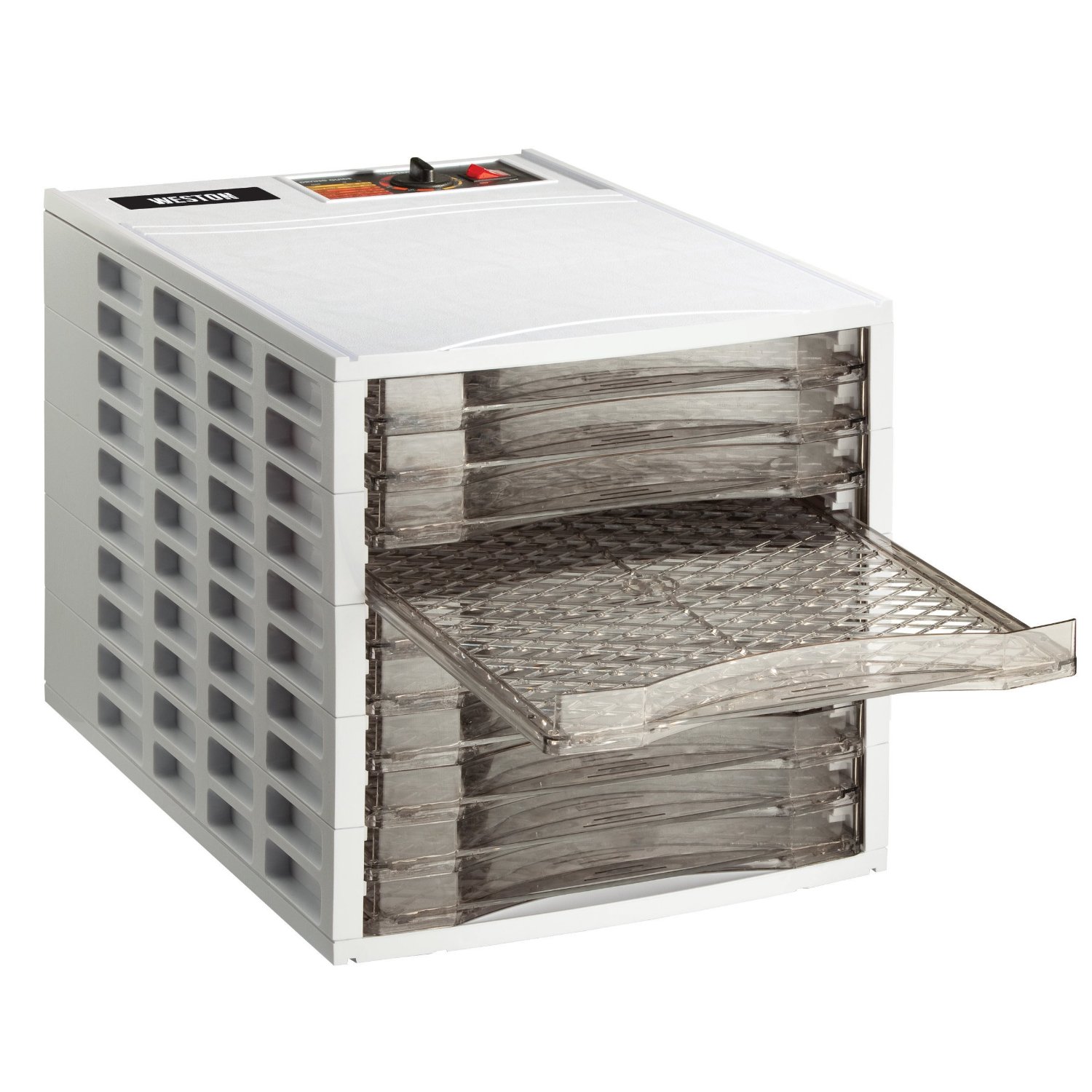
There are two types of dehydrators. The round style has a series of stackable trays. The fan and drying unit are located at the bottom of the tray set. The air is circulated through the screens of the trays upward. The other style is square and usually has between seven and nine racks configured much like an oven, but the fan and heating element are on the backside and the air is blown more evenly over the tiered racks to the front. Both types require rotating the trays for even drying. It’s not a biggie, just a part of the process. For the round style, rotate upper to lower, and for the tier style, rotate inner to outer. This insures even drying. I rotate mine on a quarterly basis. By that I mean if I think my batch of whatever is going to run for a couple of days (48 hours), I will rotate every twelve hours, which is quarterly. The timing of rotating isn’t make or break crucial, but as you get familiar with your dehydrator you’ll see that either the inner or the outer trays dry faster than the others, so simply rotate them throughout the drying cycle.

Drying Times

This varies obviously on what you’re doing and what temperature you decide to dry at, but for veggies that you want to put in the jar for long-term storage, dry until their crunchy. In other words, dry until there’s no bending, they break with a snap, or in the case of say corn or peas, they crush to a powder. I call this the crunch test. You can’t get these too dry. The drier they are, the better. Fruits will vary. Some just won’t get crunchy because of the higher sugar content, but I dry mine until I’m confident they’re as dry as they’re going to get. It never hurts to leave them in for another six, eight, or twelve hours. Now, if you’re planning to make some fruit for the family to eat short term, you will need to start with the basic recommended drying times that you find anywhere on the Internet and then simply do the taste test every quarter like mentioned earlier. Then stop drying when they suit your taste. Incidentally, fruits of any kind are seriously addictive, and drying them yourself gives you the added advantage of fine-tuning the texture (firmness) to your taste preference instead of the stores’.

Rehydrating

We covered this earlier, but in brief I have not found the classic recommendations of two-to-four hours to be even close to suitable for full rehydration. Most of my veggies are cooked and put into different concoctions that I create. Cooking does expedite the rehydration process a bit, but if you want these puppies to be indistinguishable from fresh, rehydrate a minimum of twelve hours and forty-eight hours maximum. As you watch throughout the day, you’ll see how they continue to plump. It’ll be obvious. This is especially true with broccoli and cauliflower, zucchini, and squash. Just change and add water once every twelve hours or so. You can’t hurt vegetables by soaking them too long. Fruits are a tad different. Since I usually dry for long-term storage, I dry them much longer than I do when drying to eat in the short term. But when you’re ready to eat your long-term dried fruits, simply take some out, soak in water for a half-an-hour to an hour, and then lay out on a towel. They soften to the perfect eating texture.


Letter Re: Christian Health Care

JWR:

I am not a spokesman for any health care provider, but I have had experience with one! Regarding the postings on Christian Health Care sharing programs, I have to weigh in. My wife is a member of the Christian Health Care Ministries program and has been for about three years. She selected a mid-level program and we just bite the bullet and make the monthly payments without fail, as hard as it sometimes is. Living in the Pacific Northwest/American Redoubt, we were not sure of available providers that would accept CHM, but we were in for a surprise! About a year ago, my wife had serious health problems and was admitted to a major hospital in Spokane. We had never used the CHM program, but the hospital had and there was no problem with admissions or billings. Over the next month, there were numerous visits to both the doctor, hospital, and other associated health care providers. Treatment terminated with surgery. Our total out of pocket expenses were less than $1,000.00, and while I won’t reveal the total cost of treatments, well over $100,000.00, the amount agreed on between the providers and that paid by CHM was staggering!

Wife has since used the program at a couple of Emergency Clinics in Idaho and has had emergency treatment at a Washington facility and a doctor’s office with no problems with the acceptance, billing, or payment, and the provided care has always been excellent. I would highly recommend CHM or other faith-based medical programs to anyone seeking a reasonable cost emergency health care program! CHM has three levels of coverage; one can select from bronze, silver, and gold, with the difference being in the initial cost and the deductibles. From my experiences, these programs work well!


Economics and Investing:

Marc Faber Issues A Stunning Warning That A Gigantic 50 Percent Stock Market Crash Could Be Coming – B.B.

o o o

BOJ review likely to defend massive stimulus program – sources

o o o

In recovering housing market, the starter home remains elusive

o o o

Venezuela Has But One Choice: Capitalism or Chaos

o o o

China Food Inflation Looms As Ag Output Set To Plunge Most In 50 Years Amid Historic ‘La Nina’ – H.L.

o o o

SurvivalBlog and its editors are not paid investment counselors or advisers. Please see our Provisos page for details.


Odds ‘n Sods:

These Gun Owners Are Least Likely Criminals, Report Finds. Comparing crimes committed by CCW permit holders, cops, and the general public – R.

o o o

Here’s How A US-China War Could Play Out – H.L.

o o o

Hacker demonstrates how voting machines can be compromised – B.B.

o o o

While the EEOC is considering that the Gadsen Flag is racist, The Navy says it’s OK on their uniforms: “popular “Don’t Tread on Me” and reverse U.S. flag patches are now authorized, at the discretion of the commander, on NWU Type II and III uniforms” – Perhaps the Commissioners need a forced tour in the Big Green Machine – C.S.

o o o

Global Water Crisis Looms Large – DSV