Notes for Monday – August 15, 2016

On August 15, 1961, two days after sealing off free passage between East and West Berlin with barbed wire, East German authorities began building a wall–the Berlin Wall–to permanently close off access to the West. For the next 28 years, the heavily fortified Berlin Wall stood as the most tangible symbol of the Cold War–a literal “iron curtain” dividing Europe. The wall has now been torn down for longer than it stood, but the scars in memory are still there.


Pat Cascio’s Product Review: S&W 9mm Shield Performance Center Model

Right off the bat, I’ll admit my bias against Smith & Wesson– the company, not the guns. I used to be a huge fan of their firearms for a lot of years, but their warranty service is lacking. It’s something to keep in mind when purchasing one of their firearms. However, S&W continues to produce some outstanding firearms these days.

For several years, as a private investigator back in Chicago, IL, I packed a S&W Model 586 with a 4” Bbl on a daily basis. It was a comforting (not comfortable) handgun to carry all day long. When I was in the office, my 586 resided in my briefcase next to my desk. The 586 is built on the “L” frame, instead of the smaller “K” frame. While there isn’t anything wrong with the “K” frames, they just weren’t built to handle a steady diet of .357 Magnum loads. Thus, the “L” came along. It was also in competition with the Colt Python, but that’s another story.

DSCF0073

I admit to carrying a 9mm handgun more than anything else these days, although I prefer something more like a 1911 in .45ACP, and if I’m knowingly going into harm’s way I’ll strap on a 1911. Even when going too far from home, I’ll choose a 1911 in .45ACP. However, for most of my daily needs, some kind of 9mm stoked with +P or +P+ JHP ammo and a spare mag will take care of most threats. While FBI stats say there is very little difference in “stopping power” between the 9mm, .40 S&W, and the .45ACP with JHP loads, I still believe that the .45ACP will stop an attack faster, but that’s just me!

When Smith & Wesson came out with the 9mm and .40 S&W compact Shield handguns, I jumped on getting one in .40 S&W. It was not my smartest move. The .40 S&W in the light-weight compact Shield really bucked with lots of recoil, making it hard to get back on-target for a fast follow-up shot. Plus, the trigger pull on the Shield was lacking in some respects. In short order, I traded that .40 S&W Shield for something else. One of my regular UPS drivers carries a Shield when he isn’t working, and I’ve had him out shooting several times with it. He misses a lot with it. The recoil scares him, although he won’t admit it.

DSCF0077

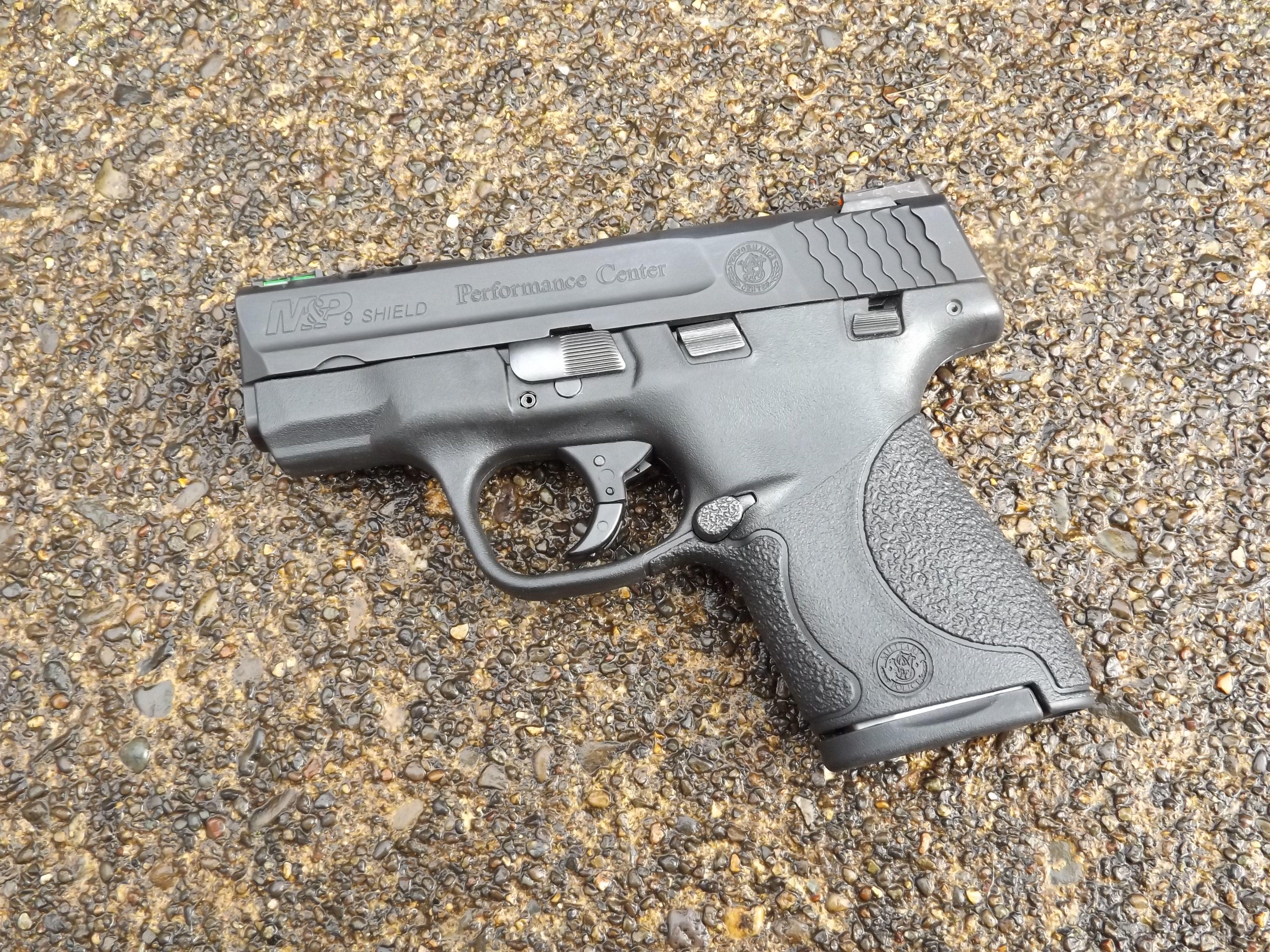
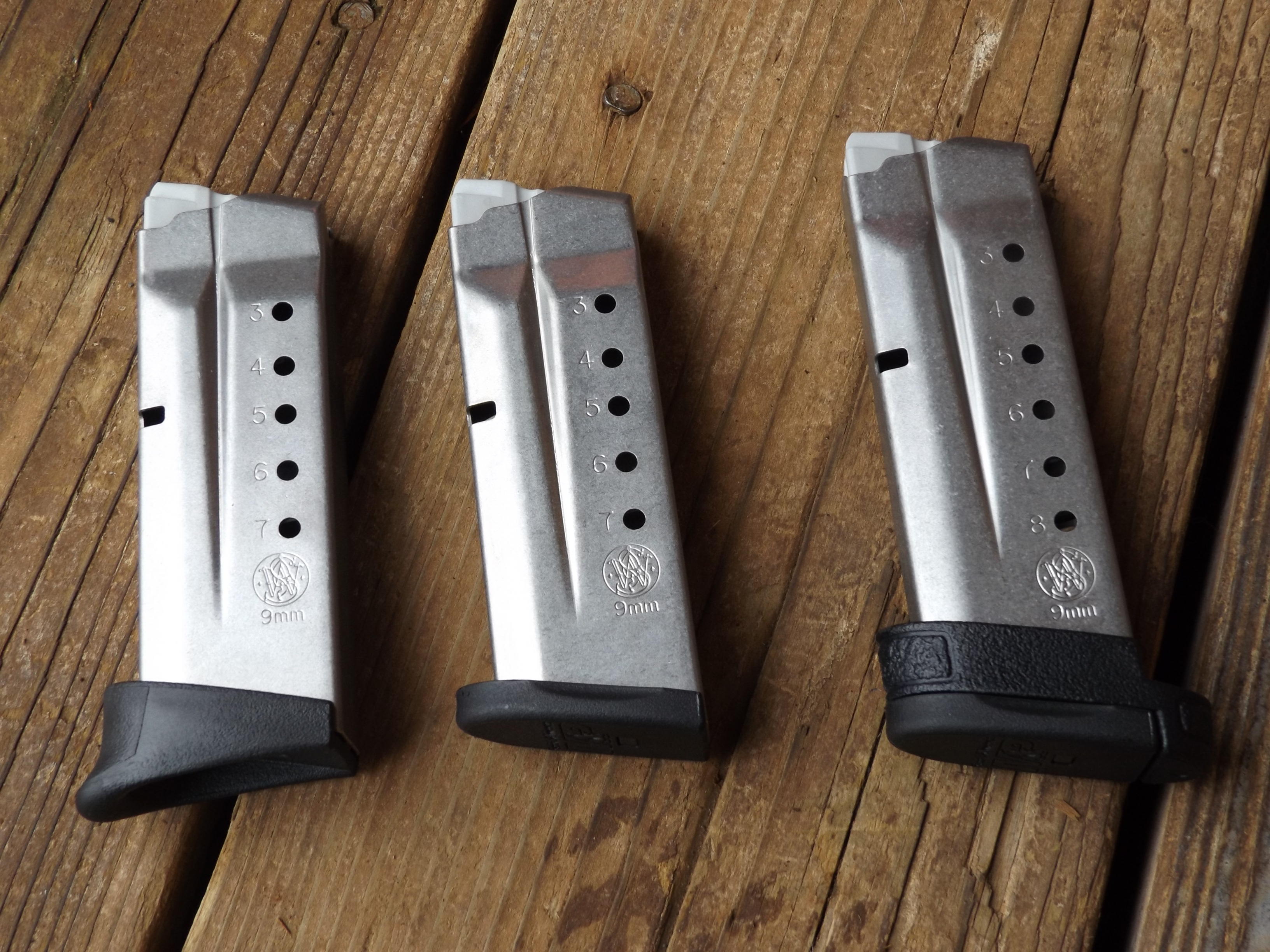
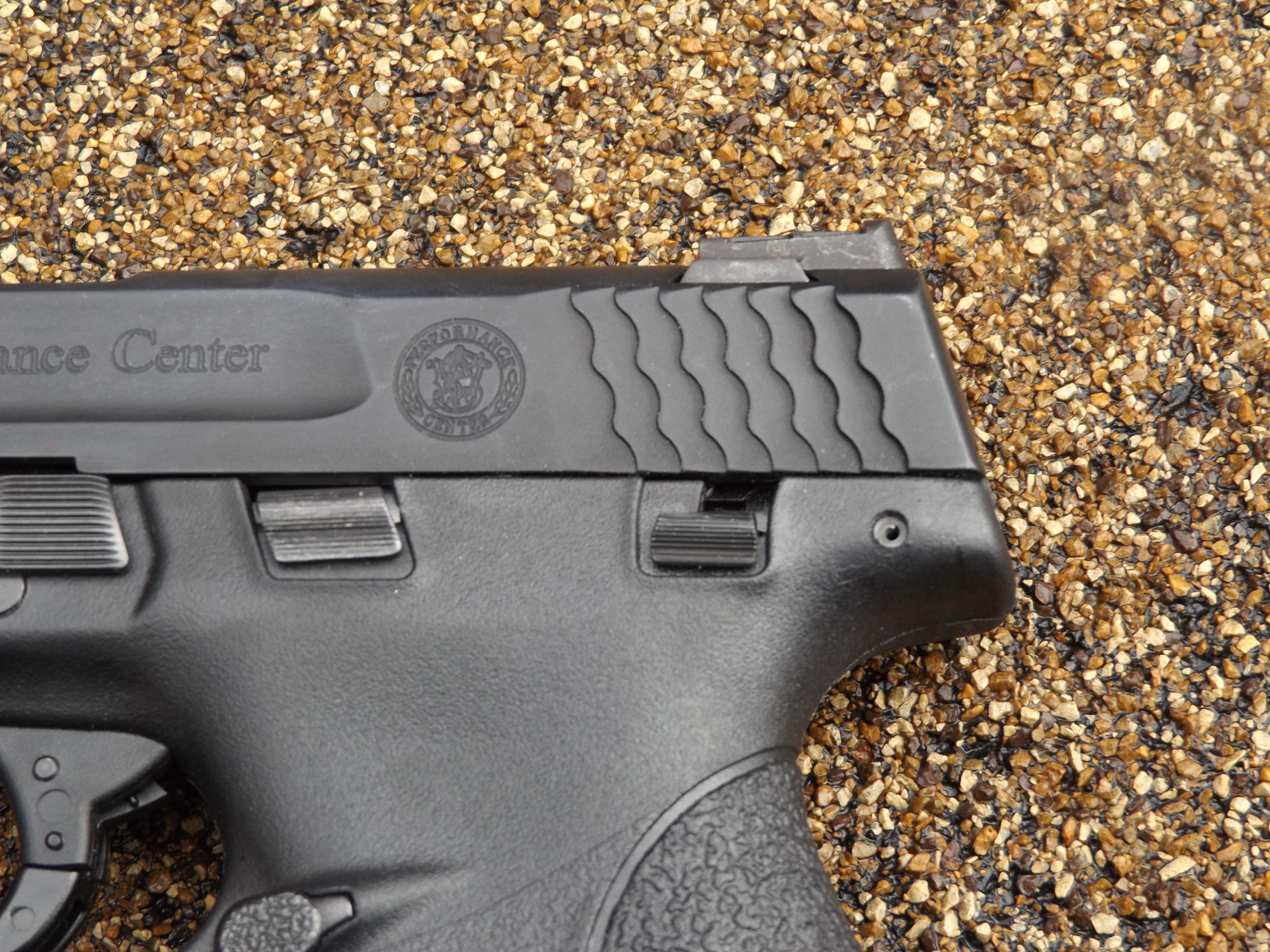
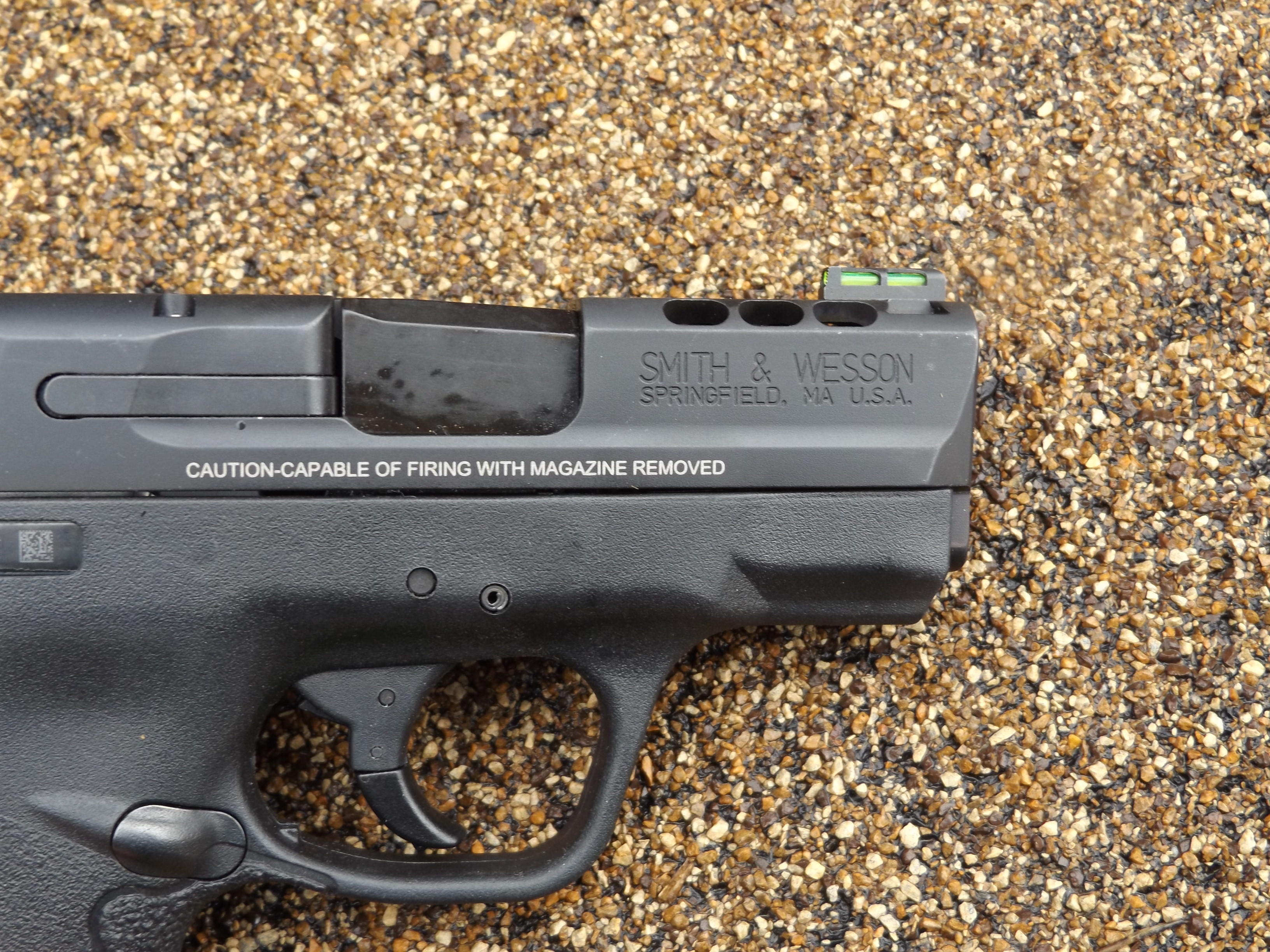
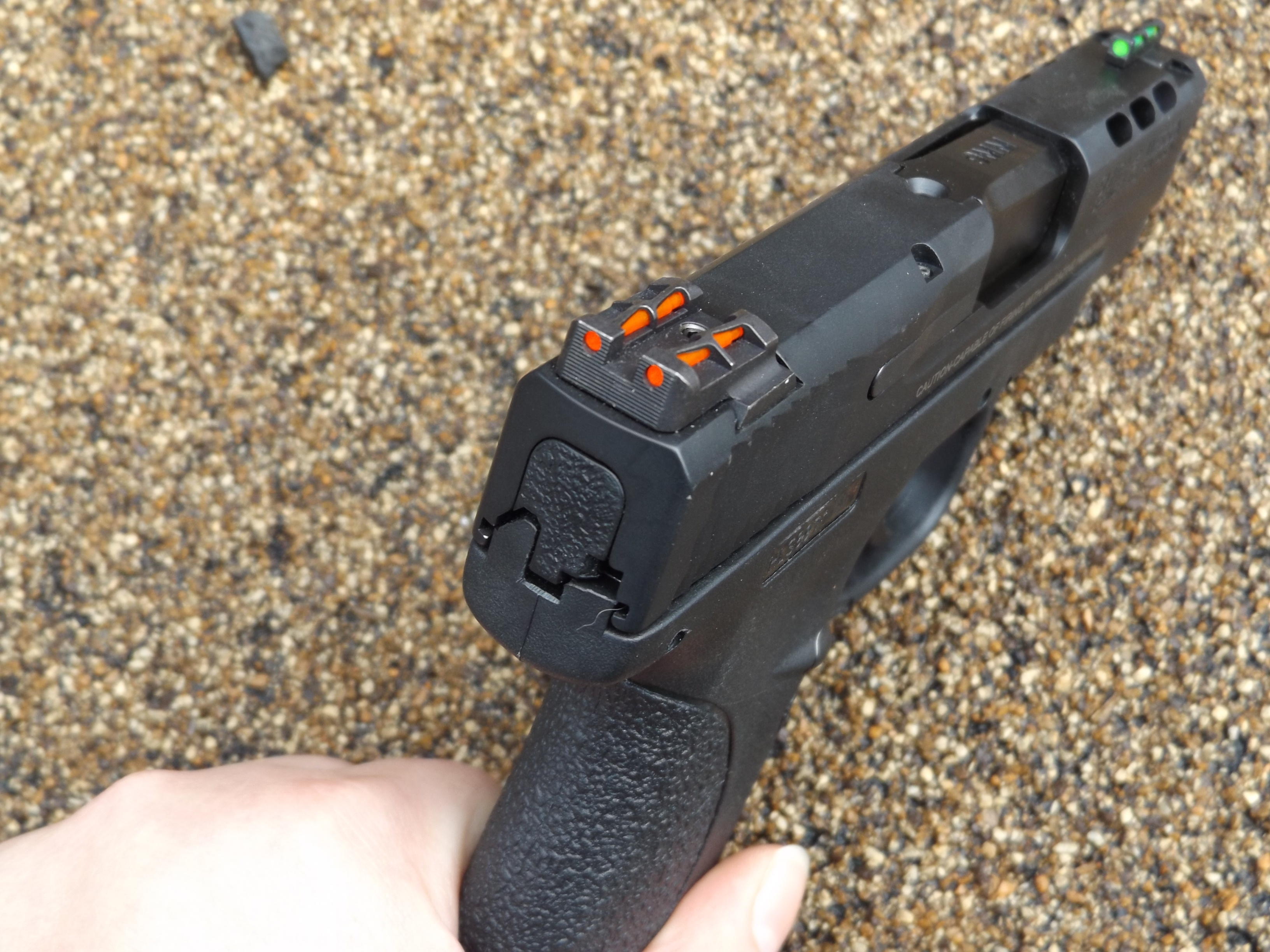
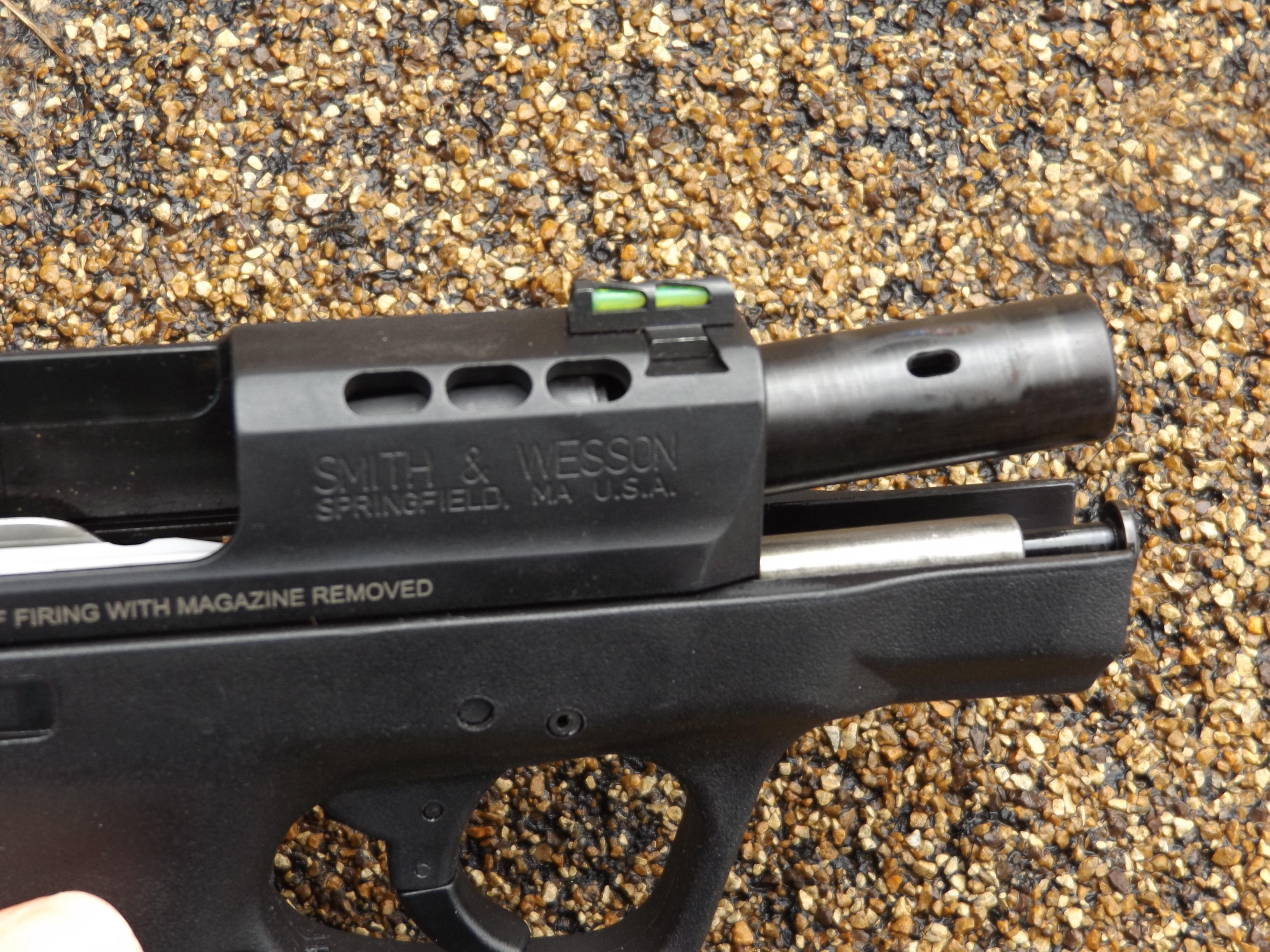
The local gun shop I haunt got in the new and improved M&P Shield in 9mm, and this one has been run through the S&W Performance Center where they do custom work on their firearms. A quick run down on the PC model is in order. As mentioned, this one is in 9mm, but they also offer it in .40 S&W, and it has a ported barrel– one port on each side, which does help keep the muzzle down for faster follow-up shots. The slide is also ported, but it has three ports (cuts). One is in-line with the ports in the barrel, and the other two are just to lighten the weight of the slide. The gun comes with two mags; one is seven rounds, and the other is eight rounds and is extended.

The PC Shield is striker-fired, as are so many other polymer framed handguns. It has a 3.1-inch barrel and weighs just 18.2 ounces. Front and rear sights are Hi-Viz fiber optic. The front sight has a green fiber optic rod, and the rear sight has two red fiber optic rods– one on either side of the sight opening, which is very, very fast to pick up.

The frame, as mentioned, is polymer, and it has a nice texturing to the grip area for a sure hold on the gun. The slide is stainless steel, however, it has a Melonite black coating on it, for a subdued look. The overall length of the Shield is 6.1 inches and height is 4.6 inchs, with the 7-rd mag. Width is a mere .95 inches, so this is a neat, compact self-defense sized handgun.

DSCF0080

On top of the outstanding Hi-Viz fiber optic sights, the Performance Center has improved on the trigger pull . I don’t know what they did, but the trigger pull is much nicer. It’s smoother than the trigger pull on the standard Shield. They should have this trigger pull on all the Shields, if you ask me. However, my understanding is that since the Shield came out a few years ago, S&W has sold about a million of these guns. Wow!

As I’ve gotten older and retired from any sort of law enforcement work, public or private, I don’t feel the need to carry a full-sized handgun as much as I used to. So, these days you can probably catch me carrying some kind of compact or subcompact handgun. More often than not it will be a Shield, Glock 26,or Springfield Armory XDs or XD Mod.2 compact. And, of course a spare mag for whatever gun I carry is mandatory. If headed towards a bigger city, I’ll strap on a 1911 in .45ACP, and more than likely it will be my Springfield Armory light-weight Range Officer Champion with a couple of spare mags.

Many people have asked me over the years, and I’ll repeat it here once again, as to what is the “best” gun to have to carry! That’s an easy one. The one you are carrying is the “best” one or you would be carrying something else, right? Life consists of compromises, and there is no one firearm that will do everything you ask of it. So, I balance out what my threat might be, and I arm myself accordingly. Then, I hope I made the right choice that day. If I didn’t, then I make do. Like the U.S. Marines say, “improvise, adapt, overcome…” Use the tools you have at hand, and make the best of the situation, and remember to PRAY!

DSCF0082

As to the two magazines that comes with each gun, the 7-rd mag just barely allows half of my pinky finger to hold onto the grip area. So I put an extended pinky catcher mag floor plate on the 7-rd mag from Pearce Grip, and it made all the difference in the world. The gun felt better in the hand, and I shot better with it. The 8-rd mags, well, that one is longer, so it fit the hand better. I carry the 8-rd mag as my spare, when I carry the PC Shield.

I tried a number of different holsters for the little 9mm PC Shield and settled on a belt slide holster from Blackhawk Products. It keeps the little gun nice and tight against my body, making the gun VERY concealable. The only drawback to this holster is that it is made out of ballistic nylon, and you can not re-holster the gun after drawing it without using two hands. When you have to use two hands, your eyes are also off the threat, which is not a good thing. So, I’m still looking for a different holster for this gun.

I had quite a selection of 9mm ammo to run through the PC Shield. From Black Hills Ammunition, I had their 115-gr JHP +P, 124-gr JHP +P, 115gr FMJ, 124-gr JHP, and their 115-gr EXP (Extra Power) hollow point. From Buffalo Bore, I had their 147-gr Hard Cast FN Outdoorsman +P load, 115-gr Barnes TAC XP all-copper hollow point +P+, 124-gr FMJ FN +P+ Penetrator round, 124-gr +P+, and their 115-gr JHP +P load. So, we had a good assortment of different types of ammo with different bullet configurations and power levels to test.

I had zero malfunctions of any type during my testing, and I’ve run more than 500 rounds through this little gun thus far. However, I will say that I would shy away from the +P+ load. The slide was really moving back and forth, and there is the potential that it could miss picking-up a round from the magazine. Then again, no gun maker warrants that their guns can shoot +P+ ammo.

DSCF0084

Even though this is a short-barreled 9mm, I did my accuracy testing at 25 yards, resting the gun over a sleeping bag over the hood of my pickup truck. Many of the groups were in the 4-inch range. A few were five inches, which is still fairly acceptable for the distance involved. I had a couple groups that were getting down there at 3 ½ inches, if I did my part. The clear winner was the Buffalo Bore 115-gr JHP +P load. However, right on the heels of this round was their 147-gr Hard Cast, FN Outdoorsman load, followed by the Black Hills 124-gr JHP load, which is always a winner in my book and an outstanding self-defense load.

Needless to say, the +P+ loads gave the most recoil, and as mentioned, the slide was really moving back and forth rapidly. I’m sure at some point, this little gun would choke on one of these rounds. Then again, there are many full-sized 9mm handguns that won’t function 100% of the time with +P+ loads, so act accordingly.

The Performance Center 9mm (and .40 S&W) Shield runs about a hundred bucks more than the standard Shield models do. The standard models run about $400 in my neck of the woods, with the PC models running $499! For my money, I’d spend the extra hundred bucks for the better sights, ported barrel, and much better trigger pull.

DSCF0090

There isn’t anything I didn’t like about the PC Shield, and I tried hardto find something to complain about, I mean really complain about. It is a nice size 9mm handgun for concealed carry on a daily basis, and stoked with some JHP ammo, standard velocity or +P, it will sure take care of any deadly threats that may come your way. I’d even feel comfortable carrying it into the woods, loaded with the Buffalo Bore Outdoorsman load that will penetrate the skull of a black bear.

So, if you’re in the market for a very concealable yet potent little 9mm for everyday carry, take a look at the S&W Performance Center Shield and pass on the standard model. The nicer trigger pull and Hi-Viz sights alone are worth the added expense. No wonder S&W has sold over a million of these little guns.

– Senior Product Review Editor, Pat Cascio



Recipe of the Week: Spaghetti Sauce

Ingredients:

  • 1 lb lean ground beef
  • 1 large onion, chopped
  • 1 clove garlic, minced
  • 2 (1lb) cans of tomatoes, cut up
  • 1 (8oz) can tomato sauce
  • 1 (12oz) can tomato paste
  • 1 cup beef bouillon
  • 2 tbs minced parsley
  • 1 tbs brown sugar
  • 1 tsp dried oregano leaves
  • 1 tsp dired basil leaves
  • 1 tsp salt
  • ¼ tsp pepper

Directions:

  1. In a large skillet or slow-cooking pot with a browning unit, crumble the meat with onion and garlic. Break up pieces of meat with fork and cook until it loses its red color, then drain off excess fat.
  2. In a slow-cooking pot, combine browned meat, onions, and garlic with remaining ingredients.
  3. Cover and cook on low for 6 to 8 hours.
  4. Serve over hot spaghetti. The sauce can be made ahead of time and frozen.

Makes 6 to 8 servings.

o o o

Do you have a favorite recipe that would be of interest to SurvivalBlog readers? Please send it via e-mail. Thanks!


Letter Re: Taurus Judge

Pat,

Hello. I just read your info about the problem with Taurus Model 85 and have a quick note about a Judge I bought from a nice dealer. I tried shooting it several times, and it worked well with no failures. I disassembled the firearm safely, then had it color-coated by a finisher. I did the disassembly and apparently lost a small spring, and when I reassembled it I didn’t find it. I then contacted Taurus and sent the firearm to them. I received a call from a service tech that the coating had to be removed, and they returned the gun. So, I had the coating removed and was going to send the firearm back to Taurus, so I called to get a return number and was told the firearm had been modified and it was unsafe to reassemble. The warranty was void. I asked if I just paid for their shop to fix it would that be possible, but the answer was “No”. I asked what I should try and do since this was a spring that Taurus won’t sell to a gunsmith, et cetera. They suggested I sell it to a parts company in New York. I was at the NRA show and spoke with the head of customer service explaining the situation. I called after the show and was told they were unable to replace the spring, so I now have a good boat anchor, but it’s a little small though. I recently purchased several Canik firearms and haven’t had a failure after firing several thousands rounds through them. (One is none; three is better.) – J.

Pat Comments: Well, several things come to mind, and one is that any modifications will void the warranty at all gun companies. This is true of even a simple coating. I’ve been there done that with S&W!! So, that explains that part of it. As to Taurus not sending a spring, that is hard to believe. I would suggest our reader contact Brownell’s. They carry millions of gun parts, thousands of springs, lots of springs, even truck loads of springs!!!

Not too many years ago, Taurus had the best customer service and repair department in the world, bar none. Sadly, this changed, and I don’t know what is going on there. Maybe they are having a hard time getting spare parts from Brazil. With the economy what it is down there, all is not well, even for Taurus. My local gun shop used to carry a lot of Taurus handguns. Unfortunately, Taurus has raised prices on most of their guns to the point where customers can buy a similar gun from S&W or Springfield Armory for about the same money, so people are turning away from a Taurus. As a result, my local gun shop hardly carries anything in the Taurus line up these days.

In the end, I just find it difficult to believe that Taurus won’t sell him a spring. There are certain parts, like barrels and frames, that most gun companies won’t sell, but a spring? Unheard of! I’m not saying it can’t be true; I just find it difficult to believe. Plus, any gunsmith worth his salt can modify a similar spring to make it fit and function. I have been there and done that, when I was doing gunsmithing many years ago. I’m still betting good money that Brownell’s has the spring.

In the end, it still comes down to the fact that the reader had the gun “modified”, even if it was just changing the finish. Gun companies are fussy about this sort of thing for some reason. Plus, we have a society that loves to sue people and companies for anything, and it is a liability concern for Taurus. The gun was modified. I am not taking the side of Taurus, but I know how so many gun companies worry about liability.

Make It Count,

Pat


Odds ‘n Sods:

(So-called) Justice Department Prevented FBI Probe Of Clinton Foundation; Reporters Slam State Department Stonewalling

o o o

After taking a break for a few weeks, Ryan, over at Total Survivalist, is back to making regular posts. Welcome back!

o o o

Above the law? What is Obama’s daughter smoking? Malia Obama snapped ‘smoking cannabis’ at music festival – KMC

o o o

‘Black Lives Matter’ Rioters Target Whites For Beat Downs. “Video footage shows violent mobs of ‘Black Lives Matter’ rioters targeting white people for brutal beat downs during last night’s unrest in Milwaukee.” – J.C. (Warning: foul language)

o o o

Another reminder to change the default password when you use these devices. US girls’ bedroom livestreamed after hacking


Notes for Sunday – August 14, 2016

For those wondering what happened to the great Paratus Familia blog: They had a domain registration glitch last week. This prompted them to migrate to: http://www.paratusfamilia.com, where they are now back up and running. Be sure to bookmark that new URL. – JWR

o o o

Safecastle’s big Lindon Farms sale ends on August 16. There are great discounts in this sale like 53% off a bucket of freeze dried veggies. Check them out!


My Tomato Process- Part 1, by Sarah Latimer

It is that time of year when the garden is bursting with its bounty, and I am regularly giving thanks to our Creator for His provision and kindness in giving us a diverse and pleasurable taste and texture smorgasbord for our palates as well as the necessities of nature, mind, and body to work the land and see its fruit come forth. He created the very earth from which they came and provides the balance of nature– the appropriate amount of sun so that the plants don’t freeze or burn, have enough oxygen, and have water and nourishment from the soil. Sure, we also do a lot of work, too, but we couldn’t do it without Him, since our very beings are immensely complex organisms that He puts together so perfectly and gave us intelligence to not only plant, water, weed, and pick plants but to make tools and irrigation systems that simplify this process. What a great God to give us not only all that we need to survive but also the pleasure of a diverse and beautiful world!

With that said, one of the mainstays in our garden is tomatoes. We use fresh tomatoes for salads, sandwiches, pizza, casseroles, and more. However, tomato sauce goes in many, many of our dishes, whether as a major ingredient or as a minor one. As a result, we require literally gallons of the stuff each year, and our tomato plants are bursting with tomatoes right now! I thought my approach to long-term tomato storage might be helpful to some of you, so I am going to share it in detail here.

Picking the Tomatoes

We grow a variety of tomatoes, though most of our tomatoes are Roma/San Marzano type, because those are the best for paste. I have grown the same heirloom plants using my own harvested seeds for at least six years now and maybe longer. (I have lost track of when I first started collecting the seeds and fermenting them in pots outside during the winter. The first year I did so thinking they would be good food for the birds during the winter, but then in the spring I was given a multitude of tomato plants, and that was the beginning of a beautiful process that has continued. I was “accidentally” blessed with learning how to produce more tomato plants than I can handle and to have to give some away each year. Rather than my “cup” overflowing, it has been my many flower pots that overflow with tiny tomato plants anxious to be transplanted where they can spread their roots and produce.) When picking tomatoes, we keep the varieties separated to make it easier to keep the seeds separate for this re-potting process. This way, I can label the pots by the types of tomato seeds going into them. Processing of each variety is done separately also. To pick, we use plastic one-gallon buckets with handles. I have found that using anything larger tends to get too much weight on the top that can crush very ripe tomatoes placed in the bottom. I believe it is better to use five one-gallon buckets than to use one five-gallon bucket for this reason. Additionally, the one-gallon buckets are small enough that they can be easily cleaned in the kitchen sink or even run through the dishwasher. They can sit in my sink filled with water to let the tomatoes soak a bit before their thorough washing.

Washing

To wash the tomatoes, I begin with soaking the bucket of tomatoes in lukewarm water. While I only use organic gardening-approved sprays and fertilizers in our garden, I do use Neem oil products to deter tomato worms and grasshoppers. (I prefer something called Neemix, but it is pricey and difficult to find. I get mine from groworganic.com. A bottle is more than enough for a growing season, even though I spray weekly.) I use it all over my garden and only lightly on the tomatoes, since the borage and marigolds usually do a great job of keeping the tomato worms away from the plants near them, but there are usually some areas of the tomato garden a bit distant from the borage and marigolds that benefit from the spray. When you spray the tomato plants, some of the spray is going to get on the tomatoes themselves, and Neem oil is bitter! We want to be sure to get it off any of the tomatoes. After soaking for at least a couple of minutes, I rinse each tomato and inspect it. That’s all that is required, since we don’t use harsh, toxic chemicals in any of our gardens.

Inspecting

Large, beefy tomatoes- Some large, unblemished, and well-ripened tomatoes are always kept aside for slicing on sandwiches. The others are stacked to be processed into sauce.

Small, cherry tomatoes- Some small, unblemished, and well-ripened cherry (Sweet 100) tomatoes are put in bowls for eating on the counter and for use in salads and soups. (In soups or stews, we call them “sweet bombs”. Just be careful not to serve them too hot or they will burn your mouth when you bite into them and the hot inner liquid squirts out.) The others are set aside to be included in the sauce-making process also. Though they are filled with liquid, it is very sweet and adds more sweetness to our sauce.

Medium, meaty Roma/San Marzano/plum tomatoes- Some unblemish, well-ripened San Marzano tomatoes are set aside to be diced and freeze-dried for future use in casseroles and dishes, but most are designated for sauce processing.

Those that are going to be used for sauce are stacked back in clean buckets next to the sink.

Storing for Sandwiches and Salads

Whole tomatoes store best outside of the refrigerator at room temperature. Those that I am keeping for sandwiches or salads are placed on my counter in a corner out of direct sunlight until I am ready to cut and place a large one on sandwiches or grab a handful of cherry tomatoes for a salad or snacking.

Dicing and Drying

I have had good success with freeze-drying diced tomatoes. (While I have not dehydrated them, I strongly suspect it is practical to do so at a low temperature until they are fully crisp and can be powdered. Just don’t powder them, except to test their doneness.) For long-term storage, all of the moisture must be removed! They are full of sugar and, therefore, can easily spoil if not dried and vacuum sealed properly.

Dicing

I do not peel the tomatoes; I simply dice them into 1/3-inch cubes. Though I freeze dry diced tomatoes that are cut to about 1/3 inch, they shrink down to about 1/4-inch cubes but plump back up with rehydration.

Drying

I lay then in a single layer on our stainless steel freeze dryer trays and put them in our Harvest Right Freeze Dryer. Because there is so much moisture, it usually takes about 36 hours for them to completely dry. (The time varies, depending upon various factors, including condition of oil, humidity, size of tomato cubes, water content of tomatoes, et cetera.)

Storage

Then, I store the dried tomato cubes in quart size wide mouth Mason jars, using a vacuum sealing system and FoodSaver jar attachment. I always mark the lids of all of my jars using a black Sharpie permanent marker so that even in a dark situation, I can shine a dim light and read the tops of a box of the jars to find what I need without having to lift jars and look. (I recommend using a black marker, because some of the other colors fade over time or in sunlight.) In this example, I might write on the label: “Freeze-dried Diced Tomatoes 8/16”. On the labels, I always say what kind of processing was used (canned, freeze dried, dehydrated/dried), the contents (including how it is sliced/diced/crushed/ground/shredded, if pertinent), and when the contents were first processed and packaged. This helps me with rotation and to find what I need quickly. Jar lids can be reused and relabeled. To remove old permanent marker, use Goof Off and a paper towel. There is sometimes a faint shadow of the former writing, but the new writing is prominent and easy to distinguish. (I use the lids first for liquid canning and then once I have opened a canned jar of something I re-use that lid for dry vacuum storage, again and again.) As long as you are careful in how you break the lid’s seal, the lid remains in “like new” condition. To remove the lid, I simply use the dull side of a table knife and follow the threads up with the knife in a horizontal position so that as the threads raise the back of the knife up, it breaks the seal. Then the flat side of the knife does not bend the lid to enable any air to get into the jar the next time I put the contents under a vacuum. I can remove a few tablespoons of dried, diced tomatoes and re-vacuum seal the jar to keep the contents good for another five or ten years, if need be. However, it just will not last that long! We do love our tomatoes!

In Part 2, I will share my sauce-making and storage processes. Meanwhile, I hope you are harvesting some delicious tomatoes are your home, whether in bulk on the farm, in a small garden with just a few plants, or from just one or two plants on the patio. Learning to grow, process, and store tomatoes (or any fruits and vegetables) requires that we get started and work at it, and most of us continue learning, adjusting, and improving our processes as time goes by.


Letter Re: So Tell Me Again…

HJL,

The writer stated that he doesn’t typically blanch so that he doesn’t destroy the enzymes. However, acid in the stomach will do the same thing as blanching. So it really doesn’t matter whether he does or not, at least as far as “destroying” the enzymes. If he eats the food, the enzymes will naturally break down as the second step of digestion.

An enzyme is simply a type of protein, a molecule that is too big for our bodies to absorb intact. (An very simplistic example: Insulin is an enzyme. If eaten, it will break down and not be insulin anymore. If a healthy person took it as a pill, their pancreas would reassemble it as insulin. A diabetic cannot do that. That is why it is given as injections.)

What really happens when a protein is heated or exposed to acids is that the links between the amino acids are broken down. The amino acids remain intact. Once they are in our cells (I won’t detail the steps of digestion), they are assembled into whatever proteins our bodies need. So, nothing is destroyed. It’s just broken down into building blocks for reassembly. – Nurse Kim

o o o

Hugh,

Just wanted to clarify something that M.P. touched upon but didn’t mention specifically: All commercial frozen vegetables have already been blanched. (I confirmed this with a producer, because I freeze dry them.) So there is no need to blanch them before dehydrating. – Matt R.


Economics and Investing:

Manipulation: The Phony Job Recovery

o o o

BIS Intervenes In The Gold Market To Aid Battered Gold Shorts!

o o o

Wall St. banks ask Fed for five more years to comply with Volcker rule

o o o

JPMorgan to Liquidate Japan Fund After ‘Significant’ Redemptions

o o o

North American Life Insurers “Accidentally” Pile Up Massive Distressed Debt Holdings

o o o

SurvivalBlog and its editors are not paid investment counselors or advisers. Please see our Provisos page for details.


Odds ‘n Sods:

Some good predictions on coming crunch times: over at the great Of Two Minds Blog:

Ultimate Long Game: Autarky and Resilience. A key quote: “Those with surplus food will be the ultimate arbiters of value.”

o o o

Bill Weld Just Compared AR-15s to “Weapons of Mass Destruction,” & Said Pistols Were Even Worse!

JWRs Comment: And he is the Libertarian Party’s Vice Presidential pick? It looks like there are NO good choices for the upcoming election. – JWR

o o o

This is how the US military would put down an armed rebellion – J.C.

o o o

College Professor Bans The Term “Melting Pot” For Being Racist (Sorry Schoolhouse Rock) – H.L.

o o o

Like the plague, such measures can and do spread! Four States to Vote on Gun Control Measures in November, including one that would limit the size of magazines.