
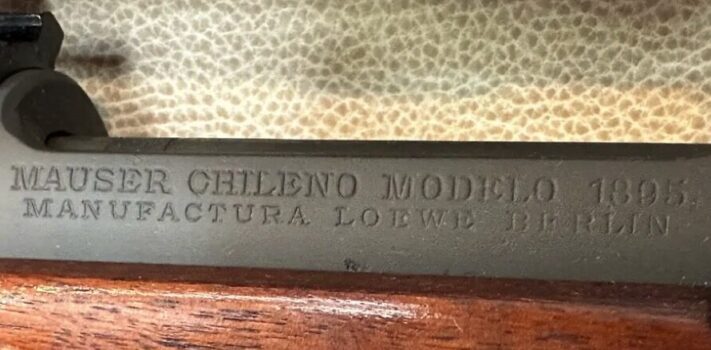


Is the 7x57mm Mauser M1893/95 rifle obsolete? The original 7mm Mauser cartridge is in no way an obsolete cartridge, yet it can be improved when modern powders are used. As of this date, few handloaders are exploring what can be done with the old warhorse when modern propellants are used to make it competitive with modern cartridges such as 7mm-08, 7.62 NATO, and even .308 Winchester. There is no discussion on this topic that I’ve yet found on the Internet. Perhaps we are breaking new ground, as we speak.
The Rifle
My goal is to develop an optimum load for an M1895 7mm Mauser that I acquired from Elk Creek Company. It was expertly sporterized. Based on its configuration, that sporterizing was apparently done back in the 1970s. They would not have done such a good job on this rifle if it was not already a good shooter. The description of the barrel that is provided by Elk Creek was accurate.
Of the six rifles I’ve acquired from Elk Creek Company, five have excellent barrels that are in like new in condition, and this one would be rated as very good. The barrel is everything when choosing a rifle. Buyers receive an invaluable advantage by purchasing their rifle there. You get an expert and accurate opinion about the bore’s condition.
The bore is in very good condition. I’ll add a 2+ lbs trigger and glass bed it, and shorten the ‘length of pull’ as I’ve done with other Mausers. A smooth crisp and light trigger is, however, all it will need to increase the accuracy of a hunting rifle, and then there is the potential that the same rife might prove to be the proverbial ‘tack driver’ or sub-MOA (group under 1 inch at 100 yards).
Mauser rifles are well known for their accuracy potential. “Aim small, miss small” goes the saying… A 2 stage military trigger could be plenty good enough for hunting, and perhaps preferable for an excitable hunter, but if I happen to use the rifle for longer range target shooting or as a counter sniper rifle, it would be good to see what it is capable of.
Developing a Handload
It is true: Prior proper planning prevents poor results. Research and planning will reduce the time and money spent and increase the performance of the cartridge developed. I attempt to use the powder and bullet combination that is mostly likely to shoot MOA or better for this contingency, and avoid the time experimenting with unknown combinations.
It is well known that small ring Mausers usually are their most accurate when the heaviest projectiles are used as they were originally designed for the longest and heaviest bullet used at the time of their development. In the case of the 7mm Mauser, it originally fired a 173 grain round nosed bullet at around 2,300 fps.
I have been studying this cartridge in depth so as to improve the handloads for this cartridge that might result during the load development phase. I’ve had practice with my method of researching the topic prior to actual load development. The more time in research, the less time and money is used is need to develop a good handload that is as close to ideal for my rifle and my hunting grounds or for defense purposes.Usually my research results in a satisfactory handloaded cartridge within 20 to 40 rounds fired. I’ve met my design goals with many different cartridges that I handload for. My load development includes a cartridge intended for hunting and another cartridge for long range target shooting if the rifle is so capable.
I would like to maximize the rifle’s accuracy, velocity, and potential effectiveness on various game weights that are in my area using only one load if possible.I’ve loaded cartridges that produced top accuracy and velocities from other antique Mausers. If it is possible attain that level of performance with my M1895 7mm Mauser, then it could also be used in a counter-sniper role. A dual purpose rifle is better than a single-purpose rifle.
To Get The Best Results, Handload Your Cartridges
If the information herein might be useful, then one would find that handloading is not difficult, and satisfactory results are relatively quick to realize if one knows the best powders and components to use to attain top performance. With this knowledge, the handloader could quickly produce a reloaded cartridge that is both pleasingly accurate and effective on game.
Handloading cartridges is the best way to get the most performance from antique rifles. Improved performance, not necessarily only in terms of higher velocities and flatter trajectories, but also in terms of a more effective game cartridge, because we can select the most suitable projectiles for the game in our area, and powder charges that are appropriate for our particular bullet choice, and tolerance for recoil.
Reloading components are no longer cheap and easy to come by and our time at this late date is even more precious than ever before, therefore it is best to do the homework and research the topic first before embarking on actual load development.
Best Propellants
Given these considerations that limit our bullet selection to traditional bullet designs and certain weights, there are yet comparsions in performance that can be made when a short list of modern propellents are used. My list includes Superformance, StaBALL 6.5,IMR 7828, IMR 4955, IMR4831, IMR4350, and H4350 in that order of preference because these medium slow to slow burn rate powders can produce much higher velocities in 24 inch barrels than medium burn rate powders.
If pursuing top accuracy, the traditional selections have been Varget, IMR4064, IMR4895 and IMR4320. This not to say that modern powders that produce signficantly higher velocities might not be just as accurate. However, my hunting loads will tend not to chase accuracy, but practical accuracy for the intended game and the highest possible velocities given the pressure limit of 46,000 CUP. I am not try to make a match grade load that could be lower in velocity. I wish to have as much punch as possible for the larger game we have around here.
My Top Choice in Powders
Detailed data can be found on the Hodgdon Reloading Center website. Based upon this fairly recently published data that I only recently discovered, one can see a clear pattern and why I would choose Superformance powder as my primary selection. While I do not have data specifically for my bullet choices, I can use the starting charge for the same weight bullet and work up. For liability and copyright reasons, I cannot reproduce their charts in this article. Again, I recommend visiting he Hodgdon Reloading Center website.
Most of the powders that they list produce a significantly higher velocity than medium burn rate powders. Maximum pressure is limited to 46,000 CUP.
Bullet rates ranged from 150 to 195 grains.
The powder types were:
- Superformance
- IMR 4955
- StaBALL 6.5
- A2700
- W760
- H4350
- IMR 4350
My Top Choice: Superformance Powder
I have chosen Superformance powder as my ‘go-to’ powder for my 7mm Mauser rifles. I thank the Lord for my supply of this powder. Even if it does not produce the extreme high velocities as recorded by the Hodgdon Reloading Center, because it’s burn rate is about the same as H4831, it should produce significantly higher velocities than do medium rate powders, especially in the heavier bullet weights. As with any slower burning ball powder, I will use a magnum primer to ensure consistent velocities and accuracy.
Fortunately I happen to have plenty of Superformance with recent and reliable reloading data source that uses a Hornady 175 grain ELD X bullet, provided by the best online source, the Hodgdon Reloading Center. I have examined in great detail and compared data from many reloading manuals over the decades and trust Hodgdon’s data the most.
Hornady advises that this data can be used for other Hornady projectiles of the same weight. This means we have data for the 175-grain Hornady Interlock, my top choice of projectiles for my 7mm Mauser. Therefore, Superformance should propel a 175-grain Interlock upwards of 2,544 fps. This would have serious knock-down power.
I will use magnum primers for all temperature conditions and for my other cartridges that use slow burning powders such as H380 and H4831 and others. Often a standard large rifle primer is adequate and produces good accuracy in warm weather, yet if one anticipates that that the cartridge might be used in cold weather conditions, err on the side of caution and use magnum primers if you have them. Military spec ammunition uses CCI #34 primers that are harder primers that also have magnum primer performance for that reason.
It is good to have an alternative choice of powders, bullets or anything else. If Superformance is not available to purchase, then I would then try StaBall 6.5, IMR-7828, IMR 4955 or the other top performers if top velocities for the purpose of hunting is desired. Best accuracy might be found using other powders such as Varget or IMR4350. These will however produce lower velocities and reduce the projectile’s ability to buck the wind at longer distances well beyond 100 yards. This is how I seperate paper punching accuracy from practical accuracy at medium long range, and extreme long ranges where the wind is the dominant factor that determines the ability to hit a target.
Reloading 175 and 160 grain Bullets Using Superformance in M94 Carbines
As reloaders, according to data found on the Hodgdon Reloading Center site, we can now produce a load that launches a 175 grain Hornady Interlock with a muzzle velocity of up to 2,544 fps when loaded to a pressure of 50,000 PSI (slightly less than 46,000 CUP) using Superformance. This load would be 194 fps faster in velocity than Sellier and Bellot 173 grain SPCE loading, and 134 fps faster than the next fastest load that would use StaBall 6.5. When using heavy bullets, an increase is a significant amount of additional energy on target and ability to create wide wounds that humanely kill wild game animals.
If our handload is fired from the 18-inch carbine length barrel, the muzzle velocity would be around 2,300 fps using a maximum load, and that happens to be the minimum velocity that Hornady recommends for their 175 and 154 grain Interlocks. If we used another powder other than Superformance, the muzzle velocity could be as low as 200 fps too slow and we would have to use the 154 grain Interlock, and go without the tremendous knockdown power of the 175 grain Interlock. These numbers are only approximations. Only a chronograph can confirm the actual muzzle velocity obtained.
If Superformance powder is used we may expect a maximum attainable muzzle velocity for 160 grain 7mm bullet to be at most, 2650 fps. If we load up a Speer 160 BTSP for a carbine length barrel (18″), the top velocity might be as much as 2,650 – 240 fps = 2,410 fps. We lose approximately 35 to 40 fps for every inch shorter than the barrel length. Most data is based upon a 24 inch barrel that might produce a top velocity of 2,650 fps. 24 inches minus 18 inches is a difference of 6 inches, times 40 fps per inch of difference in length, equals the estimated maximum velocity out of a M94 barrel.
Because the Speer 160 grain BTSP bullet is much softer than the Interlocks and will expand at impact velocities as low as 1,800 fps or perhaps 200 yards, it can be a useful hunting bullet even if the MV is only 2,000 fps. It is the best fit for a carbine length barrel if medium sized deer and black bear are on the menu. I will get some of these as well for my M94, and the 175 grain Interlocks for the M1895 24″ Sporter.
Superformance Powder and Its History
Superformance was originally developed for .30-06 and the brand name ‘Superformance’ was used to market high performance commercial loadings of many cartridges, yet the actual Superformance powder was not necessarily used. It is a confusing situation, yet where the actual Superformance powder works best, it works exceptionally well and produces some of the highest velocities at lower pressures, and good accuracy with lighter and the heavy for caliber bullets in a few rifle cartridges such as .30-06, and a few others where there is at yet no reloading data provided.
One such cartridge where I have not found data for Superformance is 7mm-08 where experimenters using H4831 data as a guide is adequate for very experienced reloaders. Some have produced video evidence of their success, and spectacular results.
Fortunately for owners of 7x57mm Mausers, Superformance can be safely used within the pressure limitations of 46,000 CUP to produce 100 to 200 fps faster velocites when compared to my short list of recommended powders such as StaBall 6.5, IMR4955 and others that also yield top velocities.
Commerical 7mm Mauser Ammunition
Beware of commercial 7mm ammunition that might be loaded to higher pressures that exceed the safe level for early actions. In addition do not use reloading data that does not include the pressure measurements for maximum loads listed. This is a common problem for reloaders who offer reloading data that are intended for strong modern action chambered in 7×57 Mauser. For 7mm Mauser reloading data, I therefore recommend data sourced from only Hodgdon Reloading Center. The maximum pressure for a 7mm Mauser is 46,000 CUP or approximately 51,000 PSI.
Commercial suppliers such as Prvi Partizan (PPU) or Sellier and Bellot do sell good quality and full power hunting ammunition that are safe for use in 6.5×55, 7mm Mauser, and 8mm Mauser rifles. But as handloaders we can do much better when reloading 7mm Mauser. And this fact is all the more relevant when reloading cartridges for carbine length barrels such as the M94 Mausers.
My top choice for commercial ammunition for 7mm Mauser is Sellier and Bellot’s 173 grain SPCE that they state has a muzzle velocity of approximately 2,350+ fps from a 24″ length barrel . PPU also produces good ammunition that is suitable for M1893/95 7mm Mausers. The low cost of this ammo justifies buying just for the Boxer-primed brass that can be reloaded. Buy a few boxes of the 173 to 175 grain ammunition for hunting and testing, and then load up 160 grainers for longer ranges to cover both contingencies at a lower cost.
(To be concluded next Tuesday, in Part 2.)