
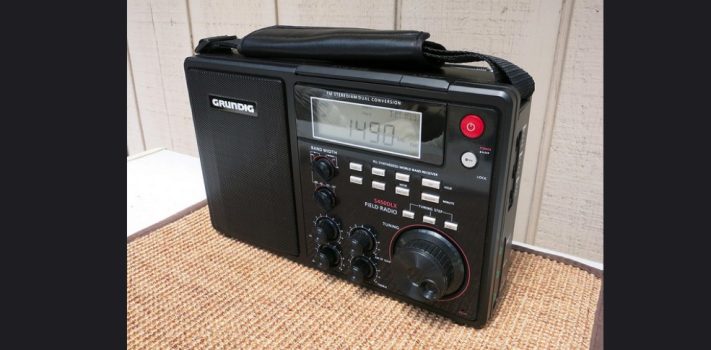


The following is my list of recommended features and some features to avoid, when looking for a general coverage receiver. This is based upon my personal experience over the years as a shortwave listener (SWL) and Amateur Radio operator.
Frequency Coverage: Look for a minimum frequency coverage of 500 kHz to 30 MHz. This covers the AM broadcast band (520 – 1710 kHz) and all of the shortwave broadcast bands (2 – 30 MHz). Coverage of the FM broadcast band (88-108 MHz) is also highly desirable.
Digital frequency display: Allows precise tuning to a specific frequency. Avoid any radios with the outdated and inaccurate analog “slide rule” type of radio dial. International shortwave broadcasters are not as numerous as they were during the 1980s. You need to be able to obtain their frequencies and broadcast times from their website and swiftly tune your receiver to that specific frequency.
Receiver Modes: The radio should capable of receiving AM and FM transmission modes at a minimum. FM Stereo reception is a plus, and makes the radio one that you will use everyday.
Note that most shortwave receivers only have one main speaker, since most shortwave broadcasts are in mono. Radios with FM Stereo reception provide stereo only when stereo headphones are plugged into the earphone jack. Since I sometimes use my shortwave receiver to listen to Bible lessons on the local FM Christian radio station, the lack of stereo reception is not a problem for me. I have a separate pocket-size FM receiver that I use for listening to stereo music broadcasts.
Single Side Band (SSB) reception: SSB is not mandatory, but this mode is used by some shortwave broadcasters. It is also the most popular transmission mode of Amateur Radio (ham) operators on the shortwave bands. It is a handy feature to consider.
Battery Type: Verify what type of battery is used by the radio. The AA size battery is one of the most common battery types available, so look for a radio that uses AA batteries. Many shortwave receivers use 4 AA batteries. Some use D or C batteries, which are not as common now. Consider using rechargeable batteries and keep two complete sets on hand. While one set is charging, the second set is powering the radio.
Avoid “oddball” batteries, such as the 18650. These batteries are not available in most stores and often must be ordered on the internet. They also require special chargers. If you happen to have a radio that uses the 18650 battery, here is a tip. Many of the larger “deluxe” vape pens use the 18650 battery. A local “Smoke” or “Vape” shop might have 18650 batteries in stock for their customers.
A few years ago, I purchased a portable “Tecsun PL880” shortwave receiver based upon its price and capabilities. Unfortunately, I did not pay attention to what battery type it used. Upon receipt I discovered it used a single 18650 rechargeable battery. Luckily, at that time a co-worker was heavy into vaping. When he needed to order additional batteries over the Internet for his vaping device, I was able to join in on his order and obtain 4 additional batteries for my radio. But I also had to separately order a special charger so I could recharge the 18650 batteries.
A recommended charger for the 18650 battery is the “new” Nitecore i4 charger. The latest model is compatible with various types of batteries to include Ni-Cd, Ni-MH, IMR, Li-ion, and LifePO4. Besides the 18650 battery, it will also charge AAA, AA, C and D size rechargeable batteries. The version I purchased on-line came with both an AC power cord and a 12-volt DC power cord, which makes it very versatile.
AC Adapter: Ideally, a shortwave receiver should come with an AC-to-DC power adapter that you can plug into a wall outlet. This allows you to listen to the radio even if the batteries are dead. If the matching AC adapter is available, but optional, be sure to order it with the radio. While there are after-market AC-to-DC adaptors available, you have to carefully match the output voltage, connector type, and connector polarity. It is far better to simply order the matching AC adapter from the radio manufacturer. Some radio models will also charge installed rechargeable batteries using the AC adapter.
Antenna: A good shortwave receiver should have the option to connect an external antenna. Most radios come with an internal antenna for AM broadcast band reception. They may also have a telescoping antenna for FM broadcast reception. The telescoping antenna may also be used for shortwave reception, but is a compromise because of the longer length usually required for the shortwave frequencies. An external antenna connection allows for the connection of longer antennas for better shortwave reception.
[JWR Adds: Some of the best general coverage receivers such as the Drake R8B also have an external ground connector (a traditional “grounding screw.”) The old saying in the ham radio world is true: “Your ground is half of your antenna.”]
I use a simple piece of thin insulated wire approximately 25-feet long, strung behind the computer desk hutch unit. Some shortwave receivers use a simple screw terminal for attaching an external wire antenna. Others use an antenna jack that requires a 3.5 mm plug on the end of the long wire antenna. To prevent receiver overload, many radios also include a two-position “DX / Local” switch to reduce the stronger signals received by the longer external antenna. Some larger radios include a similar “RF Gain” control that is completely variable over the range of the control knob.
Station Memories: The ability to store various station frequencies is handy. This allows you to store your favorite radio station frequencies for quick recall.
Packable in Luggage: If you travel a lot, a radio that can be packed away in luggage is helpful. Radios that use buttons instead of protruding knobs will survive better being stuffed in luggage.
Size: Select a shortwave receiver based upon your intended use. A large table-top model radio will have a bigger display and easier to use controls. More compact portable radios will be easier to pack. I recommend avoiding both extremes; either very large table-top models or very small portable radios.
Some of the very large table-top receivers are rather bulky. Some of the very small portable radios lack an external antenna connection. The solution for that problem is to attach a wire antenna to the existing telescoping antenna using an alligator clip on the end of the wire. Not the best solution, but it works.
Reference Frequencies: The National Institute of Standards and Technology (NIST) broadcasts time information 24/7 on several shortwave frequencies from two locations. Station WWV is located in Fort Collins, Colorado. Station WWVH is located on Kauai, Hawaii. Both stations transmit their time signals on 2.5, 5, 10, 15, 20, and 25 MHz. WWV uses a male announcer’s voice, while WWVH uses a female announcer’s voice.
Good radio signal propagation on the shortwave bands tends to start on the lower frequencies in the morning, slowly improving to the higher frequencies by the afternoon. As the sun sets, the reverse happens. The radio signals start to fade on the higher frequencies, while remaining strong on the lower frequencies. At night, only the lower frequencies around 5 MHz remain active with good signal strength.
The WWV and WWVH frequencies are spread across the entire shortwave spectrum. By listening to the various frequencies, especially 5, 10, and 15 MHz, a listener can quickly determine which shortwave bands are providing better reception based upon the strength of the individual signals. If the WWV signals are especially weak on 20 MHz, it would be best to seek shortwave broadcasters on the lower 15, 12, and 9 MHz shortwave bands.
Amateur Radio Equipment: Most modern Amateur Radio equipment designed for operation on the shortwave bands will also receive all the shortwave broadcast frequencies from 2-30 MHz. This feature is often called “General Coverage Receive”. They often feature AM and FM reception modes, in addition to the popular SSB mode. If you have an Amateur Radio license, consider exploring the world of High Frequency (HF) signals, as the shortwave bands are now called. In this situation, a good HF radio designed for the Amateur Radio bands will also serve as a good shortwave receiver as well.
If you do not have a license, a used HF “ham” radio can still be used as just a shortwave receiver. Be sure to disconnect the microphone to prevent transmitting without an adequate antenna attached. This prevents damage to the transmitter section of the radio.
Please be aware that most Amateur Radio HF radios rated for 100 watts transmit output power require a separate 12-volt DC regulated power supply capable of supplying 25 amperes of current continuously (not intermittently). Many 12-volt DC power supply model numbers are based upon their intermittent rating, not their continuous rating. A “RS-20A” power supply is actually only capable of supplying 16 amperes continuously. It is better to have a power supply with more than enough amperage capacity, rather than one that struggles to supply the required higher amperage when the radio is transmitting. Be sure to check the radio specifications, frequency coverage, and power requirements before purchase.
I hope people find this information helpful when considering the purchase of a shortwave receiver.
JWR Adds: “Sarge B.” is on target in mentioning looking for updated frequencies at the websites of international broadcasters of interest to SWLs.
There was once a great series of books titled Passport to Worldband Radio that was published up to 2009. Sadly, their 25th Edition, published in 2009, was the last one in the series. But I recommend finding a used copy of the 2009 edition on eBay, as a standby hardcopy reference. Although most of the listed frequencies have changed, the book is still a great starting point, for researching the stations that you’d like to find. Once you know their names or callsigns, you can then do a web search to find their websites.
Two good online references are Shortwave Listeners’ Digest (SWLD) and Shortwave.Live. Consult their frequency lists and broadcast schedules, and then your real hunt (on the air) can begin.
We are near “solar maximum” in the 11-year unspot cycle. Now that sunspot numbers are back up, there have been some great evenings and early mornings of SWL propagation. For listeners in North America, Evenings are generally best for listening to stations in Europe, and early mornings are best for listening to stations across the Pacific.
If you are stymied in the search for a station, or if poor propagation makes listening difficult on some days, most of the major international shortwave services now also offer Internet livestreams.
Livestreansms of low-power local AM and FM stations around the world can also be accessed online with crisp audio fidelity through Radio Garden. It is an amazing resource. If nothing else, you will find it is a great way to be able to listen to music in your favorite genres, 24 hours a day. Take note that Radio Garden has had some chronic web browser compatibility issues over the years. So if you can’t get it to work with your main browser, then you may have to try another.