
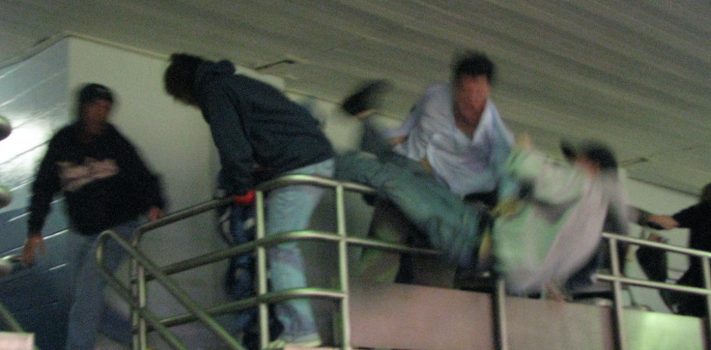


(The photo above, courtesy of Openverse, was taken by “Terren in Virginia“, a witness to a 2008 baseball team “fan rivalry” brawl at a New York sports stadium.)
The following is what I learned about security at lunch one day:
Scenario
One Tuesday, about six weeks ago, I stopped for a late lunch at a local upscale family restaurant in Virginia Beach, Virginia, that is part of a well-known chain. It was about 3 o’clock in the afternoon and it seemed to be a quiet place to have lunch and prepare my Sunday school lesson.
I selected a seat near the back of the restaurant with good light that was coming in from the windows.
After about 45 minutes, a lady that was seated at another table facing my direction, suddenly became agitated and said loudly: “You can’t do that here.” She seemed to be speaking to someone behind me and slightly to my left. It turned out that she was the manager.
As I turned to see who she was talking to, it was obvious there was some sort of disturbance going on. An older gentleman seemed to have been knocked down, and there was something happening underneath a couple of tables. Additionally, a lady in her booth was moving to her far left – away from whatever was going on. Almost immediately, two older gentlemen who were close to the disturbance tried to separate two young men who were fighting.
I considered getting involved, but the initial fighting stopped almost as soon as I was aware of the confrontation. Then an additional restaurant employee arrived. The additional employee and the manager seemed to have the situation under control. However, the fight broke out again. At this point the employee and the manager told the two young men (each were in the 18 to 20 years old range) that they had to leave the restaurant. The two young men stopped fighting and moved toward the side door exit (the patio area of the restaurant). When they reached the patio area, the fight started a third time – this time with one of the young men throwing chairs at the other. Finally, the manager announced they (the restaurant employees) were calling the police.
As the fight progressed, the restaurant employees seemed more concerned with getting the chairs back that had been thrown over a low wall, more than anything else. I noticed customers entering and leaving the restaurant in close proximity to these two individuals engaged in the fight. I decided that I would warn customers to stay away from the area where the two individuals were fighting.
Note: I was not aware of what caused this fight. However, I did hear one of the individuals say: “I told him not to take pictures”.
Also note: Both of these individuals did not appear to be particularly bright. I have been around individuals who were drunk or under the influence of drugs – they both seemed to be processing information slowly.
Police interaction: After about five minutes a Virginia Beach police car came up and drove right past the disturbance (side of restaurant patio area). Then the officer then drove around to the front of the building and parked. The officer came in the front door, walked through the restaurant looking for the disturbance. However, the two individuals involved in the fight left the scene (from the patio area) and walked/went across the street to a wooded area (behind the businesses located there).
The officer eventually came to the patio area and began talking with the manager and the second restaurant employee. At this point, I noticed one of the individuals involved in the fight was standing on the edge of the parking lot across the street. Neither the restaurant manager nor the restaurant employee had noticed this individual. I walked up to the police officer and informed her that one of the individuals involved in the fight was across the street. The young man then went to the right behind the building across the street. The police officer did not pursue the individual – she decided to go into the restaurant. I assume she wanted to find out more about the fight and determine the extent of the damage/injuries.
I decided to leave at this point – somewhat disappointed that no one seemed to be interested in catching the individuals involved in the fight. I gather up my study materials, cleaned up the table where I had been eating and exited the restaurant.
As I was leaving (probably another five minutes had elapsed) a second police car arrived and immediately drove to the area where I had last seen one individual involved in the fight. However, that police car turned left when it got to the parking lot rather than right (the direction the individual was walking when last seen).
Evaluation (from a Safety/Security Perspective)
As I thought about what happened during this incident, it occurred to me that there were several lessons to be learned. This incident has implications for individual safety and the safety of various businesses or organizations.
I will try to evaluate the actions of customers (who tried to defuse the situation and stop the fight), the restaurant manager and the additional restaurant employee, the interaction with police officers, and my own actions.
De-escalation
I should tell you right up front that I hate de-escalation. Or more specifically, I hate situations where de-escalation is necessary. Something has likely already failed if security and/or the police are called to de-escalate a situation – something went wrong. And of course, de-escalation often does not work – particularly if violence has broken out. And, if de-escalation fails the results can be serious.
De-escalation efforts by two older customers: Both of the older gentleman that initially got involved are to be commended. However, however because the situation had already turned violent, their de-escalation efforts were less likely to be successful. And, this means there was some level of danger for the individuals involved.
Further, we have to ask, was this a successful use of de-escalation? The answer may be slightly complex. You could say that there was some level of success. The level of violence did initially decrease, and no additional bystanders were injured and the combatants left the facility. On the other hand, the de-escalation failed because there were three instances of violence (two additional instances after the elderly gentleman got involved).
Restaurant personnel: The attempt at de-escalation by the restaurant manager and her additional employee were only minimally successful (stopped the second fight and caused the individuals to exit the side door). However, a third fight broke out after their de-escalation attempts. There are several other areas where the restaurant staff could have behave differently: they could have called the police earlier (rather than waiting until the third occurrence of violence), they could’ve provided warnings to customers entering and exiting the restaurant near the fights), and communications between restaurant staff and police officers appears to have been lacking (specific location of initial fight and changes in location of fight).
If this were a formal After-Action Analysis, we would likely know if the restaurant chain had any training or provides any guidelines (for their employees) on how to handle this type of situation. Unfortunately, I do not have access to that information.
Police officer interactions
I certainly don’t mean to fault the first officer for driving past the fight area and going to the front door. I suspect that the call asking for police assistance was not specific enough as to the actual location. The call requesting police assistance likely did not indicate the fight was in the outside patio area – my guess is the call just asked for the police to come to “the Panera restaurant”.
This is a fairly common error. I recently helped with a medical emergency at my church. Unfortunately, the EMTs were just told to come to the church – but that is not specific enough. Any large facility may have multiple entrances and exits, and the arriving EMTs were headed toward the front door while the individual it needed medical assistance was located in the back of the facility. I went around to the front door and redirected the EMTs to the back of the facility (and the specific door) that was optimal to provide assistance to the individual in distress.
By the way, focusing on the second officer – she turned and went in the wrong direction. I told the first officer that the suspect went to the right. The second officer went to the left. I assume she was told that the suspect went to the right. My guess is either the first officer did not know her left from her right or the second officer did not know left from right. Or, the first officer was not specific enough in with her instructions to direct the second officer toward the suspect.
My own actions: I am generally more particular about where I sit in a restaurant. Typically, I try to sit where I’m facing the main entrance and from where I can see most of the patrons. In this instance, I chose to sit in an area that was well-lit. That would allow me to prepare a lesson for my Sunday school class while I was having lunch. However, this was a failure on my part – to be aware of and keep track of my surroundings. On the plus side, I tried to keep other patrons away from the fight area and I provided the police officer with information about the location of one of the individuals who was involved in the fight.
Lessons learned
There were clearly some implications for your personal safety or for the safety of businesses that deal with the public. My specific area of interest is church security. However, some of the principles that may be learned from this incident may apply to any business that deals with the public.
When emergency personnel are coming to your facility, they need specific location information. Be it the police, the fire department or EMTs, giving them the exact location means their response time is greatly reduced. This means you’re sick or injured employees or customers are helped sooner.
One question to ask your staff and volunteers is: “How do you get the arriving officers (or fire officials or EMTs) to the exact location where they are needed?”
The other lesson for businesses (or churches) is that the police should be called early when there is the potential for violence rather than waiting for outbreaks of violence.
At a personal level, I realized that I chose an inappropriate seating location – leaving too many people behind me. Since then, I try to remain more conscience when selecting my seat location – where I can more easily monitor the activities in the room.
Church security (Further action)
I will share information from this incident with my church security team to further improve their professionalism.
About The Author: Robert E. Downing has been actively involved in church security for several years. You may have read his two previous SurvivalBlog articles: Avoiding Complacence in Security (June, 2022), and On Police and Faith Based Safety Teams (February, 2024.)