
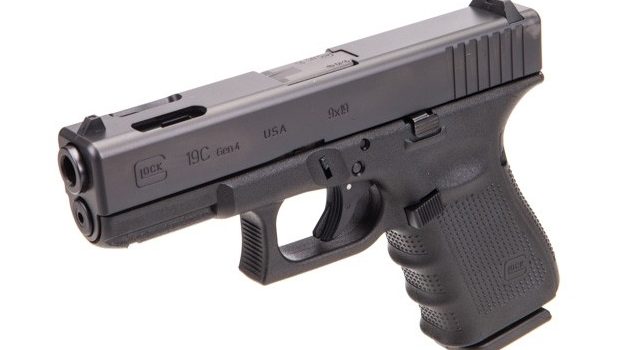


Author’s Note: I am not affiliated with Glock or the Glock Sport Shooting Foundation other than volunteering as a range officer at their matches and shooting their matches.
JWR likes to say that owning a gun doesn’t make you a shooter any more than owning a surfboard makes you a surfer. You need to learn, train, and practice. Practical pistol disciplines such as International Defensive Pistol Association (IDPA) and International Practical Shooting Confederation (IPSC) are outstanding ways to practice, but they can be intimidating to the novice. That’s where the Glock Sport Shooting Foundation, or GSSF fits in. Glock started GSSF in 1991 to promote safe and proficient use of their product. GSSF matches are structured to be beginner-friendly. Unlike disciplines such as IDPA and IPSC, there is no movement, no drawing from a holster, no reloading on the clock, and no complicated rules such as use of cover, etc.
I first encountered GSSF nearly 20 years ago when my club where I lived in Kentucky at the time asked for volunteers to assist at a match. I volunteered and was put to work as a target paster, putting stickers over the holes on targets in between shooters. The next year, I volunteered again and also signed up to shoot the match. Soon, I was recording scores and times, then running the timer and ensuring the safety of the shooters. I’ve now volunteered at about 50 matches, in Kentucky (two locations), Wisconsin, Missouri, South Dakota, and Nebraska (two locations). As a volunteer, I have encountered a broad spectrum of shooters, from people who have never shot a firearm before and just came from the gun store with their first gun new in the box, to master shooters who shoot a stage in 3 seconds with perfect accuracy. I have served as a range officer for shooters from age 9 to 90, and people with various disabilities including people in wheelchairs or on scooters. I’ve seen many families participating in GSSF matches together.
What is a GSSF Match?
GSSF matches have three different scenarios or sets of targets. In the competition world these are referred to as “stages” or “courses of fire”. You shoot two of the stages three times each, and the third you shoot four times. Each round, or “string”, you start with 11 cartridges in the pistol: one in the chamber and 10 in the magazine (Glock models with magazine capacity below 10 cartridges have modified rules). Scoring is based on a combination of your total time to shoot the ten strings and your accuracy. I’ll provide a description of each of the stages below, along with photos I took at a recent match.
Five to Glock Stage
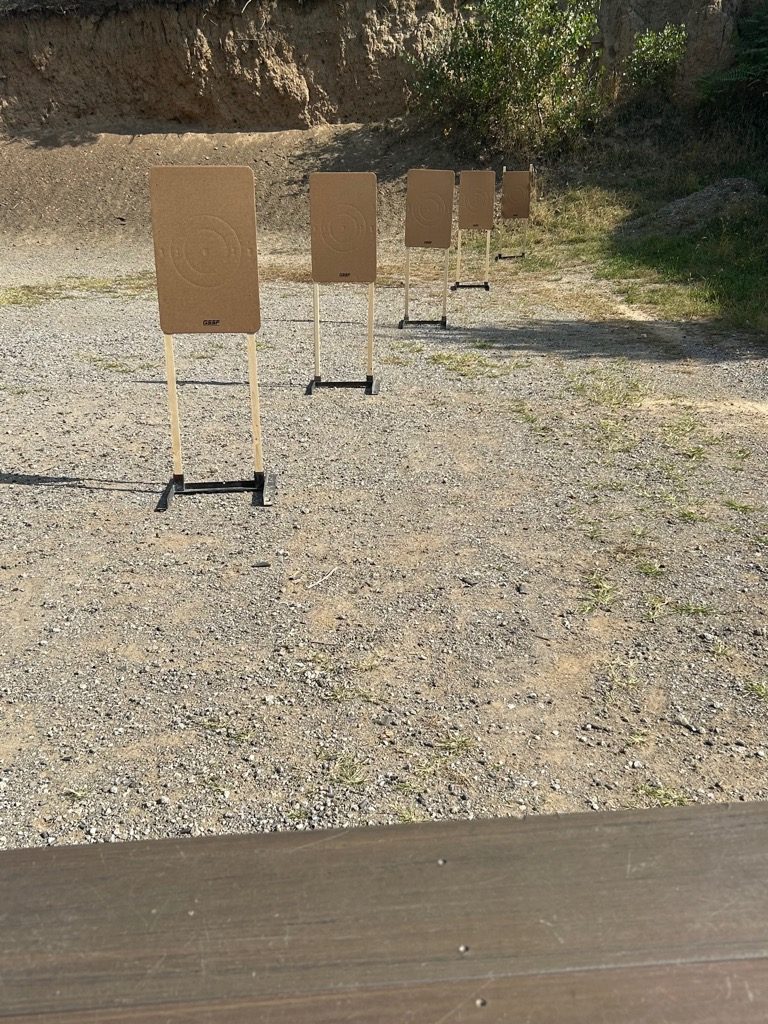
This stage tests your ability to fire accurately at targets at varying distances. The five cardboard targets are spaced five yards apart, with the closest target being five yards away from you and the farthest target 25 yards away. You shoot three strings of 10 shots each on this stage, two shots per target per string. You should have at least six hits on each target when you finish your three strings at this stage.
The Glock M Stage
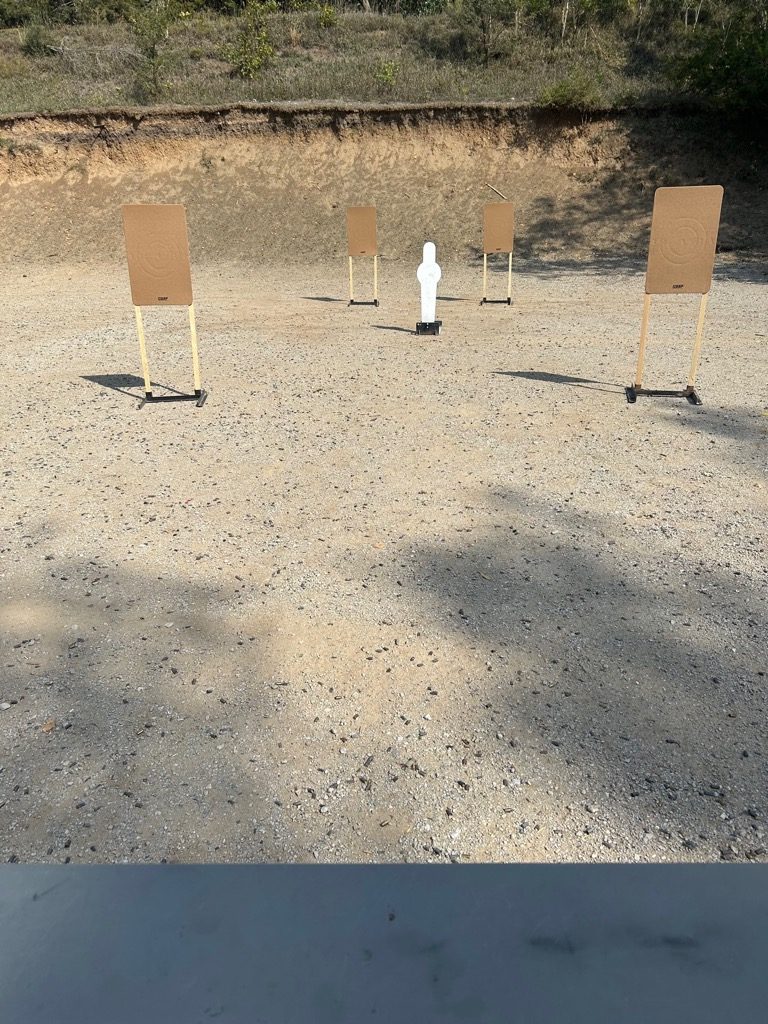
This stage tests your ability to shift between targets side to side, with shorter and longer distances mixed in. The four cardboard targets and one steel target are arranged at what would be the points of the letter M. The two close cardboard targets are at seven yards and the two far cardboard targets are at 15 yards. The steel target is about halfway between the close and far targets. Unlike IDPA and IPSC, any hit on the steel counts; the steel does not need to fall in order to be scored as a hit. The “pepper popper” steel targets typically used in the Glock M stage are pinned in place so they won’t fall, saving the volunteers from having to reset fallen steel between shooters. The volunteers spray-paint the steel white target white before any rimfire entries are shot, as the noise from a .22 long rifle hit on steel isn’t as loud as a hit from a centerfire cartridge. Participants can also ask the volunteers to paint the steel prior to shooting a centerfire entry if they would like it painted. You shoot three strings of 10 shots each on this stage, two shots per cardboard target and one shot on steel per string. You should have six hits on each cardboard target and three hits on steel when you are finished with your three strings on this stage.
Glock the Plates
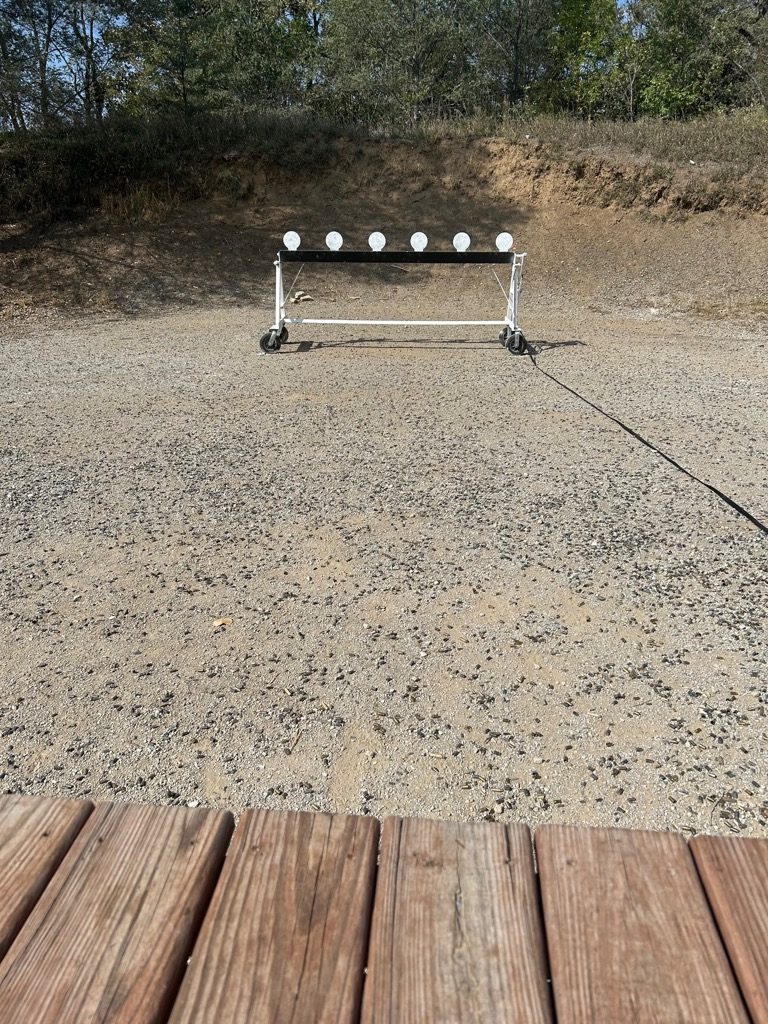
This stage features a plate rack with six 8” steel plates. The distance to the plate rack is 11 yards. Plates have to fall in order to count as a hit (except for rimfire match entries). As with the other stages, you start this stage with 11 cartridges in the pistol, so you have five extra cartridges in case of misses. You shoot this stage four times. The plates are unforgiving, as each is either a hit or a miss. Each miss adds 10 points to your time – ouch!
Scoring
Scoring is based on the amount of time you needed to complete each stage, plus added time for less accurate shots or complete misses. For example: your time for strings one through three were: 8.1 seconds, 7.8 seconds, and 8.3 seconds. Your time score would be 24.2 seconds for that stage. Penalty time for sub-optimal accuracy is added to your time score. Cardboard targets have three scoring zones: down zero, down 1 second, and down three seconds. A miss on cardboard or steel adds 10 seconds to your time.
How Can GSSF Benefit Your Prepping Efforts?
- GSSF gives you a reason to practice.
- It provides the novice with the new experience of shooting on the clock with people watching knowing that you will be scored for accuracy, which adds an element of stress. GSSF can also be a gateway to IDPA or IPSC.
- Matches are an opportunity to meet people with similar interests, especially if you volunteer. Matches are run on Saturdays and Sundays. You can volunteer for both days, one day, or even part of a day. Some matches also have a volunteer shift on Friday for set-up. My family and I keep a Sabbath on Sundays, so I volunteer on Saturdays only. During slow times, you’ll get to know the volunteers you are working with on the stage you have been assigned to work.
- If you volunteer, you’ll be exposed to gear that you might not otherwise see, based on the shooters who come through your stage. I’ve improved my personal gear over the years based on observations I’ve made on the gear of participants who’ve come through my lane.
- Who doesn’t like free guns? GSSF awards free pistols to the winner of each division, along with a random pistol to a match entrant. The representatives from Glock at the most recent match I participated in said that the weekend before the person who came in last in their division won the random gun draw. There is a “Glock Girls” side match open only to women, and the winner of that group receives a pistol. All first-time GSSF shooters and the people who brought them to the match are entered into the New Shooter drawing for another free gun. About five years ago, I took some friends with me to a match and one of them won the free new shooter pistol. GSSF also gives away smaller prizes such as cash, Glock entrenching tools, and Glock knives. The winners of pistol prizes can select the model of their choice for free among a selection of models. There is a small upcharge for certain higher-cost models. GSSF also holds a drawing for a free pistol to go to one of the volunteers. I’ve won a volunteer pistol, as have two of my sons. Remarkably, both sons won on their first time volunteering!
- Being involved in GSSF gives you access to Glock “Blue Label” pricing. Glock’s Blue Label program provides a discount to law enforcement officers. GSSF members receive an annual coupon from GSSF to purchase one Glock per year under the Blue Label program. It remains to be seen what Blue Label pricing will be on the Gen6 Glock models that are coming out in January, but in my experience the Blue Label discount is typically about $125 off. If you are going to buy a Glock, you should join GSSF just to get into the Blue Label program. The discount covers the cost of your GSSF membership several times over. Note: you can only purchase a Blue Label pistol from certain Glock dealers; check Glock’s website to locate the Blue Label dealer near you.
- GSSF membership provides you with access to certain training courses offered by Glock that are not otherwise open to the public, such as the Glock Armorer’s course. I used GSSF to access this course a few years ago. I thought it would be a good idea because everyone in my family has at least one Glock. The course was held at a local police academy, so it was me and 29 police officers in the course.
- A Glock factory armorer is part of the team of three people that GSSF sends from Glock’s US headquarters in Georgia to each match. The armorer brings a full parts inventory to each match, across the various generations of models. If you have a problem with your Glock during the match, the armorer will address the problem and replace parts for free. There is nothing stopping you from asking the armorer to take a look at that second-hand Glock you bought. I’ve availed myself of armorer service at GSSF matches to replace worn parts a couple of times on the Gen2 G17 I purchased in 1991.
- GSSF matches are “lost brass” matches. That means that participants must leave their brass behind. Many volunteers put down a net or tarp and take home the brass for reloading. I use a BrassMagnet net. I’ve come away with tens of thousands of pieces of brass to feed my Dillon 550 reloading press. Volunteering for GSSF has yielded a lifetime supply of 9mm brass.
- GSSF volunteers receive their choice of several Glock products based on the number of days they volunteer. Items include magazines, field knives, one-year GSSF membership, or a no-fee match entry. While the annual membership gives you the most value, having lived through the 1994 Assault Weapons Ban magazine capacity limitations I don’t believe that there is such a thing as having too many full capacity magazines. Volunteers also receive a GSSF ball cap and a free lunch.
Why Glock?
There are nicer pistols than the Glock, but Glocks always work and they do so at a price point that provides great value. The guns I’ve seen go down during IDPA matches have been 99% custom 1911s that typically cost multiples of a Glock’s price. I love my HK and Sig pistols, but I don’t like the $50 price tag for their magazines. Glock magazines are tough, reliable, and cheap, typically $20 each these days. If you are buying 10 magazines for your pistol, do you want to spend $500 or $200? Glock also makes 24- and 33-round magazines that will work across all of their 9mm models…and in many pistol caliber carbines from other manufacturers. Glock magazines are compatible with other models in the same caliber that are the same size or smaller. For example, a 9mm Glock 17 magazine can also be used in a G26, G19, G34, G45, G47, and G49.
Glock parts are ubiquitous and Glocks are simple to work on. In scenarios with compromised supply chains, you are more likely to be able to find spare parts for a Glock than for any other make of pistol. This is especially true of the Gen3 models which have had their patents expire and are now cloned by just about everyone. Glocks are used by more law enforcement agencies in the United States than any other make. Like it or not, this Austrian-born product has become America’s pistol. (Cue the howls from the 1911 crowd…but deep down they know it is true.)
JWR’s seminal novel Patriots introduced me to the concept of having group standard equipment. The preparedness group in the novel had M1As as the group standard rifle and Colt or Kimber-made 1911s as the group standard pistol. JWR has shared that the AR10 should be the battle rifle of choice today due to factors such as better optics compatibility and the introduction of Magpul PMAG AR-10 magazines which are much less expensive and lighter than M1A magazines. My personal opinion is that if Patriots were being written today, the group standard pistol would be a Glock. JWR has shared that his family carries Glock Model 30 pistols in .45 ACP…and he takes advantage of magazine cross compatibility within the .45 models by pairing the compact-sized G30 with full-sized G21 magazines. If Glock is going to be your family or group standard, then getting involved in GSSF will support your logistics.
How do I get involved in GSSF?
Go to the GSSF.pro website and find a match near you. Unfortunately for me, there are no matches in Iowa, so I have to travel out of state to participate. There are numerous match locations in the American Redoubt, as well as all over the country.
There are two types of matches listed on the GSSF.pro website: outdoor and indoor. This article has discussed the traditional outdoor matches. Indoor matches are a modified version offered by local indoor shooting ranges on their own, without GSSF representatives present and without most of the advantages listed in this article. Indoor matches are better than nothing, but I recommend that you go to an outdoor match if there is one geographically accessible to you.
You can either join GSSF and register for an outdoor match on the GSSF.pro website, or you can just show up at the match and join and register at check-in. If you want to volunteer at an outdoor match and don’t know who the match director at the host club is, just click on the “Volunteer at this Match” button on the GSSF.pro website next to the location and date of the match within the list of outdoor matches.
Tips for first-time attendees
- GSSF matches have cold range rules. The firearm you plan to compete with must either be unloaded and in some kind of closed case or holstered with the magazine removed and the action locked open. If you often carry a loaded pistol, then you need to leave your concealed carry gun in your car. The only exception to the cold range rule is for uniformed law enforcement officers who are on duty.
- Tell the range safety office at each stage that you are new to GSSF. They will be happy to orient you to the procedures.
- Sign in at all three stages before waiting to shoot at any of the three. The time you signed in dictates where you will be positioned in the queue of people waiting to shoot.
- Ask the range officers if you can help paste targets for the shooters ahead of you. This will help everyone get through the match faster, and the range officers will appreciate your help.
- Come to the stage with enough magazines already loaded to shoot the course of fire. That will either be three or four magazines per stage, three for the Glock M and Five to Glock and four for Glock the Plates. Magazines need to be loaded to 10 or 11 rounds; you start the stage with 11 rounds in the gun for full-sized guns.
- Bring 150 rounds to the match. You shoot 100 rounds, but you could need a re-shoot if something doesn’t go right.
- And of course, you can only shoot a Glock factory pistol at a GSSF match.
Whether it is GSSF or some other activity, make a commitment to practice more and increase your shooting skill in 2026. Shoot safely.