Two Letters Re: WaterBOBs and Reservoirs

Mr. Latimer,

Just an FYI that I saw the WaterBob on Amazon. Not sure if it is indeed “discontinued”, but it’s still for sale–it looks like. I have one. Thanks for your blog. I have received good info on it to help my family prepare for all sorts of scenarios. – MHC

o o o

Thanks to JWR’s post, I just ordered two WaterBOB’s from Amazon for $40. I checked and the Reservoir cost was about $75 for one. The WaterBOB is a one time use. Not sure that’s the case for the Reservoir. I assume the supply of WaterBOBs won’t last long. Thanks for the heads up.


Economics and Investing:

$213,300,000,000: Individual Income Taxes Set Record in First 2 Months of FY17 – B.B.

o o o

The Case For And Against Universal Basic Income. What is terrifying is the fact that some libertarian thinking economists think a basic income is a good idea. – B.B.

o o o

Leaked Memo Reveals Trump’s Energy Priorities. While the selection of ExxonMobil CEO Tillerson for State Secretary stole the headlines, a leaked memo on Trump’s energy priorities could be moving the markets

o o o

Buoyant Markets Pose New Challenge for the Fed

o o o

SurvivalBlog and its editors are not paid investment counselors or advisers. Please see our Provisos page for details.


JWR’s Recommendations of the Week:

Books:

EMP-Hardened Radio Communications by William Prepperdoc. (This newly-released paperback and e-book was written by a SurvivalBlog reader. I volunteered to write the book’s Foreword, but I have no financial interest in the publishing project.)

Killing the Rising Sun: How America Vanquished World War II Japan (by Bill O’Reilly)

Movies:

Terminator Genisys. Yes, it often seems like an “in joke” and you will have to suspend disbelief at several junctures, but this movie ties together the other Terminator films fairly well.

Love & Mercy. A biography of the very talented but psychologically troubled Beach Boys singer Brian Wilson.

Television:

The Last Ship A global pandemic drama, from the perspective of the crew of a fictional new class of U.S. Navy guided missile destroyer. (Loosely based on the Flight IIA variant Arleigh Burke class DDG, but with a smaller crew—much simplified, for television.) Originally aired on the TNT network. Now available via Hulu.com or on DVD from Amazon. Based on the novel of the same name by William Brinkley.

11.22.63 (A time travel tale with a twist. Available via Hulu.com or on DVD from Amazon. Based on the novel by Stephen King.)

Instructional Videos:

Lloyd Kahn on his NorCal self-reliant half-acre homestead

How To Build a Shed (Darbin Orvar)

Magazines:

Popular Mechanics

Full Cry magazine (a great magazine for hunting houndsmen.)

Blogs:

Ultimate Reloader

Food In Jars (Marisa McClellan’s blog)

Podcasts:

FieldCraft Survival Presents

Silver Doctors (SD) Podcast. (Pro-precious metals investing)


Odds ‘n Sods:

Don’t forget Safecastle’s sale on Lindon Farms’ 25-year freeze dried foods. It ends Thursday, December 15 and you can save up to 50% on a great variety of fruits, veggies, and entrees.

o o o

Former intelligence officer on the bogus Russian hack

o o o

Tillerson’s Assault on Scouting – D.S.

o o o

Two soda bottle water distillation – G.P.

o o o

No Peace In Mind – B.B.

o o o

After the recent series of letters on making your own firestarters, Reader Okie Ranch Wife wrote in to remind readers of her old letter: Do-It-Yourself Campfire Starters


Notes for Tuesday – December 13, 2016

After spending nine months on the run, former Iraqi dictator Saddam Hussein was captured on December 13, 2003. During his 24 years in office, Saddam’s secret police, charged with protecting his power, terrorized the public, ignoring the human rights of the nation’s citizens. While many of his people faced poverty, he lived in incredible luxury, building more than 20 lavish palaces throughout the country. It was fitting that, in the end, he was hiding in nothing more than a hole in the ground covered by plywood.

o o o

Today, we present another entry for Round 68 of the SurvivalBlog non-fiction writing contest. The nearly $15,000 worth of prizes for this round include:

First Prize:

  1. A $3000 gift certificate towards a Sol-Ark Solar Generator from Veteran owned Portable Solar LLC. The only EMP Hardened Solar Generator System available to the public.
  2. A Gunsite Academy Three Day Course Certificate that is good for any one, two, or three day course (a $1,195 value),
  3. A course certificate from onPoint Tactical for the prize winner’s choice of three-day civilian courses, excluding those restricted for military or government teams. Three day onPoint courses normally cost $795,
  4. DRD Tactical is providing a 5.56 NATO QD Billet upper with a hammer forged, chrome-lined barrel and a hard case to go with your own AR lower. It will allow any standard AR-type rifle to have a quick change barrel, which can be assembled in less than one minute without the use of any tools and a compact carry capability in a hard case or 3-day pack (an $1,100 value),
  5. Gun Mag Warehouse is providing 20 Magpul PMAG 30-rd Magazines (a value of $300) and a Gun Mag Warehouse T-Shirt; (an equivalent prize will be awarded for residents in states with magazine restrictions),
  6. Two cases of Mountain House freeze-dried assorted entrees in #10 cans, courtesy of Ready Made Resources (a $350 value),
  7. The Ark Institute is donating a non-GMO, non-hybrid vegetable seed package (enough for two families of four) plus seed storage materials, a CD-ROM of Geri Guidetti’s book “Build Your Ark! How to Prepare for Self Reliance in Uncertain Times”, and two bottles of Potassium Iodate (a $325 retail value),
  8. A $250 gift certificate good for any product from Sunflower Ammo,
  9. Two cases of Meals, Ready to Eat (MREs), courtesy of CampingSurvival.com (a $180 value).

Second Prize:

  1. A Tactical Self-Contained 2-Series Solar Power Generator system from Always Empowered. This compact starter power system is packaged in a wheeled O.D. green EMP-shielded Pelican hard case (a $2,400 value),
  2. A Glock form factor SIRT laser training pistol and a SIRT AR-15/M4 Laser Training Bolt, courtesy of Next Level Training, which have a combined retail value of $589,
  3. A gift certificate for any two or three-day class from Max Velocity Tactical (a $600 value),
  4. A transferable certificate for a two-day Ultimate Bug Out Course from Florida Firearms Training (a $400 value),
  5. A Trekker IV™ Four-Person Emergency Kit from Emergency Essentials (a $250 value),
  6. A $200 gift certificate good towards any books published by PrepperPress.com,
  7. A pre-selected assortment of military surplus gear from CJL Enterprize (a $300 value),
  8. An infrared sensor/imaging camouflage shelter from Snakebite Tactical in Eureka, Montana (A $350+ value),
  9. RepackBox is providing a $300 gift certificate to their site, and
  10. American Gunsmithing Institute (AGI) is providing a $300 certificate good towards any of their DVD training courses.

Third Prize:

  1. A Royal Berkey water filter, courtesy of Directive 21 (a $275 value),
  2. A custom made Sage Grouse model utility/field knife from custom knife-maker Jon Kelly Designs, of Eureka, Montana,
  3. A large handmade clothes drying rack, a washboard, and a Homesteading for Beginners DVD, all courtesy of The Homestead Store, with a combined value of $206,
  4. Expanded sets of both washable feminine pads and liners, donated by Naturally Cozy (a $185 retail value),
  5. A Model 175 Series Solar Generator provided by Quantum Harvest LLC (a $439 value),
  6. Two Super Survival Pack seed collections, a $150 value, courtesy of Seed for Security, LLC,
  7. Mayflower Trading is donating a $200 gift certificate for homesteading appliances,
  8. Montie Gear is donating a Y-Shot Slingshot and a $125 Montie gear Gift certificate.,
  9. Two 1,000-foot spools of full mil-spec U.S.-made 750 paracord (in-stock colors only) from www.TOUGHGRID.com (a $240 value), and
  10. Fifteen LifeStraws from SafeCastle (a $300 value).
  11. A $250 gift certificate to Tober’s Traditions, makers of all natural (organic if possible) personal care products, such as soap, tooth powder, deodorant, sunscreen, lotion, and more.

Round 68 ends on January 31st, so get busy writing and e-mail us your entry. Remember that there is a 1,500-word minimum, and that articles on practical “how to” skills for survival have an advantage in the judging.


Trekking for Survival, by G.U.

I have to admit that I have watched one or more movies or movie shorts with an apocalyptic theme. Often the survivors (or survivor) are either walking or driving along a barren road, through a barren town, or through the country side. Sometimes, they will have some gear, maybe a backpack, a bottle of water or canteen, and maybe a gun or some kind of club. In some cases, they are well organized and have a compound of sorts, but eventually they have to take to the road for supplies or to find others. In most of the movies, there was some kind of major catastrophic event that placed the person in the most dire of straits. If you think about it, there are numbers of scenarios and possibilities for a situation where a person might become that roaming survivor.

I live in the suburbs of Houston, where we have experienced more than one hurricane that has caused some kind of event where life quickly moved from normal to some level of survival mode– widespread power loss, business closures, food and water shortages, gas shortages, blocked roadways, et cetera. These, of course, are not apocalyptic by any means, but it is events like these that offer a sense or taste of what might occur if the event is more devastating.

In 2007, a hurricane struck near Galveston. Authorities asked thousands to evacuate. Stores and service stations closed. Power was out for weeks for some residents. If you did not plan, you went without food, water, power, and even shelter. I was a first responder, so I knew I would have food, water, and shelter, but that was not the case. I had not planned. I admit that I depended on the government, even though I knew better. The city did not provide anything but MRE’s and some bottled water, but we ran out. None of the other responders thought to bring supplies; we were the ones who stayed to help. I thought surely we would have enough. If we suffer, we cannot help others, right? After we were out of food and bottled water, I thought at least we have generators and city water. However, it did not last long; the city pumps failed. We did not have drinking water and could not flush the toilets for days. It became unbearable, especially since MRE’s do crazy things to your digestive system.

Since that event, I have often wondered what kind of environment I might find myself after some type of truly catastrophic event. Would I be that solitary figure roaming, scavenging, surviving, or searching for some thing or somebody. What might cause such a situation, I have asked myself? The hurricane event was the proverbial wake-up call. It was the event for me that offered a taste of how bad things could be. It became a life marker. A marker is a memory that causes you to reflect back on the circumstances and conditions and respond differently in the future. Fortunately, when things were bad during the hurricane, the roads were empty because of the evacuation. I was able to trek to my house in my Ford F-150 for supplies and clean facilities. In a truly apocalyptic event where I have to displace, I am almost certain it will be on foot, and as I said before there are numerous possibilities where one might be trekking for survival.

I am not a novice by any stretch. I led backpacking trips in the Colorado Rocky Mountains for years. I know what I need for a short- or long-term backpacking trip. I have trekked around for days in the mountains. I have even been lost and found my way using a compass. Yet, even these experiences are just a sense or taste of how difficult things could be. Nevertheless, it is these experiences and skills that I now fall back on to prepare for what sometimes seems to be the inevitable big event. It is these experiences and skills that I offer to the readers for practical preparation when you find yourself trekking to survive. Also, when I refer to trekking, I am referring to long periods and long hikes while trying to survive. My presupposition for my advice is that your bugout bag, backpack, Alice pack, or rucksack is already full of those things that most preppers or survivalist stock in them. Here I will focus on what I believe are neglected areas. I believe there are a couple of essential items for trekking that are not covered extensively in preparations. These items are essential if you have to trek long distances as part of your plan or if it is out of necessity.

First Advice– Footwear

My first piece of advice is regarding footwear. Picture yourself driving along in an post-apocalyptic world and you have a blowout on your vehicle on one or more tires. Discount Tire Company is closed for good. You could find a replacement tire and rim on another vehicle, if one is available. However, what if the blowout is on your footwear? If you have a blowout with a boot, you are done. Most people do not carry a spare pair of hiking boots in their packs. Footwear is not where you want to skimp on quality. An investment in a high quality pair of hiking boots will literally save your life. Depending on the terrain, altitude, or circumstances, you cannot afford to have an unglued sole or some other failure. You cannot walk, run, work, or fight unless you have really tough feet. You can use liberal amounts of duck tape to repair shoes, but not even that will last when you are traveling many miles. If you have ever had a foot injury and were out of service, a blowout on a boot will be similar. It will render you useless.

On one of my many hikes, we were drenched with a monsoon for four days. One of the novice hikers was drying out his $30 hiking boots near the fire. The sole on one boot was already loosening. The fire melted part of the sole and almost destroyed the boot. The sole almost came off. We had tape and were able to make it functional. It was nearly a rescue situation or at least a long hike to get him replacements. You just cannot hike out from nearly 12,000 feet in elevation in the steepest range of the Rocky Mountains with one boot. This is an extreme example, but it illustrates the point.

The point is that footwear can be a single point of failure when you have to trek to survive. My advise is to read as much as you can about footwear. Backpacker Magazine is good place to start. A few things to consider are brand and quality. Be prepared to spend as much or more on good hiking boots as you would on the finest mens or ladies shoes. I have paid as much as $300, but I own boots that cost $200 and are over ten years old. I still wear them to hike, and they are still comfortable. I have never skimped on buying the best brand, which often equates to quality. You will see a distinct difference in the construction of expensive boots over less expensive boots. Some of the features you will want to ensure are included in the boots you purchase are: fit, waterproof, good stitching, full shank support in the soles, and how the sole is attached to the boots (glued or welted).

I cannot stress the issue of how a boot fits enough. You can have $300 boots and if they fit poorly, you will be miserable. If they’re too tight, they restrict circulation and your feet get pounded. If they’re too loose, you will develop hot spots or blisters. Blisters will slow you down or cripple you. On that note, carry a lot of mole skin. It is very packable and may save you if you have to move long distances or fast. You will want to apply mole skin when you feel a hot spot that is working toward a blister. It means there is too much friction in that area and the skin is not calloused enough to withstand it. Prevention is the key. You do not want to lose a layer of skin and then apply mole skin. It may help, but it will still hurt. Also, you can develop hot spots and blisters if the boots fit well. You need to do some hiking in the boots as part of your preparations. Most boots these days are synthetic and do not require a lot of break-in, but any new boots should be put through their paces to ensure they will work best for you. Don’t wait until the day before you have to take off to remove the tags and start hiking.

The issue of waterproofness speaks for itself. If you are outdoors for days, you will get wet. The full shank support in the soles of the boots is a must for preventing bruising on the soles of your feet especially on rough terrain. The stitching is essential to prevent failures in the uppers of the boots. As far as how the sole is attached to the upper, most modern hiking boots are glued; however, you can still find boots with welted soles. Welted means that the soles are stitched to the upper. The caution here is that stitching can rot, so you must keep it dry and clean. All of my boots are glued, as far as I can tell, and they have never came loose. Do your research, read reviews, and you will be fine. Any equipment can fail, so have a backup plan on how to deal with a failure in footwear.

Also, good socks are essential complements to good boots. You want padded, synthetic socks that will wick moisture away from your feet. Friction and moisture equal blisters. Also, padded, synthetic socks will provide cushion for your feet and will be resilient in adverse conditions.

Second Advice– Backpacks

My second piece of advice is regarding backpacks. Here is where some of you may stop reading and say you have the best pack for any event. I encourage you to keep reading. I have seen or read dozens of reviews about bugout bags, 3-day packs, and backpacks. The market is flooded with packs. I have personally owned several and ended up selling some on Amazon, just to recover some of my money. I am here to tell you that, as with boots, I am certain you will regret trying to trek long distances with some of these packs. It is important to note also that they are not intended to support you for more than a few days. In all fairness, they are for bugging out in a hurry or for three days. I respect that aspect, and I personally own a Condor and Maxpedition. This is by no means an endorsement of those packs, but those are two I own. I liked the price and for the most part the quality. However, I would not trek in them unless I did not have a choice, and even then I would have my doubts.

My main backpack that I have used on numerous trips is actually an old, internal frame, Mountainsmith Expedition III pack. It is overkill, I know, but it is very comfortable and holds tons of gear. It has been retired for backpacking trips, but I will use it if I have to become the roaming nomad in the post apocalyptic world. It is not my recommendation for the readers. My first experiences with backpacks were with the old external frame packs. I used Kelty, and they still make them. You can purchase them for under $200. They are adjustable for fit, carry a lot of gear, are very compartmentalized for easy access, and you can also lash or hang tons of stuff on them.

So, what is my point? You have done tons of research on packs and you have filled them with the best survival gear. Now, you have to trek dozens of miles. The single most important feature of any pack you are using to trek long distances is the waist belt. I have seen many packs, and I am always surprised at how little attention is paid to the waist belt. If you have to travel for days, regardless of the weight of your gear and you have a thin waist belt, you will be miserable. It will cut into your hips, cause bruising, and will rub your hips raw. The very best packs are designed with the focus of distributing the weight of the pack to the hips of the hiker. The goal is to have most of the weight sitting comfortably on your hips. Padding is essential. If you are shopping for a pack and the size and padding of the waist belt does not stand out to you, walk away. I do not sleep with my head on a board, and you should not trek with a lame waist belt.

The waist belt is extremely important because the distribution of the weight in the pack to the hiker is going to be primarily through the belt. The waist belt needs to well padded, adjustable, and comfortable for you. In addition to the weight sitting on your hips, the bulk of the weight in the pack should be low and toward the back. You want the weight in over your hips as the center of gravity. If it is high and toward the back, you will teeter and totter down the trail. The importance of the hips is because they are at the top of the legs. Remember, you are trekking.

Notice that I started talking about footwear, now I am talking about hips and legs. The hips and then the legs support the weight, as the legs propel the person and the weight down the trail. The largest muscles in the body are in the legs. You want your legs to do the work. This sounds like obvious advice, but I have seen more that one hiker try to distribute weight to the shoulders. You will not travel far if you distribute the bulk of the weight to your shoulders. Just sitting hunched over a desk can stress your shoulders, but people train and run marathons with their legs.

It is also important to note that shoulder straps, chest straps, support straps, load straps, et cetera are all important as well and serve an ancillary purpose for the pack, load adjustment, weight distribution, et cetera. Be sure to have a qualified sales person explain the use of these features to you when you purchase a backpack. For instance, there are load straps that draw the weight in toward your back. It is important to understand how these work and also how to pack the backpack. Additionally, you should have repair kits for your pack. The kits are made up of grommets, buckles, and strap replacements that do not take up much space and do not add much weight.

My final thoughts for you regarding trekking to survive. Is to always hydrate and take in nutrition in regular intervals, since you are a human pack mule. You do not want to grunt your way down the road while conserving supplies. If they are available to you, use them if you are trekking. In a trekking scenario, your body is the transportation machine, and you need to fuel it. Most of you have taken this into account in your preparations, but trekking to survive adds a new dimension. If you are constantly moving, then you are in constant need of fuel. Remember, that you do not have to eat like it is Thanksgiving dinner to maintain strength. However, you need to maintain your energy levels for a successful trek.

In conclusion, if you have not already considered the things I have said, place good footwear and good backpacks for trekking on your Christmas wish list this year. If the apocalypse does not occur for some time, then you can enjoy them for years and they will still serve you well when the time comes to trek to survive.

Letter Re: Hurricane Experience

Friends,

After reading the contribution about hurricane preparedness, I would like to recommend the bathtub liners for water. We were without water for three or four days. We barely tapped one. I feel that we could have gone six weeks with what the two afforded us. I also keep one full outside contained in a 95-gallon horse trough. There were no problems noted. I so appreciate what all of you do. Thanks. – A. Reader

JWR’s Comment: (The WaterBOB bathtub liner is no longer in production, but The Reservoir is comparable.)


News From The American Redoubt:

Eastern Washington lawmakers file bill to split state

JWR’s Comment: This partition is long overdue. In the long term I believe that it is almost inevitable, given the deepening socio-political divide between the two Washingtons—east and west of the Cascades.

o o o

Extreme Wyoming cold frosts even Moscow Ballet

o o o

Thousands of snow geese have died after toxic exposure in Berkel – DSV

o o o

Proposed amendment would risk Wyoming public lands

o o o

Montana avalanche buries Idaho skier, killing him


Economics and Investing:

IRS Wants Court Authority To Identify Bitcoin Users & Transactions At Coinbase

o o o

What Could Strengthen Gold Heading Into 2017?

o o o

As The Power Struggle Endures, Libya Eyes 900,000 Bpd Oil Output Libya will be increasing oil production by one third, eying 900,000 bpd total out as the struggle for the control of exports facilities continues.

o o o

Sovereign funds pulled cash from world markets for third year running

o o o

SurvivalBlog and its editors are not paid investment counselors or advisers. Please see our Provisos page for details.


Hugh’s Quote of the Day:

“For libertarians, freedom entails the right of people to live their lives any way they choose, so long as their conduct is peaceful. For conservatives, freedom entails the right of government to do just about anything it wants, even if its conduct is violent.” – Jacob Hornberger


Notes for Monday – December 12, 2016

On December 12, 1989, the Queen of Mean was sentenced to four years in prison, 750 hours of community service, and a $7.1 million tax fraud fine in New York. Leona Helmsley, nicknamed the “Queen of Mean” by the press, became the object of loathing and disgust when she quipped that “only the little people pay taxes.” Helmsley died in August 2007 at age 87. She famously left $12 million to her dog, Trouble.


SurvivalBlog Welcomes New Sponsors and Advertisers

Tobers Traditions is now a sponsor of the SurvivalBlog Writing Contest and is offering a $250 gift certificate to their store.

Tober’s Traditions formulates, produces, and sells, safe, healthy, effective all natural personal care products that actually work! Our product line includes lotions, soaps, deodorant, sunscreen, tooth cleaner, lip balm, massage oil, and insect repellent. Unlike many of the big name brand products, which contain harmful synthetic chemicals and preservatives, our products don’t put your health at risk by using them. And unlike many other all natural products, our products actually work well. Our product line was originally formulated for people with sensitive skin and skin allergies. But as our research and business developed we realized that not only do a large percentage of people have such sensitivities, but that most of the personal care products on the market put people’s health at risk.

o o o

Portable Solar LLC is a new sponsor of the SurvivalBlog Writing Contest and is offering a $3000 gift certificate towards a Sol-Ark Solar Generator. These are EMP hardened Solar Systems.

Portable Solar LLC is a Veteran-owned engineering company with the mission of helping families be less dependent on our vulnerable Grid in an affordable way.

Their company was formed by many engineers who specialize in solar, electrical, mechanical, and nuclear engineering, and they are rewriting the book on solar generators. They design their own patent pending electronics and systems that are tested on automated test stations. The Sol-Ark system was named “The most well thought out solar generator on the market” in 2016.

They also designed patent pending self-storing adjustable angle mounts for solar panels to harness 10-15% more solar energy. Furthermore, they wanted to make sure the complete portable system could be installed by the homeowner to save the cost of installation. As their final contribution, they built EMP generators for testing. Over eight months of testing was needed to test the Solar Flare / EMP Hardening design to assure it would hold up when needed. Their EMP Hardening is modeled after military designs that protect the system, solar panels, and your appliances while in use. One of their engineers tested the solar systems and panels at White Sands N.M. EMP test range.

They are on a mission: A mission to make their portable solar generators the most reliable, affordable solution available for you and your family.

o o o

Snakebite Tactical is also a new sponsor of the SurvivalBlog Writing contest and is donating an IR shelter.

Wondering how you can combat FLIR technology? Snakebite Tactical in Eureka, Montana is the creator of the Ghost Suit which makes you nearly invisible to FLIR devices, even when they are set on on their most sensitive setting. This same technology is used in the creation of a quick shelter which can hide you from FLIR devices while you remain stationary. The shelter covers both the visible spectrum camouflage and the Infrared Spectrum.

Take a look at their site and know that the defense against FLIR technology is much less expensive than the FLIRs themselves.

o o o

X-L Cyber System is a new advertiser. They offer a completely self-contained terabyte repository of critical lifesaving information. Their system comes with a fully configured laptop, an easy to use search engine, and a solar powered charging system in an 80 dB EMP hardened case. If you lost access to the Internet, would you be lost?

Some of their archives contents:

  • Over 25,000 classic books, including the Bible
  • More than 500 Military FMs Full Wikipedia with images
  • Over 500 instructional and interesting preparedness videos
  • High resolution imagery over select cities
  • Landsat satellite imagery of the lower 48 States in color
  • Stan and Holly Deyo’s Prudent Places and other great prepper resources
  • Emergency medicine, drug dosages, and dentistry
  • Farming and Animal husbandry
  • Firearm reloading information and ballistics
  • Water purification
  • NBC protection and survival
  • Alternative power
  • Radio frequencies across the U.S. / HF included with Ham radio software
  • Worldwide satellite programs and frequencies
  • Bio-diesel / wood-gas / et cetera
  • Computer utilities, Open Office, and Linux operating systems
  • Sun-Moon Calculators
  • Prevailing wind direction and speed, thousands of U.S. cities
  • FCC radio tower information and ownership
  • FAA chart

Take a look at their system, and see if it’s what you need for your informational security.


FN PS90 PDW, by Pat Cascio

I first read about one back in the early 1990s and then again in 2005, when the civilian-legal version was released. Several years ago, I actually saw one and handled it in my local gun shop. Recently, my local gun shop got another one in. I hesitated because of the cost, and two weeks later a trade was worked out; I got it.

I actually fired this caliber in a converted AR-15, and I liked it, but it offered nothing in an AR-sized gun. Long-time SurvivalBlog reader, Mike C., and good friend in Eugene, OR got one along with the pistol in the same caliber, and he taunted me about getting one. It was unrelenting, until I got one for myself.

What am I talking about? It’s the FN P90 select-fire and the FN PS90 civilian-legal semiauto only carbine. The FN P90 was released in 1990, as a personal defense weapon (PDW) to replace handguns for behind the line military troops. However, it rapidly caught on, and military and law enforcement all over the world were issuing the very compact P90. The P90 is, as mentioned, a select-fire weapon in 5.7x28mm, and the PS90 is the semiauto-only version for us civilians in the USA.

The 5.7x28mm round was meant to be a replacement for 9mm handguns, again for behind the line troops. However, many law enforcement and military units found the 5.7x28mm round perfectly acceptable for offensive applications as well. Many Special Forces military units use the P90 for hostage rescue operations, as does our own U.S. Secret Service. That’s what they are carrying in those briefcases that some agents carry. The P90 was even used in the first Gulf War to great success.

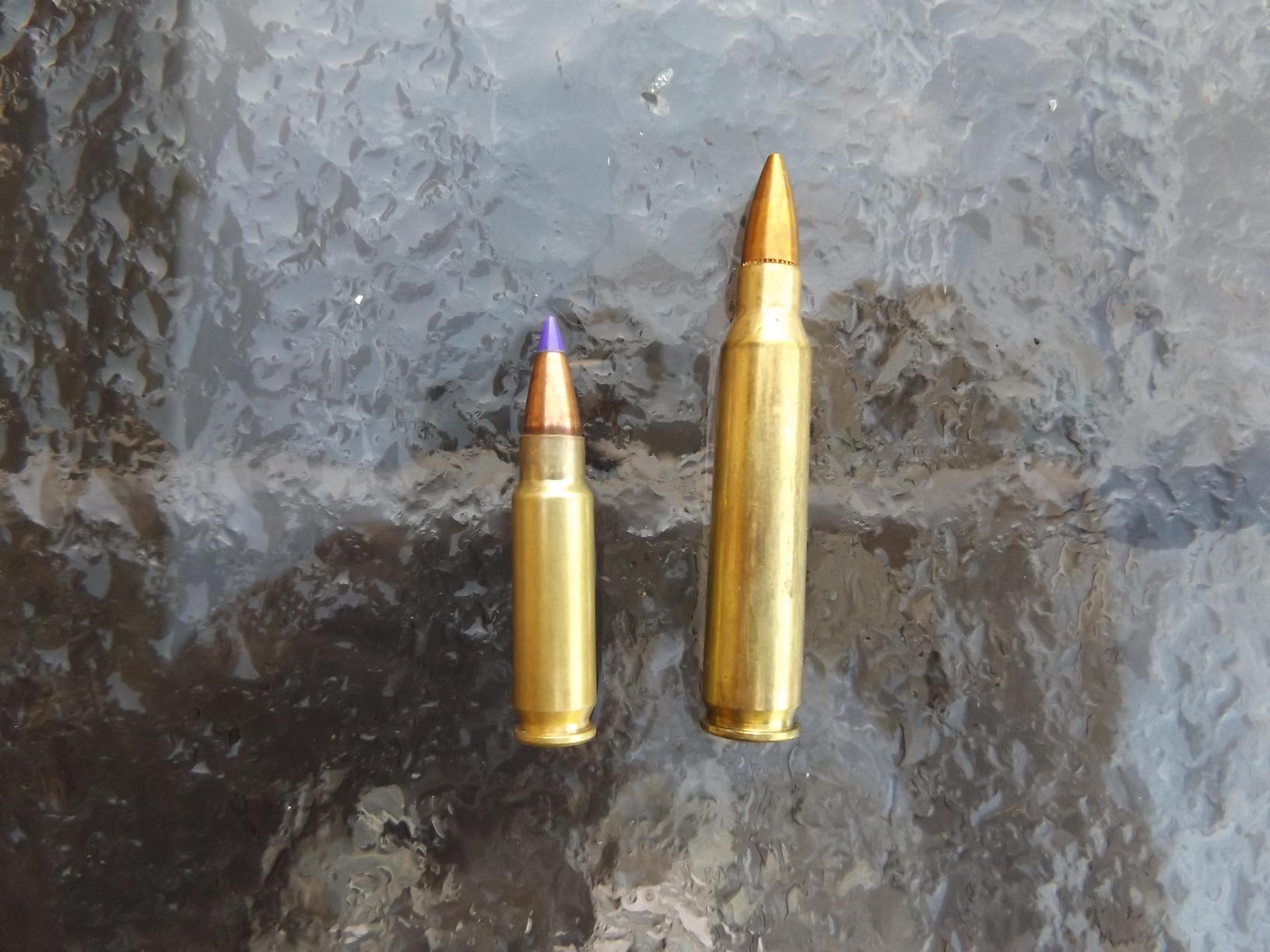
When you look at a 5.7x28mm round, next to a 5.56mm round, it looks like the smaller brother; it is in a way. It fires the same .224 sized caliber bullet, albeit a lighter bullet. The most common bullet is a 40gr version, where the most popular 5.56mm bullet is either a 55-gr or 62-gr round, traveling faster. The 5.7x28mm 40-gr bullet is traveling a little over 2,000 FPS from the PS90, where the 5.56 bullets are moving about 1,000 FPS faster. However, speed isn’t everything, as many believe. There are several factors to make a bullet perform to a desired end. I’ll share more on this later.

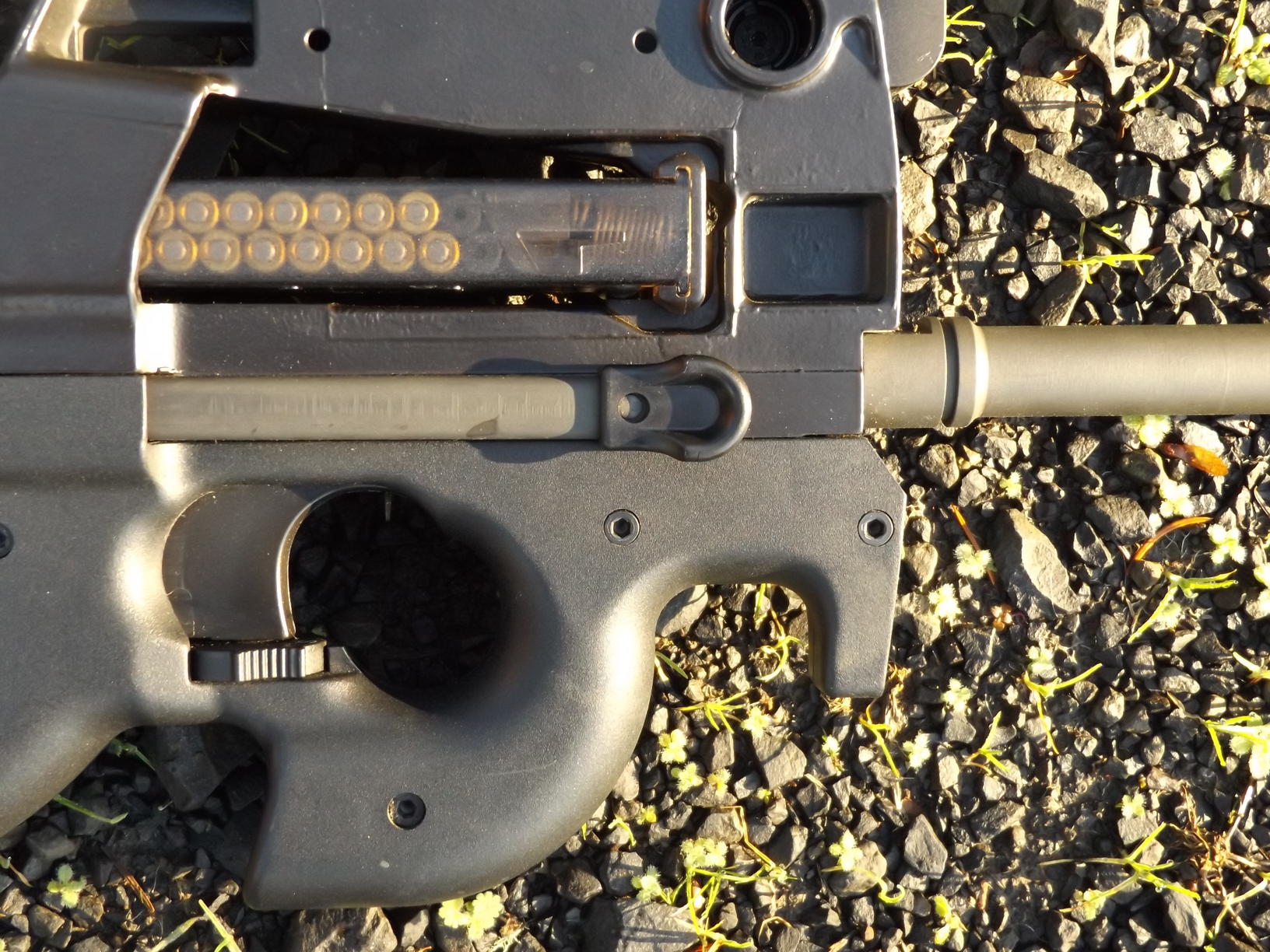
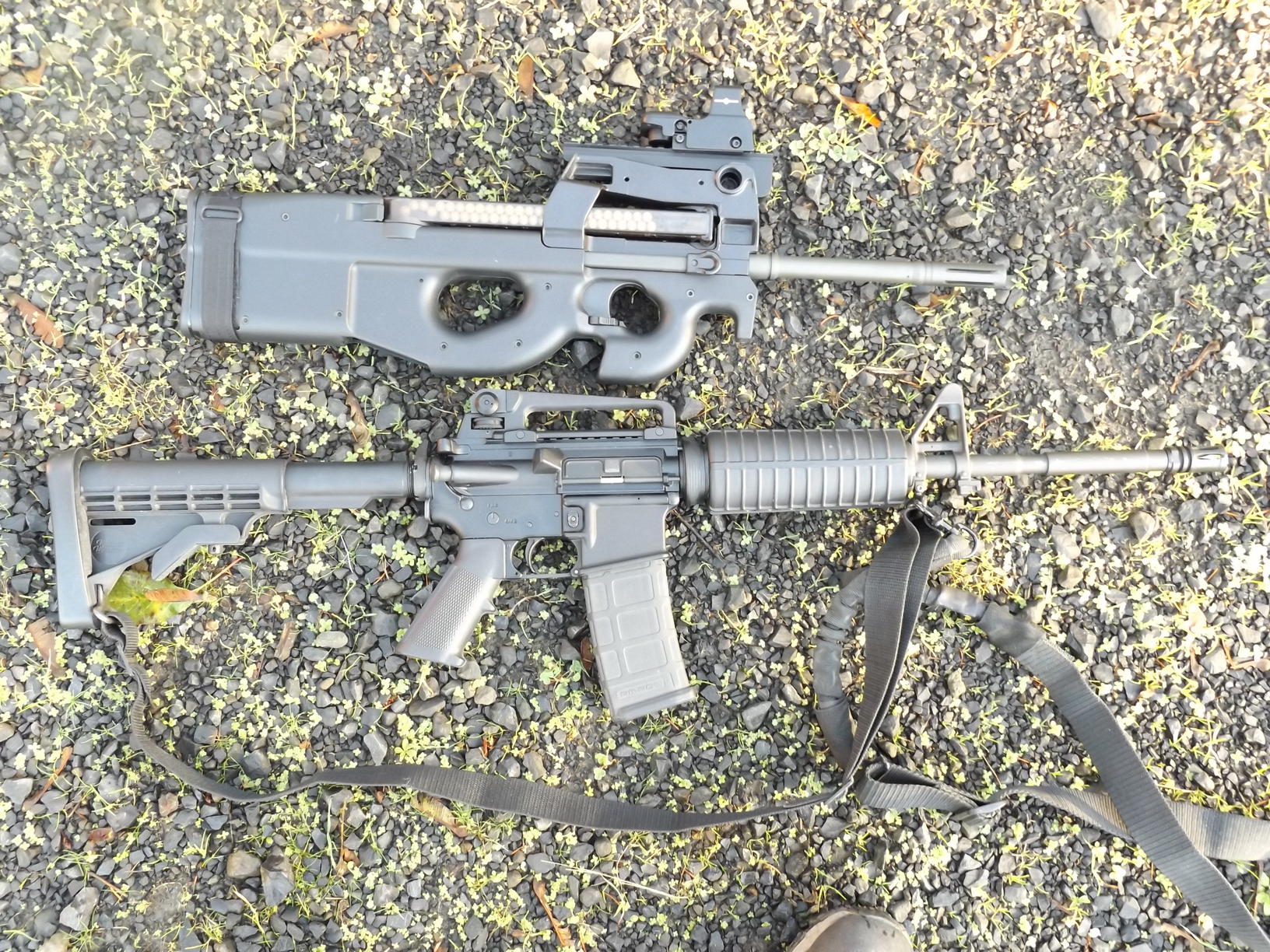
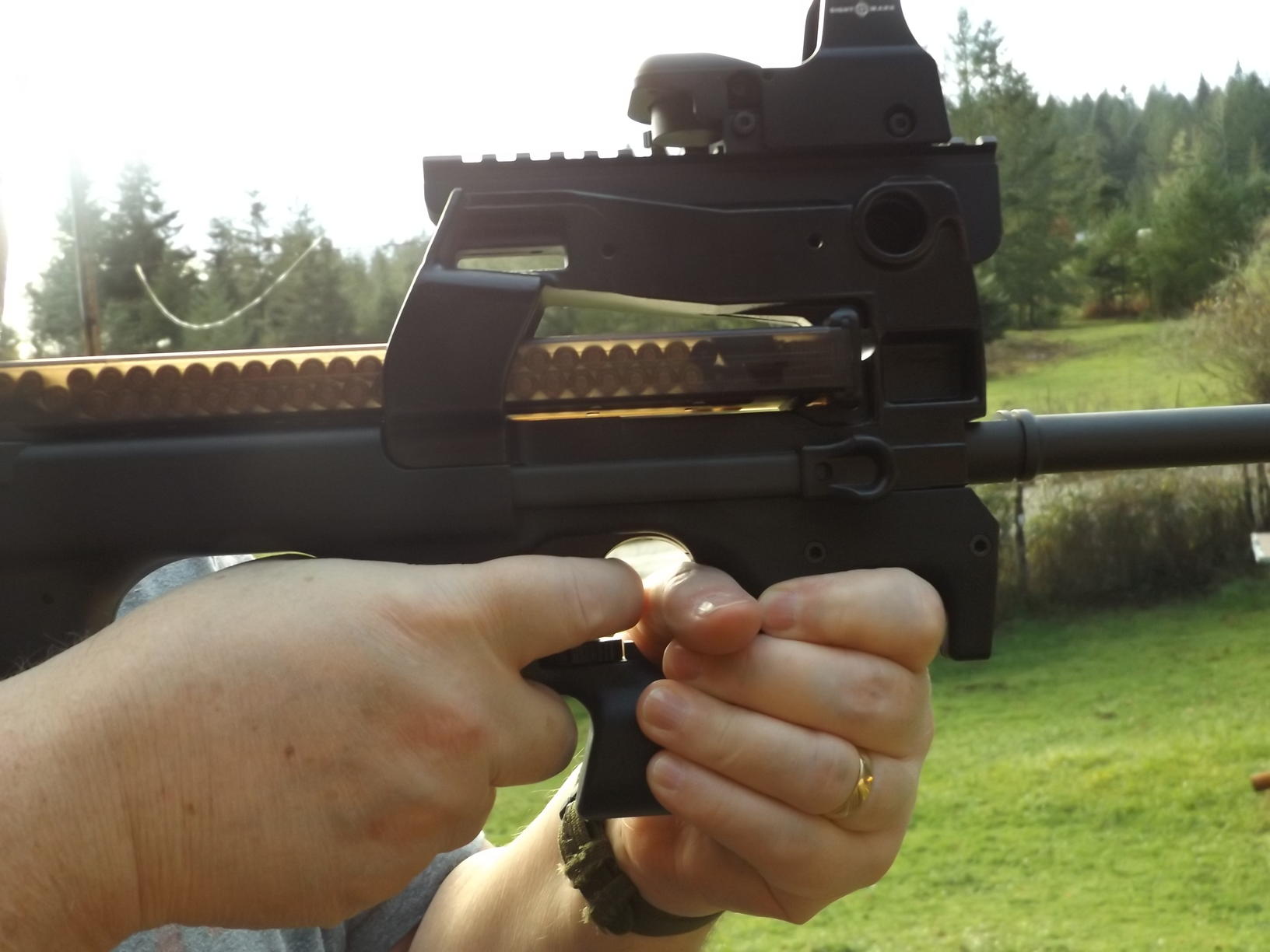
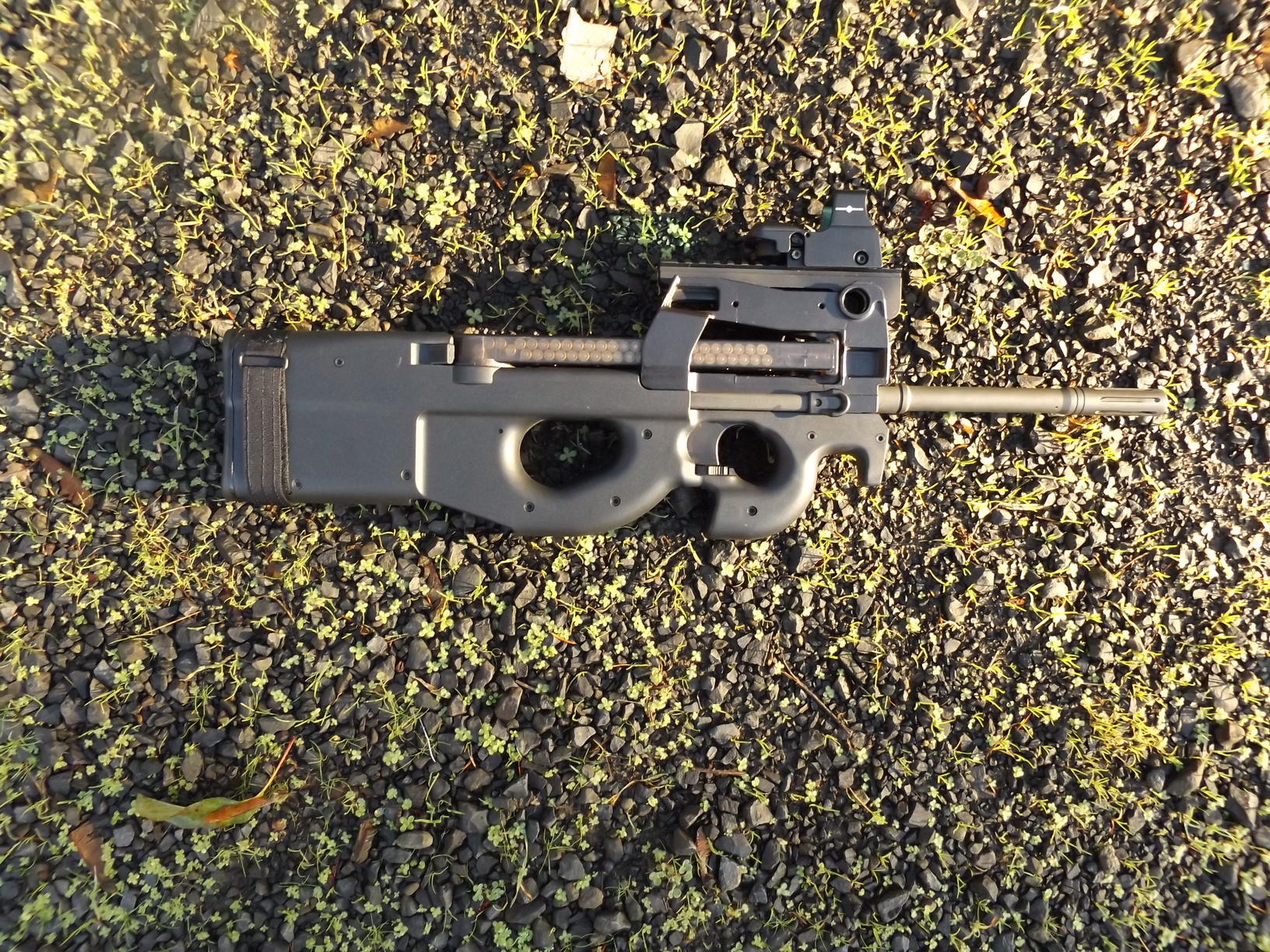
The FN PS90 is a bullpup design with the actual firing group behind the trigger. The 16” Bbl doesn’t appear to be that long, because most of it is behind the trigger. The total overall length of the PS90 Carbine is only 26.23 inches. It’s very compact compared to a military M4. The gun only weighs a little more than six pounds empty. It fires from a closed bolt and is blow-back in operation; it’s very reliable. The barrel has a muzzle brake, not a flash suppressor, however it does reduce muzzle flash a little bit. The trigger is a sliding proposition, like that on the grand ol’ 1911. The safety is ambidextrous as well as the magazine release. The trigger guard is enlarged for use with gloves as well as the unique way you have to hold the gun to fire it. The charging handle is also ambidextrous as well, which is a super cool feature!

There have been several iterations of the PS90 over the years. My version came with the holographic sight in the handle that has the very poor white outline cross-hairs, which are very difficult to see in bright light and slow to pick up. I replaced it with a SightMark Ultra Shot Reflex red dot sight. I had to purchase the FN-made M1913 USG rail in order to mount the red dot. FN is a bit crazy on the price– $150.00, but no one else makes it. There is also a built-in sight in the mount. It is just about totally useless, if you ask me. It’s too hard to see and too slow to pick up. The “carry handle”, for lack of a better word, that the M1913 rail fits into actually has very crude but useful “iron” sights built into it. There is one on either side, and they’re good enough for close-in ranges should the optics fail.

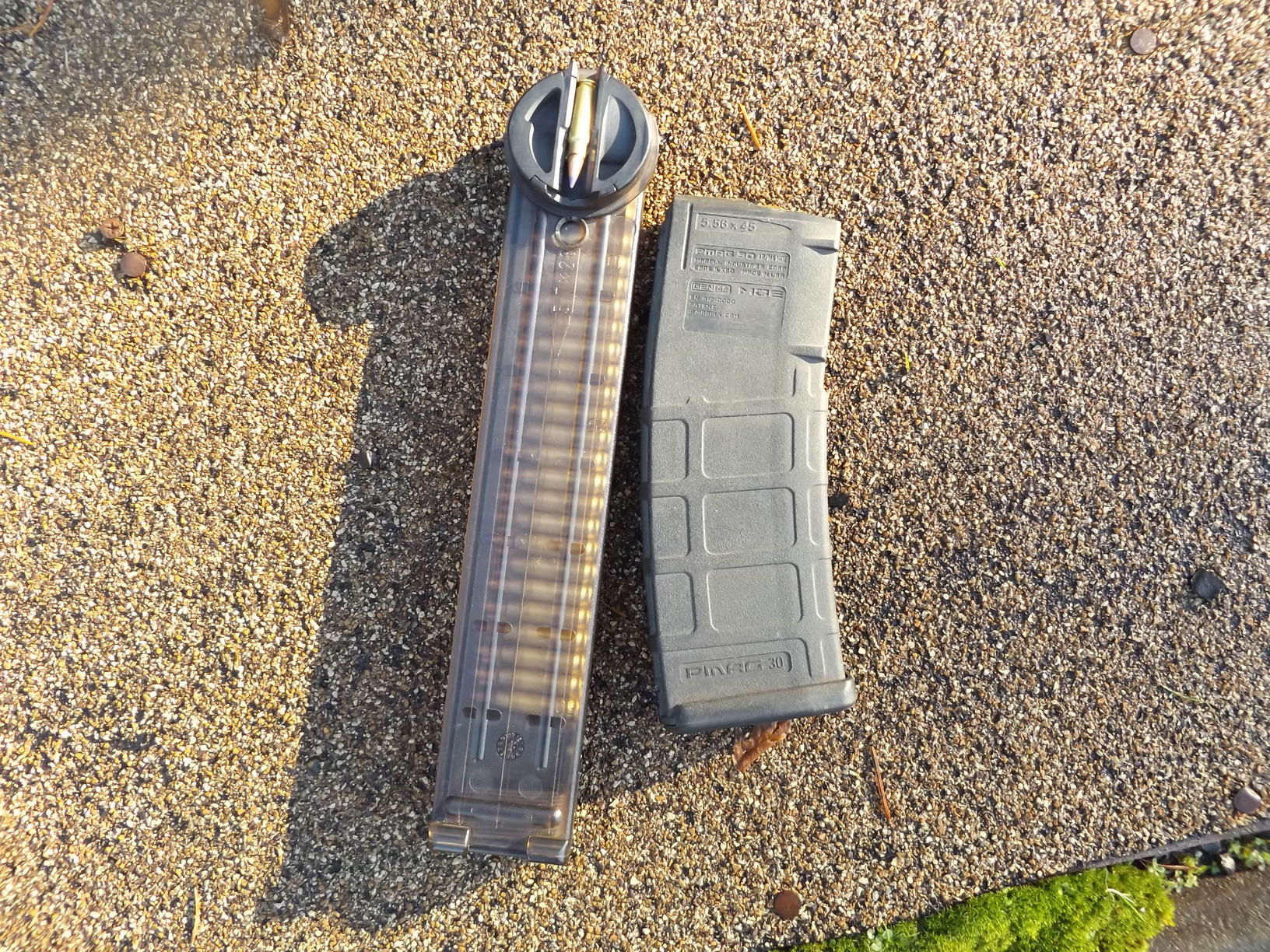
At last count, more than 40 countries were issuing the P90 and the PS90 to their police and military units. The gun is very compact in either version and ideal for close combat work, especially inside of buildings, where a larger weapon might slow you down or be cumbersome. I can readily see the outstanding benefits of the P90 or PS90 as a PDW (Personal Defense Weapon), because it is so compact. The gun can take a 10-, 30-, or 50-round magazine that sits on top of the gun just under the sights. The 5.7x28mm round in the 40-gr bullet weight has proven itself as a stopper. It’s much better than the 9mm round is, and there is less chance of ricochet or over-penetration. Extensive testing has been done by military and law enforcement agencies around the world on this. The PS90, with a 50-rd magazine, loaded with the FN 40-gr V-Max bullet might just be the ultimate Zombie-killing weapon in the world in my humble opinion.

There is very little recoil to speak of in the PS90 and very little in the FN Five-seven handgun chambered in 5.7 that my friend, Mike C., allowed me to shoot. Okay, he actually demanded I shoot it and kept loading magazine after magazine for me. I’ve had several people out shooting my PS90, and after they fired a few round every one of them stopped shooting, turned around with the biggest smile on their faces, and said, “I didn’t expect this…”, meaning the low-recoil and the massive fire-power not to mention the absolute fun factor and outstanding accuracy, too.

Federal Ammunition manufactures a 40-gr FMJ found in 5.7x28mm. However, the velocity is much, much lower than that of the FN 40-gr V-Max polymer-tipped round. It’s about 400 FPS slower. I don’t see the benefit of the Federal round. The price is very close to that of the V-Max round, so I prefer to practice with the round I’m going to use– the V-Max. In my gun trade to get the PS90, the gun came with 900 rounds of ammo and two magazines– one 30-rd and one 50-rd magazine. MidwayUSA has the 50-rd genuine FN mags for sale for $21.99, which is a bargain.

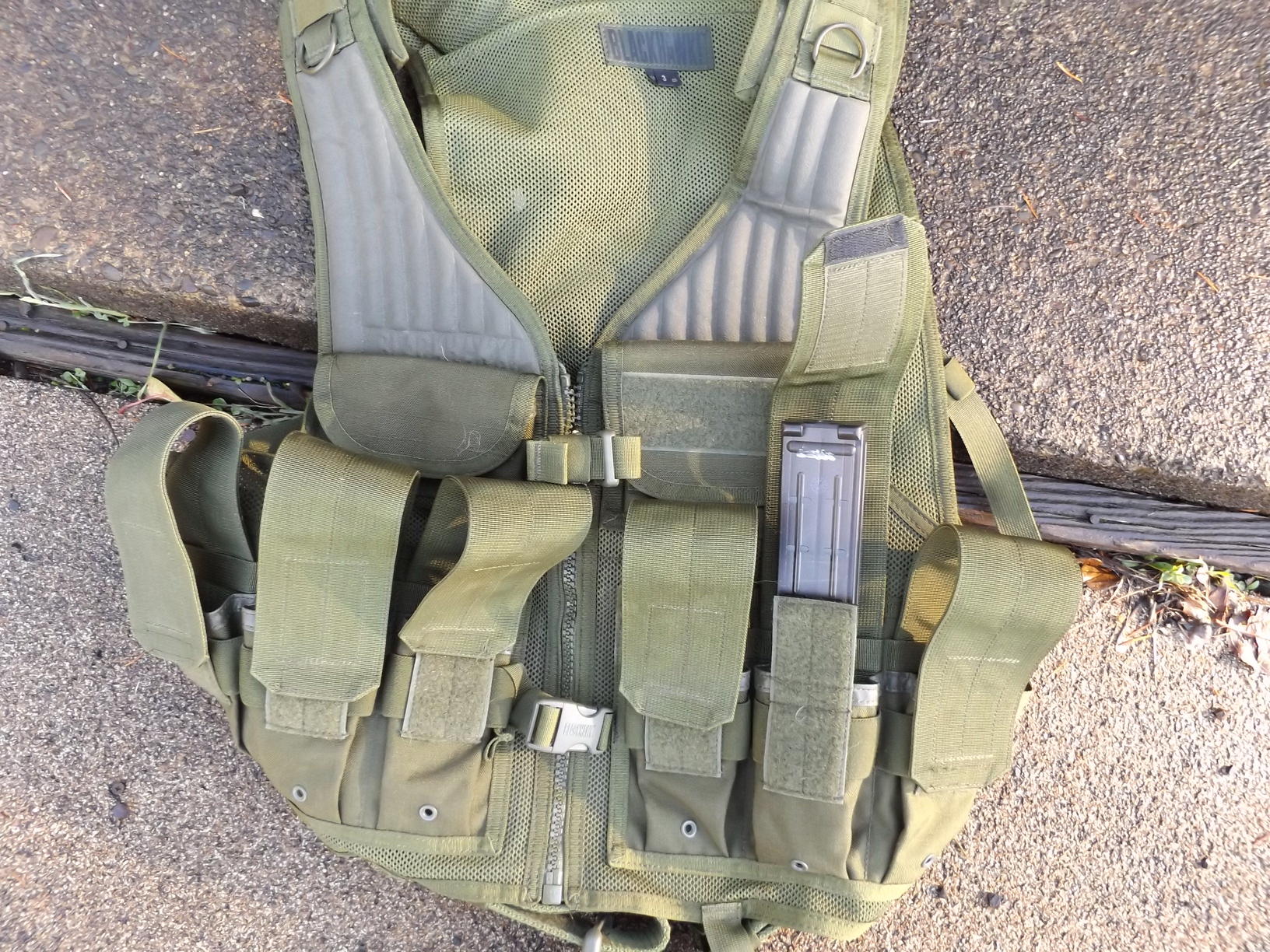
FN sells a tactical thigh magazine pouch that holds two PS90 magazines, but FN is insane. They want $240 for it. You can find similar set-ups on the ‘net for under $50. I took my Blackhawk Products tactical assault vest, which has six pockets on it for 30-rd AR magazines, and had my wife sewed on an added piece of Velcro on the closure flap so that it grabs a little bit more on the matching Velcro on the pocket. Now, the PS90 magazines fit nicely. We are talking six of the 50-rd magazines on-hand and one more in the carbine. That’s serious fire power there. Plus, with the added much lighter weight of the 5.7x28mm ammo, you aren’t carrying all that much weight at all. As I get older, I think I’m getting smarter; I don’t want to carry any more weight than I have to.

FN claims the 5.7x28mm round with 40-gr bullets has an “effective” range of 200 meters. I think that might be a little optimistic. I haven’t done any serious testing for penetration, and you need penetration to stop an attacker, but I’m thinking 150 yards might be more realistic in the stopping department. Much combat takes place at 100 yards or less. This round and gun aren’t designed for long-range work, so don’t get one if you think that. This is a great urban weapon. Again, it is a PDW and would make an outstanding home defense weapon and a great house-clearing weapon as well. Of course, we in the USA can’t get the armor piercing ammo that many military and law enforcement units use on a regular basis, designed to penetrate soft body armor. Still, the 40-gr V-Max bullet will sure get the job done, and it does, according to my research.

The P90 and PS90 also ejects empty brass from under the gun into a nice little pile at your feet. This is great if you reload. There is even an ejection port cover that you can keep closed ala the AR15 to keep dirt out of the action. The trigger pull is a bit different, because it is a bullpup design. The trigger is up front and the hammer is in the back of the stock, so there is a linkage that connects the trigger to the hammer. The trigger pull on my PS90 is about 7-lbs; however, it doesn’t feel that heavy when actually firing the weapon. I love the ambidextrous safety. It is in the bottom of the trigger guard and is easy to put on and disengage as well. The charging handle is located on either side of the gun above the trigger guard, and it doesn’t take much effort to chamber a round; it’s a very short stroke.

Blackhawk Products sells a neat little strap that was designed to go around the stock at the rear of the gun and into a slit. Attach it and you can then snap-on a single-point sling.

I have a few thoughts on the polymer magazines. They are easy to load. Also, you slide the round down and back and then when you slide the next round in the round below, it rotates around 90-degrees and you continue until the magazine is loaded and you can see the loaded rounds in the magazine. I have had zero malfunctions at all. The rounds simply rotate from the magazine into the chamber with ease. That’s nice, very, very nice. The magazine just slides into the gun and snaps in place, very securely. The ambidextrous magazine release is easy to operate as well.

Disassembly of the PS90 takes all of about 10 seconds. Yes, you read that right– 10 seconds. The gun breaks down into several components/sub-assemblies and goes back together just about as fast, too. I like it a lot! Thus far, I’ve put more than 1,000 rds through the PS90 with no malfunctions of any type, and I haven’t cleaned the gun. It is remarkably clean after all that shooting.

When my lovely wife got the chance to fire the PS90, I got “that” smile when she turned around. “That” smile is “I want it”, and she was informed that this was my gun, and we were not “sharing” it, as she often says when she lays claim to one of my firearms. The funny thing is, when she gets one of my guns, I don’t know where the “sharing” part comes it. It is her gun!

Now for the bad news, the FN PS90 retails for $1,449, so it’s not cheap. Then again, it is an FN, which is one of the world’s finest weapons makers, and the PS90, even though it has been out for more than 11 years, is still a bit difficult to find, new or used. When guys or girls buy one, they tend to hold onto them, which is very understandable.

As to accuracy, I’m getting one-inch groups, if I do my part out to 50 yards. It’s a little difficult to get very small groups with a red dot sight on any gun. The FN 40-gr V-Max polymer tipped bullet is super-accurate and very consistent, when it comes to performance. I did a little bit of testing by shooting into water-filled gallon milk jugs, and the spectacular eruption of the bullets when they hit the water-filled jugs is something to see; the milk jugs explode, the bullets expand, and some break apart in the second jug of water. I have no doubts these bullets will get the job done, stopping a violent attack. As mentioned earlier, many police departments in the U.S. and around the world have conducted their own testing and are satisfied with the performance of the little 5.7x28mm round, and that’s what is important. The U.S. Secret Service wouldn’t use this round if it wasn’t effective.

If faced with the Golden Hoard or a Zombie Apocalypse, my PS90 would absolutely be my first choice in a weapon. It’s fast to fire, has very little to no recoil, is accurate, and has 50 rds of ammo on tap. What’s not to like here? My friend, Mike C., said to make sure I let everyone know he goaded me into getting this gun; he shamed me for at least six months until I found one. Okay, Mike, thanks!

A side note: 5.7x28mm ammo is a little difficult to find, and once again Mike C. turned me on to Palmetto State Armory . No one, and I mean no one, comes close to their prices on this ammo. My only complaint is that they are slow to ship, but many places are selling the FN 40-gr V-Max ammo for twice the amount of money that Palmetto is selling it for. Just order well in advance of when you want some ammo from them.

– Senior Product Review Editor, Pat Cascio