
Leatherworking for the Beginner, by R.S.

Leather has been used for millennia as a durable resource for clothing, shelter, armor, and more. If you pay attention, there is an abundance of leather all around you. It’s on furniture and baseball fields, in cars, and on garment racks. If you found yourself in a post-collapse situation, leather is a readily available scavenge resource. If you know how to work with it and have a few simple tools and supplies, you have the solution to countless problems. Later I’ll explain some basics. My journey with leather began a few years ago.

I was attending a homeschool conference and saw a beautiful leather backpack. It was extremely durable, functional, and handsome to look at. It had been constructed to minimize points of failure and last a lifetime. Zippers, for example, were eschewed in favor of buckles, as zippers are typically the first thing to fail on a bag or garment.

I immediately began my online search for this glorious bag only to find that it retailed for $695. Knowing my wife would have an aneurysm if I paid that much for a bag, my dream of carrying this pack died a little that day. A few weeks passed, but I couldn’t shake the thought of the bag. I began to wonder if I could possibly make a backpack. Never mind that my leather-working had been confined to Boy Scout camp 30 years earlier and a failed attempt to make a pair of sandals, I knew I had to try.

Several months earlier I had bought a shoulder of vegetable tanned leather in at attempt at making a pair of sandals. While that effort ended in failure, I was undeterred at a much more difficult undertaking in this backpack project. I began in the same way all beginners since the beginning of time have begun, on Youtube. Several hours later, I was ready to head to my local leather supply store– Tandy Leather.

If you’ve ever taken up a hobbyist endeavor, you likely had the same experience I did as I walked into Tandy that first time. I asked very dumb questions, and they treated me like the idiot I was. But I got my supplies and headed home to begin the first of many leather projects.

I started with the smallest project I could think of, card wallets. These simple creations are literally one piece of leather folded in half and stitched on each side. Simple as it may seem, my first attempts were in hindsight Frankenstein-like. I had yet to realize the importance of patterns, stitch techniques, and overall finishing details. Nevertheless, I was proud of those first pieces. I had created something!

By trade, I’m a sales person. I sit at a desk, write emails, and talk on the phone all day. I don’t work with my hands, and there’s no lasting evidence of my trade. So it was monumentally satisfying to create something functional and lasting.

I started creating larger pieces, like notebook covers and Field Notes holders. Then I made my first shoulder bag. I’ll admit that it was a thrill when people noticed it. Looking back, however, I’m amazed that anyone even mentioned it. My skills were so limited that it was still very amateurish looking. It was those comments though that led me to a revelation, the vast majority of people are overwhelmed at the prospect of learning a trade like leather working. And yet, with less than one week’s worth of self-led training, I was able to make basic goods.

At this point, I decided I was ready to tackle the bag. I’d spent hours researching construction and planning the design. I read online forums and watched more videos and went back to Tandy to buy the hide I would use. I asked them more questions, and they still looked at me like I was an idiot. Undeterred, I began.

I spent every free minute for weeks working on my bag. I worked slowly (mainly because I was slow) to minimize error. I lined it with pigskin and melted down when I made a mistake. After nearly 40 working hours, I completed my bag. It was an amazing feeling. Everywhere I went people commented on it and asked where I bought it. Even now, I carry that bag every day to work. The bag I didn’t want to spend $695 on probably ended up costing me about four times that to make myself when considering time and materials, but I’d learned a trade.

Now I run my own small leather-working business selling duffle bags, tote bags, wallets, belts, and other assorted custom leather goods. It will likely always be a side project for me, which is fine. I don’t do it for the money. Now I know that if I need to make something, I have the basic skills necessary to do so by hand without electricity. Here’s the best part– so can you!

There are really only a few basic tools that are needed for simple leather projects. Several of these are likely already lying around any modestly appointed garage.

First, the tools you likely have:

  • Rubber mallet or dead blow hammer (do not use a standard hammer, as it will damage your punches)
  • Utility knife
  • Lighter – for melting the ends of your stitch
  • A few small-to-mid-sized washers – handy for cutting rounded corners
  • Awl – used for marking your cutting lines and punching through a hole that’s too small
  • Plastic kitchen cutting board – when you punch through the leather it’ll save your tools to punch into this board
  • Ruler – preferably flat, metal

Leather-working-specific tools you’ll need to buy:

  • Diamond punches
  • Needles
  • Cutting mat – These can be bought at a sewing shop or Wal-Mart. While not required, it’ll save your table top and extend the life of your cutting blades, not to mention prove a handy measuring tool.
  • Wing Divider

Materials:

  • Waxed poly cord – I use the waxed cord from Maine Thread Company. It is made in the U.S.A and great quality. I prefer a .030” diameter cord.
  • Leather hides – I could write a series of articles on this topic alone. Let’s assume that you won’t be dyeing your leather at this point. Considering we’re talking about a survival situation, you’d be re-purposing whatever you can find. My advice is to make life easy on yourself and find a hide that’s already tanned at the thickness for your desired project. Get creative as your skillset grows.
  • Poster board – Buy good, thick stock for making your patterns. Leather moves when you work with it, so you’ll definitely want to make patterns of the pieces you’ll be cutting out.
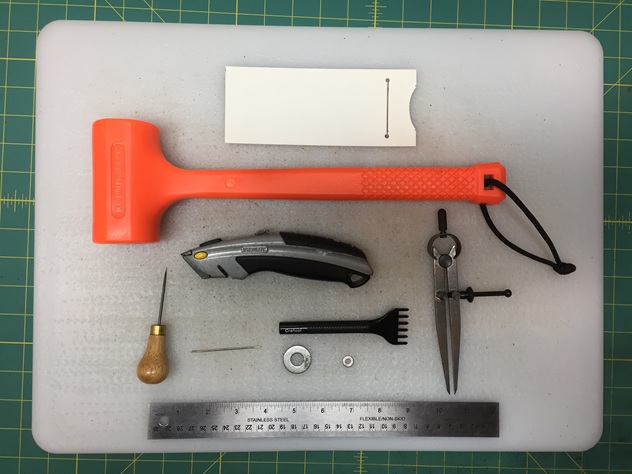
Depending on your project, there could be a much longer tool and material lists. Things like rivets, buckles, snaps, and d-rings could be on this list. Let’s start small, shall we?

The Project

Now that you have your materials, you are ready to begin. For the purposes of this article, we will begin where I began– with a card wallet.
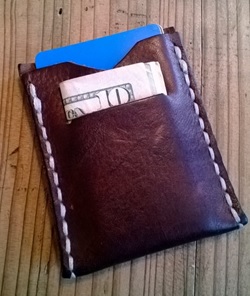
This is one of the first card wallets that I made. As you can see, it’s a very simple straight-forward design.

  1. Make your pattern

    Measure out and mark the following dimensions on your poster board: 2 3/4” x 6 3/4”. The slit should be 2 1/8” wide.
    Use your utility knife and the edge of your metal ruler to cut out the pattern. Be as exact as possible. This will help immensely later in the process. Cut the slit open at this point as well.

  2. Mark your pattern on the hide

    Lay your pattern on the finished side of the hide. I like to use a paperweight to hold the pattern in place so it doesn’t slip while tracing it. Use the awl to trace the outside of the pattern and the slit.

  3. Cutting the leather

    Using your metal ruler as a guide, cut along the lines you marked on the finished side of the hide, being careful to keep your knife upright and the ruler still throughout the process.

    This is a stressful part of the process when you’re just beginning. You’ve probably paid a decent amount for your hide and don’t want to mess up. Have no fear; we’re starting with a small project and you can’t mess it up that badly.

    Now take one of your small washers and align it flush to the edges of the top right corner. Use your utility knife to trim off the edge using the washer as a guide. This should result in a nice, rounded corner. Repeat for each of the four corners.

  4. Marking your stitch lines

    Set your Divider Wing to a width of 1/8”. You’ll notice that one of the tines on the tool is slightly longer than the other. Place the shorter tine on the leather and use the longer tine as a guide along the outside edge of the length of the hide. This allows you to mark a straight line a consistent width from the side of the piece. Do this on Side A and Side B.

  5. Punch stitching holes

    Using your diamond punch, align the first tine of the punch just off the top of side A. The first tine won’t actually punch through the leather, if you do it correctly. This simply allows you to get a consistent alignment of the holes on each side. Line the remaining tines up along the line you just marked in step 4.

    Use your mallet to hammer the punch through the leather into the cutting board. (Pro-tip: Do not do this into a table top or your cutting mat. It’ll ruin the table and is very hard on your punches over time.)

    After punching through the leather, place your finger lengthwise along the face of the punch and hold the leather down while you extract the punch with your other hand. This will help keep the leather from stretching out as you remove the punch.

    Now put the first tine of the punch in the last hole on the piece and hammer the next set of holes. Do this until you have a row of holes along the length of side A. Once that’s complete, do the same on side B.

  6. Fold and stitch

    Now, fold your piece in half so the holes are aligned. To measure the amount of thread you’ll need, pull off a piece that is roughly 4” longer than the length of the folded piece and then double that length. You can cut two pieces to that length, as you’ll need the second piece for side B.

    Thread your waxed cord through your stitching needle. We’ll be using what is called a saddle stitch. A saddle stitch is essentially a running stitch that is stitched in each direction. It’s especially durable, as you’re basically stitching the piece twice. This ensures that if one stitch breaks, the other will still be intact.

    Start at the bottom where the piece is folded and push your needle and waxed cord through (yes, it may be difficult; yes, your hand will hurt if you stitch long enough!). Leave about two inches out of the end of the initial hole. Now, with your needle, go up to the next hole and back through. Weave your way to the top of the piece and then back down to where you started. Your stitch should look like the picture of the card wallet shown above.

    Now you should have one end of the waxed cord point one way out of the initial hole and the other end with the needle pointing the other way. Take the needle and stitch back up one hole so your threads are both pointing the same direction, one hole above the other. Take your needle and thread it under the stitching to the immediate north (up) from where it is. Push the needle all the way through, which should create a small loop. Put the needle back through the loop and pull it tight. This will knot the thread.

    Remove the needle and re-thread the other end of the waxed cord and knot that one in the same manner.

    Now trim the loose ends to about 1/8”, and use the lighter to singe them down to nothing.
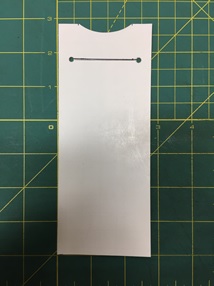
Voila, you have a card wallet!

With these simple skills and tools, you have the foundation you need to start creating (or surviving) using leather craft.


Letter: Major Mistakes with a Building Contractor

Hi,
I purchased 150 acres in my chosen location and intended to have a cabin built on it with a well and septic system. I found a contractor who said he would complete a well, septic, and “dried in cabin” for me. He was making good progress and completed about 60% of the work and then just stopped working on it. He has been at it for over four years, and the wood framing is getting very old. Anyway, this was the first time I’ve ever hired a contractor to build something for me, and like a moron I gave him the final payment (over $110,000 in total) about two years ago. I now have four walls, 1/4 roof with tar paper, and a septic tank.

I am told suing him wouldn’t get me anything, since he is completely broke. I dumped much of my retirement into this and am slowly saving up again. Do you have any advise for me? I feel like such an idiot. – B.M.

HJL’s Comment: Sadly, you have now learned a lesson from the school of hard knocks that countless others have learned. It’s not necessarily that your contractor set out to defraud you either (though the industry is rife with charlatans). Many simply underbid the project, can’t pay the necessary bills, and start the dangerous practice of using your money to pay for another project’s bills. Like any “borrowing from Peter to pay Paul” situation, it usually catches up to them and they can’t continue, leaving the last few customers holding the bag. I’m skeptical of your contractor’s skills and knowledge, because two years is a very long time for a build. Six to nine months is more typical, and a well prepared contractor can move the project along in as little as four months.

In the future, here are a couple of things you can do:

  1. Make sure your contractor is licensed and bonded. While I dislike the idea of the government telling me what I can and can’t build or who I can hire, those are two things that go a long ways towards alleviating the issue. Many laborers believe that since they have the skill and knowledge to build a house that they can be a contractor, but running a business is something at a whole other level. All the building skill in the world won’t teach you good business practices. Those who make the effort to be licensed and bonded are at least trying.
  2. YouTube is your friend. There are videos on every aspect of building a home. When your contractor tells you he is doing something or describes a process to you, look it up on YouTube and see if it is standard practice.
  3. Always pay your contractor in segments and never release a payment until the agreed upon work for that particular segment is complete. The final payment should be up to 1/3 of the price of the project and should never be released until the project has your final inspection and approval. You will probably hear all manner of sad stories about why you should release a payment early, but if you do, you lose your leverage, especially that final payment.
  4. Do your due diligence on the contractor before signing a contract with him. Ask for references and projects that you can view in person. Simple background checks for criminal history are easy and inexpensive. In retrospect, the cost is well worth it when you consider how much you’ve lost. Depending on your location, you may be able to ask the county/city/state inspector for an opinion.
  5. As much as it pains me to say it, be careful about friends, family, and even fellow church members when it comes to building contracts. I’ve seen many relationships destroyed over the parties inability to separate business from personal. It would seem that those who are closest to you just expect you to release them from any responsibility when the going gets tough. I’m not suggesting that you avoid those contacts, but make sure the other person understands that it is a business contract. You should understand that saying “no” to making an early payment for these people is extra difficult and most will expect you to bend.


Economics and Investing:

Three former London-based traders face US charges over currency rigging – G.G.

o o o

Lincoln Cent Roll Searching: What I Found in a $25 Box of Pennies – DSV

o o o

The “Curse” of Labor-Saving Machinery Is Nothing New

o o o

Record 95.1 million Americans not in the labor force. The challenge of having an army of non-working adults.

o o o

SurvivalBlog and its editors are not paid investment counselors or advisers. Please see our Provisos page for details.


Odds ‘n Sods:

Land of the Free: Michigan man issued parking ticket in his own driveway

o o o

Airport Shooter Converted to Islam, Identified as Aashiq Hammad Years Before Joining Army – W.C.

o o o

US-Funded White Helmets Exposed in Al-Qaeda Plot that Poisoned Water of 5 Million Syrians. It is bad enough they contaminated the water supply, but they control the area so no one can go there and fix it. Same with electricity. Civilization is easy to destroy and easy to keep from being rebuilt if you are dependent on it. – T.Z.

o o o

Finally! The US Air Force has embraced reality — the A-10 is here to stay ‘indefinitely’ – T.P.

o o o

And we wonder what is wrong with our churches today? Koran Verse Denying Jesus Was Son Of God Sung in Scottish Cathedral – D.S.


Notes for Wednesday – January 11, 2017

January 11th is the birthday of Alexander Hamilton (1757-1804). It is also the natal day of the late Gunnar Fridtjof Thurmann Sonsteby, who was born in 1918. He was the most decorated hero of the Norwegian resistance under the German occupation. He died May 10, 2012.

o o o

Today, we present another entry for Round 68 of the SurvivalBlog non-fiction writing contest. The nearly $15,000 worth of prizes for this round include:

First Prize:

  1. A $3000 gift certificate towards a Sol-Ark Solar Generator from Veteran owned Portable Solar LLC. The only EMP Hardened Solar Generator System available to the public.
  2. A Gunsite Academy Three Day Course Certificate that is good for any one, two, or three day course (a $1,195 value),
  3. A course certificate from onPoint Tactical for the prize winner’s choice of three-day civilian courses, excluding those restricted for military or government teams. Three day onPoint courses normally cost $795,
  4. DRD Tactical is providing a 5.56 NATO QD Billet upper with a hammer forged, chrome-lined barrel and a hard case to go with your own AR lower. It will allow any standard AR-type rifle to have a quick change barrel, which can be assembled in less than one minute without the use of any tools and a compact carry capability in a hard case or 3-day pack (an $1,100 value),
  5. Gun Mag Warehouse is providing 20 Magpul PMAG 30-rd Magazines (a value of $300) and a Gun Mag Warehouse T-Shirt; (an equivalent prize will be awarded for residents in states with magazine restrictions),
  6. Two cases of Mountain House freeze-dried assorted entrees in #10 cans, courtesy of Ready Made Resources (a $350 value),
  7. The Ark Institute is donating a non-GMO, non-hybrid vegetable seed package (enough for two families of four) plus seed storage materials, a CD-ROM of Geri Guidetti’s book “Build Your Ark! How to Prepare for Self Reliance in Uncertain Times”, and two bottles of Potassium Iodate (a $325 retail value),
  8. A $250 gift certificate good for any product from Sunflower Ammo,
  9. Two cases of Meals, Ready to Eat (MREs), courtesy of CampingSurvival.com (a $180 value).

Second Prize:

  1. A Tactical Self-Contained 2-Series Solar Power Generator system from Always Empowered. This compact starter power system is packaged in a wheeled O.D. green EMP-shielded Pelican hard case (a $2,400 value),
  2. A Glock form factor SIRT laser training pistol and a SIRT AR-15/M4 Laser Training Bolt, courtesy of Next Level Training, which have a combined retail value of $589,
  3. A gift certificate for any two or three-day class from Max Velocity Tactical (a $600 value),
  4. A transferable certificate for a two-day Ultimate Bug Out Course from Florida Firearms Training (a $400 value),
  5. A Trekker IV™ Four-Person Emergency Kit from Emergency Essentials (a $250 value),
  6. A $200 gift certificate good towards any books published by PrepperPress.com,
  7. A pre-selected assortment of military surplus gear from CJL Enterprize (a $300 value),
  8. An infrared sensor/imaging camouflage shelter from Snakebite Tactical in Eureka, Montana (A $350+ value),
  9. RepackBox is providing a $300 gift certificate to their site, and
  10. American Gunsmithing Institute (AGI) is providing a $300 certificate good towards any of their DVD training courses.

Third Prize:

  1. A Model 175 Series Solar Generator provided by Quantum Harvest LLC (a $439 value),
  2. A Royal Berkey water filter, courtesy of Directive 21 (a $275 value),
  3. A custom made Sage Grouse model utility/field knife from custom knife-maker Jon Kelly Designs, of Eureka, Montana,
  4. A large handmade clothes drying rack, a washboard, and a Homesteading for Beginners DVD, all courtesy of The Homestead Store, with a combined value of $206,
  5. Expanded sets of both washable feminine pads and liners, donated by Naturally Cozy (a $185 retail value),
  6. Two Super Survival Pack seed collections, a $150 value, courtesy of Seed for Security, LLC,
  7. Mayflower Trading is donating a $200 gift certificate for homesteading appliances,
  8. Montie Gear is donating a Y-Shot Slingshot and a $125 Montie gear Gift certificate.,
  9. Two 1,000-foot spools of full mil-spec U.S.-made 750 paracord (in-stock colors only) from www.TOUGHGRID.com (a $240 value), and
  10. Fifteen LifeStraws from SafeCastle (a $300 value).
  11. A $250 gift certificate to Tober’s Traditions, makers of all natural (organic if possible) personal care products, such as soap, tooth powder, deodorant, sunscreen, lotion, and more.

Round 68 ends on January 31st, so get busy writing and e-mail us your entry. Remember that there is a 1,500-word minimum, and that articles on practical “how to” skills for survival have an advantage in the judging.


Four Procedures For Survival in Your Camp, by ARD

We recently saw how important it is to uphold 2 Chronicles 7:14. Although we have known that this beloved United States that we call home is not quite so “united”, we have discovered there are more Christians than there are non-Christians. (If God be for us who can be against us!) For some time, the liberals have used the media to be their trumpet or voice, which has made it appear that they are the majority. But I tell you this; I believe that what has occurred recently, with the election of Donald Trump, is that the normal quiet Christian (myself included) has realized that to survive in America we must stand up, voice our Godly opinion, and act and also understand that prayer does change things! Miracles are real, but they do not occur without faith, trust in our Lord, and action or prayer on our part. You can study, read every survival blog, and have the best “prepper” camp in the world, but without God on your side you will not survive. Given the fact that your camp is pretty much “ready to rock when it all goes down”, I ask you to take a step back, look over everything, and see if you are truly ready.

I cannot stress the importance and necessity of implementing the following procedures in your camp for your successful survival: (1) Fasting & Prayer, (2) Continual Intercessors, (3) Praise and Worship, and (4) Discerning Individuals.

My background is 20 years in law enforcement (local and federal level police as well as my last year spent in corrections) and 23 years of committed Christian service. I have seen the evidence of miracles from prayer and fasting. I have witnessed incidences in my law enforcement career that were only the divine hand of God preventing evil from occurring to me, my family, and other officers. I never in a million years believed I would work in the jail, but (after prayer and careful consideration of pros and cons) I now understand the importance of gaining the knowledge of working there and being able to apply it to a society of lawlessness if the unthinkable (EMP, terror attack, financial crisis, man-made, or natural disaster) were to occur. With that said, it is my belief and understanding to survive mentally, physically, and spiritually, these are the best ways to prepare for what is to come.

Fasting and Prayer

Fasting and praying is something I never understood until I began faithfully going to church with my family and researching the significance of the results. In the Bible, the Book of Esther reveals that fasting combined with prayer can change the course of an entire nation!  I have read and heard that numerous people in America were led to fast and pray in regards to the elections and Trump winning. As proof from my own life, nineteen years ago, I fasted and prayed for three days with no food and only some water. The first day in I thought I was going to die without food. Mentally, that was the hardest part to overcome. Determined to get to day three, when it finally came, I realized it was more about setting aside my needs and showing the Lord that I was serious and nothing was going to prevent me from completing this important task. The reason I set the goal to fast and pray was to go to a revival and see miracles of healing in people there. Little did I know that I was one of the beneficiaries of the whole fasting and prayer! It was during a time that I wanted a child with my husband. Without getting into a lot of detail, I can honestly say that miracles can and will occur, as a result of prayer and fasting, as we have two beautiful children now. Along the way, I saw the hand of God appear that has forever strengthened my faith. During the rough times ahead, we are going to need miracles to survive, and trusting in God is going to be inevitable for survival. Not everyone in your camp will be able to partake of the “fasting and prayer” as physical and mental strength is required for certain jobs, such as security or jobs with physical labor. There may be those who are physically not well enough to do this, so volunteers will be needed, as they can function as your intercessors, too. In doing further research, you will see there are different types of fasting, as well as different times when it is needed. Prayer intercession is also something that will be essential at your camp.

Continual Intercessors

The number of people in your camp would determine the number of people who could be assigned the duty of praying over the camp. It should be noted that no one should be forced to do this and you definitely want those individuals who truly will be dedicated to the cause and understand the importance of the task. For example, if you have a minimum of 24 people in your camp, that equals 24 hours in a day, with each individual assigned one hour devoted to prayer. The more individuals you have the better, because you could assign at least two or more to the continual prayer group. Just a few verses from the Bible stating strength comes from praying together are as follows:

Matthew 18:20 – “For where two or three are gathered together in my name, there am I in the midst of them.”

Matthew 18:19 – “Again I say unto you, That if two of you shall agree on earth as touching any thing that they shall ask, it shall be done for them of my Father which is in heaven.”

Romans 12:12 – “…rejoicing in hope; patient in tribulation; continuing instant in prayer;”

Once you have a schedule of those who will be praying constantly, it is important to recognize who has the ability of discernment or basically can recognize good and evil. That will be discussed later, after the importance of learning praise and worship.

Praise and Worship

I have learned through praise and worship that the Holy Spirit comes, and when this occurs miracles can happen. Some may not agree that music, like food, is essential for living. But in my opinion, you will not understand unless you have sung praises to the Lord and reach that connection to Him that provides strength to accomplish anything. I would not be in law enforcement for over 20 years if I did not trust in the Lord to protect me. (Psalm 91 is a must to memorize.) I get up two hours early to pray before going to work. I live enough of a distance away that I can listen to about three praise and worship songs before entering the “den of hell”, which is the jail. I say this not complaining, because I have always loved law enforcement and I love even more now my newest job in corrections. However, there is no way I would go to work without first praying and second singing praises to God. It provides a confidence and a strength of who is backing me up when I am faced with any situation, whether it is an uncooperative person from drugs and/or alcohol or whether it is a demonic/possessed person. You cannot have fear, and you cannot rely on your own strength. It is impossible to do this on your own, but with God all things are possible! When you sing a song to the Lord, it becomes written in your heart and you carry it with you throughout the day. It can make a horrible day much easier to bare. Not to sound doom and gloom, but you and I both know that there are horrible days to come.

It only makes sense to have songs on hand for praise and worship. Go ahead and print out praise and worship songs and have them available because if there is no electricity later you won’t be able to get them. Have plenty of Bibles on hand. The good news is that without power, you can still have praise and worship if you have musicians who can play the piano, guitar, drums, or basically any instrument that does not require electricity. If you do not have any music, you still have your voice!

Praise and worship Him now while you still can, for the day may come soon when silence will be a requirement to survive. At least you will have the song in your heart, which no one can take away.

Discerning Individuals

Having discernment is invaluable in your camp. You must be able to recognize good over evil and not be swayed by their skills or occupation. I have known many people in law enforcement or even pastors in the community that “on paper” looked really good, but due to their character, morals, or even racist beliefs I definitely would not want in my camp. I have also known individuals that would admit they were once “rotten to the core” (whether from drugs, assaults, burglaries, et cetera), yet God changed their heart and transformed them into the kind of person you would want on your team. However, I have yet to hear or see any transformation of sex offenders. It’s not to say there are not any, but I have not seen or heard it. Therefore, you may want to go ahead and print off a “sex offender registry” in your region or area and have on file in case electricity goes out. This will not cover everyone due to laws such as “first offenders” or “first offenders as youths”. It also will not cover those who are repeat offenders but were never prosecuted, and from experience I have seen this happen way too often. When it comes to the safety of the women and children in your camp, as well as your own safety, having discernment of individuals is a necessity.

“Dear friends, do not believe every spirit, but test the spirits to see whether they are from God, because many false prophets have gone out into the world.” 1 John 4:1 NIV

For many this can be an exciting time or a terrifying time. Some things are going to happen that truly will be tragic, and there is no way to prepare for that except by trusting God and thanking God that “He will never leave us nor forsake us”! God has given you the Bible; therefore, the only true preparation is knowing where you will spend eternity. As the parable of the Good Samaritan states in Luke 10:25-28 (NIV), follow the words of Jesus, and you will live.

The Parable of the Good Samaritan

On one occasion an expert in the law stood up to test Jesus. “Teacher,” he asked, “what must I do to inherit eternal life?”

“What is written in the Law?” he replied. “How do you read it?”

He answered, “‘Love the Lord your God with all your heart and with all your soul and with all your strength and with all your mind’[a]; and, ‘Love your neighbor as yourself.’[b]”

“You have answered correctly,” Jesus replied. “Do this and you will live.”

May God bless you, protect you, and keep you safe from harm, in Jesus’ name, Amen.


Letter Re: Thriving With Airedales

Folks,

It appears that the War Dog leashes I purchased may be available again. In looking up the company (T3gear.com) they are now carrying a leash that appears to be similar to, if not the same as, the ones I bought when I knew the people running the company. Link supplied merely to assist. I cannot vouch for this particular product; the leashes I have are amazing, and these look nearly identical. I have no connection to this company – “Food Guy”


Economics and Investing:

It is notable that spot gold is now at around $1,187 per Troy ounce, while platinum is down around $978. This nearly $200 price disparity means that you can buy slabbed (PCGS graded) platinum U.S. Mint Liberty bullion coins for less than equivalent weight gold U.S. Mint Liberty bullion coins that are loose (ungraded). In my estimation, that makes platinum a screaming “Buy!”, especially with President Trump’s tax cuts just around the corner. (Those cuts should encourage an economic revival, which will likely mean a return to the historic norm of platinum selling for more than gold.) – JWR

o o o

L.A. needs to borrow millions to cover legal payouts, city report says – H.L.

o o o

Mike Maloney: Prince: GOLD HOARDER? How Much Did He Own?

o o o

Taxpayers Footing the Bill for the Inauguration Junkets

o o o

Living Wage Idiocy and Free Money Experiments

o o o

SurvivalBlog and its editors are not paid investment counselors or advisers. Please see our Provisos page for details.


JWR’s Recommendations of the Week:

Books:

The Total Money Makeover: Classic Edition: A Proven Plan for Financial Fitness, by Dave Ramsey

The Lose Your Belly Diet: Change Your Gut, Change Your Life, by Travis Stork

Movies:

13 Hours: The Secret Soldiers of Benghazi (Now also available with Amazon Prime.)

97% Owned (Documentary on the global debt-based monetary system. Note that although the producers of this film obviously have a leftist bias, the information included about how modern “money” is created is correct. Amazon Prime members can watch it free.)

Television:

Ken Burns: The Dust Bowl (Now available with Amazon Prime.)

1916: The Irish Rebellion. (Now available with Amazon Prime.)

Music:

The Essential Guy Clark

Firefly Soundtrack (Greg Edmondson)

Instructional Videos:

Active Self Defense YouTube Channel. (Thanks to reader Peter S. for the link suggestion.)

Dave Delany: Winter Survival Shelter under a large conifer

Podcasts:

Folk Alley’s AlleyCast

SGT Report

Gear:

(Both of the following Glock pistol home armorer tools were recommended to me by Tamara at the great View From the Porch blog. They work great!)

Truglo Glock Front Sight Installation Tool

Ameriglo Sight Pusher Tool for Most Glock Models, Angled Sided


Odds ‘n Sods:

Pat Cascio informs us that the “news” announcer cited the wrong state yesterday. Washington is the state in trouble with the anti-second amendment onslaught after the elections.

o o o

10 fire types for outdoor survival – G.P.

o o o

All of the talk about “Universal Background Checks” seems to overlook two key points: First, private party sales of USED guns in INTRASTATE commerce is completely outside of Federal Jurisdiction, under the Commerce Clause (which controls INTERSTATE commerce.) Second, a universal background check would presumably stop someone from legally handing out (gifting or selling) guns from their personal collection in the event of a disaster, an invasion, or in a legitimate uprising to counter an oppressive government. These “mandatory checks” are wolves in sheep’s clothing! – JWR

o o o

For anyone who read my novel Liberators and had doubts about how easy it is to transit the Canadian border without being noticed, watch this YouTube video.

o o o

Giant asteroid flies by Earth closer than the moon – G.P.

o o o

Video: A Dream Came True: Home Made Full Auto Crossbow! – G.G.


Hugh’s Quote of the Day:

“In a free society, crimes would be limited to aggression against persons and property, including fraud. So-called “victimless crime” laws are incompatible with liberty.” – Ron Paul


Notes for Tuesday – January 10, 2017

January 10th, 1776 is the day that North Carolina Governor Josiah Martin issued a proclamation calling on the king’s loyal subjects to raise an armed force to combat the “rebels”. This ultimately led to Colonel Donald McLeod leading the men on an assault on the Patriots that ended with fifty of his men dead and 880 captured. The Patriots lost only two of their number. Also on this day in 1976 the song “Convoy” by C.W. McCall was the #1 song on the U.S. pop charts.

o o o

Today, we present another entry for Round 68 of the SurvivalBlog non-fiction writing contest. The nearly $15,000 worth of prizes for this round include:

First Prize:

  1. A $3000 gift certificate towards a Sol-Ark Solar Generator from Veteran owned Portable Solar LLC. The only EMP Hardened Solar Generator System available to the public.
  2. A Gunsite Academy Three Day Course Certificate that is good for any one, two, or three day course (a $1,195 value),
  3. A course certificate from onPoint Tactical for the prize winner’s choice of three-day civilian courses, excluding those restricted for military or government teams. Three day onPoint courses normally cost $795,
  4. DRD Tactical is providing a 5.56 NATO QD Billet upper with a hammer forged, chrome-lined barrel and a hard case to go with your own AR lower. It will allow any standard AR-type rifle to have a quick change barrel, which can be assembled in less than one minute without the use of any tools and a compact carry capability in a hard case or 3-day pack (an $1,100 value),
  5. Gun Mag Warehouse is providing 20 Magpul PMAG 30-rd Magazines (a value of $300) and a Gun Mag Warehouse T-Shirt; (an equivalent prize will be awarded for residents in states with magazine restrictions),
  6. Two cases of Mountain House freeze-dried assorted entrees in #10 cans, courtesy of Ready Made Resources (a $350 value),
  7. The Ark Institute is donating a non-GMO, non-hybrid vegetable seed package (enough for two families of four) plus seed storage materials, a CD-ROM of Geri Guidetti’s book “Build Your Ark! How to Prepare for Self Reliance in Uncertain Times”, and two bottles of Potassium Iodate (a $325 retail value),
  8. A $250 gift certificate good for any product from Sunflower Ammo,
  9. Two cases of Meals, Ready to Eat (MREs), courtesy of CampingSurvival.com (a $180 value).

Second Prize:

  1. A Tactical Self-Contained 2-Series Solar Power Generator system from Always Empowered. This compact starter power system is packaged in a wheeled O.D. green EMP-shielded Pelican hard case (a $2,400 value),
  2. A Glock form factor SIRT laser training pistol and a SIRT AR-15/M4 Laser Training Bolt, courtesy of Next Level Training, which have a combined retail value of $589,
  3. A gift certificate for any two or three-day class from Max Velocity Tactical (a $600 value),
  4. A transferable certificate for a two-day Ultimate Bug Out Course from Florida Firearms Training (a $400 value),
  5. A Trekker IV™ Four-Person Emergency Kit from Emergency Essentials (a $250 value),
  6. A $200 gift certificate good towards any books published by PrepperPress.com,
  7. A pre-selected assortment of military surplus gear from CJL Enterprize (a $300 value),
  8. An infrared sensor/imaging camouflage shelter from Snakebite Tactical in Eureka, Montana (A $350+ value),
  9. RepackBox is providing a $300 gift certificate to their site, and
  10. American Gunsmithing Institute (AGI) is providing a $300 certificate good towards any of their DVD training courses.

Third Prize:

  1. A Model 175 Series Solar Generator provided by Quantum Harvest LLC (a $439 value),
  2. A Royal Berkey water filter, courtesy of Directive 21 (a $275 value),
  3. A custom made Sage Grouse model utility/field knife from custom knife-maker Jon Kelly Designs, of Eureka, Montana,
  4. A large handmade clothes drying rack, a washboard, and a Homesteading for Beginners DVD, all courtesy of The Homestead Store, with a combined value of $206,
  5. Expanded sets of both washable feminine pads and liners, donated by Naturally Cozy (a $185 retail value),
  6. Two Super Survival Pack seed collections, a $150 value, courtesy of Seed for Security, LLC,
  7. Mayflower Trading is donating a $200 gift certificate for homesteading appliances,
  8. Montie Gear is donating a Y-Shot Slingshot and a $125 Montie gear Gift certificate.,
  9. Two 1,000-foot spools of full mil-spec U.S.-made 750 paracord (in-stock colors only) from www.TOUGHGRID.com (a $240 value), and
  10. Fifteen LifeStraws from SafeCastle (a $300 value).
  11. A $250 gift certificate to Tober’s Traditions, makers of all natural (organic if possible) personal care products, such as soap, tooth powder, deodorant, sunscreen, lotion, and more.

Round 68 ends on January 31st, so get busy writing and e-mail us your entry. Remember that there is a 1,500-word minimum, and that articles on practical “how to” skills for survival have an advantage in the judging.


Thriving With Airedales, by Food Guy and Treat Girl

The article “Surviving An Airedale” was a good start. The writer has begun a journey we started almost seven years ago, and the advice on raising a puppy is pretty good; we’d not argue with it. Crate training is very important, as is all training for these strong-willed and very bright dogs. We bought our Airedales in part due to JWR’s recommendation. The breed being hypo-allergenic was also a major consideration. The dogs are an ideal compromise in size for a couple whose childhood dogs were Great Danes and miniature Poodles, respectively. We considered standard Poodles as well, but the Airedales won out. They are at once a “Force Multiplier” and a joyous addition to our household. We are now a “pack”.

We’ve done and learned some things that perhaps warrant consideration:

Not Only One Airedale

You don’t want just one Airedale. Unless you’re a stay-at-home person who is also a runner, you want two Airedales. There are many reasons for this; one is the operating maxim “One is none, two is one”, and just as important it’s for the well-being of the dogs themselves. Any dog that is as smart and energetic as an Airedale needs a canine playmate. Unless you are going to be your dog’s best and pretty much only friend, you’ll want a companion dog for your Airedale, and another Airedale is the best choice. We arranged to get a male and female out of the same litter, and there are advantages and disadvantages of this practice. The first is that they of course cannot be bred to each other, which in our case necessitated early spaying and neutering. We have heard of some problems with litter mates in the same household, but we have never experienced any. When our dogs are playing together, they play roughly, but they have never injured each other. There were times when they were growing up that their play resembled the old cartoon depiction of the Tasmanian Devil! They do not play nearly as vigorously when there are other dogs in the mix. The advantages are that both dogs go through the same developmental stages at the same time and share similar temperaments and traits. One thing we have found is that our dogs have some complementary characteristics. One has a sharper nose and seems bound to track, while the other is much more aware of things most dogs don’t seem to notice.

Gear and “Tack”

Leashes and Harnesses

When the dogs were pups I would “yoke” their collars together leading to one leash with a simple “Y-splitter”. This kept them “in trace”, which was handy on some narrow trails in the foothills and compelled them to learn to walk together.

As the dogs grew bigger and stronger, Treat Girl was having difficulty managing them, particularly the male, on the leash. We were on vacation when someone noticed this and said, “I’ve got just the thing for you!” dashing into a nearby pet shop. Enter the Easy Walk, which keeps the lead at the dog’s chest above the forelegs. This was an absolute game changer for Treat Girl; walks were no longer a power struggle. These are readily available at Amazon, and we recommend them highly to anyone with a strong dog.

We are in the process of researching “Patrol Harnesses” for the dogs. The ones that have some MOLLE straps on them allowing them to carry some of their own gear (water at least) have a lot of appeal. The usual backpacking packs have reflective panels and are in colors that are bit too exuberant for our liking.

Treat Girl also wanted more substantial leashes for the dogs, which gave me the welcome excuse to buy war dog leashes from a company started by a friend. Unfortunately, the company changed hands and the leashes are no longer available. There are some good ones out there. We just can’t endorse them, because we have no experience with them. Some of the ones found by web search use the same Kong Frog connector ours have. We also see many leashes advertised that bear some resemblance to ours but appear to be cheap imitations. Our leashes were designed by the first Navy SEAL to use a war dog and are typically “bullet proof” in design and construction, and they cost us accordingly.

A handy rig for riding in the back of the pickup is available from Petco. The leads attach at the dog’s back in a harness that is made to protect the dog (much as a good car racing harness will) from sudden deceleration. These proved their value the very first time I took the pups for a ride in the pickup and the male decided that a squirrel on the side of the road needed to be chased. I was driving slowly in preparation for just such an event, and the male wound up dangling alongside the truck with his paws fortunately above the pavement. We bought and use the same harness in the larger size when the dogs are in the back of the truck, but they long ago learned to stay in the truck bed. I’m ambivalent as to their utility in the event of a wreck.

The harness we use for the truck could easily do double-duty as towing harnesses. I’ve been looking for an Ahkio-type sled for the dogs to pull, but the ones I’ve found so far are bigger than I remember using. The ones I’ve found are too large to easily carry on the car top.

Boots

We’ve found dog boots are very handy, though they ironically use them even more in the city. Many businesses scatter snowmelt in huge quantities on the sidewalk, and most of these are not good for a dog’s paws (though there is such a thing as “dog friendly snowmelt”). The first time we put these on the dogs (and now the first time of the season) was quite comical; they flapped around the house like sea lions! They do grow accustomed to them and soon are striding out as if the boots weren’t there.

Doggles

We bought these doggles for fire season and have yet to try them on, but we see these as important protection for their eyes. We need to do some “training” with them, before we really need to use these “dog goggles”/sunglasses.

Water Bottle

We bought our Gulpy bottles at REI, but these are also available from Amazon. There are varying capacities and now colors for the folding “water trough” that makes these so handy. The trough folds out. Then, you simply upend the bottle to put water into it, allowing the dogs to drink naturally. The trough is long enough that both dogs can drink out of the same Gulpy if need be. The trough has a hanging clip on it that would hold the bottle vertical, but there is also a loop at the top that we use to tie the bottle to gear with 550 paracord. Our oldest son discovered that the trough fitting is compatible as well with regular, individual sized water bottles found at every convenience store. We keep more than one Gulpy in each of our vehicles and have separate ones for our BOBs.

Travel Considerations

Settling Down

We travel with our dogs frequently. Neither is especially enamored of long car trips, but they bear with us. We have found calming treats, which are available at any pet store or even from your local ranch supply, and Thunder Shirts, which are again available through Amazon, to be useful in getting them to just settle down and ride. When we drive at night, they really do just sleep. Taking their collapsible wire crates was helpful when they were pups. Now we just take the pads that used to be in the crates for a little touch of home as well as something to tell them “here’s your place” in hotel/motel rooms.

Food for the Trip

On our first trip, I carefully portioned their food into Ziploc bags and put these bags into larger (gallon-size) bags. While we were in a restaurant, the pups got into the bags. There was kibble all over the cargo area, much to the delight of a friend who came to meet them. We have since taken to putting the individual ration bags into hard plastic containers with latching lids. Each container holds individual meals for about four days. These individual rations could be halved, if the need arose. A very nice thing is the dogs are now too well-mannered (to say nothing of too big) to go diving into the cargo area in search of extra food.

One experience that gave us a good rehearsal was being evacuated a couple of times for a fire in our area. It was a simple matter to pack as if the dogs were going on a car trip. The fire did give us the impetus to buy Doggles as well.

Doggy Pack

Besides the food boxes, we also throw the doggy pack in the car. This is a small day pack containing a Veterinary First Aid guide, a small first aid kit, and some OTC and prescription meds we have found useful for our dogs. Some of the OTC medications include Benadryl and Pepto Bismol. At least one headlamp with spare batteries is top and center in the bag. Recent additions are RATS tourniquets, which are less costly than the CATs we have and would be easier to use on the dogs. The boots and Doggles are also kept in this pack along with poop bags.

Operating With the Dogs

When the dogs were younger and we left them at home on a rooftop deck, I’d take them for walks immediately after work in one of the foothill canyons near us. We’d frequently jump deer, and from the first their reaction has been to merely watch them attentively. I’ve never had to try to keep them quiet, and they don’t strain at the leash as if they want to give chase. I wish I could take credit for this, but it seems innate.

Our dogs are usually leashed, except for outings to dog parks or other such places. (We’re fortunate to have some wonderful locations in the foothills.) They will roam a bit off leash, but we keep them trained at returning to voice command. Since they are very “treat motivated”, this is pretty simple to do. As the off-leash time progresses, they will come closer and match our pace more and more. They are also turned loose at the place that will be our eventual refuge and are pretty good at staying on our property. They love snow, so keeping them leashed as we snow shoe would be cruel as well as inviting a face plant. The female will gladly break trail, but the male has figured out it’s much easier to walk in our tracks or even on the tails of our snow shoes on occasion. They seem impervious to cold and snow, but they don’t like being in the rain as much. They are stoic under those and other conditions, but one can sense they’d much prefer the snow. They don’t seem to care much for the heat of summer though. Again, they will “soldier on” while looking longingly at the shade. In one regard, ours are not typical Airedales; neither one really likes to swim. They can swim, but they seem to avoid it, even in the heat.

The Airedale’s coloring is well suited for camouflage in the western U.S. away from snow. Their dual coat is akin to armor, particularly if they’ve not been recently stripped. This entails pulling out dead undercoat in a fashion similar to carding wool. This should be done on about a quarterly basis for the dog’s well-being, and it results in them looking even more attractive than usual.

When we were raising our dogs, we found some books helpful. We highly recommend the books by the Monks of New Skete. We found The Art of Raising a Puppy particularly valuable. One of the techniques recommended for getting dogs used to sudden and loud noise was to make such noise as they were feeding. After banging pans together got old, I shot some .22 blanks well away from them but still in the same space. They didn’t react any more to that than the pans, but some months (perhaps even a year or more) later, they were in the car at the range and didn’t much care for louder gunfire. They seem to be okay with shooting on the other side of a berm, but if they’re directly exposed even at a distance they’re not happy. Given their exceptional hearing, this is no surprise. We certainly don’t want to damage that hearing! This is something we still need to research and work on.

If I were to have to start patrolling (fortunately we still have some training time), I would probably take the female out and leave the male to guard the homestead, ironically. This is because the female is more prone to bark at noises when inside the house but is quiet outside it. She also seems more the hunter/stalker of the two. She’s very attentive and wants very much to please as well, so those would be considerations in choosing her for this task. Again, we’re very thankful that we apparently have some more time to work on these things than we might have had.

Our dogs weigh-in in the mid-60 pound range, so I am able to lift and carry either of them, but if we needed to “medevac” one of them, a poncho or poncho liner would make a good field-expedient litter. If need be, I could sling a dog in either and carry them on my back.

We have noticed that our dogs seem to “divide up the watch”. One is usually close by when we’re sleeping while another is farther out in the house. It’s rare to have both in our bedroom when we sleep. We’ve noticed they seem to do this in motel/hotel rooms as well. The male will be very near the door while the female is closer to us. Perhaps we’re reading too much into it, but these dogs have impressed us so much that we might be forgiven for that.

Maintenance

As noted above these dogs need activity, mental and physical, every day. This is a good thing, as it gets us out of the house on weekends, regardless of the weather. Because we both work in places that are not dog-friendly, the dogs go to a daycare during the work week. This has been very good for the most part. The dogs get lots of activity and are well socialized. They are also favorites of the staff where they go. The only downside is that, like children attending public school, they occasionally bring home bad habits learned from their peers. They have learned to howl, apparently from one or more huskies. The come home happy and tired and look forward to their “work days” far more than we do.

Veterinary care is vital to the well-being of any animal, and our two have a great vet; they actually enjoy entering the vet’s office. They get annual check-ups, and each has been in for ailments and injuries as well, if nothing else to confirm Food Guy’s initial treatment was correct. Our female had grown some fatty masses that were removed. (They were benign, thank the Lord.) Rather than use the hard plastic “cone of shame”, which robs dogs of their peripheral vison along with their dignity, we have found inflatable collars to work well when the dog needs to be prevented from following their own treatment instincts. Beyond that, an old t-shirt has served us all well when needed to keep incision sites clean. Our vet recently introduced a wellness plan, which saves us considerable money. We could never find a pet insurance plan that worked for us.

In summary, Airedales are a maintenance-intensive force multiplier whose presence will bring great joy to your refuge and may very well save the lives of your family besides.


Letter Re: Jumper Cable Gauge

Hugh,

The Prep Your Ride recommends 4-Gauge jumper cables, but I say 2 Gauge is the minimum, and the lower the better. The power is Current Squared over Resistance, so your 800 Amps / 14 V at your end might end up under 6V, under 300A at the car you are trying to jump. It is going over 10-20 feet so even what seems a trivial resistance causes lots of power loss even if the cables don’t heat up.

At least a half dozen times, with one car racing the engine and the other failing to turn over, I swapped their thin cables for my longer 2 Gauge (Sportsman’s Guide but also on Amazon though I can’t find the exact ones), and the car with the dead battery started immediately. – T.Z.