
“And in the fourteenth day of the first month is the passover of the Lord. And in the fifteenth day of this month is the feast: seven days shall unleavened bread be eaten. 18 In the first day shall be an holy convocation; ye shall do no manner of servile work therein” – Numbers 28:16-18 (KJV)
- Ad LifeSaver 20K JerryCan Water PurifierThe best water jerrycan you can buy on the market! Mention Survivalblog for a Free Filter ($130 Value)
- Ad Civil Defense ManualClick Here --> The Civil Defense Manual... The A to Z of survival. Looks what's in it... https://civildefensemanual.com/whats-in-the-civil-defense-manual/
Notes for Friday – April 14, 2017
For those who use RSS feeds to follow SurvivalBlog: We recently retired a holdover from our old blog format. The “atom.xml” will no longer work. Instead, we are using a WordPress native format. You can access the feeds at these URLs:
- https://survivalblog.com/feed/
- https://survivalblog.com/feed/rss/
- https://survivalblog.com/reed/rss2/
- https://survivalblog.com/feed/rdf/
- https://survivalblog.com/feed/atom/
You can also directly access the feed for comments by inserting the word “comments” in the above URLs:
You can also subscribe to the comments of any individual post by inserting the permalink of that post in the above URLs:
o o o
Sad News: William Norman Grigg passed away at age 54. He will be sorely missed by freedom-loving Americans. Our condolences to his family.
o o o
Today, we present another entry for Round 70 of the SurvivalBlog non-fiction writing contest. The nearly $15,000 worth of prizes for this round include:
First Prize:
- A $3000 gift certificate towards a Sol-Ark Solar Generator from Veteran owned Portable Solar LLC. The only EMP Hardened Solar Generator System available to the public.
- A Gunsite Academy Three Day Course Certificate that is good for any one, two, or three day course (a $1,195 value),
- A course certificate from onPoint Tactical for the prize winner’s choice of three-day civilian courses, excluding those restricted for military or government teams. Three day onPoint courses normally cost $795,
- DRD Tactical is providing a 5.56 NATO QD Billet upper with a hammer forged, chrome-lined barrel and a hard case to go with your own AR lower. It will allow any standard AR-type rifle to have a quick change barrel, which can be assembled in less than one minute without the use of any tools and a compact carry capability in a hard case or 3-day pack (an $1,100 value),
- An infrared sensor/imaging camouflage shelter from Snakebite Tactical in Eureka, Montana (A $350+ value),
- Two cases of Mountain House freeze-dried assorted entrees in #10 cans, courtesy of Ready Made Resources (a $350 value),
- A $250 gift certificate good for any product from Sunflower Ammo,
- Two cases of Meals, Ready to Eat (MREs), courtesy of CampingSurvival.com (a $180 value).
Second Prize:
- A Model 175 Series Solar Generator provided by Quantum Harvest LLC (a $439 value),
- A Glock form factor SIRT laser training pistol and a SIRT AR-15/M4 Laser Training Bolt, courtesy of Next Level Training, which have a combined retail value of $589,
- A gift certificate for any two or three-day class from Max Velocity Tactical (a $600 value),
- A transferable certificate for a two-day Ultimate Bug Out Course from Florida Firearms Training (a $400 value),
- A Trekker IV™ Four-Person Emergency Kit from Emergency Essentials (a $250 value),
- A $200 gift certificate good towards any books published by PrepperPress.com,
- A pre-selected assortment of military surplus gear from CJL Enterprize (a $300 value),
- RepackBox is providing a $300 gift certificate to their site, and
- American Gunsmithing Institute (AGI) is providing a $300 certificate good towards any of their DVD training courses.
Third Prize:
- A Royal Berkey water filter, courtesy of Directive 21 (a $275 value),
- A custom made Sage Grouse model utility/field knife from custom knife-maker Jon Kelly Designs, of Eureka, Montana,
- A large handmade clothes drying rack, a washboard, and a Homesteading for Beginners DVD, all courtesy of The Homestead Store, with a combined value of $206,
- Expanded sets of both washable feminine pads and liners, donated by Naturally Cozy (a $185 retail value),
- Two Super Survival Pack seed collections, a $150 value, courtesy of Seed for Security, LLC,
- Mayflower Trading is donating a $200 gift certificate for homesteading appliances,
- Montie Gear is donating a Y-Shot Slingshot and a $125 Montie gear Gift certificate.,
- Two 1,000-foot spools of full mil-spec U.S.-made 750 paracord (in-stock colors only) from www.TOUGHGRID.com (a $240 value), and
Round 70 ends on May 31st, so get busy writing and e-mail us your entry. Remember that there is a 1,500-word minimum, and that articles on practical “how to” skills for survival have an advantage in the judging.
- Ad USA Berkey Water Filters - Start Drinking Purified Water Today!#1 Trusted Gravity Water Purification System! Start Drinking Purified Water now with a Berkey water filtration system. Find systems, replacement filters, parts and more here.
- Ad USA Berkey Water Filters - Start Drinking Purified Water Today!#1 Trusted Gravity Water Purification System! Start Drinking Purified Water now with a Berkey water filtration system. Find systems, replacement filters, parts and more here.
Key Elements for Self-Sufficient Gardening – Part 2, by B. C.
Heating the Greenhouse (continued)
We’ve got a small solar system on one of our chicken tractors that can be switched over to control the thermostat on the heater and the exhaust fan if we lose electricity long-term in the greenhouse. If we need to, we can move the woodstove back in, but for now this system works well. No matter what kind of heating system you choose, having a backup plan makes you sleep easier at night. At minimum have a kerosene heater and a few cans of fuel on hand that you can move into the greenhouse for a night or two if your main heat or electricity goes out. It will save a greenhouse full of plants and a season’s worth of food.
Temporary Greenhouses and Tunnels
Instead of a permanent wooden or metal-framed greenhouse, you can use a less expensive, temporary greenhouse design made from PVC. However, I wouldn’t recommend it, because they will only last a year or two and have no snow load capacity. The PVC will get brittle in the sun, and a good wind or a small snow will break them down. This will most likely happen when they are full of plants and/or there is a blizzard. Trust me, I’ve constructed several over the years, and the end result is always the same. Unless you absolutely can’t afford anything else, just save yourself the trouble and put up a more permanent structure. If you don’t want to frame up a wooden greenhouse, I would suggest getting a greenhouse bow bender from Johnny Seeds . These are less than one hundred dollars and you can bend the bows to construct several sizes and styles of greenhouses from readily available, and affordable, chain link fence piping.
They also sell low tunnel benders, which make short tunnels about waist high from ½-inch or ¾-inch electrical conduit. These are pretty much extended cold frames, which serve the same purpose. Low tunnels have become a mainstay in our production, as they are affordable and very quick and easy to put up and take down. We cover them with plastic early to get a jump on the season in the spring, and then use a woven floating row cover when it warms up. The clear plastic can heat up fast and kill whatever is inside without proper venting. So, if you aren’t going to be around to constantly monitor your low tunnels, then just stick to the woven covers, which will give you less heating but at the same time won’t overheat. The added benefit to these covers is the protection from insects.
Most of our early mustard and greens crops go under these woven covers to exclude flea beetles, which if left uncovered will be decimated without a lot of pesticide sprays. Use of these covers allows us to grow these greens perfectly without chemical sprays, which is worth their cost alone.
You can also use the lighter weight fabric without a frame, just letting it float over crop, thus it is sometimes called a “floating row cover”. In both uses the edges have to be weighed down to keep them in place and to prevent insects from getting underneath. We’ve found that using sandbags to weigh down the edges is the best option, as they don’t tear holes in the fabric. Just making use of this material alone will increase the quality and yield of your produce exponentially. This is one of the items that you should buy and lay up for a rainy day while it is still readily available. If protected from the sun it will keep indefinitely and is one of our most valuable resources on the farm.
A high-tunnel is essentially an unheated greenhouse in which you grow everything in the ground. Even a single layer of plastic allows you to plant about three weeks earlier in the spring and lets you extend the season at the end a month or more. Those extra weeks make a big difference in the availability and amount of food you can produce in a year. Late summer plantings of cold-season crops like collards, kale, chard, spinach, lettuce, and carrots can be made in the high-tunnel and harvested throughout the winter. You can put low-tunnels within high tunnels for the coldest climates. The plants don’t really grow in the winter, but rather if they are fully mature in the fall they are held in a living dormant state in what is essentially a giant walk-in refrigerator.
Most high tunnels have roll up sides or end-doors that you open up manually for ventilation. If you aren’t around during the day, you’ll need an automatic venting system, as a high tunnel can overheat and kill your plants, although not as fast as a low-tunnel. All of these structures need to be covered with special greenhouse film that is UV treated, or it won’t last. Treated 6-mil film is guaranteed for about four years, although I’ve left it on a lot longer. It just becomes opaque over time and lets less light pass through.
I’ll give an example of how your greenhouse and your high-tunnel allow you to exponentially lengthen your growing season and your potential food production. As I mentioned before, we are in USDA zone 6 and east of the Mississippi. If you are located in colder Zone 5 or warmer Zone 7, you can tweak the dates I use a bit, but there won’t be a huge difference, and most of the country’s population will find themselves in one of these three zones.
Let’s take tomatoes for an example, as everyone likes to grow them. If you want to direct seed tomatoes directly in the ground, you can do that around the end of April or the first of May when the soil is warm enough so that the seed germinates directly in the ground. From that direct seeding you will have a ripe tomato from most common 70-day varieties around four months later, or in late August/early September. The first frost comes in October, so you’ve got about six weeks of ripe tomatoes. You’d better grow a bunch at one time and have the capacity to preserve them if you want tomatoes to use year-round.
Now here is an alternative that we use to extend our season. Our first tomatoes get seeded on February 1st in the greenhouse. That gives us large, healthy, eight-week old transplants the first of April that go into the high tunnel. We get some frosts in April, but the unheated high tunnel is enough protection in most years; if it gets super cold, we can cover the plants inside with a woven frost blanket, or even move in a portable kerosene heater for a night or two, which has always been enough, since we’ve never lost our early crop to frost. We use a super-early tomato for our first crop. (We like Stupice or Polbig). By doing this we can have ripe tomatoes by the middle of May.
We continue to seed and plant a succession of field and high-tunnel tomatoes throughout the season with the last being seeded when the first tomatoes are ripening. The very latest varieties are transplanted into 15-gallon pots and moved into the now empty greenhouse. They’ll grow just fine there with a minimum and very efficient use of supplemental heat. If the weather gets really cold and it doesn’t make financial sense to keep burning propane, then we can harvest the rest of the tomatoes and move them into the basement. This is normally right around Christmas.
By using storage varieties (Burpee’s Longkeeper, “Reverand Morrow’s Longkeeper”, Giraffe, et cetera) that have a long shelf-life, you can continue to have edible fresh tomatoes for another six weeks or so, which gets you through January and into February if you are lucky. So then, you’ve got three months of canned/dehydrated tomatoes that will get you to your first ripe tomatoes in May. Having fresh tomatoes nine months of the year in our area is just one example of the worth of the investment in season extension.
For most, these structures will end up being multi-use. We often use our high tunnels in the fall for temporary animal housing. They clean up the weeds and fertilize the soil with their manure, which is tilled in and decomposed before we replant. We also use ours for drying crops in mid-summer when it’s too hot to grow anything inside. We use the better-insulated greenhouse for overwintering plants that need a bit of help, like our potted figs and semi-hardy herbs, like rosemary. Outside they might be winter killed, but in the depths of winter our greenhouse is mild even without heat. A greenhouse kept heated above freezing gives you access to those favorite tropical plants of ours, like tea, olive, citrus, or banana that may not be possible in your part of the country outside a heated environment.
- Ad STRATEGIC RELOCATION REALTYFOR SALE: Self-sustaining Rural Property situated meticulously in serene locales distant from densely populated sanctuary cities. Remember…HISTORY Favors the PREPARED!
- Ad Survival RealtyFind your secure and sustainable home. The leading marketplace for rural, remote, and off-grid properties worldwide. Affordable ads. No commissions are charged!
SurvivalBlog Resources: Hidden Storage Spaces
Introductory Note: The following is another in a series of articles by JWR that links to some of the thousands of archived SurvivalBlog articles, grouped topically.
Today we address hidden storage spaces, hidden rooms, secret compartments, wall caches, door caches, and related topics.
Delving into SurvivalBlog’s deep archives, which now have more that 27,600 articles, columns, and letters that are all freely accessible, you will find many articles on this topic. The following is just a sampling:
Letter Re: Advice on Construction a Hiding Place for Precious Metals in a Home
Letter Re: Hidden Rooms and Compartments–Conning the Burglars
Letter: Storage Without a Basement
Keeping Secrets in Suburbia–Constructing Our Hidden Basement Room, by A.
Letter Re: Hidden Entrances, and Secret Rooms
Constructing and Finding Hiding Places, By Eli in The Southwest
Letter Re: Information Security Considerations When Selling a House with “Special Features”
Letter Re: Advice on Home Security Webcams
Letter Re: Advice on Security for Unattended Retreats
Now You See It, Now You Don’t — The Value of Concealment, by Joe M.
Letter Re: Advice on Constructing a Hidden Basement Room
Letter Re: Storage Options–Hidden in Plain Sight
Letter Re: Another Hidden In Plain Sight Storage Tip
Letter Re: Gear That is Hidden in Plain Sight
I highly recommend a paperback book titled The Construction of Secret Hiding Places which is a succinct “must read” on this topic.
Also, don’t overlook the dozens of videos on secret rooms and hidden compartments available on YouTube. Not only will these give you some good tips, but they are also fascinating to watch.
Closing Note: You can use our recently improved Search box at the top of the blog’s right hand column to find even more articles. (The ones that I’ve linked to are just a sampling.) The new Search tool is much more useful than the old one. When searching, use quote marks around terms that need to appear together, for example “wall cache”. You can also use “AND” in search phrases to combine multiple search terms, such as “velcro and compartment”. – JWR
- Ad Ready Made Resources, Trijicon Hunter Mk2$2000 off MSRP, Brand New in the case
- Ad Trekker Water Station 1Gal Per MinuteCall us if you have Questions 800-627-3809
Letter Re: The United Airlines Passenger Dragging Incident
JWR,
I am a loyal reader, but your reference to the officers who removed this nut case off the plane as “goons” was uncalled for and unfortunate. With your military background, I would think that you would have been more inclined to view a “lawful order” as one that should be complied with and then questioned later.
This disreputable, defrocked, drugs-for-sex doctor obviously has mental problems, and he refused to comply with federal law and the officers who were merely doing their duty. Were I there in an official capacity, he would have had even more problems. – E.M.
HJL’s Comment: There are a number of things in play here, but the overarching question is not “Is it lawful?” but “Is it ethical?” The tired old excuse of “I was just following orders” has never been a valid excuse. Even if your job or your boss does not make any allowance for you to refuse to follow an unethical order, you still bear the responsibility of your actions. Let’s break this down on several levels:
- The doctor – There is no question that the doctor’s actions more resembled that of a five year old child than an adult. He may even have been, as you say, a “disreputable, defrocked, drugs-for-sex doctor”, but the fact remains that the treatment of him was cruel and not respectable. His background has no bearing on how he was treated at that moment. Those beating him into submission knew nothing more than the fact that he wouldn’t “volunteer” his seat. In addition, the article that is cited attempts to make the comparison of this man’s behavior to that of a terrorist. What they are really doing is manipulating the reader’s emotional response by dehumanizing this man and making it uncomfortable for anyone to disagrees with their view of his behavior. The statement “disreputable, defrocked, drugs-for-sex doctor” also does this. (It’s somewhat how the media can distort the story of a homeowner shooting an armed home invader while defending himself in his own home, yet the story headline read: “Tragic Killing of Local Football Hero” and readers demand charges be filed for the murder of their hometown football hero, disregarding the fact that he was the one threatening a family in their home.) This doctor demanding to keep what he (and all of the other passengers) had purchased from the airline does not constitute terrorism, as he was not threatening harm to anyone; yet the word “terrorism” stirs up emotions, and we see what appears to be violence. The violence just isn’t on the part of the doctor. This is tranference, and it is unjust to apply it to the doctor and then grossly exaggerate it into terrorism on his part.
- The police – Were these private rent-a-cops or were they sworn police officers? If they were sworn police officers, they should be fired and charged with criminal intent for beating a man on such flimsy grounds. I believe they violated their oaths, if they were sworn officers. If they were rent-a-cops (as I suspect), they should still be charged and the organization they work for should have its policies and procedures investigated with the proper consequences to all in the chain of authority. Remember, “I was just following orders” is not an excuse for this sort of jack-booted and thuggish behavior. How abusive does the behavior from anyone in authority (perceived authority or real authority) have to get before the people say “enough is enough!”. The police were not arresting or apprehending someone who was threatening the lives or safety of others. The only one who was threatened was the one who was beat senseless by these “officers”.
- The pilot – This pilot should never have escalated the situation to the level that he did. There are far better alternatives, and the captain has many options at his command. There are far better ways to deal with the situation than an immediate escalation like this. This shows an arrogance and carelessness for those who are trusting him with their lives. At a minimum, there should be an investigation to find out if he has made similar decisions in the past.
- The airline – They know better than this. They have, for years, dealt with situations like this without escalation into violence. This definitely shows that the airline truly doesn’t care about their passengers. You are no more than paying cattle to them. People should vote with their pocketbooks and refuse to fly United. Remember, you could be the next one beat into submission, or it could be your disabled wife, pregnant daughter, veteran son, or a grandchild who is occupying a seat the airline insists upon reclaiming at the last moment.
So how should the airline have dealt with this situation? The same way they have for years! I spent four years in college and flew home with round-trip tickets every spring break, summer vacation, Thanksgiving, and Christmas break, and I only bought two tickets in all of those years. I simply booked my flights on the busiest days of the year and made sure that I showed up in time to be one of the first to board the plane. When the overbooked plane invariably ran out of seats, the head flight attendant would get on the intercom and start bribing customers to give up their seats. They might start with $100 voucher, but I simply waited until they were offering a voucher for an additional flight (preferably round trip) and then I would volunteer my seat. I was always on the next flight, and I had my next plane ticket for the next break in hand. When the bribe got large enough, they never had a problem getting people to volunteer their seats. In this case, even if United had offered free tickets and $5,000 cash to give up the seat, they would have saved many times over what this will eventually cost them. Ultimately, it was United’s policies that failed here, and when the dust settles there should be consequences to those who created those policies. In the meantime, those who “just followed orders” should see consequences for the unethical behavior that they willingly perpetuated.
- Ad California Legal Rifles & Pistols!WBT makes all popular rifles compliant for your restrictive state. Choose from a wide range of top brands made compliant for your state.
- Ad Click Here --> Civil Defense ManualNOW BACK IN STOCK How to protect, you, your family, friends and neighborhood in coming times of civil unrest… and much more!

Economics and Investing:
Gold Owners See Massive Jump in Value on Fears of WWIII
o o o
Video interview: Peter Schiff: Yellen’s Fed Bad for America but Will be Good for My Investments
o o o
Using Postage Stamps for Money – DSV
o o o
Wind & Solar Technology Won’t Stop the Collapse Of The U.S. Empire
o o o
SurvivalBlog and its editors are not paid investment counselors or advisers. Please see our Provisos page for details.
- Ad Don't wait - get the ultimate US-made ultra-high performance US-made SIEGE Stoves and stunning hand-crafted SIEGE belts for Christmas. For stocking-stuffers see our amazing fire-starters. Gifts that can save lives. Big Sale!Every bespoke SIEGE buckle goes through an hours-long artisanal process resulting in a belt unlike anything else, with blazing fast performance and looks and comfort to match.
- Add Your Link Here
Odds ‘n Sods:
In a recent phone conversation, one of my relatives mentioned that he’s had great success in keeping his dog on his property by using a wireless system sold under the PetSafe brand. It is called the Free To Roam Wireless Fence. Most dogs learn quickly and become comfortable with the boundaries. The collar gives a warning before it shocks, so there are no accidental shocks from the collar. He mentioned that the positioning of the base station is critical, so take plenty of time to set it up right. – JWR
o o o
I just noticed that Brilliance Audio Books has now combined the MP3 audio books of two of my novels on one CD, at a bargain price of $10.73. – JWR
o o o
Over at our favorite video site, Full30: STOP Buying Fake CAT Tourniquets!
o o o
Dylan over at Portable Solar LLC has released a video of some of the EMP testing that they do on their Solar Panels, Inverters, and more. Of particular interest is the testing on an iPhone and laptop computer. It’s very interesting!
o o o
While this is relatively old news, it underscores a couple of important concepts. 1) Renting from the government is an issue. 2) Being displaced by preferential treatment of immigrants. It’s Come To This: Swedish Family Kicked Out Of Home To Make Way For “Refugee” Invaders

Hugh’s Quote of the Day:
“There is no art which government sooner learns of another than that of draining money from the pockets of the people.” – Adam Smith
Notes for Thursday – April 13, 2017
April 13, 1743 was the birthday of Thomas Jefferson. (He died on July 4, 1826 just a few hours before the death of John Adams. How patriotic of both of them to pass away on the Fourth of July.)
o o o
Today, we present another entry for Round 70 of the SurvivalBlog non-fiction writing contest. The nearly $15,000 worth of prizes for this round include:
First Prize:
- A $3000 gift certificate towards a Sol-Ark Solar Generator from Veteran owned Portable Solar LLC. The only EMP Hardened Solar Generator System available to the public.
- A Gunsite Academy Three Day Course Certificate that is good for any one, two, or three day course (a $1,195 value),
- A course certificate from onPoint Tactical for the prize winner’s choice of three-day civilian courses, excluding those restricted for military or government teams. Three day onPoint courses normally cost $795,
- DRD Tactical is providing a 5.56 NATO QD Billet upper with a hammer forged, chrome-lined barrel and a hard case to go with your own AR lower. It will allow any standard AR-type rifle to have a quick change barrel, which can be assembled in less than one minute without the use of any tools and a compact carry capability in a hard case or 3-day pack (an $1,100 value),
- An infrared sensor/imaging camouflage shelter from Snakebite Tactical in Eureka, Montana (A $350+ value),
- Two cases of Mountain House freeze-dried assorted entrees in #10 cans, courtesy of Ready Made Resources (a $350 value),
- A $250 gift certificate good for any product from Sunflower Ammo,
- Two cases of Meals, Ready to Eat (MREs), courtesy of CampingSurvival.com (a $180 value).
Second Prize:
- A Model 175 Series Solar Generator provided by Quantum Harvest LLC (a $439 value),
- A Glock form factor SIRT laser training pistol and a SIRT AR-15/M4 Laser Training Bolt, courtesy of Next Level Training, which have a combined retail value of $589,
- A gift certificate for any two or three-day class from Max Velocity Tactical (a $600 value),
- A transferable certificate for a two-day Ultimate Bug Out Course from Florida Firearms Training (a $400 value),
- A Trekker IV™ Four-Person Emergency Kit from Emergency Essentials (a $250 value),
- A $200 gift certificate good towards any books published by PrepperPress.com,
- A pre-selected assortment of military surplus gear from CJL Enterprize (a $300 value),
- RepackBox is providing a $300 gift certificate to their site, and
- American Gunsmithing Institute (AGI) is providing a $300 certificate good towards any of their DVD training courses.
Third Prize:
- A Royal Berkey water filter, courtesy of Directive 21 (a $275 value),
- A custom made Sage Grouse model utility/field knife from custom knife-maker Jon Kelly Designs, of Eureka, Montana,
- A large handmade clothes drying rack, a washboard, and a Homesteading for Beginners DVD, all courtesy of The Homestead Store, with a combined value of $206,
- Expanded sets of both washable feminine pads and liners, donated by Naturally Cozy (a $185 retail value),
- Two Super Survival Pack seed collections, a $150 value, courtesy of Seed for Security, LLC,
- Mayflower Trading is donating a $200 gift certificate for homesteading appliances,
- Montie Gear is donating a Y-Shot Slingshot and a $125 Montie gear Gift certificate.,
- Two 1,000-foot spools of full mil-spec U.S.-made 750 paracord (in-stock colors only) from www.TOUGHGRID.com (a $240 value), and
Round 70 ends on May 31st, so get busy writing and e-mail us your entry. Remember that there is a 1,500-word minimum, and that articles on practical “how to” skills for survival have an advantage in the judging.
Key Elements for Self-Sufficient Gardening – Part 1, by B. C.
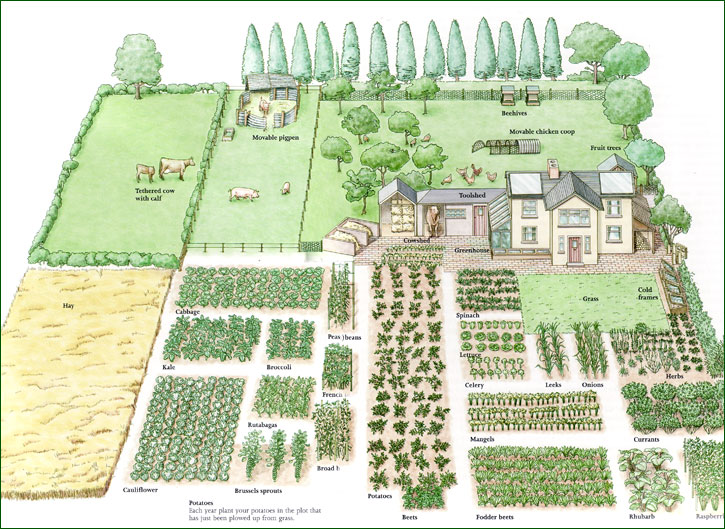
I was blessed to grow up on a farm and later was fortunate to be able to receive an advanced degree in Agriculture. For the last 15 years my wife and I have been running a small diversified farm where we produce vegetables, fruit, and animal products for local markets and a C.S.A. (Community Supported Agriculture). During this time we’ve spent several years in several countries doing agricultural mission work, seeing how the rest of the world feeds itself, and doing our part to assist them with that.
Over time we’ve worked hard to turn our own 30-acre farm into a self-sufficient property. My goal has been to see our farm as one that could feed my family and other families far into the future if “the front gate gets shut and locked.” As SurvivalBlog readers are well aware, this seems to be more of a possibility with every passing day. The discussion on growing your own food often arises, and a recurring theme is the advice that you aren’t just going to open a pack of survival seeds and feed your family. I couldn’t agree more, but I often feel like readers get brow-beaten with that advice and can leave the discussion a bit overwhelmed and in the end do nothing to advance their food security.
Growing enough food to feed your family for an extended period of time is a daunting task, but let me assure you that it is doable with a plan, a little land, and the willingness to try. We have to be successful every year in order to stay in business, and that has naturally led us into growing techniques that work. With this article I want to share with you a few key elements of these techniques that I hope will be a big help in your journey towards food security.
Element Number One: The Importance of Timing and Food Storage
Step number one for growing enough food to survive is food storage. Now I know that this seems contradictory, since we are talking about growing food. Why would we store a bunch of food if we are planning on growing it ourselves? The answer is timing. Unless you never buy anything from the grocery store and already grow all your own food, year-round, most people would need to ramp up production tremendously in order to provide all of the food that they need.
Nobody knows when the tractor trailers will stop rolling and the grocery shelves will be empty. It could be any time of the year. The absolute worst time of the year for this to happen would be at the end of summer or the beginning of fall when warm season crops are a distant memory and it may be even too late to start any cool season/winter crops, which are normally started in August/September in our Zone 6. Starting in October, you would have a long winter and at least six months before the earliest spring crops could be harvested, and even longer for the high-calorie crops like potatoes, corn, and other carbohydrate-rich grains. So, even if you are planning on growing enough to feed yourself, six months of food storage is a minimum. A year’s worth is even better, especially for inexperienced growers. You’ll definitely need a little food insurance, as your first year’s crops are probably not going to meet your expectations.
If you are going to be eating year-round from food you produce yourself, it makes sense that you need to be growing just about year round. There is no need to take the extra expense and work to preserve all your food when you can eat most of it fresh. This is entirely possible in most zones, with good planning and the willingness to eat a wider variety of crops than corn, beans, and tomatoes.
The key here is a good plan and a succession of crops that are planted and harvested at the right time. The easiest way I’ve found to do this is to buy a cheap monthly planner and to write all my seeding, transplanting, and harvest dates down. Make notes on what varieties you use, what works and what doesn’t. Start with a planting calendar from your local extension agent if you need a place to begin. The point is that every year you tweak your planting schedule on what works best, and after a season or two you’ll be way ahead of the game and planning will get easier with every passing year.
The bulk of our produce is grown from April to October, but we have things growing and eatable, pretty much year round. We do this with some basic season extension techniques, the main one being the use of a greenhouse and unheated high tunnels.
Element Number Two: Season Extension
A key element to growing success is how long it takes you to go from seed to harvest and how much of the year you are able to produce food. The normal three or four month growing season most people enjoy is not enough to produce the food you’ll need for the entire year, especially if you are limited in growing space. For that reason you are going to have to use season extension techniques with a minimum of a small heated greenhouse and a bigger unheated high-tunnel.
The one technique that we use that I consider the most valuable in extending our season and resulting in successful crops is producing our own transplants. Using a transplant rather than direct seeding crops automatically allows you to start the growing season weeks ahead of time. If we can start it in the greenhouse, we do. The only crops that don’t begin as transplants are the large seeded crops, like corn and beans, as well as some of the root crops like carrots. That said, even corn and beans can be transplanted, but they can only stay in pots for about two weeks before they need to be set out, so you aren’t gaining that much. If you have the ability and means to start your own plants from seeds, you are greatly broadening your horizons into the best varieties for survival gardens that you will never see for sale as a transplant in your local nursery or garden center.
Another advantage of producing your own transplants is the fact that you can provide optimum germination conditions for your seeds, which means you need less of them. You also give the plants several weeks head-start free from weed-competition, which is the bane of direct seeded crops. If the weather is not conducive to plant growth you can hold the plants a little longer in a protected environment before planting them out. A trick I use is to use a larger volume container for the first transplants I produce. That way they have plenty of growing space if I need to hold them a week or two later to wait for the weather. The later transplants that go from seed to field in just a few weeks get smaller containers that take less soil, as there won’t likely be a need to hold them longer in the greenhouse.
It doesn’t have to be big, but you do have to have a place to produce transplants. We are a commercial farm, but our greenhouse is only about 14 by 33 feet, and for several years we made due with one half that size. For a small family, an eight by twelve foot greenhouse would be a good start and would be doable in most anyone’s backyard. Of course, go as big as you can afford or have space for, as you’ll find a greenhouse is a useful structure that can be used year around. Our current greenhouse has insulated north and west walls and is a wood frame covered by double-walled poly-panels.
On the north wall we have a bank of 55-gallon water barrels that act as a heat sink, as well as a base for our plant benches. This water bank is made from food-grade poly barrels that are locally available for about eight dollars each. Filled with potable water, this is also an instant water storage system of nearly 1000 gallons of water. This design is very efficient, and we can heat it with a small propane heater. We’ve got a mid-sized storage tank that holds about two years worth of propane at our current usage.
Heating the Greenhouse
I tried a wood stove to heat the greenhouse at one point, but it just doesn’t make sense unless you are living in the greenhouse and can constantly monitor the temperature. An external wood burning boiler on a thermostat would be great, but it doesn’t make economic sense to use a costly unit like that to heat a small greenhouse. It’s better to spend money on improved insulation and be able to use a smaller heater.
Letter Re: Bugging In or Bugging Out
JWR,
Hi, I have a question. I live in a middle-sized city in South Carolina. Our population is approximately 180,000. There are good and bad neighborhoods, one being on the east side and the other on west side of the city. The city’s crime is #33 in the FBI’s stats. We’ve gone through disasters and we’ve seen only minor looting in the wakes of them but nothing serious. I have general confidence that if something major was to happen, my church and neighborhood could come together to cope with the situation, making leaving the city entirely unnecessary. However, I have read, particularly on your blog, that remaining in a large city would be dangerous in a grid down scenario. My question is, in the event of a grid down scenario, would it be wise to bug in at my house, which is located in a good neighborhood or would it be better to bug out to another location, say a relative’s house in the country? Would a city our size make bugging in dangerous? Is it realistic? Assume I have all the necessary supplies to survive at my house for six months. – N.R.
JWR’s Comment: In my estimation, any city over 5,000 population will probably lose any sense of cohesion in an extended (3 week+) grid-down collapse. And if civic water supplies are disrupted, a large city would also be a public heath nightmare. Please make plans in advance and pre-position supplies so that you can bug out to double up with your Country Cousins.
Economics and Investing:
Deutsche Marks Still Being Hoarded as Hedge Against Euro – DSV
o o o
Stupid Asset Protection Tricks. A short list of things not to do with your assets. You might think this is obvious, but there are apparently those who still do it. – H.L.
o o o
Turkey to Confiscate Gold in New Clever Way – To Help Citizens Earn Money – DSV
o o o
Gold Spikes On Foreign Policy Fears
o o o
SurvivalBlog and its editors are not paid investment counselors or advisers. Please see our Provisos page for details.
Odds ‘n Sods:
There has been a global uproar over the manhandling and bloodying of a paying United Airlines passenger. The plane was sold out, and the airline said that they needed four seats to shuttle crew to another airport. What followed was a gross misuse of force in removing a passenger against his will. United’s President apologized, but the airline policies are a reflection on their view of the world and “customer service.” Clearly, they look at paying passengers with the same disdain as they would sheep or cattle. So not only do we have to endure TSA inspections (with all of the appeal of a proctology exam), now we learn that the airlines themselves can call in the goons if we have the temerity to refuse to be herded like sheep. – JWR
o o o
Paul Joseph Watson: I was right about Sweden
o o o
Crosshair Customs has offered SurvivalBlog readers a 3% discount on their orders for the next week. If you are looking for some sweet, American made accessories for your AR-15, you need to take a look! Use the coupon code “american redoubt 3” when you order.
o o o
The information devices that spy on you in your home are now front and central in a corporate war: Burger King TV Ad Asks, Hoping Google Home Devices Answer – DSV
o o o
A very cool (yet incredibly scary) look at a steampunkish military oddball: M1915 Howell Automatic Rifle Enfield Conversion – J.C.

Hugh’s Quote of the Day:
“We want to be open-minded enough to accept radical new ideas when they occasionally come along, but we don’t want to be so open-minded that our brains fall out.” – Michael Shermer
Notes for Wednesday – April 12, 2017
April 12th is the birthday of the late novelist Tom Clancy. (Born 1947, died October 1, 2013). It was Clancy who almost single-handedly created the modern techno-thriller genre. Coincidentally, Tom Clancy’s first literary agent was my agent, Robert Gottlieb. – JWR
o o o
SurvivalBlog would like to wish all of those who celebrated Passover and are beginning the Feast of Unleavened Bread a wonderful time of fellowship with friends and family as you keep God’s appointed times. May your cup overflow with happiness, peace, and prosperity!