Letter Re: Bundys in Nevada

A recent letter regarding the Bundy family claimed, “[The Bundys] don’t own the land; they lease it. If they won’t abide by the terms of the lease, then they can and should be given a chance to meet the terms of the lease, but if they won’t then the landlord (in this case the BLM) has the right to evict them and try to collect back rent.” This reflects a common misconception. If the assertion were true that the land is in fact leased, the logic would of course be unassailable. However, BLM grazing allotments are *not* leases (at least, some of them aren’t, and the Bundys claim theirs are among those that aren’t). The grazing fees the Bundys and others refuse to pay are explicitly described in law as *not* being lease payments. Some legal history is required to understand the situation.

Originally, homesteaders received grants of 160 acres each as fully private property: the homesteaders had full rights to water, forage, minerals, and access on the full 160 acres. They also had the right to prevent anyone else from accessing their parcels. As homesteaders moved west, they discovered it wasn’t possible to support a family on only 160 acres, because the land simply wasn’t as productive in the arid climate. Grants therefore became larger, growing as large as 640 acres, but even that wasn’t sufficient to support a family in many of the more desert areas. Congress was hesitant to grant even larger portions as fully private property, knowing the west had vast wealth in the form of other resources, and that homesteaders likely wouldn’t ever exploit those resources. So Congress came up with the grazing allotment. Under this plan, homesteaders still had their original grant of fully private land, plus they were granted access to all forage, and all water resources they were able to develop, on a larger parcel of land. Title to this land remained in the hands of the federal government, who could grant access to prospectors, hunters, and others, but the homesteader had full rights to the forage, rights to develop water sources, and rights of access to the land. These rights were treated as private property, which could be (and were extensively) traded and sold like any other property. The rights had no stipulations about the number of animals the homesteader could graze on the land, nor the seasons when they could graze.

Since that time, the federal government has reacquired some of these rights, but many remain in private hands. The Bundys trace their allotments to homesteading days. The BLM was established in part to help allotment owners (note: “owner” is the correct term for an allotment) manage various legal and administrative requirements, and grazing fees were meant to pay the BLM for that help. The law puts specific requirements on how grazing fees are to be used, including a certain percentage that is to go back to the land it came from in the form of improvements. The BLM has long ignored these requirements. Therein lies at least some of the Bundy’s justification for refusal to pay grazing fees.

Please don’t make the mistake of believing land law is as simple as “The government owns full rights to all the land and ranchers have to abide by whatever terms the government sets forth.” That is wholly incorrect. Ranchers, mineral developers, and others simply wouldn’t ever invest in land resources without the assurance that rights to the land were legally in their full control. – JT


Economics and Investing:

Why Americans have stopped moving.

JWR’s Comment: What is missing from this otherwise good article is a mention of the fact that people aren’t moving because they recognize that the economy is stagnant, and the “recovery” was just a resurgence of spending propelled by debt rather than a genuine renaissance. In essence, Americans are hunkering down for the Second Great Depression.

o o o

Is Aramco IPO Behind Saudi Eagerness For OPEC Cut Extension? Saudi Arabia, Kuwait, Iraq, Algeria, and Angola have all stressed the need for further production cuts in order to return markets to a state of balance.

o o o

Here’s a new report from PeakProsperity.com contributing editor Charles Hugh Smith that explores the opportunities & challenges of maintaining a separate “Plan B” retreat property – something prudent people are increasingly considering during these volatile times. Maintaining a functional separate retreat residence is a responsibility that comes with real costs and complexities. But if done right, it can yield great returns during both good times and bad.

o o o

More reason to own tangible precious metals.

o o o

SurvivalBlog and its editors are not paid investment counselors or advisers. Please see our Provisos page for details.


Odds ‘n Sods:

X22 Report Spotlight(podcast interview) When The Disaster Hits You Better Be Prepared: James Wesley Rawles. (This discussion covers a lot of topics—mainly economics, geopolitics, and military flashpoints.)

o o o

David Codrea: Are YouTube Restrictions Targeted on Conservative and Gun Channels?

o o o

Protests sweeping South America show rising antigovernment anger – H.L.

o o o

Cringe worthy news: Obama to give speech in Berlin to mark Reformation anniversary – D.S.

HJL’s Comment: I think I just threw up in my mouth a little bit…Yeah, I’m sure I did. Where did I put those antacid tablets?!

o o o

Here we go again: New Bill to Penalize Missed Vaccines – DSV


Notes for Sunday – April 16, 2017

April 16th is the birthday of two notable novelists– J. Neil Schulman and Samuel Youd.

Agorist-Libertarian activist J. Neil Schulman (born April 16, 1953) is best known as author of the novel Alongside Night.

The late Samuel Youd (born 1922, died February 3, 2012) was the British novelist who was best known for his science fiction writings under the pseudonym John Christopher, including the survivalist novel Death of Grass (titled No Blade of Grass, in the American edition) as well as the Tripods Series of young adult sci-fi novel series. A fascinating man, Youd wrote prolifically, using eight pen names. He was a good friend of sci-fi novelist John Wyndham, and both of them were famous for writing what are often called cozy catastrophes.

o o o

Predictably, I’ve started receiving urgent requests from non-prepper friends and distant relatives about preparedness for nuclear war. My advice: Read through SurvivalBlog’s archives on fallout protection. It mainly comes down to putting sufficient MASS between you and any deposited fallout. Serious SurvivalBlog readers moved away from major targets years ago, and they’ve constructed “cold cellars” that can double as fallout shelters. (Although adding a hand- or pedal-powered HEPA filter is advisable.) And having a three-month supply of food and gravity fed water are also “givens”. It is also wise to stock up on Potassium Iodide (or Iodate) and get yourself a Nuk-Alert. I suspect that both of those will be sold out, shortly. Please give our advertisers your business first! – JWR

o o o

Mrs. Latimer is taking a break from her normal column today due to company so instead we present part four of an entry for Round 70 of the SurvivalBlog non-fiction writing contest. The nearly $15,000 worth of prizes for this round include:

First Prize:

  1. A $3000 gift certificate towards a Sol-Ark Solar Generator from Veteran owned Portable Solar LLC. The only EMP Hardened Solar Generator System available to the public.
  2. A Gunsite Academy Three Day Course Certificate that is good for any one, two, or three day course (a $1,195 value),
  3. A course certificate from onPoint Tactical for the prize winner’s choice of three-day civilian courses, excluding those restricted for military or government teams. Three day onPoint courses normally cost $795,
  4. DRD Tactical is providing a 5.56 NATO QD Billet upper with a hammer forged, chrome-lined barrel and a hard case to go with your own AR lower. It will allow any standard AR-type rifle to have a quick change barrel, which can be assembled in less than one minute without the use of any tools and a compact carry capability in a hard case or 3-day pack (an $1,100 value),
  5. An infrared sensor/imaging camouflage shelter from Snakebite Tactical in Eureka, Montana (A $350+ value),
  6. Two cases of Mountain House freeze-dried assorted entrees in #10 cans, courtesy of Ready Made Resources (a $350 value),
  7. A $250 gift certificate good for any product from Sunflower Ammo,
  8. Two cases of Meals, Ready to Eat (MREs), courtesy of CampingSurvival.com (a $180 value).

Second Prize:

  1. A Model 175 Series Solar Generator provided by Quantum Harvest LLC (a $439 value),
  2. A Glock form factor SIRT laser training pistol and a SIRT AR-15/M4 Laser Training Bolt, courtesy of Next Level Training, which have a combined retail value of $589,
  3. A gift certificate for any two or three-day class from Max Velocity Tactical (a $600 value),
  4. A transferable certificate for a two-day Ultimate Bug Out Course from Florida Firearms Training (a $400 value),
  5. A Trekker IV™ Four-Person Emergency Kit from Emergency Essentials (a $250 value),
  6. A $200 gift certificate good towards any books published by PrepperPress.com,
  7. A pre-selected assortment of military surplus gear from CJL Enterprize (a $300 value),
  8. RepackBox is providing a $300 gift certificate to their site, and
  9. American Gunsmithing Institute (AGI) is providing a $300 certificate good towards any of their DVD training courses.

Third Prize:

  1. A Royal Berkey water filter, courtesy of Directive 21 (a $275 value),
  2. A custom made Sage Grouse model utility/field knife from custom knife-maker Jon Kelly Designs, of Eureka, Montana,
  3. A large handmade clothes drying rack, a washboard, and a Homesteading for Beginners DVD, all courtesy of The Homestead Store, with a combined value of $206,
  4. Expanded sets of both washable feminine pads and liners, donated by Naturally Cozy (a $185 retail value),
  5. Two Super Survival Pack seed collections, a $150 value, courtesy of Seed for Security, LLC,
  6. Mayflower Trading is donating a $200 gift certificate for homesteading appliances,
  7. Montie Gear is donating a Y-Shot Slingshot and a $125 Montie gear Gift certificate.,
  8. Two 1,000-foot spools of full mil-spec U.S.-made 750 paracord (in-stock colors only) from www.TOUGHGRID.com (a $240 value), and

Round 70 ends on May 31st, so get busy writing and e-mail us your entry. Remember that there is a 1,500-word minimum, and that articles on practical “how to” skills for survival have an advantage in the judging.


Key Elements for Self-Sufficient Gardening – Part 4, by B. C.

Element Number Five: Permaculture and Perennial Crops

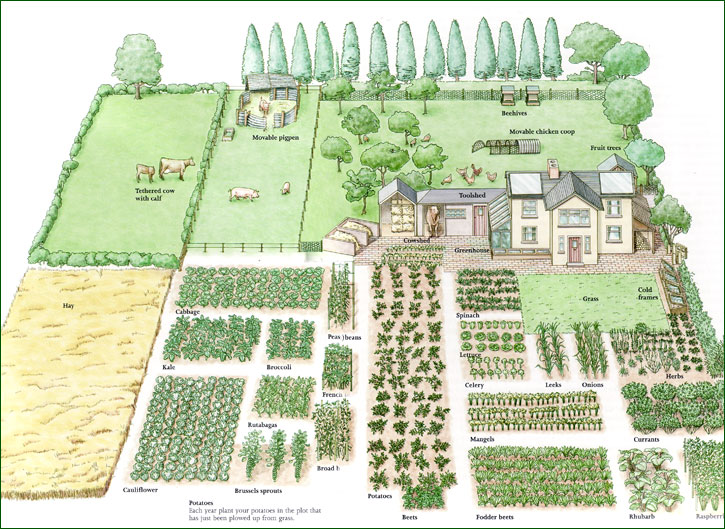
Annual crops may make up the bulk of your food and take the most of your labor when you are survival gardening. However, a critical part of our sustainable farm is the use of perennial crops, which actually give you more return on your investment than the yearly planting and production of annuals. The great thing about most perennials is that you plant them once, and they produce for several years. You don’t have to worry about what time of year the apocalypse starts; they are there waiting for you year after year. For that reason, perennial crops are an essential element for the survival gardener.

I’m not going to go into specifics, but perennial crops include some vegetables, like asparagus and rhubarb, as well as small fruits and tree crops. Producing tree fruit east of the Mississippi is tough to do, especially if you don’t have access to pesticides. Here, in the Mid-South, we have a lot of pest and weather concerns that the big fruit growers out west don’t have to deal with. These issues are why the big fruit growers are out west! Many people plant a few fruit trees in the back yard with high hopes of bushels of perfect fruit, only to be disappointed year after year. Let me save you a little trouble and give you a few recommendations that will produce fruit year after year with little inputs.

Blackberries are native to our part of the U.S., so they do well here with little help. We grow erect-thorn-less varieties, such as Apache and Ouachita, which come out of the University of Arkansas breeding program. They continue to release new varieties, so start with them, and you probably won’t go wrong. We trialed some of their primo-cane fruiting varieties last year, and they were great producers with large, sweet tasting fruit. They also have the potential to produce two crops a year or one late one, which really makes them great for the survival gardener trying to extend the season.

The other native berries that we rely on are elderberries and aronia berries. Both are native and do well with little care. The birds don’t seem to like them as much as blueberries, and they are much easier to grow. The aronia are too astringent to eat out of hand. (They are also called Chokecherries!) However, that astringency comes from their high levels of antioxidants. So along with elderberries, they are sort of like medicine on a bush, with both having noted health benefits. When combined together, elderberries and aronia berries make a great jam, and we concentrate them into a syrup, which is our flu preventative as well as our pancake topping.

Our other sure producer is the small-fruited Nanking Cherry (Prunus tomentosa). They produce their tasty fruit on bushes that are fast-growing and productive. Their fruit isn’t as large as that from a cherry tree, and they have a rather large pit, but they are easier to protect from the birds, which is the number one pest of cherries. They make a wonderful pie, jelly, or syrup, which is where most of our cherries end up anyway.

Pears produce well, and take less intensive care than apples. Ayers is a standard eating pear that does pretty well all over the south. Kieffer is an old–blight resistant pear that is a little gritty to eat but makes a good canning pear and reliably produces year after year. Newer, fire blight resistant varieties are available and they are worth planting. We have “Potomac” and “Shenandoah” in our pear orchard, both of which are also later maturing varieties and thus have a longer storage potential, extending the season.

We round out our lesser-known perennial favorites with greens, like Good King Henry (Chenopodium bonus-henricus) and French Sorrel (Rumex acetosa), both of which are available early in the spring when there is a lack of fresh greens. We also rely on a wide range of perennial herbs, which are important for adding essential nutrients and flavor. These nutrients and flavors should not to be taken for granted when you can’t buy your favorite junk food. Welsh onions and cutting celery are easy to grow in pots, and we can keep them year-round in the unheated greenhouse. Horseradish beds can produce a reliable kick to a boring diet, and you can dig the roots any time.

Diversity is key. Having a wide range of perennial crops helps insure that there is something to eat every year. Small nut trees (Hazelnut), deciduous trees with edible parts (Basswood, or Linden), and other beneficial plants can be incorporated around your property, even in your small backyard. Not every crop does well every year, but with a wide variety of crops there is generally something that you can round up and put in the pot to eat.

Element Number Six: Incorporate Animals

A truly sustainable, diversified farm will need to incorporate animals in some way. There is no better source of protein, and the benefit of animals on the farm is great. Farms used to be mixed systems that grew crops and animals that complemented each other. When we moved all the animals to concentrated facilities, we separated the two, making them as dependent on a food-supply chain as we are and creating a waste problem with their manure. Animals are worth keeping for their manure alone, as they take feed that we can’t eat, like grass, and turn it into milk, meat, and fiber while the whole time also producing a valuable organic fertilizer.

I won’t get into the details, but for the most part it is hard to beat rabbits for the perfect animal for the small, self-sufficient farm. Everything they need can be grown on a small scale by hand, and they don’t take a lot of infrastructure to get started. They multiply quickly, and they are quiet and easy to care for.

Chickens would be a second favorite, but they need to be fed grain, which if you can raise is no problem. They have the added benefit of a continual source of protein (eggs) and, if you have hens that can raise their own chicks, are quite sustainable. We keep dairy and beef cattle, goats, a horse, and sometimes pigs. However, for the small farm family that wants milk, I’d stick with a small dairy goat. It is possible to raise enough vegetarian protein to survive, but long-term you’ll probably want to think about animal protein as well.

Conclusion

There is a lot that we can’t cover in this article, but the whole of our farm’s sustainability is not just in what we do but who we are. Maintaining fertile soils and caring for the land and for each other is a big part of what makes our farm one that can continue to grow into the future. I think there is a certain amount of romanticism in growing your own food, starting with just a pack of seeds and a hoe. There is something wonderful about that, something in us that remembers Eden and looks ahead to something better. That is one reason I enjoy my job so much. However, most people get a good dose of reality the first time they try it.

Having the knowledge and experience doing something is worth a lot, and you can easily fall back on that when you need to. Growing a 1/10 acre garden is certainly different that growing a two-acre garden, but it’s mostly a difference in scale and the amount of hard work you’ll be doing. So learning how to do things on a small scale is a valid preparation for doing it in a larger scale. But you do have to do it. There is no substitute for trying it yourself. You can make a plan and start preparing and planting your perennial crops now.

Truly being able to grow all the food you need to feed your family is hard work and takes a high level of skill, which comes with years of experience. You’ll have setbacks and disappointments, but it can be done. However, in order to do it more efficiently, it takes a lot of help, whether that is labor saving devices, advances in plant breeding, or plastics and pesticides. Survival gardening is a different beast than putting a few tomato plants out in the backyard. On our farm, our family is in the midst of our busy spring planting season. There is no better time than now to start acquiring the equipment, skills, and experience to make that happen for your own family as well. Good luck, and may God bless your endeavors!



Letter Re: Bundys in Nevada

Hi Hugh,

I found your blog a few days ago and really enjoy reading it. I would like to comment on the sentiment expressed in one of the links you posted in “Odds ‘n Sods” today– Judge Openly laughs at Bundy Ranch Defendants Rights.

First, I agree that our courts are corrupt, many judges are openly undermining our Constitution and Rule of Law, and denying a defendant’s rights and then laughing about it is inexcusable.

What I disagree with is the idea that the Bundy family is a bunch of “patriots” standing up to “the tyrannical state.” In my opinion, what they are is a family that feels entitled to use public land as if it was their own. They don’t own the land; they lease it. If they won’t abide by the terms of the lease, then they can and should be given a chance to meet the terms of the lease, but if they won’t then the landlord (in this case the BLM) has the right to evict them and try to collect back rent.

I’ve had an experience with a rancher like this near Reno. I was hunting on public land (fenced but BLM) when an armed “guard” approached me and informed me I’d have to get off of “private property” as I was trespassing on a ranch (with not a cow or steer in sight). I left; I wasn’t going to fight it out with an armed “guard”, and I figured maybe I was wrong about it being BLM land. Later when I checked, it was (is) in fact BLM land, but some “rancher” thinks it’s his to use as if he owned it.

I might be wrong about the Bundy family, and if they don’t interfere with hunters, hikers, campers, et cetera on “their” public land I’ll change my mind. As long as they keep acting and talking like they own it though, it’s very hard for me to have much sympathy for them.

HJL’s Comment: The Bundys are probably not the best example nor is the whole issue the best court case. Similarly, it took a long time before “D.C. vs Heller” presented itself as the right case to bring the issue of gun ownership before the Supreme Court. SurvivalBlog has been cautious from the beginning about the Bundys, as we saw many issues with how they were setting up the conflict. However, it is the case that sits before us, and there are serious issues in the court cases where the government has stacked the deck in their own favor. If the abuses of the Feds continues unchecked, it makes it more difficult the next time the issue has to be dealt with. It would certainly be nice if a clean-cut case presented itself in the complex issues surrounding the BLM and Federal ownership of large swaths of land, but in the meantime this is what we have to work with, and we need to make the best of it. You may not like the Bundy’s and you may not even agree with their politics or their actions, but the issues are real and they are a danger to each one of us.


Economics and Investing:

China Ready To Cut Oil Supplies To North Korea. Beijing is ready to cut oil supplies to North Korea as the country continues to conduct nuclear missile tests.

o o o

Miami condo market acting as if it is 2007: Condo market in Miami is saturated with units and inventory is growing.

o o o

Drop In Gasoline Causes U.S. CPI To Fall 0.3% In March

o o o

Tax Day. Excerpt: “The first great lesson to learn about taxation is that taxation is simply robbery. No more and no less.”

o o o

SurvivalBlog and its editors are not paid investment counselors or advisers. Please see our Provisos page for details.


Odds ‘n Sods:

Prep warning: North Korea may have a new KN14 ICBM – This missile has a range of 7000+ miles putting it within the continental U.S. There is just one problem: They’ve never had a successful test launch of it. – P.S.

o o o

Woman Fights To Raise Chickens In Backyard – Life And Death Situation For Son – DSV

o o o

Feds Illegally Maintain Registry of Firearm Owners; Media Fails to Report It. This under-reported article from late 2015 is STILL being ignored!

o o o

DPM camouflage wearers will love these: British Army Cold Weather Parka

o o o

Just For Fun: The Gun Addict Song. (Jordan Winkler is a firearms instructor who has a Master’s Degree in music. His songs are priceless and wonderfully satirical. This one hits a bit close to home. Oh, and Preppers are sure to enjoy The EDC Song – JWR)


Hugh’s Quote of the Day:

“Moreover, brethren, I would not that ye should be ignorant, how that all our fathers were under the cloud, and all passed through the sea; and were all baptized unto Moses in the cloud and in the sea; and did all eat the same spiritual meat; and did all drink the same spiritual drink: for they drank of that spiritual Rock that followed them: and that Rock was Christ.” 1 Corinthians 10:1-4 (KJV)


Notes for Saturday – April 15, 2017

The “unsinkable” Titanic sank on April 15th, 1912. 1,517 people lost their lives on the ship’s maiden voyage. As research into the incident has progressed over the last 100 years, it seems as if, one way or another, the ship was just going to sink. With the adversities including an iceberg, raging coal fires in the fuel supply, wrong turns, locked-up binoculars, weak rivets, too few lifeboats, and more, perhaps this whole incident was really the result of man’s hubris.

o o o

Today, we present another entry for Round 70 of the SurvivalBlog non-fiction writing contest. The nearly $15,000 worth of prizes for this round include:

First Prize:

  1. A $3,000 gift certificate towards a Sol-Ark Solar Generator from Veteran owned Portable Solar LLC. The only EMP Hardened Solar Generator System available to the public.
  2. A Gunsite Academy Three Day Course Certificate that is good for any one, two, or three day course (a $1,195 value),
  3. A course certificate from onPoint Tactical for the prize winner’s choice of three-day civilian courses, excluding those restricted for military or government teams. Three day onPoint courses normally cost $795,
  4. DRD Tactical is providing a 5.56 NATO QD Billet upper with a hammer forged, chrome-lined barrel and a hard case to go with your own AR lower. It will allow any standard AR-type rifle to have a quick change barrel, which can be assembled in less than one minute without the use of any tools and a compact carry capability in a hard case or 3-day pack (an $1,100 value),
  5. An infrared sensor/imaging camouflage shelter from Snakebite Tactical in Eureka, Montana (A $350+ value),
  6. Two cases of Mountain House freeze-dried assorted entrees in #10 cans, courtesy of Ready Made Resources (a $350 value),
  7. A $250 gift certificate good for any product from Sunflower Ammo,
  8. Two cases of Meals, Ready to Eat (MREs), courtesy of CampingSurvival.com (a $180 value).

Second Prize:

  1. A Model 175 Series Solar Generator provided by Quantum Harvest LLC (a $439 value),
  2. A Glock form factor SIRT laser training pistol and a SIRT AR-15/M4 Laser Training Bolt, courtesy of Next Level Training, which have a combined retail value of $589,
  3. A gift certificate for any two or three-day class from Max Velocity Tactical (a $600 value),
  4. A transferable certificate for a two-day Ultimate Bug Out Course from Florida Firearms Training (a $400 value),
  5. A Trekker IV™ Four-Person Emergency Kit from Emergency Essentials (a $250 value),
  6. A $200 gift certificate good towards any books published by PrepperPress.com,
  7. A pre-selected assortment of military surplus gear from CJL Enterprize (a $300 value),
  8. RepackBox is providing a $300 gift certificate to their site, and
  9. American Gunsmithing Institute (AGI) is providing a $300 certificate good towards any of their DVD training courses.

Third Prize:

  1. A Royal Berkey water filter, courtesy of Directive 21 (a $275 value),
  2. A custom made Sage Grouse model utility/field knife from custom knife-maker Jon Kelly Designs, of Eureka, Montana,
  3. A large handmade clothes drying rack, a washboard, and a Homesteading for Beginners DVD, all courtesy of The Homestead Store, with a combined value of $206,
  4. Expanded sets of both washable feminine pads and liners, donated by Naturally Cozy (a $185 retail value),
  5. Two Super Survival Pack seed collections, a $150 value, courtesy of Seed for Security, LLC,
  6. Mayflower Trading is donating a $200 gift certificate for homesteading appliances,
  7. Montie Gear is donating a Y-Shot Slingshot and a $125 Montie gear Gift certificate.,
  8. Two 1,000-foot spools of full mil-spec U.S.-made 750 paracord (in-stock colors only) from www.TOUGHGRID.com (a $240 value), and

Round 70 ends on May 31st, so get busy writing and e-mail us your entry. Remember that there is a 1,500-word minimum, and that articles on practical “how to” skills for survival have an advantage in the judging.


Key Elements for Self-Sufficient Gardening – Part 3, by B.C.

Element Number Three: Irrigation

A downside to growing in greenhouses and high tunnels is that you have to have access to water and a way to irrigate these crops. That can be a positive, as it motivates you to build a system that you can use for your field crops as well. Even in the eastern U.S. where we farm, our irrigation is used every year. Rainfall seldom comes exactly when you need it, and having a way to irrigate your crops is the difference between being subject to droughts and being able to produce a crop every single year.

For a small greenhouse and high tunnel, you can, for the most part, just run a garden hose from whatever water source you use for your house. If you are dependent on a public water supply, it is a good idea to have a backup system for truly sustainable growing, independent of whatever is happening in the public municipalities. The easiest, and relatively cost-effective, system is to just catch runoff water from whatever buildings you have on your property. If you are in the desert southwest, you may not get enough rainfall to make this work, but even a small rainfall event can produce a pretty good volume of water.

A simple system that we find effective is to use food-grade IBC water containers. These are the big square water tanks with a metal frame around them. They normally have a capacity of 275 gallons, and depending on where you live are relatively inexpensive. I purchased several that had once held artificial flavorings for $40 each. The great thing is that they already have an opening at the top and a water valve at the bottom. This makes them perfect for collecting roof runoff from a gutter with a simple reducing valve. If you elevate them a few feet off the ground, then you’ve got a perfect gravity-fed irrigation system. There is generally enough head to supply a small drip irrigation system if you use low-pressure irrigation tape, which functions fine at less that 7 psi or so. You can always raise the tank or connect multiple tanks to create a larger capacity or more head (equals more pressure). Make sure you set the tank on a good solid base, as these tanks will weigh over 2200 pounds when full. We buy our irrigation supplies locally, as all the material we’ve discussed comes on large, heavy rolls. If you don’t have a local source, Drip Works (www.dripworks.com) out of California is a good mail-order source that has everything you need.

We collect water from our barn roof and even have our high tunnel guttered, which gives us a huge capacity to fill our water tanks. You can even collect water from your greenhouse, which is one reason I like wood framed greenhouses; they are easier to gutter! We have a public water supply, but it is comforting to have the capacity to water many of our crops right from our own property. Strategically placing your garden or growing beds close enough to your gravity-fed water source is an important consideration that will pay you back sooner rather than later.

These tanks are clear, so they will allow algae to grow, which can clog up your drip tape. You can paint these tanks or cover them to prevent algae from growing, but we’ve found that we use the water fast enough that it isn’t a problem. If algae starts to grow, then just empty the tank. You can also get some algae-eating fish and put them inside. We keep goldfish in any uncovered rain catchment to keep mosquito larvae down. Our goldfish survive the winter in the tanks, which suggests a more advanced aquaponics system, which we haven’t tried yet but is a great option for raising protein and liquid plant fertilizer.

If you want to pressurize your system and add the potential for pumps, filters, et cetera, then make sure you’ve got an off-the-grid system that is able to provide that. The time when you’ll need it the most is when it won’t be available, so make it happen now.

Element Number Four: Plastic Mulch

You’ll also need an irrigation system for this next element—plastic mulch. A product that most commercial growers use, but for some reason hasn’t been widely adopted by the backyard gardener, is plastic mulch film. There is a lot of back and forth in the organic/sustainable growing community about the use of plastics in agriculture. Technically, since plastics aren’t all that sustainable long-term many people avoid them. But if the benefits are so great, why not use them while you can? Everybody I know still drives around using fossil fuel and plastics are a part of life. Even battery powered car folks use fossil fuels, as 99% of our electricity in our area is derived from either coal or natural gas. They don’t like to be told they have a coal-powered car, so I just grin and keep my mouth shut! Plastic mulch is just a thin 1-mil film that you lay over your planting bed and plant into. It is a weed barrier as well as a season extender, as it warms the soil, allowing you to plant much earlier and obtain higher yields with less pesticide use. It is a win-win. The fossil fuel you save on tillage and pesticides probably equals what goes into the plastic. Even if it didn’t, it is worth the benefits you get. Plastic mulch is generally black, but comes in other colors for different purposes. For instance, red-colored mulch gives you a supposed 20% yield increase in crops like tomatoes, but it also costs about 20% more than the black, so for the most part it’s not worth it unless you absolutely need the highest yields from the smallest area. Silver or white mulch reflects some heat and can be used in the hottest climates, and gives some insect deterrence. Since this plastic is impermeable to water, you have to lay down drip irrigation tape under the plastic in order to water your plants.

While commercial growers lay this with a machine, it is easy to do by hand. We lay it all by hand in our high tunnels. You just unroll a piece or two of irrigation tape on your growing bed where your plants will be. The edges of the plastic are buried with a shovel or hoe as you go along, which seals the mulch and keeps it from blowing up. This is a process that can be done alone, but iit is easier with a helper or two.

You transplant tomatoes, peppers, eggplants, melons, et cetera directly into the mulch with a sharp hand tool to cut through the plastic. The plastic keeps the produce cleaner, decreasing soil-borne disease and allowing greater yields. Just make sure you water enough, as the only water that makes it under the plastic is what you put there, so you have to check moisture levels frequently. It also works well for potatoes and sweet potatoes, which are harvested by pulling up the plants and plastic, which is done at the end of the season anyway.

If you are careful you can double-crop on this mulch. For instance, we’ll plant early squash on a fresh bed, and when the squash is done in mid-summer we direct seed plant green beans for a fall crop. The extended season and quick growth you get using this mulch makes it possible. At the end of the season you can pull it up and dispose of it or recycle it. There are even organic-approved biodegradable mulch films made from corn starch that you can just till in when you are finished. They are quite a bit more expensive, but as the price comes down they’ll be a useful option for many.

The areas between the rows can be carefully tilled, or mulched with straw or some other material to keep down weeds. For this space we often use another groundcover most often called landscape fabric that is a heavier, woven material. This material is often used as permanent mulch as it lets water through and will last for several years. We use it for applications like this by unrolling it and fixing it to the ground with landscape staples. At the end of the season we roll it back up and store it out of direct light; this process allows us to use it year after year. You can use bleach to disinfect it between crops, if you wish.

Either of these materials can last indefinitely if you store them out of the sun, so it is worth putting a few rolls on the shelf. These products are worth learning how to use for the gardener who wants the best yields in the smallest area with the least amount of work. A few rolls stored up will increase your growing potential and survival potential greatly. While we can and do use organic, all-natural growing techniques on a commercial scale, you may have to boost production substantially, and these materials can help you do just that.


Letters Re: The Human-Powered Veggie Garden, by J.A.

HJL,

To be successful, the gardener needs to know about their local soil. We have taught vegetable gardening down in South Florida. Often it is more manageable to build a raised garden. Since our soil is about 2” to 4″ before we hit coral rock, we are more successful with the raised garden. This also applies to other poor soiled areas. And if the soil quality is controlled, so are pests. The better the soil, the sweeter the yield. – ebec.usa

o o o

Hugh,

The only thing that I would add is to include a spading fork to the essential tools list. An initial loosening of the ground with a spading fork is useful if your ground is clay heavy. – J.A.

o o o

HJL,

Great letter on gardening by hand. Another invaluable tool to get now is a high quality, all steel broadfork. I used one to prepare a garden bed, and it works wonderfully. It is not easy work, but it is simple work, and much like the shovel and hoe the broadfork is almost invaluable for preparing a garden bed. – JKR


Economics and Investing:

Gold Prices Near Five Month High: Is More Climbing In Store?

o o o

Federal government reports deficit of $526 BILLION despite record-breaking income and payroll tax collection – G.G.

o o o

104 Years of the Income Tax: Then and Now – B.B.

o o o

Goldman’s $50 Forecast May Prove Bullish. Goldman Sachs is standing by its oil price forecast of $50 a barrel, predicting stability but a limited upside in the future.

o o o

SurvivalBlog and its editors are not paid investment counselors or advisers. Please see our Provisos page for details.


Odds ‘n Sods:

Getting ready: Pentagon to protect electric grid from massive attack. “Kim Duck Soup” doesn’t have the missile technology (yet) to land a warhead on the West Coast of North America, but he could do a high-altitude air-burst of a warhead over the Pacific and still impact the West Coast. – P.S.

o o o

U.S. May Launch Strike if North Korea Reaches for Nuclear Trigger – W.W.

o o o

How an Anarchist Bitcoin Coder Found Himself Fighting ISIS in Syria

o o o

Coming to a city near you: ‘shariah Cop’ Cracks Down On Minnesota Muslims – H.L.

o o o

Trump Admitting Syrian Refugees At Quicker Pace Than Obama – B.B.