Odds ‘n Sods:

How To Practice Drawing a Pistol From Concealment

JWR’s Comment: This is an important but overlooked skill to practice! I agree with Tam that using a “Blue Gun” for draw and holstering practice is wise.

o o o

Human trafficking – Notice that Turkey, a NATO member, is mentioned in this pamphlet.Do You Know How Much It Costs To Buy A 9 Year Old Girl? The Sickness Of ISIS Has Just Informed Us – H.L.

o o o

Venezuela On The Brink – Images and Video… – B.B.

HJL’s Comment: Socialism at its best. Notice the military/police person shooting a woman for no other reason than she is filming the officers walking down the street randomly firing at buildings.

o o o

In Venezuela, the ‘Mother of all Marches’

o o o

Preparedness Is A Biblical Concept“: Pastor Joe Fox Has Some Hard Words For The Doritos Denomination Of Christianity…Starting With Proverbs 6:6 – GJM


Hugh’s Quote of the Day:

“And Nadab and Abihu, the sons of Aaron, took either of them his censer, and put fire therein, and put incense thereon, and offered strange fire before the Lord, which he commanded them not. And there went out fire from the Lord, and devoured them, and they died before the Lord.” – Leviticus 10:1-2 (KJV)


Notes for Friday – April 21, 2017

April 21st is Aggie Muster Day, for all Texas A&M Corps of Cadets graduates. Aggie Muster celebrations/meetings are held as far away as Japan, Germany, and Afghanistan. I should mention that Jim’s grandfather (a U.S. Army Cavalry LTC) was an Aggie– something mentioned so often that everyone in his family felt like de facto Aggies, too. Other than the officers that matriculate though West Point, the four institutions that seem to have the greatest ongoing esprit de corps for graduates are Texas A&M, The Citadel, Norwich University, and VMI. Jim felt almost obliged to include an Aggie character in his novels Survivors and Founders, even though his connection to Texas A&M is two generations removed.


Should I Bug Out or Survive in Place?- Part 2, by Jonathan Hollerman

So, what SHTF scenario should I be preparing for?

In part one, I cautioned you to be diligent to only follow the advice of credible prepping experts with real-life experience and a true understanding of human psychology in desperate circumstances. Before I can give my advice on the Bug Out/Survive in Place debate, we must first determine what scenario you are preparing for.

In my opinion, the most likely threat today is a natural disaster, like a hurricane or tornado or maybe a days-long blackout in a localized area. However, preparing for these things is common sense and being able to survive them does not make someone a prepper. Anyone can easily buy a few cases of water, two cases of MREs, and a few other basic survival supplies, put them in their basement, and be “good to go”. Most preppers, even if they lost all of their supplies in the storm, could easily brainstorm their way through a few days without food and water. (This would be a good example of where those wilderness survival skills could come into play.) Alternatively, they could literally just recline against a moss-covered tree stump and wait it out. It would be unpleasant and they’ll likely get really hungry while they wait, but the rest of the country will band together and the FEMA trucks will arrive in short order. This type of “prepping for natural disasters” is one of the main reasons why there is so much conflicting information on how to prepare for a total societal collapse scenario and whether or not to bug out.

So, what are the big threats that you should really be preparing for? I realize that the next points are debatable, but in my years of research today’s most likely culprits for a complete collapse of society, where you will need to put your preparedness skills to use, include the following events:

  1. A long-term grid-down event,
  2. A massive financial collapse, or
  3. A dire national or worldwide pandemic.

Now I realize that some of you have been preparing for nuclear war, biological warfare, global warming, food shortages, and many other scenarios for a very long time. I have researched those threats, and I do acknowledge there is legitimacy to most of them and would never judge you for wanting to prepare for them. My question is, what is the biggest and most likely SHTF threat, today? The world is constantly changing, and while prepping for all-out nuclear war during the Cuban missile crisis made perfect sense, today there are more probable SHTF scenarios to be concerned with. This goes back to my point in Part 1 about most preppers “latching on” to the first SHTF scenario they learn about. In my opinion, the most dangerous of these threats is a long-term grid down scenario brought on by an EMP attack, a cyber-attack on the electric grid, a Carrington-sized solar flare, or a good old-fashioned physical attack on the electric grid. (Google the dry run attack a few years ago at the Metcalf Substation in California.) To some, it may be easy to dismiss the grid-down threat if you only research one of those four scenarios at a time. If you do your research and add up the risk likelihood from all four scenarios, a national grid-down event is likely to happen in our lifetime.

I have the research and documents to back up my assertion, but that would be too much information to share here. For now, let’s assume you have read about a grid-down scenario and you do believe there is at least some legitimacy to it. However, you believe that a financial collapse, pandemic, or (insert your SHTF Scenario X here) is more likely to occur in the near future. You are convinced, by God, that the dollar is going to collapse in six months and that’s what you are getting ready for. Great! You might be right.

But what if you are wrong? See, here’s the thing…. If you plan and prepare for a grid-down event, a financial collapse or pandemic will be a walk in the park. But if your plans strictly revolve around bugging in, boarding up your windows in town, gardening in your back yard, forming a security team with your neighbors, and fighting off the looters brought on by the coming financial collapse, and then instead of a financial collapse we end up getting hit by an EMP attack from North Korea or Iran, you and your loved ones are in trouble.

While I know that my next point is debated on a lot of prepping forums, I am going to solidly and firmly plant my flag on the following mountain: There is very little to zero chance of surviving a long-term grid down scenario in the city surrounded by tens or hundreds of thousands of starving and desperate people who will eventually search and loot EVERY single store, every single building, and every single house…even yours. When the on-demand food delivery infrastructure that most Americans rely on to feed themselves shuts down from lack of electricity, there will be no way to keep 300+ million Americans fed. It cannot happen, regardless of what the government or other prepping experts tell you! In today’s world, electricity is crucial to keeping our population fed. When the masses haven’t had a crumb to eat for weeks, there will not be a single rock left unturned in the city and surrounding areas during their search for a scrap of food. That includes the very rock you are hiding under.

But what about a pandemic or financial collapse? Do I still need to bug out? In the case of a massive financial collapse, I believe it may be possible to survive in suburbia. I can’t give you a definite answer to that question until the financial collapse plays out and we see how bad it really gets. (The most importantly question: does the food delivery infrastructure shut down?). By the way, neither should any other prepping expert give you a straight-forward answer to that question. I can assure you of this: if you base your survival plans around bugging-in and the situation becomes far worse than you anticipated or planned for, it is too late at that point to get out of the deadly situation you are in. I hear this a lot on forums: “I’m planning to survive in place, and if the rioting and looting gets too bad, then I’ll just bug out to my Uncle Charlie’s farm.” Sorry, you’ll be too late!

If you go this route and have all your prepping plans, like off-grid power, roof water collection system, a large productive garden growing, and thousands of pounds of other supplies, like food, blankets, guns, ammo, et cetera all tucked away and hidden at your suburban location, you are not going to want to leave all the assets behind that won’t fit in your car! It’s not like you can take your massive prepper garden that you spent weeks of blood, sweat, and tears building and fold it up into a suitcase and throw it in your trunk. Are you really going to leave all that half-grown food behind? What if you used up most of your survival seed while planting the garden? What if it’s now too late in the growing season to start a new garden? Do you have the know-how to disconnect your off-grid solar system and hook it up somewhere else, or did a professional install it for you? You’ll likely have limited room in your bug out vehicle, especially if you have family members to take with you. Do you take your bulky solar power system or some extra food instead?

Most people will also cling to the perceived safety and familiarity of their personal home for as long as possible. Most that go with “survive in place unless it gets too bad” plan will stay in their home way too long. They will wait until they are forced to kill a desperate or hungry home intruder in self defense and can no longer deceive themselves into believing that it is safe for their family to stay in suburbia. If you wait till things get “too bad”, then travelling on the open road with your bug out bags or a vehicle laden with food and supplies makes you a target of opportunity.

So, am I saying that you have to bug out to survive a massive financial collapse? No. Yes. Maybe. What I’m implying is that it would be better to be safe than sorry. Isn’t that the whole point of prepping? If you designed your prepping plans around bugging out of the city to a safer location from the get-go, you won’t find yourself in the crappy scenario of sitting in your house while the city around you tears itself apart and wondering, “Did I wait too long to leave?” or “Is it too late to travel through town and get my family out of here safely?” That would be an awful situation to find yourself in.

Where I allow you a little wiggle room to survive in place during the early throws of a financial collapse, I won’t allow it in the case of a deadly pandemic. During a financial collapse, even during a rapid downward spiral, you will still have the ability in the initial days to hit up your local stores and buy extra food, ammo, gear, or other prepping items that you may need to survive. These last minute purchases may be of items that maybe you didn’t get around to purchasing beforehand or couldn’t afford earlier. Depending on the severity of the financial collapse, it may take multiple days, weeks, or months before businesses start closing or get completely looted.

However, during a serious and fast-growing pandemic, commerce will likely shut down much quicker. As the infection rate grows, more and more people will stop venturing out, even for work. The threat of contracting the virus and bringing it home to loved ones will override most people’s fear of losing their job. At first it will likely be the minimum wage employees that stop showing up for work. They have little to lose by risking their job at the local supermarket, sporting goods store, or gas station; they rationalize that they can easily find another minimum wage job after the threat has passed. To them, it’s just not worth it to run a cash register all day while standing face to face with potentially infected people. This will result in supermarkets and other stores quickly growing understaffed. At some point, the big box store managers will be under so much stress trying to make the understaffed store function despite long checkout lines filled with frustrated and angry people, they will likely throw up their hands and stop coming in to work themselves. Middle management typically has little vested interest in the store anyway, and it’s just not worth the hassle and the risk of infection. The only people with a real vested interest in that corporate store are the board members in some far-away city who can’t do anything about the situation anyway. This will result in desperate and sick people getting angry at all the stores they rely on now being closed, and the rioting and looting will escalate.

As the rioting and looting escalates during the early days of the pandemic, it will be splayed across TV screens around the country by a shameless media ecstatic to show the sensationalized coverage. As a result, more blue collar and white collar workers will stay home. Vitally important interstate truck drivers will see the never-ending video loops the media are playing and think to themselves, “Do I really want to leave my family alone and drive my food-laden truck two hundred miles away from home and into that insane city with all that violence?” I suspect a lot of them will start using up sick days and vacation days. As more grocery stores and gas stations close from lack of employees and the dwindling re-supply shipments, things will get even more chaotic. Add this to the growing number of people infected, and more people will question whether their job is worth the risk.

This applies to hospital workers, policemen, firefighters, and employees responsible for maintaining our nation’s infrastructure, like the electric grid, gas lines, sewer companies, and power plants. Please don’t think I am disparaging the people in those career fields. Like any other industry, it will just be a few at the beginning. But as the chaos and pandemic spreads, fewer of these people will show up for work over time. At some point the remaining individuals who are desperately trying to pick up the slack for their missing co-workers and keep our nation’s infrastructure functioning, will throw up their hands in frustration and head home themselves. No amount of forced intervention or government edict will convince someone to risk their life and show up for work if they believe it’s no use or the threat of infection is too high. There are exceptions to this rule, but there likely won’t be enough people risking their lives to keep these vital industries and our nation’s critical infrastructures afloat. Depending on the severity of the pandemic and how long it persists, I believe it is possible to result in rolling blackouts and maybe even a total loss of the electric grid throughout various parts of the country. That means a pandemic could result in the worst-case scenario of a grid-down event. Add that to the spreading illness and you’re in a world of hurt.

I am not saying that a pandemic will result in a grid-down event. I am just saying that it is a very real possibility, depending on the severity of the virus and how quickly the government can find a cure for it. So, if you decided to survive in place for a pandemic and it grows seriously out-of-control, it may be too late to travel; however, travel will be limited for different reasons than the financial collapse. First, there will be a rapidly growing number of hungry and starving people as the nation’s infrastructure and on-demand food delivery systems shut down. While the risk of getting the virus will mean less people out and about coordinating ambushes on travelers, you still run a big risk of contracting the virus during your bug out. You waited too long and there are just too many people infected now. Anyone with whom you cross paths on your travels could lead to you or a family member getting infected.

Second, you need to do some research into the government’s response to pandemics. They have strict plans in place to try and slow the spread of a serious pandemic. Those plans include shutting down means of travel. You may get stuck in a quarantine zone against your will, especially if your initial plan is to bug in as long as possible. Remember, the government will not announce when they are going to quarantine your town, so you won’t get a heads-up to leave beforehand. In my opinion, for a massive pandemic, it’s best if your initial plans revolve around bugging out and getting away from the mass population areas as soon as possible.

On a side note to the second point, please don’t assume you are going to four-wheel your way around a military roadblock like they did in the classic movie Red Dawn or evade your way through their lines at night, on foot, with your bug out bag. With today’s drone technology and their forward looking infrared cameras, it’s very unlikely that you will be successful in sneaking your family through the quarantine lines. If captured, you could end up in an overstuffed holding zone of other captured escapees, and this could significantly increase you and your family’s risk of getting infected.

So now I’m just going to come out and say it. In the aftermath of a long-term SHTF scenario where there is even a risk of widespread food shortages, you need to bug out (away from mass population areas) and do so quickly. I’ll explain how to do so in Part Three. But for now, please promise me to get off the “Urban Prepper” websites. The term Urban Prepper is an oxymoron. Those two words go together like a bottle of Tabasco sauce and a severe case of jock itch! Those urban prepper experts will tell you that hitting the open road and travelling from place to place like they do in The Walking Dead is a really bad idea. It is a straw man argument. I actually agree with that statement. No one is telling you that bugging out and wandering around the countryside is a good idea, least of all me.

Some urban prepping experts will tell you about all the abundant resources that big cities have to offer for scavenging. What hogwash! You put a few million, or even tens of thousands, of starving people in a small land area and they are going to pick that place clean in no time! You aren’t the only one who is going to be scavenging for rapidly disappearing food sources. Ninety-nine percent of the surviving population will be doing the same thing as you. The idea of scavenging for survival in some city should scare the living crap out of you. It’s understandable to me how some people might store up a lot of food in their suburban basement and believe they can ride out the storm by hiding and keeping their head down. I disagree with that plan, but I can understand their thought process. If you don’t have long-term food stored up and your plans involve sneaking around the city at night scavenging for your food like everyone else, you’re a special kind of stupid. You think that’s too strongly worded? I don’t think so.

I don’t care about how many guns you plan to carry, your hand-to-hand combat skills, or the fact that you think you have perfected the foolish “grey man movement” techniques, you’re still going to die eventually. You’re in a city full of starving people who are wandering around day and night desperate to find the same stuff you are looking for. They are going to be raiding the same distribution centers and stores you plan to hit and fighting with you over every scrap of food. Sure, you might get away from an ambush a time or two and maybe kill off a few of your attackers, but eventually you’re going to get yourself shot in the back from some dark second story window. Some Holocaust-skinny dude who’s too sick now to leave his house and join the scavenging parties just shot you from a distance on the off chance that you may have a scrap of food in your pack. Heaven forbid you have a family at home depending on you to bring food back. On one of those scavenging trips, you’re not going to make it home, and that’s a fact, Jack!

Some prepper experts will try and scare you into surviving in place by insisting you are better off in the suburban location you know well than hitting the open road. They’ll explain how dangerous it will be to wander around the countryside post-SHTF. That’s true, and I would never advocate for aimlessly wandering around post-SHTF, like they do in the popular movie The Road. However, you must realize that trying to survive in town surrounded by thousands of desperate and starving people will be much harder to do than surviving in a remote location. Before making a final decision to survive in place, it is imperative that you are only doing so if your current residence is already in a remote location. Do some research and see how well your home location fits in with survival retreat considerations. Very few locations are perfect, but if you are not checking off more boxes than you are leaving blank on the survival retreat checklist, you need to seriously reconsider staying in place.

There are far better options on the table for someone, even on a tight budget, than just riding it out in town waiting for a large band of looters to kill you and take all your food. I will be discussing these options in Part Three. In the meantime, remember to scrutinize the source of your prepper advice and determine what SHTF scenario you are preparing for.

Jonathan Hollerman is a former military S.E.R.E. (Survival) Instructor and best-selling author on preparedness. Hollerman is a full-time Emergency Preparedness Consultant specializing in Survival Retreat Design through Grid Down Consulting.


Economics and Investing:

Cash Crisis in India, ATMs Running Dry

JWR’s Comment: Currency “reforms” like these are all about control of the populace and tax revenue. Governments want full transparency of all private transactions—and thus the ability to tax everything.

o o o

Video: Hidden Secrets Of Money Part 7 – Mike Maloney

o o o

50 Great Jobs for Retirees – H.L.

o o o

17 Reasons Why You Should Own Gold – DSV

o o o

Troubling Signs At Bakken As Oil Production Growth Stalls

o o o

SurvivalBlog and its editors are not paid investment counselors or advisers. Please see our Provisos page for details.


Odds ‘n Sods:

Venezuela braces for ‘mother of all protests’ – B.B.

o o o

Courts are Using AI to Sentence Criminals – B.B.

o o o

An article by Benjamin Baruch over at News With Views: The March To World War III

o o o

From the people who brought you beheadings, burning alive, and other atrocities for no other reason than they don’t like you: Taliban Decry Environmental Impact of U.S. MOAB Explosion – G.M.

o o o

Meet Babel Street, the Powerful Social Media Surveillance Used by Police, Secret Service, and Sports Stadiums – S.G.

o o o

I ran across this on YouTube today. Too bad they don’t make them anymore: Rare Gas-Powered Circular Saw [Rescue]


Notes for Thursday – April 20, 2017

On April 20th, 2010, an explosion on the Deepwater Horizon oil platform, leased by BP, killed 11 workers and began spewing an estimated 200 million gallons of crude into the Gulf of Mexico for nearly three months, creating the worst known offshore oil spill.

April 20th is also the day that we remember the victims of the Columbine High School tragedy, where two students stormed into a suburban high school in Littleton, Colorado in 1999, at lunch time with guns and explosives, killing 13 and wounding dozens more in what was, at the time, the nation’s deadliest school shooting.

o o o

I just heard that fellow blogger Kevin O’Brien (aka WeaponsMan) has passed away at age 59 of a heart attack. Our condolences to his family. Kevin was a great guy and and served his country well as a Special Forces weapons man. (An 18 Bravo, he also worked in Ops and Intel capacities, including a tour in Afghanistan.) Starting in 2011, he began sharing his knowledge in one of the best blogs I’ve ever read. He was also the primary author of the Firearms Design Library. Kevin will be greatly missed! – JWR


Should I Bug Out or Survive in Place?- Part 1, by Jonathan Hollerman

Where are you getting your prepping advice? Why?

Should I try to survive in place or should I bug out? This is a hotly debated question in the prepping community with many people firmly entrenched on both sides of the aisle. There are numerous articles discussing the topic, but most are only a handful of paragraphs that never really explain how or why they arrived at their recommendation. To answer the “Bug Out” or “Bug In” question effectively, we must discuss essential background information and context. I will break down the discussion into three sections: your source for prepping advice, what SHTF scenario you are preparing for, and how to bug out if you don’t have a survival retreat. So, grab a cup of coffee, find a comfortable chair, and put on your seat belt as I get ready to challenge a good bit of commonly embraced ideas and “prepper theology” that are dangerous to you and your family surviving a long-term SHTF scenario. On a side note, if your idea of “prepping” revolves around getting ready for the next hurricane and storing up enough food and water in your basement to last a couple days until FEMA shows up, well… this article probably won’t apply to you.

Your plan to either bug in or bug out depends on what SHTF scenario you are preparing for. Some of them seem silly and unlikely, but most of the scenarios that could lead to a collapse of our society have at least some legitimacy. What should you be preparing for? Should you plan to bug in or bug out? These are the two most fundamental questions to wrap your head around before making any plans for surviving a SHTF scenario. When getting started, I always recommend my clients apply the age-old philosophy, “Prepare for the worst and hope for the best!”  At the same time, you need to find a balance between the worst-case SHTF scenario with what is most likely to occur in your lifetime.

So what are you preparing for? Pandemic? Financial collapse? Nuclear war? Long-term loss of the electric grid? I have noticed that most preppers typically “latch on” to the first SHTF scenario they were introduced to and become overwhelmed by the thought of that event coming to pass. Consequently, they focus all their energy on preparing for that particular scenario. They think about how it would affect their family’s chances of survival and dive head first into the confusing Internet world of preparedness. A lot of them start by Googling the word “prepping” or by spending countless hours watching some popular YouTube prepper channel. Unfortunately, what follows is a long, confusing string of bad information, deadly advice, and Top 10 Prepping Tips from “experts” who, quite frankly, have no earthly idea what they are talking about and have no background in surviving a world full of starving and desperate people.

This is why I am starting the discussion by asking “Where are you getting your prepping advice?”. The source of your knowledge will literally make the difference between whether you live or die, should a total societal collapse occur. I see a lot of preppers spending boat loads of cash on the wrong survival supplies and, more importantly, on the wrong plan of action. Part of the confusion on “how to prep” comes from the plethora of prepping advice available at the click of a mouse. I’ve read many “how to” prepping articles on major websites and magazines that literally made me spit out my morning coffee and laugh out loud. I’ve also read over a hundred prepper-fiction novels, some of them extremely popular. Most of them I can’t even finish, due to instance after instance of unbelievably stupid actions the main character takes that he miraculously survives. My most common frustration with most survival fiction authors is how they very rarely explain with any believability how the main characters stay fed in the post-apocalyptic world they are living in.

In one such immensely popular book, the main character is forced to walk home after being stranded by an EMP attack in another state. He completes the journey over multiple weeks and survives out of his get-home pack that he had in the trunk of his car at the time. Nearly every day, the author explains how “Macho Man X” pulls out an MRE to eat when he only had a half dozen or so to start out with. Halfway through the story, I am screaming at the book, “How many freakin’ MREs does this guy have?!” It must be a miracle, like the story of Jesus feeding the five thousand. This character has eaten nearly four dozen MREs over the course of his travels, and I was only halfway through the book. I couldn’t help but envision a Sherpa carrying nine MRE cases on his back, stacked four feet high over his head while following a climbing team to the base camp on Mount Everest. Is no one else picking up on these important discrepancies? How in the world does this guy have a four-and-a-half-star review average on Amazon? That is just one of a hundred things I could point out about this unnamed book. Unfortunately, this author has sold an insane number of novels in his never-ending series, and therefore he’s sold thousands of terrible ideas and recommendations to unsuspecting readers along the way.

Please do some research on who you are getting your advice from. If the bio reads “…an experienced outdoorsman who loves to hunt and fish, [Author X] has had numerous articles published in [X prepper forum] and [X prepper magazine],” or “[Author X] lives off grid in the Great Northwest with his wife and nine children,” that means he can hunt and fish; it does not necessarily mean that he has the experience to tell you the best way to prepare for a SHTF scenario. It’s your and your family’s lives that are at stake! What’s the point of spending your time and money on prepping if you are following bad advice and doing it wrong? Most of the more “experienced preppers” reading this are vigorously nodding their heads in agreement right now. They are thinking back to when they first got started and something specific they spent a lot of time or money on. They eventually had to re-do or re-buy whatever it was, when they realized the original suggestion from “X Prepping Expert” was bunk.

Another bad place to get your advice is on the thousands of Internet prepper forums where everyone is an expert on everything. At this point, you are likely bypassing any semblance of reliable and experienced prepping advice. In fact, you are potentially subjecting yourself to some nameless, faceless, self-proclaimed prepper typing away at his computer in downtown Chicago. You have no way to verify the information you are reading and whether or not the person has actually done what he is recommending. There are exceptions to this rule, however. SurvivalBlog is one forum that does a good job of vetting its articles and authors. The main reason behind this, I believe, is because the website is run by James Wesley, Rawles. While Rawles and I don’t always see eye to eye on every aspect of prepping, he has still lived the prepper lifestyle for decades and has the life experience to back up his advice and recommendations. Most other forums seem to be run by people who are experts at Internet marketing that will post any story to get a Facebook share or another follower.

I will give you two examples of very bad prepping advice. Normally, I don’t drop names, but in this case I am going to make an exception because I believe this first guy is going to be responsible for tens of thousands of preppers dying (when their family’s food runs out sooner than they had planned). His name is “Frank Bates” (Google “Frank Bates Charlatan,” if you like). “Frank,” a pseudonym of course, is the owner and profiteer of Food4Patriots. If you have been running in the prepping circles for any length of time, you’ve surely clicked on a link that took you to one of his infomercials where he tells you that “the government is buying up all the long-term food and if you don’t act quickly, you won’t be able to buy any freeze-dried food in the near future.”

“Frank” is nothing more than an Internet marketing guru who has made a lot of money off those infomercials. The problem is, much of the information he is peddling is provably false or misleading, and it is designed to scare you so that you will “act quickly” to buy his product. It’s the oldest trick in the book for scam artists. If you have made a long-term food purchase from him, please realize that all he has done is re-labeled freeze-dried food from another company and made a quick buck off you. You could have purchased the same exact food from the original company for ten or twenty percent less. You also need to realize that the one-year food plan you purchased is only four or five months’ worth of calories for the average adult. I am bringing to light one of the biggest scams in the prepper industry: most long-term food companies are guilty of deceitful serving size recommendations to one degree or another. Never, ever, ever buy long-term food based off a freeze-dried company’s serving sizes or meal counts. The only way to purchase long-term food is by knowing your personal caloric needs (based on your height, weight, sex, and activity level) and buying your long-term food based on the food’s caloric count. But that’s an article for a different time.

The second example is a popular prepping author who wrote seven different prepping guides and books that were peddled online. The guy isn’t even a prepper. He admitted to having zero background experience in prepping and to just writing those books to make money off the “prepping craze”. He believes most preppers are crazy or gullible rednecks. Google his article called “Confessions of a Former Apocalypse Survival Guide Writer” and read it, if you’d like. He refuses to give his name or the names of the prepping guides and books that he wrote. He pokes fun at the entire “paranoid prepping industry” and boasts how he made money ghostwriting for another “prepping expert” who also remains un-named. The moral of the story here is that you need to be extremely careful where you are getting your prepping advice from, especially if you are new to the concept. Just like any other industry on the Internet, charlatans abound. Unfortunately, the prepping industry seems to be overflowing with them.

So who should I trust?

Now, I realize that it seems like I have just painted the entire prepping industry as a bunch of idiots or scam artists. That really isn’t the case. The truth of the matter is that most legitimate prepping experts are honest, upstanding people who have spent years prepping and truly want to help others follow in their footsteps. However, a lot of them just plain don’t know what they don’t know. They have spent years following bad advice and forming opinions on recommendations from other prepping experts who also don’t know what they don’t know.

One of the biggest problems is that the term “prepping” is used to encapsulate a wide array of SHTF scenarios. A lot of these writers are purely focused on short-term solutions for minor inconveniences to our way of life (like preparing for a natural disaster). Some even travel around the country putting on seminars and have hundreds of thousands of followers on YouTube. While I strongly recommend researching the person’s background and qualifications as a prepping expert, I also recommend you research what type of SHTF they are suggesting that you prepare for. A prepping expert whose entire thought process revolves around how to survive the next hurricane is NOT going to offer relevant guidance on how to survive a long-term grid down scenario. His advice will assume that phones, Internet, banking, food distribution, hospitals, the military, and your local police will still be functioning as normal, and his position on looting or rioting will be that it will be mostly contained to the inner city.

Regardless of where any expert falls on the SHTF spectrum, the answer to the question of whether to Bug Out or Survive in Place comes mainly from the on-demand food delivery infrastructure in this country. Can America keep its citizen’s fed under “X” SHTF scenario? Are people going to start starving? The vital take-away from this entire article is this fact: Once people begin starving, they become desperate, and the playbook for surviving such a scenario changes dramatically. This is a key point that a lot of prepping experts don’t understand.

In honesty, most preppers have done little research into and never fully wrapped their heads around what American society will look like in a serious SHTF collapse situation. They began their prepping journey with an incomplete and incorrect understanding of what type of world they are even preparing for. How can you make plans to prepare for something that you don’t understand?

Most prepping experts are Americans. They grew up in the greatest land of opportunity, and the vast majority have never experienced true desperation or starvation. At the flick of a switch, their lights always come on and with the turn of a faucet, clean water flows endlessly. Their life experience and knowledge base of a world in societal collapse is severely lacking. Most “prepper experts” have never been to third-world countries experiencing a famine. They don’t understand that if the same food shortages were to happen in America, the response from the public would be drastically worse than the famine in Mogadishu or the current food shortages in Venezuela. They have likely never seen the effects of true hunger or starvation on America’s shores, and have probably not studied the human psychology behind it.

I highly recommend everyone reading this to research the various works of Philip Zimbardo for a better understanding on the utter insanity and evil atrocities that will ensue when people are desperate and starving and when the laws of the land are a moot point with no functioning law enforcement. Zimbardo is a world renowned social psychologist; his life’s work revolves around studying how good people can turn evil. (You may be familiar with his work during the 1970s—the Stanford Prison Experiment.) His main focus since then has been studying the atrocities that average and everyday people can commit when there is no law and order, or when they are driven to desperation. It will likely have a radical transformation on your overall preparedness plans.

The other prepping experts you need to be careful of are the cross-industry “Wilderness Survival Experts”, who sometimes don the prepping label as well. Don’t get me wrong: learning wilderness survival skills is a vitally important tool in your prepper’s toolbox. Knowing how to start a fire in the rain and build a shelter is very important, and they are life skills that most Americans have lost over the last fifty years. I am not saying that all wilderness survival preppers are wrong, but if their advice is to bug out to your nearest National Forest and live off the land with the skills they are teaching you, then I say, “Run, Forrest, RUN!” The wise point of that advice is the fact that they promote fleeing the major cities after the SHTF. Where they go wrong, however, is their plan to survive off the land like the Legend of Mick Dodge. If you plan to follow their advice and become a “Lone Wolf,” I can assure you there is a 99.9% chance that you are going to end up dead, period. I’ve personally “lived off the land” in the mountains of Washington State for a month straight in January with six feet of snow on the ground. That was during the initial phase of my military training to become a SERE (Survival, Evasion, Resistance, and Escape) Instructor. I was a budding expert in wilderness survival at the time, and I still lost fifteen pounds during that single month. (That’s a lot for a lean nineteen-year-old in peak physical shape.)

Now I realize that a few of you reading this are feeling pretty livid towards me right about now. You are sharpening your knives, about to go off on me in the comments section below, explaining how you were left on the roadside as an infant and raised by a pack of wolves or other wildling creatures. It…doesn’t…matter! I still hold to the belief that you will die. Most people that claim these skills on the Internet forums have never actually done it, or they did so in a controlled environment. Even “if” you could prove to me that you had the necessary background to survive and “live off the land” in some wilderness area for an extended period of time, you are not taking into account that the other 99% of Lone Wolves running around the mountains post-SHTF don’t have our skillset.

While you are successfully surviving, the woods will be chock full of unprepared yahoos who fled the big cities and are totally desperate and starving. At some point, you will need to build a fire to cook the occasional squirrel you snare or to warm your hypothermic body; the smoke and light from your fire will bring the other starving Lone Wolves like a moth to a flame. At some point, they will stumble across your camp, or you will stumble into the crosshairs of someone who is so desperate that they will kill you with their deer rifle from a distance, long before you see them, just on the off chance you might have a morsel of food in your pack. At some point, the hungry masses and the rural folk who live around your forest will have killed off every living creature in the woods to feed their family. Your idea of surviving the SHTF next to a fire with venison on a spit will evaporate.

I could go on for hours about the hundreds of scenarios that would get you killed while living off the land post-SHTF. The biggest take-away here is that while you “may” have the ability to survive in the wilderness for a long period of time during normal times, in a post-SHTF world, with starving and desperate people running around the forest, those wilderness skills are not going to save you. Again, the prepper experts that will lead you down this path are offering advice from their personal life experiences of a “surviving in the woods during normal times” mindset. They’ve never wrapped their heads around what life looks like after a SHTF scenario, or more importantly, what their favorite forest bug-out-location is going to look like.

The last piece of bad prepping advice I see often is to grow your prepping slowly when working on a budget. That advice typically goes something like this: start preparing for a hurricane first and then slowly work your way up to surviving the bigger threats. That’s great if you have all the time in the world to slowly build your preparations and you know nothing big will happen until you are done. While I realize that most people are working with a limited budget, your plans for survival should not revolve around your budget. Now listen… I do not mean you should cash in your kid’s college fund. What I mean is that you need to set up your plan of action first to survive the worst-case scenario, taking into consideration your limited supplies. If you start out by preparing for a hurricane and something big happens, you might not have time to re-evaluate your current situation and put in place a better plan of action to deal with it. You are stuck surviving a total collapse scenario in the city with a couple boxes of MRE’s and some candles.

The other problem with this philosophy is that you could get stuck in the small-minded, hurricane prepper community. The websites you visit to help you prepare for these minor situations typically don’t have the needed experience or mindset to help you get prepared for anything bigger. The more you read their advice and recommendations, the more you will begin to believe that the “survive in place” mentality will actually work for something big. Again, prepare for the worst and hope for the best. Don’t prepare for the least and die if it’s worse.

So, before you jump on board the prepping train, even if you’ve been on board for years, please do some research on human psychology. That way, you will have a much better understanding of true human nature and people’s true response to starvation and desperation. You’ll know whether “prepper blogger X” knows what he is talking about or is just offering suggestions from his narrow, pre-SHTF life experience and mindset. Think about who you are getting your advice from, and then ask yourself, “Why?”

Jonathan Hollerman is a former military S.E.R.E. (Survival) Instructor and best-selling author on preparedness. Hollerman is a full-time Emergency Preparedness Consultant specializing in Survival Retreat Design through Grid Down Consulting.



Economics and Investing:

Bitcoin Drives Revolution and ‘Startup Government’ for Syrian Kurds

o o o

Silver Price Forecast 2017/2018: Silver Prices Likely To Rise In A Concentrated Manner

o o o

US Auto Industry Factory Production Falls Most Since August. “Output at U.S. auto manufacturers fell unexpectedly in March by the most since August of last year, according to Federal Reserve data that was released on Tuesday.” – H.L.

o o o

Will The Gold Price Always Face Resistance At $1,350?. “Is there really something to the idea of a psychological barrier for gold at $1,350, and if so, is there any evidence for it?”

o o o

Don’t Believe The Hype: Oil Markets Far From Recovery. Oil markets are in a slow process of recovery, aided by OPEC and non-OPEC output cuts, but the road to market balance remains long and bumpy.

o o o

Markets Start to Ponder the $13 Trillion Gorilla in the Room. “Fed officials discuss when to start reducing asset holdings.”

o o o

Homebuilders Could Be Losers in Early Test of Trump Trade Policy. “A long-simmering trade dispute between the U.S. and Canada over lumber is heating up, increasing the cost of building houses and causing American businesses to hunt for supplies in other countries.”

o o o

SurvivalBlog and its editors are not paid investment counselors or advisers. Please see our Provisos page for details.


Odds ‘n Sods:

Max Velocity Tactical (MVT) has several training events scheduled for May and June near Midvale, Idaho and in Romney, West Virginia. This is top notch training. Be sure to check it out!

o o o

The Liberty Brother podcast: James Wesley Rawles on the possibilities of WW3 and a civil war

o o o

Parents In Germany Face $26,500 Fine If They Don’t Destroy Controversial ‘My Friend Cayla’ Dolls. “After researchers found that My Friend Cayla dolls were recording users and sending this information out to a third party specializing in voice-recognition for police and military forces, officials in Germany told parents to get rid of the toys.”- H.L.

o o o

School-issued devices allow the Feds to spy on everything students have ever done – G.M.

o o o

Bose headphones spy on listeners – lawsuit. “Bose Corp spies on its wireless headphone customers by using an app that tracks the music, podcasts and other audio they listen to, and violates their privacy rights by selling the information without permission, a lawsuit charged.” – DSV

o o o

The Most Controversial DNA Test You’ve Never Heard Of. “A vote on whether to approve a proposal that would allow familial DNA searching in certain criminal cases has been delayed by New York state’s Forensic Science Committee.” – D.W.

o o o

Socialist Venezuelan Leader Steps Up Arming of Supporters After Outlawing, Confiscating Civilian Guns. Of course we all know that gun registries never lead to confiscation and that a government that disarms its own people will never abuse them… – B.B.

o o o

U.S. Border Officials Suspected of Working with Drug Smugglers, Says Border Patrol Council President – B.B.

Reader J.N. sent in these two privacy related links:

How To Guide: Hardening Mozilla Firefox For Privacy & Security 2016 Edition

How I made my own VPN server in 15 minutes


Notes for Wednesday – April 19, 2017

April 19th is the original Patriot Day which marks the multiple anniversary of the battles of Lexington and Concord, known as “The Shot Heard ‘Round the World”. This first battle, leading to our nation’s independence, was the then-dictator’s (United Kingdom King George III’s) failed attempt at “gun control”– an act being carried out in too many parts of our USA right now. This first gun control of the colonies was a failure, because of the will and determination of a small part of the population (about 3% actually fought for our independence actively, with many others supporting) to stand up to an oppressive, controlling government (England). Without the sacrifice by those few Patriots, we could very well still be “British subjects” rather than independent citizens. Note that due to corporate and government bureaucracy, the celebration has generally been moved to the third Monday in April to facility a postal/banking holiday.

It also marks the anniversary of the Warsaw Ghetto uprising against the Nazis in 1943, the BATF’s costly raid on the Branch Davidian Church in Waco, the gun turret explosion on the USS Iowa in 1989, the capture of the Boston Marathon bomber in 2013, and very sadly also the Oklahoma City bombing in 1995.

April 19th is also the birthday of novelist Ralph Peters. Coincidentally, Ralph and JWR both have the same literary agent, Robert Gottlieb.

o o o

Today, we present another entry for Round 70 of the SurvivalBlog non-fiction writing contest. The nearly $15,000 worth of prizes for this round include:

First Prize:

  1. A $3000 gift certificate towards a Sol-Ark Solar Generator from Veteran owned Portable Solar LLC. The only EMP Hardened Solar Generator System available to the public.
  2. A Gunsite Academy Three Day Course Certificate that is good for any one, two, or three day course (a $1,195 value),
  3. A course certificate from onPoint Tactical for the prize winner’s choice of three-day civilian courses, excluding those restricted for military or government teams. Three day onPoint courses normally cost $795,
  4. DRD Tactical is providing a 5.56 NATO QD Billet upper with a hammer forged, chrome-lined barrel and a hard case to go with your own AR lower. It will allow any standard AR-type rifle to have a quick change barrel, which can be assembled in less than one minute without the use of any tools and a compact carry capability in a hard case or 3-day pack (an $1,100 value),
  5. An infrared sensor/imaging camouflage shelter from Snakebite Tactical in Eureka, Montana (A $350+ value),
  6. Two cases of Mountain House freeze-dried assorted entrees in #10 cans, courtesy of Ready Made Resources (a $350 value),
  7. A $250 gift certificate good for any product from Sunflower Ammo,
  8. Two cases of Meals, Ready to Eat (MREs), courtesy of CampingSurvival.com (a $180 value).

Second Prize:

  1. A Model 175 Series Solar Generator provided by Quantum Harvest LLC (a $439 value),
  2. A Glock form factor SIRT laser training pistol and a SIRT AR-15/M4 Laser Training Bolt, courtesy of Next Level Training, which have a combined retail value of $589,
  3. A gift certificate for any two or three-day class from Max Velocity Tactical (a $600 value),
  4. A transferable certificate for a two-day Ultimate Bug Out Course from Florida Firearms Training (a $400 value),
  5. A Trekker IV™ Four-Person Emergency Kit from Emergency Essentials (a $250 value),
  6. A $200 gift certificate good towards any books published by PrepperPress.com,
  7. A pre-selected assortment of military surplus gear from CJL Enterprize (a $300 value),
  8. RepackBox is providing a $300 gift certificate to their site, and
  9. American Gunsmithing Institute (AGI) is providing a $300 certificate good towards any of their DVD training courses.

Third Prize:

  1. A Royal Berkey water filter, courtesy of Directive 21 (a $275 value),
  2. A custom made Sage Grouse model utility/field knife from custom knife-maker Jon Kelly Designs, of Eureka, Montana,
  3. A large handmade clothes drying rack, a washboard, and a Homesteading for Beginners DVD, all courtesy of The Homestead Store, with a combined value of $206,
  4. Expanded sets of both washable feminine pads and liners, donated by Naturally Cozy (a $185 retail value),
  5. Two Super Survival Pack seed collections, a $150 value, courtesy of Seed for Security, LLC,
  6. Mayflower Trading is donating a $200 gift certificate for homesteading appliances,
  7. Montie Gear is donating a Y-Shot Slingshot and a $125 Montie gear Gift certificate.,
  8. Two 1,000-foot spools of full mil-spec U.S.-made 750 paracord (in-stock colors only) from www.TOUGHGRID.com (a $240 value), and

Round 70 ends on May 31st, so get busy writing and e-mail us your entry. Remember that there is a 1,500-word minimum, and that articles on practical “how to” skills for survival have an advantage in the judging.


Rainwater Harvesting: An Easy and Efficient Build, by L.R.

With spring finally here, many a homesteader is turning their thoughts to this year’s vegetable garden. Whether their garden is large or small, experienced gardeners know the successful garden begins well before the seed is planted. Many gardeners diagram on paper where they want to plant what vegetable, how many rows of each, and calculate how many bedding plants or how much seed they will need. Then, it’s off to the seed catalogs or local nursery to stock up.

For many of us who have been raising gardens for a long time, there’s nothing quite like planting seeds in grow boxes to raise our own bedding plants or planting seeds directly into the ground. I confess, I go to the garden everyday to see if the seeds I planted have sprouted. I walk to the end of the row, and even after all these years I still get a thrill when I see a perfect row of tiny plants breaking through the soil. When that happens, I know I’ve been successful at least up to that point.

Being successful as a gardener brings many rewards; you learn and develop a practical skill, provide food for yourself and family, lower grocery bills with home-grown produce, enjoy the freshest of food, and hopefully grow enough to dry, can, or freeze the extra for later non-season use. Yes, the benefits are many, but the disappointments can be there as well. Here, where I live in Tennessee, summers can be extremely hot and dry. In some years, I will not cut my grass for three or four weeks at a time, because we’ve received so little rain. No rain means all the hard work I’ve put into my garden to that point is completely wasted. Nothing, and I mean nothing, is more disappointing than watching your plants wither and die because of no rain.

Mother nature does the best job of watering; it’s far superior to anything I can do with a garden hose and a few hundred gallons of city (read chemicals added) water. But during periods of drought, especially when your plants are setting fruit, regular amounts of water are vital. Enter a rainwater harvesting system. Yes, you still have some work to do to actually water your garden, but with harvesting rainwater your plants will get the best water possible. You’ll also save money on your water bill, and depending on where your garden is located you may be able to significantly reduce the number of hoses you have to buy, maintain, and use to stretch from your home faucet to your garden. Perhaps the best reason of all is that by harvesting rainwater you will never be completely dependent on your municipality’s electric-driven water pumps to obtain water. If we are ever faced with a TEOTWAWKI situation, raising your own food will take on an extremely critical role in your personal long-term survival. With no city water available, your rainwater harvesting system will take on added importance, providing you and your family with precious drinking water as well as water for your garden.

I built my own version of such a rainwater harvesting system several years ago and have used it with great success ever since. It was very easy to build, requires virtually no maintenance, and is 100% efficient in capturing and storing rainwater. I already had four 55-gallon metal barrels I’d picked up a few years ago, but I wanted an additional four barrels to store more water. After making a few neighborhood inquiries, I found the four additional barrels I needed. Eight barrels gave me a total storage capacity of 440 gallons.

Figure 1

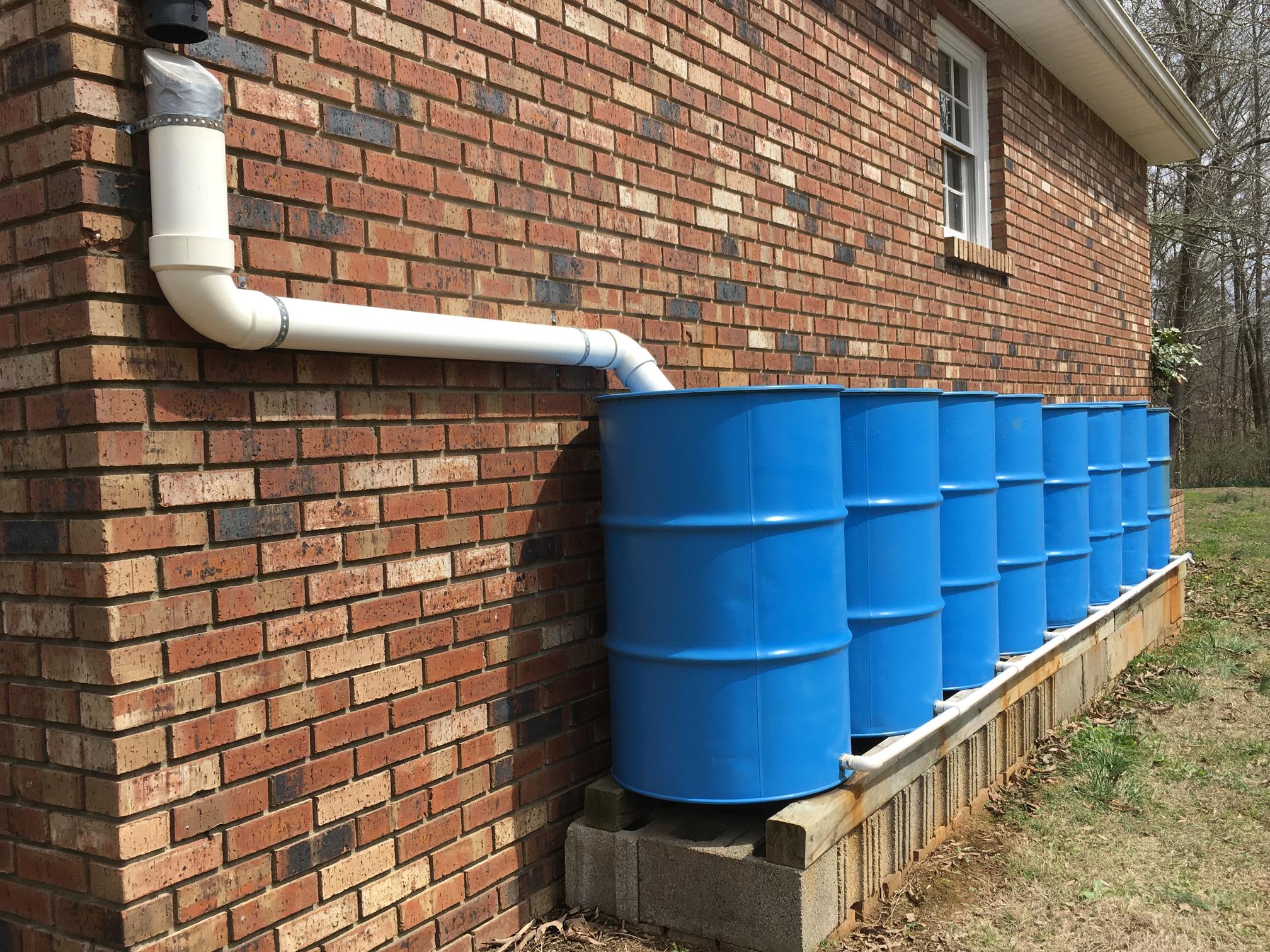
It wasn’t hard in determining where my harvesting system was to be located. My 6,200 square foot garden space is behind a 20′ x 32′ garage. I wanted to capture the rainwater runoff from the garden-facing roof of the garage, so I figured it would be easy enough to set the rain barrels side by side along the garage wall. (Figure 1.) Water is heavy, weighing in at 8.34 pounds per gallon. A full 55-gallon drum is going to weigh nearly 460 pounds; that’s a lot of weight, and a proper foundation is critical for a trouble-free system.

After determining where the barrels would be located, I began leveling the ground with a hoe and a four foot level. Because the ground was on a slight slant, and because I’m basically lazy and didn’t want to do a lot of digging, I used some old brick on a part of the slope to help level the ground. Next, I set twelve standard 8” x 16” concrete blocks end to end directly along the garage wall on the ground or bricks making sure they were reasonably level. That completed the back side of my foundation. Then, I measured 24” out from the wall (the width of a 55-gallon barrel) and put a second row of concrete blocks to finish the foundation. Knowing that each barrel would weigh 460 pounds when full, I decided to lay 4” x 4” posts on the concrete blocks to help more evenly distribute the overall weight. Then, I set the first barrel in place.

Figure 2

I located the first barrel a few feet away from the downspout, since I wanted to route the water directly into the top of this barrel. I cut the downspout off about 24” above this barrel and ran a short piece of 4” PVC pipe from the downspout to a hole I cut into the lid of the barrel. (Figure 2.) I secured the piping with metal straps screwed into the garage wall. One PVC elbow on each end of the 4” PVC pipe directed the water from the downspout through the pipe and into the first barrel. I wanted to be able to filter out any small twigs, leaves, and other debris, so I cut a slant to the PVC collector and covered it with screen wire. The screen easily filters out what I don’t want in the barrels but lets the water pass through. I cut the PVC collector at a slant so any debris caught by the screen is simply washed off by the flow of water. When the barrels are completely full of water, I cover the PVC collector (a small plastic bag works great) to shed off any more water, letting it simply fall on the splash guard on the ground below. When I want more water, I take the plastic bag off and collect all the water I need.

Figure 3

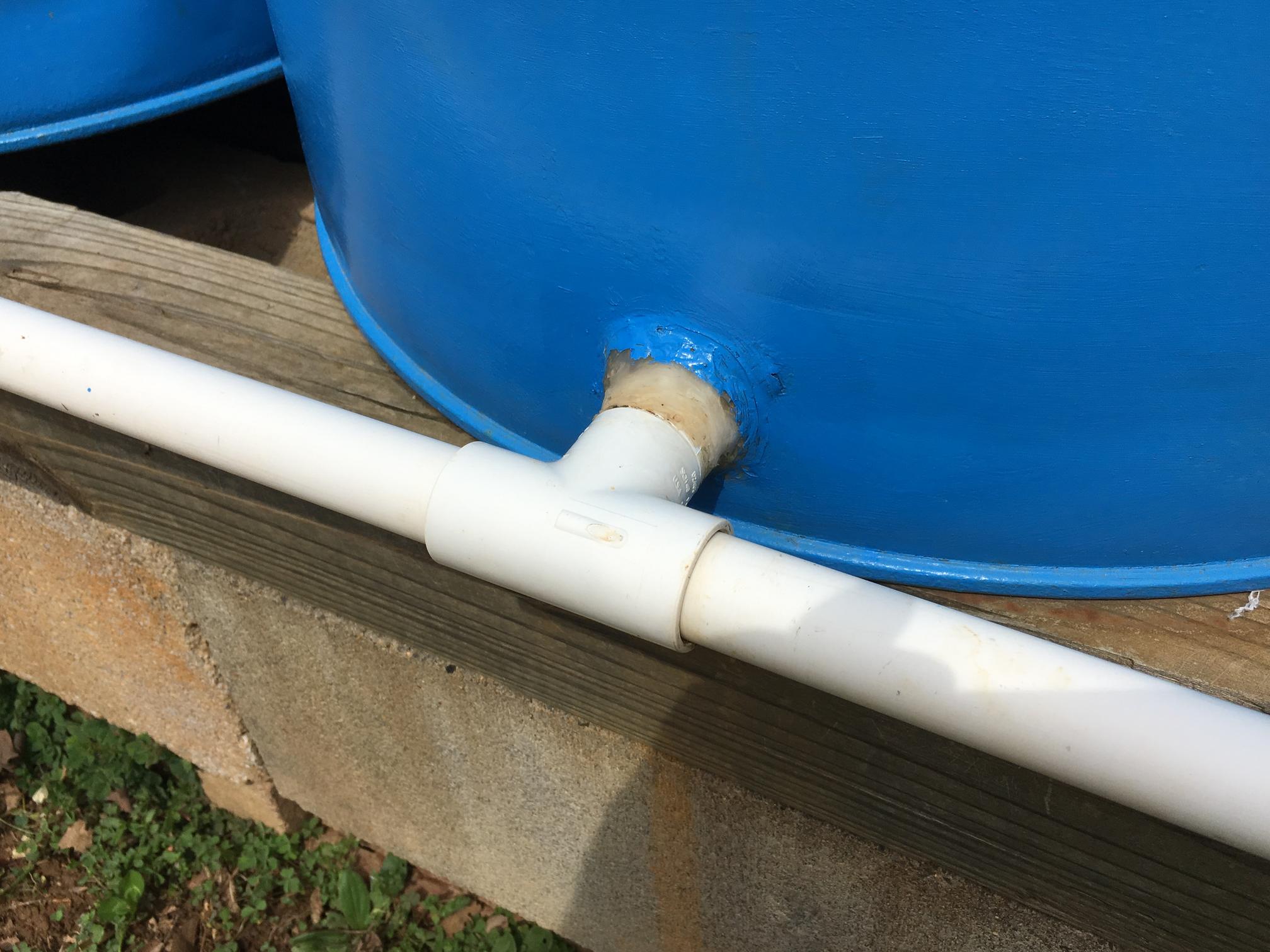
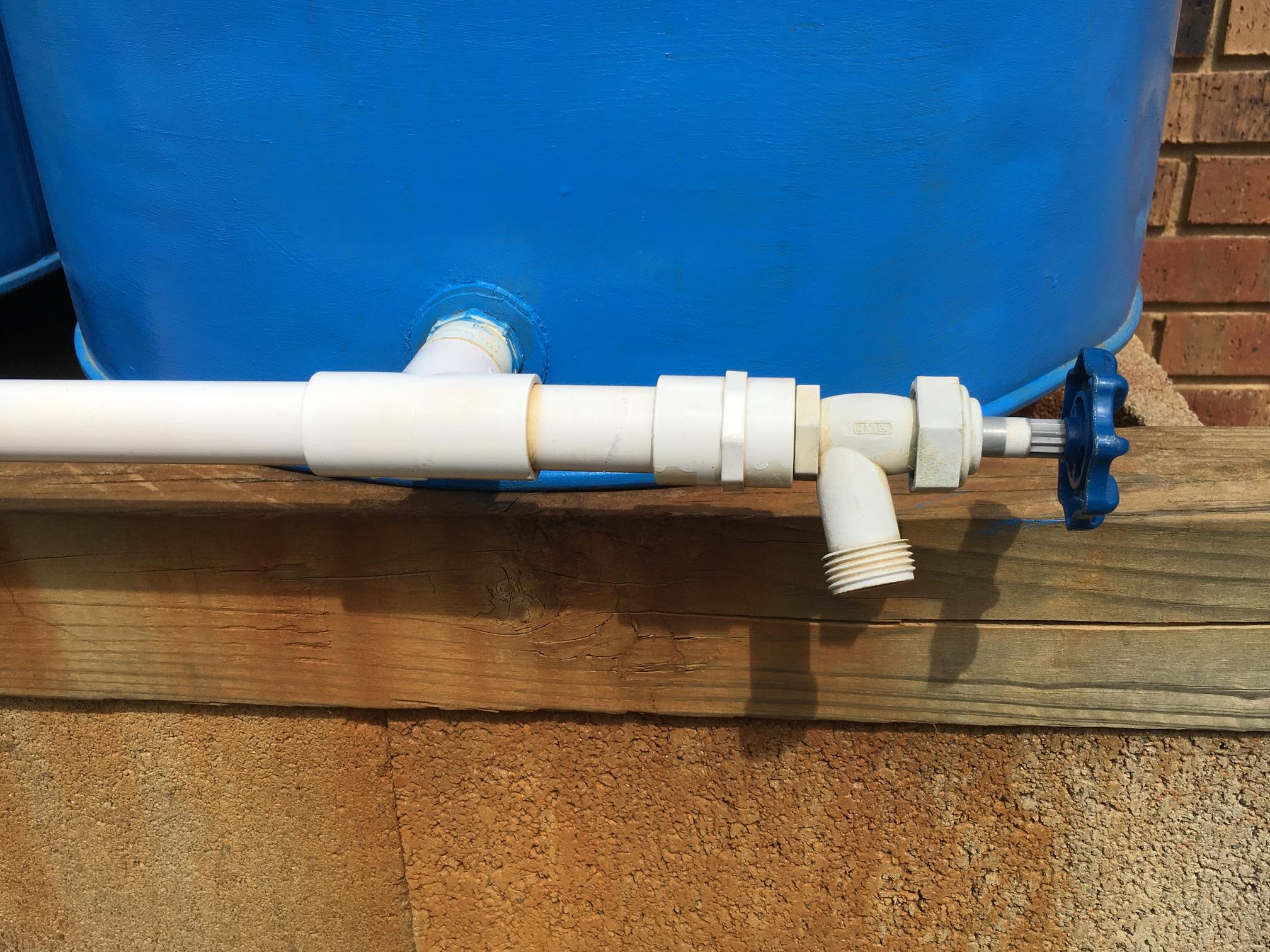
I drilled a 1 1/4” hole on the side of each barrel, 2” up from the bottom, and inserted a 1” x 3/4” PVC adapter (thread & slip) pipe threaded on one side and secured it with a nut. I used a rubber washer on both sides of the barrel to prevent leakage and, just as added insurance, sealed both sides with a waterproof sealant. I then attached 1” PVC elbows, pipes and tees to link each of the barrels together. (Figure 3.) At the end of the piping (the barrel furthest from the downspout), I added a plastic faucet with threads for a hose attachment (Figure 4.) My rain harvesting system was complete. Now for the fun part (Reference Figure 1.) You will notice that only the first barrel has water emptying into it from the top. None of the other barrels has any water emptying into their top. That is because as the first barrel begins to fill with water, the water flows through the 1” PVC piping into the second barrel, then to the third, and so on. Water always seeks its own level, so all of the other barrels fill as the first one does. Essentially, the barrels fill from the bottom up! (I always have fun with that one when I explain it to my neighbors.)

Figure 4

It is fairly easy to calculate the number of gallons you will collect from the amount of rainfall you receive. The size of your roof, the “catchment area,” will determine how much rainwater you will harvest during any one rainfall. To calculate the number of gallons you will collect, you will need to measure the dimensions of the roof from which you will collect water. Convert each measurement into inches (multiply x 12). Multiply the two numbers together and determine the number of square inches of the roof or “catchment area.” Then, multiply this by the number of inches of rain you receive. Divide that number by 231 because one gallon equals 231 cubic inches. The result is the number of gallons you will collect.

The Example of My Roof

I am collecting rainwater from only one side of my garage roof. That roof measures 12′ x 32′ or 144” x 384”; the catchment area is therefore 55,296” square inches. Let’s assume I get 1.5” of rainfall. Multiply the total square inches by the amount of rainfall and divide that amount by 231. In this example, 55,296 x 1.5 = 82,944 / 231 to determine 359.0 gallons of harvested rainwater. I have eight 55-gallon barrels for a total of 440 potential gallons of water storage. With 1.5” of rain, I have already collected 80% of all the water my barrels can hold. That’s not bad!

This is a relatively easy rain harvesting system to construct. I already had the concrete blocks and 4 x 4 posts. The 55-gallon barrels were given to me, so all I was out was some PVC piping, rubber washers, a tube of sealant, and a faucet. The project took me a couple of days working just part-time to construct the foundation, drill holes in the barrels, and cut and tie together all the PVC piping. I worked the entire project by myself. With help, it could have been done in much less time. I’ve used this system to harvest rainwater from early spring through the fall with excellent results. My barrels have never leaked and are nearly always full. After I use them to water my garden, they are always ready to accept every bit of rainwater that falls. In the hot summer, a half inch of rain doesn’t seem like much, but a half inch of rain on my 55,296 square inch catchment area is equal to nearly 120 gallons of free water, which is more than a welcome thing for a thirsty garden.

My biggest question in designing and building this rainwater harvesting system was whether or not I’d actually have enough water pressure coming through the hose to water effectively. I did have one slight advantage. My garden is on a gently sloping hillside, so I had not only the water pressure within the barrels themselves but a slight drop in elevation. I could stand in the center of my garden, which is forty feet from my water barrels, and had enough water pressure that I could hold my thumb over the end of the hose and squirt water a good four feet away. For me, that was acceptable. Of course, if you wanted to add a small water pump, you could do far better. But this was my project, and I’m pleased with the results.

Additional thoughts and hints:

  1. With the height of the concrete blocks and the 4” x 4” posts, I had a good foot above ground level for the barrels. You cannot go so high that the foundation is unsteady, but some height is an advantage. It allows plenty of room to attach your garden hose and also for filling buckets, watering cans, et cetera, and it provides for better drainage when watering with a hose. In addition it makes for easier weed eating or mowing right next to the concrete blocks without the PVC pipe or barrels being in the way.
  2. I also covered each barrel with a top. You don’t want all manner of debris settling in the water, not to mention mosquitoes and bugs. The cleaner you are able to keep the stored water, the easier and faster it will flow through your hose.
  3. I did not cement any of the PVC pipes together. They fit snugly enough that they never leaked. When very cold weather comes, I drain the tanks and take the piping apart to keep any residual water from freezing and bursting them. It’s an easy job, taking only minutes; plus, it gives me a chance to thoroughly inspect and clean any sediment that may have settled in them during the past several months of use. (If you live in a more temperate climate, you’ll be able to leave your system intact.)
  4. The first time I took the piping apart, I numbered each PVC piece with a permanent marker so reconstructing them next spring would be an easy chore to put them back in exactly the same location. Theoretically, all the pieces should be interchangeable, but with even slight variations in drilling holes and cutting PVC pipe, well, it’s just easier reassembling everything exactly like I originally put it together.
  5. This design will work with one barrel (you’ll forgo any of the connecting PVC pipe) or with any number of barrels you choose. I used eight because I wanted to have an ample supply of water to use during drought periods, and 440 gallons seemed about right to me. You can start with two or three and add to it as time goes by.

No doubt, there are many designs for rainwater catchment systems. The design I used was easy to construct, required very little time, and was more or less permanent. It also cost me very little, because I had four barrels and was able to scrounge four more. I’ve used harvested rainwater to water my garden for several years now with little maintenance and no trouble. Plus, for much of the year, I rest easy knowing that if for any reason the grid goes down, I’ve plenty of water ready for my Berkey filter.


Letter Re: Transporting Documents – Empty the Trash!

Hugh,

The files that you think you deleted from your portable drive using the Windows “delete” command or the Mac “move to trash” command are still there; you just can’t see them. Learn how to securely delete files from the .trashes and hidden files from thumb drives by doing an Internet search on the topic of .trashes file and how to securely delete old files from them. This is a must do for anyone using a USB thumb or SD card. If you have a Windows computer and can find the option to “show hidden files” you should do that. Look into using Apple’s FileVault.

The mini-SD card is small enough that it can easily be concealed underneath a round band-aid stuck to your skin.

RT