In February 2018, there was a small news item that didn’t get near the attention that is deserved. It described how The Marshall Islands–formerly a U.S. Territory, but now an independent sovereign nation–plans to launch it own cryptocurrency, called the SOV and use it as legal tender. This will be the world’s second sovereign cryptocurrency. (Venezuela has announced pre-sale of a national crypto that is backed by oil. But the Marshall Islands SOV is a much more legitmate venture.)
Sovereign Cryptocurrency
For any sovereign nation to release a legitimate sovereign cryptocurrency and give it legal tender status is huge news–even if it is done by a tiny nation.
Here are three key quotes from the article:
“The country has capped the SOV supply at 24 million tokens in order to prevent inflation…”
and,
“The Marshall Islands is partnering with Neema, an Israeli financial technology startup, to issue the SOV…”
and,
“[The] SOV is based on what the Marshall Islands government calls the “Yakwe framework”, which requires users to identify themselves on the blockchain, solving the anonymity problem that has plagued bitcoin and precluded its mainstream adoption. Paul said that because bitcoin and other cryptocurrencies are anonymous, they are not compatible with the framework of a regulated banking environment.”
The story behind the Marshall Islands SOV is interesting reading, just in itself.
Hmmm… This is all food for thought. The SOV articles helped crystallize in my mind a plan for a sovereign cryptocurrency that I had been considering for several months.
Paying Off THE National Debt
If Donald Trump and senior U.S. Treasury Department officials are paying attention, then they are probably considering a similar cryptocurrency token issue. (Or they should be considering it!) Here is my prediction: If there is a US Treasury Sovereign crypto token issued and if it is done correctly, then it could literally pay off the U.S. National Debt in less than ten years. I’m not joking. Here is how this could work:
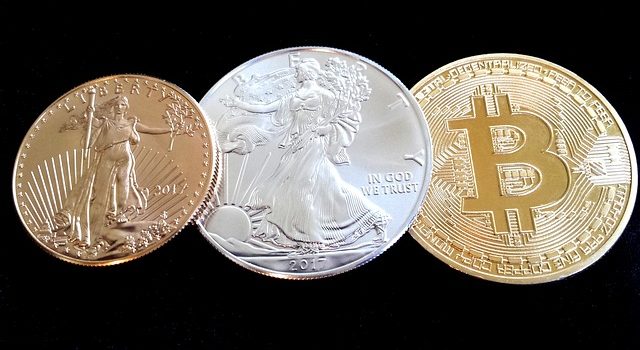
1.) The U.S. Treasury creates a variant of proven blockchain software and releases a strictly-limited quantity of crypto tokens. I propose that these crypto tokens be called U.S. Eagles or (“US-E”), to distinguish them from fiat US Dollars (USD). These would be strictly limited to a total issue of 100 Million US-E tokens. They’d be released at the rate of 10 Million US-E Tokens per year, over the course of 10 years. This strict token limit would insure that inflation of the US-E cryptocurrency is impossible. Instead, a sustained price deflation is inevitable, most likely at a geometric rate as the US-Eagle gains popularity.
2.) The exchange rate of US-E (“Eagles”) would be free-floating versus all other currencies.
3.) The selling price of the Initial Coin Offering (ICO) for 10 Million US-E Tokens be set at $100 USD. But each subsequent annual release will be sold into circulation based solely on its then-current free market exchange rate. If demand is high then they should be sold with priority given to individual buyers who place online buy orders for less than .10 US-E each, to prevent a small group of individuals from amassing most of the tokens thereby allowing them to manipulate the market.
4.) That the US-E have 12 decimal places of divisibility, to give it long term utility, even if it advances to great value versus fiat currencies and other cryptocurrencies. (Most other cryptos only have 9 decimal places,)
5.) That US-E be given legal tender status for paying all debts, public and private in the United States and its territories.
6.) That ES-E be made 100% tax exempt throughout their chain of creation, issuance, use, and re-use. (“No taxes, ever“) This would mean that holders of US-E who sell them, spend them, or earn them would not be subject to any Federal taxes. Thus, US Dollar (USD) earnings and profits would still be taxable, but the US-E would not.
7.) That there be no electronic mining of US-E sovereign cryptocurrency. Rather, they will be sold or spent into circulation in annual batches as a land-backed currency. By law, 100% of the revenue derived would be used to pay down the National Debt. And after all that debt is extinguished, any additional revenue would then be used to build up a national infrastructure trust fund to build roads, bridges, canals, border fences, and electrical/Internet infrastructure.
8.) For its land backing, the US-E sovereign cryptocurrency would have perpetual at-will convertibility on demand into Allodial Patent Deeds for almost any BLM land within Owyhee County, in the southwestern corner of Idaho. This Southwest Idaho Free Trade (SWIFT) Zone would be bounded by the Nevada State line (to the south) and the Oregon State line (to the west.) But it would exclude the already sovereignly-held Duck Valley Indian Reservation. Nearly all of the BLM-administered Federal land inside Owyhee County wodu be eligible to be redeemed with US-E, with the price for each parcel set at auction. These parcels would be allodially-held freeholds in the SWIFT Zone.
9.) The minimum size parcel for subdivision would be five acres. Owyhee County measures 7,665 square miles (4,905,600 acres.) That is about three times the size of Delaware. But it has a population of less than 12,000. So there is plenty of vacant BLM land to redeem there. (Since it is likely that the free market price of land inside the SWIFT Zone would soon exceed 300 US-E per acre, the entirety of the BLM land inside the zone would never be redeemed.)
10.) Any land that is already privately owned in Owyhee County would automatically become allodially-held freeholds, at no charge. Any currently-held mining claims would be converted to patented allodial freeheld claims, at no charge. And currently-held BLM cattle grazing permits inside the SWIFT Zone would end, but the holders of those permits would be reimbursed by free allodial grants of smaller parcels of BLM land, of their choice. The holders of US-E sovereign cryptocurrency could redeem their choice of any BLM land inside the SWIFT Zone, with the exception of land set aside for road right-of-ways, shooting ranges, water reclamation sites, a few small riparian parks, public landfills, and airports.
11.) All land inside of the SWIFT Zone would be entirely exempt from any property taxes (Federal, State, or Local), in perpetuity. But with more billionaires per capita that any other US county, there will be no shortage of donations for scholarships to private schools and to build and maintain roads. Further, all land inside the SWIFT Zone would also be exempt from all Federal Alcohol, Tobacco, and Firearms laws. And even better, the holders of these parcels would be exempt from Federal income tax for any income generated by their business ventures located inside the SWIFT Zone. To clarify: Any business venture, trust, or individual, located inside the SWIFT Zone would be fully exempt from all Federal taxes including all duties, tariffs, corporate taxes, excise taxes, income taxes, estates taxes, the Firearms and Ammunition Excise Tax (FAET), NFA taxes, or capital gains taxes, forever.
Conclusion:
If this new US-Eagle sovereign cryptocurrency and SWIFT Zone are created as I have outlined, then I predict that they would immediately flourish with unprecedented abundance. Each successive annual US-E token issue would jump in value in relation to all other currencies. By the time that the Eighth Round of US-E tokens is issued, the value of US-E sovereign cryptocurrency put into circulation would pay off the current $21 trillion National Debt. (It will probably be at least $23 trillion by the time this plan could be implemented.) And by the time that the 10th Round is issued, it will have built up an Infrastructure Trust Fund so large that it would last the nation for generations.
Pay attention, President Trump. This US-Eagle sovereign cryptocurrency can fly. This is your opportunity to go down in history as America’s Greatest President. Ever. – JWR
Note: Permission is granted for re-posting of this entire article, but only if done so in full, with proper attribution to James Wesley, Rawles and SurvivalBlog, and only if the included links are preserved.)