

“Peace is more than just the absence of war. True peace is justice, true peace is freedom. And true peace dictates the recognition of human rights.” – Ronald Reagan, 1986
- Ad Elk Creek Company - Federally-Exempt No-Paperwork GunsPre-1899 Antique Cartridge Guns -- No FFL Required. Can be mailed to your doorstep with no Federal paperwork!
- Ad Prepare for chaos with the essential SIEGE belt. Perfected for CCW with flexible, no-stretch, high-grip custom HD ballistic nylon and capabilities unmatched in any other belt. Go anywhere. Solid 5.5-7 oz of persuasion has saved many. Save $20!SIEGE STOVES: in a fuel crisis twigs are free and abundant. Ultra-compact high-performance portable survival stoves. Enter "SBLOG" at checkout for $20 off any belt. USA-made.
Preparedness Notes for Wednesday — July 2, 2025
After a stab in the back to gun owners by the RINOs of the U.S. Senate, the Budget Reconciliation Bill is now back in the House of Representatives. Please repeatedly contact your U.S. congressmember by phone and e-mail and demand that they vote for Rep. Andrew Clyde’s new (July 1st) House Amendment restoring the full versions of the Hearing Protection Act and the SHORT Act to the bill. We are now within inches of getting this important legislation passed. It will only take about five more House member votes to get this passed!!! Please phone the Capitol switchboard: (202) 224-3121. Thanks, – JWR
—
On July 2, 1698, English engineer Thomas Savery patented the first steam engine.
—
And On July 2, 1901, Butch Cassidy and the Sundance Kid robbed train of $40,000 at Wagner, Montana, on the Northern Pacific Railroad’s Hi Line.
—
SurvivalBlog Writing Contest
Today we present another entry for Round 119 of the SurvivalBlog non-fiction writing contest. The prizes for this round include:
First Prize:
- A Gunsite Academy Three Day Course Certificate. This can be used for any of their one, two, or three-day course (a $1,095 value),
- A Peak Refuel “Wasatch Pack” variety of 60 servings of premium freeze-dried breakfasts and dinners in individual meal pouches — a whopping 21,970 calories, all made and packaged in the USA — courtesy of Ready Made Resources (a $350 value),
- American Gunsmithing Institute (AGI) is providing a $300 certificate good towards any of their DVD training courses. Their course catalog now includes their latest Survival Gunsmithing course.
- HSM Ammunition in Montana is providing a $350 gift certificate. The certificate can be used for any of their products.
Second Prize:
- A SIRT STIC AR-15/M4 Laser Training Package, courtesy of Next Level Training, that has a combined retail value of $679
- A $269 retail value survival-ready power package from Solar Power Lifestyle. This includes two Solar Power Lifestyle 25W Portable Solar Panels, plus a $150 gift card to use for any purchase at solarpowerlifestyle.com.
- Two 1,000-foot spools of full mil-spec U.S.-made 750 paracord (in-stock colors only) from TOUGHGRID.com (a $287 value).
- A transferable $150 FRN purchase credit from Elk Creek Company, toward the purchase of any pre-1899 antique gun. There is no paperwork required for delivery of pre-1899 guns into most states, making them the last bastion of gun purchasing privacy!
Third Prize:
- A Berkey Light water filter, courtesy of USA Berkey Filters (a $305 value),
- Two sets of The Civil Defense Manual, (in two volumes) — a $193 value — kindly donated by the author, Jack Lawson.
- A $200 credit from Military Surplus LLC that can be applied to purchase and/or shipping costs for any of their in-stock merchandise, including full mil-spec ammo cans, Rothco clothing and field gear, backpacks, optics, compact solar panels, first aid kits, and more.
- A transferable $150 FRN purchase credit from Elk Creek Company, toward the purchase of any pre-1899 antique gun.
—
More than $960,000 worth of prizes have been awarded since we started running this contest. Round 119 ends on July 31st, so get busy writing and e-mail us your entry. Remember that there is a 1,500-word minimum, and that articles on practical “how-to” skills for survival have an advantage in the judging. In 2023, we polled blog readers, asking for suggested article topics. Please refer to that poll if you haven’t yet chosen an article topic.
- Ad Click Here --> Civil Defense ManualNOW BACK IN STOCK How to protect, you, your family, friends and neighborhood in coming times of civil unrest… and much more!
- Ad USA Berkey Water Filters - Start Drinking Purified Water Today!#1 Trusted Gravity Water Purification System! Start Drinking Purified Water now with a Berkey water filtration system. Find systems, replacement filters, parts and more here.

Preparing To Go To Gunsite – Part 2, by N.C.
(Continued from Part 1.)
Physical Requirements
Can you stand for six hours a day in the sun and weather? Be brutally honest with yourself here. I saw one gentleman who came who could not. I felt so bad for him. To have spent all the money and time and be unable to actually complete the training would be heartbreaking. On the other hand there were absolutely people north of 60 completing the course. You don’t need to be able to run a marathon but you do need to be able to stand in the sun for several hours. Bear in mind that at even at your most tired, you are still responsible for controlling deadly force.
If your body can no longer handle that sort of exertion, then consider where better to spend the money that you’ve earned and saved. Maybe you should spend it on a cruise for yourself. Maybe you should go on a trip to Hawaii or Florida. Or whatever it is that floats your boat. There’s a time to enjoy the fruits of your labors.Continue reading“Preparing To Go To Gunsite – Part 2, by N.C.”
- Ad Survival RealtyFind your secure and sustainable home. The leading marketplace for rural, remote, and off-grid properties worldwide. Affordable ads. No commissions are charged!
- Ad USA Berkey Water Filters - Start Drinking Purified Water Today!#1 Trusted Gravity Water Purification System! Start Drinking Purified Water now with a Berkey water filtration system. Find systems, replacement filters, parts and more here.
SurvivalBlog Readers’ & Editors’ Snippets
Our weekly Snippets column is a collection of short items: responses to posted articles, practical self-sufficiency items, how-tos, lessons learned, tips and tricks, and news items — both from readers and from SurvivalBlog’s editors. Note that we may select some long e-mails for posting as separate letters.
—
Reader Hollyberry wrote us last month:
“Not much excitement goes on in rural Maine, which is why we live here. Back in April this year, while reading the local paper, it ran a story on a local soldier that had died in WWII. The young man, US. Army Private Willard D. Merrill, was from Doverfoxcroft, Maine. He was captured by the Japanese and later died in a POW camp in 1942. He was just 21 years old. Pvt. Merrill was buried in a common grave. According to the Maine news outlets, the grave was exhumed in 1947 and the task of identifying the soldiers began. Three sets of remains were unidentifiable and were buried in the Manila American Cemetery and Memorial. He remained here until January 2019 when he was exhumed again and the remains were re-examined in an attempt to identify the three remaining soldiers. I do not know if the other two soldiers were identified. It was said that Pvt. Merrill would be returning home in June.
When my husband — a disabled Air Force veteran — read the story, he said we needed to go to honor this young man when he returns home. Life went on and the story faded from our minds until today, June 7th, 2025. I looked at the local news and there was an article that Pvt. Merrill was returning home today!
It rained all day and the bugs are seriously thick right now. Pvt. Merrill was due to arrive around 8 pm. at the local funeral home. I kept checking the local news for updates in case the plane carrying him to Logan Airport in Boston was delayed and found one update that the escort procession had crossed into Maine at approximately 4:30. We left our home early figuring his remains would arrive earlier than 8 pm. As we were leaving the house, the rain finally stopped!
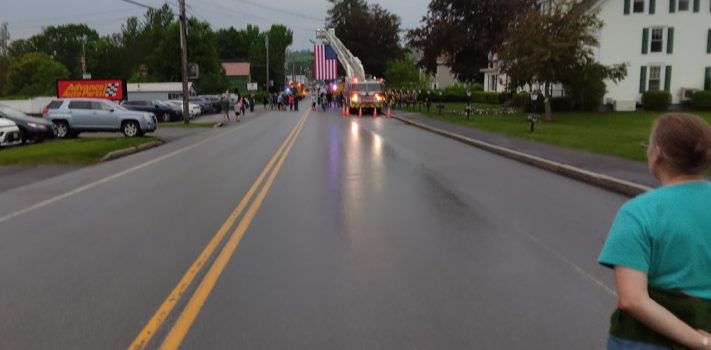
The road was blocked right at the funeral home and I could see people gathered. The fire truck was in the middle of the road with the ladder extended and from it hung an American flag. The Boy Scouts were also there holding flags, along with many veterans and just ordinary people welcoming this young man home. We had just made in time to see the remains transferred into the funeral home. He will be buried on June 9th in the local cemetery.
We were very humbled to be able to be part of the crowd to witness Pvt. Merrill’s arrival home. This is why we went out on Saturday night. It was the least we could do for him and his family.”
o o o
The latest video update from our favorite intrepid Finns: After 181 Days Frozen In, the Ice Breaks Up.
o o o
The silent boom: How rising CO2 levels are making trees bigger and stronger.
- Ad SurvivalRealty.com: Sell Your Remote LandAdvertise your hard-to-sell remote land to eager buters. We specialize in rural, remote, and off-grid properties worldwide. Affordable ads. No commissions are charged!
- Ad California Legal Rifles & Pistols!WBT makes all popular rifles compliant for your restrictive state. Choose from a wide range of top brands made compliant for your state.

The Editors’ Quote of the Day:
“Napoleon’s troops fought in bright fields, where every helmet caught some gleams of glory; but the British soldier conquered under the cool shade of aristocracy. No honours awaited his daring, no despatch gave his name to the applauses of his countrymen; his life of danger and hardship was uncheered by hope, his death unnoticed.” – General William Francis Patrick Napier (1785-1860), in Peninsular War (1810). Vol. ii. Book xi. Chap. iii.
- Ad STRATEGIC RELOCATION REALTYFOR SALE: Self-sustaining Rural Property situated meticulously in serene locales distant from densely populated sanctuary cities. Remember…HISTORY Favors the PREPARED!
- Ad Survival RealtyFind your secure and sustainable home. The leading marketplace for rural, remote, and off-grid properties worldwide. Affordable ads. No commissions are charged!

Preparedness Notes for Tuesday — July 1, 2025
On July 1, 1836, US President Andrew Jackson announced to Congress a bequest by James Smithson of 100,000 gold sovereigns to found the Smithsonian Institution in Washington.
—
On July 1st, 1997, the crown colony of Hong Kong officially reverted to Chinese sovereignty, ending 156 years of British rule. There have been sporadic protests by locals, ever since then.
—
July 1st, 1535, Sir Thomas More went on trial for treason for refusing to accept King Henry VIII as head of the Church of England.
—
And on July 1st, 1863 is the anniversary of the beginning of the Civil War Battle of Gettysburg.
—
SurvivalBlog Writing Contest
Today we present another entry for Round 119 of the SurvivalBlog non-fiction writing contest. The prizes for this round include:
First Prize:
- A Gunsite Academy Three Day Course Certificate. This can be used for any of their one, two, or three-day course (a $1,095 value),
- A Peak Refuel “Wasatch Pack” variety of 60 servings of premium freeze-dried breakfasts and dinners in individual meal pouches — a whopping 21,970 calories, all made and packaged in the USA — courtesy of Ready Made Resources (a $350 value),
- American Gunsmithing Institute (AGI) is providing a $300 certificate good towards any of their DVD training courses. Their course catalog now includes their latest Survival Gunsmithing course.
- HSM Ammunition in Montana is providing a $350 gift certificate. The certificate can be used for any of their products.
Second Prize:
- A SIRT STIC AR-15/M4 Laser Training Package, courtesy of Next Level Training, that has a combined retail value of $679
- A $269 retail value survival-ready power package from Solar Power Lifestyle. This includes two Solar Power Lifestyle 25W Portable Solar Panels, plus a $150 gift card to use for any purchase at solarpowerlifestyle.com.
- Two 1,000-foot spools of full mil-spec U.S.-made 750 paracord (in-stock colors only) from TOUGHGRID.com (a $287 value).
- A transferable $150 FRN purchase credit from Elk Creek Company, toward the purchase of any pre-1899 antique gun. There is no paperwork required for delivery of pre-1899 guns into most states, making them the last bastion of gun purchasing privacy!
Third Prize:
- A Berkey Light water filter, courtesy of USA Berkey Filters (a $305 value),
- Two sets of The Civil Defense Manual, (in two volumes) — a $193 value — kindly donated by the author, Jack Lawson.
- A $200 credit from Military Surplus LLC that can be applied to purchase and/or shipping costs for any of their in-stock merchandise, including full mil-spec ammo cans, Rothco clothing and field gear, backpacks, optics, compact solar panels, first aid kits, and more.
- A transferable $150 FRN purchase credit from Elk Creek Company, toward the purchase of any pre-1899 antique gun.
—
More than $960,000 worth of prizes have been awarded since we started running this contest. Round 119 ends on July 31st, so get busy writing and e-mail us your entry. Remember that there is a 1,500-word minimum, and that articles on practical “how-to” skills for survival have an advantage in the judging. In 2023, we polled blog readers, asking for suggested article topics. Please refer to that poll if you haven’t yet chosen an article topic.
- Ad Elk Creek Company - Percussion Blackpowder Guns - No FFL Required.Elk Creek Company - Percussion Blackpowder Guns - Pre-1899 Guns - Knives - Bayonets - Magazines - The last bastion of privacy!
Preparing To Go To Gunsite – Part 1, by N.C.
I think the most important preparations we make are those that overlap in “fun” and “useful” categories. For me, that overlap is best represented in marksmanship. I’ve always loved marksmanship and being a better marksman makes me better able to defend my family if the second worst day of my life happens to be today.
I used a SurvivalBlog Writing Contest prize Course Certificate toward the full Gunsite 250 class. The 250 defensive pistol is their standard basic defensive pistol class. Because 250 Defensive Pistol is a 5-day course, the credit that I won writing an article for SurvivalBlog only went part of the way. I had to put my own money towards the rest of the tuition, as well as money for the ammo, gear, lodging, food, and transportation. Being so far away, this training was a once-in-a-lifetime opportunity, so making the jump to the 5-day course was the best choice for my family.
Possibly the biggest cost to my family was the time, something all the students invested equally. This was Dad doing something on his own for a week. That means that Mom had to take care of the kids using her Paid Time Off. That’s time that we as a family can’t use. Now, some things lined up, some grandparents were able to help, but it was still a big ask for my family. Now that I’m on the other side, I’m glad I did it.
Defensive Pistol 250
The Defensive Pistol 250 course is 40 hours of instruction. The lecture portions cover mindset, firearm maintenance, ammo selection, and self-defense considerations. There’s a lot more hands-on training than there are lectures. The training will have you practice basic marksmanship, quick shooting, malfunction clearing, low light shooting, use of cover, and “simulators” where you will use frangible ammunition to do room clearing. At the end of it, you will have more rounds downrange and more firearm specific training than most new cops.
This base course for pistol qualifies you to take more advanced training, where force-on-force, concealed carry, and low-light simulators are the focus. If you do exceptionally well, then you can advance to their most advanced courses without the intermediate ones. Completion alone allows you access to multiple things at Gunsite that are smaller than full-blown courses and occur throughout the year. At that point, you’ve demonstrated competence and a basic understanding of their approach. You’re safe and at a certain base level, and as a result you can now do more with them.
If you live within 800 miles of the Gunsite Academy in Paulden, Arizona, I’m pretty unequivocal: you should spend the money and get the training. If you are more than 800 miles away, then it might be better to spend that amount of money working your way up through another trainer’s curriculum. If you’re looking for options, I’ve reviewed the training by Warrior Poet Society before. Working your way through the multiple levels in another training “ecosystem” may be better for you if that ecosystem is closer. But if you live close to it, then I strongly suggest Gunsite.Continue reading“Preparing To Go To Gunsite – Part 1, by N.C.”

SurvivalBlog’s News From The American Redoubt
This weekly column features news stories and event announcements from around the American Redoubt region. (Idaho, Montana, eastern Oregon, eastern Washington, and Wyoming.) Much of the region is also more commonly known as The Inland Northwest. We also mention companies located in the American Redoubt region that are of interest to preppers and survivalists. Today, news about another bison death at Yellowstone. (See the Montana section.)
Idaho
Suspected gunman found dead after fatal shooting of Idaho firefighters.
o o o
“Truth and Reconciliation” Conference being held to voice concerns on Victor Perez shooting.
o o o
Firefighters battle blazes near Greer, Pierce.
o o o
North Idaho woman sentenced to jail for road rage crash that left child in coma.
o o o
Continue reading“SurvivalBlog’s News From The American Redoubt”

The Editors’ Quote of the Day:
“Hinc quam sic calamus sævior ense, patet.” (Translated: “The pen worse than the sword.”) – Robert Burton (1576-1640) Anatomy of Melancholy. Part I. Sect. 2, Memb. 4, Subsect. 4.

Preparedness Notes for Monday — June 30, 2025
An Important Note: Please repeatedly contact your state’s two U.S. Senators by phone and e-mail and demand that they overrule the unelected Senate Parliamentarian’s recent bogus ruling that the Hearing Protection Act and the SHORT Act did not qualify as “tax measures” under the Byrd Rule. Clearly, the National Firearms Act of 1934 IS INDEED part of the Federal tax code, and any modification to NFA-’34 is indeed “tax-related.” Tell your Senators: Vote NO on the entire bill, unless the Hearing Protection Act and the SHORT Act are fully restored! If they can overrule the Senate Parliamentarian on Senator Dan Chenshaw’s bill, then they can do the same for ours. And for that matter, the Senate Parliamentarian can and should be immediately fired and replaced! – JWR
—
On June 30, 1893, the Excelsior diamond (blue-white 995 metric carats) — then the world’s largest — was discovered in Jagersfontein Mine, South Africa.
—
June 30, 1908: A giant fireball, most likely caused by the airburst of a large meteoroid or comet flattened 80 million trees near the Stony Tunguska River in Yeniseysk Governorate, Russia, in the largest such impact event in recorded history. Some more details are available here: The Tunguska explosion rocked Siberia 117 years ago. (Our thanks to reader “BOG”, for the link.)
—
June 30th is the anniversary of the tragic death of 19 hotshots in the Yarnell Hill Fire. (In 2013.)
—
The last day! We have been running a one-week sale on all of our pre-1899 sporter rifles at Elk Creek Company. There are some very deep discounts. Order yours, ASAP! They can be mailed directly to your doorstep or your P.O. box, in most states. This sale ends at midnight Eastern Time, tonight (Monday, June 30th, 2025.)
—
Today’s feature article is a “how-to” piece written by our own Tom Christianson.
—
We are seeking entries for Round 119 of the SurvivalBlog non-fiction writing contest. More than $960,000 worth of prizes have been awarded since we started running this contest. Round 119 ends on July 31st, so get busy writing and e-mail us your entry. Remember that there is a 1,500-word minimum, and that articles on practical “how-to” skills for survival have an advantage in the judging. In 2023, we polled blog readers, asking for suggested article topics. Please refer to that poll if you haven’t yet chosen an article topic.
DIY Wood-Lined-Steel-Drum Corn Storage, by Thomas Christianson
“Some deer came to the squirrel feeder today,” Kari announced at supper one evening. Kari and I both love deer. Kari loves deer because she thinks that they are pretty. I love deer because I think that they are tasty. As a result, our priorities don’t always coincide. But we do both agree that we like having deer around on the property. It isn’t that I have ever actually shot deer on our property. I just want them nearby in case I get hungry.
The squirrel feeder had not always been a squirrel feeder. It was originally a platform that I had built to hold a salt block for the deer. But when the deer consistently ignored the salt, the platform eventually became a place where we set out stale bread and other treats for the squirrels that flourished in the woods near our home. Harsh weather conditions in January and February had made it difficult for the deer to find sufficient food. Now they were getting desperate enough to compete with the squirrels for scraps of stale bread.
“One of the deer was crippled,” Kari continued. “She couldn’t walk on one of her front legs. And she was pregnant too!”
I suddenly knew that our family had acquired a new dependent.
Kari bought a 40-pound bag of shelled corn for the deer. Between the deer, squirrels, turkeys, and other wild inhabitants of the wetlands surrounding our home, the corn did not last long. Kari began making plans for purchasing more.
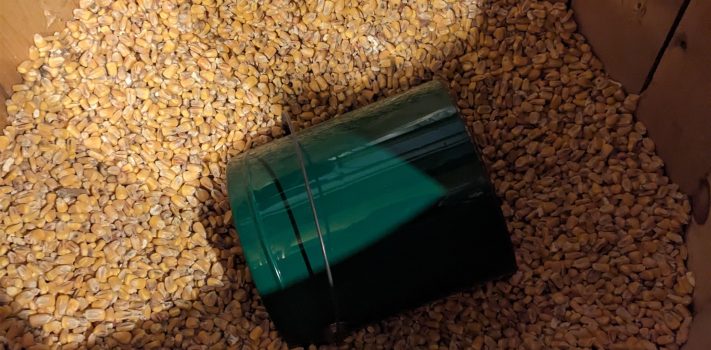
At that moment, I had an inspiration. I said, “I purchased some shelled corn back in 2016. It has been stored in a steel drum in the pole barn ever since. It is due to be rotated. Let’s use that corn instead.”Continue reading“DIY Wood-Lined-Steel-Drum Corn Storage, by Thomas Christianson”

Recipe of the Week:
The following recipe for Traci’s Marinara Sauce is from SurvivalBlog reader Callie B.
Ingredients
-
- 2 large cans whole tomatoes, chopped (Or fresh tomatoes of equivalent volume, plus a bit of water)
- 1/4 c. tomato paste
- 1/2 c. olive oil
- 1 Tbsp. minced onion
- 1 or 2 Tbsp. fresh basil, thinly sliced
- Garlic, to taste
- 2 tsp. minced parsley
- 1/2 tsp. crushed dried oregano
Directions
- Place all of the ingredients in a large saucepan.
- Bring the pan to a boil.
- Reduce heat, and cover with a lid.
- Simmer for 40 minutes, stirring occasionally, until sauce is reduced and thickened to a volume of only about 1 quart.
STORAGE
You may freeze or water-bath can this, but it is best served freshly-cooked.
—
Do you have a well-tested recipe that would be of interest to SurvivalBlog readers? In this weekly recipe column, we place emphasis on recipes that use long-term storage foods, recipes for wild game, dutch oven recipes, slow cooker recipes, and any recipes that use home garden produce. If you have any favorite recipes, then please send them via e-mail. Thanks!
SurvivalBlog Graphic of the Week
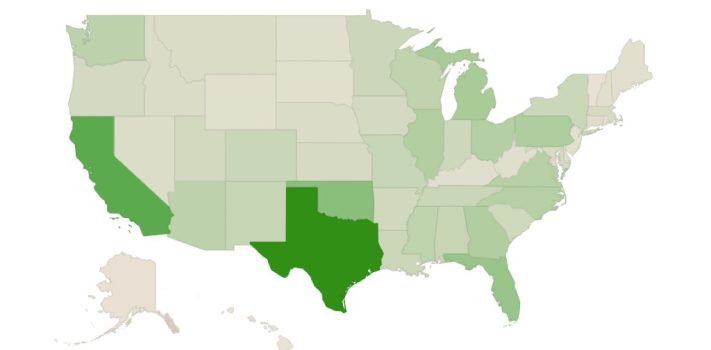
Today’s graphic: The number of propane fueling stations, by State. (U.S. Dept. of Energy Map. See the original site, for specific locations, or use the Alternative Fueling Station Locator.) “Thousands of fueling stations across the country provide propane, also known as liquefied petroleum gas (LPG).”
The thumbnail below is click-expandable.

—
Please send your graphics or graphics links to JWR. (Either via e-mail or via our Contact form.) Any graphics that you send must either be your own creation or uncopyrighted.

The Editors’ Quote of the Day:
“Equal and exact justice to all men, of whatever state or persuasion, religious or political; peace, commerce, and honest friendship with all nations,—entangling alliances with none; the support of the State governments in all their rights, as the most competent administrations for our domestic concerns, and the surest bulwarks against anti-republican tendencies; the preservation of the general government in its whole constitutional vigour, as the sheet anchor of our peace at home and safety abroad; . . . . freedom of religion; freedom of the press; freedom of person under the protection of the habeas corpus; and trial by juries impartially selected,—these principles form the bright constellation which has gone before us, and guided our steps through an age of revolution and reformation.” – Thomas Jefferson, First Inaugural Address. March 4, 1801.

Preparedness Notes for Sunday — June 29, 2025
On June 29, 1194, Sverre Sigurdsson was crowned King of Norway, after years of dispute.
—
June 29, 1922: France granted 1 km² at Vimy Ridge “freely, and for all time, to the Government of Canada, the free use of the land exempt from all taxes”, for a memorial ground. The Canadian Army had famously captured that ground from the German Army in April,1917.
—
SurvivalBlog Writing Contest
Today we present another entry for Round 119 of the SurvivalBlog non-fiction writing contest. The prizes for this round include:
First Prize:
- A Gunsite Academy Three Day Course Certificate. This can be used for any of their one, two, or three-day course (a $1,095 value),
- A Peak Refuel “Wasatch Pack” variety of 60 servings of premium freeze-dried breakfasts and dinners in individual meal pouches — a whopping 21,970 calories, all made and packaged in the USA — courtesy of Ready Made Resources (a $350 value),
- American Gunsmithing Institute (AGI) is providing a $300 certificate good towards any of their DVD training courses. Their course catalog now includes their latest Survival Gunsmithing course.
- HSM Ammunition in Montana is providing a $350 gift certificate. The certificate can be used for any of their products.
Second Prize:
- A SIRT STIC AR-15/M4 Laser Training Package, courtesy of Next Level Training, that has a combined retail value of $679
- A $269 retail value survival-ready power package from Solar Power Lifestyle. This includes two Solar Power Lifestyle 25W Portable Solar Panels, plus a $150 gift card to use for any purchase at solarpowerlifestyle.com.
- Two 1,000-foot spools of full mil-spec U.S.-made 750 paracord (in-stock colors only) from TOUGHGRID.com (a $287 value).
- A transferable $150 FRN purchase credit from Elk Creek Company, toward the purchase of any pre-1899 antique gun. There is no paperwork required for delivery of pre-1899 guns into most states, making them the last bastion of gun purchasing privacy!
Third Prize:
- A Berkey Light water filter, courtesy of USA Berkey Filters (a $305 value),
- Two sets of The Civil Defense Manual, (in two volumes) — a $193 value — kindly donated by the author, Jack Lawson.
- A $200 credit from Military Surplus LLC that can be applied to purchase and/or shipping costs for any of their in-stock merchandise, including full mil-spec ammo cans, Rothco clothing and field gear, backpacks, optics, compact solar panels, first aid kits, and more.
- A transferable $150 FRN purchase credit from Elk Creek Company, toward the purchase of any pre-1899 antique gun.
—
More than $960,000 worth of prizes have been awarded since we started running this contest. Round 119 ends on July 31st, so get busy writing and e-mail us your entry. Remember that there is a 1,500-word minimum, and that articles on practical “how-to” skills for survival have an advantage in the judging. In 2023, we polled blog readers, asking for suggested article topics. Please refer to that poll if you haven’t yet chosen an article topic.