Design, Function, and Repair
This week I started on the core of the course. One of the things emphasized heavily in this course, according to the introductory material that I reviewed last week, was the essential of design, function, and repair (DFR).
Design, Function, and Repair (DFR)
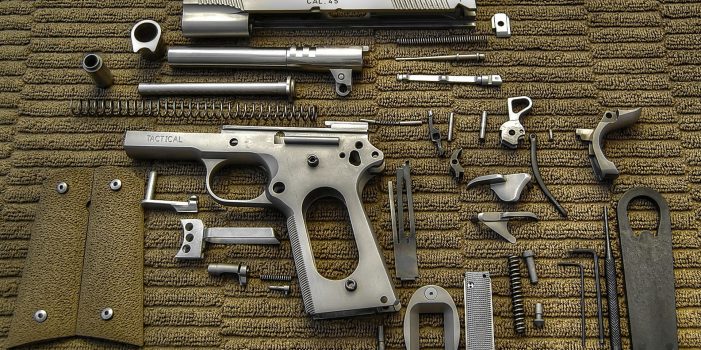
To be anything more than a rudimentary parts swapper, you have to have a complete understanding of how the firearm was designed to work, how it functions, and what your courses of action are to make any sort of repairs or changes to it. Without understanding the design, it’s just a black box that works magic when you pull the trigger. Very few firearms are so simplistic that you can instantly understand why things are designed the way they are. In fact, many firearms are literally works of art. The ability to see and understand how the parts fit together and their relationship in a three dimensional space is a critical skill.
This is where I found AGI’s cutaway views inside of functional firearms to be invaluable. It amazes me how sensitive some of these parts. Changes of only a few thousandths of an inch can have a huge impact on the reliability or whether or not the firearm even functions. This is also where I wish that there were some three dimensional depictions or animations of the parts, but I suspect that if/when these videos are updated, that will make it in. In the meantime, the primary instructor– Bob Dunlap– does very well at explaining the “how” and “why” using these cutaway views, disassembled parts, and working firearms.
Continue reading“Gunsmith Training: Pistolsmithing – Week One, by R2”