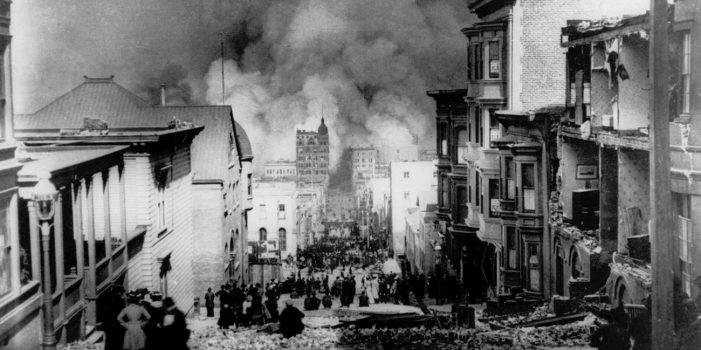
The recent strong earthquake near Anchorage, Alaska underscores the importance of family earthquake readiness. Thankfully, we live in a country with modern building standards. This is not in the case of many Third World nations, where unreinforced masonry construction is the norm. In the Third World, folks tend to be very stingy with reinforcing bar (“rebar”). So its seems that every time there is a large earthquake in those regions, there are building collapses, with large loss of life.
By far, the safest houses for earthquakes are of wood frame construction. This is because such structures can flex and sway, when an earthquake rolls through. If you look at recent history of fairly large earthquakes in California, the three things that suffer the most are: 1.) Bridges and overpasses, 2.) Brick fireplace chimneys attached to wood frame houses, and 3.) Water mains. Again, we can be thankful that wood frame construction is the norm, and that most masonry buildings in the U.S. and Canada have sufficient rebar reinforcement. But even reinforced concrete and brick is inherently more vulnerable that wood frame, in the most severe earthquakes. (Magnitude 7.0, or higher, on the Richter scale.) By the way, the Richter scale is logarithmic. That means that a Magnitude 7.0 is 10 time more powerful that a Magnitude 6.
For those of you reading this who live in a wood frame house or apartment, you should have two concerns: A.) Seismic retrofitting, if needed, and B.) Securing furniture, water heaters, wall hangings, and fragile items from falling, in the event of an earthquake. In this article, I will be discussing both of these.
Continue reading“Family Earthquake Preparedness: Are You Ready?”