Editor’s Introductory Note: The following are some recounted experiences, observations, and advice, earned through experience. I hope that you benefit from this, and thereby avoid repeating the author’s mistakes. – JWR
—
Incident 1
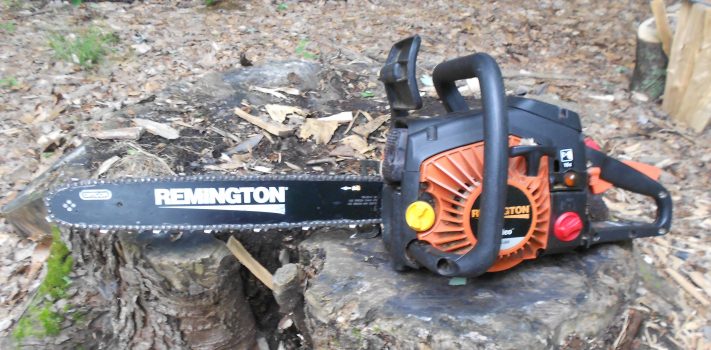
It was an unremarkable autumn day: pleasantly cool, and a trifle overcast. I had thrown some logs on top of the last load of wood that I had hauled. Those logs now needed to be bucked for splitting.
All of the proper protective equipment was in place: eye protection, hard hat with attached hearing protection and face screen, gloves, Kevlar chainsaw chaps, and sturdy footwear. As I prepared to start the chainsaw, I noticed a hole in the thumb of my right glove. I commented to my wife, “The next time we go to the hardware store, I need to pick up a new pair of gloves.” Then I started the saw.
After the first log had been bucked, I turned the saw to set it down. Something tweaked my right thumb. I looked down and saw a surprising amount of blood.
Observation: Wood cutting can be dangerous: According to the Bureau of Labor Statistics, logging workers have the most dangerous occupation in the United States, with a fatal injury rate of 135.9 per 100,000 workers per year and a non-fatal injury rate of 2,449 per 100,000 workers per year. A task that is so dangerous for trained and experienced professionals poses significant risks to less experienced amateurs like me.
Observation: Damaged or worn out protective equipment may not protect: Murphy’s Law says that if something can go wrong, it will. I am still not sure how the chain managed to seek out the one hole in my gloves. In a dangerous environment, being truly prepared means being prepared even for unlikely occurrences.
I put pressure on the wound with my other glove, and asked my wife to get something with which to control the bleeding. She ran into the house and grabbed one of her best dish towels. After applying direct pressure with the dish towel for a couple of minutes, I removed it to assess the wound. I saw a large flap of white, dead-looking skin. It was rapidly inundated by a rising tide of blood. I said, “I think I need stitches. We should probably go to the emergency room.”
Observation: When you or a loved one is bleeding, it may be difficult to make good decisions: Based upon an objective assessment of the injury, urgent care would have been a more cost effective solution than the emergency room. But the words “chainsaw injury” and “emergency room” somehow seemed to go together at the time.
Observation: Telling emergency room personnel that you have been injured with a chainsaw is a good way to get prompt attention.
In the treatment room, the doctor put an o-ring around the base of my thumb to stop the bleeding. He then cut away the dead skin, cleaned the wound, and glued it together with super glue. Finally he removed the o-ring and applied a dressing. With the clarity of 20/20 hindsight, I realized that I could have provided similar treatment at home. I have since used this knowledge after reaching into a tool box and grabbing the wrong end of a cutting implement.Continue reading“Wood Cutting Made Slightly Less Dangerous – Part 1, by The Novice”