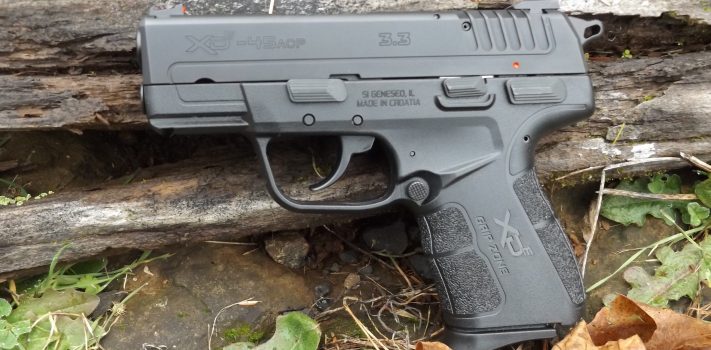
Quite some time back, I wrote a review of the Springfield Armory XDe in 9mm. It was an outstanding little gun, all things considered. I wanted to test this particular model, because it was hammer-fired, instead of striker-fired. I had no real complaints on the XDe 9mm, other than I was wondering, why it was so “big” compared to the XDs 9mm. Okay, maybe “big” isn’t the right term, but it is bigger than the XDs models in 9mm and .45 ACP. However, I wasn’t about to second guess Springfield Armory on this. After all, the XDe is hammer-fired, and thus it had to be a little bit bigger than the striker-fired models. But still, I wondered.
I decided to take the plunge and requested an XDe in .45ACP — and it all respects, other than the caliber, it is the same exact gun as the XDe 9mm is. Not to go over too much of what I already reported on the 9mm version, I wanted to touch on some of the salient features of the XDe that sets it apart from the XDs. As already mentioned, it is hammer-fired. Many people shy away from striker-fired handguns for some reason — I don’t understand it myself. However, in the case of the XDe, there are a number of different ways you can carry this gun, once its loaded. You can insert a magazine, and chamber round, and from there you can press down on the ambidextrous thumb safety to decock the pistol and carry it that way. Or if you prefer, once decocked, you can apply the thumb safety, by pushing it up, and when you need to fire it, you simply press down on the decocker and the gun is ready to go. Personally, I don’t see the need to put the XDe in “safe” once you have decocked it. Then, as another option, you can chamber a round, and the hammer is cocked, and you can apply the safety (by pushing it upward, just like a good ol’ 1911) and carry the XDe “cocked tn locked.” This is my preferred carry mode. But of course don’t carry it cocked without the safety in the “on” position.Continue reading“Springfield Armory XDe .45 ACP, by Pat Cascio”