(Continued from Part 1. This concludes the article.)
The Finished Project
Since there is a lot of information on building rocket stoves on SurvivalBlog and elsewhere, I have not described any construction details on the stove itself. The following photo shows what my working rocket water heater (RWH) looks like, with an explanation of the number and letter annotations.
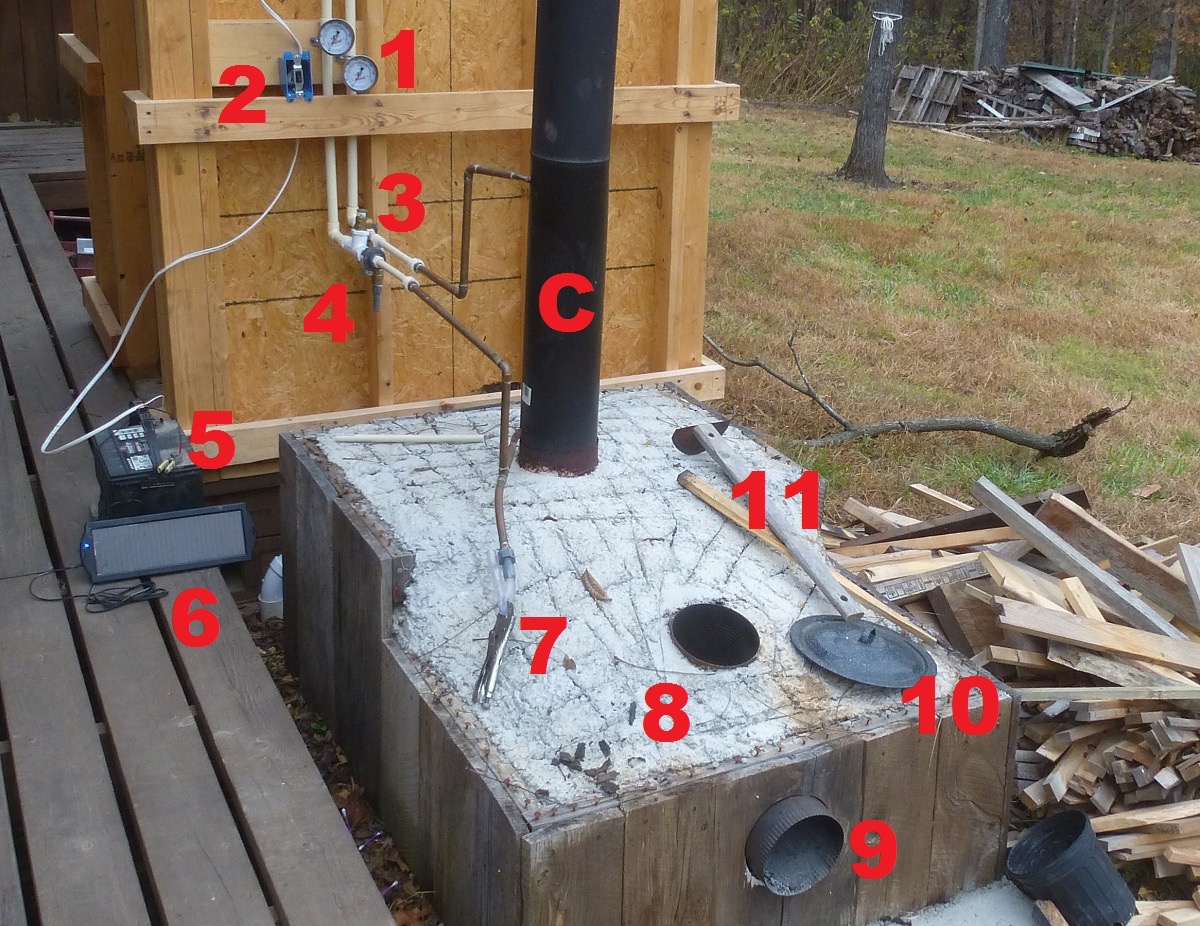
This small building was later covered with bat and board siding, with a small door covering the on/off switch and thermometers. Here are all of the key bits and pieces: 1. Inflow and outflow water temperature thermometers. (Thread these into the adapter before you glue the adapter into the tee to you be sure you get the thermometers oriented properly.) 2. On/off switch to the 12-VDC, 3-GPM water pump. 3. Water pressure-relief safety valve is a must when working with hot water. 4. Plumbing unions. 5. Car battery for 12-VDC pump. 6. Solar battery charger. 7. Drain valve. 8. Fuel entrance for rocket stove. 9. Clean out access (closed off when stove in use). 10. Rain lid for fuel entrance during non-use. 11. Ash-removing cleanout stick. “C” is the Heat Exchanger (section of chimney pipe containing the copper coil.) It slides down into the rocket stove chimney and has an additional piece of chimney pipe attached to the top of it.
Something to consider: One thing worked well in my trial but not as well in the actual setup. Obviously that huge copper coil inside a 6” chimney is going to restrict the airflow somewhat. In hindsight, maybe what I should have done was stick with the same size coil, but put the coil inside an 8” chimney pipe and connected it to my 6” rocket stove chimney using adapters. It still works well but smoke tells me I’m not getting quiet the efficiency I could from my rocket stove. I say “maybe” because when I tested out my coil/pump setup ahead of time (see photo 5 below), I got very little smoke. So perhaps in a portable rocket stove setup using a shorter chimney, a 6” chimney pipe is the best way to go. Further experimentation is needed.
But Does It Work?
Yes, it works! The $64,000 question is, how much water will it heat, how quickly, and with how much fuel? I used my RWH exclusively for three months straight when I first built it, just to be able to get some actual long-term, grid-down experience with making hot water and to get a real understanding of what I’d do to make improvements.
Unfortunately, I have a 30-gallon water heater. I will say unabashedly, for nearly everyone living in a 1- or 2-person household, 30 gallons is a huge mistake now and even more so after the grid goes down. A 20-gallon heater is more than adequate, but that’s a discussion for another day. With a 30-gallon water heater as my storage tank, I can heat 30 gallons of 57°F water to 130°F in 45 minutes using less than two 6” round bundles of kindling. My kindling is 16” firewood split into pieces that are approximately 1” x ¾”. (With a ΔT of 25°F which I mentioned earlier, this should come out to 30 minutes, but with ramping up the heat, then ramping back down, the total time is 45 minutes.) With a 20-gallon water heater, or the 10-gallon water heater I wish I had, the time could probably be cut down to 15-to-18 minutes.Continue reading“Rocket Water Heater – Part 2, by St. Funogas”