
“Everybody who is paying attention knows that the left will gut the Bill of Rights to the Constitution. Actually, not gut it but just eliminate it completely. In their own words, they are coming to take your guns. Beto O’Rourke, Joe Biden, and Kamala Harris — everybody knows that they want to disarm their subjects.” – Ted Nugent – October, 2020
- Ad Prepare for chaos with the essential SIEGE belt. Perfected for CCW with flexible, no-stretch, high-grip custom HD ballistic nylon and capabilities unmatched in any other belt. Go anywhere. Solid 5.5-7 oz of persuasion has saved many. Save $20!SIEGE STOVES: in a fuel crisis twigs are free and abundant. Ultra-compact high-performance portable survival stoves. Enter "SBLOG" at checkout for $20 off any belt. USA-made.
- Ad Elk Creek Company - Federally-Exempt No-Paperwork GunsPre-1899 Antique Cartridge Guns -- No FFL Required. Can be mailed to your doorstep with no Federal paperwork!

Preparedness Notes for Sunday — October 25, 2020
Margaret Thatcher was born on October 13, 1925. She was the UK’s first female Prime Minister. She died in 2013.
This is also the birthday of explorer and pilot Admiral Richard Byrd (1888–1957). His autobiography titled Alone is a must-read.
—
SurvivalBlog Writing Contest
Today we present another entry for Round 91 of the SurvivalBlog non-fiction writing contest. The prizes for this round include:
First Prize:
- The photovoltaic power specialists at Quantum Harvest LLC are providing a store-wide 10% off coupon. Depending on the model chosen, this could be worth more than $2000.
- A Gunsite Academy Three Day Course Certificate. This can be used for any of their one, two, or three-day course (a $1,095 value),
- A course certificate from onPoint Tactical for the prize winner’s choice of three-day civilian courses, excluding those restricted for military or government teams. Three-day onPoint courses normally cost $795,
- DRD Tactical is providing a 5.56 NATO QD Billet upper. These have hammer forged, chrome-lined barrels and a hard case, to go with your own AR lower. It will allow any standard AR-type rifle to have a quick change barrel. This can be assembled in less than one minute without the use of any tools. It also provides a compact carry capability in a hard case or in 3-day pack (a $1,100 value),
- Two cases of Mountain House freeze-dried assorted entrees in #10 cans, courtesy of Ready Resources (a $350 value),
- A $250 gift certificate good for any product from Sunflower Ammo,
- American Gunsmithing Institute (AGI) is providing a $300 certificate good towards any of their DVD training courses.
Second Prize:
- A Front Sight Lifetime Diamond Membership, providing lifetime free training at any Front Sight Nevada course, with no limit on repeating classes. This prize is courtesy of a SurvivalBlog reader who prefers to be anonymous.
- A Glock form factor SIRT laser training pistol and a SIRT AR-15/M4 Laser Training Bolt, courtesy of Next Level Training, that have a combined retail value of $589,
- Two 1,000-foot spools of full mil-spec U.S.-made 750 paracord (in-stock colors only) from www.TOUGHGRID.com (a $240 value).
- Naturally Cozy is donating a “Prepper Pack” Menstrual Kit. This kit contains 18 pads and it comes vacuum-sealed for long term storage or slips easily into a bugout bag. The value of this kit is $220.
- An assortment of products along with a one-hour consultation on health and wellness from Pruitt’s Tree Resin (a $265 value).
Third Prize:
- Three sets each of made-in-USA regular and wide-mouth reusable canning lids. (This is a total of 300 lids and 600 gaskets.) This prize is courtesy of Harvest Guard (a $270 value)
- A Royal Berkey water filter, courtesy of Directive 21 (a $275 value),
- Two Super Survival Pack seed collections, a $150 value, courtesy of Seed for Security, LLC,
- A transferable $150 purchase credit from Elk Creek Company, toward the purchase of any pre-1899 antique gun. There is no paperwork required for delivery of pre-1899 guns into most states, making them the last bastion of firearms purchasing privacy!
Round 91 ends on November 30th, so get busy writing and e-mail us your entry. Remember that there is a 1,500-word minimum, and that articles on practical “how-to” skills for survival have an advantage in the judging.
- Ad USA Berkey Water Filters - Start Drinking Purified Water Today!#1 Trusted Gravity Water Purification System! Start Drinking Purified Water now with a Berkey water filtration system. Find systems, replacement filters, parts and more here.
- Ad Survival RealtyFind your secure and sustainable home. The leading marketplace for rural, remote, and off-grid properties worldwide. Affordable ads. No commissions are charged!
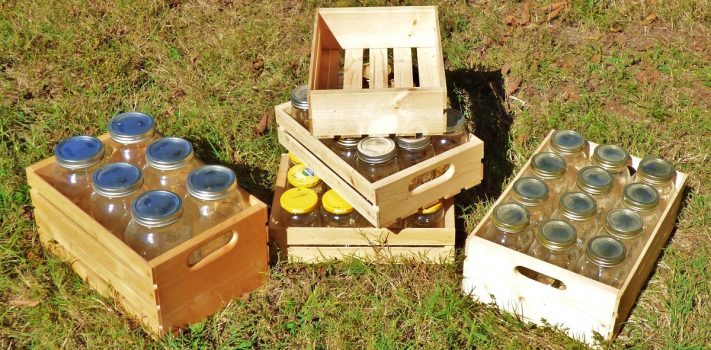
How to Make Wooden Mason Jar Crates – Part 2, by St. Funogas
(Continued from Part 1. This concludes the article.)
Second Jig – Drill-Press Jig
If you have a pneumatic stapler, which greatly speeds up many nailing tasks, you can skip this section. Once you have the first slats cut, you’ll need to drill guide holes for the 4d nails using a 3/16” drill bit. If you try to nail without a pilot hole, not only will many of the slats split, but it’ll slow down your nailing time considerably. This is where jig number two comes in.
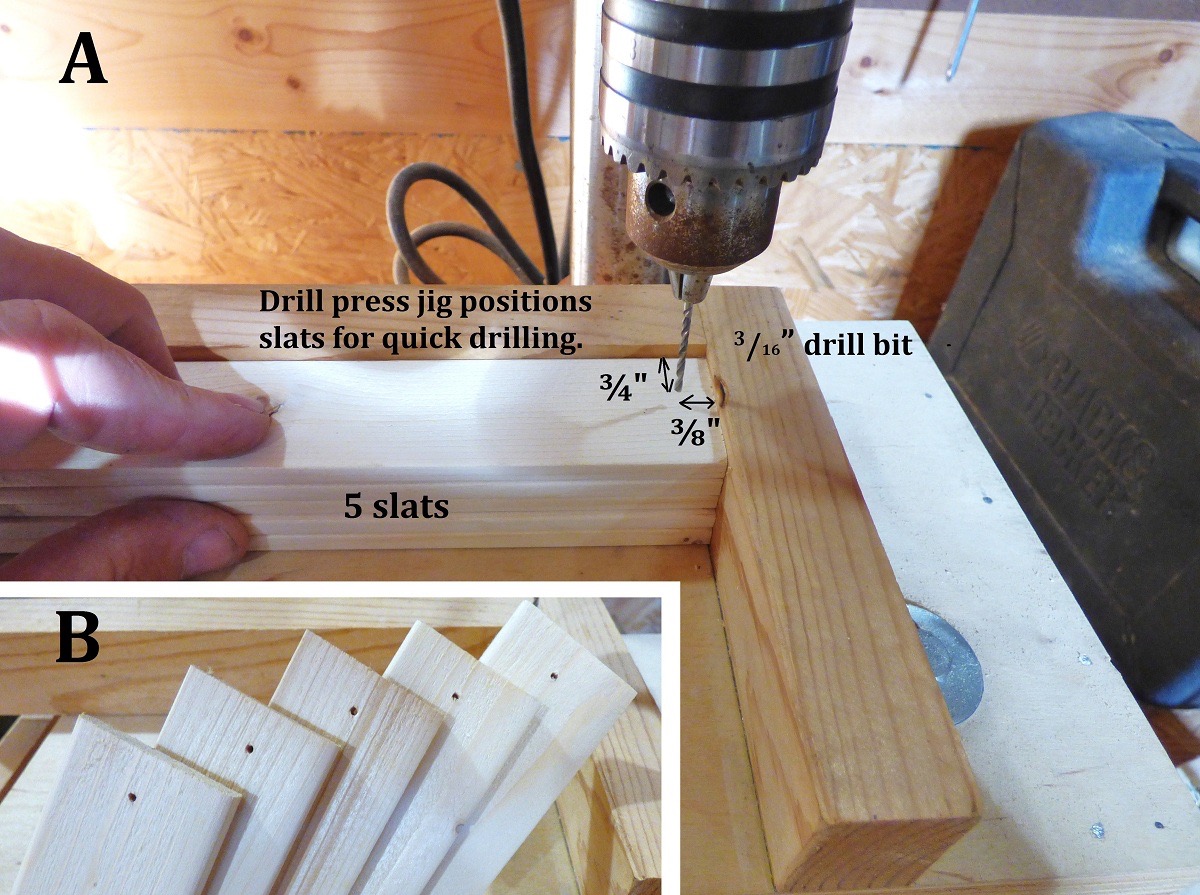
As seen in Photos 10A and 10B (inset), this jig positions stacks of five slats so you can quickly drill the nail hole in each end without having to mark the spot first. It attaches to the deck of any drill press and the wooden “L” holds the stack in just the right position while you drill five holes at once. You then spin the stack around and drill holes in the opposite end.
The simplest way to make and use this jig is to cut out the base, attach the right-angle “L” made from 2 x 4 scraps, and then use clamps to fasten the jig to the drill press in the precise spot. Using a slat pre-marked with the hole position will help you line up the drill bit with the jig before clamping everything down tight. In addition to my regular drill press, I have a small $59 drill press dedicated to this task alone, so I have the jig permanently attached to the drill press plate with bolts.
After you drill the first slat, test out one of the 4d nails to be sure the fit is correct. Once your slats are cut and the nail holes drilled, you are now ready to cut the end boards for the crate.Continue reading“How to Make Wooden Mason Jar Crates – Part 2, by St. Funogas”
- Ad USA Berkey Water Filters - Start Drinking Purified Water Today!#1 Trusted Gravity Water Purification System! Start Drinking Purified Water now with a Berkey water filtration system. Find systems, replacement filters, parts and more here.
- Ad California Legal Rifles & Pistols!WBT makes all popular rifles compliant for your restrictive state. Choose from a wide range of top brands made compliant for your state.
JWR’s Meme Of The Week:
The latest meme created by JWR:

Liberals Ask: Is There a Way for CNN’s Disgraced “Justice Analyst” Jeffrey Toobin
to Regain a Good Reputation?
Sure There Is! Once Someone Invents a Functional Time Machine
To share this, you can find it here: https://kapwi.ng/c/0KHEdL9g
- Ad SurvivalRealty.com: Sell Your Remote LandAdvertise your hard-to-sell remote land to eager buters. We specialize in rural, remote, and off-grid properties worldwide. Affordable ads. No commissions are charged!
- Ad Click Here --> Civil Defense ManualNOW BACK IN STOCK How to protect, you, your family, friends and neighborhood in coming times of civil unrest… and much more!

The Editors’ Quote of the Day:
“Finally, be ye all of one mind, having compassion one of another, love as brethren, be pitiful, be courteous:
Not rendering evil for evil, or railing for railing: but contrariwise blessing; knowing that ye are thereunto called, that ye should inherit a blessing.
For he that will love life, and see good days, let him refrain his tongue from evil, and his lips that they speak no guile:
Let him eschew evil, and do good; let him seek peace, and ensue it.
For the eyes of the Lord are over the righteous, and his ears are open unto their prayers: but the face of the Lord is against them that do evil.
And who is he that will harm you, if ye be followers of that which is good?
But and if ye suffer for righteousness’ sake, happy are ye: and be not afraid of their terror, neither be troubled;
But sanctify the Lord God in your hearts: and be ready always to give an answer to every man that asketh you a reason of the hope that is in you with meekness and fear:
Having a good conscience; that, whereas they speak evil of you, as of evildoers, they may be ashamed that falsely accuse your good conversation in Christ.
For it is better, if the will of God be so, that ye suffer for well doing, than for evil doing.
For Christ also hath once suffered for sins, the just for the unjust, that he might bring us to God, being put to death in the flesh, but quickened by the Spirit:
By which also he went and preached unto the spirits in prison;
Which sometime were disobedient, when once the longsuffering of God waited in the days of Noah, while the ark was a preparing, wherein few, that is, eight souls were saved by water.
The like figure whereunto even baptism doth also now save us (not the putting away of the filth of the flesh, but the answer of a good conscience toward God,) by the resurrection of Jesus Christ:
Who is gone into heaven, and is on the right hand of God; angels and authorities and powers being made subject unto him.” – 1 Peter 3: 8-22 (KJV)
- Ad STRATEGIC RELOCATION REALTYFOR SALE: Self-sustaining Rural Property situated meticulously in serene locales distant from densely populated sanctuary cities. Remember…HISTORY Favors the PREPARED!
- Ad Elk Creek Company - Percussion Blackpowder Guns - No FFL Required.Elk Creek Company - Percussion Blackpowder Guns - Pre-1899 Guns - Knives - Bayonets - Magazines - The last bastion of privacy!
Preparedness Notes for Saturday — October 24, 2020
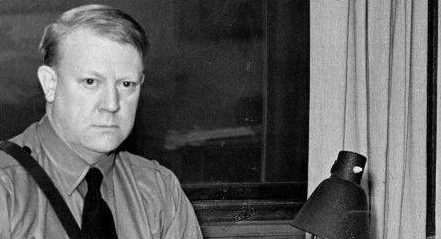
October 24th is the anniversary of the firing squad execution of Norwegian traitor Vidkun Quisling, in 1945. His ignominious place in history was to have his surname become a noun. “Quisling” is now a moniker synonymous with treason and alliance with an invading army.
—
SurvivalBlog Writing Contest
Today we present another entry for Round 91 of the SurvivalBlog non-fiction writing contest. The prizes for this round include:
First Prize:
- The photovoltaic power specialists at Quantum Harvest LLC are providing a store-wide 10% off coupon. Depending on the model chosen, this could be worth more than $2000.
- A Gunsite Academy Three Day Course Certificate. This can be used for any of their one, two, or three-day course (a $1,095 value),
- A course certificate from onPoint Tactical for the prize winner’s choice of three-day civilian courses, excluding those restricted for military or government teams. Three-day onPoint courses normally cost $795,
- DRD Tactical is providing a 5.56 NATO QD Billet upper. These have hammer forged, chrome-lined barrels and a hard case, to go with your own AR lower. It will allow any standard AR-type rifle to have a quick change barrel. This can be assembled in less than one minute without the use of any tools. It also provides a compact carry capability in a hard case or in 3-day pack (a $1,100 value),
- Two cases of Mountain House freeze-dried assorted entrees in #10 cans, courtesy of Ready Resources (a $350 value),
- A $250 gift certificate good for any product from Sunflower Ammo,
- American Gunsmithing Institute (AGI) is providing a $300 certificate good towards any of their DVD training courses.
Second Prize:
- A Front Sight Lifetime Diamond Membership, providing lifetime free training at any Front Sight Nevada course, with no limit on repeating classes. This prize is courtesy of a SurvivalBlog reader who prefers to be anonymous.
- A Glock form factor SIRT laser training pistol and a SIRT AR-15/M4 Laser Training Bolt, courtesy of Next Level Training, that have a combined retail value of $589,
- Two 1,000-foot spools of full mil-spec U.S.-made 750 paracord (in-stock colors only) from www.TOUGHGRID.com (a $240 value).
- Naturally Cozy is donating a “Prepper Pack” Menstrual Kit. This kit contains 18 pads and it comes vacuum-sealed for long term storage or slips easily into a bugout bag. The value of this kit is $220.
- An assortment of products along with a one-hour consultation on health and wellness from Pruitt’s Tree Resin (a $265 value).
Third Prize:
- Three sets each of made-in-USA regular and wide-mouth reusable canning lids. (This is a total of 300 lids and 600 gaskets.) This prize is courtesy of Harvest Guard (a $270 value)
- A Royal Berkey water filter, courtesy of Directive 21 (a $275 value),
- Two Super Survival Pack seed collections, a $150 value, courtesy of Seed for Security, LLC,
- A transferable $150 purchase credit from Elk Creek Company, toward the purchase of any pre-1899 antique gun. There is no paperwork required for delivery of pre-1899 guns into most states, making them the last bastion of firearms purchasing privacy!
Round 91 ends on November 30th, so get busy writing and e-mail us your entry. Remember that there is a 1,500-word minimum, and that articles on practical “how-to” skills for survival have an advantage in the judging.
- Ad Survival RealtyFind your secure and sustainable home. The leading marketplace for rural, remote, and off-grid properties worldwide. Affordable ads. No commissions are charged!
How to Make Wooden Mason Jar Crates – Part 1, by St. Funogas
If you’re an average prepper, you no doubt have enough mason jars to sink a small yacht if they were all filled with pickles and tomato sauce and snuck aboard. And if you’ve done a lot of canning, you’ve probably thought there has to be a better way to manage all the jars than those cardboard boxes they come in. I’ve found that homemade wooden crates work great for me and may work for you as well.
What I really like about these crates is that you can store empties in them as well as full jars, then stack the crates so you can use valuable shelf space for other things.
The Basics
If you don’t have a woodshop or a table saw, fear not, you can probably find someone who will cut these pieces out for you for a small fee, then you can nail them together at home. While these are easy to make with my Grizzly cabinetmaker’s table saw and a drill press, they can also be made with a hand drill and the $95 reconditioned portable table saw I bought at Home Depot a few years back.
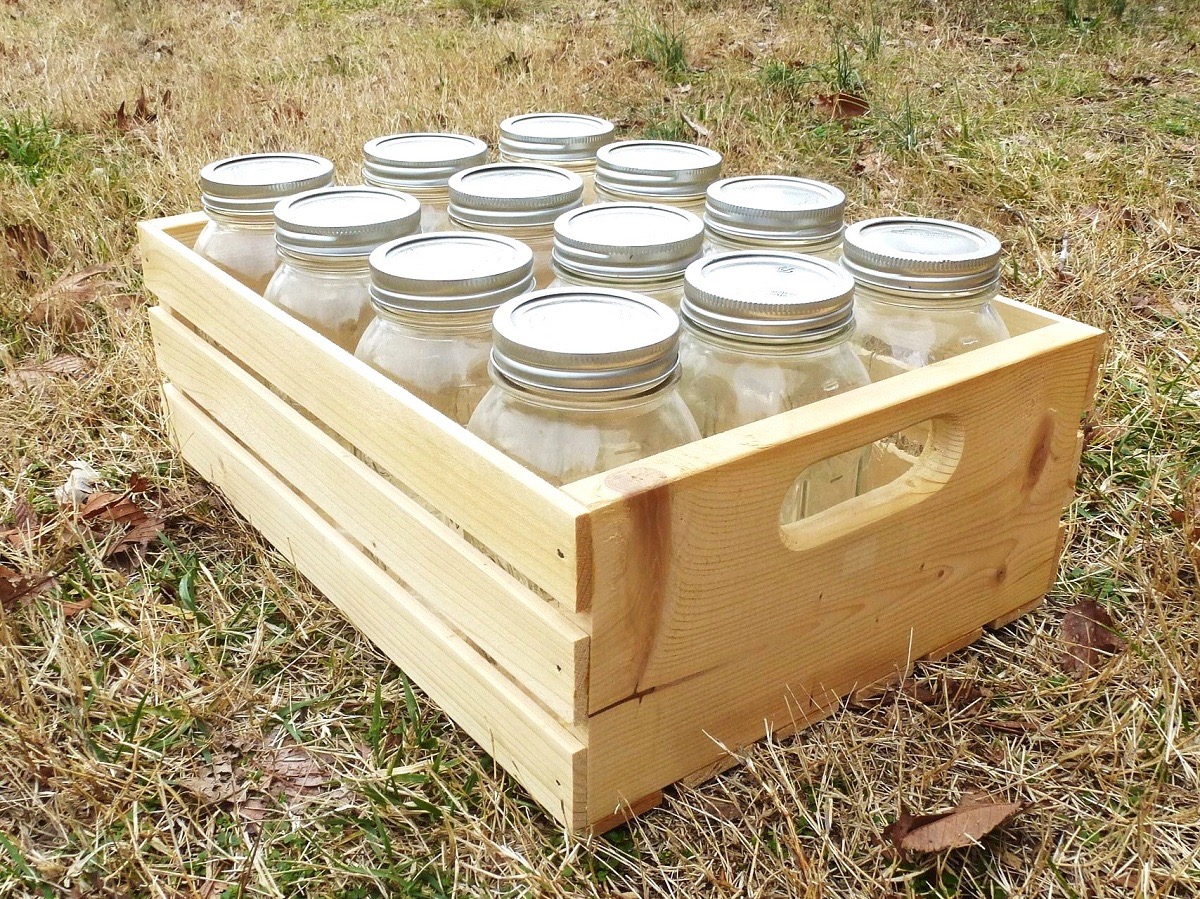
I make four kinds of crates: half-pint, pint, quart, and half-gallon (the moonshine crate). For this tutorial, I’ll walk you through the process of making a crate for a dozen quart-sized jars. At the end of the article, the dimensions will be listed so you can construct all 6 types and sizes of crates. I’ll show you how to make handles in the ends for easy carrying, but if you lack the tools, or have to hire someone to cut these out for you, and/or you’re trying to keep this on the tightest budget possible, you can get by without handles. (See the top center crate in the lede photo.)Continue reading“How to Make Wooden Mason Jar Crates – Part 1, by St. Funogas”
Editors’ Prepping Progress
To be prepared for a crisis, every Prepper must establish goals and make long-term and short-term plans. In this column, the SurvivalBlog editors review their week’s prep activities and planned prep activities for the coming week. These range from healthcare and gear purchases to gardening, ranch improvements, bug out bag fine-tuning, and food storage. This is something akin to our Retreat Owner Profiles, but written incrementally and in detail, throughout the year. Note that as an Amazon Associate I earn from qualifying purchases. We always welcome you to share your own successes and wisdom in the Comments. Let’s keep busy and be ready!
Jim Reports:
This week I was very busy writing, taking antique gun orders for my sideline Elk Creek Company biz, and doing radio interviews. I also did a podcast interview with the host of Radio Free Redoubt. And I took a day to meet with a “fairly local” consulting client–just one mountain range away.
To help out a friend, I slightly drew down my inventory of ammo and magazines from JASBORR. So I’ve been spending time online, looking for replacements. I’ve been shocked at how much prices have accelerated. 500-round bricks of .22 Long Rifle are now ranging between $75 and $85 each! And the going rate for 5.56mm NATO ball is about 80 cents a round, while 7.62mm NATO ball is hovering in the vicinity of a buck a round. Yikes!
I usually drain the water system in our guest cabin in late October, each year. But this year, with lots of out-of-town family staying over here at Thanksgiving, I’m delaying that until the 1st of December. So that means leaving the electric wall heater on a low setting, to keep the pipes from freezing, between now and then. Thankfully, here in the Inland Northwest, electricity is still fairly inexpensive.
The “Pre-Election” sale that we’re running at Elk Creek Company is generating lots of orders. I keep hearing the same thing from customers: “I’m hedging my bets.” With no sure victor in the upcoming Presidential election, I can’t blame folks for wanting to buy a few guns that are entirely outside of Federal jurisdiction.
Deer and elk season will be opening soon, so I’ll be facing a scheduling dilemma: Booking radio and podcast interviews to promote my new book versus my desire to be out in the woods — to top off our chest freezers. The result? I’ll probably reduce the number of interviews. After all, a man has to have his priorities!
And now, time for Lily’s section:
The Editors’ Quote of the Day:
“Hear ye this word which I take up against you, even a lamentation, O house of Israel.
The virgin of Israel is fallen; she shall no more rise: she is forsaken upon her land; there is none to raise her up.
For thus saith the Lord God; The city that went out by a thousand shall leave an hundred, and that which went forth by an hundred shall leave ten, to the house of Israel.
For thus saith the Lord unto the house of Israel, Seek ye me, and ye shall live:
But seek not Bethel, nor enter into Gilgal, and pass not to Beersheba: for Gilgal shall surely go into captivity, and Bethel shall come to nought.
Seek the Lord, and ye shall live; lest he break out like fire in the house of Joseph, and devour it, and there be none to quench it in Bethel.
Ye who turn judgment to wormwood, and leave off righteousness in the earth,
Seek him that maketh the seven stars and Orion, and turneth the shadow of death into the morning, and maketh the day dark with night: that calleth for the waters of the sea, and poureth them out upon the face of the earth: The Lord is his name:
That strengtheneth the spoiled against the strong, so that the spoiled shall come against the fortress.
They hate him that rebuketh in the gate, and they abhor him that speaketh uprightly.
Forasmuch therefore as your treading is upon the poor, and ye take from him burdens of wheat: ye have built houses of hewn stone, but ye shall not dwell in them; ye have planted pleasant vineyards, but ye shall not drink wine of them.
For I know your manifold transgressions and your mighty sins: they afflict the just, they take a bribe, and they turn aside the poor in the gate from their right.
Therefore the prudent shall keep silence in that time; for it is an evil time.
Seek good, and not evil, that ye may live: and so the Lord, the God of hosts, shall be with you, as ye have spoken.
Hate the evil, and love the good, and establish judgment in the gate: it may be that the Lord God of hosts will be gracious unto the remnant of Joseph.
Therefore the Lord, the God of hosts, the Lord, saith thus; Wailing shall be in all streets; and they shall say in all the highways, Alas! alas! and they shall call the husbandman to mourning, and such as are skilful of lamentation to wailing.
And in all vineyards shall be wailing: for I will pass through thee, saith the Lord.
Woe unto you that desire the day of the Lord! to what end is it for you? the day of the Lord is darkness, and not light.
As if a man did flee from a lion, and a bear met him; or went into the house, and leaned his hand on the wall, and a serpent bit him.
Shall not the day of the Lord be darkness, and not light? even very dark, and no brightness in it?
I hate, I despise your feast days, and I will not smell in your solemn assemblies.
Though ye offer me burnt offerings and your meat offerings, I will not accept them: neither will I regard the peace offerings of your fat beasts.
Take thou away from me the noise of thy songs; for I will not hear the melody of thy viols.
But let judgment run down as waters, and righteousness as a mighty stream.
Have ye offered unto me sacrifices and offerings in the wilderness forty years, O house of Israel?
But ye have borne the tabernacle of your Moloch and Chiun your images, the star of your god, which ye made to yourselves.
Therefore will I cause you to go into captivity beyond Damascus, saith the Lord, whose name is The God of hosts.” – Amos 5 (KJV)
Preparedness Notes for Friday — October 23, 2020
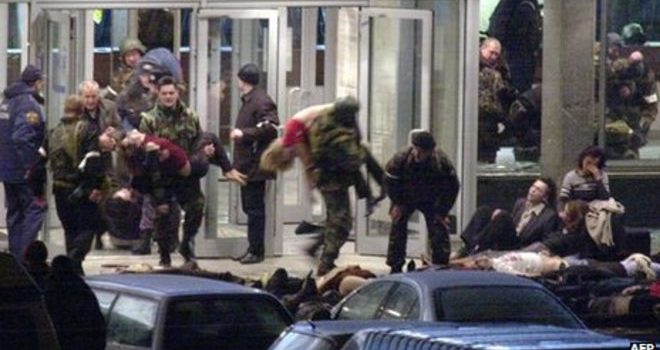
On October 23rd, 2002, around 50 Chechen rebels stormed a Moscow theater, taking 700 hostages during a popular musical. After 57 hours, during which two hostages were killed, Soviet Special Forces pumped a powerful narcotic gas into the theater knocking the terrorists and hostages unconscious before breaking in through the walls and roof. When the dust settled, most of the rebels and 120 hostages were dead–many of them killed by the gas.
—
SurvivalBlog Writing Contest
Today we present another entry for Round 91 of the SurvivalBlog non-fiction writing contest. The prizes for this round include:
First Prize:
- The photovoltaic power specialists at Quantum Harvest LLC are providing a store-wide 10% off coupon. Depending on the model chosen, this could be worth more than $2000.
- A Gunsite Academy Three Day Course Certificate. This can be used for any of their one, two, or three-day course (a $1,095 value),
- A course certificate from onPoint Tactical for the prize winner’s choice of three-day civilian courses, excluding those restricted for military or government teams. Three-day onPoint courses normally cost $795,
- DRD Tactical is providing a 5.56 NATO QD Billet upper. These have hammer forged, chrome-lined barrels and a hard case, to go with your own AR lower. It will allow any standard AR-type rifle to have a quick change barrel. This can be assembled in less than one minute without the use of any tools. It also provides a compact carry capability in a hard case or in 3-day pack (a $1,100 value),
- Two cases of Mountain House freeze-dried assorted entrees in #10 cans, courtesy of Ready Resources (a $350 value),
- A $250 gift certificate good for any product from Sunflower Ammo,
- American Gunsmithing Institute (AGI) is providing a $300 certificate good towards any of their DVD training courses.
Second Prize:
- A Front Sight Lifetime Diamond Membership, providing lifetime free training at any Front Sight Nevada course, with no limit on repeating classes. This prize is courtesy of a SurvivalBlog reader who prefers to be anonymous.
- A Glock form factor SIRT laser training pistol and a SIRT AR-15/M4 Laser Training Bolt, courtesy of Next Level Training, that have a combined retail value of $589,
- Two 1,000-foot spools of full mil-spec U.S.-made 750 paracord (in-stock colors only) from www.TOUGHGRID.com (a $240 value).
- Naturally Cozy is donating a “Prepper Pack” Menstrual Kit. This kit contains 18 pads and it comes vacuum-sealed for long term storage or slips easily into a bugout bag. The value of this kit is $220.
- An assortment of products along with a one-hour consultation on health and wellness from Pruitt’s Tree Resin (a $265 value).
Third Prize:
- Three sets each of made-in-USA regular and wide-mouth reusable canning lids. (This is a total of 300 lids and 600 gaskets.) This prize is courtesy of Harvest Guard (a $270 value)
- A Royal Berkey water filter, courtesy of Directive 21 (a $275 value),
- Two Super Survival Pack seed collections, a $150 value, courtesy of Seed for Security, LLC,
- A transferable $150 purchase credit from Elk Creek Company, toward the purchase of any pre-1899 antique gun. There is no paperwork required for delivery of pre-1899 guns into most states, making them the last bastion of firearms purchasing privacy!
Round 91 ends on November 30th, so get busy writing and e-mail us your entry. Remember that there is a 1,500-word minimum, and that articles on practical “how-to” skills for survival have an advantage in the judging.
Low-Tech Off-Grid Living, by Ani
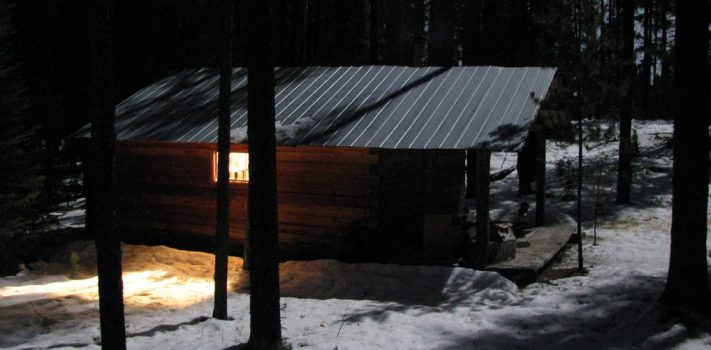
I’m writing this article early in the morning during a power failure. I’ve only lived in this house for six months but this is not the first power failure I’ve experienced here. Previously I house-sat in this town and experienced a long duration power failure complete with four days or so of no cell service either. I got on my phone and looked up the outage map and realized that my town and a couple of adjacent towns have a significant outage, definitely due to the high winds of last night. The electric utility will begin mobilizing the line crews when it’s light out. Might be a while due to how many customers are without power, our rural and wooded nature and that the wind is still blowing quite well. Meanwhile, the woodstove is burning, I’ve got some tea candles lit and strategically placed small solar outdoor lights, stood up in canning jars, are lending some light around the house as needed. As always, when the power is out, the house, without the ever-present audible hum, at least to me, of the grid powered appliances and lights, is blessedly tranquil and quiet. Plus, the light of the candles always makes me feel at peace in a way that any electric light, no matter where on the color spectrum it falls, cannot.
So why, knowing how frequent the power failures, even during “normal times” are here don’t I have a generator? Why don’t I invest in a PV system? All good questions. Recent articles and comments on SB revealed different trains of thought regarding the use of alternative power systems and generators during power failures or prolonged outages. It was clear that there is a big gap in the outlook between some of the posters and an inability to comprehend why others think as they do. I figured I’d explore this subject further here. This won’t be a “how-to” article, at least not in the sense of complete prescriptive measures and equipment lists although I will throw out some ideas for many categories. Maybe that will come later. It’s just meant to provoke thought, challenge thinking and hopefully generate some good (but civil) discussion.Continue reading“Low-Tech Off-Grid Living, by Ani”
Economics & Investing For Preppers
Here are the latest news items and commentary on current economics news, market trends, stocks, investing opportunities, and the precious metals markets. We also cover hedges, derivatives, and obscura. Most of these items are from the “tangibles heavy” contrarian perspective of SurvivalBlog’s Founder and Senior Editor, JWR. Today, we look at the coming divergence in rural versus urban real estate prices. (See: The Work From Home Transformation section and the Tangibles Investing section.)
Precious Metals:
U.S. stimulus to trigger rally: Gold price to surge to $2,200 by year-end – ANZ
o o o
The Piper is Calling: A Sea of Debt, a World of Problems
o o o
Video from Dunagan Kaiser: Behind The Scenes at Miles Franklin’s Bullion Ops
Economy & Finance:
At Zero Hedge: An Emerging Markets “Doom Loop” Time Bomb Emerges, And Inflation Could Set It Off
o o o
Morgan Stanley: The Soaring US Current Account Deficit Will Act As A Global Reflationary Impulse. JWR’s Comments: Massive government over-spending by 40+ nations will surely lead to a resurgence in currency inflation. At the minimum, we will see late-1970s-scale inflation. But I suspect that it will be even worse. Plan and invest accordingly. In times of high inflation, cash is trash and tangibles are king.
o o o
At Wolf Street: Extend-and-Pretend Caused Bankruptcies to Plunge in Germany, France, Spain. Now Central Banks Tell Banks to Prepare for Bankruptcy Surge
The Editors’ Quote of the Day:
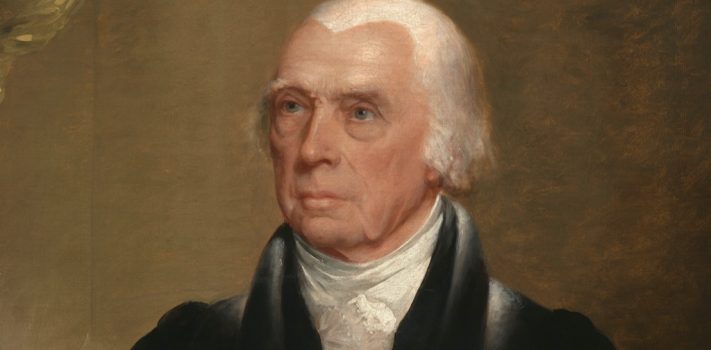
“It is not certain that with this aid alone [possession of arms], they would not be able to shake off their yokes. But were the people to possess the additional advantages of local governments chosen by themselves, who could collect the national will, and direct the national force; and of officers appointed out of the militia, by these governments and attached both to them and to the militia, it may be affirmed with the greatest assurance, that the throne of every tyranny in Europe would be speedily overturned, in spite of the legions which surround it.” – James Madison

Preparedness Notes for Thursday — October 22, 2020
This is the birthday of painter and book illustrator N.C. Wyeth (1882–1945).
This is also the birthday of actor Jeff Goldblum (born 1952), who had unforgettable roles in Buckaroo Banzai and in the Jurassic Park and Independence Day films.
—
I just noticed that Amazon.com has updated their ordering page for my latest book (The Ultimate Prepper’s Survival Guide) to read: “Usually ships within 1 to 2 months.” Sooooo… They apparently blew through their entire inventory in two days. (I just love Book Bomb days!) I really doubt that Simon & Schuster is going to want to do Amazon any favors, since the book is printed in Hong Kong and any subsequent print runs have a three-month lead time. This opens up some interesting possibilities for anyone who dabbles in retail arbitrage. Given Amazon’s current corporate zero supply, enterprising folks can buy up stacks of copies at Costco stores, at $14.99 each and then re-sell them on Amazon or eBay for around $22 to $25 each, plus postage. And if the supply gets any tighter between now and Christmas, then the market price might get to $30+ each. Buy low and sell high, folks!
SurvivalBlog Writing Contest
Today we present another entry for Round 91 of the SurvivalBlog non-fiction writing contest. The prizes for this round include:
First Prize:
- The photovoltaic power specialists at Quantum Harvest LLC are providing a store-wide 10% off coupon. Depending on the model chosen, this could be worth more than $2000.
- A Gunsite Academy Three Day Course Certificate. This can be used for any of their one, two, or three-day course (a $1,095 value),
- A course certificate from onPoint Tactical for the prize winner’s choice of three-day civilian courses, excluding those restricted for military or government teams. Three-day onPoint courses normally cost $795,
- DRD Tactical is providing a 5.56 NATO QD Billet upper. These have hammer forged, chrome-lined barrels and a hard case, to go with your own AR lower. It will allow any standard AR-type rifle to have a quick change barrel. This can be assembled in less than one minute without the use of any tools. It also provides a compact carry capability in a hard case or in 3-day pack (a $1,100 value),
- Two cases of Mountain House freeze-dried assorted entrees in #10 cans, courtesy of Ready Resources (a $350 value),
- A $250 gift certificate good for any product from Sunflower Ammo,
- American Gunsmithing Institute (AGI) is providing a $300 certificate good towards any of their DVD training courses.
Second Prize:
- A Front Sight Lifetime Diamond Membership, providing lifetime free training at any Front Sight Nevada course, with no limit on repeating classes. This prize is courtesy of a SurvivalBlog reader who prefers to be anonymous.
- A Glock form factor SIRT laser training pistol and a SIRT AR-15/M4 Laser Training Bolt, courtesy of Next Level Training, that have a combined retail value of $589,
- Two 1,000-foot spools of full mil-spec U.S.-made 750 paracord (in-stock colors only) from www.TOUGHGRID.com (a $240 value).
- Naturally Cozy is donating a “Prepper Pack” Menstrual Kit. This kit contains 18 pads and it comes vacuum-sealed for long term storage or slips easily into a bugout bag. The value of this kit is $220.
- An assortment of products along with a one-hour consultation on health and wellness from Pruitt’s Tree Resin (a $265 value).
Third Prize:
- Three sets each of made-in-USA regular and wide-mouth reusable canning lids. (This is a total of 300 lids and 600 gaskets.) This prize is courtesy of Harvest Guard (a $270 value)
- A Royal Berkey water filter, courtesy of Directive 21 (a $275 value),
- Two Super Survival Pack seed collections, a $150 value, courtesy of Seed for Security, LLC,
- A transferable $150 purchase credit from Elk Creek Company, toward the purchase of any pre-1899 antique gun. There is no paperwork required for delivery of pre-1899 guns into most states, making them the last bastion of firearms purchasing privacy!
Round 91 ends on November 30th, so get busy writing and e-mail us your entry. Remember that there is a 1,500-word minimum, and that articles on practical “how-to” skills for survival have an advantage in the judging.

Sign Language as a Survival Skill, by B.R.
When I see and read all manner of survival books, magazines, online articles, I’ve noticed a major issue important to me that is never talked about at all, for the most part. What is this issue? In any survival situation how do the healthy, hale members of any society or culture communicate treat and work with our handicapped people/family members? For this article, I will concentrate on the deaf/hard-of-hearing citizens of our own country.
As a being profoundly deaf man since the age of four, I have experienced numerous good and bad situations throughout my life. Sometimes the situations were truly laughingly funny, other times would be really disgustingly bigoted or idiotic. Historically speaking, every culture that has arisen on the average does not look upon its handicapped members with beneficial eyes due to the perception that such people are less capable of work, of thinking, need more help or time to teach them that could be used to better effort elsewhere.
Since the 1880s, American society in general is one that has consistently on the average looked at and treated deaf people as having little to contribute to society at large. Why is that? Communication is the reason, our entire world is based upon, every tool and technology created came about because humans by sound, our voices, the words we pronounce as we speak. We speak what we hear, it takes very little time to say papa correctly when a baby hears its parents or adults gently correct the child’s pronouncing the word. As we grow up, we are constantly learning the proper rules of grammar and speech (word) pronunciation.
What about the deaf or the hard-of-hearing people? When anyone loses the ability to hear the spoken words, how can they say words correctly, learn the correct rules of English grammar when they simply cannot hear the voiced sounds. Do you try to force them to speak (orally) so that they can fit into a society dependent upon sound or would you be willing to learn another language that truly benefits them and adds another important skill to your list of abilities important to surviving? It has been true for a very long time that when hearing members of our society hear deaf/hard-of-hearing people unable to correctly say words spoken to them, they are then seen as less capable, less smart, less dependable, it is seen as so much easier to ignore them, to not hire them, their capabilities and skills in favor of people who can hear and understand the spoken sounds of speech.Continue reading“Sign Language as a Survival Skill, by B.R.”