Building A Small Off Grid PhotoVoltaic Power Supply
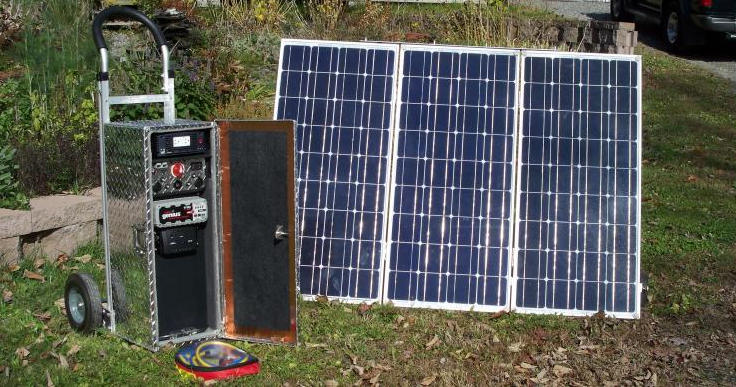
A small solar power system is a “must-have” and does not have to cost more than $1,000 USD. Here are a few tips that might help. I’ve lived off-grid for years and learned by doing.
If in a sunny part of the U.S., then 200 watts would be my minimum. In the north, I would want 400 watts minimum, and two small inexpensive generators, and two 20-amp automotive battery chargers for redundancy sake, and 50 gallons of fuel for two years. One, or both sets can be used at the same time to charge two separate battery banks, or a larger battery bank of 400 amp-hour capacity. On cloudy days, panel production is about 10 percent of the panel’s rating. I do not need an expensive Honda, when a good used and inexpensive 1,000 watt generator is more cost-effective as a 200 battery bank should only receive a 20 amp-hour charge rate to avoid damage. An automotive battery charger that provides up to 20 amps per hour, requires almost 400 watts from the generator. If only powering a few radios, I should not need to run the generator, except occasionally during the darkest and most cloudy months– typically December through February. A Baofeng or analog scanner only draws .075 amps per hour when ‘listening’.
Storage Batteries
Two 6 volt golf cart batteries are deep cycle batteries that as a wired-in-series pair that can have about 200 to 220Ah capacity at a nominal 12 VDC when wired in series. I will choose old tech lead acid over modern choices as these are more cost-effective and foolproof. Other forms are attractive, yet they also have special requirements and quirks. Good old wet cell lead-acid batteries are hard to beat, and the maintenance required is well worth it, given their low price and the proven reliability. Also, we do not want a marine battery or a car battery, but a true deep cycle battery, if possible. Starting batteries will not last long if used in the same way as deep cycle batteries are used. Starting batteries will have a Cold Cranking Ampere (CCA) rating. Marine batteries now come with a CCA rating denoting that it is a ‘starting’ battery. These will have a short service life of only months if used as if they were deep cycle batteries.
Deep cycle batteries can provide 3 to 5 years of service if used to their full capacity daily, yet not abused. We must avoid letting the voltage drop lower than 12.4 to 12.3 volts, or to a depth of discharge of no more that 50 percent as indicated by voltage, or better yet, use a hydrometer. Additional photovoltaic (PV) panels will reduce the depth of discharge, and ensure that it is possible to recharge the batteries to 100 percent each day before drawing them down again. Recharge to 100 percent each day to get the full potential service life. If you live in a sunny part of the U.S., then we want, at a minimum, 1 watt of solar power for every 1 ampere hour of battery storage. In Montana, I want 2 to 4 watts of PV power, for every 1 ampere hour of the battery’s rated capacity. We need enough wattage to fully charge up the batteries by midday after period of discharging. PV power is reliable and requires no fuel. It is now much less expensive per watt, and now harder to justify a generator because we can afford additional panels, yet during the darkest part of a long snowy winter in the American Redoubt, a generator will likely be needed.Continue reading“No Power: No Commo, No Layered Defense, by Tunnel Rabbit”