Building Prepper Infrastructure – Part 2, by 3AD Scout

(Continued from Part 1.)

Where do we Start?

Like everything we do in survival we have to look at vulnerability, that is: That which can hurt us the most and quickest. In my opinion safe and plentiful potable water is the highest priority. So, what can we do now to build our own water infrastructure so that when our blue 55-gallon drum is empty we don’t die of dehydration or cholera? Depending upon your living situation (urban/suburban/rural) this may be a simple process or a major challenge. The point however is to ensure that you have the infrastructure ready to fill the void. Again, depending upon your living arrangements, you may be able to plan, build and integrate your survival infrastructure right alongside your current infrastructure.

For an example of water infrastructure, someone living in a rural area with a well can easily add a hand-operated pitcher pump, a ram pump, a PV-powered pump, or make a bailer bucket to access water when commercial power goes down. A person in an urban/suburban area that has supplied water could add a rain catchment system. But they would also have to have a system for purifying that water for personal use. For some, their survival water infrastructure may be centered around traveling to a lake or stream to fetch containers of water to take back to their home for purifying. So perhaps this infrastructure would be a bicycle and trailer with cargo racks, 5-gallon jugs, and a water purifier. This plan would, however, create a dependence upon your post-SHTF transportation infrastructure for your water infrastructure.

Depending upon your situation your survival water infrastructure may also need to include how to water plants and livestock. For some, being able to set up and use systems like rain barrels may not be an option until SHTF. Perhaps your option might be to design your system, gather the equipment and supplies, put the system together, test it then take it down and store it. Think about routine maintenance that might need to be done to keep your systems operating. If your water system relies upon a bike do you have a patch kit, extra bike parts? Do you have a way to patch containers that might get a hole in them due to gunfire or due to an accident? Do you have spare parts for your pitcher pump?Continue reading“Building Prepper Infrastructure – Part 2, by 3AD Scout”



The Editors’ Quote of the Day:

“The superior man, when resting in safety, does not forget that danger may come. When in a state of security he does not forget the possibility of ruin. When all is orderly, he does not forget that disorder may come. Thus his person is not endangered, and his States and all their clans are preserved.” – Confucius, in The Analects


Preparedness Notes for Tuesday — April 20, 2021

On April 20th, 2010, an explosion on the Deepwater Horizon oil platform, leased by BP, killed 11 workers and began spewing an estimated 200 million gallons of crude into the Gulf of Mexico for nearly three months, creating the worst known offshore oil spill.

April 20th is also the day that we remember the victims of the Columbine High School tragedy, where two students stormed into a suburban high school in Littleton, Colorado in 1999, at lunchtime with guns and explosives, killing 13 and wounding dozens more in what was, at the time, the nation’s deadliest school shooting.

It is time to contact your two U.S. senators, again. Insist that they oppose S.529 (The Senate’s version of H.R. 8, which would criminalize intrastate private party gun transfers.) And while you are at it, tell them that they should oppose the nomination of horribly anti-gun David Chipman as Director of the BATFE.

SurvivalBlog Writing Contest

Today we present another entry for Round 94 of the SurvivalBlog non-fiction writing contest. The prizes for this round include:

First Prize:

  1. The photovoltaic power specialists at Quantum Harvest LLC  are providing a store-wide 10% off coupon. Depending on the model chosen, this could be worth more than $2000.
  2. A Gunsite Academy Three Day Course Certificate. This can be used for any of their one, two, or three-day course (a $1,095 value),
  3. A course certificate from onPoint Tactical for the prize winner’s choice of three-day civilian courses, excluding those restricted for military or government teams. Three-day onPoint courses normally cost $795,
  4. DRD Tactical is providing a 5.56 NATO QD Billet upper. These have hammer forged, chrome-lined barrels and a hard case, to go with your own AR lower. It will allow any standard AR-type rifle to have a quick change barrel. This can be assembled in less than one minute without the use of any tools. It also provides a compact carry capability in a hard case or in 3-day pack (a $1,100 value),
  5. Two cases of Mountain House freeze-dried assorted entrees in #10 cans, courtesy of Ready Made Resources (a $350 value),
  6. A $250 gift certificate good for any product from Sunflower Ammo,
  7. American Gunsmithing Institute (AGI) is providing a $300 certificate good towards any of their DVD training courses.

Second Prize:

  1. A Front Sight Lifetime Diamond Membership, providing lifetime free training at any Front Sight Nevada course, with no limit on repeating classes. This prize is courtesy of a SurvivalBlog reader who prefers to be anonymous.
  2. A Glock form factor SIRT laser training pistol and a SIRT AR-15/M4 Laser Training Bolt, courtesy of Next Level Training, that have a combined retail value of $589,
  3. Two 1,000-foot spools of full mil-spec U.S.-made 750 paracord (in-stock colors only) from www.TOUGHGRID.com (a $240 value).
  4. An Israeli CBRN Gas Mask with Hydration Straw and two Extra 40mm NATO Filter s – Manufactured in 2020 (a $229.99 value), courtesy of McGuire Army-Navy.
  5. Naturally Cozy is donating a “Prepper Pack” Menstrual Kit.  This kit contains 18 pads and it comes vacuum-sealed for long term storage or slips easily into a bugout bag.  The value of this kit is $220.
  6. An assortment of products along with a one-hour consultation on health and wellness from Pruitt’s Tree Resin (a $265 value).

Third Prize:

  1. Three sets each of made-in-USA regular and wide-mouth reusable canning lids. (This is a total of 300 lids and 600 gaskets.) This prize is courtesy of Harvest Guard (a $270 value)
  2. A Royal Berkey water filter, courtesy of Directive 21 (a $275 value),
  3. Two Super Survival Pack seed collections, a $150 value, courtesy of Seed for Security, LLC,
  4. A transferable $150 purchase credit from Elk Creek Company, toward the purchase of any pre-1899 antique gun. There is no paperwork required for delivery of pre-1899 guns into most states, making them the last bastion of firearms purchasing privacy!

Round 94 ends on May 31st, so get busy writing and e-mail us your entry. Remember that there is a 1,500-word minimum, and that articles on practical “how-to” skills for survival have an advantage in the judging.


Building Prepper Infrastructure – Part 1, by 3AD Scout

Today’s modern society, for the most part, is dependent upon several intertwined and dependent infrastructures. We rely upon these intertwined and dependent systems for our 21st Century Western lives. As we have witnessed in the COVID-19 pandemic and the Texas Polar Vortex, these infrastructures can be very easy to interrupt and one disruption can start a domino effect. For many preppers, storing equipment and supplies back is the failsafe method for handling societal infrastructure disruptions. A family of four putting away a 55-gallon blue drum of water seems like a major achievement but in reality, that water will only last 3 to 7 days. Then what? As we prepare for when SHTF, we need to ensure we are building our own prepper infrastructure versus building a false sense of security by just storing things away.

Building prepper infrastructure is different than just storing away equipment and supplies. The concept of prepper infrastructure is that while stores of equipment and supplies are limited or finite, infrastructure allows you to continue to produce to meet your needs. For example, the concept of prepping equipment and supplies would have one store a hammer, nails, and perhaps some lumber away. The prepper infrastructure concept, on the other hand, concentrates on the means of production of hammers, nails, and lumber. We will interchange survival infrastructure for prepper infrastructure but the terms mean the same.Continue reading“Building Prepper Infrastructure – Part 1, by 3AD Scout”


SurvivalBlog Readers’ & Editors’ Snippets

This weekly column is a collection of short snippets: practical self-sufficiency items, how-tos, lessons learned, tips and tricks, and news items — both from readers and from SurvivalBlog’s editors. We may select some long e-mails for posting as separate letters.

First, and foremost, here is a very useful piece from my friend Commander Zero’s excellent Notes From The Bunker blog: Canned beef back at Costco.

o  o  o

Americans will likely have to navigate a maze of vaccine “passports”

o  o  o

Duane had this comment:

“Tunnel Rabbit’s informative article on solar power is helpful for someone just starting and trying to keep some lights on with minimal cash outlay.  I’ve lived off-grid for 23 years and have over 4KW of panels, many on a tracker, and a large Iron Edison battery bank.  Also have 1095 watts of solar on my RV using linear actuators to raise the panels.  {Available from W.W. Grainger}  I’m writing to explain something most solar installers don’t consider.  There is a difference between AC and DC voltage.  AC starts at zero and follows a sine wave to maximum and then returns to zero and follows a sine wave to maximum in the opposite direction and returns to zero.  You can measure the area under the curve and play with the numbers, but the bottom line means you need larger [gauge] wire for DC which stays at one voltage and amperage.  The wire size ratings from Underwriters Lab are for fire prevention on AC circuits, not efficiency.  They say #14 will carry 15 amps,  #12  20 amps,  #10  30 amps,  #6  60 amps.  For a continuous load, such as lights, decrease #12 from 20 amps to 16 amps.  For efficient DC, such as from solar panels to the controller, triple the wire size.  Instead of #12 for 20 amps, use #6.  A favorite trick of solar panel installers on RVs is to use small wire on the DC circuits so they can sell more panels to get enough power.  A small voltage drop from the panel to the solar controller will make a large drop in the output because batteries need a voltage above their rated voltage to charge them. Like many things in life, it comes down to money.  If you are starting with a small system and think you will add more panels later, install larger wire now.  If you are using a large enough system to wire the solar panels in series for 24 volts or 48 volts, you will save on wire because raising the voltage decreases the amperage.  Consider this when buying a solar controller.  Most people are impressed with free energy from solar and like no electric bill every month.  If the solar controller, wire, and inverter are sized properly it is easy to add a couple solar panels and more batteries later.  Prior planning prevents poor performance.”

o  o  o

Lily spotted this: Israeli data shows South African variant able to ‘break through’ Pfizer vaccine

Continue reading“SurvivalBlog Readers’ & Editors’ Snippets”


SurvivalBlog’s News From The American Redoubt

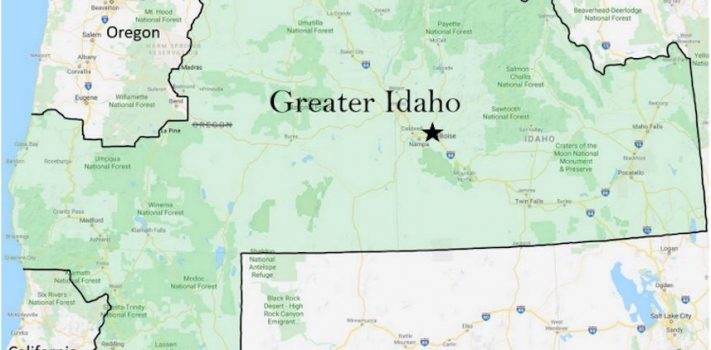
This weekly column features news stories and event announcements from around the American Redoubt region. (Idaho, Montana, eastern Oregon, eastern Washington, and Wyoming.) Much of the region is also more commonly known as The Inland Northwest. We also mention companies of interest to preppers and survivalists that are located in the American Redoubt region. Today, we focus on the renewed push for a Greater Idaho border realignment. (See the Idaho section.)

Idaho

Idaho Legislature Considers Absorbing Part Of Oregon. The article begins:

“A group of Oregon residents want their rural counties to be absorbed by Idaho, to throw off the control Portland exerts on a very different area of the state. Two counties have already voiced majority support for the idea in ballot initiatives.

The latest step for the organizations Move Oregon’s Border and Citizens for a Greater Idaho, was to present the idea to House and Senate committees in the Idaho legislature.The former house speaker of Oregon, who lives in one of the counties that want out, joined the movement’s leader to help pitch the plan.

In order to move the border, both Oregon and Idaho legislatures would have to approve the plan, as would the US Congress. Even the groups’ leaders admit that’s a long shot, but said, “When the 13 colonies got together, it was a long shot.”

And that spirit of freedom is what the movement wants to capture— escaping what they see as a tyrannical state government which does not represent the interests of the rural sections of the state.”

o  o  o

Idaho Power bills could soon be going up

o  o  o

Investigators: 8-year-old Emmett girl’s body found in trash bag in grandmother’s car

o  o  o

Police investigating bank robbery at Post Falls Wells Fargo. JWR’s Comment: Armed bank robbery is a rarity, anywhere in Idaho.

o  o  o

Coeur d’Alene School District reevaluating mask requirement on Monday

o  o  o

Rep. Heather Scott: Social Justice Indoctrination for Idaho Children Age 0-5 Action Alert!

Continue reading“SurvivalBlog’s News From The American Redoubt”


The Editors’ Quote of the Day:

“This was once a land where every sane person knew how to build a shelter, grow food, and entertain one another. Now we have been rendered permanent children. It’s the architects of forced schooling who are responsible for that.” – John Taylor Gatto


Preparedness Notes for Monday — April 19, 2021

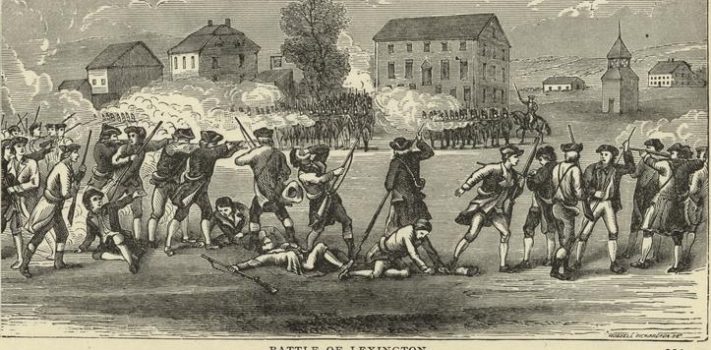
April 19th is the original Patriot Day which marks the multiple anniversaries of the battles of Lexington and Concord, known as “The Shot Heard ‘Round the World”. This first battle, leading to our nation’s independence, was the then-dictator’s (United Kingdom King George III’s) failed attempt at “gun control”– an act being carried out in too many parts of our USA right now. This first gun control of the colonies was a failure, because of the will and determination of a small part of the population (about 3% actually fought for our independence actively, with many others supporting) to stand up to an oppressive, controlling government (England). Without the sacrifice by those few Patriots, we could very well still be “British subjects” rather than independent citizens. Note that due to corporate bureaucracy, the celebration has generally been moved to the third Monday in April to facility a postal/banking holiday.

It also marks the anniversary of the Warsaw Ghetto uprising against the Nazis in 1943, the BATF’s costly raid on the Branch Davidian Church in Waco, the gun turret explosion on the USS Iowa in 1989, the capture of the Boston Marathon bomber in 2013, and very sadly also the Oklahoma City bombing in 1995.

April 19th is also the birthday of novelist Ralph Peters. Coincidentally, Ralph and I both have the same literary agent, Robert Gottlieb.

Today we present another product review written by our Field Gear Editor, Pat Cascio.


Zero Tolerance 0230, by Pat Cascio

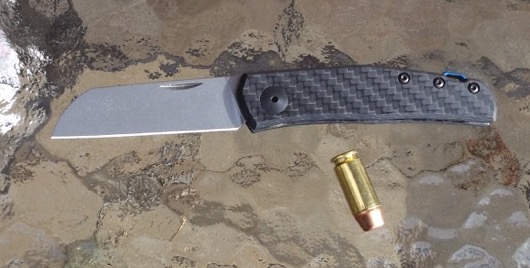
Today, we’re looking at something a bit different from Zero Tolerance knives. Zero Tolerance used to say their knives were built for use by “Professionals” and they were rock-solid designs, meant to take on the harshest battlefields, or the meanest streets of any city in the world, or meant for survival situations. The ZT-0230 is about as far removed from the above as you can possibly get.

Many of you are old enough to remember way back in the day when almost all folding knives had a “detent” ball system, and that kept the blade opened under most circumstances, and well as keeping the blade closed in your pocket – a very important thing if you ask me – in the far past, I had more than a few folding knives either open-up in my pants pocket, or the blade close on my fingers during use – ouch! The detent system that is still in wide use today, keeps the blade closed in the bottom of your pocket, and helps keep it “locked” open per se, when using the knife. However, under hard use, the blade can still close on your fingers, if you’re not careful.

The ZT0230 folder was designed by a Danish designer Jens Anso, and it is a slip joint folder – as are some folders today that are considered “tactical” folders and it features a double detent system – two steel detent balls, one on either side of the blade, helps keep the blade from accidentally opening in your pocket, or closing on your fingers under use. Another thing you don’t see much of these days, is a half-open position on the blade, that means you can open the blade about halfway open, and it keeps the blade open at that position – nice!Continue reading“Zero Tolerance 0230, by Pat Cascio”


Recipe of the Week: Big Ben’s Hopping John Black-Eyed Peas

The following black-eyed pea recipe is courtesy of SurvialBlog reader Ben P. He calls it Big Ben’s Hopping John.

Ben notes: “Some folks think the rice should be cooked separately, but that isn’t how Grandma ever remembers it being served up. The ham hocks are the best way to go by far.”

Ingredients
  • 1/2 lb dried black eyed peas
  • 1 smoked ham hock, or 1 lb diced ham, or 12 oz diced bacon
  • 1 medium onion, diced
  • 1 tsp minced garlic
  • 1 tsp cayenne pepper
  • 1 jalapeno, diced with seeds and veins removed
  • 2 tablespoons Chipotle sauce
  • 1 cup long grain rice
Directions
  1. Soak peas 1 hour in warm water.
  2. Drain.
  3. Cook ham hock in enough water to cover for 30 minutes.
  4. Add peas, onion, garlic, cayenne, and jalapeno.
  5. Simmer/slow boil covered for 45 minutes.
  6. Stir in rice and tabasco sauce. Cook 30 minutes at low, or until rice and peas
    are tender.
  7. Remove ham hock.
  8. Dice meat and discard fat and bone.
  9. Return to pot. Add one can of stewed diced tomatoes, if desired.
SERVING

This recipe makes about six servings (or just four servings if you have me over for dinner).

Do you have a favorite recipe that would be of interest to SurvivalBlog readers? In this weekly recipe column, we place emphasis on recipes that use long term storage foods, recipes for wild game, dutch oven and slow cooker recipes, and any that use home garden produce. If you have any favorite recipes, then please send them via e-mail. Thanks!


Economics & Investing For Preppers

Here are the latest news items and commentary on current economics news, market trends, stocks, investing opportunities, and the precious metals markets. We also cover hedges, derivatives, and obscura. Most of these items are from the “tangibles heavy” contrarian perspective of SurvivalBlog’s Founder and Senior Editor, JWR. Today, we again look at the nationwide ammunition shortage. (See the Tangibles Investing section.)

Precious Metals:

We’ll start out with a link to this interesting video interview: Gold and silver prices spike, but can the rally last? Jim Wyckoff on the long-awaited bull market

o  o  o

Singapore Dealer Prepares Vault for 15,000 Tons of Silver

Economy & Finance:

Consumer prices rise more than expected, pushed by 9.1% jump in gasoline

o  o  o

At Zero Hedge: BofA “Sell” Signal Triggered Any Moment… The Last This Happened Time Was May 2007

o  o  o

“The Biggest Concern Is Stagflation” – Factory Orders Tumble As Services Surveys Signal Soaring Inflation

o  o  o

At Wolf Street: US National Debt Passes $28 Trillion, +$4.7 Trillion in 13 Months. General Treasury Account Down by $480 Billion in 2 Months, $620 Billion to Go

Continue reading“Economics & Investing For Preppers”


The Editors’ Quote of the Day:

“The key fallacy of so-called gun control laws is that such laws do not in fact control guns. They simply disarm law-abiding citizens, while people bent on violence find firearms readily available.

If gun control zealots had any respect for facts, they would have discovered this long ago, because there have been too many factual studies over the years to leave any serious doubt about gun control laws being not merely futile but counterproductive.

Places and times with the strongest gun control laws have often been places and times with high murder rates. Washington, DC, is a classic example, but just one among many.” – Thomas Sowell


Preparedness Notes for Sunday — April 18, 2021

America Strikes Back: The Doolittle Tokyo Raid took place on April 18, 1942.

April 18th is the birthday of former Washington Representative and Pastor, Matt Shea. (Born 1974).

On April 18th, 1906, the San Francisco earthquake struck northern California, killing hundreds of people as it toppled numerous buildings and started fires that engulfed whole neighborhoods. The quake was so powerful that it knocked down chimneys in the Anderson Valley, 120 miles north of the city.

SurvivalBlog Writing Contest

Today we present another entry for Round 94 of the SurvivalBlog non-fiction writing contest. The prizes for this round include:

First Prize:

  1. The photovoltaic power specialists at Quantum Harvest LLC  are providing a store-wide 10% off coupon. Depending on the model chosen, this could be worth more than $2000.
  2. A Gunsite Academy Three Day Course Certificate. This can be used for any of their one, two, or three-day course (a $1,095 value),
  3. A course certificate from onPoint Tactical for the prize winner’s choice of three-day civilian courses, excluding those restricted for military or government teams. Three-day onPoint courses normally cost $795,
  4. DRD Tactical is providing a 5.56 NATO QD Billet upper. These have hammer forged, chrome-lined barrels and a hard case, to go with your own AR lower. It will allow any standard AR-type rifle to have a quick change barrel. This can be assembled in less than one minute without the use of any tools. It also provides a compact carry capability in a hard case or in 3-day pack (a $1,100 value),
  5. Two cases of Mountain House freeze-dried assorted entrees in #10 cans, courtesy of Ready Made Resources (a $350 value),
  6. A $250 gift certificate good for any product from Sunflower Ammo,
  7. American Gunsmithing Institute (AGI) is providing a $300 certificate good towards any of their DVD training courses.

Second Prize:

  1. A Front Sight Lifetime Diamond Membership, providing lifetime free training at any Front Sight Nevada course, with no limit on repeating classes. This prize is courtesy of a SurvivalBlog reader who prefers to be anonymous.
  2. A Glock form factor SIRT laser training pistol and a SIRT AR-15/M4 Laser Training Bolt, courtesy of Next Level Training, that have a combined retail value of $589,
  3. Two 1,000-foot spools of full mil-spec U.S.-made 750 paracord (in-stock colors only) from www.TOUGHGRID.com (a $240 value).
  4. An Israeli CBRN Gas Mask with Hydration Straw and two Extra 40mm NATO Filter s – Manufactured in 2020 (a $229.99 value), courtesy of McGuire Army-Navy.
  5. Naturally Cozy is donating a “Prepper Pack” Menstrual Kit.  This kit contains 18 pads and it comes vacuum-sealed for long term storage or slips easily into a bugout bag.  The value of this kit is $220.
  6. An assortment of products along with a one-hour consultation on health and wellness from Pruitt’s Tree Resin (a $265 value).

Third Prize:

  1. Three sets each of made-in-USA regular and wide-mouth reusable canning lids. (This is a total of 300 lids and 600 gaskets.) This prize is courtesy of Harvest Guard (a $270 value)
  2. A Royal Berkey water filter, courtesy of Directive 21 (a $275 value),
  3. Two Super Survival Pack seed collections, a $150 value, courtesy of Seed for Security, LLC,
  4. A transferable $150 purchase credit from Elk Creek Company, toward the purchase of any pre-1899 antique gun. There is no paperwork required for delivery of pre-1899 guns into most states, making them the last bastion of firearms purchasing privacy!

Round 94 ends on May 31st, so get busy writing and e-mail us your entry. Remember that there is a 1,500-word minimum, and that articles on practical “how-to” skills for survival have an advantage in the judging.


No Power: No Commo, No Layered Defense, by Tunnel Rabbit

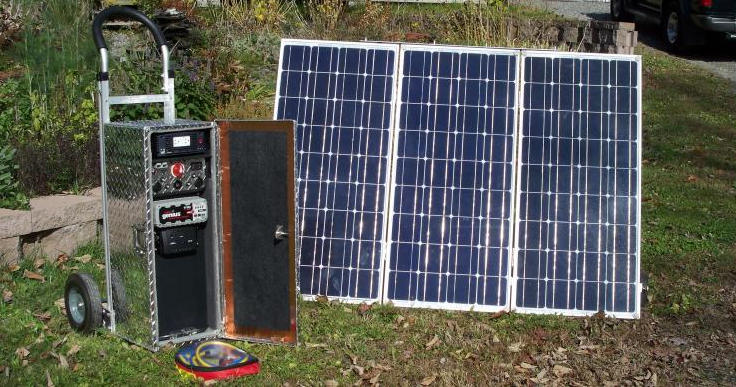
Building A Small Off Grid PhotoVoltaic Power Supply

A small solar power system is a “must-have” and does not have to cost more than $1,000 USD. Here are a few tips that might help. I’ve lived off-grid for years and learned by doing.

If in a sunny part of the U.S., then 200 watts would be my minimum. In the north, I would want 400 watts minimum, and two small inexpensive generators, and two 20-amp automotive battery chargers for redundancy sake, and 50 gallons of fuel for two years. One, or both sets can be used at the same time to charge two separate battery banks, or a larger battery bank of 400 amp-hour capacity. On cloudy days, panel production is about 10 percent of the panel’s rating. I do not need an expensive Honda, when a good used and inexpensive 1,000 watt generator is more cost-effective as a 200 battery bank should only receive a 20 amp-hour charge rate to avoid damage. An automotive battery charger that provides up to 20 amps per hour, requires almost 400 watts from the generator. If only powering a few radios, I should not need to run the generator, except occasionally during the darkest and most cloudy months– typically December through February. A Baofeng or analog scanner only draws .075 amps per hour when ‘listening’.

Storage Batteries

Two 6 volt golf cart batteries are deep cycle batteries that as a wired-in-series pair that can have about 200 to 220Ah capacity at a nominal 12 VDC when wired in series. I will choose old tech lead acid over modern choices as these are more cost-effective and foolproof. Other forms are attractive, yet they also have special requirements and quirks. Good old wet cell lead-acid batteries are hard to beat, and the maintenance required is well worth it, given their low price and the proven reliability. Also, we do not want a marine battery or a car battery, but a true deep cycle battery, if possible. Starting batteries will not last long if used in the same way as deep cycle batteries are used. Starting batteries will have a Cold Cranking Ampere (CCA) rating. Marine batteries now come with a CCA rating denoting that it is a ‘starting’ battery. These will have a short service life of only months if used as if they were deep cycle batteries.

Deep cycle batteries can provide 3 to 5 years of service if used to their full capacity daily, yet not abused. We must avoid letting the voltage drop lower than 12.4 to 12.3 volts, or to a depth of discharge of no more that 50 percent as indicated by voltage, or better yet, use a hydrometer. Additional photovoltaic (PV) panels will reduce the depth of discharge, and ensure that it is possible to recharge the batteries to 100 percent each day before drawing them down again. Recharge to 100 percent each day to get the full potential service life. If you live in a sunny part of the U.S., then we want, at a minimum, 1 watt of solar power for every 1 ampere hour of battery storage. In Montana, I want 2 to 4 watts of PV power, for every 1 ampere hour of the battery’s rated capacity. We need enough wattage to fully charge up the batteries by midday after period of discharging. PV power is reliable and requires no fuel. It is now much less expensive per watt, and now harder to justify a generator because we can afford additional panels, yet during the darkest part of a long snowy winter in the American Redoubt, a generator will likely be needed.Continue reading“No Power: No Commo, No Layered Defense, by Tunnel Rabbit”