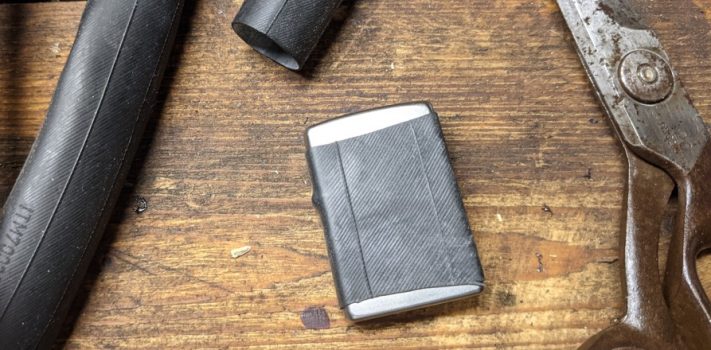
The iconic Zippo lighter is an excellent tool for starting fires. Battlefield tested from World War 2 to the War on Terror, it has proven to be a versatile, durable, and reliable tool in daily use.
One major drawback of the Zippo is that it loses fuel fairly quickly due to evaporation. I had previously read about an old trick for slowing this evaporation by using a piece of bicycle inner tube. I decided to give it a try.
Lighter History
A lighter is a portable and reusable device designed to produce a flame.
Already in the 1600s, the first lighter-type devices were developed. These devices were tinderboxes that used a wheel lock mechanism similar to those employed by the firearms of the time. Sparks from the lock were used to ignite gunpowder or other flammable substances in order to create a flame. When firearms advanced from the wheel lock to the flintlock, these early lighters followed in their footsteps.
Then in the 1800s, chemist Johann Wolfgang Döbereiner invented a device that created a flame by passing hydrogen over a platinum catalyst. The device proved quite popular, although it was unwieldy and somewhat dangerous to use.
The next major step forward in lighter technology was built upon the development of ferrocerium by Carl Auer von Welsbach in 1903. For the next six decades and longer, sparks produced by ferrocerium became the most widely used ignition source for lighters.
During World War I, trench warfare was characterized by some as long periods of boredom punctuated by short interludes of pure terror. Many soldiers coped with the periods of boredom by crafting lighters from readily salvageable battlefield materials like spent cartridge cases of various sizes. Their frequent exposure to the elements inspired these soldiers to introduce design improvements like perforated chimneys intended to help protect the lighter’s flame from the wind. These improvements were adopted into the lighter designs of the interwar period.
In the early 1930s, George G. Blaisdell observed a friend using an Austrian-made lighter. Blaisdell felt that he could improve on the concept, and in 1932 he introduced his new “Zippo” lighter.Continue reading“Slowing Evaporation From a Zippo Lighter, by The Novice”