(Continued from Part 1.)
Transceiver Selection
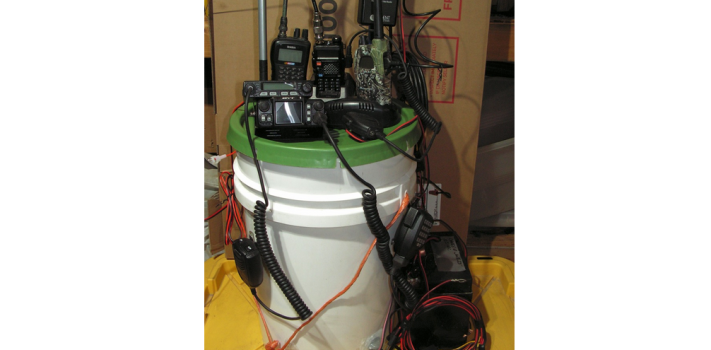
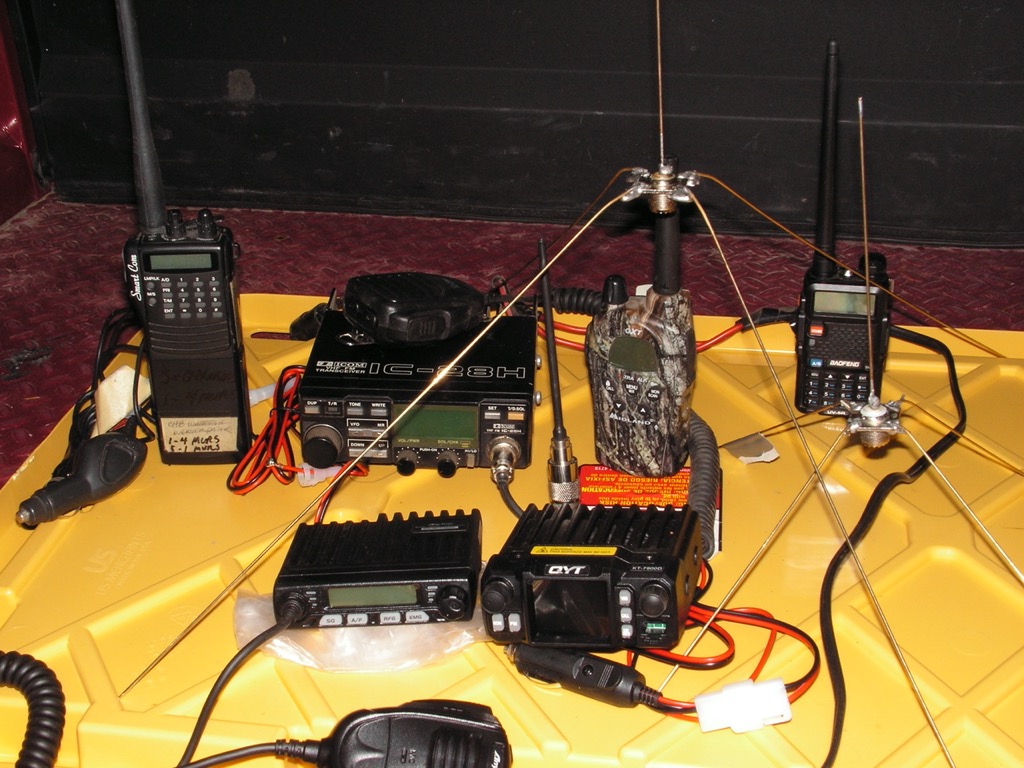 These are various sizes and types of radios. For the purpose of size comparison, the photo illustrates why we should choose the smaller-size transceivers that will allow one to pack as many as possible into the metal can that is housed inside the 6-gallon bucket. The metal can is needed for protection from EMP, and as an additional protection from the environment when stored inside, or outside the bucket.)
The smallest in size is the tiny Anytone Smart which is a 10 Meter FM, and 16-watt PEP CB AM/FM that has 400 channelized frequencies between 24 to 30Mhz. It covers 10, 11 and 12 Meter and CB services in foreign countries if the owner performs two modifications. Unmodified, it is a 10 Meter AM/FM that might be of just limited utility. It does not have SSB, but it is inexpensive. A small-in-size and inexpensive (less than $100) Uniden CB would be a better choice for most. While there are better CBs, the smaller size transceivers makes room for other important equipment. The lower-in-cost CBs should transmit with the same amount of power as the most expensive mobile CBs.
Each of the two 25-foot coaxial cables can be put into a tree, or on a pole and attached to several 1/2 wave dipoles antennas for CB, 10 Meter, VHF, or UHF 1/4 wave ground plane wire antennas. The other mobile transceiver transmits with a maximum of 45 watts, however, it is relatively large and only covers VHF. The largest 1/4 wave ground plane antenna is for 70cm. 1.25CM and 2 Meter/MURS are dipoles.Continue reading“A Low Power Communications Station in a Bucket – Part 2, by Tunnel Rabbit”