Odds ‘n Sods:

News from formerly pleasant Oxfordshire, England: Mob takes emergency water supplies during Banbury shortages.

   o o o

Today is the last day of the three day sale: Ready Made Resources is also having a 25% off sale on Mountain House foods where they are offering a free copy of “Survivors” when you order two cases Mountain House foods. Note that this offer can be multiplied — i.e. you will receive five copies of the novel if you order 10 cases of Mountain House foods.

   o o o

The Los Angeles Times reports: Emails show top Justice Department officials knew of ATF gun program. Note that they termed it a “surveillance operation”. But taxpayer dollars were used to buy some of the guns, so it was much more than that. Your Tax Dollars At Work! In related news: House Republicans Request Special Counsel to Probe Holder on ‘Fast and Furious‘. And we also read: CBS News Reporter Says White House Screamed, Swore at Her Over Fast and Furious. (So, it seem that it was the BATF that was “Fast” and the White House that was “Furious”.)

   o o o

Tennessee Prepper sent an interesting link on farming weather predicted for the next 10 years: Hunker Down to Weather the Next 10 Years.”‘There are indications that the climate will become increasingly volatile over the next 20 years. Dry years will be drier and wet years will be wetter. Volatility may not be permanent, but it will be a fixture for the next 10-20 years,”


Today is Book Bomb Day!


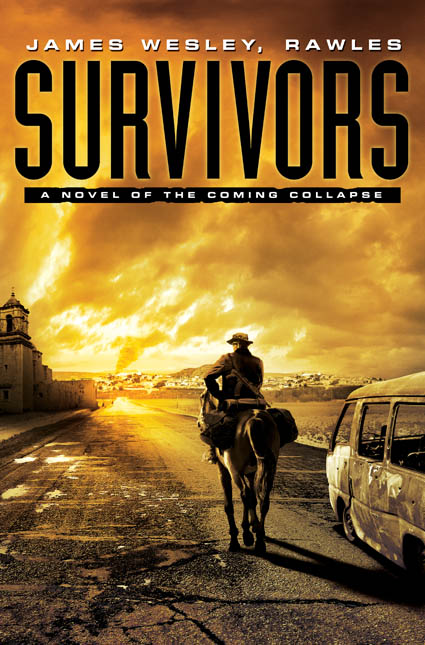
This is the release day for my novel “Survivors: A Novel of the Coming Collapse”. (October 4th, 2011.) Thank you for waiting to order your copies until today. Keep an eye on the book’s Amazon Sales Rank, as the day progresses. This should be fun!

Survivors Cover

Here is some information on the novel, without any spoilers: Much of the novel is set in the Four Corners Region of the American Southwest. “Survivors” is unusual for a novel sequel. Unlike most sequels, instead of extending the “Patriots” saga further into the future, it is contemporaneous with the action in the first book. But it is set in different locales, with mostly different characters, with vastly different levels of preparedness. The novel begins from the perspective of a U.S. Army officer deployed in Afghanistan, just as “The Crunch” unfolds.

Unlike the protagonists in “Patriots”, most of the characters in “Survivors” don’t have a deep larder, so they are forced to scramble and improvise. There are just a few crossover characters between the two novels, such as Ian and Blanca Doyle (whom you will remember from “Patriots” as the husband and wife Laron Light Experimental airplane owners living near Luke Air Force Base.)

The cover art for the book was masterfully rendered by mixed-media artist Tony Mauro, Jr. of New York. He took my vague one-minute verbal description of what I had in mind for the art, and he nailed it. I am very happy with his design and his choice of color palette. It really captures the essence of the novel. (The lead character, Andy Laine, is depicted on horseback in Texas, in the midst of The Crunch. You’ll see how closely Tony matched the storyline when you read the novel.

“Survivors” is being published by Atria Books, a division of Simon & Schuster. This first released is in hardback. It retails for $24, but Amazon sells it at the deeply discounted price of $14.40.) It will be followed sometime in 2012 by a trade paperback. (The latter is the same binding format that was used with “Patriots”.)

The publisher tells me that the first print run of hardbacks was 35,000 copies. This big initial printing was in part based upon Amazon’s strong pre-order of 15,000 copies. I’d prefer that readers in the U.S., Canada, and the UK order through Amazon. (If your order is at least $25, you can qualify for Amazon’s free “Super Saver” shipping. See our Catalog Page for ideas on other items that you might want to order, to bring your total over $25.)

I should also mention that Kindle, Nook, and iBook e-books as well as the audio book are also now orderable. The award-winning Dick Hill narrated the audio book. (He also narrated “Patriots”.)

Where to Buy Your Copies of “Survivors”

Hardcover Book Sellers:
Amazon.com
BAMM
Barnes & Noble
Indie Bound
Powell’s
Boomerang (Australia)
Amazon.de (Germany)
Whitcoul’s (New Zealand)
Amazon.co.uk (UK)

eBook Sellers:
Kindle (Amazon.com)
Nook
iBook (iPods and iPhones)

Audio Book Sellers:
Amazon.com
AudioBookstand.com
AudioEditions.com
Boomerang (Australia)
Amazon.de (Germany)
Whitcoul’s (New Zealand)
Amazon.co.uk (UK)

The hardback will also soon be available to U.S. armed forces servicemembers, through the All Services Exchange Catalog.

If you’ve already read it, succinct, positive reviews at the Amazon and Barnes & Noble web sites are greatly appreciated. For example, here is one that was just posted:

“I was fortunate enough to get an advance copy of Survivors and truly enjoyed reading it. If you liked Patriots you will love Survivors! While Patriots was about 50% technical manual and 50% novel, Survivors is much more a story but still has enough “technical” in it to keep a true Rawles fan happy. Survivors is a wide-ranging book that takes place with different groups in many locations who are much less prepared than the groups in Patriots. That makes it very interesting, coupled with the fact that Rawles dosen’t mind killing off a character you like once in a while to keep you guessing. I especially like the “Kentucky Seed Lady”, Sheila Randall, who shows that you just don’t lay down and take it when things go bad but get to work instead. Also, who wouldn’t like Andy Laine and his story of sacrifice and scrappiness to get home from Afganiston when things go bad. The world and timeline that Rawles has created will continue to support many new books in the future. Survivors (unlike Patriots) leaves you with some unfinished business which, I assume, will be tied up when [the second sequel] Deo volente comes out.

I also have to mention that even though I have read Survivors I ordered a new copy so I can get the great cover art on my bookshelf (the advance copy has a plain cover). The art fits the theme of Rawles world and the story itself perfectly. Great story, great read, educational, interesting and timely – just what you want in a book. Nice work James Wesley Rawles!” – Robert A. Jacobsen

Thanks for your help in making the Book Bomb Day a success!


Economics and Investing:

Things are looking more like my novels with every passing day. Here are the latest headlines…

Stocks tank as Greece admits it won’t hit targets.

Mentioned over at Don’t Tread On Me: 2011 US Mint Silver Set To Have Bigger Sales Than ’86 to ’92, combined!

Are Hedge Fund Managers Dumping Gold Assets To Raise Cash?

Four (4) Market Signs Signaling A Recession

John R. kindly sent me a whole bunch ‘o links:

The Dollar and Reserve Currency (Martin Armstrong) 

Debt Men Talking (Richard Webb)
 
Batten Down The Hatches, A Big Storm’s Coming (Dave Cohen)

The FINal Countdown (over at Zero Hedge)
 
Getting The Wrong Things At The Wrong Time (Bob Chapman)

Banking crisis set to trigger new credit crunch (Harry Wilson)

The Savings of Millions of People are Going to Vanish in Less Than 12 Months (Mac Slavo at the excellent SHTFPlan blog.)

Prediction of Imminent End Of The Eurozone And A Global Financial Apocalypse (Zero Hedge)


Odds ‘n Sods:

Shortages Lead Doctors To Ration Critical Drugs. (A hat tip to Brian D. for the link.)

   o o o

Couple recovering from home bear attack. Important safety tip: Keep a loaded gun handy at all times, for both two-legged and four-legged predators! (Thanks to F.J. for the link.)

   o o o

Fed Plan to Consolidate Power Over Nation’s Power Highway Has States Nervous

   o o o

A bit more truth comes out: ATF Fast and Furious: New documents show Attorney General Eric Holder was briefed in July 2010. Meanwhile, we read: Whitehouse Document Dump Raises Possibility of Second ‘Gunwalking’ Program

   o o os

I’ve been having fun watching the almost real life Sons of Guns television series available via Netflix streaming. I say “almost” because a few of the situations seem a bit contrived and/or too coincidental to be mere happenstance. The show is about a father and daughter that operate Red Jacket, a Class 3 manufacturer in Baton Rouge, Louisiana. They have an eccentric crew of enthusiastic gunsmiths with very positive attitudes. (And, refreshingly, much cleaner vocabularies than the wrench-turners in all those “Monster Garage” type shows.) Other than the fact that the producers glossed over the $200 transfer tax requirement for full auto, SBRs and SBS transfers in the U.S., the show is quite good, overall. Many of their modification work involve suppressors, Saiga 12 shotguns, and other guns in the AK family.


Jim’s Quote of the Day:

"Pro captu lectoris habent sua fata libelli." (Loosely translated: "According to the intellect of their readers, books have a destiny.") – Terentianus Maurus, De litteris, De syllabis, De Metris


Notes from JWR:

Tomorrow (October 4th) is Book Bomb Day for my latest novel “Survivors”. Please wait until midnight, Pacific time to place your order. The book is already ranked #170 in overall sales rank and #23 in Amazon’s “Action Adventure” books category. I’m hopeful that it will get in to the Top 20, overall, and the Top Three in the Action Adventure category. (There is some weighty competition, with authors like CJ Lyons, Stieg Larsson, George R.R. Martin, K.C. May, and Brett Battles.) At least my book won’t be competing against multiple “Twilight” vampire novels, like “Patriots” was, on its release day.

Competing for attention, the Australian near-future war of resistance movie Tomorrow When the War Began will also be released on Blu-Ray on October 4th. And simultaneously, the Elves of Cupertino are expected to announce the iPhone 5. In the publishing world, “The Heroes of Olympus, Book Two: The Son of Neptune” will be released the same day. Since that book is part of such a wildly popular series, I expect that it will jump to #1. (That book’s predecessor was both #1 on Amazon and #1 on the New York Times bestseller list.)

Hopefully there might even be room for “Survivors” in Amazon’s Top Ten.

“Survivors” Rankings In The Past Week:

Date

Amazon Rank
(Overall)

September 26 384
September 27 365
September 28 308
September 29 281
September 30 212
October 1 176
October 2 170

Tomorrow, I’ll be graphing hourly updates. And hopefully I will also have a live ranking feed from Amazon, if my #2 Son can complete coding a shell script.

I’m scheduled to be on both the Peter Schiff show and the G. Gordon Liddy show, tomorrow. (Tuesday, October 4, 2011.) Both shows will be available as podcasts.


Pat’s Product Reviews: SOG Knives – SEAL Knife 2000 and SEAL Pup

Pat’s Product Review: SOG  Knives – SEAL Knife 2000 & SEAL Pup

SOG Knives makes some of the best cutlery around, bar none! I’ve been using their knives for many years, and have never been let down by any of ’em, including their multi-tools. My youngest daughter, who is a Combat Medic in the US Army, carries a SOG folding knife everyday – that says a lot! I’ve had several SurvivalBlog readers write and ask me to do a review on the SOG Seal Team and SOG SEAL Pup fixed blade knives, and I’m happy to oblige.
 
The SOG SEAL Knife 2000 has been discontinued, and was replaced by the SEAL Team Knife, it’s basically the same knife, with a few exceptions, one being that the blade shape is slightly different. I don’t have the new SEAL Team Knife on-hand, so I can only report on the older model, the SEAL Knife 2000.
 
Now, there has been several “official” SEAL knives made over the years, by a number of different companies and custom knife makers. However, if memory serves me correctly, SOG was the first commercial knife company to be awarded a contract for an “official” SEAL knife. Bids went out, with specifications for a fixed blade knife for the US Navy SEALs. Some of the requirements were: tip breaking stress, blade breaking limit, sharpness, edge retention, hand twist off force, two week salt water immersion tests, gasoline and acetylene torch resistance, chopping, hammering, prying, penetration tests, cutting six different types of rope and line, plus an intense hands-on competition in the field. SOG Knives won the competition against all comers, including some custom make knives.
 
Anyone who is even slightly familiar with the US Navy SEALs know these guys are the best-of-the-best in Spec Ops. Their training is extremely difficult and demanding, very few candidates make it through the first two weeks of training, to be sure. The SEALs also demand the very best in everything, including weapons and equipment. These guys can be out on a recon or patrol for weeks at a time, with very little in the way of support, so they demand weapons and equipment that won’t fail, period.
 
The SOG SEAL Knife 2000 has a 7″ blade made out of AUS 8 stainless steel – one of my favorites. The knife is 10.3 oz, making it light enough for close combat and heavy enough for many everyday tasks and chores. The handle material is some type of black synthetic called GRN, and it’s super-tough to be sure. The knife comes with a black Nylon sheath, however an optional Kydex sheath is available as well. The handle material has finger grooves on the bottom for a sure grip under all sorts of conditions. Normally, I don’t like this feature, as the grooves always seem to be in the wrong place for my fingers, on the SOG SEAL knife, the grooves are in the proper place. There is also a lanyard hole on the butt of the handle, which is a must-have feature when working in and around water – where the SEALs operate. The blade has a soft powder coating on it for a non-reflective look, again, something that is necessary when working in the dark.
 
I’ve had my sample SEAL Knife 2000 for several years now, and I’ve put it through all manner of tests around my meager homestead. I’ve used the knife for cutting chores, as well as digging – which is was not really designed for. The blade holds an edge a good long time, even when subjected to digging. The knife is fast in the hand, which makes it a good choice for close quarters combat work.
 
Needless to say, I couldn’t possibly duplicate all the tests the SEALs subjected the knife to during their testing. However, over many years, I’ve given my sample a good work out, and it has held-up to everything I’ve thrown at it. About the only “damage” to the knife has been scratching the powder coating on the blade – no big deal!
 
The late Col. Rex Applegate, who employed me for about three years told me that during WWII, the OSS did a lot of research into what makes a good combat knife. One of the requirements was that the knife had to have a blade of at least 6″ in length, in order to stab through heavy clothing and reach vital organs. The full size SEAL knife easily meets that requirement with it’s 7″ blade.
 
The blade is also partially serrated on the SEAL knife, and that’s a good feature if you have to cut a lot of rope or poly cord, as the serrations really rip through even slick and wet rope or poly cord. The blade holds an edge a good long time, and one of the things I like about AUS 8 stainless steel is that, it’s easy to re-sharpen. What’s not to like here?
 
The new SEAL Team Knife is just now coming on the market, and it retails for $160.50 and that’s a good price for a knife this tough. [JWR Adds: And it is already available at discounted price under $100, through Amazon.com and a few online knife dealers.] If it’s good enough for the US Navy SEALs, then it’s good enough for anything you or I can throw at it.
 
Now, this may come as a surprise to you – I know it did to me. I was told by SOGs marketing guy, Chris Cashbaugh, that the SOG SEAL Pup fixed blade knife is actually more popular with the US Navy SEALs than the full-sized knife is. It is also a better seller to civilians than the full-sized knife, as well. As I’m sure you know, a knife is used as a tool more than it is used as a weapon, and the smaller SEAL Pup seems to fill the bill nicely.
 
With a 4.75″ blade made out of AUS 6 stainless steel, it’s about the right size for most everyday chores that the SEALs or anyone else can throw at it. While I would prefer to see the SEAL Pup make out of slightly tougher AUS 8 stainless steel, the AUS 6 seems to hold up very well, in my tests.

The handle, like it’s big brother, is made out of black GRN synthetic and has finger grooves as well as a lanyard hole. The blade is powder coated, giving it a non-reflective finish. A Nylon sheath comes with the SEAL Pup, and you can also get the optional Kydex sheath if you want for a few bucks more. The knife weighs in at 5.4 oz and the blade is partially serrated. Retail is $98.50, again a good buy in my book.
 
I’ve also has my SEAL Pup sample for quite a few years, and to be honest, I’ve used it more than the it’s big brother – go figure? Actually, for many everyday tasks and chores, the smaller SEAL Pup just works better than the bigger knife does. The bigger knife is, without a doubt, better for close combat, chopping and slashing applications. But the smaller “Pup” makes easier work of everyday chores.
 
I honestly wish I could report something negative about either the SEAL Knife 2000 or the SEAL Pup knife, but there’s nothing wrong with either of these knives. SOG makes some very fine knives and tools.

Some folks I know are totally turned-off when they see “Made in Taiwan” on the blade of any knife. Look, manufacturers can contract for whatever quality they want, from Taiwan. If you want a crummy $5 knife, they will make one for you, and you’ll have a piece of junk. If you want some of the best knives around, and I consider the full-sized SEAL knife and the Pup, as some of the best, then that’s what the factories in Taiwan will produce for you. I have no problem with any knife being made any place in the world, and I can care less what’s marked on the blade, so long as the knife is of good quality. Sure, I like to see “Made in the USA” marked any products just as much as the other guy does. However, I believe if either of these knives were produced in the USA, the cost would probably be at least a third more to double the retail asking price. Again, what is stamped on the blade as to where the knife is made is not crucial. SOG simply doesn’t make and sell junk!
 
So, if you’re in the market for a knife that won’t let you down, then take a close look at the SOG SEAL and Pup fixed blade knives. You could do a lot worse, but I don’t know if you’d do a lot better, just by spending more of your hard-earned dollars. If these knives are good enough for the US Navy SEALs, then they are good enough for me (and you). – Pat Cascio, SurvivalBlog Field Gear Editor


Letter Re: Lessons From Wayward Motorists

Mr. Rawles:
Here is a quote from a recent news story: “A 67-year-old man found alive days after his car plunged 200 feet off a mountain road built a makeshift camp, ate leaves and drank water from a nearby creek to survive, his daughter said.”

Interesting. “Non Life Threatening Injuries”! 

Lessons learned:

(1) Leave a trail of breadcrumbs? Let folks know where you’re going, your route, and when to expect a check-in. This lesson is oft repeated in stories of fatalities.

(2) Put some water in your car’s backseat. Hook the seat belt to it so it doesn’t become a missile. Plan for a few days; if not a week.

(3) Communications? Combine an idea from a commercial — a weather balloon on a tether. Signal fire. Air horn. FRS or CB radio. Whistle. 

(4) Society needs to engineer roads that can detect accidents or cars leaving the roadway. I remember in the 1960s a Nevada State Trooper told me that the road crews would create a small ridge of dirt a little off the road so that they could see when a driver fell asleep and drifted off the road. He said they found people a considerable distance away from the road. That seems like a cheap way to detect such accidents.

(5) As always, awareness. It’s a dangerous world out there for us very fragile humans.

Now imagine this happening in The End Of The World As We Know It (TEOTWAWKI). Scary!

Regards, – F.J.


Economics and Investing:

World is heading for ‘Great Stagnation’, says Goldman

“It’s Going to Get a Lot Worse”: ECRI’s Achuthan Says New Recession Unavoidable. (Thanks to Alan W. for the link.)

J.B.G. sent this: Protectionism beckons as leaders push world into Depression

Erik B. spotted this article: Greece to Miss Deficit Targets Imposed by Lenders as Part of Bailout

Texas Bank Is Closed; U.S. 2011 Failures at 74. (Link courtesy of G.G.)


Odds ‘n Sods:

Reader C.D.V. kindly sent me a map of the most rural counties in the U.S., compiled by Purdue University. This map is a great tool to help in selecting retreat locales. By the way, you can right-click to zoom in on the map. Do you notice a correlation with my designated American Redoubt states? Interesting. (And BTW, here is the source page and there is an accompanying Rural-Metropolitan Levels map, and here is the key for the second map. And it is also interesting to correlate that data with the Frontier designation of some counties.

   o o o

The folks at Safecastle are now providing a free hardcover copy of my new book “Survivors” with qualifying purchases of Mountain House three-can packages. They are also including a free Aurora Firestarter. I may be biased, but that sounds like a great deal, to me!

   o o o

Meanwhile, Ready Made Resources is also having a 25% off sale on Mountain House foods (from Monday through Wednesday) and offering a free copy of “Survivors” when you order two cases Mountain House foods. Note that this offer can be multiplied — i.e. you will receive five copies of the novel if you order 10 cases of Mountain House foods.

   o o o

G.P. sent this: TEOTWAWKI: The perfect solar storm. (A nice succinct piece by Travis Kelly, a newspaper writer in in Grand Junction, Colorado.)

   o o o

Pierre M. spotted this: As Prisoner Exchange Begins, Los Angeles County Officials Predict Doom

   o o o

Methinks that the “Just Us” Department has found their convenient scapegoat: New Fast and Furious docs released by White House. (Thanks to K.A.F. for the link.) Oh, BTW, some have surmised that the entire BATFE might be disbanded. But I’m afraid that is just wishful thinking. I suspect that there will be some grandstanding and organizational shuffling. But inevitably this rogue agency will simply be re-named and the same agents will be sent out to continue trampling our right to keep and bear arms.


Jim’s Quote of the Day:

“We’ve all had to rewrite the scripts of our lives the last few weeks, we’ve learnt a lot and we’ve had to figure out what’s important, what matters – what really matters. Its been quite a time.” – Caitlin Stasey as Ellie Linton in the film Tomorrow When the War Began, (Screenplay by John Marsden and Stuart Beattie.)


Notes from JWR:

Just two days to Book Bomb Day! Tuesday (October 4th) is Book Bomb Day for my latest book “Survivors: A Novel of the Coming Collapse”. Please wait until Tuesday to place your order, so that the book will get a big boost in Amazon’s sales ranks. (When I last checked, “Survivors” was already ranked at #152 in Amazon books (overall), and #20 in the “Action Adventure” category.) Thanks!

Today we present the first entry for Round 37 of the SurvivalBlog non-fiction writing contest. The prizes for this round include:

First Prize: A.) A course certificate from onPoint Tactical. This certificate will be for the prize winner’s choice of three-day civilian courses. (Excluding those restricted for military or government teams.) Three day onPoint courses normally cost $795, and B.) Two cases of Mountain House freeze dried assorted entrees in #10 cans, courtesy of Ready Made Resources. (A $300 value.) C.) A 9-Tray Excalibur Food Dehydrator from Safecastle.com (a $275 value), D.) A $250 gift certificate from Sunflower Ammo, and E.) An M17 medical kit from JRH Enterprises (a $179.95 value).

Second Prize: A.) A Glock form factor SIRT laser training pistol. It is a $439 value courtesy of Next Level Training. B.) A “grab bag” of preparedness gear and books from Jim’s Amazing Secret Bunker of Redundant Redundancy (JASBORR) with a retail value of at least $300, C.) A $250 gift card from Emergency Essentials, and D.) two cases of Meals, Ready to Eat (MREs), courtesy of CampingSurvival.com (a $180 value).

Third Prize: A.) A Royal Berkey water filter, courtesy of Directive 21. (This filter system is a $275 value.), B.) Expanded sets of both washable feminine pads and liners, donated by Naturally Cozy. This is a $185 retail value, C.) A Commence Fire! emergency stove with three tinder refill kits. (A $160 value.), and D.) Two Super Survival Pack seed collections, a $150 value, courtesy of Seed for Security.

Round 37 ends on November 30th, so get busy writing and e-mail us your entry. Remember that articles that relate practical “how to” skills for survival have an advantage in the judging.


Some Seed Saving Advice, by Lydia S.

Currently I have a couple hundred tomato seeds in my supplies. For the moment, I am focusing on cv. “Raincross Rock” as that is saved seed for a variety I happen to be developing. If I continue to grow and save this variety each year, those few seeds pretty much means that my friends and family (and hopefully many generations into the future) will be assured of a bounty of tomatoes each year. Such is the promise of seed saving!

However, not every plant in every place is a great candidate for seed saving. Plants have rules, too, and while the rules are simple, it is really best to follow them. Thus, this guide.

First of all, it is usually best to save from known varieties that are either heirlooms or open-pollinated. Both of these categories represent stabilized cross-breeds that will tend to breed true. Thus, if you save a “Roma” tomato, the seeds will also show “Roma” characteristics. The difference between these is that heirlooms come with a lineage which is at least 50 years old and sometimes a great deal older than that, while open-pollinated crops are newer, but they are still generally stable and very useful for seed saving. One caution here is to never save from a variety that is labeled “PVP”, or “Plant Variety Protection.” That’s essentially a plant patent. These people have invested thousands of dollars and seeds in protecting their work. Please be mindful of their efforts.

Obviously, a plant grown from vegetative tissue– like potatoes, yacon, oca, garlic, some onions, horseradish, etc.—will be genetically the same as the parent plant and are thus obviously true to type.

Hybrids represent what is essentially an unstable cross. In other words, if you save the seeds of a hybrid pepper, the plants the next year will probably resemble the parent varieties used to make the cross more than they will the plant that was expected. Sometimes this can be useful if trying to make foundation stock from which to breed one’s own variety, but in general it is best avoided. There are a multitude of reasons not to save anything with genetic modifications, either. At the top of that list is that all of those genes are patented and cannot be used in any way, which can lead to civil litigation trouble.

Assuming an heirloom or open-pollinated variety, one needs to know what type of genetic tango the species uses. There are two basic divisions—incrossers and outcrossers.

Incrossers have a variety of pollination mechanisms that ensure a high level of self-pollination. Such species—tomatoes, peppers, lettuce, peas and beans are great examples—usually do not require much isolation from other plants to stay true to type. Ten feet of separation pretty much guarantees purity. Additionally, it is not necessary to save seed from as many individuals. Often, it is possible to save seed from a single specimen without harming its genetic bounty.

Most crops, however, are outcrossers. Outcrossers are a bit pickier. First of all, they like to spread their pollen widely. These crops often use the wind or insects to help spread the pollen between different individuals to assist in the process of maintaining as much genetic diversity as possible. This means that to keep a variety of corn absolutely pure, it might need an isolation distance (distance between varieties) of two miles! This might be a little less depending on the local winds, but generally speaking it is a lot more than the home garden can hope to achieve—particularly if there are neighbors growing a different variety! Also, it is necessary to find a large number of individuals to save seed from. Outcrossers are prone to something called “inbreeding depression” which is essentially a lack of genetic diversity through the generations. Inbreeding depression can cause yield or vigor loss. It is caused by either not saving seed from enough individuals or from trying to save from individuals that are too similar. The number of individuals needed to be saved from varies by species and can range from 6 plants to as many as 200!

Additionally, some crops require special treatments such as fermentation or being saved over the winter so that they will go to seed the next year. In places like southern California , it is relatively easy to vernalize such a crop so it will go to seed, but this can be a bit more challenging in climates with severe winters. The key is that the plant needs to experience cold conditions that are then followed by enough warmth to trigger the reproductive process. For example, in Riverside , California , Zone 10a, chard planted in February often would flower in May of the same year. The increasing warmth of spring was enough to trigger vernalization. To do the same in southern Colorado , the chard would need to be kept alive through the winter either through mulching of roots (cutting back the greens) and season extenders or by harvesting and saving the roots in a cool, humid area.

Here are a few crops for the amateur seed saver to consider.

Beans and Peas

Beans and peas are among the easiest of crops to save, which is one excellent reason that they are a popular component of the “seeds in a can” gardens. If the beans get to harvest stage, it is not hard to get them to the seed saving stage: simply allow some to grow beyond the edible harvest stage until the pod is nearly dried out. At this point the pod will probably be tan or yellow. Shell the beans gently from the pods and allow to dry at room temperature. If they are hard like a dry bean that would be cooked with, then they are ready to be saved. The beans are strong incrossers and require trivial separation between varieties. Simply plant one variety per plot, and separate bean plots with a different vegetable.

Peas are treated almost identically: wait for dry pods, shell, dry at room temperature, and store. Saving enough pods at the end of the season to make up for what was planted that year is a very sustainable practice.

Tomatoes

Yes, I’m coming back to tomatoes. Since I am working on my own variety, I do have some experience in saving tomato seed. Tomatoes are pretty much incrossers. To save from multiple varieties, about 10 feet of spacing between varieties is generally needed. An exception is the potato-leaved varieties, which need a bit more spacing. The cross that resulted in the formation of Raincross Rock came from two vines that were practically touching.

I am a proponent of fermenting tomato seed. Some people merely dry it, but others say fermenting helps reduce disease. It is really not that difficult. Save only from tomatoes that are fully ripe red (or whatever the ripe color is). When slicing open fruits to dry them, have a spoon and a glass at the ready. Scoop the seeds and the surrounding tomato gel from the fruits and place that in the glass before slicing the tomato into slices for drying. When there are enough tomatoes for a batch, there usually is a nice glassful of tomato seed goo. Put a paper towel over the glass and set it on top of the refrigerator or somewhere out of the way. Wait several days until a mold has formed. Scoop off the mold (along with seeds embedded in that) and throw it out. Rinse the remaining seeds and dry them. They tend to stick to paper towels; aluminum foil as a surface to dry on works reasonably well. At this point they truly need to be in a dry, wind-free location. Once the seeds are dry, they can be bagged for saving.

Basil

Is it possible to discuss tomatoes without discussing basil? There might be a law about that. Basils are outcrossers whose pollen is primarily insect-carried. As a result, a considerable distance (100-150 feet) is needed between varieties to keep them true. Alternatively, try using a screening cover that prevents insects from getting through. Or, just simply save seed from one variety at a time.

To save seed, stop pinching the basil (if doing so) and allow the flowers to form. Once the whole stalk has turned brown, it has died, and the seeds can be harvested. Carefully clip the whole stalk over a plate or bowl. Sometimes the seeds can just be gently tapped from the stalk into the bowl, but often they will need to be gently crushed and then winnow the chaff. The seeds are black, the chaff is brown. Use sieves as much as possible and then gently blow the chaff, which is light, from the heavier seed.

Squashes

The first thing to remember is that there are multiple species of squashes, although they all belong the genus Curcubita. It is very possible to grow four types of squash and still maintain pure seed saving so long as they are all from different species. That is important as squashes are outcrossers. The pollen is primarily carried between plants by insects, but this can mean separation distances of ½ mile or more.

As an example of accidental crossing, and I doubt one of my friends will ever forget this: I planted what I thought were her zucchini seeds and wound up with this sprawling giant plant that threw white crooknecks. Well, as it turned out, the cross was a good one and we’re anxiously waiting to see if the next generation holds true. But this was entirely an accident, as she had forgotten that she had another Curcubita pepo in her yard. We were lucky that the inadvertent cross was more serendipity than disaster!

Therefore, be very careful which species being planted if the intention is to save seed. The saving process itself is not hard. Let the squash grow far past harvest time, and then harvest when it is totally ready. It can sit another few weeks. Then cut the squash open. For summer squashes and zucchini, just save the seeds. Of course, for winter squash all that yummy flesh needs cooking and freezing or eating. In either case, rinse the seeds clean of debris and dry them on a towel. Once totally dry, they can be bagged.

In conclusion, hopefully this will inspire responsible seed saving, with an eye towards maintaining the genetic legacy that is indeed the inheritance of the heirloom and open-pollinated varieties. May all gardens grow and prosper!


Letter Re: Another Job Opportunity in The American Redoubt

Sir,
I’m a country kid who never knew other people were hopelessly dependent on “the system”. I got interested in being prepared while serving as a US Marine during a Mountain Warfare and Survival course in Bridgeport, California. I now live in Wyoming which has just opened up concealed carry to responsible citizens without having to have permit.

While reading your books you’ve talked about employment near a retreat in the American Redoubt. I work for the Wyoming Department of Corrections (WDOC). They pay very well and offer a retirement following 20 years of service. New officers start out at about $17 an hour with no state income tax. The two main facilities work four days-on and four-off, on twelve hour shifts. If you research  the locations of our facilities all of them offer immediate access to remote areas that are defensible and offer year round hunting and fishing with water sources. I recommend Wyoming. It’s reasonably affordable to live here. [Some deleted, for OPSEC.] The WDOC is always hiring. Thanks, – W.K.