Imagine a scenario where there are no more hospitals, no more drugs, no more pharmacies, no more walk in clinics. No more ER’s or Acute Care Clinics. The OTC medicine’s shelves have been cleaned bare by looters. All the nurses and orderlies and support staff have fled the ruins of the healthcare edifices to be with their families. The modern healthcare system is no more.
Now imagine someone you are depending on for your security and perhaps even survival wrenching their back while hopping out of the back of a pick up. Their back muscles seizing up so tight and the pain that they are experiencing, so excruciating that they can barely walk, let alone perform the tasks necessary for survival in a post TSHTF world. With modern healthcare now non-existent, what are you going to do?
Now, given the fact that our American healthcare system is highly dependant on high cost, high tech interventions, the idea that our current healthcare system would very quickly suffer a horrible degradation should TSHTF is a very real probability.
Given that high tech complexity and the subsequent hole that will be left should our healthcare system ever collapse, it makes sense to prepare by learning a low cost, easy to use, scientifically proven, versatile form of medical care not dependant on electrical power, knowledge of advanced applied organic chemistry or even nuclear science (all of which modern medicine is based on). With this single article, you have the tools to offer your loved ones the benefit of the 2500 years of proven effectiveness acupuncture provides.
Should one find themselves in a TEOTWAWKI situation, acupuncture could be very useful in a wide range of medical situations when medications are hard to come by (or increasingly expensive). Acupuncture is free when you know how to do it. Since most clinical studies show that acupuncture has a long lasting pain relieving effect, it could be very useful in post-pharmaceutical America.
I believe that knowing a little bit of acupuncture could not only prove potentially lifesaving for ones own inner-circle of family members, but also would be a skill that would quickly become a valuable tradable service in a post pharmaceutical healthcare landscape.
Acupuncture. Really???
Dating back thousands of years, the practice of acupuncture has held the distinction of being one of the worlds most commonly used and scientifically tested and verified forms of medical care. While it is common in China to utilize acupuncture as routinely as an aspirin, here in America, acupuncture is still relatively portrayed as an exotic, mystical or mysterious voodoo medicine by popular media. That is unfortunate because with a little bit of instruction (as in this article) anyone could learn to perform a simple yet effective acupuncture treatment with great results.
Acupuncture has shown itself over the centuries to be one of the most versatile medical therapies out there (being utilized for just about any dysfunction in the body, from digestive health issues to urinary issues to allergies). I often say that it’s easier to list the things acupuncture cannot treat than to go down the much longer list of the things it can be successfully used for.
For brevity, this article will focus ONLY on low back pain. Perhaps subsequent articles will give condition specific treatments for other health issues such as knee, shoulder or neck pain, PTSD, asthma, anxiety & depression, headaches, nausea, etc.
Acupuncture has recently become well regarded by the mainstream western medicine establishment in recent years. It has been endorsed by the National Institutes of Health (NIH), The World Health Organization (WHO), The American Medical Association (AMA), Mayo Clinic & Harvard, the socialized medical plans of France, Germany, Italy, England and several others, as well as the US military who provides “battlefield acupuncture” as part of the rehab to active duty personal as well as returning vets returning with wounds from overseas. Based on results from a comprehensive study they conducted, even the Israeli government now recommends and utilizes acupuncture for PTSD in soldiers and civilians alike.
While acupuncture is starting to be found more and more in hospitals her in the US; in Europe, acupuncture is much more integrated into their medical systems. In Britain for instance, acupuncture is considered a “first-line therapy” for lower back pain as it also is in Germany, where 1/3 of their MDs report routinely using acupuncture as a treatment for their patients.
Please note that in most states, acupuncture is a regulated profession and one must be licensed by the state to practice. So utilizing the information in this article in normal day-to-day society could likely be flirting with “practicing medicine without a license” in your state. Because of that, I suggest printing this article and keeping it stored away until a TEOTWAWKI situation develops, when such legal implications would likely be overlooked by state & local government officials.
Yet, doing a course of 12 treatments on a loved one by yourself in today’s environment would theoretically save you $900 in medical bills (based on the national average of $75 per treatment). Should you have had the acupuncture done at a typical hospital that charges $220 a treatment, the hypothetical savings would be $2,640 or more.
Please keep in mind that properly trained acupuncturists receive 6-8 years of higher level college education in acupuncture and herbal medicine from one of the TCM (Traditional Chinese Medicine) schools here in the US or overseas. The “how-to” information is this article is a very cursory overview with a few “down and dirty” protocols, so should you not get the results you are looking for when performing “TEOTWAWKI Acupuncture”, please remember that this article is just a few pages while a practicing acupuncturist studied 10,000’s of pages of information just to begin practicing. This article is a very cursory “how-to” for the simplest of cases, so as they say; “individual results may vary”. Should this article pique your interest in learning more; there are millions of pages online and books available to gain further information on the practice of acupuncture.
So let us begin…
Acupuncture is the practice of inserting fine, thin sterilized metal needles (or threads / slivers / pins / etc) into specific spots on the body to elicit specific physiological responses, such as triggering the body to produce a surge of natural anti-inflammatory, natural endorphins (natural pain-relieving morphine-like chemicals), or muscle relaxants. One would say that acupuncture triggers the body to “make its own medicine” or “rekindle the body’s natural healing response”.
Although acupuncture has undergone more scientific scrutiny than any other medical procedure in the world, modern science does not fully understand how it works (This is not truly a concern since neither do they fully understand or explain the effects of aspirin or any other medication for that matter). Regardless; acupuncture can be used for muscle skeletal pain relief, hormonal and menstrual issues, stress, anxiety, depression and numerous other mental health conditions, digestive conditions such as irritable bowels and acid reflux. But since this article must only focus on back pain for brevity sake; again, I suggest you find supplementary information on the web with info on how to treat conditions readily treatable.
Let’s have an example; for simplicity sake, let’s say one of your family members strained their back chopping firewood or laying sandbags or jumping off the back of a truck bed wearing a backpack. In my practice, I see people like this all the time.
Often, after wrenching their back, they take OTC pain relievers for a week, anticipating that the pain will go away on its own in due time. When that doesn’t happen they next go to their doctor and get an x-ray or MRI and get prescribed a combination of narcotics and muscle relaxants. After several more weeks of waiting for the medications to “kick in”, they come see me at the acupuncture office. After doing a quick intake exam, I typically place 5 half-inch long (.16mm thick) acupuncture needles into the cartilage of each ear (the floppy outer part of the ear; just deep enough for them to stay there) as well as three one inch needles of the same gauge on each hand at a depth of about ½ in. Finally I place a needle on the back of each ankle in the hollow formed by the Achilles tendon. I then tell them to sit there for half an hour quietly at which point I come back to remove the needles and they leave. Done.
Unbelievably this cuts pain in 85% of the people that get acupuncture. For some people (about 15%), they experience what could be considered a miraculous, instantaneous alleviation of the pain.
Unfortunately; for 15% on the other end of the spectrum, no amount of acupuncture seems to give any relief. Everyone else is somewhere along that relief gradient. So like all medicine; it is a percentage game. Even aspirin does not work in 100% of all cases. Keep in mind that acupuncture works best as a short series of treatments. A single session is almost never enough (no matter what you see in the movies), but 6-12 sessions are often enough to alleviate and eliminate someone’s long term chronic pain. On average, in my office, I typically see a back pain patient 6 visits before they consider themselves pain free. If they do not see any change or even the slightest improvement after 3 sessions, I make the assumption that they are in that 15% category which will not respond. I typically release them from care after the three sessions instead of continuing and wasting their money.
Preparing Your Kit
The amazing thing about using acupuncture as a medical treatment is that you need so little equipment. A single needle is often enough. In a typical modern acupuncturist office, you will have some pre-sterilized needles, maybe some disinfecting alcohol swabs to swipe the puncture points beforehand (although this is arguably not necessary) and perhaps a cotton ball, Q-tip or tissue to apply pressure to the puncture site after removing the needles to “close the hole”.
Procuring Needles Today
Acupuncture needles are very affordable. You can find them for around 2¢ or less per needle if you shop around. The more expensive Seirin brand, which is considered “top of the line” will put you back only about $12 for a box of 100. Since acupuncture needles are considered “medical instruments” in most states, some suppliers may ask for some sort of proof of licensure from your state when you try to purchase them online. Don’t worry; the fortunate thing is that most suppliers online do not bother asking for your credentials. So if you go to purchase needles online and they ask for you to fax them a copy of your acupuncture license, simply go to another site. Since there are 100’s of manufacturers and brands to choose from, I would simply mention that I favor the DBC brand. I almost exclusively use the DBC brand 0.16mm size. For body acupuncture I use the one inch needles (30mm) and for ear acupuncture, I use half inch (15mm) needles.
The thing to keep in mind is that some practitioners suggest that the patient needs to get a strong sensation from the needles, so “bigger is better”. These practitioners typically would use .30mm thick needles, which is something I have found that patients DON’T usually enjoy. If you want a patient to come back for enough acupuncture to get the job done, I suggest sticking to the thinner needles. From my observations, you can use thinner needles and get just as good of results. The only caveat is that you should perhaps pick up at least one box of the thicker needles for elderly patients who need a little more “oompf” or for the nut who thinks “I have to feel it for it to work”.
Another avenue of procuring acupuncture needles is to go to your nearest acupuncture college book store which often has them available for purchase by alumni right on the shelf, no questions asked. Needles are sold in boxes of either 100 needles or 1000. Either pre-wrapped and sterilized as individual needles or in bulk packs of 5 and 10’s. When you are doing the math to determine how many to buy and cache, consider that most acupuncturists will use 10 needles per patient per treatment.
Use The “Guide Tube” When You Can
Most manufacturers supply their needles with disposable “tubes” or “pipes” which make acupuncture even more pain free. To do acupuncture using a guide tube, you simply place the acupuncture needle into the guide tube, gently apply a bit of pressure downward onto the skin and tap the protruding top of the needle down. The tip of the needle slips into the flesh painlessly. The purpose of the guide tube is to gently pull the area of the skin about to be punctured a bit more taut, so that the tip of the needle goes in easier.
DIY Acupuncture Needles, Sterility and Reusing Needles When TSHTF
While it would be wisest to procure an ample supply of acupuncture needles before TSHTF, there really isn’t anything magical about the needles acupuncturists use. They are simply threads of metal wire, usually stainless steel. Under dire circumstances, you could make acupuncture needles easily. If need be, you literally could use sewing needles from your sewing kit or a spool of thin wire from the machine shop.
I have personally made and used acupuncture needles (on non-litigious leaning family members) out of steel wire I found in the garage, and leftover electrical copper wire I had. Should you find yourself in such a situation requiring you to make your own, look for thin, springy, flexible wire. Wire will typically have the diameter printed on the spool. You’ll want to use something in the ballpark of .15mm to .30mm. Using anything larger than that will not make you any new friends but can be used in a pinch. Snip the wire to the length of about 1 ½” and use needle nose pliers to create a small loop on one end to prevent the needle from getting lost by slipping too deep into the muscle. You can also use a piece of tape wrapped around the top ½ inch to give it a more comfortable handle for yourself. Otherwise, you can give it a more sturdy handle by soldering a few additional treads of wire around the center main wire needle. Once you have the handle on, you will want to buff the tip with some emery cloth to give it a bit of a sharper tip. What I have done is simply draw the emery cloth in single strokes away from myself towards the tip of the needle. I doubt that I could ever get the tip as surgically sharp as the manufactured ones, but its somewhat close.
Once the needle is honed, you’ll want to sterilize them before use. One option is to bake them in an oven for 30 minutes at 356° F (180°C). I’m pretty “old school”, so I have even used the “direct flame” method of sterilizing, which is holding the needle over an open flame until the metal glows red. Once it cools off, it is ready for use. [JWR Adds This Warning: DO NOT use the flame from matches or a wood fire for sterilizing needles. This will coat them with carbon and you will then be inadvertently permanently tattooing your patient!!! Use only a clean gas flame from a propane or natural gas burner, or from a disposable butane lighter.] Obviously, this method has major disadvantages (such as weakening the integrity of the wire and potentially leads to breakage) which I won’t otherwise get into here for brevity. Another back woods disinfection technique is soaking in bleach or alcohol or by boiling the needles in water for 20 minutes. Of the three options, boiling is considered the most effective way to disinfect. Just keep in mind that the greatest danger to a patient would be person-to-person blood-borne pathogens from reusing needles amongst several people. So never do that.
A word about the risk of infections with acupuncture. Statistically, acupuncture is THE most commonly performed invasive medical procedure in the world; Yet is considered the therapy with the lowest incidence of adverse medical events. Approaching the range of one in a million insertions causing a problem requiring further medical care. Problems that arise may be a local infection (0.01% rate of incidence), short term nerve injury (0.01% chance), systemic infection (0.001%), punctured lung (0.001%) or a broken needle (0.001%).
Those odds are pretty good statistics compared to our modern western medical model which is so powerful that we all run a lifetime risk of one in four of spending some time in the hospital due to an issue caused by that standard medical care such as pharmaceuticals or doctor error (at least that’s what the CDC says). Even if you have a very ample supply of ibuprofen in your medical cache, keep in mind that daily use of ibuprofen doubles ones chance of having a stroke. Having a stroke is not a good thing, especially after TSHTF.
In my practice, the most common adverse reaction is a bruise that develops when I don’t “close the acupuncture point” after removing the needle. You “close the point” by momentarily pressing the point with a cotton ball, Q-tip or finger immediately after removing the needle while the body quickly closes the microscopic wound through its clotting process. Acupuncture is safe enough for routine use for a lifetime (as was typically done by members of the Chinese Imperial court for millennia and by millions to westerners today).
It is also possible to clean, re-sterilize and re-use needles. Although I have never seen any special “reusable” acupuncture needles sold here in the US, In China, even today, you can find hospitals and individual practitioners alike, reusing acupuncture needles. They simply, wipe off the needles, wash them, buff and hone them with a sharpening cloth and then re-sterilize them, much the same way a dentist re-sterilize and reuses his tools. But I do admit that I have a very deep hesitation to reuse needles between people, regardless of how sterile they come out of the autoclave (And never would in my current professional practice… with needles costing just two cents each, there is absolutely no reason to in this modern day and age). There is the “ick” factor, regardless of blood-borne pathogen concerns.
So the moral of the story is that using fresh, unused, disposable single use needles made in a factory under strict sterile conditions is best. By picking up a few boxes of needles before TSHTF and throwing them into your medical kit, you will be set for years to come.
The DIY Low Back Pain Protocol
There are several approaches to effectively address lower back pain. The most obvious would seem to be inserting the needle into the painful area. You simply find the “knot” and insert a needle half an inch deep. You just slip it in. Easy. Simple. Let the person rest quietly for 20-40 minutes and then remove the needle. From this pure scenario comes a million variations of possible treatment protocols from a trained acupuncturist.
In general, you will want to use several needles in tandem for best result. Let’s use a scenario where a compatriot strains his back while chopping and stacking wood for the winter. If you are familiar with back sprains, you’ll know that they can be quite debilitating… sometimes for weeks. To perform acupuncture, you would have your patient lay face down or on his side (if laying face down is too uncomfortable) and locate the problem area. Most often, lower back pain involves the muscles around the second to the fifth vertebras (right around the belt line). The approach I find most effective is to simply insert 6 needles into the muscle two finger widths away from the spine on either side. For simplicities sake, I would suggest that you put 3 needles on both sides of the spine, regardless of which side the pain is on. So ideally, if the person has pain at the level of the third lumbar vertebra, you would want to put a needle two fingers width away from the 2nd, 3rd and 4th lumbar vertebras on both sides. You just slip them right in. Really; they insert so easy if they are good needles. Once you try it, you’ll be amazed at how easy they are to insert.
Once they are inserted, you’ll want to “wiggle” or “shimmy” them deeper to a depth of about a half inch to a full inch. Don’t worry; on a healthy sized male, there is at least 3-4 inches of muscle you would have to go through before getting to the organs inside (if you have ever seen a whole pork loin at the grocery store, you’d get some idea of how beefy the back muscles are). So that is 6 needles total.
With muscle pain, the locations don’t have to be exact. Some practitioners just feel around in the local area and look for the most tender or tightest spots. And that is where they place the needles. But for some degree of organization, here are the main three “official” acupuncture points most commonly used;
1. “Shen Shu” (Bladder 23) Located two fingers lateral from the spinal process of the 2nd lumbar vertebra (which is the second vertebra not connected to a rib). Typically located at the highest point on the paraspinal muscle. This point can also be easily found by feeling for the natural thinnest part of the waistline (if you go feeling along the sides of the torso; at the level typically below the bottom ribs and above the iliac crest of the hip bones). The point is at that level but close to the spine. This point can also be acupunctured for urinary issues, fatigue, lung issues such as asthma and menstrual issues.
2. “Qi Hai Shu” (Bladder 24) Located two fingers width away from the 3rd lumbar vertebra. Typically located at the highest point on the paraspinal muscle.
3. “Da Chang Shu” (Bladder 25) Located two fingers width away from the 4th Lumbar vertebra. Typically located at the highest point on the paraspinal muscle.
Here is a link to photo of these points to aid in locating them.
Additionally; For even better effect, you should also place a needle a half inch to a whole inch deep into the middle of the popliteal crease located in the depression at the back of the knees midway between the tendons. This point is called “Bladder 40”. A final, very effective point is “Kidney 3” which is located in the spaces between the ankle bone and the Achilles tendon. The flesh there really isn’t all that thick, so the needle only needles to be placed ¼” or so.
These “distal points” many not make sense to most readers, but just please temporarily suspend your disbelieve that an acupuncture point on the back of the knee or on the ankle could help back pain. They do. Many of the most effective points in an acupuncturist’s repertoire are located away from the area of complaint.
The Million Dollar Points
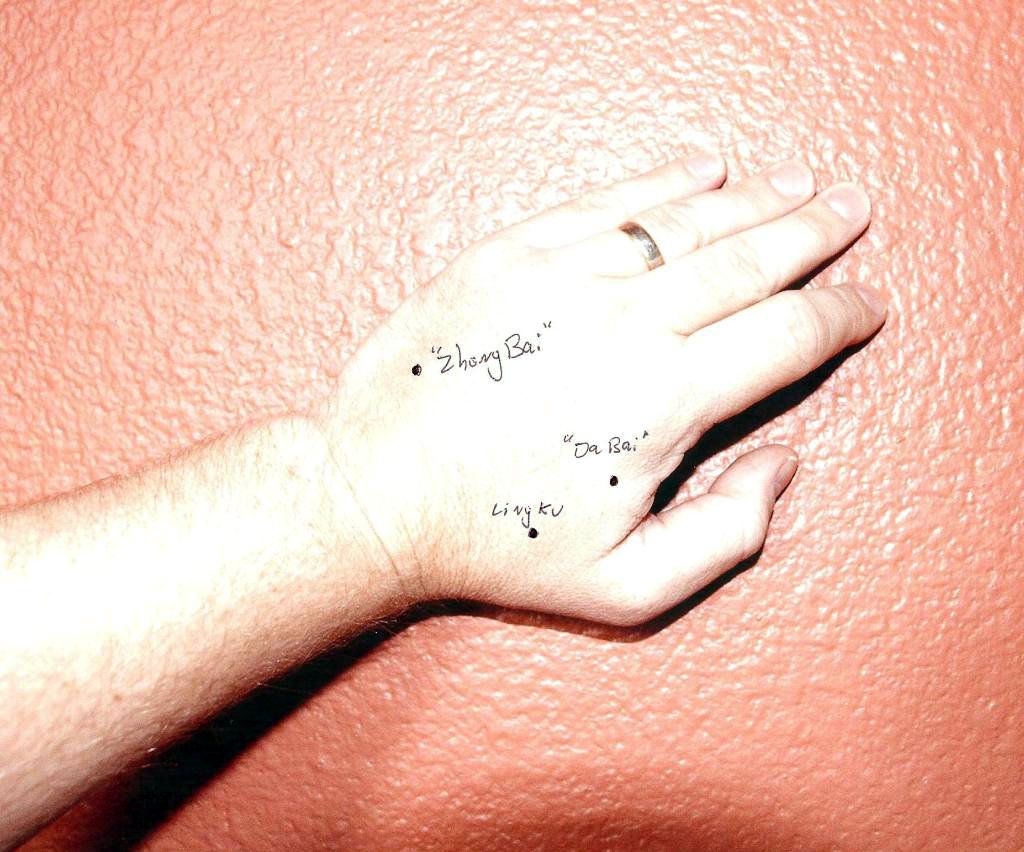
Another effective approach in treating low back pain is utilizing the 3 “million dollar points” for back pain on the hands. “Ling Ku, Da Bai and Zhong Bai”, when used together can be all one needs for instant improvement in cases of back pain. I have literally seen patients who come into the office bent over in pain and holding onto furniture and walls to keep from falling over, walk out of the office 80% better after using just these three acupuncture points on the back of the hand for a half hour. The locations are easy to find, but again, I encourage you to look at the picture online should there be any confusion as to their location. I recommend applying these points on both hands.
1. “Ling Ku”; Located on the hand in the depression just distal to the junction of the first and second metacarpal bones. If you feel the meaty webbing which is between your thumb and index finger, you’ll simply feel for the spot where the two metacarpal bones meet. This spot alone is commonly used for sciatic pain, back pain, headaches or just pain throughout the body. It is a very commonly used point in most acupuncture practices. Insert the needle 1/3 to ½ inch.
2. “Da Bai”; is located close by. It is located just a bit more distally (towards the finger tip) of ling ku, in the depression just before the head of the second metacarpal bone which is the index fingers knuckle. Insert the needle ¼ inch or so.
3. “Zhong Bai”; is located in the depression on the back of the hand just distal to the fourth and fifth metacarpal joints. So if you feel for the short trench on the back of the hand between the bones of the pinky and ring finger, slide up to where the longer bones meet. The needle goes into the fleshy soft spot about a half inch deep but not completely through.
Below is a link to an image showing these acupuncture point locations.
http://i1150.photobucket.com/albums/o616/098123acupuncture/LingKuDaiBaiZhongBai001_zps447283a8.jpg
You can either do a “back treatment” or a “front treatment” since it’s hard to hit all the points mentioned simultaneously. If your treatment is just the three hand points and the ankle points, you can have the patient sit in a chair or lay on their back. I know it’s hard to believe, but you really do NOT have to do acupuncture in the local area to get great results. Once all the needles are in place, the patient should be allowed some quiet time for about a half hour before taking the needles out. Since the needles are now considered “bio-hazardous waste”, be sure to dispose of them properly. While state regulations vary, in my state here, sharps can be disposed of into municipal garbage as long as they are disposed of in a hard sided container such as an empty laundry detergent jug. If you have questions about your state regs, just ask a diabetic who takes insulin. They will be able to tell you what they do with their used needle sharps containers once they are full.
Good Luck
With acupuncture being so affordable (free) and easy to use, gaining a basic understanding of its use could be quite valuable in a post SHTF world either for yourself or as a tradable service. I hope this is the first of many articles showing how easy acupuncture can be to learn and apply for very common medical conditions. What you take away from this article could potentially be a lifesaver for someone otherwise debilitated with pain.
A Few Reminders to Keep In Mind When Providing Acupuncture;
- Acupuncture shouldn’t hurt. If it does, you may have landed on one of the billion thread-thin nerve ending or an artery, so simply remove the needle and replace it 1/10th of an inch away.
- Sterility of the needles is priority number one. Most practitioners will disinfect the puncture site before insertion of the needles with 70% alcohol.
- Once the needles are in place, you can either leave them be or feel free to “wiggle and jiggle and thrust up and down” until the patient experiences a mild sensation in that area. For some this “arrival of the qi” feels like pressure (either bearing down or pushing up), a warmth or mild tingling, etc. Some practitioners disagree over how important or not getting this sensation is for patients. Some argue that this “DeQi” sensation confirms that the needles will be effective. Other acupuncturists will argue that too much stimulation is counterproductive. To be honest; even after 10+ years and seeing thousands of patients, I still can’t make a determination on this. I typically do NOT try to produce this “DeQi” sensation in patients unless they are elderly or the acupuncture is not producing quick enough results after several sessions. Try to find the answer on your own with experience.
- Leave the needles in place for ½ hour to 45 minutes while the patient rests quietly. Chatting and “visiting” decreases effectiveness. Just relax for God’s sake.
- The first session is the least effective. Just like taking that first antibiotic pill. Subsequent sessions build off of the prior sessions.
- Acupuncture typically does not give instantaneous relief. For some patients, it does, but they are the exception. It usually takes hours for patients to begin to see improvement. It seems to take about three days for the full effect of a single treatment to kick in. Because of that, doing acupuncture every day or every other day is ideal. Three times a day is possible in the most extreme situations.
- Acupuncture is a medical therapy. Don’t expect Hollywood miracles. A single session is almost never enough. Like going to the gym or doing a course of antibiotics, the effects are accumulative over the course of treatment. It is not uncommon to treat a chronic pain patient 12 sessions.
- Remember; approximately 15% of people will not respond to acupuncture no matter what the practitioner does. In my practice, I encourage new patients to do at least three sessions to get an idea of how well they may respond. What I have found is that if they show no signs of improvement after 3 sessions, they fall into that category. On the other hand; 15% of people respond remarkably well to this form of therapy. These are the ones you hear about who get a single session of acupuncture and the bad back they had for 10 years goes away instantly. Since acupuncture is free, if a patient doesn’t see results after 3 sessions, you can still encourage them to do 3 more. They may be just a “late bloomer”.
- Have the patient also look for secondary areas of improvement. Since acupuncture is improving function and circulation throughout the body, most patients see improvement is other areas of health. A patient may come in for rotator cuff pain but report that they also saw a marked improvement in sleep, digestion, allergies or other ailment.
- The exact biological explanation of how acupuncture works is still out, but it may simply be explained that acupuncture kick-starts the healing response and triggers various natural chemical responses from within the body. It triggers the body to produce natural pain relievers, endorphins, muscle relaxants and anti-inflamatories, among other chemicals and hormones.
Rose R. owns and operates a Midwestern acupuncture clinic currently treating 20 patients each day. Rose has operated this sole proprietorship for 14 years.
JWR Adds: Be forewarned that you should not experiment with do-it-yourself acupuncture without proper training. Train only under a fully-qualified practitioner. Even with sub-millimeter diameter needles, things can go wrong if you are clumsy or if you don’t pay attention to hygiene–including subdermal bleeds, nerve damage, inadvertent tattooing, or inadvertent infections.