
“When liberal democracies collapse, someone comes along who promises to make the trains run on time if we load the right people into them.” – Tamara Keel, Editor of the View From The Porch blog
- Ad Survival RealtyFind your secure and sustainable home. The leading marketplace for rural, remote, and off-grid properties worldwide. Affordable ads. No commissions are charged!
- Ad Elk Creek Company - Federally-Exempt No-Paperwork GunsPre-1899 Antique Cartridge Guns -- No FFL Required. Can be mailed to your doorstep with no Federal paperwork!
Notes for Sunday – June 07, 2015
On June 7th, 1776, Richard Henry Lee of Virginia proposed to the Continental Congress a resolution calling for a Declaration of Independence.
- Ad Click Here --> Civil Defense ManualNOW BACK IN STOCK How to protect, you, your family, friends and neighborhood in coming times of civil unrest… and much more!
- Ad California Legal Rifles & Pistols!WBT makes all popular rifles compliant for your restrictive state. Choose from a wide range of top brands made compliant for your state.
Street Combat – This Ain’t No Game! – Part 9 of 9, by Pat Cascio
Chapter Seven
Threats in the Future…Today?
Some so-called “experts” believe that future threats to our safety and well-being will come from our children. In a manner of speaking, they are correct in their assumptions. However, you need only watch the evening news to see that the future has already arrived. Read on.
Los Angeles, California District Attorney, Gil Garcetti, probably best summed it up when he said, “My God, this could happen to me . . . What is going on here?” Garcetti was in a news conference describing what was being called the “Wrong Way Shooting” of an innocent, little, three year old girl whose uncle turned onto a gang-infested street in Los Angeles. The precious little girl was killed by indiscriminate (gang) gunfire.
The Wave of the Future?
Gang violence is perhaps what the future holds, according to a number of recognized authorities in the field of criminal study, sociology, and psychology. Patrick F. Fagan, a Fitzgerald Fellow with the think-tank Heritage Foundation in Washington D.C., has an insightful and thought-provoking thesis on the subject of violent crime. In his thesis, Fagan stated, “Though overall crime rates have dropped slightly (emphasis added) in America in recent years, the frightening news is that both the level and viciousness of teenage crime have been rising steadily.”
On October 1, 1997, CBS news anchor, Dan Rather, reported Department of Justice figures showing that adults committing murders has dropped by 27 percent. On the surface, this appears to be good news. However, in this same news report, Rather reported that murders committed by teens has risen 141 percent! How does this bode with Fagan’s statement about an overall drop in crime rates? You be the judge!
Professor James Fox, a North Eastern University Criminologist stated, “Thirty-nine million children, 11 years old and over don’t have full-time adult supervision between the hours of 3:00pm and dinner time.” Fox further said that this is a “recipe for a coming crime wave. By the year 2005 a blood bath of teen violence will occur.” I’ve got news for Fox, it is already happening! Fox’s solution to the problem has been to “spend more money on (social) programs.” This is clearly the view that most Liberals hold as a solution to all our problems; they say that it is necessary to spend more money! This approach hasn’t worked yet.
Adam Wolinski, a noted criminal justice “expert”, expressed his solution when he said, “We literally need 500,000 cops on the streets at a cost of 30 billion dollars.”
Neither Fox nor Wolinski have confronted the real root cause of violent crime in America. Rather, Patrick Fagan believes that the cause is “the breakdown of the family.” Statistics and history back-up Fagan’s thoughts on this all-important subject.
While many so-called “experts” in law enforcement tend to point toward poverty or racial make-up as the primary cause of teen violent crime, Fagan pointed toward failed government programs that actually encourage the break-up of the family.
Washington, DC’s Answer
The 1994 Violent Crime Control and Law Enforcement Act, which was nothing more than cleverly disguised gun control and social spending by the Clinton Administration, is just the latest example of an experiment doomed for failure. It provided for billions of dollars in new spending, and it also added at least 15 new social (or should that be “socialist”) programs, on top of the already overburdened welfare system, which has cost taxpayers over five trillion dollars since the ill-conceived War on Poverty that President Lyndon Johnson declared.
Fagan cited that “since 1965, welfare spending has increased 800 percent in real terms, while the number of major felonies per capita is roughly three times the rate prior to 1960.” Fagan continued, “Official Washington also believes that race is the second most important cause of crime.” Fagan disagrees! “However, a closer look at the data shows that the real variable is not race, but family structure and all that it implies in terms of commitment and love between adults and children. A major 1988 study of 11,000 individuals found that the percentage of single-parent households with children between the ages of 12 and 20 is significantly associated with rates of violent crime and burglary.” Taking this study at face value, it would appear that illegitimacy, not race, is the key factor in teenage violent crime.
It would indeed appear that the future holds a bleak picture for all Americans. Within the next twelve to twenty years the American illegitimacy rate is predicted to reach 50 percent.
Homicides Increase
The homicide rates of major cities have steadily increased according to Fagan. “Between 1989 and 1990, for example, the homicide rate for Boston, MA increased by over 40 percent; Denver, CO rose by 29 percent; Chicago, IL, Dallas, TX, and New Orleans, LA by more than 20 percent; Los Angeles, CA by 16 percent; New York, NY by 11 percent.” This is certainly street combat by any definition. Anyone who believes they are safer on the streets today than they were 25 years ago is sadly (and dead) wrong!
If indeed, as some “experts” claim, violent crime is a result of poverty and/or race, then why, during the Great Depression of the 1920’s, did the crime rate drop when many individuals and families were at their lowest rung on the financial ladder? Why then, during the recession of 1982, was there a dip in crime and not an increase?
Senator Phil Gramm of Texas rightly observed, “If social spending stopped crime, America would be the safest country in the world.” It is not!
The current Federal budget battle that is currently (and always) taking place in Washington, DC focuses (once again) on social(ist) spending. The Administration is determined to increase social spending rather than decrease it! Social spending buys votes! Sadly, it also buys a future of violent crime among our teens.
As Dan Rather stated, “Crime does not (emphasis added) come out of nowhere.” This was a surprising (and true) statement coming from the left-wing controlled press.
In past decades, the murder rate for young black males tripled, and it doubled for young white males. Why is it that the latest government statistics insist that violent crime is down overall? Could it be that certain crimes have been “reclassified” by the F.B.I. and the Department of Justice, and thus, are no longer classified as “violent”? Or perhaps, we’re being sold a false bill of goods, and the federal statistics are being “doctored”? You be the judge.
The Christian Broadcasting Network’s The 700 Club aired a news story that may have dispelled the myth that race and poverty are factors in teenage violent crime. Reporter Randall Brooks investigated the school system in Fairfax, VA, which has one of the highest (if not the highest) per capita income in the nation. At that time, Fairfax schools were the 11th largest in the nation, yet they were facing a steady rise in violent crime in the public schools and on the streets. Violent crime by teens was up 61 percent since 1991. Juveniles with guns in public schools was reported to be up 118 percent since 1989, and drug arrests of teens was up 208 percent. Clearly, high or increased income (or wealth) was not a factor in reducing teen violence.
CBS News correspondent, Bill Whitaker, reported that during the first three quarters of 1995 there were over 400 gang-related deaths in Los Angeles alone. This figure doesn’t take into account murders as a result of armed robberies, rapes, or other violent deaths, either. This figure only takes into account “gang-related” deaths where gang members killed gang members. How many gang members killed innocent civilians? The Los Angeles Police Department reported that more than 40 years ago, there were approximately 125 street gangs with a total membership of 25,000. Just about two decades later, Los Angeles boasted over 1,000 street gangs with a membership in excess of 150,000 members!
During all this time, social spending and social programs increased. During President Clinton’s administration, he funded (with your tax dollars) “midnight” basketball games, which promoted illegitimacy and did nothing to reduce violent crime with all his increased spending. Since then, other social programs were attempted.
Ben Kinchlow, the author’s friend and the former co-host of The 700 Club, cited a perfect example of what we’re talking about. On the program, Kinchlow presented a rich “uncle” who told all his male nephews to go out and sleep with as many young girls as they like. He said it was also okay for these young girls to get pregnant and have babies. This rich uncle said it’s all okay, don’t worry about it. The rich uncle says he will support the girls and their illegitimate children, as long as the nephews don’t marry them. The rich “uncle” in this case is “Uncle Sam”, and this is “his” policy.
By promoting illegitimacy and rewarding the participants, “Uncle Sam” is in fact promoting violent crime among our youth. This is yet another failed government “experiment,” and it’s not only a waste of tax payer dollars, but it also leads to the deaths of many honest, law-abiding tax payers.
Ora Watson is the Executive Principal of Town View Center, a public school in Dallas, Texas. This school is manned with closed circuit cameras and armed security guards. Watson stated during an interview on CNN, “We live in a ‘social’ environment where, unfortunately, security measures are necessary that were not necessary 25 years ago.” Truer words were never spoken. The failed social programs that were started by the liberal Democrats and supported by sympathetic Republicans have resulted in unprecedented security measures in our schools, homes, and on the street.
These so-called “security measures” promote the violation of our Constitutional rights, as outlined in the first, second, and fourth Amendments to the Constitution of the United States of America.
Increased social spending and the continuance of the welfare system, as it stands today, will only provide us with more violent (and deadly) crimes upon innocent Americans by our children. Indeed, the “threats of the future are here – today!”
Just remember the title of this book as you leave your home today, or next time you see a group of “children” approaching you.
Remember, this is Street Combat – This Ain’t No Game!
- Ad STRATEGIC RELOCATION REALTYFOR SALE: Self-sustaining Rural Property situated meticulously in serene locales distant from densely populated sanctuary cities. Remember…HISTORY Favors the PREPARED!
- Ad USA Berkey Water Filters - Start Drinking Purified Water Today!#1 Trusted Gravity Water Purification System! Start Drinking Purified Water now with a Berkey water filtration system. Find systems, replacement filters, parts and more here.
Letter Re: Becoming A Warrior At Gunsite Academy, by J.H.
Hugh,
There is no way a civilian can develop the proper mindset, skills, and base of knowledge required to be considered a “warrior” by attending a class for a weekend or even a week. Please do not misunderstand what I am trying to say. Classes like this can be beneficial to an individual as long as they do not leave the false impression that a warrior has been created. This false belief can lead someone to get hurt if they respond with inflated confidence during an actual life-threatening situation. There is no way to become a warrior, unless you make it your profession. The amount of training required for an action to become “muscle memory” is immense. J.H. did mention situational awareness (SA). The best high threat engagement a civilian can have is the one he or she avoids. Proper SA can save someone from having to draw a gun while unfamiliar adrenaline courses through their arteries and the targets are shooting back. If an encounter is unavoidable, then SA can place an individual in the best possible tactical position to win the engagement. The difference is that warriors have signed up to go into harm’s way for other people’s benefit, not their own. We did not accidentally bump into a bad man one night; we purposely pursue him in the darkness. We do bad things to bad people.
The military knows how to train their warriors, though funding may get in the way of bringing that know-how to the average line unit Joe. Mastering a skill takes constant repetition, reviewing the basics, and training these skills in an arena that can induce adrenaline. I have seen soldiers, who can smoothly draw a pistol and shoot paper accurately all day on the flat range, lose their minds while conducting force on force Simunitions(TM) training that promises to hurt and leave bruises, if not break the skin. I have seen competent soldiers lose their bearing in combat because none of their training prepared them for the real deal. True warriors are born with a mindset that is refined through training. It is misleading to sell someone the notion they are a warrior by attending a class. Being a warrior is a lifestyle.
HJL Responds: I believe that the definitions that we are using may not be the same. What you define as a “Warrior”, I would have defined as a “High Speed Operator”. I would have defined a “Warrior” as simply someone who is willing to escalate a conflict to violence, if necessary, to ensure that the object of their affection is afforded protection. Because we live in a culture defined by movies, we often believe that we have this capability. The reality is that few people do. J.H. was willing to take the first steps to begin to train his body and mind to accept what is necessary to become that warrior. Whether it is unarmed martial arts, weapons handling, computer hacking, or offensive/defensive driving, you have to start somewhere. Every person that I know who has taken that first class has come away with a drastically different outlook on the escalation of violence.
With deadly martial arts, the initial contact is the most dangerous to an individual. The more violent contact you survive, the higher the likelihood of your continued survival, simply because you learn to adapt, respond, and anticipate. The whole point of classes like Gunsite or any other martial art is to create an environment where that initial violent contact can be made under controlled conditions and your survival can be guaranteed, while you learn to adapt. While a man willing to protect his home and village is not necessarily a high speed operator (mostly because he has not had the thousands of hours of training required to attain that skill level), he is still a warrior just because of his willingness to place others above himself and escalate the situation to the level of violence required to guarantee the outcome. He is a mighty man of valor.
“And there came an angel of the Lord, and sat under an oak which was in Ophrah, that pertained unto Joash the Abi-ezrite: and his son Gideon threshed wheat by the winepress, to hide it from the Midianites. And the angel of the Lord appeared unto him, and said unto him, The Lord is with thee, thou mighty man of valour.” Judges 6:11-12 (KJV)
- Ad SurvivalRealty.com: Sell Your Remote LandAdvertise your hard-to-sell remote land to eager buters. We specialize in rural, remote, and off-grid properties worldwide. Affordable ads. No commissions are charged!
- Ad Survival RealtyFind your secure and sustainable home. The leading marketplace for rural, remote, and off-grid properties worldwide. Affordable ads. No commissions are charged!
Economics and Investing:
Is The Price Of Gold Really Headed Above $19,000?
o o o
IMF has betrayed its mission in Greece, captive to EMU creditors. – JBG
o o o
Why The Fed Can’t Raise Rates. – J.B.
o o o
Canadian Silver Maple Leaf Sales Hit New Record Q1 2015
o o o
Items from Mr. Econocobas:
Investors Start To Panic As A Global Bond Market Crash Begins – Whether the trend continues and gets out of control or for the time being things turn around, I am not sure, but this is something to follow.
- Ad USA Berkey Water Filters - Start Drinking Purified Water Today!#1 Trusted Gravity Water Purification System! Start Drinking Purified Water now with a Berkey water filtration system. Find systems, replacement filters, parts and more here.
- Ad Elk Creek Company - Percussion Blackpowder Guns - No FFL Required.Elk Creek Company - Percussion Blackpowder Guns - Pre-1899 Guns - Knives - Bayonets - Magazines - The last bastion of privacy!
Odds ‘n Sods:
The Fat Lady Hums A Few Notes. – B.B.
o o o
Parents call on school’s chief to resign after Smitten Kitten field trip. – H.L.
o o o
o o o
Urban Warfare Exercise Starts Without a Warning. – J.R.
o o o
Entire police dept. disbanded after councilwoman and her son were arrested. – JBG
- Ad Prepare for chaos with the essential SIEGE belt. Perfected for CCW with flexible, no-stretch, high-grip custom HD ballistic nylon and capabilities unmatched in any other belt. Go anywhere. Solid 5.5-7 oz of persuasion has saved many. Save $20!SIEGE STOVES: in a fuel crisis twigs are free and abundant. Ultra-compact high-performance portable survival stoves. Enter "SBLOG" at checkout for $20 off any belt. USA-made.
Hugh’s Quote of the Day:
“And one of them, when he saw that he was healed, turned back, and with a loud voice glorified God, and fell down on his face at his feet, giving him thanks: and he was a Samaritan.” Luke 17:15-16 (KJV)
Notes for Saturday – June 06, 2015
Camping Survival is moving to Sanford, North Carolina (near Raleigh) soon and has a few open positions. If you are interested in any of the positions, please send a resume per the instructions. You may also want to check out their moving clearance section. Also, June 7th-13th they are having a Mountain House sale with 25% off of #10 cans and 15% off of pouches and buckets. It’s always better to sell it than move it, so be sure to check it out.
o o o
Today, we present another entry for Round 59 of the SurvivalBlog non-fiction writing contest. The $12,000+ worth of prizes for this round include:
First Prize:
- A Gunsite Academy Three Day Course Certificate, good for any one, two, or three course (a $1,195 value),
- A course certificate from onPoint Tactical. This certificate will be for the prize winner’s choice of three-day civilian courses. (Excluding those restricted for military or government teams.) Three day onPoint courses normally cost $795,
- DRD Tactical is providing a 5.56 NATO QD Billet upper with a hammer forged, chromlined barrel and a hard case to go with your own AR lower. It will allow any standard AR type rifle to have quick change barrel, which can be assembled in less than one minute without the use of any tools, and a compact carry capability in a hard case or 3-day pack (an $1,100 value),
- Gun Mag Warehouse is providing 20 Magpul pmags 30rd Magazines (a value of $300) and a Gun Mag Warehouse T-Shirt. (An equivalent prize will be awarded for residents in states with magazine restrictions.),
- Two cases of Mountain House freeze dried assorted entrees in #10 cans, courtesy of Ready Made Resources (a $350 value),
- A pre-selected assortment of military surplus gear from CJL Enterprize (a $300 value),
- A Model 120 Series Solar Generator provided by Quantum Harvest LLC (a $340 value),
- A $300 gift certificate from Freeze Dry Guy,
- A $250 gift certificate from Sunflower Ammo,
- KellyKettleUSA.com is donating both an AquaBrick water filtration kit and a Stainless Medium Scout Kelly Kettle Complete Kit with a combined retail value of $304,
- TexasgiBrass.com is providing a $300 gift certificate, and
- Two cases of meals, Ready to Eat (MREs), courtesy of CampingSurvival.com (a $180 value).
Second Prize:
- A Glock form factor SIRT laser training pistol and a SIRT AR-15/M4 Laser Training Bolt, courtesy of Next Level Training, which have a combined retail value of $589,
- A FloJak EarthStraw “Code Red” 100-foot well pump system (a $500 value), courtesy of FloJak.com,
- Acorn Supplies is donating a Deluxe Food Storage Survival Kit with a retail value of $350,
- The Ark Institute is donating a non-GMO, non-hybrid vegetable seed package–enough for two families of four, seed storage materials, a CD-ROM of Geri Guidetti’s book “Build Your Ark! How to Prepare for Self Reliance in Uncertain Times”, and two bottles of Potassium Iodate– a $325 retail value,
- A $250 gift card from Emergency Essentials,
- Twenty Five books, of the winners choice, of any books published by PrepperPress.com (a $270 value),
- TexasgiBrass.com is providing a $150 gift certificate, and
- RepackBox is providing a $300 gift certificate to their site.
Third Prize:
- A Royal Berkey water filter, courtesy of Directive 21 (a $275 value),
- A large handmade clothes drying rack, a washboard, and a Homesteading for Beginners DVD, all courtesy of The Homestead Store, with a combined value of $206,
- *Expanded sets of both washable feminine pads and liners, donated by Naturally Cozy (a $185 retail value),
- Two Super Survival Pack seed collections, a $150 value, courtesy of Seed for Security,
- Mayflower Trading is donating a $200 gift certificate for homesteading appliances,
- APEX Gun Parts is donating a $250 purchase credit,
- Montie Gear is donating a Y-Shot Slingshot and a Locking Rifle Rack (a $379 value), and
- Two 1,000-foot spools of full mil-spec U.S.-made 750 paracord (in-stock colors only) from www.TOUGHGRID.com (a $240 value).
Round 59 ends on July 31st, so get busy writing and e-mail us your entry. Remember that there is a 1,500-word minimum, and that articles on practical “how to” skills for survival have an advantage in the judging.
Conditions for Combining Survival Groups Under Extraordinary Circumstances – Part 1, by G.R.
The following is a response addressing concerns of those to whom a proposed “Plan B” bug-out scheme had been provided by a larger, existing group to multiple smaller groups. This larger group had extended an invitation to smaller groups that are lacking the financial and over-all resources of that larger group. This is a series of responses that have been/were made to the chief “officers” of the smaller groups. The basic proposal is for a 60-day, temporary sheltering at a safe location with provision capabilities for a larger group of individuals and families beyond the recognized community/core member group. This is provided so that if your group is looking at a similar situation, you can use it as a basis to get started.
The word “exigent” is defined in criminal law as “an emergency situation requiring swift action to prevent imminent danger to life or serious damage to property.” There is no ready litmus test for determining whether such circumstances exist, and in each case the extraordinary situation must be measured based upon the facts known by officials. The circumstances are those that would cause a reasonable person to believe that entry (or other relevant prompt action) was necessary to prevent physical harm to persons. I’ve used the term “exigent” for a good reason. It is taken a bit out of the normal legal context, but it is very appropriate for what we are considering and has been proposed. We are talking about extraordinary circumstances. We are talking about preventing loss of life to those we think we might be able to save (and will do their best to aid, not detract or weaken, those who they seek assistance from).
Questions and Answers to Leaders of Various Exigent Groups
Let’s get all concerns, or as much as possible, out of the way right here right now. It goes hand-in-hand with the organizational needs of any and all groups. As the tentative leader of your group, it will be to you that your group’s individuals will (and must) direct their questions. It’s not me nor anyone who is a member of the community group in the bylaw papers who they will seek. It is the only way any such operation can or will work properly.
- On simple matters, “…for things like…, will we have a vote, a say in how things are done there? No. You will be responsible for yourselves and follow the rules that are in place. This is the correct answer. How one governs himself and their family, or those they are in turn responsible for is what is of paramount importance.
- “What if the crisis lasts longer than 60 days?…” It most likely will. The correct answer is that the community I’d dare say will know that is the case and will decide what to do based on resources utilized over the past two months that have gone by; in general, we’ll look at how things have evolved to that point in time. Again, if those who are temporary, “exigent” members will recall, it is and will be that they must prove themselves to the community. It’s not the other way around. If they do so, things will work out fine then.
- “If you bring us in for 60 days with 60 days worth of food, and then after the 60 days you want us to stay, what about food?” First, it’s dependent upon the numbers involved, as all provisions always have a limit. No matter how many or for how long, nothing is limitless; everything will require resupply and re-provisioning by the group and all individuals. Second, the community does have a large quantity of what could be called “emergency” rations. This includes mostly rice, beans, and similar items. Everyone will have to be a part in the process of securing food, one way or the other, through foraging, scavenging, rationing, or something else. If it was a brutal enough world “out there” hungry people lose their preconceived concepts of right and wrong. Furthermore, the 60 day time marker is a good one. No assumption should be made that any request for a prolonged stay will be forthcoming. I must reiterate that it is not the community that must alter to fit anyone’s needs, it is the individual(s) that must. All individuals are responsible to earn their keep. No exceptions. No special privileges.
I’ll mention “ifs” later, but you neglected the biggest “if” in your question; it’s the part about “if you want us to stay…” That is a big ‘if’, all right. Remember the word “exigent” and the circumstances surrounding this proposal– extraordinary circumstances.
All people need to think of their futures. At 60 days, hopefully all will have some idea of what is to be done next. Your eventual goal is to have your own home, or to return to salvage, rebuild, and restore what was once yours. None of us believe in communism. None of us wish for some hippie-style communal living for our futures– at least none I know of in the community. Are we not all free Americans, able to think for ourselves, be, live, do for ourselves? I often reflect that this entire prepping process has seen the strangest of mergers of the oldschool flower-power days with a military adjunct. It isn’t. We’re trying to retain what was built upon– our rights, lives, liberties, and the pursuit of happiness. None of us embody or consider any other ideas of those four things as some universal constraints to be applied to all other Americans. However, we certainly allow for others to seek their own meanings to these.
- “How much space for living quarters will we have?” That is the purpose of the roster and information sheet. We won’t know until the number of influx is counted and ascertained. The more people, the less room. It’s basic geometric simplicity at its finest.
- “Suppose we run out of… (fill in the blank)?” If you’re talking about water, you won’t. If you’re referring to food, there are emergency supplies that would last a while. One job that will be needed to be done is re-procurement and replacement of what is used up.
- “I have a special need (fill in the condition)… and will need preferential treatment… (of some kind)”. The simple answer is that you will then have to supply any special need for yourself or for the individual that requires it. There simply will no longer be a welfare state.
Just remember, beyond a safe location, water, some basic triage medical facilities, a defense network, and a lot of jobs that will need to be filled and done, everyone will work without exception– no one is exempt, and everyone will have a task and be expected to do it (multiple tasks) to the very best of their ability.
The democratic process does not exist on private property. I use the example that if I visit a home and am invited into the living room and then find that I need to use the head/john, I ask, “May I use the facilities?” If granted a “yes”, I then ask, “Where is it located?” Upon receiving that answer and permission, it means only that I may use the plumbing. It does not mean that I may wander around the house opening cabinets and drawers in any room I may pass or see. That same rule applies to the community site. The case where I might be denied use of the head/john means what? It means that I must leave and seek relief elsewhere. Otherwise, I may hold it and stay put, as uncomfortable as I might be. My proposal needs to be understood as it is intended and not as it is assumed to be, hoped to be, or even perhaps as anyone thinks it should be. It must be taken just as it is. It’s fairly simple, and though I personally hate the word “fair” because I do not believe there exists such a phenomena as “fair” upon this earth in this life, I do feel it could actually be just that– fair. It is an offer, a proposal, simple, direct, and up to the persons being offered what they will make of it.
- What if I was asked to do something that conflicted with my moral convictions before God. Are there provisions for a consciousness objection?
Sure. You would leave. You’d take what you brought with you and simply depart, and you would not be allowed to return. You’d be asked to be silent, considered maybe not an enemy but never again a part of the group in terms of any demand or assistance you may require down the road.
“Congress shall make no law respecting an establishment of religion, or prohibiting the free exercise thereof…” , nor will the group. Regarding the freedom of speech, we as people do need to talk and to exercise the ability to speak, or so it seems. However, this situation would not be a democracy. Once again, I must repeat what I’ve said; there is and would be a strict chain of command. A private or a recruit does not address or demand an audience with an officer in the military…ever. Speech amongst yourselves is fine, but to the community it’s only to your immediate person responsible for you…only. Read the amendments.
We are of four parts– physical, emotional, mental, and spiritual. All must act in concert. All must grow and become together, equally, as we are those.
- What would we live in and shower in (i.e. tent, camper, etc)?
You tell me. You will be allotted a space. You can park a camper, pitch a tent, or live in a car or truck or van. That is your responsibility. As long as you can be able to leave within a 30-minute time span. That time limit is not chosen randomly. It is for multiple reasons. That’s the best possible guess as to a maximum amount of time it would require for all to bug-out of the area if push came to shove. Never forget that nowhere is completely safe in a world like we’d be living in, if it had already necessitated such a mass of people seeking security as they had and were there at the community site at the time. In addition, permanence is not a “given” for anyone who is “exigent”. No tolerance of wrong-doing would be shown. Thirty minutes is all it should take to prepare a bug out to get to the site, and it’s all it should take to leave it.
Showers would be communal at a central facility, unless your vehicle provides its own facility and the means to keep it running/filled. Water rationing is a must. Always remember that. Life would have changed or you would not be out there. There is no long leisurely bathing to be expected or provided for. Hark back a hundred years, say to pre-WWII days. People did not bathe daily, and when they did, often they bathed as a family. In short, you will stink at times. You learn to live with it.
- What about sewer treatment with such an influx of people?
There is an existing septic system, recently improved, but like any system, it can’t exist without maintenance. Any system’s operation is dependent for proper operation on the simple fact of how many are utilizing it. Gone are the days of flushing the toilet and “that’s that”; there is no more thought given. If you are there at the community site, you most likely will have as one of many chores the constant digging of the latrine ditch-works or similar facilities at some point. Think militarily. Finally, septic hygiene is an excellent question all in all. It is something that must be fully understood by all and thought of. No tolerance of relieving oneself wherever the urge pressed you to go would or could be safely allowed, especially with more people. Diseases, medieval in nature, would rapidly appear. Cholera, typhus, dysentery and so on are not good ways to die.
- Will there be any climate-controlled facility to store our food in?
Boy, I had to really rein myself in here on answering this one. You need to study up. You can dig a hole to gain some cooling effects. You can shade your provisions, but this is *** (a southern state)*** and it gets hot here, miserably hot and humid. All foodstuffs need to be able to endure the climate or be discarded once it’s gone bad. Read up on dry goods– rice, flour, sugar, beans, dried meat and fish, canned goods, dehydrated or freeze-dried foods, and salt. That last item will be the most crucial. Salt, vinegar, or brine will be the primary preservative for our needs, if such a calamitous event does occur to cause us all to leave our homes and seek shelter at the community. Climate control? One good and viable suggestion is to look up Zeer pots. Those would assist and do a fair job of somewhat of a climate-control mechanism for food, and they are possible. Otherwise, like the question about a shower facility, the answer is for you to bring a fridge along that you can fuel or power on your own, and be sure it doesn’t fall outside of the noise restrictions that may be in place. Then, you’ve got something cool.
- Is a list of medical supplies required from individuals and families?
The listing of medical supplies for exigent members is for your own familial uses, primarily. The community also needs knowledge of what medical– physical and psychological– conditions are present at the site, as a part of the make-up of all persons present. Additionally, medications would make good barter goods. They would also be a good way to contribute to the community, if they are non-essential surplus to your own medical needs. Of course, a good chemist is always being sought by the community.
Letter: The Coming Global Financial Fiasco
Mr. Latimer,
Lately it’s becoming quite clear that the global financial system has passed the point of no return and is essentially doomed. My question now is, when the system begins its meltdown, those who will be able to get their money out before it’s all lost will no doubt be putting that money into hard assets as fast as they can. This of course will cause gold and silver to skyrocket. So here’s the question, should I sell my gold and silver at these fantastically high prices and receive a lot of paper money, which may become worthless due to hyperinflation, or illegal to keep as cash, or risky to put in a bank? Or do I sell half of the silver and gold and try to buy other hard assets while prices still are reasonable?
It is hard to find sound and honest financial advice in these upside-down, whacked out financial times, so I turn to SurvivalBlog, where I know I will get a straight story. – TWT
HJL Responds: In a time of economic upheaval, obtaining equipment, parts, spares, and supplies will most likely be exceedingly difficult, so the basics need to be covered first. If you have PMs but you do not have food, life will get expensive in a hurry because you cannot eat PMs. Traditionally, PMs do not fare very well during the economic upheaval because an established barter market does not generally exist and people have difficulty in shifting their thinking from valuing things in fiat dollars to whatever the market wants. Your comment about selling for “fantastically high prices” is an example of the difficulty in transitioning how we value things and we all have this difficulty. PMs do work very well for holding value through the economic upheaval until the market is somewhat stabilized though. Understand that if the established market is a grey or black market, PMs will generally hold less value if you use them than would a commodity that is in demand at the time. For this reason, the standard advice is to make sure the Beans, Bullets, and Band-aids are taken care of first. Then make sure any tangible assets that could be required are dealt with (tractor, spare parts, tools). Consider debt relief, then start thinking about storing value in PMs for the other side of a crises. Anytime you can deal directly with a commodity that is in demand rather than PMs, your position will improve. Consider fiat money only as required to deal with obligations that have no other way to satisfy them. If you already hold PMs and do not have the basics covered or debt relieved, consider selling the PMs now and taking care of those issues.
If cash becomes illegal, there will be an alternative market that picks up, but your ability to transition from the regulated market to the alternative market will be controlled by your debt to the financial institutions and the taxes collected by whatever government is in place. Obviously, the less stake you have in either of those two institutions, the more freedom you have in your own financial affairs.
Economics and Investing:
o o o
Cash-Strapped Kansas Moves To Limit ATM Withdrawals For Residents On Welfare. – D.S.
o o o
Items from Mr. Econocobas:
Greece Unable To Make €300 Million IMF Payment, Requests “Bundling”
Video- David Stockman Fox TV Interview: The Most Fantastic Bubble In Recorded History
US Added 280,000 Jobs in May; But Jobless Rate Edged Up to 5.5%
Odds ‘n Sods:
A great precedent has been set for our Fourth Amendment Rights: Cop Who Arrested Man for Legally Carrying Gun Gets Sued
o o o
There might be no saving the world’s top banana Another reason why it is critical that people continue to plant non-GMO heirloom seeds of all kinds to add variety to food sources. Having only one viable strain (in this case shippable) risks doing without someday. Corporations, such as Monsanto and others, have moved towards just a FEW GMO varieties and use heavy-handed tactics to “force” farmers, even in third-world countries to use ONLY their seeds and sell Roundup, which is toxic. – H.L.
o o o
An update to an earlier story: Comments disabled/censored at “Letter to stingy American consumers”. I went back to re-read comments between yesterday and tonight; I noticed this articled was disabled from receiving more comments. Also of note is that at least two dozen comments have been removed, which had no offensive profanity, but all the missing comments made reference to some combination of pitchforks, boiled rope or guillotines. – formerly middle class America
o o o
Egg rationing in America has officially begun. – JBG
o o o
o o o
A brief “Must Read” essay, over at the Paratus Famalia blog: To Quiet the Dry Bones of Liberty
Hugh’s Quote of the Day:
“And it came to pass, when the ark set forward, that Moses said, Rise up, Lord, and let thine enemies be scattered; and let them that hate thee flee before thee. And when it rested, he said, Return, O Lord, unto the many thousands of Israel.” Numbers 10:35-36 (KJV)
Notes for Friday – June 05, 2015
Don’t get MAD; Get Prepped! The road warrior bounty sale is still going on at Safecastle with discounts of up to 41% on Mountain House products and lots of added bonuses.
o o o
Today, we present another entry for Round 59 of the SurvivalBlog non-fiction writing contest. The $12,000+ worth of prizes for this round include:
First Prize:
- A Gunsite Academy Three Day Course Certificate, good for any one, two, or three course (a $1,195 value),
- A course certificate from onPoint Tactical. This certificate will be for the prize winner’s choice of three-day civilian courses. (Excluding those restricted for military or government teams.) Three day onPoint courses normally cost $795,
- DRD Tactical is providing a 5.56 NATO QD Billet upper with a hammer forged, chromlined barrel and a hard case to go with your own AR lower. It will allow any standard AR type rifle to have quick change barrel, which can be assembled in less than one minute without the use of any tools, and a compact carry capability in a hard case or 3-day pack (an $1,100 value),
- Gun Mag Warehouse is providing 20 Magpul pmags 30rd Magazines (a value of $300) and a Gun Mag Warehouse T-Shirt. (An equivalent prize will be awarded for residents in states with magazine restrictions.),
- Two cases of Mountain House freeze dried assorted entrees in #10 cans, courtesy of Ready Made Resources (a $350 value),
- A pre-selected assortment of military surplus gear from CJL Enterprize (a $300 value),
- A Model 120 Series Solar Generator provided by Quantum Harvest LLC (a $340 value),
- A $300 gift certificate from Freeze Dry Guy,
- A $250 gift certificate from Sunflower Ammo,
- KellyKettleUSA.com is donating both an AquaBrick water filtration kit and a Stainless Medium Scout Kelly Kettle Complete Kit with a combined retail value of $304,
- TexasgiBrass.com is providing a $300 gift certificate, and
- Two cases of meals, Ready to Eat (MREs), courtesy of CampingSurvival.com (a $180 value).
Second Prize:
- A Glock form factor SIRT laser training pistol and a SIRT AR-15/M4 Laser Training Bolt, courtesy of Next Level Training, which have a combined retail value of $589,
- A FloJak EarthStraw “Code Red” 100-foot well pump system (a $500 value), courtesy of FloJak.com,
- Acorn Supplies is donating a Deluxe Food Storage Survival Kit with a retail value of $350,
- The Ark Institute is donating a non-GMO, non-hybrid vegetable seed package–enough for two families of four, seed storage materials, a CD-ROM of Geri Guidetti’s book “Build Your Ark! How to Prepare for Self Reliance in Uncertain Times”, and two bottles of Potassium Iodate– a $325 retail value,
- A $250 gift card from Emergency Essentials,
- Twenty Five books, of the winners choice, of any books published by PrepperPress.com (a $270 value),
- TexasgiBrass.com is providing a $150 gift certificate, and
- RepackBox is providing a $300 gift certificate to their site.
Third Prize:
- A Royal Berkey water filter, courtesy of Directive 21 (a $275 value),
- A large handmade clothes drying rack, a washboard, and a Homesteading for Beginners DVD, all courtesy of The Homestead Store, with a combined value of $206,
- *Expanded sets of both washable feminine pads and liners, donated by Naturally Cozy (a $185 retail value),
- Two Super Survival Pack seed collections, a $150 value, courtesy of Seed for Security,
- Mayflower Trading is donating a $200 gift certificate for homesteading appliances,
- APEX Gun Parts is donating a $250 purchase credit,
- Montie Gear is donating a Y-Shot Slingshot and a Locking Rifle Rack (a $379 value), and
- Two 1,000-foot spools of full mil-spec U.S.-made 750 paracord (in-stock colors only) from www.TOUGHGRID.com (a $240 value).
Round 59 ends on July 31st, so get busy writing and e-mail us your entry. Remember that there is a 1,500-word minimum, and that articles on practical “how to” skills for survival have an advantage in the judging.
Protecting Both Tube and Transistor HF Communications Equipment From E1 EMP Pulse- Part 2, by PrepperDoc
Transistor / QRP Equipment
The solutions shown so far may not adequately protect computer-based software-defined radios, hybrid transistorized-vacuum tube radios, or fully solid-state QRP or low-power stations, or transistorized shortwave radios. These radios will need to use protection that clamps at a much lower voltage than 700 volts! While transistor transmitters may use power amplifier transistors that may have breakdown voltages in the scores to hundreds of volts, the input circuitry of many QRP transistorized receivers will likely be fried with voltages well under 100 volts. There are a couple of solutions that can offer lower-voltage clamping more appropriate to these lower-power transistorized radios.
Certainly the grounding antenna switch described above, as well as some coax cable somewhere if possible, should be utilized. Shortwave radios with a collapsible antenna should have it at minimum size when not in use. The case of transistor-based equipment should ideally be constructed of metal, for its shielding ability, and ideally grounded, and any wires longer than a couple of inches (e.g., Morse code key, speaker wire, headphone wire) should have protection added. A typical electromagnetic-interference technique of adding a 0.01- 0.1 microfarad ceramic capacitor across those kinds of low-frequency signals wires (to ground/shield) will knock out a lot of the higher frequency components of an EMP E1 surge.
To provide further voltage clamping for those low-signal lines, a metal-oxide-varistor device (“MOV”, as shown in Figure 4) can also be placed across speaker and similar wires. These semiconductor devices do not have a “polarity” and do not conduct until their breakdown voltage is reached. They come in a dizzying array of protection (breakdown) voltages and can protect repetitively unless the onslaught is extremely large. An 18-volt MOV suitable for speakers, headphones, many Morse code keys, and probably digital data lines as well, is available for less than $1.[1] One can select higher or lower voltage ratings as appropriate.
![Figure 4: Metal oxide varistor designed to pass 140VAC (RMS) and to clamp at 198 volts, capable of shunting 6,500 amperes for 20 microseconds (which is much longer than an E1 EMP pulse). These are available in many different breakdown voltage levels, including levels suitable for Morse code keys, speaker, and headphone wires.[1]](https://survivalblog.com/wp-content/uploads/2015/06/img_10051.jpg)
To protect a transistorized receiver, “back-to-back” silicon diodes (see schematic, Figure 5) can be connected at the receiver input between the center conductor and the shield, either connecting inside the feedline connector or added inside the receiver’s enclosure. The reverse breakdown voltage rating is of less importance. One diode conducts and limits the voltage to 0.6 V when the center conductor is driven positive, and the other conducts and limits the voltage to -0.6 V when the center conductor is negative, so the peak-to-peak AC voltage is limited to 1.2 VAC. Because the transmitter may well produce more than this voltage, there has to be some relay or other mechanism to disconnect the receiver from the transmission line during transmitting, so these diodes don’t short out the transmitter output. This type of protection has been used in some commercial and homebrew QRP transceivers to protect the receiver even from the transmitter output. (References [2] and [3] give examples.) A small signal diode, such as a 1N914 or 1N4152, will have a negligible amount of capacitance of a few picofarads and a very fast response but be able to carry a current of a few amperes for a microsecond. At the cost of a bit more parallel capacitance added to the line, a heavier power diode, such as the 1N4004 or 1N4007, can be used for the back to back diodes, with a peak current capability of more than 30 amperes. For most of the high frequency Ham bands, the added capacitance of the heavier power diode will not be noticeable to the receiver. When I tested this on 40 meters, there was absolutely no discernible loss in received signal strength. However, in my heart of hearts, I don’t trust just two diodes to protect a transistor receiver connected to a very long wire antenna from EMP. I would therefore use four diodes– two small-signal diodes like 1N914, and two heavier ones like 1N4004/ 1N4007. Additionally, I would also connect a 60-volt gas discharge surge arrestor (see next section) from the center conductor to ground as “belt and suspenders” protection for my valuable radio! In the case of a transistorized shortwave antenna with a small collapsible antenna, using two back-to-back diodes connected with short wires between the antenna (at its base) and chassis “ground” or “ground” on the internal circuit board (often a very long trace encircling the entire border of the circuit board) would probably add a large amount of protection.
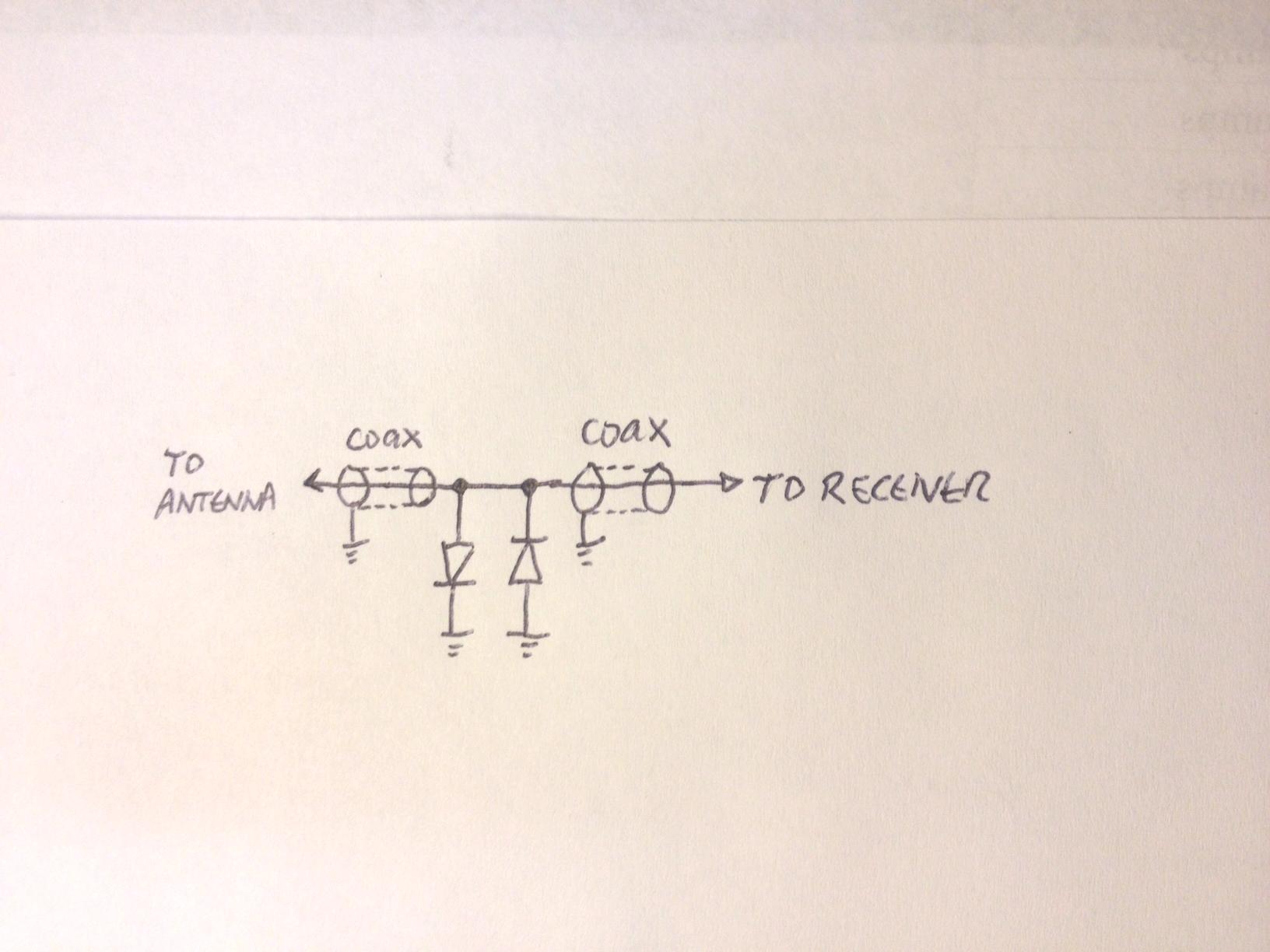
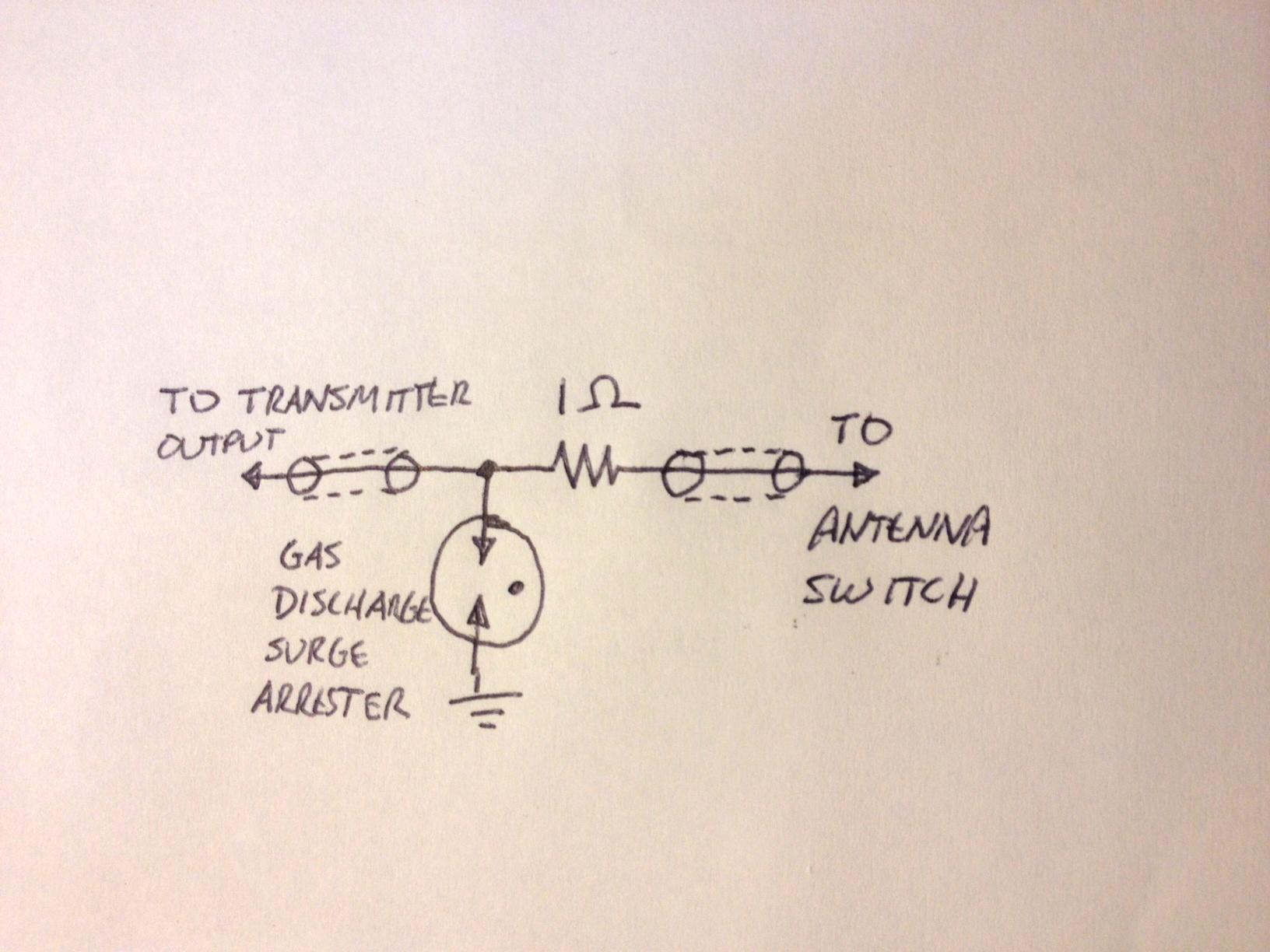
Fully protecting the antenna output of a transistorized QRP transmitter is a bit more difficult, because one must again allow passage of the normal power output voltages generated for commonly-encountered SWR ratios, yet short out voltages just higher than those to protect the transistor amplifier. If for a single instant a power amp transistor or any other within the transmitter is exposed to, say, a voltage greater than its rated Vceo or Vcbo voltage, that transistor is likely to be irreparably damaged. (It might be a good idea to stock up on some spares.) While the punch of lightning is long enough to literally melt/burn conductors and thus leave an indelible mark wherever it coursed, the E1 EMP is gone so quickly that likely only the PN junctions of semiconductors are invisibly but very effectively destroyed. Some transistor designs have relatively little margin of voltage safety. However, it is also possible that the output tuned circuit of the amplifier will screen out some of the frequency spectrum from reaching the vulnerable transistor, also. If we assume an SWR of better than 2:1 and the common 5-watt output, the output voltage is on the order of 31VAC RMS, or under 50 volts peak. One immediately thinks of using a MOV (available in all manner of voltages) to provide protection. The problem with using metal oxide varistors is that they have far larger capacitance (often THOUSANDS of picofarads) than is tolerable in the matching circuits of typical QRP HF transmitters. To get an acceptably lower capacitance requires once again using a gas discharge tube, such as the Bourns Inc. 2020-15T-C2LF. This gas discharge tube has a breakdown at 60volts (the selection of breakdown voltages for gas-discharge is somewhat more limited than for MOVs) and can shunt up to 10 kiloamperes. It is manufactured in a 3-wire version with two surge arrestors connected together. Simply connect the center wire of the pack to the transmitter output and both outer wires to the shield (ground). The capacitance is less than 1 pF; it will not affect your transmitter’s tuning, and the price is less than $3! [4] It may possibly provide adequate protection for the transistorized QRP transmitter. However, this obviously cannot be guaranteed, as we are dealing with enormous instantaneous currents. To give your gas-discharge surge arrester a fighting chance to clamp that voltage sufficiently, I suggest that you add a 1-ohm carbon or carbon-film resistor in series with the center conductor, on the antenna side of your 60-volt gas discharge surge arrestor. (See Figure 6) This can be a common 1/2 watt or 1 watt resistor, just not a wire-wound one. It will not appreciably affect your transmitted power.
CB Radios
These same solutions just described for transistorized QRP transmitters above can be applied to common transistorized CB AM transceivers. Twelve-watt single sideband transceivers with feedline SWR below 2:1 may also work well with this system.
In conclusion, for about the price of a fast food meal and a bit of wiring, one can purchase and install all the protection devices reasonably useful to protect either a QRP transistorized or higher-power vacuum tube Ham radio station, and thus have a reasonable chance of surviving a first or second strike, even while using the equipment. Equipment not in use should be disconnected from antennas; a shorting antenna switch can make this more convenient. Spare equipment should be left completely unconnected, and if economically possible, backup radios stored in a Faraday cage. As a side benefit, one gains some appreciable near-vacinity lightning protection. Power line protection from E2/E3 components of an EMP attack will be discussed in a later writing.
References
[2]An example of a QRP homebrew transceiver using back-to-back diodes to protect the receiver input. See diodes D5 and D6, which protect the receiver.
[3]An example of a commercially-available QRP transceiver using diodes to protect the receiver input. (See D4-D7).