Scot’s Product Review: DeLorme inReach Explorer

The first warning is that this is an electronic device. It probably won’t work after an EMP or Carrington event. It communicates via the Iridium satellite system, which is also used by the government, so it isn’t secure, not that any electronic communications are. It depends on the GPS satellite constellation, which is another government service. The government can, when it feels like it, degrade the accuracy of civilian GPS units or even shut down the service to all but government clients. There are, therefore, drawbacks that you have to be aware of. Regardless, the DeLorme inReach offers some pretty amazing abilities, especially for those who get off the beaten path or who need to communicate or navigate in times of a disaster, short of a countrywide collapse.

There are two inReach units. The one I reviewed, thanks to a loaner from DeLorme, is the inReach Explorer. The other one is the SE. The essential difference between the two units is that the Explorer has navigation capabilities, though it has some limits. Both units allow the user to be tracked over a web page and to send and receive messages through the Iridium satellite network anywhere on the planet.

In my mind, the biggest ability with both is that you can send an SOS message, complete with your location, by flipping off the safety lock and pressing one button. The SOS message goes to GEOS http://www.geosalliance.com/, which could be thought of as an international 911 center located in Houston, Texas. GEOS, which also provides services to other vendors, will contact the emergency dispatch site closest to your location who will then send help. Your SOS message will include your position and who you are, and you can also add information about what exactly is the nature of your problem so you can get an appropriate response.

This service is not for boo boos, however; it is for serious life-threatening matters only. You could face substantial fines or other problems if you use this feature inappropriately. There may also be charges, even for legitimate search and rescue services, and GEOS offers extra cost plans to help cover those. Such charges are unlikely in the U.S., if the call was for a real emergency, although there may be costs for ambulance services and transport to a hospital. GEOS offers medevac plans to get you from the hospital you were deposited in to a hospital of your choice. That could be a huge benefit if you are far from home or in a location with subpar medical care. Information on the plans, costs, and how they work are on the GEOS http://www.geosalliance.com/ website.

Besides the SOS function, you can text message or email whoever you desire. I had to spend some time to get used to messaging with the inReach. The functions were not intuitive to my personal brain, but I persisted with bumbling about until I was able to do it. Part of the problem is that, besides the SOS button and its safety lock, there are only three controls on the unit– an enter button, an escape button, and a four-way rocker switch. The screen is about 1.5×1 inches, which is a bit small for the amount of information it can deliver. You have to scroll around a virtual keyboard with the rocker switch to compose and address messages, though it does start to learn words and addresses and prompt for them, which can help a bit.

There are pre-written messages, like “yes”, “no”, “starting trip”, “delayed”, or “pick me up” among others, which I found very useful. You can add more from the web page that works with your inReach account.

When you send a message, there is a little rotating icon next to it until it completes sending, which is helpful to know. It took me a while to figure that out, which frustrated me since I wanted to be sure the message went out. I didn’t see this information in the rather sparse “get started” manual that came with the unit, when I read it. There is, however, a lot of information on the DeLorme website that I found very helpful. There is also help information available on the device.

When someone replies to an email message, it is important for them to know that they can’t reply directly to the email. They have to go to the link that came with the email and use the messaging function on the web page. The email does warn the recipient, but many people don’t fully digest what they read. (Who, me?) If you want people to retain the ability to message you, be sure to warn them not to delete the email with the link or to at least bookmark the link.

Thankfully, you can reply directly to a text message from your cell phone. Every text message I sent came to my cellphone with the same “reply to” number, so one could add it to their address book for future use. The text message contains a link that will take you to a map showing the sender’s location, if your phone can do that. The map, as with the one that comes with an email, uses the excellent DeLorme topographic maps, as well as offering a simpler version with just the streets or a satellite view. The satellite view showed where I was sitting inside my house, which was somewhat disturbing in some ways. You can also configure it to include your longitude and latitude with a text message.

A key point to remember about messaging is that, unlike your cell phone, it is not instantaneous. To save battery life, the inReach checks at preset intervals. You can, however, change the intervals or force a check whenever you wish. You may still have to wait for a satellite to come into view, however, for the inReach to connect.

The navigation features of the inReach are helpful but rudimentary. The problem is that the maps presented on the inReach have no details. You can create a waypoint to navigate to, but you pretty much have to know its longitude and latitude. It is possible to scroll the map and point to a location, but without map features, that is tough. You can’t just ask it to show you Shellman, Georgia, how to get there, and what’s in between. Entering the information for a waypoint on the inReach itself is tedious and really requires a map with longitude and latitude.

When you subscribe to a plan for the inReach, you get access to a web page that gives you access to the excellent DeLorme topographic maps, upon which you can plan a route and place waypoints. When you connect the inReach to your computer, you can use their Sync application to upload the information to the inReach. This makes it a lot easier to use for navigation.

When you plan a route, you are actually drawing a line across the map, not saying I’m here and want to go there. It isn’t like one of the car GPS units that can follow roads automatically. This has advantages in that you can create off-road treks, but it really isn’t designed for navigating your car. You can do it, but it will take more effort than most car-oriented GPS units.

Once you have placed your waypoints in the inReach, it will show you which way to go to get to them. If you have input a route, it will guide you along it. There is also a compass, so you know which direction is which. This is all extraordinarily useful if you go astray.

You can upload contacts from the web page, which is a lot easier than entering them through the inReach. The inReach will remember any addresses to which you send a message, which does help the next time you message that person.

When you send an email message to someone, it will include your location. You can have the inReach track you at desired intervals and send periodic messages to tell people where you are. If you don’t think Facebook and Twitter are security violations, it can update those too. I didn’t try this feature, as I don’t do social networks. It is possible to set up access for family or friends, so they can ping your inReach to see where you are now, but there may be costs when they do it, depending on your service plan.

There is the usual stuff on the web page to manage your account, and you will need access to it to finalize setting up the inReach, as it requires a lot of emergency contact information should you ever need rescue.

In my view, the inReach really comes to life if you have an Android or Apple device with Bluetooth. You can pretty much run the inReach using DeLorme’s Earthmate app from the mobile device, which is a whole lot easier than using the three buttons on the inReach. Even more powerful are the full-featured maps you can download from DeLorme and display on whatever size screen you can afford and feel like carrying.

The one drawback is that I didn’t find a search function to find addresses on the PC or mobile device maps. To set a destination, you need to locate it on the map and mark it as a waypoint. On the mobile device or inReach, it will draw a straight line from where you are to the waypoint. You can create additional waypoints along the trails or roads you plan to use to force it to route you along your desired path. This gets tedious, though. The web-based, PC version gives you the option to draw the route as precisely as you desire, though it takes time and energy.

Messaging was also far easier with a paired device. You can create additional preset messages that are easily accessible from the app and access contacts in your address book. While it will send and receive messages from the mobile device through the inReach, it will not sync your contacts without an Internet connection.

I had no problems getting it to pair with a 2012 Nexus 7 tablet, and it worked quite well. One oddity to me was seeing that the app required the mobile device to have its own GPS, rather than pulling information from the inReach. So, beware of that.

One thing to always remember about the inReach is that it depends on satellites that use line-of-sight radio frequencies. That means you are trying to get a signal to something overhead; if there is much between you and the satellite, it won’t work well. The GPS in the unit was startlingly sensitive, and as noted above could even detect in which room I was hiding in my house, which has a plywood sheathed asphalt shingled roof. It didn’t work in my shed with a metal roof, so there is some safety from it.

The messaging was not as good as the GPS. It would work from a window in my office, which was a bit of surprise. It definitely worked better than the Iridium handsets I managed back in my newspaper days, so technology has improved in the last ten years. Heavy tree cover will cause issues with the messaging system, and it may be necessary to move to an area with a clearer view of the sky. It is best to have a full view of the sky, not just part of it as a satellite might be on the wrong side of whatever is preventing you from seeing the whole sky. Since there are 66 satellites in the system and they are in different planes of orbit, sooner or later most of your local sky will be covered, but it can take longer to get out a message if it has to wait for a satellite to show up. Being deep in a canyon is a particular problem as only a small part of the sky is available and it may be a long while before a satellite can see you. This is why satellite communications don’t work well in downtown cities with tall buildings.

Another concern is that messages on satellite services don’t always go through as quickly as they do on your cell phone. Satellite services use older and slower technologies. You have to add this to the wait time for a satellite to be in view. I had a wide range of times to send and receive messages, from almost instantaneous to 20 minutes. It usually took three to five minutes to punch one out from my office window and one to two minutes while we were walking the dog with it hung from my neck on a lanyard. It also worked well on a road trip hanging from my rear view mirror while driving south, but it didn’t work well at all while going north. So, apparently the car roof was blocking the needed portion of the sky.

The inReach weighs just 6.7 ounces, and it measure 6.0 inches high, 2.5 inches wide, and 1.3 inches thick. You can get it for $359.00 from Amazon. You also need a subscription service to use it. There are two types of plans– an annual contract and the Freedom plan, which allows you to suspend service whenever you don’t think you will need it. There are different levels of plans, and if you pay more you get more services. The plans run from $12 to $100 per month. The Freedom plan requires a $25 annual fee, and then you turn it on when needed for 30 day increments. You have to have an Internet connection to activate it after suspending it.

I should mention that there is another device that somewhat competes with the inReach; it’s the Personal Locator Beacon (PLB.) PLB’s run about the same price as an inReach but only do one thing– call for help. They operate on different satellites and communicate with Cospas-Sarsat– an international governmental organization. Cospas-Sarsat stands for Space System for the Search of Vessels in Distress-Search and Rescue Satellite-Aided Tracking which is a breath-taking but descriptive name. PLB’s system operates with more power and on a lower frequency than inReach’s, which gives them a better ability to reach the satellite through overhead cover. If you buy one, be sure to get one with a built-in GPS. Some don’t have this capability, which makes it harder to find you. If all you want is to get help, a PLB might be a better choice, and they have no subscription fees; however, the messaging ability of the inReach is extremely useful, in my view.

DeLorme rates the battery life at 100 hours with tracking points sent at 10-minute intervals. This will vary, depending on how much other messaging you do or how long you keep the screen lit. The rated battery life seemed realistic in my trials. It charges quickly from a USB charger.

Delorme markets inReach largely to outdoors people, like hunters, hikers, and the like. As a prepper, I have mixed feeling about the inReach. The requirements for satellite and Internet service and the inherent insecurity of electronic communications concern me. I do know I am going to buy one for my son when he starts going on scout trips next year, so I can keep track of where he is and he can call for help if needed. I may have a squabble with the scouting leadership over it but so it goes. They don’t like electronic devices on trips, but I see this as quite different from a game thing or texting on a cell phone.

One big caveat about any electronic navigational device is that you should not throw out your paper maps and compass. Electronics get broken, fail, or we forget to charge batteries. As preppers, we have concerns about EMP or Carrington events. Any electronic device that is in communication with other electronic devices is a security issue. I see inReach as a very useful tool, but we mustn’t forget these facts about electronics.

Out of curiosity, I put the inReach in one of the MobileSec Cell Phone blocker bags I reviewed in December, and a single bag appeared to completely block the signal to the Iridium and GPS satellites. It appears to me that when the inReach is powered down, it is invisible, but I can imagine times when one would want to be completely sure of privacy, and these bags would take care of that concern.

I currently live in an area with solid cell phone coverage in normal times, but I would like to have this capability on hand for hurricanes and other regional issues. If we were still spending much time outdoors out of cellular coverage, it would be a no brainer, but it is hard in my part of the country these days to escape cellular contact even when you want to. As much as I would like to have this capability, the monthly costs and initial outlay deter me until I get it for my son’s trips. I also have the feeling that they will come out with better products down the road that might answer my desire to do address searches and provide the ability to plot over road navigation as well as by straight line.

If you decide an inReach is for you, expect to spend some time learning to use it along with the web site and the Earthmate app. Like any powerful tool, it requires commitment. Some of the features aren’t obvious to find. I spent several hours working with them and then going back and doing research and then working some more. It was all worthwhile, but it wasn’t always instinctive for me. The most important function, though, getting help, is obvious and easy to use and would be a great comfort to have at any time.

– SurvivalBlog Field Gear Editor, Scot Frank Erie


Pat Cascio’s Product Review: Kershaw – Siege Tomahawk

Please indulge me for a few minutes, with some of my past. I was raised by my grandparents from the time I was 6-weeks old. The sad thing is that my grandparents had already raised nine kids of their own, and it sure wasn’t fair to them to have to raise me, but that’s the way it was. I had a good life though; I have no complaints. I didn’t realize it, but back then, in the 1950s, my grandparents were dirt poor. When I was younger, they both worked in the same factory on different shifts so one could be home with me. Both stopped working at some point, and my grandfather turned to alcohol to pass the time of day. Still, I had a good life with plenty of friends on my block to play with all the time. Back in those days, no one locked their doors, so it wasn’t the least bit unusual for a neighbor or friend to just open the door and come right into the apartment. It was like that on our entire block back in Chicago.

I’m sure many older SurvivalBlog readers will remember S&H Green Stamps. Many grocery stores, gas stations, and other retail outlets would give you one S&H Green Stamp for every ten cents you spent. You pasted these little stamps into booklets, and when you had enough books filled with those stamps, you went to a department store that contained the S&H Green Stamp outlet. There, you traded the filled S&H Green Stamp booklets for something you found in their catalog. Needless to say, it took a LOT of those little stamps to fill a booklet, and it took many booklets to trade for something. I guess it was something akin to a barter system back then.

When I was six or seven years old, I longed for a hatchet and hunting knife set that I saw in the S&H catalog, and I would help my grandmother paste those stamps into the booklets, until the day came when there were enough filled booklets to take and trade for that hatchet and hunting knife set that I longed for. It was quite the big deal, at that young age, to hop on a CTA bus with my grandmother and go to downtown Chicago to the S&H redemption center to get whatever it was my grandmother could afford to get. Needless to say, she never had enough filled booklets to get everything she wanted. Again, my grandparents were poor, real poor. Many times, my grandmother would send me to the corner grocery store with a quarter to ask for 25-cents worth of baloney for a sandwich. Even at a young age, I knew the store’s owner always gave me more than 25-cents worth of lunch meat. They knew my grandparents were poor. I remiss….

I longed for “that” day, the day when my grandmother and I would hop on the bus and head downtown to trade those stamps for my prized hatchet and hunting knife set. One of my favorite tv shows back then was “Davey Crockett”, and I pictured myself out in the wilds of our backyard, hunting big ol’ bears with that hunting knife and then making a fire using the hatchet to chop some wood. I never stopped to think where the wood would come from. There weren’t any trees on our block! For whatever reason, my grandmother kept delaying heading out that day to get my treasure. Then my grandfather got off the bus. He had gone downtown and got that hatchet and hunting knife for me. I was in heaven!

Needless to say, it was a very cheap hatchet and hunting knife. The knife came dull and so did the hatchet. They had plastic handles on them that was supposed to simulate a bone handle. To this day, you can still find these sets in tourist shops around the country. Still, I was the only kid on the block who had a set-up like this. I never did get around to hunting a bear with the knife, like Davey Crockett did, nor did I ever chop down a tree with the hatchet. I owned that set until I was in my teens, too.

100_5867

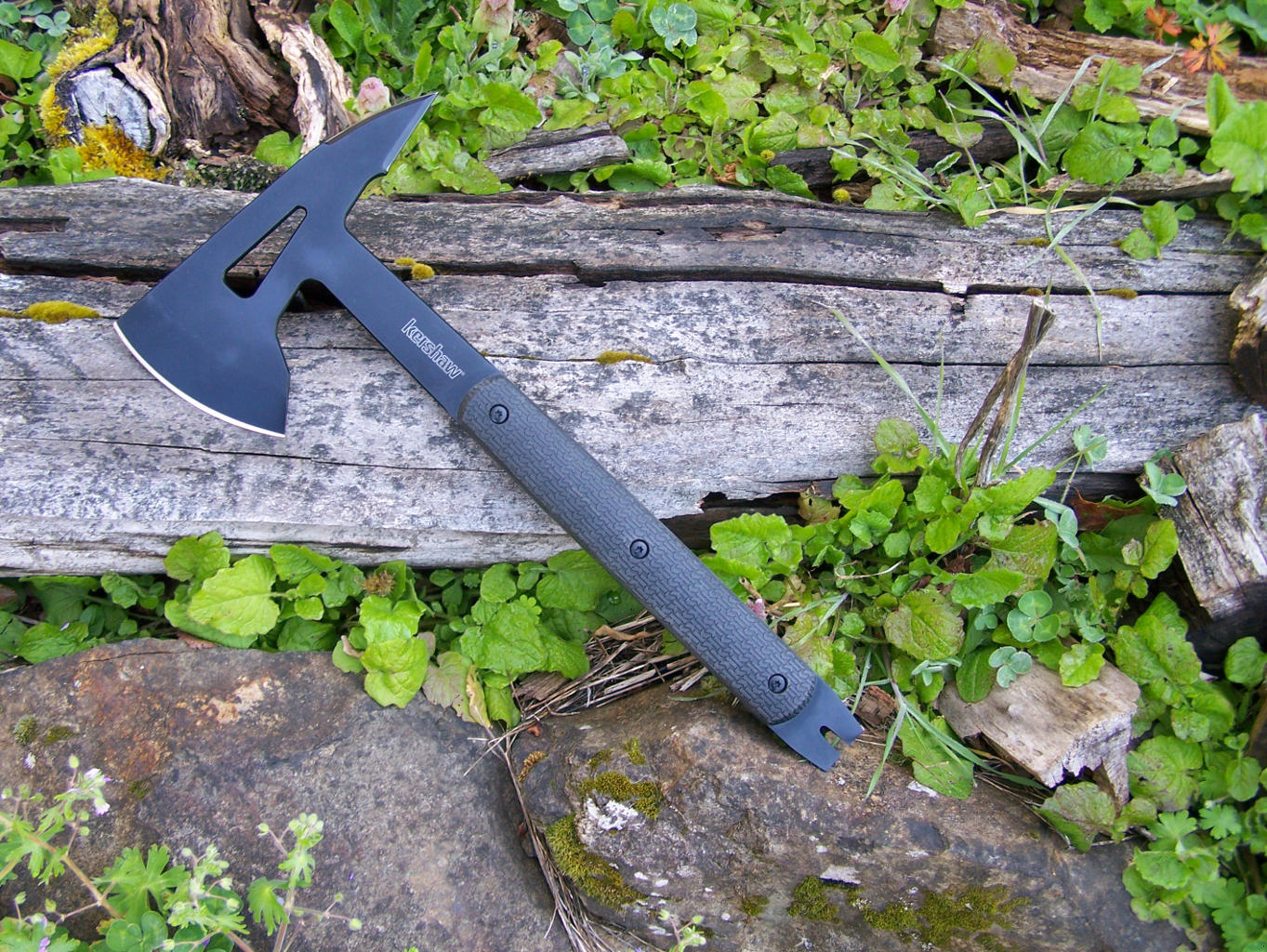
All right, the above is going the long route to introduce SurvivalBlog readers to the new Siege Tomahawk from Kershaw Knives www.kershawknives.com, which I recently received for testing. To be sure, I got the first writer’s sample for testing. I’m here to tell you that this is no cheap toy hatchet. This is a masterfully-made tomahawk for serious survival and, if needed, it’s a weapon of last resort. SurvivalBlog readers are getting a first look at the Kershaw Siege, too!

A little history on the tomahawk is in order, and this goes back to Colonial days or maybe even long before that, if you consider a Native American war club as a tomahawk. In short order, our founders discovered that a tomahawk was not only a great tool to carry, but it was also an excellent weapon. Native Americans back then would trade just about anything to get their hands on a British-made tomahawk, as did many settlers, who wanted a good tool and a weapon of last resort. To this day, many in our military use tomahawks in the field, and there is one company that even sells mil-spec NSN (National Stock Number) tomahawks to our troops. During the Vietnam War, many of our Special Forces carried a tomahawk in the field, too. I’ve mentioned this before; if I were going up against someone armed with a knife, I’d much rather have a tomahawk instead of a knife. Because of the longer reach you have and the power behind a tomahawk when you swing it, it’s devastating, to say the least. Have you seen the movie The Patriot starring Mel Gibson? If so, you saw some serious use of a tomahawk or two by Gibson’s character against the British.

100_5868

The tomahawk was also used as a throwing weapon, however, I would never throw my weapon away like that. I’m not skilled enough, and most of us aren’t, in the art of throwing a tomahawk. To be sure, there are competitions held all over the country that involve throwing tomahawks, as well as logger axes and knives. Still, I would prefer to keep my weapon in my hand, instead of throwing it at an attacker.

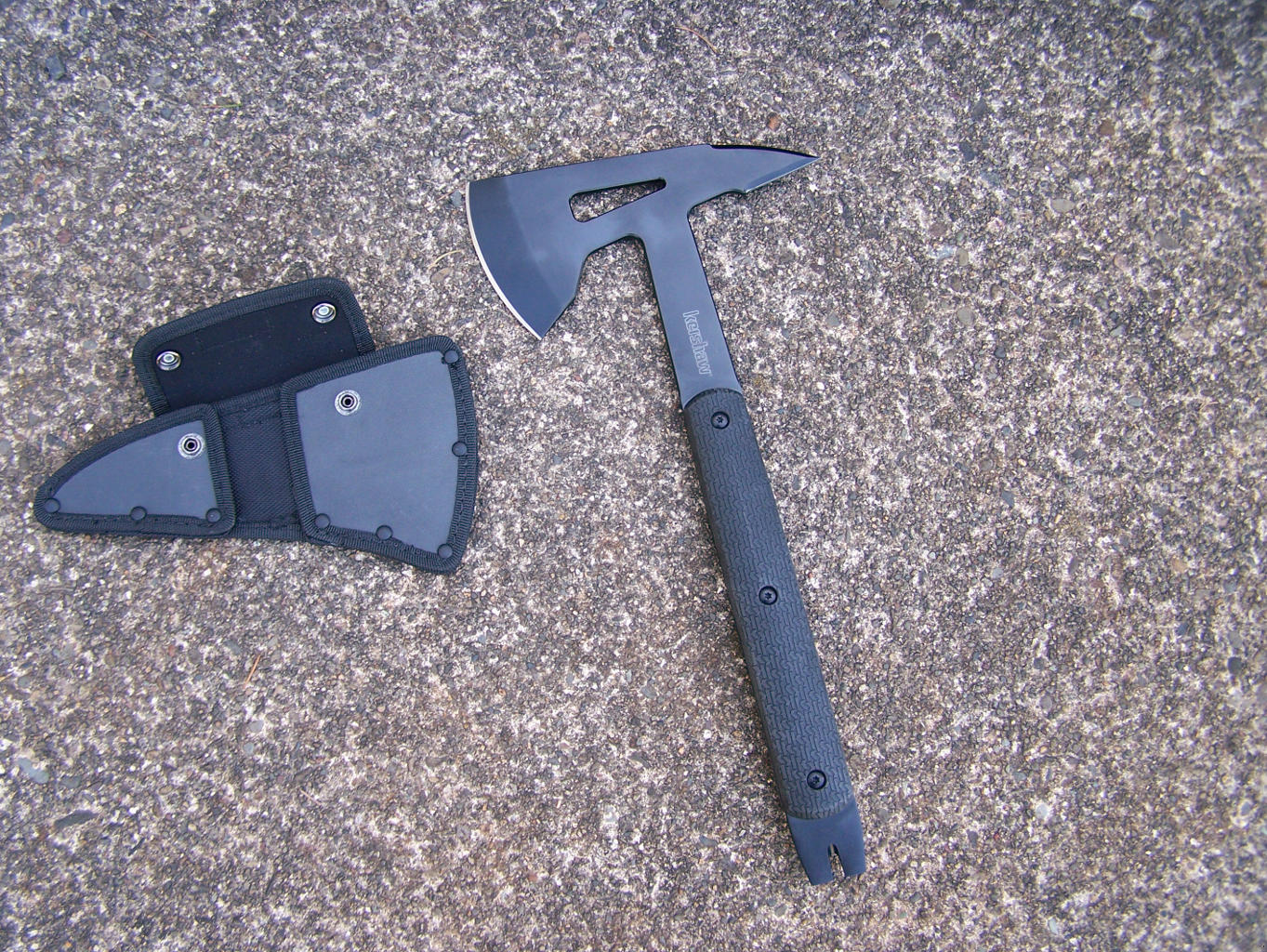
A closer look at the Kershaw Siege shows that this big tomahawk has a double edge blade that is 4-inches long, and I’m here to tell you right now that this thing can easily shave newsprint; it’s “that” sharp. We also have a spike head on the other end that can easily penetrate a skull, without much effort, which is a great way to take out a Zombie! The Siege has a full-tang that is made out of 3Cr13 steel, and it is black oxide coated. Many tomahawks sold today had a wooden shaft or a fiberglass shaft that can break. This won’t happen with the Siege. The handle material itself is glass-filled Nylon scales, which has something called a K-Texture; it’s rubbery and clings to your hand, too. On the end of the handle is a nail-puller, and it can also be used as a pry bar. I’m not sure where a nail-puller comes into play, if you are out in the wilds, but it’s there just the same. The weight of the Siege is 1-lbs 1.6-oz, but it feels heavier, perhaps because of the long shaft. It also comes with a sheath and a belt loop on the back. However, the belt loop isn’t large enough to fit on a military pistol belt, which is a disappointment to me.

100_5869

When my delivery guy brought the package from Kershaw, he asked what it was. He knew full well that it wasn’t ammo , which he brings me so often. I told him what was in the box and asked him if he wanted to see it. Needless to say, he jumped at the opportunity, and he helped me open (he ripped) the box to get at the contents. He then ripped the Siege out of the blister packaging, too. He was like a kid in a candy store; it is nice! He loved the feel and the balance of the Siege, and I have to agree with him on this point. He announced he was getting one as soon as he could.

I have a small homestead in western Oregon on slightly less than four acres. This is all the land I need, and it’s a lot of work keeping it up, too. We are always having a problem with blackberry vines; they can grow a foot a day when weather conditions are right. Luckily, this time of year they are dormant, but they’re still there. It always serves as a great test to see how sharp a knife is, as many knife blades will either slip off a blackberry vine or simply bend it or break it but not cut it through. The Siege easily sliced right through the blackberry vines. I used the spike head, and it easily penetrated half inch plywood. I could easily chop on fallen trees. The long shaft of the Siege really gives you some power, compared to a shorter hatchet that many campers carry. I even tried my hand at throwing the Siege, and it actually stuck in a tree, many times. Sometimes it would stick by the head, sometimes by the spike, and sometimes by the end with the nail puller. I would suggest, though, if you use the nail puller end that you keep the sheath on the Siege to prevent getting cut by the head of the tomahawk or getting poked by the spiked end should your hand slip.

100_5875

With the all-steel construction of the Siege, it is a bit heavier than a wooden shaft or fiberglass shift tomahawk, especially compared to those used in throwing competitions. The longer shaft makes the Siege a bit slower in the hand when swinging it. Still, the Siege is an awesome tool and weapon of last resort, in my humble opinion. You simply are NOT going to break this thing, and during all my testing and throwing it I didn’t do any damage to the thing! Wow! It got a little dirty, but it cleaned right up. The only change I’d make is to have a larger belt loop on the sheath so it will fit on a U.S. pistol belt or allow it to attach to MOLLE gear on a backpack. That would be nice.

100_5878

You can go out and purchase one of those cheap $12 survival hatchets, but they can’t compare to the Siege tomahawk from Kershaw. Quality doesn’t come cheap. However, in this case, the full retail of the Siege is only $79.99, which is quite a bargain, and you’ll never have to replace it; it will last your lifetime. What I would have given to have had a Siege back when I was a kid. There’s not a doubt in my mind that I could have tamed the entire wilderness of Chicago.

– Senior Product Review Editor, Pat Cascio


Recipe of the Week: Chocolate Chick Pea Pudding

Hello Hugh, here is a simple and highly nutritious chocolate chick pea pudding recipe made from all food storage ingredients. The pudding has no beany taste, and if you have a Vitamix or blend the chick peas long enough in a regular blender there is no graininess. I also have used oats as a thickener, in case a person does not use flour or corn starch.

Ingredients:

  • 1-15 oz. can chick peas or garbanzo beans
  • 2 cups water
  • 2/3 cups non fat powdered milk
  • 2 Tbsp. cocoa powder
  • 1/4-1/2 cup sugar
  • 2 Tbsp. oats
  • 1 Tsp. powdered egg
  • berries ( optional)
  • 1 Tbsp. oil or butter (optional)

Directions:

  1. Drain and rinse the peas/beans three times.
  2. Combine remaining ingredients into Vitamix or blender; blend on high 3-5 minutes, until contents are smooth and no longer grainy.
  3. Prepare a double boiler. Alternatively, if you have no double boiler, place two dinner knives in the bottom of a cast iron skillet, add water to barely cover the knives. Place a medium-sized heavy sauce pan on top of the dinner knives.
  4. Pour blender contents into the top portion of the double boiler or the heavy sauce pan and heat over medium heat, stirring constantly until the pudding begins to thicken.
  5. Pour into serving cups or dishes.

o o o

Useful Recipe and Cooking Links:

Do you have a favorite recipe that would be of interest to SurvivalBlog readers? Please send it via e-mail. Thanks!


Letter Re: Pat Cascio’s Product Review: Inter Ordnance “AK-47″

Hugh/JR:

I own the same rifle; I just bought it last fall. Full concurrence with all Pat’s observations, but the plastic furniture can be a drawback. During repeat (not full auto) firing, the hand guard failed (melted) at the forward-most position, welding the heat-softened material to the increasingly-hot barrel.

I recommend owners of this otherwise fine product consider either increasing the gap between the plastic hand guard and the barrel or swapping it for one of different material.

V/R


Economics and Investing:

The World Bank has been found to have violated its own policies, on protecting the rights of indigenous peoples.

o o o

Ford to spend $2.5 billion on plants in Mexico, angering UAW. – A.W.

o o o

Oil Busts Triggering Economic Seizures: “A Stream of Bankruptcy Attorneys Running Around”. – H.L.

o o o

1 out of 4 college adjunct faculty collecting government assistance: Students in debt and professors barely getting by all the while tuition soars.


Odds ‘n Sods:

The Death of the Left. – H.L.

o o o

Car thieves’ scary new tool. – D.S.

HJL Adds: While the article on the dangers of new technology was interesting, I found the link to the video of the scythe-vs-weed whacker at the end of the article to be incredibly amazing.

o o o

This New Libertarian Micronation Might Just Be Crazy Enough to Work. – H.L.

o o o

SurvivalBlog reader L.B. has recommended the OneYardRevolution channel on YouTube. Its focus is on frugal and sustainable organic gardening. In particular, L.B. likes that he doesn’t waste your time by constantly repeating himself.


Hugh’s Quote of the Day:

“He knelt among the shadows and felt his isolation bitterly. They were savages it was true; but they were human.” ? William Golding, Lord of the Flies


Notes for Sunday – April 19, 2015

April 19th marks the multiple anniversary of the battles of Lexington and Concord, known as “The Shot Heard ‘Round the World”. This first battle, leading to our nation’s independence, was the then-dictator’s (United Kingdom King George III’s) FAILED attempt at “gun control”– an act being carried out in too many parts of our USA RIGHT NOW. This first gun control of the colonies was a failure, because of the will and determination of a small part of the population (about 3% actually fought for our independence actively, with many others supporting) to stand up to an oppressive, controlling government (England). Without the sacrifice by those few Patriots, we could very well still be “British subjects” rather than independent citizens.

It also marks the anniversary of the Warsaw Ghetto uprising against the Nazis in 1943, the BATF’s costly raid on the Branch Davidian Church in Waco, the gun turret explosion on the USS Iowa in 1989, the capture of the Boston Marathon bomber in 2013, and very sadly also the Oklahoma City bombing in 1995.

April 19th is also the birthday of novelist Ralph Peters. Coincidentally, Ralph and JWR both have the same literary agent, Robert Gottlieb.


Street Combat – This Ain’t No Game! – Part 4 of 9, by Pat Cascio

[Street Combat – This Ain’t No Game is a SurvivalBlog exclusive.]

Chapter Two

DIRTY FIGHTING TECHNIQUES

Growing up, most of us have witnessed school yard fights. These usually amounted to a shoving or wrestling match. However, every once in a while, things got serious and punches flew. In some instances, one opponent will do something “dirty” to win the battle. In the eyes of school children, this is a “no-no”. In real-life, it’s another story. Remember, this is Street Combat – This Ain’t No Game. Also, as mentioned in the last chapter, there is no “second place winner” in this sort of combat.

I’ve witnessed more than my share of bar fights, and I’ve even participated in a few (in my “young and dumb” days). I have yet to hear any participant of a bar fight claim that the other opponent fought dirty. You do whatever you have to do to be the victor. Sometimes bar fights are nothing but stupid disagreements, or sometimes patrons have simply over-indulged in spirits. Words fly, and fists soon follow suit.

Other times, bar fights turn deadly serious. Guns, knives, clubs, baseball bats, motorcycle gangs, and other things determine the circumstances involved and the outcome.

CASE STUDY: Uncle Dave Challenges Cheetah

My Uncle Dave was a terrific guy, whether drunk or sober. He was just a lot of fun to be around. However, whenever he and I would go bar hopping, the alcohol would usually take control of his common sense. After hitting several bars, Dave would be feeling pretty tough and would then pick a fight with the meanest and toughest “regular” in the place. Dave always lost! There were usually no hard feelings after the fight; there’d just be a ’round of drinks for everyone, which Dave bought.

In one particular bar we had not previously patronized, Dave had the misfortune of picking a fight with a regular patron called “Cheetah”. It was in short order, that Dave learned how Cheetah got his name.

As was the usual routine with Dave, he would ask who the meanest or baddest guy was in the bar. (Honestly, that’s how he did it.) Someone was always willing to step forward, especially in view of the fact that Dave was only about 5′ 6″ and 150 lbs, if soaking wet. There was never a want for an opponent.

Cheetah stepped forward at the invitation and was more than willing to oblige Dave’s request for a sparring partner. Within moments, Dave and Cheetah were outside the bar, and the battle was on. Within less than a minute, Dave lay on the cold concrete sidewalk, dazed and bloodied. It was night time, and I only saw a flurry of punches from Cheetah. After I picked Dave up from the ground and tended to his bloodied face, a ’round of drinks was forthcoming, and Dave and Cheetah became good friends.

LESSON LEARNED:

First of all, don’t ever pick a fight with anyone called Cheetah. The odds are that they earned that name and not because they’re soft and cuddly like a little kitten! Secondly, keep an eye on your attacker’s hands. You never know when they might conceal a roll of coins, a knife, gun, stick, et cetera to use against you. Lastly, don’t go around to strange bars picking fights. There’s a pretty good chance you’ll always lose, and there’s always someone willing to take it on the chin and land you on your behind!

TECHNIQUE USED:

Cheetah had been a former prize fighter. He had lightning fast hands, faster than any of Dave’s other opponents. Added to the incredible speed was a roll of nickels in Cheetah’s clenched fist. This gave him a rock-solid hand to punch with. There were no hard feelings after the fight, but I believe Uncle Dave learned a valuable lesson that night.

I hold black belt ranks in several styles of martial arts, which include but are not limited to: Judo, Goju-ryu Karate, American Kenpo Karate, American Combat Karate, and others. However, I teach my students and am of the opinion that it’s always better to use your hands and/or feet as a last resort.

If you can secure some type of “equalizer”, such as a stick, rock, sap, black jack, baseball bat, baton, or any other such weapon, it’s better to use that than your bare hands or feet. When attacked, the attack will come viciously, without warning, with blinding speed, and the odds are that you’ll be outnumbered. So, why shouldn’t you have some sort of advantage in your hand when the deck is stacked against you?

CASE STUDY: Bar Fight II

Yeah, in my drinking days (now long gone), I was known to frequent bars in all types of neighborhoods. Some neighborhoods weren’t exactly friendly to folks of other races, either. Some figured if you were crazy enough to walk into their neighborhood and bar, you were “bad” enough to take any and all challengers on.

My childhood friend, Moe, and I were in just such a bar one night. Moe is Mexican– not your South-of-the-Border variety but the kind born and raised in Chicago. Like myself, he doesn’t speak a word of Spanish. As a matter of fact, I can at least order food in a Mexican restaurant in the language of the people; Moe can’t! So much for the Mexican blood running through Moe’s veins.

Sober, I can barely shoot pool; after I’d had a number of drinks, I was virtually impossible to beat. Most of my friends would refuse to play pool with me after I’d gotten drunk. Moe, on the other hand, was a pretty fair man with a pool cue. His dad, Gunner, had a pool table in his basement that Moe used daily to get plenty of practice.

While drinking in an unfamiliar bar, Moe and I were challenged to a game of Eight Ball by some of the local patrons. At the onset I was fairly sober, but this changed with the consumption of several Cutty and water drinks. The locals had won several games from us, which was all fine and dandy. We were only playing for a few bucks a game. By the way, the local patrons were all white, but Moe isn’t! We should have known there would be problems when we first walked in and all the attention was focused on Moe.

The stakes were raised after several games of pool. The locals were feeling pretty lucky. Unfortunately, I was starting to get on the stick with my usual drunken accuracy. We started winning the (now) bigger table stakes. This didn’t bode very well with the locals. They were sure we had set them up by losing the first few games.

A pool cue is a pretty dandy weapon, when wielded properly– much like a bo or staff. I’ve always favored a stick over a knife, because it keeps your opponent farther away from you during a fight. Unfortunately, a stick is a bit hard to conceal and carry with you all the time. Luck was with me this time around, as a “stick” was already in my hands.

Words were exchanged. Remarks were directed at the “Mexican” I had with me, and fists started to fly, as did my pool cue! Moe is a fairly good-sized fellow; although not a trained fighter, he could give a good accounting of himself with his bare fists.

The fight wasn’t limited to the four of us; other friends of the locals quickly joined in. Within less than two minutes, the entire affair had been settled, and the Chicago Police were on their way. Moe and I jumped on our motorcycles and left, pronto!

LESSON LEARNED:

First of all, I was a bit of a hard-headed individual in my younger days. I always thought it was pretty exciting to go into other neighborhoods and bars to drink. I thought of myself as being rather indestructible. My martial arts background and training had given me a pretty high self-confidence level. I could better handle two or three opponents easier than I could just one. When fighting multiple opponents, they tend to get in one another’s way, at least in my experience.

Don’t go looking for trouble; if you do, it’ll ALWAYS find you! As my Uncle Dave learned, you can always find someone willing to step outside with you.

Although Moe and I weren’t looking for trouble, we found it. We had simply wanted a change of scenery by going into this bar. It was located in a middle-class area of town. Still, trouble ALWAYS has a way of brewing after alcohol has been consumed. If you have no business being in that particular part of town, then stay away!

If you have no business (or friends) in a particular bar or tavern, then stay away! One of the best ways to avoid a fight, is not to be there when one starts.

TECHNIQUE USED:

I’ve always been a fan of down-to-earth, simple, basic techniques. The Hollywood movies would lead you to believe that nothing works in a fight except fancy, high-flying kicks and make-believe “mysterious” punches. Such is NOT the case!

You should always attempt to direct your attack at your opponent’s most vulnerable areas, too. This is the essence of “dirty fighting”. In the above fight, one of the best vulnerable areas was the groin. Don’t ever be afraid to attack your opponent’s vulnerable areas.

As with any physical skill, you must master the basic techniques. Without mastery of basic physical skills, advanced skills will not be learned (properly) or mastered. In my martial arts classes and seminars, I constantly instill the importance of mastering the B-A-S-I-C- skills and techniques before moving on to a more advanced one.

The bar fight Moe and I were involved in ended rather quickly, thanks to the weapons– the pool cues– we had in-hand! Moe made a good accounting of himself simply by swinging his pool cue like a baseball bat or club. I, on the other hand, used several simple moves.

One of the most effective is the horizontal stroke. This is exactly like the old military horizontal butt stroke, performed with a rifle. The pool cue is swung horizontally toward your opponent’s head or body area. (In my case, I aimed for the head.)

The next easiest and very effective move is the vertical stroke. Again, this is exactly like the military vertical “butt” stroke with a rifle. The pool cue (or other stick-type weapon) is brought up from the ground in a straight vertical movement. Your two target areas are the groin or chin. In the above fight, I went right to the groin area.

In my U.S. Army Basic Combat Training Unit, we had a black drill sergeant who would occasionally teach our so-called “hand-to-hand combat” classes. He would always tell us to strike, kick, or hit the enemy in the “groan”. Obviously, he was mispronouncing “groin”. However, when you stop and think about, it really is a strike to the “groan” area. I just thought I’d mention this little tidbit for “historical” purposes. (PSG Johnson, if you’re out there, thanks for the “groan” lessons. My opponents have always “groaned” when hit in the “groin”.)

CASE STUDY: My Sister’s Hero

Donald was a great big guy, standing well above my 5′ 11′ height. However, he was younger and obviously not very bright. I don’t exactly recall the circumstances that brought him into the life of our family, but somehow or another he was dating one of my sisters.

A feud broke out between me and this sister; it was merely sibling rivalry and nothing serious. This sort of thing always happens between brothers and sisters!

Donald happened to be standing in our front yard and heard the commotion. He was determined to be my sister’s hero by calling me out. That was a big mistake!

I flew out the door and didn’t touch a single step leading down to the walk. In short order, I had Donald on the ground, unable to breath, speak, or follow through on his challenge. The fight was over in a blink. Luckily, my dad arrived on the scene and broke up the whole affair. Otherwise, Donald might not have survived my attack.

LESSON LEARNED:

Be merciless and unrelenting in your attack. Surprise and the first blow often wins battles. In Donald’s case, he didn’t really expect me to take the drastic action I did. He had no idea I would bound through the door and launch such a vicious attack on him. I suspect he thought the fight would be nothing more than a huffing match. You know the kind– two men standing there threatening one another to see who would back down first.

Although an adversary may be bigger and stronger than you, surprise and aggressiveness (on your part) may rule the day. In this incident, I knew that Donald was much bigger and stronger than me. I knew that he considered himself some kind of tough guy. I also knew that if a person couldn’t breathe, they couldn’t do much harm.

TECHNIQUE USED:

Go for the throat! If a person can’t breath, they’ll break off any aggressive action in rapid order. I immediately grasped Donald’s windpipe in a death grip. I could have easily crushed his trachea without any resistance from him.

At the time, I used all four fingers and my thumb to subdue my opponent. I’ve since learned an even better and more effective technique.

First of all, it’s extremely difficult to get all four of your fingers behind and around the trachea. With sheer brute force it can be done. Master martial artist John McSweeney, however, has developed a better (and easier) technique, called the Eagle’s Talon or Eagle’s Claw.

This technique is executed using only the thumb and index finger (of either hand). Using a pincer motion (like a lobster does with its claw), you grab the windpipe with the index finger and thumb. It is now very easy to apply a grasping motion and pinch the windpipe between the finger and thumb. This technique is deadly if performed with any amount of force. You can easily crush or rip-out a persons windpipe, thereby killing them!

I want to warn all readers that this is a deadly technique, and it is one to be used only when deadly force is being used against you. If a doctor or medic is on hand when this technique is used, they may be able to save your opponent’s life. If, however, no trained and properly equipped “medico” is on the scene, it’s going to be the end of the line for your attacker! This is dirty fighting at its best!

CASE STUDY: Brutal Bat Attack

You’re gonna love this tale. I wasn’t involved, but I was a witness, and what I’m about to tell you is 100% true!

The west side of Chicago, Illinois is a part of town you don’t want to be caught in after dark, even if you live there! This is one tough area, to be sure. I was in this area while working a temporary job driving a dump truck. While assigned to work with the Streets & Sanitation Department, I witnessed a brutal attack.

It was like any other summer day in Chicago– hot and humid! The work crew was finishing up a patch job at a street corner. Our crew was made up of whites, blacks, and a Hispanic fellow. We were not quite the U.N., but we were close. The neighborhood we were working in was, for the most part, made up of blacks.

While waiting (in my truck) for the crew to finish their job, I saw a young black man (probably in his late teens or early 20’s) standing across the street from us in front of a hamburger stand. Another black man, probably in his late teens or early 20’s, come up behind the first black man. I saw that he had a baseball bat in his hands. This wasn’t going to be pretty, because no one involved had a baseball glove or ball.

The second man got into the most picture-perfect batting stance I’ve ever seen. He took a full swing and struck the first man square in the back of the skull. The first man’s head went flying across the street, as you would expect… NOT!

Much to my surprise and amazement, the fellow who had been attacked by the of full force of the baseball bat went down to his knees and then almost as quickly came right back up swinging at the man who attacked him. I don’t know the details of the entire affair; I’m guessing it was probably a drug deal gone bad or some sort of love triangle.

I beeped my horn to alert the work crew to the incident, and we high-tailed it out of the area as quick as everyone could get on the truck. To this day, I don’t know the outcome of the fight, but my money was on the guy who got hit with the bat.

LESSON LEARNED:

At least we had a racially-diverse work crew. This is somewhat acceptable to the residents of certain (racial or ethnic background) neighborhoods in Chicago. The Ward Supervisor, in his wisdom, had seen to it that our crew had this racial mix. As a matter of fact, I believe we had more black men on the crew than whites.

I believe it was prudent on our part to high-tail it out of the neighborhood when the fight broke out. Remember the Rodney King riots in Los Angeles, CA a few years ago. Poor Reginald Denny found himself in the wrong part of town at the wrong time. It nearly cost him his life.

After this incident, I started carrying my 6″ Colt Trooper, .357 Magnum revolver with me. I kept it under the front seat of the truck. I just didn’t have a lot of faith in my little Colt Detective Special that I kept in an ankle holster. I was of the opinion, at the time, that bigger was better. If one gun was good, then two were better.

TECHNIQUE USED:

Well, as for our part, we got away from the troubled area as fast as we could. There was no sense in our work crew staying in the immediate area to cheer on the contestants.

The technique used in this attack, by the second man (with the baseball bat), should have been a sound one, but it wasn’t. The law of physics would seemingly dictate that the first man’s head should have been cleanly removed from his shoulders or at the very least his skull should have been crushed by the blow, but it wasn’t!

I can only imagine the surprise and sheer terror that the second man experienced when the man he hit with the baseball bat went down on his knees only to come right back up swinging! That’s enough said.

I teach my students the importance of ALWAYS carrying some type of weapon with them, even if they don’t realize they have a weapon. This part of my class is simply called “Improvised Weapons”. Students are taught to take what they have on hand and use it as a weapon against an attacker. In my class, I give the students 10 seconds to find an improvised weapon and explain to the rest of the class how they’ll use it. This procedure is repeated several more times throughout the first hour of this particular class, until everyone gets the idea. We then spend the second hour of the class building much more sophisticated, improvised weapons, some pretty deadly, too! A little common sense and thought have produced some real interesting, improvised weapons, even by my very young (5-12 year old) students.

CASE STUDY: The Harassing Senior

I think I already mentioned that I was a bit on the skinny side when I was growing up. (I’ve since made up for it, though.) While I was a freshman in high school, there was one particular senior who thought it was fun to pick on me. Oh, he never beat me up or anything like that’ he just found ways to embarrass me, mess up my hair, and you know, things like that. Every school has one of these guys. This fellow was probably six feet tall and outweighed me by at least 50 or 60 pounds.

I was always fortunate enough to have this character sit with me during study hall and lunch. I guess no one else wanted to be his “friend”. Lucky me. If that wasn’t bad enough, I was also “fortunate” enough to run into this guy between classes in the halls.

It’s simply amazing what a rolled-up magazine can do to a fellow. I had finally had enough of this monster bullying me, and I let him have it, right in the belly with a rolled-up gun magazine. To this day, I remember that it was an issue of the “NRA’s AMERICAN RIFLEMAN” magazine.

LESSON LEARNED:

Don’t ever let a bully get the best of you. No matter how big they are, they can be taken out, especially if you catch ’em by surprise. The longer you let things go on, the harder it is to correct the situation. I didn’t want to make waves in my new school, because my folks were paying some serious money to send me to a private Lutheran high school. I didn’t want to blow it, but there has to come a time when you take a stand.

TECHNIQUE USED:

As already mentioned, I rolled up a magazine and jammed it into this guys gut. Oh, it didn’t kill him or anything like that. However, there is immense power in something so simple, like a rolled-up newspaper or magazine, if used properly. I completely caught this guy by surprise and knocked the wind out of him. He was NEVER a problem after that. He still sat at the same table in study hall and at lunch, but he had a new respect for me after I fought back.

A rolled-up newspaper works just as well as a magazine; it might be even better, because you can get a real good two-handed hold on it when you thrust it into someone’s gut, face, throat, et cetera.

You can also use it to slap someone across the face. Now, while this won’t stop their attack, it will divert their attention long enough for you to find a better target, like the groin, gut, throat, et cetera.

A ball point pen can be used to stab someone in the face or eyes. An attack to an eye socket will just about guarantee an end to the attack. If they can’t see you, they can’t hurt you.

I also teach my students to use their keys to strike at someone’s eyes. The ripping motion can blind a person. The blood from the ripping motion can also run into an attacker’s eyes, blinding him.

Women, for the most part, carry an arsenal with them in their purses. Nail files, hair spray (when sprayed into the eyes can permanently blind a person), car and house keys, and even the purse itself can be used as a weapon when swung at the head area. Have you ever picked up a woman’s purse? They’re heavy.

How about a hand full of change, flung into someone’s face. It can injure an eye, and at the very least give you a moment to escape or plan your attack. A few rocks carried in your coat or pants pocket can also be flung into an attacker’s face.

The list of improvised weapons is only limited by your own imagination. Take a few minutes right now to inventory what you have in your pockets, purse, or within your reach that can be used as a weapon.

Right now, if front of me, I see two pairs of scissors, numerous magazines and newspapers, PC disks (that can be flung), a briefcase that can be swung, two staplers that can be used as striking weapons or for that matter how about a few staples (stapled) into an attacker’s face? Ouch!

If I look to what I’m carrying as weapons right now, my right front pocket has an Ernest Emerson Commander folding combat knife (clipped inside the pocket, for rapid deployment) as well as a lot of loose change. My left front pocket has a Gerber (Applegate-Fairbairn) Covert folding knife (also, clipped inside the pocket) and two sets of keys. In my left rear pocket, I have my wallet, which contains my private investigator’s badge (I still take on a few PI cases every now and then). This badge has a 7-point star, and it could be flung into someone’s face (ala, martial arts throwing stars), or it could be used as a stabbing device to a face. On my right hip is Glock Model 26, 9mm pistol with a 10-round magazine plus another spare magazine in my jacket pocket, both loaded with Norma (made by Black Hills Ammunition) 9mm 124 gr. Plus P ammo.

The above should give you some kind of an idea as to what type of improvised weapons you have with you for immediate use. Don’t be afraid of being a “Dirty Fighter”. At least you’ll be a live fighter after an attack.

Remember, this is Street Combat – This Ain’t No Game!


Letter: Posse Comitatus Won’t Save You From The U.S. Military

HJL,

The Posse Comitatus Act of 1878 (Pub. L. 18 USC P 1385) was supposed to keep the U.S. Military from enforcing local and federal law, or assisting local law enforcement in that duty. Well before the Posse Comitatus Act was passed, Congress passed the Insurrection Act of 1807 (Pub. L. 10 USC 331 thru 335), which was a “set of laws that govern the ability of the President to deploy U.S. troops on American soil.” Such deployment could only come at the request of a governor of the state in which an event was taking place requiring a larger military force. This all changed after Hurricane Katrina, where the Louisiana governor did not request federal troops to restore order. Congress went ahead and modified the Insurrection Act as follows:

“Section 1076 of the law changed Sec. 333 of the ‘Insurrection Act,’ and widened the President’s ability to deploy troops within the United States to enforce the laws. Under this act, the President may also deploy troops as a police force during a natural disaster, epidemic, serious public health emergency, terrorist attack, or other condition, when the President determines that the authorities of the state are incapable of maintaining public order. The bill also modified Sec. 334 of the Insurrection Act, giving the President authority to order the dispersal of either insurgents or ‘those obstructing the enforcement of the laws.’ The law changed the name of the chapter from ‘Insurrection’ to ‘Enforcement of the Laws to Restore Public Order.'”

The Insurrection Act is the most important legal authority for the President to authorize the use of federal troops to enforce the law. The Insurrection Act (there is really no single ‘Insurrection Act’ per se, but this name has been applied collectively to the four statutes noted below) consists of four statutes enacted at different times for different reasons that, when considered as a whole, provide the power that Presidents have used many times as the legal basis for using troops to enforce the law. The four sections of the act are as follows:

• Title 10, Section 331 was enacted in 1792 in response to challenges to the taxing power of the federal government. It allows the President, at the request of a governor or state legislature, to put down an insurrection by calling into federal service sufficient militia to “suppress the insurrection.”

• Title 10, Section 332 was enacted in 1861 at the outset of the Civil War. It allows the President to use the armed forces to enforce the laws or suppress a rebellion whenever, in his opinion, unlawful obstructions, combinations, or assemblages or rebellion against the authority of the United States make it impractical to enforce the laws using the course of judicial proceedings.

• Title 10, Section 333 was enacted in 1869 during the Reconstruction Era. It allows the President to use the armed forces or militia to respond to insurrection, domestic violence, unlawful combination, or conspiracies that prevent a state government from enforcing the laws.

• Title 10, Section 334 was enacted in 1861. It prescribes that the President shall issue a proclamation calling on insurgents to disperse before using the militia or armed forces to enforce the law.

The Insurrection Act is the most sweeping authority for the President to authorize and order the use of the federal troops for domestic operations. The President may not act on warning or even at the start of an incident, but must wait until the governor or a state legislature asks for federal assistance. This tends to discourage advance preparations and movements of troops-although Presidents have authorized such actions. This tiered approach in which the federal government acts only after local and state governments have failed, was workable when the cost of delayed response was acceptable, but it is inappropriate for the current situation.

Retrieved from http://www.newswithviews.com/Ewart/ron199.htm


Economics and Investing:

IRS Budget Cuts: Tax Administration v. Tax Handouts – PLC

o o o

Most new US jobs are in vulnerable industries — food, drink, office temp, transactional stuff like banking, etc. — and it’s hard to see where tomorrow’s debt service payments will come from.

o o o

Wal-Mart’s ex-CEO Mike Duke joins private equity firm Carlyle. – RBS

o o o

THE U.S. GOLD MARKET: Completely Insane

o o o

Meet the latest country with negative interest rates. – S.B.


Hugh’s Quote of the Day:

“Jesus said unto him, If thou canst believe, all things are possible to him that believeth. And straightway the father of the child cried out, and said with tears, Lord, I believe; help thou mine unbelief.” Mark 9:23-24 (KJV)


Notes for Saturday – April 18, 2015

Today, we present another entry for Round 58 of the SurvivalBlog non-fiction writing contest. The $12,000+ worth of prizes for this round include:

First Prize:

  1. A Gunsite Academy Three Day Course Certificate, good for any one, two, or three course (a $1,195 value),
  2. A course certificate from onPoint Tactical. This certificate will be for the prize winner’s choice of three-day civilian courses. (Excluding those restricted for military or government teams.) Three day onPoint courses normally cost $795,
  3. DRD Tactical is providing a 5.56 NATO QD Billet upper with a hammer forged, chromlined barrel and a hard case to go with your own AR lower. It will allow any standard AR type rifle to have quick change barrel, which can be assembled in less than one minute without the use of any tools, and a compact carry capability in a hard case or 3-day pack (an $1,100 value),
  4. Gun Mag Warehouse is providing 20 Magpul pmags 30rd Magazines (a value of $300) and a Gun Mag Warehouse T-Shirt. (An equivalent prize will be awarded for residents in states with magazine restrictions.),
  5. Two cases of Mountain House freeze dried assorted entrees in #10 cans, courtesy of Ready Made Resources (a $350 value),
  6. A pre-selected assortment of military surplus gear from CJL Enterprize (a $300 value),
  7. A Model 120 Series Solar Generator provided by Quantum Harvest LLC (a $340 value),
  8. A $300 gift certificate from Freeze Dry Guy,
  9. A $250 gift certificate from Sunflower Ammo,
  10. KellyKettleUSA.com is donating both an AquaBrick water filtration kit and a Stainless Medium Scout Kelly Kettle Complete Kit with a combined retail value of $304,
  11. TexasgiBrass.com is providing a $300 gift certificate, and
  12. Two cases of meals, Ready to Eat (MREs), courtesy of CampingSurvival.com (a $180 value).

Second Prize:

  1. A Glock form factor SIRT laser training pistol and a SIRT AR-15/M4 Laser Training Bolt, courtesy of Next Level Training, which have a combined retail value of $589,
  2. A FloJak EarthStraw “Code Red” 100-foot well pump system (a $500 value), courtesy of FloJak.com,
  3. Acorn Supplies is donating a Deluxe Food Storage Survival Kit with a retail value of $350,
  4. The Ark Institute is donating a non-GMO, non-hybrid vegetable seed package–enough for two families of four, seed storage materials, a CD-ROM of Geri Guidetti’s book “Build Your Ark! How to Prepare for Self Reliance in Uncertain Times”, and two bottles of Potassium Iodate– a $325 retail value,
  5. A $250 gift card from Emergency Essentials,
  6. Twenty Five books, of the winners choice, of any books published by PrepperPress.com (a $270 value),
  7. TexasgiBrass.com is providing a $150 gift certificate, and
  8. RepackBox is providing a $300 gift certificate to their site.

Third Prize:

  1. A Royal Berkey water filter, courtesy of Directive 21 (a $275 value),
  2. A large handmade clothes drying rack, a washboard, and a Homesteading for Beginners DVD, all courtesy of The Homestead Store, with a combined value of $206,
  3. *Expanded sets of both washable feminine pads and liners, donated by Naturally Cozy (a $185 retail value),
  4. Two Super Survival Pack seed collections, a $150 value, courtesy of Seed for Security,
  5. Mayflower Trading is donating a $200 gift certificate for homesteading appliances,
  6. APEX Gun Parts is donating a $250 purchase credit,
  7. Montie Gear is donating a Y-Shot Slingshot and a Locking Rifle Rack (a $379 value), and
  8. Two 1,000-foot spools of full mil-spec U.S.-made 750 paracord (in-stock colors only) from www.TOUGHGRID.com (a $240 value).

Round 58 ends on May 31st, so get busy writing and e-mail us your entry. Remember that there is a 1,500-word minimum, and that articles on practical “how to” skills for survival have an advantage in the judging.


The Reluctant Prepper, by M.R.

Most of us, “preppers”, know that all our time, money, and hard work will only pay off if we are able to keep, use, and protect what we have. My prepping beginnings came in a somewhat odd way. It began with a small kit to keep in my SUV after following a major news story here in the Pacific northwest about a family from California who got lost in the backwoods while trying to drive from California to Oregon using back roads in the dead of winter.

Slowly as the pieces were put together it was learned that the family– a mother, father, toddler, and infant– had picked up some maps from an information center and mentioned the route they wanted to take. Against the warnings of the staff who gave them the maps (supposedly the family were told that route was impossible to make with the winter snow and locked gates), they decided they could make it. So with some snacks they bought at a gas station, they set off on their wonderful and exciting adventure. Sadly only three would survive long enough to be found by search and rescue. There were many valuable lessons in this unfortunate situation.

While stuck in the snow, the mother decided that she should attempt to breastfeed both children, even though the toddler was well past the breast feeding age (contrary to those over at Newsweek). So now the family technically have two mouths to feed as the mother feeds the two children.

As they waited for someone to find them, the father decided to light the spare tire on fire in hopes that with all the black smoke emitted, it would be noticed. Once all tires were burned the father followed with burning as much of the car as possible. Fearing no one was coming the father decided he would try and walk out and get help. Sadly, not long after he left, the family were spotted by air and rescued. The father was found a few miles away dead from hypothermia.

I am sure all of you who read this will see the lessons one can take from the poor family’s nightmare. Shortly after they were found I began replaying the situation in my mind, as if it were me. From there I soon found myself inside REI putting together, while not knowingly, my “get home bag/box”. From there it snowballed, and soon my family started teasing me and nicknamed me Dale Gribble.

Now I had a kit for each season and decided I should have kits for my house. I had officially fallen down the rabbit hole.

After a few years of slowly building up my preps, I found some teotwawki books and was hooked. JWR’s three books were the start. Needless to say the teasing really took off.

Soon I became truly fearful for those around me who would be “up the creek” and I would be right beside them, because I love them and would not nor could not turn them away. Hey, I am fighting every day to pay my own bills and keep my head above water, but I do have a few years of food, water, medicine, defense materials, and pet food for my pets and me.

From there I became a bit angry with those closest to me, seeing as I am beyond poor compared to them and I was able to do all this without a single hand out from them or the government. I soon decided that instead of staying mad I could begin working out ways to get them prepared without me buying it for them and without them knowing they were prepping.

Take my older sister, Sarah, who was the one who started the Dale Gribble name calling. She works in downtown Portland, spends more on shoes and clothes than I can even fathom, has horrible asthma, and even an allergy to the cold. That’s no joke! Take her down the frozen food isle and if she hasn’t taken an allergy pill, the girl breaks out in hives and blows up like the blueberry girl in Charlie & The Chocolate Factory. After I have almost peed my pants laughing at the sight of her, I pull out her epi pin and enjoy the fact that I get to stab her in the butt with it. It’s so satisfying! The last time I had to do that to her, I decided I could use this to my advantage.

I told her to give me $50 so I can go to Costco and buy her five years’ worth of off brand Claritin. Bam, that’s one item off her emergency preps.

In July she gave birth to her first child– the love of my life, Cora. After 10 minutes of digging, I learned that Sarah is scared of the fact that we are due for a major quake. So imagine my shock when I get a text from her asking me what she can do to ease her fears.

Now Miss Prissy Pants has “earthquake comfort bags” in all their family cars set up for her, Cora, and her husband that are filled with clothes, food, baby items, and a few grown up wine juice boxes that will take care of them for 10 days.

From there, I was able to get her house moving in the right direction. They now have food, formula, medicine, dog food, and a few other preps that are not unlike mine.

I even found a way to convince her to take some classes and get her CHL. I was able to accomplish this miracle by texting her every local news story about crimes happening downtown near where she lived that could have ended differently had the “damsel in distress” been a trained CHL holder. However, if you ask her if she is a prepper, you will get a goofy look from her and she will tell you, “Heck no! I am not crazy.”

Next up is my dad and step mom. We run a family business going on 80 plus years, and the guy has never even held a BB gun. So after a year of failed attempts to sell one of the old work vans, I asked him if it was okay to trade it for an AR15 that comes with 30 magazines and 2,000 rounds. He looked at me like I was insane, but after explaining I could turn around and sell the AR in 15 minutes, he reluctantly gave in.

I forgot to tell him I would not sell the gun. Six months later someone tried to break in to his house. His reaction? Call 911.

Shockingly, the police told him over the phone to fill out a report online. Needless to say, I showed up an hour later with the AR and three hours later he was learning to field strip and clean it. That AR opened the preps door a half an inch, and now he has two closets full of preps, rain barrels, two generators, and he is buying an old Ford truck that is an EMP-proof bugout beast. However, if you ask him if he is a prepper, you will get the same response as from my sister. Although I think he knows he is one, because we sure spend a lot of time hiding all of this from my step mom. Please don’t tell her!

Next were the neighbors. All it took to get their minds moving in the right direction was my crazy insane garden. Well, it’s a small version of what I have in the backyard, but it’s set up in the front yard. It was that, combined with a can or two of my stewed tomatoes, pickled beans, and raspberry jam. Then came the icing on the cake– a boil water emergency deceleration.  Within one hour, you couldn’t find a bottle of water to save your life. Before I knew it, I had my one million gallon water  filter set up in my neighbor’s front yard (someone else can pay that water bill), and people from three blocks away were lined up the day they ran out of their bottled water.

Most of them now own the same filter. While filtering their water, I took the time to talk with them about gardening, and many took me up on my offer of free raspberry, onion, and pepper starts. I have even done a few canning classes for them after they asked. It’s funny how a small garden and a few hours spent in my front yard ended up opening a door to getting to meet many awesome people, literally in my front yard. All of this from a girl, who is proud to be called Dale Gribble.

I feel I should mention a few oddities I have noticed since I set up my front yard micro garden. I am a renter who lives in a very seedy neighborhood. During my first year living there, I kept my shades closed and my head down. I figured there was no real point in getting to know my neighbors.

In that first year I had my car and home broken into and even managed to upset one person so deeply with my “I Don’t Believe The Liberal Media” bumper sticker that they decided they should spray paint the whole back end of my Honda Element. Sadly the mint green spray paint only managed to highlight it.

I soon began noticing different tags showing up on the fences around my house and decided to google them. It turns out some members or wannabes of MS13 and the 18th Street Gang were well represented. In doing some research, I feel I was pretty good at picking out who belongs to what, and in the time I spent in my garden after work I began just saying “hi” to everyone who walked past. Figuring after everything that had happened, what did I have to lose? After a few weeks, most of those who I profiled into those two groups would make it a point to stop and chat with me about the different veggies I am growing.

Then I decided to make a few calculated moves in regards to what I was growing, and during the time spent in my yard I began getting to know those who frequented my street.

It turns out the MS boss had just brought up his grandma from California and she is now living with him. He brought her by one summer evening to look at my peppers, and an hour later they left with a goody bag of spicy peppers that are almost a comfort food in their household.

Next was the 18th Street. They are mostly Pacific Islanders who are members in my neighborhood, and their leader I swear outweighs me by 200 lbs. I began to see him every once in a while walking what I had to guess was maybe a younger niece who has Down Syndrome to the park a few blocks away. When we would see each other outside he always stops to admire my beautiful hibiscus plant, which I keep in a large pot.

One day he brought her over to look at it. Noticing she had a fake flower behind her ear, I quickly cut off a bloom and handed it to her. I swear you would have thought I gave the girl a gold bar based on her reaction. Thus began our friendship.

Since then, the tagging in my neighborhood has ended completely. No one has had a break-in in 16 months, and I don’t think I have once had to wheel my trash can up the driveway. I truly understand my moves were risky, and I am a 29 year old blue-eyed blonde who lives alone. I am also pretty sure at one point in time all who stop to talk to me as I garden has discreetly seen my concealed glock 26 and know if they try to break in and come for me, they will have to go through my ruthless 100-lb German Shepard Poodle, Dagny, and my glock.

This change could also be because word spread really quickly about an encounter with the neighbor’s pit bull, who went after my Boston terrier, but ended up fighting me and Dagny. Dagny ended up with 30 stitches. I had seven, but I also removed its eyeball with my bare hands, before caving its head in with a shovel.

A few of the guys I suspect as gang members heard my screams that day, and after the dust had settled there stood a handful of each standing side by side with mouths open in shock. It turns out that both groups came running to my screams and were dumbfounded by what they saw. I guess my screams traveled all the way to the park that day.

It was pretty amazing to see both groups helping me sit down while two called 911. When the police showed up, they thought it was a gang fight, until they saw the super dead pit bull, me covered in blood still clutching the eyeball while two guys– one MS and one 18th– were holding shirts to Dagny’s neck while trying to keep my dog calm. Even the local gang task force came to get my statement. It seems they had noticed the crime drop off in my neighborhood.

The highlight came a few days later when a couple of the MS guys came by to check on me. One guy, Jose, became really quiet and then asked me why I didn’t just shoot the dog.

It took me a minute to respond, because the truth was that in the heat of the battle I honestly forgot I had it holstered inside my waist band. So after a few minutes the only lie I could come up with was that I did not want to waste the bullet.

Okay, sorry. I’m getting back on track now. For those people around you who you feel could possibly be like minded or those who you know would most likely become preppers, if they had the idea, may I recommend buying a few copies of your favorite SHTF novels and giving them as gifts or simply lending a copy to a friend while telling them how good the book was?

Finally, I now give you my solo attempt at reaching strangers. Here, in Portland, there is an odd trend of people setting up small little lending libraries in their front yards usually with a cute little note saying “take a book and leave a book”. Unlike the others I have seen, I stock mine with everything from Atlas Shrugged to One Second After, even a copy or two of Patriots.

I go into my local Goodwill weekly and always pick up a few books that I think will help foster the idea of self-reliance, faith, and a few helpful how-to books. Here’s an interesting side note; a few months after I put up my library, I saw on the side of a mini mart that someone painted in huge block letters “I AM JOHN GALT!” I will selfishly believe that came from someone reading a copy of the book from my little library. (I am not condoning destruction of other people’s property, however.)

I hope this will give you a few ideas on how to help prepare those around you. Please know that the more those around you are prepared, even just a little, the easier it will be on you. Just take a few minutes to feel out each person and attack it from an angle they understand or accept, and start laying that foundation one brick, pretty flower, spicy pepper earthquake, break-in, or water emergency at a time.

Good luck!