Notes for Tuesday – May 19, 2015

Ready Made Resourcesis currently running their 25-40% off Mountain House sale. It’s a good time to stock up!

o o o

Today, we present another entry for Round 58 of the SurvivalBlog non-fiction writing contest. The $12,000+ worth of prizes for this round include:

First Prize:

  1. A Gunsite Academy Three Day Course Certificate, good for any one, two, or three course (a $1,195 value),
  2. A course certificate from onPoint Tactical. This certificate will be for the prize winner’s choice of three-day civilian courses. (Excluding those restricted for military or government teams.) Three day onPoint courses normally cost $795,
  3. DRD Tactical is providing a 5.56 NATO QD Billet upper with a hammer forged, chromlined barrel and a hard case to go with your own AR lower. It will allow any standard AR type rifle to have quick change barrel, which can be assembled in less than one minute without the use of any tools, and a compact carry capability in a hard case or 3-day pack (an $1,100 value),
  4. Gun Mag Warehouse is providing 20 Magpul pmags 30rd Magazines (a value of $300) and a Gun Mag Warehouse T-Shirt. (An equivalent prize will be awarded for residents in states with magazine restrictions.),
  5. Two cases of Mountain House freeze dried assorted entrees in #10 cans, courtesy of Ready Made Resources (a $350 value),
  6. A pre-selected assortment of military surplus gear from CJL Enterprize (a $300 value),
  7. A Model 120 Series Solar Generator provided by Quantum Harvest LLC (a $340 value),
  8. A $300 gift certificate from Freeze Dry Guy,
  9. A $250 gift certificate from Sunflower Ammo,
  10. KellyKettleUSA.com is donating both an AquaBrick water filtration kit and a Stainless Medium Scout Kelly Kettle Complete Kit with a combined retail value of $304,
  11. TexasgiBrass.com is providing a $300 gift certificate, and
  12. Two cases of meals, Ready to Eat (MREs), courtesy of CampingSurvival.com (a $180 value).

Second Prize:

  1. A Glock form factor SIRT laser training pistol and a SIRT AR-15/M4 Laser Training Bolt, courtesy of Next Level Training, which have a combined retail value of $589,
  2. A FloJak EarthStraw “Code Red” 100-foot well pump system (a $500 value), courtesy of FloJak.com,
  3. Acorn Supplies is donating a Deluxe Food Storage Survival Kit with a retail value of $350,
  4. The Ark Institute is donating a non-GMO, non-hybrid vegetable seed package–enough for two families of four, seed storage materials, a CD-ROM of Geri Guidetti’s book “Build Your Ark! How to Prepare for Self Reliance in Uncertain Times”, and two bottles of Potassium Iodate– a $325 retail value,
  5. A $250 gift card from Emergency Essentials,
  6. Twenty Five books, of the winners choice, of any books published by PrepperPress.com (a $270 value),
  7. TexasgiBrass.com is providing a $150 gift certificate, and
  8. RepackBox is providing a $300 gift certificate to their site.

Third Prize:

  1. A Royal Berkey water filter, courtesy of Directive 21 (a $275 value),
  2. A large handmade clothes drying rack, a washboard, and a Homesteading for Beginners DVD, all courtesy of The Homestead Store, with a combined value of $206,
  3. *Expanded sets of both washable feminine pads and liners, donated by Naturally Cozy (a $185 retail value),
  4. Two Super Survival Pack seed collections, a $150 value, courtesy of Seed for Security,
  5. Mayflower Trading is donating a $200 gift certificate for homesteading appliances,
  6. APEX Gun Parts is donating a $250 purchase credit,
  7. Montie Gear is donating a Y-Shot Slingshot and a Locking Rifle Rack (a $379 value), and
  8. Two 1,000-foot spools of full mil-spec U.S.-made 750 paracord (in-stock colors only) from www.TOUGHGRID.com (a $240 value).

Round 58 ends on May 31st, so get busy writing and e-mail us your entry. Remember that there is a 1,500-word minimum, and that articles on practical “how to” skills for survival have an advantage in the judging.


An Introduction to Gangs – Part 1, by T.N.

The Threat

Unfortunately our American justice (or in-justice) system has utterly failed to curtail certain groups and organizations from threatening the safety of the American public. I am warning you that just beneath the super-thin veneer of American civil society lurks a dark and deadly threat. It’s a threat so insidious that it kills young children often times for sport and so powerful it has purchased politicians at both state and federal levels of government. Most people see very little of this threat, only catching glimpses of it as it burns through the thin layer of civility and boils over in the streets or in the sensationalized Hollywood versions glorified on our TV screens. However, the moment this façade is removed and SHTF (the “Shmuck” Hits The Fan) this threat will burst forth and affect the lives of nearly every American.

What is this threat? It’s gangs and other criminal groups, which are far more prolific and powerful than most Americans can comprehend. There are an estimated 30,000 different gangs with 800,000 members in the U.S., and according to the FBI they are responsible for 80% of all crime in America. With 800,000 members that means there are more gang members than there are members of the US Army and Marine Corps COMBINED!

My opening statement is not in anyway to disparage the hard working members of law enforcement who have spent their lives battling these groups. Rather I blame the lawyers, politicians, and judges who defend and promote these groups as well as the culture and media, which have helped them recruit and excused their behavior as “cultural differences”.

What Is A Gang And What We Need To Know

In this article I intend to give a brief but informative overview of common American gangs, how they can be identified, and how they can be expected to behave in a SHTF situation. I’ll also share some ideas on how you can protect yourself and family as well as how to deal with these groups, should you come in contact with them. Most of my experience is in dealing with groups from the west coast– primarily California, Oregon, Nevada, Idaho, Arizona, and New Mexico, so if anyone has any additional information from other areas that could be supplemental to this article or any corrections to information given, please feel free to sent it to SurvivalBlog for them to forward on to me so I can add it into any future articles or revisions. (I’m not perfect, though I have done my best; there probably are errors in this article.)

First, let’s talk about the definition of a gang. What is a gang? Every state and law enforcement department defines a gang in a different way; however, they all have common elements. A general definition should go something like this: “A gang is a group of people who have a common name, mode of dress, identifying mark or symbol, goal, and cooperates to further or commit criminal activities.” Now as for the difference between a gang and a criminal group, that is a little more complicated and varies by law in different parts of the country. Gangs, such as the Bloods or Crips, are usually less organized and have very little rigid command structure compared to criminal groups such as the “Mafia” or various syndicates. That being said, some groups that are considered gangs are as organized as any military in the world and as such for the purpose of this article I will refer to all criminal groups as gangs. This will only serve to simplify the discussion without loosing any significant information.

Basic Structure

Not all gangs have the same structure, and an entire book could be written on the various command structures employed by different gangs. However, there are several common structures used by the vast majority of large gangs, and these are what I will discuss here, and I will go more in depth into the structure of some gangs later when I discuss specific gangs.

Cell Or Set First:

This is arguably the most common and prolific structure used to organize gangs here in America. It is the basis for household names, such as The Crips and Bloods as well as gangs like MS-13 and nearly all small, local gangs. This structure is based on a single group of people in a region or area who have banded together. Often times they adopt names, styles, rules, and methods of a larger umbrella gang. In such you have gangs like the Crips, which are more like the United Nations of street thugs. Each neighborhood has its own “set”, such as “Rollin’ 60’s Crips”, or “Grape St. Crips”. Each is a semi-autonomous group, who has their own territory, criminal activity, and leadership.

They adopt common modes of dress and the basic behavioral standards of Crips more as an alliance amongst sets for mutual support. Even though they adopt these common ways and are supposed to work together, sets often will fight amongst themselves for territory and over personal issues, only coming together to fight common rival groups, such as Bloods. Being a Crip is more of a culture than a specific gang; loyalty and command are centered at the set level. Sets are often broken up farther into “crews”, which are small groups of friends who commit crimes together.

As most other gangs are organized, the cell or set first structure starts at the recruit. Called hang-around, peewees, prospects, associates, or many other names, these are not members but rather potential members who hang out with and commit crimes for the actual gang members. Often this recruitment process starts as young as when they’re just 10 or 12 years old in most gangs, and these young children are often used to hold drugs or guns, because they are less likely to be searched by police or they serve as messengers and lookouts near drug houses.

Next in line are the soldiers; they are the members who do most of the day to day work. Every gang has different names for each level, but the soldier takes orders and does the work. Next would be the lieutenant or “shot caller”. These are the street level guys who tell the soldiers what to do. Every set will have several people at this level who run a crew of criminals. They keep their own guys in line and make sure that work is being done, drugs are sold, and other gang needs are being carried out by the soldiers as well as making sure taxes are collected and sent up the chain of command.

At the top of every set is a boss who may run a single set or may run several sets with one being his home set. From this position, a set’s large drug deals are organized and its business is controlled. All taxes collected from the neighborhoods that the set controls are sent up from the soldiers and lieutenants up to this level. Whoever holds this position makes all decisions for the set and coordinates activities with other sets.

Although in this structure sets often fight each other on the street, once in prison due to isolation from their set, members often go under the common “gang” banner, taking orders from whoever is the most powerful or influential member in the same facility without significant regard to who is from what set on the street. In prison a “Rollin’ 60’s Crip” is now just a Crip and being a Crip is the primary concern.

This structure generally causes the gang to be extremely prolific and numerous, but the individual sets remain rather weak by comparison and only maintain significant control over smaller geographic areas.

Para-military:

This is a much more organized structure used by more powerful groups, such as the Mexican Mafia, La Cosa Nostra (Italian Mafia), Mexican Drug Cartels, and 1% Biker Gangs. The structure of this organization system lends to good command of the gang and a very efficient criminal enterprise. However, it prevents large recruiting and keeps numbers relatively low.

Think of the gangs using this structure as more or less a military unit. For example, the Mexican Drug Cartels start off with the lowest level street dealer, who is usually a smaller gang or individual simply buying from the cartel. This is essentially the civilian in the area of a military operation. They give intel and support to the cartel in exchange for protection, favor, and good supply of product.

Next is the “Halcones” or “Ventanas”. These are the lowest level cartel associates, often time local neighborhood children. They serve primarily as lookouts to warn cartel soldiers of incoming law enforcement or rival cartel members.

Next you have the soldiers. There are different levels of soldiers with different names in each cartel, but they all serve the same basic function. These are the entry-level guys, who do most of the work for the cartel. They escort drug shipments, collect taxes and payments, and oversee the day-to-day operation of the drug manufacture and smuggling.

Next you have “Estacas”, which is essentially a unit or team of armed cartel soldiers, who serve as armed backup for drug deals.

Next you have “Sicario”, who are the hit men or assassins for the cartel. These are soldiers who have proven themselves to be particularly skilled and loyal. These guys rarely serve as guards for shipments but rather are sent purely to kill informants and rivals or enforce the cartel’s will upon an area.

After the hit men, you have the lower command structure. These guys are the lieutenants of the cartels. They have specific areas, crews, or smuggling routes they are in charge of. They ensure that the work in their area of operations is being done and that the cartel’s will is being carried out.

Above the lieutenants, you have the different levels of bosses, which varies from cartel to cartel but are usually a group of business men or family members who do little to no work and rarely touch illegal drugs themselves. These guys make high level decisions, buy off police and politicians, and deploy their lieutenants into the field to get things done. Most large drug deals which establish new smuggling routes are organized by these players and brokered by a trusted high level lieutenant.

The only step left is “El Heffe”. Sometimes thought of as a fictional character, El Heffe is the boss of the entire cartel. Not every cartel has one, overarching boss, but some do; a great example of a classic El Heffe who had no boss above or equal was Pablo Escobar, who ran the Medaine cartel in Columbia with an iron fist until he was finally killed by the Columbian authorities (with help from U.S. intel assets).

This structure varies from gang to gang but is always very rigid within the gang. This grants the gang a great efficiency in getting orders from the boss to the street level. It also provides an enforcement method which allows the leaders will to remain in place throughout a large territory while maintaining a relatively low number of actual members.

Hybrid Structure:

A hybrid structure is exactly what it sounds like. It is a blending of the cell or set structure and the Para-Military structure.

Usually the hybrid structure is used by a huge coalition of gangs, which are brought together under the leadership of one more powerful group. An excellent example of this would be the Mexican Mafia and the Sureno street gangs.

The Sureno street gangs are a huge group of Hispanic gangs, which originated in Los Angeles California. Much like the Crips, they are more like a culture than an actual gang. Within this culture you have individual sets which operate semi-independent criminal organizations using the set first structure. The difference is that unlike the Crips, the Surenos are not nearly as independent. In most of the western states (not all, but generally most) the Surenos are loyal to the prison-based gang called The Mexican Mafia, which employs a rigid para-military style organizational structure.

Each set has a representative who deals with The Mafia; they take marching orders from the Mafia leaders and pass them down to the street level Sureno gang members. Then, they in turn pass the gang’s taxes up to the Mafia. This arrangement was made to bring the warring factions of Hispanic gang members under a peaceful control of the Mexican Mafia who in turn provided protection to individual gang members while in prison.

This structure provides a good compromise between the two systems, allowing a decent level of control to be put out over a massive number of gang members over a vast geographical area.


Letter Re: Reverse Mortgages

HJL,

If I really needed to get a reverse mortgage, I would swallow hard and do it, but….I wanted to add my bit of information on what I discovered on reverse mortgages. Most of what is said is glossy sales pamphlet type info; there’s not much substance. So I started asking questions and pressing for a straight answer. Reverse mortgages give you money based on a percentage of what they think your house is worth. You can either take the money as a lump sum or take payments. My question to them was how is the interest calculated. The answer is that interest is added based on the whole amount they are willing to give you, starting with day one. So say you have a $200,000 house; they are willing to give you $150,000, at the rate of $500 a month. The interest is then calculated on the full $150,000 from the beginning. So if the interest rate is 5% per year, in the first year they give you $6000 and you rack up an extra $7500 in interest. The banks always win. – J.D.


News From The American Redoubt:

Idaho House Approves Child Support Measure, 49-21, (Submitting Idaho to International Law). The bill now heads to the senate in a special session. – J.J.

Update: The bill has now passed the senate and is headed to the governor’s desk

o o o

Montana boy shoots through window, kills friend trying to wake him

o o o

Wyoming city rallies to remove graffiti after soldier’s home is vandalized

o o o

Washington Governor declares statewide drought emergency

o o o

Rancher dies in plane crash in Eastern Oregon’s Malheur County


Economics and Investing:

Fed Rate-Hike To Trigger ‘Next Crash’ In 2016?

o o o

Once Cash Is Banned They Will Be Able To Force You To Buy Products: “Just Tax Their Excess Account Balance”. – B.B.

o o o

Items from Mr. Econocobas:

David Stockman Interview——-Kick-The-Can Economics Is Entering The End Game

Traders Watch for More Signs of Economic Stall in Week Ahead

Bond-Market Crash Has Wall Street Divided on What’s Next – some in the main stream pushing off from the September rate hike theory. At some point even the Lemmings have to start to realize it’s all a show..

US Gas Prices Rise 22 Cents Per Gallon


Odds ‘n Sods:

Fighting Entropy – The survival of civilization. – S.G.

o o o

Video: Five ways to hide something in plain sight

o o o

SurvivalBlog reader T.S. notes that anti-virus firm AVG has recently acquired Privax, the parent company of HideMyAss. The following is from an AVG license agreement, according to Wikipedia:

“The AVG license agreement includes a clause (Section 9) authorizing AVG to collect, from your computer, any Non-Personally Identifiable Information they desire and to share it with their business partners anywhere in the world. It also authorizes AVG to track your computer usage.”

AVG is also controversial in its use of software that can’t be removed easily and annoying pop-ups. We’re not sure what that means for users of the VPN service, but it certainly raises a flag or two.

o o o

Jim Rogers On The Coming Water Wars. – B.B.

o o o

One more reason I despise public schools: ‘He’s got a gun!’ Surprise school intruder drill traumatizes elementary students. – D.S.


Notes for Monday – May 18, 2015

May 18th, 1825 was the birthday of Daniel B. Wesson (of Smith and Wesson fame).

o o o

Safecastle has launched a big Mountain House sale called the Road Warrior Bounty Sale. Not only do they have MH discounts of up to 32% with shipping included, but there is a long list of items thrown in for members qualifying purchases, just because they can. Check them out.


Scot’s Product Review: Century Arms C39V2 AK 47

This review is something of an exploration of the AK platform by one with limited familiarity to it as well as a review of the Century Arms C39V2, a U.S. made AK.

I should first explain that the reason I have little AK time is that I am something of a gun snob. I have always thought that the United States, a nation founded upon riflemen and being unique in having the Second Amendment, was first among gun makers, so most of my shooting is with American arms. Folks like John Moses Browning, Horace Smith, Daniel Wesson, Eugene Stoner, and of course Samuel Colt have cemented this belief in my being. After the U.S. probably comes Germany. The Mauser brothers had a pretty profound effect, and then there are all of those German machine guns, submachine guns, and sturmgewehrs that profoundly altered military small arms. The British fielded many excellent military small arms, but you see a lot of influence from elsewhere in most of them. Their shotguns, though, take my breath away. The Swiss are known for their accurate rifles, while the Spanish and Italians produce remarkably beautiful sporting arms.

So what of Russia? They are known for serviceable weapons suitable for peasants, right? In other words, they make simple and easy to maintain weapons that are perhaps on the crude side. While I like refined firearms, I have begun to ask myself what is wrong with simple guns that can be maintained and used by relatively unskilled and untrained shooters? Not much, I have to admit, despite the fact they may sacrifice the ergonomics, smoothness of operation, and accuracy valued by gun lovers.

I recently wrote about the Mosin Nagant, and I found it to be a very useful weapon, though not my first choice in a bolt action rifle. I am a lot happier with my Enfield, Mexican Mauser, or Savage Scout. All that said, the Mosin would get the job done, and it cost less than my preferred choices.

When we get to more modern weapons, the AK-47 comes up, though technically what we subjects of the current United States can own aren’t really AK-47’s. A true AK-47 is a select fire weapon capable of semi-auto or full automatic fire. The first AK-47’s had stamped receivers, but production issues led to AK’s with a milled receiver. Once they worked out the stamping process, though, they went back to that style receiver to ease production. To be precise, the final version of the AK-47 with a stamped receiver is called an AKM, but to most of us it is easier to just call them all AK’s. AK’s have been made in numerous countries; some have made excellent rifles, while others are sloppy.

The semi-auto only variants that we get to buy are from a number of manufacturers with both milled and stamped receivers. The milled ones are generally heavier, but many of us like milled steel better than stampings. That’s often snobbery again. Theoretically, milled parts should offer more strength, though stamped ones can be plenty strong. Some argue the milled ones should be more accurate by being more rigid and having a barrel that is screwed rather than pressed in as on the stamped receiver. I’ve listened to the arguments, but I am unconvinced that either side is more right than the other.

A number of parts are not interchangeable between the two types. So if you already have one version, you might keep that in mind when buying another. A collector will probably want different types, while someone equipping their family for self-defense will probably want commonality.

Many AK’s are assembled from imported parts in the U.S., often using some U.S. made parts to get around onerous legal restrictions. There are also some that are completely U.S. made.

AK weapon quality appears to vary widely. However, I was very favorably impressed with the test gun, a C39V2 from Century Arms, which is totally made in the U.S.

Before I go much further, I should comment a bit on the intent of the weapon’s designer– Lt. General Mikhail Kalashnikov. The Soviet Union had been very impressed with German assault rifles in WWII and wanted their own. Kalashnikov designed one for the new 7.62x39mm cartridge. This was considerably less powerful than the previous Russian service cartridge. Accuracy was not as important; AK’s usually shoot around 6- to 8-inch groups at 100 yards, which is disappointing to many American shooters who cherish accuracy. Regardless of American expectations, Kalashnikov’s design was a great success, and some estimates place the number of his rifles around the world at over 100 million.

Inevitably, the AK gets compared to the AR. I have looked for figures on AR production and have trouble with finding anything definitive, but many estimates say 10-11 million of all types have been churned out. Universality, then, goes to the AK.

I personally prefer the AR, though I feel it lacks perfection. I would like for it to hit harder than it does in its most common caliber, 5.56x45mm. I have doubts about the direct impingement gas system, which allow the combustion gases to enter the action. An AR clearly gets dirtier and is harder to clean than a piston gun like the AK that keeps the exhaust gases out of the action.

The worst question to pose to the AR fan is reliability. The extraction system seems weak to me. While bad ammo has been the source of virtually all of my AR malfunctions, they inevitably resulted in failures to extract which causes a difficult problem to clear that often requires a cleaning rod.

The AK, on the other hand, is probably best known for stunning reliability, even when abused or neglected. Bad ammo? That’s generally not a problem. Extraction? Ha! The extractor on the AK is huge; it could probably pull out a case you Super Glued in the chamber.

While I wish I had been able to run many thousands of rounds through the Century Arms C39V2 in question, I only had about 500 rounds available. It gobbled them up with no problems, and I suspect it would go many, many rounds without issue.

With those points made, the AR tends to be very accurate and most can shoot three inch or better groups at 100 yards. They have excellent ergonomics. While most AR’s, as issued, are not left-hand friendly, it is easy though pricey to swap out the safety, charging handle, and magazine release to remedy that. More and more AR’s are coming with some or all of these parts already in place. AR triggers usually leave something to be desired, but once again money can fix that. There are also no end of other bits and pieces available that allow you to set your AR up to meet your every specification (or becomes so heavy you can’t carry it)!

The AK, in my view, lacks the ergonomic qualities of the AR. I find that the issue safety is awkward, even for a right-handed shooter. The quirk to me about the safety is that it is on the right side of the gun, which means the right-handed shooter is apparently expected to use their trigger finger to operate it. Perhaps Kalashnikov was looking ahead to Lt. Col. Jeff Cooper’s Third Rule of Gun Safety, which is “Keep your finger off the trigger unless your sights are on the target.” Keeping your finger on the safety to disengage it quickly means it is off the trigger. The difficulty is that it usually takes a good deal of force to operate most of the AK safeties I have encountered, though I have been told this can be tuned. My index finger has had problems pushing some AK safeties off. I prefer the safety to be operated with my thumb, which is stronger than the index finger. It is probably also a matter of the habit developed with the 1911 and the AR.

Oddly, I think that I, a persecuted left hander, have less trouble running the AK safety than a rightie. I place my support hand on the magazine and use the thumb to operate the safety. This goes against current fashion, which requires placing the support hand as far forward as possible, but being able to easily operate the safety seems more important to me. It isn’t as easy as operating the lever on the AR with the shooting hand thumb, but it is quite workable. There are ambidextrous AK safeties on the market that can be fitted as well as some with reshaped levers to make it easier to operate. I have not tried any of these and can’t make recommendations, but I actually think they might be more useful for right handers.

The safety is also noisy, making a distinctive click when engaged or disengaged. It annoys me, but when you think about it, it probably doesn’t matter for self-defense. It should be on until you are bringing the sights onto the target to fire and the ensuing bang should drown out the click. It should go back on once you stop shooting, and the click will probably be lost in the echoes of gunfire.

I was pleased that the safety has a notch to allow you to lock the bolt back. Many AK’s lack this notch and I really dislike weapons that can’t be locked clear. As with other AK’s, the bolt does not lock back when the last round is fired, which I dislike.

Changing the magazine is a bit more troublesome with the AK. On the AR, we simply press the button, and most of the time the magazine falls clear; we can then slam another one in straight up the magazine well. With the AK, we have to press a lever and then rock the old magazine out and the new one in. It is clearly a more cumbersome chore but quite similar to what one does with an M14 or Mini 14. I prefer the AR method, but hitting the lever and rocking magazines in and out is quite doable, even at speed. I have noticed that many AK’s are showing up with enlarged paddle levers, like the one on the C39V2 that make it quite easy to remove the magazine. They are very left-hand friendly as well.

I am a huge fan of aperture sights, and that’s another let down for me with the AK. The open rear sight is placed forward of the action, producing a shorter sight radius than found on recent U.S. military small arms. This can magnify shooter error.

Optics are a big deal, especially for those of us with older eyes. The stamped receiver AK’s often have rails to mount an optic over the action. The ones with the milled receiver usually don’t, and other strategies must be taken to get a scope or red dot sight attached to the rifle. The two primary ones are replacing the receiver cover or the gas tube. The receiver cover mounts place the sight in the more conventional location closer to the eye, while the gas tube versions place it ahead of the rear sight in what is usually called the Scout position that is favored by Lt. Col. Cooper. Both positions are serviceable, particularly for red dot sights, which I think suit this weapon very well.

The big issue with either type of mount is whether or not they provide solid mounts for the optic. It is a greater problem with the receiver cover as this must be removed for routine maintenance. Yes, it is an AK, but you should clean and lube it occasionally. You need the sight to return to zero, since we usually clean after shooting. The gas tube mount doesn’t need to be removed anywhere near as often, but it still has to be solid. It should also return the sight to zero if removed and replaced for maintenance.

Ultimak http://ultimak.com/BuyAK.htm, whose Scout mount for the M1 Garand I recently reviewed, makes gas tube mounts for $98 that I would like to try, but I didn’t get a response when I asked to borrow one. I like the fact that it has clamps to hold it to the barrel and that it allows the user to retain the existing rear sight for emergency use after removing the optic.

Texas Weapons Systems http://www.texasweaponsystems.com/, which also didn’t reply to a request to borrow a mount, makes both a receiver cover mount and a gas cover mount. Century Arms recommended their mounts and I have gotten good reviews on them from people I respect. Their $140.00 receiver mount requires removal of the issue rear sight, but you can buy an aperture sight to use as a backup on their receiver cover for another $40.00.

AK quality seems to vary widely, and I often hear arguments about which one is the best or worst. I’m not sure who is right, but the Century Arms C39V2 surprised and impressed me. I was actually shocked when I pulled it out of the box. I expected to see something a bit on the crude side. It’s an AK, right? This rifle, however, is very nicely finished with a black nitride finish. There were no ugly machine marks, though there is a slight bit of texture on the receiver that I found pleasing. The sight block and gas block have what appears to be slight casting textures, which didn’t bother me at all. I had expected something crude, and instead I found something that was as nicely finished as a top tier AR.

The nitride finish, besides being attractive, offers a number of advantages over other gun finishes. It is also called salt bath nitro-carburizing and is essentially the same type of finish as the Tenifer on Glocks or the Melonite used by S&W. It has wide industrial use, and I believe that Glock was the first to use it on firearms. I am not competent to explain it chemically, but it involves dunking parts into a heated liquid that causes the surface to harden and turn black. It comes close to making it rust proof as well as reducing friction. It is highly wear resistant. It seems to me, especially after watching it on Glocks for 30 years or so, to be an ideal finish for firearms, and I suspect that it will eventually dominate the market for steel guns.

The next shocker for me was the trigger. It is quite clean and crisp. At five pounds, it is just a touch heavier than I would prefer, but the crispness and lack of creep makes it very workable. I have never gotten an AR with this quality trigger without spending some serious bucks after purchase.

The stock, forend, and handguard are walnut, and while not what one would find on a British or Spanish best-grade shotgun, it is pleasing to the eye and much nicer to look at than plastic. The finish is probably some form of satin polyurethane that will survive a nuclear holocaust. I’m old fashioned and prefer a matte oil finish, but this will do just fine. The pistol grip is some type of plastic.

Two things that initially flummoxed me a bit are that the AK stock butt is small and the stock length is shorter than I am used to. I feared the small butt plate would enhance recoil, but I found it a non-issue and got used to it quickly. It has an advantage in one regard, using it with armor. Armor often gets in the way when one is shouldering a long arm, and the smaller butt interferes less with it.

The length of the stock, though, was bothersome, as it places the end of the receiver almost on my glasses. Even with armor, I felt it was too short for me. There are a number of inexpensive recoil pads available that will lengthen the pull to remedy that issue. A more expensive solution could be one of the conversion kits that allow you to use the AR carbine telescoping stock, which allows you to adjust length of pull as needed. I’ve seen a few that even allow the stock to be folded. Since there are variations in AK’s, be sure to check if what you are looking at will fit your rifle. This, of course, is a generic issue with AK’s, not one particular to the C39V2. I have to note that many people get by just fine with the issue stock, so it could just be me.

The front sight tower appeared to be slightly canted, which is a common issue with AK’s. I was able to get a good zero but had to push the front sight almost all the way to the right to do so. Century said this would be covered by a one-year warranty. One might be able to detect this issue with a close look before purchase, but it takes a hard look to see it.

As mentioned above, C39V2 was boringly reliable. I fed it Sellier & Bellot full metal jacket (FMJ) and soft points (SP), Silver Bear SP, and Winchester FMJ and SP ammo. Winchester was kind enough to provide 100 rounds, while I provided the rest. Silver Bear, a Russian brand, was fittingly what I shot the most of.

Accuracy, with two exceptions, ran to the expected 7- to 8-inch groups at 100 yards with the issue sights and my bad eyes. A younger, better shooter would do better. The Winchester and Silver Bear SP’s were noticeable more accurate and provided 4.5 inch groups. If this were my rifle, I would stock up on those rounds. I trust Winchester more than Russian ammo, so I could see using the Silver Bear for practice and the Winchester for hunting or self-defense.

Interestingly, all of the groups were pretty close to one another, so little sight adjustment would not be required if you stick with these loads.

I would like to see how this would shoot with optics. I suspect the groups would shrink by 25-40%. If that happens with the Winchester and Silver Bear SP, it would be getting competitive with AR’s.

I used Magpul MOE, Romanian, Polish, Bulgarian, and Tapco magazines with it, and everything fed and went bang. The Magpul and Tapco magazines are polymer, while the others were steel. All seemed sturdy, but the plastic ones were, of course, much lighter. All of the magazines, save the Tapco, were 30-round ones. The Tapco held 20 rounds, which made it shorter and a lot easier to use when prone or from a bench. I have a leaning towards steel but would be happy with any of the magazines and would probably buy them based on price. The rifle comes with two of the excellent Magpul MOE’s.

This is, by the way, the second version of this rifle from Century, hence the V2 in the name. The new model corrects complaints about non-standard parts in the earlier one. I did not handle the earlier one, so I can’t compare them, but I like the idea of standardized parts with the realization that there will be difference between milled and stamped receivers as well as rifles from different countries.

One thing I would have to work on is attaching a sling. The loop on the barrel is on the left side of the rifle, which is awkward for the left-handed shooter. Blue Force Gear makes a nifty Universal Wire Loop that solves that problem for around $25. You could easily create your own solution, of course, for less money.

I did note some sharp edges on the trigger guard and would probably attack them with some emery cloth if it were my rifle.

I ran some of my normal drills with the C39V2 and found it worked quite well. These involve 5- to 25-yard engagements of two or three targets starting with the rifle at the ready position. Once I sorted out a way to operate the safety, they went well. I was a bit slower with the AK than with an AR. There were several factors, the first being my limited time on the AK. The lack of an optic hurt, as did the slightly greater recoil from the cartridge. Reloads were slightly slower, too, but I could improve that with practice. Overall, it worked a lot better for me than I expected.

I really want to buy this rifle, but I probably won’t be able to afford it. This was the first time I got to spend any serious time with an AK, and I was frankly surprised at how well it worked for me. It was far better than I expected, based on the handful of rounds I had put through AK’s in the past, usually off a bench. I have far more respect now for those who choose the AK over the AR.

Personally, I still prefer the AR to the AK, snob that I am. Accuracy and ergonomics mean a lot to me, and I think the AR has the edge there. Reliability, however, goes to the AK. Comparing extractors was quite sobering as was cleaning it. Keeping the gas out of the action makes a big difference. Either weapon will serve well in self-defense, but you will probably need to be more particular with the care of an AR.

Whichever platform you choose, it is a good idea to know how to run both platforms, and that’s why I really would like to own this one. You never know what you might come up with someday, and being skilled in multiple weapons could be a huge advantage.

The C39V2 has an MSRP of $799, but they seem to be going for under $700 on Gun Broker. The rifle is 37.5 inches long and weighs 8.2 pounds. The barrel is 16.5 inches long.

– SurvivalBlog Field Gear Editor, Scot Frank Eire



Pat Cascio’s Product Review: Benchmade’s Impel Automatic Folder

If ever there was a true gentleman, that person would be my friend– the late Grandmaster of American Kenpo Karate, John McSweeney. McSweeney was responsible for introducing American Kenpo Karate to Ireland many years ago. To be sure, McSweeney, was one of Ed Parker’s Black Belts, and if you don’t know who Ed Parker was, Google him. He was the Grandmaster of Kenpo Karate. Even Elvis Presley was one of Parker’s Black Belts. However, what I’m discussing here is a true gentleman, and John McSweeney was certainly at the top of the list, in my book. John knew how to treat women, and he knew all the rules of etiquette, too. Of course, underneath that gentleman was a true warrior, in every sense of the word.

This brings me to the subject of knives. McSweeney loved knives, all kinds of knives, and he taught knife fighting skills, as well as self defense against knife attacks. There is even a video out there of McSweeney teaching his method of knife fighting. I’m tying this all together with the Benchmade Knives Impel gentleman’s folder, a knife designed for the gentleman hidden in all of us.

100_5862

Back in the 1950s, it was very stylish for gentlemen to not only dress nicely but to also carry a small folding knife in their pocket; they carried a stylish folder for some of the chores that might require a cutting tool. I still remember when I was a kid growing up in Chicago in the 1950s, I saw many older gents in the neighborhood, whittling on a piece of wood to pass the time of day or using a small folding knife to clean beneath their finger nails. I’m not exactly sure when I started carrying a folding knife, but it was early on– maybe when I was five or six years old, but I carried larger folding knives, and I still do. Can you imagine what would happen today if your child were caught carrying a folding knife, or any knife, in school these days? Almost every place, it’s an automatic one-year expulsion from school. How upside down can this world be any longer?

100_5863

My oldest daughter bought me a small folding knife for my birthday one year. I want to say that she was about four or five years old; she’s now getting ready to turn 35. I carried it for many years and still have it. However, it wasn’t a gentleman’s folder, which has a small single blade and a nail file. It wasn’t anything fancy; it was just a small using folder. So, I guess that’s about as close as I’ve ever come to owning a gentleman’s folder in my life.

100_5864

Occasionally, I still see well-dressed men, pulling a small folding knife out of their pocket and using it to open mail or clean beneath their finger nails. To be sure, many are carrying stylish, small folding knives. It amazes me today when I see a man who is well-dressed in today’s society. It seems like we all dress-down. I’m guilty of it myself. Last time I wore a suit was when my oldest daughter graduated from college, and that was at least 12-14 years ago. My daily wear consists of cargo pants, a t-shirt, and hikers– the same “uniform” each day. I think things started to change back in the 1960s, during the “Hippie” era. To be sure, I was never a Hippie; I never had long hair or acted that way.

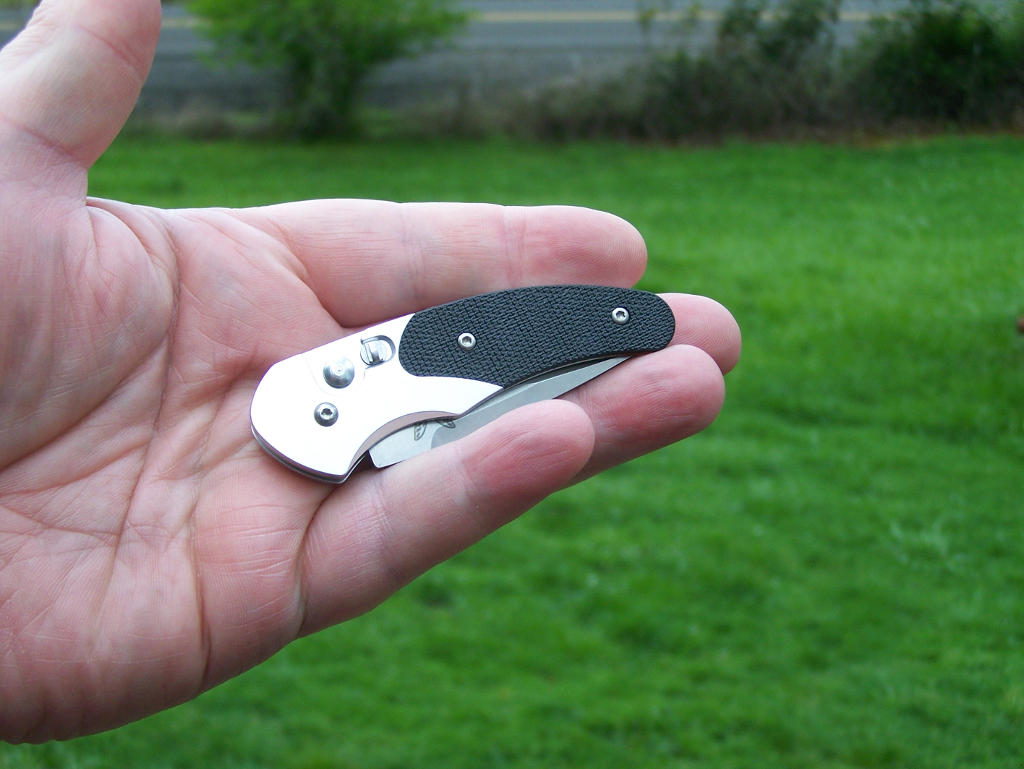
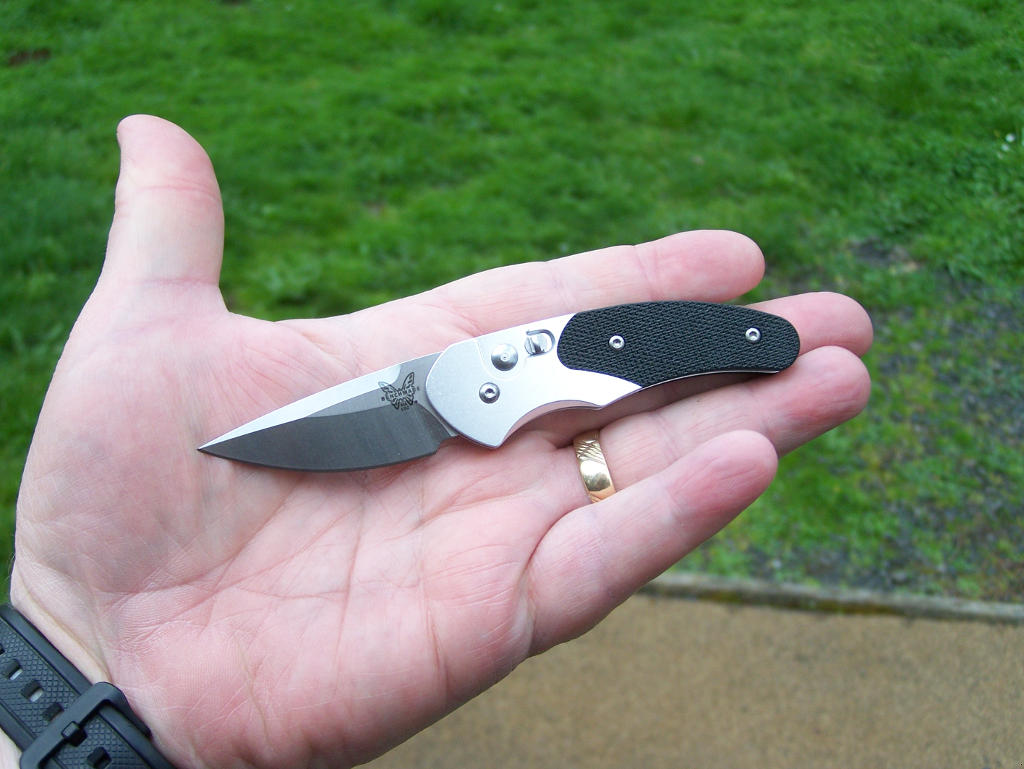
There are some really nice and expensive gent folders out there these days. Some custom knife makers only produce gent’s folders, and there is a big market for this type of knife. I recently received the Impel automatic folder, and one doesn’t usually associate an automatic folder as being a Gent’s knife. However, in my humble opinion, the Impel is without a doubt a Gent’s folder.

100_5865

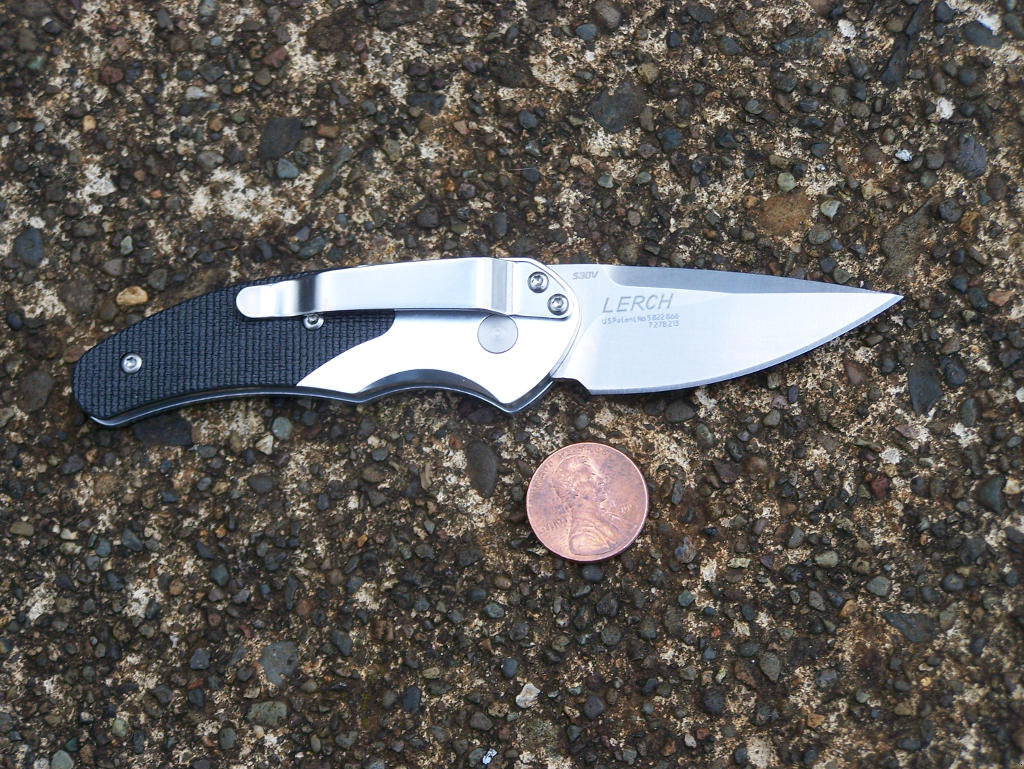
A quick look at the Impel shows that it has a small 1.98-inch long blade, manufactured out of S30V premium stainless steel– one of the better powdered metals used for knife blades. Rockwell hardness is 58-60, which is just right for this stainless steel. The blade is a modified drop point– one of the most popular blade designs and great for all kinds of chores. The handle scales are machine aluminum with super-tough G-10 inlays in the handle scales and a tip-down pocket/clothing clip. Then we have the push button for fast automatic opening. We also have a manual safety on the Impel that locks the blade closed, so there are no worries about it accidentally opening when in your pocket. However, I’ve owned a lot of automatic folders over the years and have never used any safety; it only slows down opening the knife, if you have to search for the safety with your thumb to take it “off” in order to open the knife. The Impel was designed by custom knife maker Matthew Lerch, who is well-known in the knife industry, and this isn’t his first collaboration with Benchmade, either.

A close examination of the Impel shows the usual high-quality one expects from Benchmade. The knife is absolutely flawless in all respects. I’ve owned custom-made knives that weren’t as nicely made as the Impel. I like the G10 inlays in the aluminum handle scales. It’s a nice touch!

100_5866

With the 1.98-inch long blade, the Impel is perfect for opening UPS/FedEx packages that arrive almost daily at my digs. A quick “zip” through the sealing tape and a package is opened for me. The Impel is also great for opening letters instead of using a letter opener. The Impel is more efficient at this task, if you ask me. I removed a splinter from my hand with the Impel.

I tested blade sharpness by cutting some cotton clothes line, and the Impel zipped right through it. I also tested blade sharpness on some poly rope; the Impel sliced right through it, too. Another good test is shaving the edge of newsprint if you want to test how sharp a knife’s blade is. Many simply won’t shave newsprint, but it was no problem with the Impel, and even though I’m no gentleman (my wife says I am) I used the Impel to clean beneath my finger nails. However, one needs to go VERY carefully with the Impel’s needle-like point and the overall sharpness of the blade. While I didn’t cut myself while cleaning beneath my finger nails, I can easily see that happening, if one doesn’t pay attention.

So, where does the Impel fit into the scheme of things, when it comes to survival? That’s a good question. I’m sure this will be open to debate. Having spent 35 years in the martial arts and teaching knife fighting and knife defense skills to students, I can see the Impel being used as a weapon of last resort, if one’s life is in danger. The Impel could be used to jab a person in the eyes. If an attacker can’t see you, they can’t harm you. In a last ditch move, the Impel could be use to severe a ceratoid artery in the neck. You don’t have to have a long blade to reach an artery in the neck; not at all. The Impel can also be used out camping or in a survival situation to make a “fuzzy stick” to aid in starting a fire. It can even be used to dress out small game, like a rabbit for a meal.

My understanding is, and I could be mistaken on this, the Impel with it’s 1.98-inch blade is legal in California, even though it is an automatic opening folder. I recall reading some place that if the blade is two inches or under, it is legal in California. Plus, many police officers, who might have reason to pat you down, wouldn’t think that a knife with such a short blade would be considered a weapon of any sort, either. [Editors Note: Californians, you are responsible for ensuring compliance with your state and local laws.]

I would mention that when you press the button to open the blade on the Impel, make sure you have a good grip on the little knife; the coiled spring really slings that blade open, and on more than one occasion the knife left my hand because I didn’t have a good enough hold on it. I didn’t expect the spring to be that powerful.

Full retail pricing on the Impel is $165. That’s quite a bargain in my book. We are talking custom-quality in a Gent’s folding knife. It’s one that you would be proud to show off, while cleaning beneath your finger nails during a boring meeting. Little knives DO have their place!

– Senior Product Review Editor, Pat Cascio


Recipe of the Week: A Prepper’s Pierogi Casserole, by Mags

This recipe can be made with fresh ingredients, leftovers, or with freeze-dried/canned ingredients. There are lots of options for personalizing it, too. You can use whatever meat you prefer– beef, bacon, ham, turkey, venison, or even chopped jerky that’s left over after a hunting or camping trip (if it’s even possible to have leftover jerky).

Ingredients:

  • 9 lasagna noodles, uncooked
  • 4 cups of mashed potatoes, hot or reheated (or use about 1 1/2 cups of potato flakes mixed into about 3 1/2 cups of hot water)
  • 4 ounces of herb & garlic cream cheese (or use reconstituted powdered cream cheese and add 1/2 tsp. garlic powder, 2 tsp dried basil, 2 tsp dried parsley, and 2 tsp dried chives)
  • 1/2 cup finely sliced or chopped green or red onions (or use freeze-dried onion or freeze-dried garlic chives)
  • 3/4 lb of cooked meat bits (hot dogs chopped up, ham chunks, cooked bacon pieces, crumbled and cooked ground beef, cooked turkey sausage, venison jerky pieces, beef jerky pieces, cooked turkey bacon pieces, spam cubes, or whatever you have on hand)
  • 2 cups of shredded cheddar cheese (or moistened freeze-dried cheddar cheese)

Directions:

  1. Preheat oven to 375 degrees, and coat a 13×9 inch rectangular baking dish with cooking spray. Set dish aside.
  2. Bring a large pot of water to boil; add 1/2 tsp salt and add lasagna noodles, cooking noodles according to package instructions.
  3. While noodles are boiling, combine all of the mashed potatoes, cream cheese, and onions, plus 2/3 of the meat and half of the cheese. Stir together well.
  4. Spread three of the cooked noodles across the bottom of the oiled baking dish. Then, spread a total 1/3 of the mashed potato/meat/cheese mixture over the three lasagna noodles.
  5. Lay three more lasagna noodles on top of the potato/meat/cheese mixture; spread 1/3 of the mixture on top of these three noodles, and repeat once more with the final three noodles and final 1/3 potato/meat/cheese mixture.
  6. Sprinkle the remaining meat on the top layer of potato/meat/cheese mixture. Then, sprinkle the remaining cheese over the meat.
  7. Cover with a lid or foil. Bake 30 minutes or until thoroughly heated throughout and cheese begins to brown a little. Serve warm.

o o o

Do you have a favorite recipe that would be of interest to SurvivalBlog readers? Please send it via e-mail. Thanks!


Letter Re: Digital Security

HJL,

Where TrueCrypt left off, VeraCrypt has picked up the baton. (It has the exact same interface, same features with improvements made behind the scenes.)

The TrueCrypt letter specifically said that there “May still be unresolved security issues…” They didn’t say it wasn’t secure. They were quite vague. They were in the middle of an audit and quit before the results came out. VeraCrypt takes the results of the audit and appeared to correct some of the very minor issues. I was impressed by how few they are (i.e., increasing some iterations from a few thousand to hundreds of thousands), and bringing parts of the coding to current standards. They have a FAQ on their website. The transition has been stable for me. – C.S.


Odds ‘n Sods:

Something is rotten in Albany…

o o o

I just ran across this interesting post at my old friend Commander Zero’s blog: See the red button? Push the red button. – JWR

o o o

Mike Williamson, SurvivalBlog’s Editor At Large pointed out a review of the Ruger SR1911.

o o o

Looks like things just took a turn for the worse in Mexico: The Rising. – M.S.

o o o

Education Secretary Sets The Stage For ‘Public Boarding Schools’. As scary as the thought of this is, you will find parents in favor of it. Hey, it’s free babysitting. – H.L.