Hugh’s Quote of the Day:

“Jesus saith unto her, Said I not unto thee, that, if thou wouldest believe, thou shouldest see the glory of God? Then they took away the stone from the place where the dead was laid. And Jesus lifted up his eyes, and said, Father, I thank thee that thou hast heard me. And I knew that thou hearest me always: but because of the people which stand by I said it, that they may believe that thou hast sent me. And when he thus had spoken, he cried with a loud voice, Lazarus, come forth. And he that was dead came forth, bound hand and foot with graveclothes: and his face was bound about with a napkin. Jesus saith unto them, Loose him, and let him go.” John 11:40-44 (KJV)


Notes for Saturday – May 30, 2015

Today, we present another entry for Round 58 of the SurvivalBlog non-fiction writing contest. The $12,000+ worth of prizes for this round include:

First Prize:

  1. A Gunsite Academy Three Day Course Certificate, good for any one, two, or three course (a $1,195 value),
  2. A course certificate from onPoint Tactical. This certificate will be for the prize winner’s choice of three-day civilian courses. (Excluding those restricted for military or government teams.) Three day onPoint courses normally cost $795,
  3. DRD Tactical is providing a 5.56 NATO QD Billet upper with a hammer forged, chromlined barrel and a hard case to go with your own AR lower. It will allow any standard AR type rifle to have quick change barrel, which can be assembled in less than one minute without the use of any tools, and a compact carry capability in a hard case or 3-day pack (an $1,100 value),
  4. Gun Mag Warehouse is providing 20 Magpul pmags 30rd Magazines (a value of $300) and a Gun Mag Warehouse T-Shirt. (An equivalent prize will be awarded for residents in states with magazine restrictions.),
  5. Two cases of Mountain House freeze dried assorted entrees in #10 cans, courtesy of Ready Made Resources (a $350 value),
  6. A pre-selected assortment of military surplus gear from CJL Enterprize (a $300 value),
  7. A Model 120 Series Solar Generator provided by Quantum Harvest LLC (a $340 value),
  8. A $300 gift certificate from Freeze Dry Guy,
  9. A $250 gift certificate from Sunflower Ammo,
  10. KellyKettleUSA.com is donating both an AquaBrick water filtration kit and a Stainless Medium Scout Kelly Kettle Complete Kit with a combined retail value of $304,
  11. TexasgiBrass.com is providing a $300 gift certificate, and
  12. Two cases of meals, Ready to Eat (MREs), courtesy of CampingSurvival.com (a $180 value).

Second Prize:

  1. A Glock form factor SIRT laser training pistol and a SIRT AR-15/M4 Laser Training Bolt, courtesy of Next Level Training, which have a combined retail value of $589,
  2. A FloJak EarthStraw “Code Red” 100-foot well pump system (a $500 value), courtesy of FloJak.com,
  3. Acorn Supplies is donating a Deluxe Food Storage Survival Kit with a retail value of $350,
  4. The Ark Institute is donating a non-GMO, non-hybrid vegetable seed package–enough for two families of four, seed storage materials, a CD-ROM of Geri Guidetti’s book “Build Your Ark! How to Prepare for Self Reliance in Uncertain Times”, and two bottles of Potassium Iodate– a $325 retail value,
  5. A $250 gift card from Emergency Essentials,
  6. Twenty Five books, of the winners choice, of any books published by PrepperPress.com (a $270 value),
  7. TexasgiBrass.com is providing a $150 gift certificate, and
  8. RepackBox is providing a $300 gift certificate to their site.

Third Prize:

  1. A Royal Berkey water filter, courtesy of Directive 21 (a $275 value),
  2. A large handmade clothes drying rack, a washboard, and a Homesteading for Beginners DVD, all courtesy of The Homestead Store, with a combined value of $206,
  3. *Expanded sets of both washable feminine pads and liners, donated by Naturally Cozy (a $185 retail value),
  4. Two Super Survival Pack seed collections, a $150 value, courtesy of Seed for Security,
  5. Mayflower Trading is donating a $200 gift certificate for homesteading appliances,
  6. APEX Gun Parts is donating a $250 purchase credit,
  7. Montie Gear is donating a Y-Shot Slingshot and a Locking Rifle Rack (a $379 value), and
  8. Two 1,000-foot spools of full mil-spec U.S.-made 750 paracord (in-stock colors only) from www.TOUGHGRID.com (a $240 value).

Round 58 ends on May 31st, so get busy writing and e-mail us your entry. Remember that there is a 1,500-word minimum, and that articles on practical “how to” skills for survival have an advantage in the judging.


Compressed Air Well Pump and Pressurized Home Water System Bubbles- Part 2, by H.W.

Acquiring Parts

To build this pump, I wandered for about two hours through the plumbing section of one of the big box home improvement stores. I love it when the guys who work there come up to me and ask what I’m looking for. I tell them I have no idea, and then I show them the back of my envelope with still-wet scribbles, as I design my project in real-time while I’m walking through the store! They see this a lot, I think. It might be called Home Depot engineering.

I’ve noticed that the big box stores have stopped carrying many of the parts I used in my pump. I guess the market for these oddball parts is not too large. However, you should be able to find them at a plumbing supply house locally. Just take a lunch and ask if you can wander through the warehouse!

To connect the parts, I used generous amounts of PVC cement. I also ran two stainless steel sheet metal screws through the end caps into the PVC pipe with some cement in the pre-drilled holes, just to be sure it would all stay together. Heating the screws before installation makes for a permanent fit. Don’t rely just on glue to hold the weight of the pump; it could be an expensive mistake if you loose the pump or parts of it down the hole!

The check valves are the most expensive parts of this pump, costing about $20 each. They are brass. My water has a lot of lime in it, but the valves have continued to work well in spite of that. You might want to put a filtered foot valve on the bottom of the pump, if your water contains a lot of silt.

One Internet source recommended removing the springs from the check valves, but this will totally disable the pumping action, so please ignore that advice.

On the compressor side, it’s a good idea to use a filter on the air line going to the pump, as you don’t want to be drinking whatever crud is in your air tank. This made me a bit leery about using compressed air, especially since we have no idea what is going into these Chinese compressors that we buy from the discount tool stores. However, I have had no problems or funny taste in the water with the filter in line.

Water Storage

After getting the water into your home, you will need to store it. You can purchase what are called “doorway tanks” from reputable suppliers. These are poly tanks that will fit through a 30” wide doorway, which are typical of residential installations. I was able to wrangle a 250-gallon tank into an isolated basement utility room with a helper. You should expect to pay about $2 per gallon of capacity for these tanks. The tanks at the farm store typically run $3 to $4 per gallon. My 250-gallon tank cost about $500, delivered on a truck to my door. This one weighs about 100 pounds when empty.

Before installation, I used a garden hose and a new floor mop to clean out the tank in the back yard, with liberal application of bleach. This was a new tank and had not contained any other materials before purchase. Once installed, I did fill the tank and let it sit for about a month before emptying it and refilling. That took care of any plastic odor or taste.

You’ll need to locate the tank on a concrete floor, as water weighs about 8.3 pounds per gallon. My tank weighs over one ton when full!

I set the tank not directly on the concrete but on a piece of concrete backer board used as a foundation for tile projects. Many sources recommended not setting the tank directly on concrete because of absorption of chemicals through the plastic. I’m not too sure about the veracity of that advice, but I compromised by using the backer board. I sprayed the board with some bleach on the bottom side, so that if the tank wept condensation at least I would not have a mold issue. So far, the tank outside has been bone dry, and the water tastes great.

To fill the tank quickly from my regular well pump, I put a tee fitting and ball valve draining into the tank from the incoming well line with an inline cartridge filter. It takes only about 15 minutes to fill the tank initially. I also add bleach to the tank if the water will be sitting for a considerable period. I use a liquid ounce of bleach for the 250-gallon tank. The odor is detectable, but not objectionable, and the water is crystal clear.

Raising Water to Upper Levels of House

I pondered how to get the water out of the tank in the basement up to the living levels of the house. Eight point three pounds per gallon is not a wife-friendly number when carried up the basement steps! I first bought some foot operated galley pumps that you might find on a boat. These worked merely okay, but they did not seem to hold their prime. I would have had to pump for a while to be able to brush my teeth.

Next, I researched electric water pumps and found that the RV industry has a ton of options. I settled on a 12V pump that has a servo controller to provide proportional pumping action, to maintain a constant pressure. This pump was about $250 at a camping gear chain store. There are less expensive pump options with the usual pressure switch at about half that price. These pumps will run dry without damage, in case the tank empties.

With the pump in hand, I plumbed it into my house’s system. I ran a spare piece of half-inch PEX from the water tank over to the pump, which is near my well pressure tank and main cutoff valve. This had to go up and over a wall, and it turns out I needed a check valve at the tank end to prevent the supply line from draining dry with the pump off. From the output of the pump I ran the line through a manual valve and then into my main water supply pipe.

I have the two manual valves situated so I can supply the main house water line from the well and pressure tank, or from the 12-volt RV water pump. The servo controller in the RV pump is confused by the pressure tank, and the instructions say to avoid using one with that pump. When the pressure tank is on the line, the servo controller generally works, but when no water is running the RV pump sometimes turns on at a very slow speed or oscillates. Turning off the valve to my main well and pressure tank line solves that problem.

The proportional action of the RV pump means that it does not run full bore when running the water slowly. When taking a shower, the pump runs flat out and makes a bit of noise in the basement, but we cannot hear it on the first floor of the house. I run the RV pump from my 12V solar batteries through a Rigrunner fused power feed block. The pump draws about 8 amps maximum (100 watts) and uses a lot less when it’s running slowly.

It is very nice to have pressurized water running through my normal house plumbing even when the power is out. My family has not expressed any reservations. In fact, the RV pump maintains a constant 30PSI, while the regular well pump with pressure switch allows the pressure to roam over the typical wider range of 25-50PSI. I actually like the constant water pressure better.

Another of the aspects of this system I like is that all the equipment down in the hole is not electric, and so it is not susceptible to EMP. If you keep your air compressor and power source shielded, you can have water whenever you need it.

Expense

As for my costs, not including solar power, here is the breakdown:

PVC pump parts: $100
PEX tubing, 500ft: $129
Wire rope, 1/8 inch: $61
Well cap: $15
Air compressor, 20 gal: $250
Water tank, 250 gal: $500
Air valve control rig: $75
RV water pump: $250
Total: $1380

I hope my experience will help those of you with electric well pumps have some other options to get water out of the ground after the lights go off. Keep your powder dry, water wet, and be ready for constitutional reconstruction after the crash!


Letter Re: Historians Perspective At Natural Diets Link

Mr. Hugh,

There are significant facts to be gleaned from the post: A Plea For Culinary Modernism. This post should be read by all. This should be read slowly to glean the correct viewpoints. For example: Those who are not “prepared” will be thrust back to the 1200’s and gathering roots and berries, which will kill them due to their lack of knowledge. We have been enjoying fresh chick weed salads from random patches of weeds from our fence rows this spring. It tastes 10 times as good as lettuce from the store.

Some think that if not prepared, they will just return to the days of the “wild west” and ride horses. This is not true, because there are not enough trained horses, blacksmiths, or people who have the tools or knowledge to trim their own horses hooves. There are not enough wagons for horses to pull. Most of the horse-drawn plows are rusting away in people’s front yards as “decorations”. People today can’t think outside the box enough to improvise if a major disruption wrecks life as we know it.

As for me and my food choices, I totally reject McDonald’s. I prefer food that is not that “processed”. Everything they sell is “factory” to me. There are fast food places where I will eat. My favorite type of “fast food” is when I go to my freezer and take out a link of smoked sausage made from a pig I butchered, ground, stuffed, and smoked myself and nuke it for a sandwich. I certainly don’t want to go back to the “primitive food” days, but our society has gone too far in the other direction. At our farm we raise and can our own green beans, butter beans, purple hull peas, pumpkins, squash, and corn. We also raise our own potatoes and save seed for the next planting. I just finished butchering, cutting up, and wrapping two (250 lb) pigs. I’m making and smoking bacon and sausage at this time. I have a 600+ pound calf being fed out to butcher in a month or so.

As far as time at the “grindstone”, I have my own hand powered grain mill for grinding wheat and corn into corn meal and wheat into flour. I have a friend whose wife does not cook. They eat out or do take home most of the time. Sometimes I take him a serving of our “leftovers” of fresh vegetables, meat, and cornbread. He notices the next day how much more vitality and energy he has after he eats this. This lasts for one day, and then he returns to his previous state. I just wanted to provide a little perspective to a very good article. – MER


Economics and Investing:

JPMorgan Chase & Co. Warns Greece “Is Not Investable” As Germany Denies Any Deal Progress

o o o

Inflation acts as a pickpocket on the wallets of working Americans: Young Americans take a big hit given the small weight given to tuition in the CPI.

o o o

Millennials in Texas and in California reject home ownership for vastly different reasons. – H.L.

o o o

Lunch With Elvis (Sarcasm and fantasy)

o o o

This Is What Happens When A Millennial Tries To Get A Job. – H.L.


Hugh’s Quote of the Day:

“Speak to Aaron and to his sons, saying, ‘Thus you shall bless the sons of Israel. You shall say to them:
The Lord bless you, and keep you;
The Lord make His face shine on you, And be gracious to you;
The Lord lift up His countenance on you, And give you peace.’
So they shall invoke My name on the sons of Israel, and I then will bless them.” Numbers 6:23-27 (KJV)


Notes for Friday – May 29, 2015

Today, we present another entry for Round 58 of the SurvivalBlog non-fiction writing contest. The $12,000+ worth of prizes for this round include:

First Prize:

  1. A Gunsite Academy Three Day Course Certificate, good for any one, two, or three course (a $1,195 value),
  2. A course certificate from onPoint Tactical. This certificate will be for the prize winner’s choice of three-day civilian courses. (Excluding those restricted for military or government teams.) Three day onPoint courses normally cost $795,
  3. DRD Tactical is providing a 5.56 NATO QD Billet upper with a hammer forged, chromlined barrel and a hard case to go with your own AR lower. It will allow any standard AR type rifle to have quick change barrel, which can be assembled in less than one minute without the use of any tools, and a compact carry capability in a hard case or 3-day pack (an $1,100 value),
  4. Gun Mag Warehouse is providing 20 Magpul pmags 30rd Magazines (a value of $300) and a Gun Mag Warehouse T-Shirt. (An equivalent prize will be awarded for residents in states with magazine restrictions.),
  5. Two cases of Mountain House freeze dried assorted entrees in #10 cans, courtesy of Ready Made Resources (a $350 value),
  6. A pre-selected assortment of military surplus gear from CJL Enterprize (a $300 value),
  7. A Model 120 Series Solar Generator provided by Quantum Harvest LLC (a $340 value),
  8. A $300 gift certificate from Freeze Dry Guy,
  9. A $250 gift certificate from Sunflower Ammo,
  10. KellyKettleUSA.com is donating both an AquaBrick water filtration kit and a Stainless Medium Scout Kelly Kettle Complete Kit with a combined retail value of $304,
  11. TexasgiBrass.com is providing a $300 gift certificate, and
  12. Two cases of meals, Ready to Eat (MREs), courtesy of CampingSurvival.com (a $180 value).

Second Prize:

  1. A Glock form factor SIRT laser training pistol and a SIRT AR-15/M4 Laser Training Bolt, courtesy of Next Level Training, which have a combined retail value of $589,
  2. A FloJak EarthStraw “Code Red” 100-foot well pump system (a $500 value), courtesy of FloJak.com,
  3. Acorn Supplies is donating a Deluxe Food Storage Survival Kit with a retail value of $350,
  4. The Ark Institute is donating a non-GMO, non-hybrid vegetable seed package–enough for two families of four, seed storage materials, a CD-ROM of Geri Guidetti’s book “Build Your Ark! How to Prepare for Self Reliance in Uncertain Times”, and two bottles of Potassium Iodate– a $325 retail value,
  5. A $250 gift card from Emergency Essentials,
  6. Twenty Five books, of the winners choice, of any books published by PrepperPress.com (a $270 value),
  7. TexasgiBrass.com is providing a $150 gift certificate, and
  8. RepackBox is providing a $300 gift certificate to their site.

Third Prize:

  1. A Royal Berkey water filter, courtesy of Directive 21 (a $275 value),
  2. A large handmade clothes drying rack, a washboard, and a Homesteading for Beginners DVD, all courtesy of The Homestead Store, with a combined value of $206,
  3. *Expanded sets of both washable feminine pads and liners, donated by Naturally Cozy (a $185 retail value),
  4. Two Super Survival Pack seed collections, a $150 value, courtesy of Seed for Security,
  5. Mayflower Trading is donating a $200 gift certificate for homesteading appliances,
  6. APEX Gun Parts is donating a $250 purchase credit,
  7. Montie Gear is donating a Y-Shot Slingshot and a Locking Rifle Rack (a $379 value), and
  8. Two 1,000-foot spools of full mil-spec U.S.-made 750 paracord (in-stock colors only) from www.TOUGHGRID.com (a $240 value).

Round 58 ends on May 31st, so get busy writing and e-mail us your entry. Remember that there is a 1,500-word minimum, and that articles on practical “how to” skills for survival have an advantage in the judging.


Compressed Air Well Pump and Pressurized Home Water System Bubbles – Part 1, by H.W.

There have been many great articles and letters on SurvivalBlog recently regarding alternative, non-electric, or low power well pumps. I’ve built an alternative well pump that runs on compressed air. It does require electricity to compress the air, but an air compressor can be run off a modest solar/battery rig easily and can pump a decent amount of water suitable for an emergency situation. I’d like to describe how I built this pump and how it works.

First, let me say that there are various air-operated pumping systems out there, including variations of this one; there are also some you can buy off the shelf. This is not my original idea, and you should take a look at videos of what others have done, including simpler air lift pumps. However, this pump work well for my well, which is too deep for a surface hand or electric pump with simple drop tube, and it would be rather expensive to install one of the higher quality deep hand/electric pumps, like Simple Pump or Bison Pump. I was looking for something I could build and not break the bank as well as something I could power from my solar setup AND not have to send my wife out in the snow to hand pump a bucket of water for my morning bath.

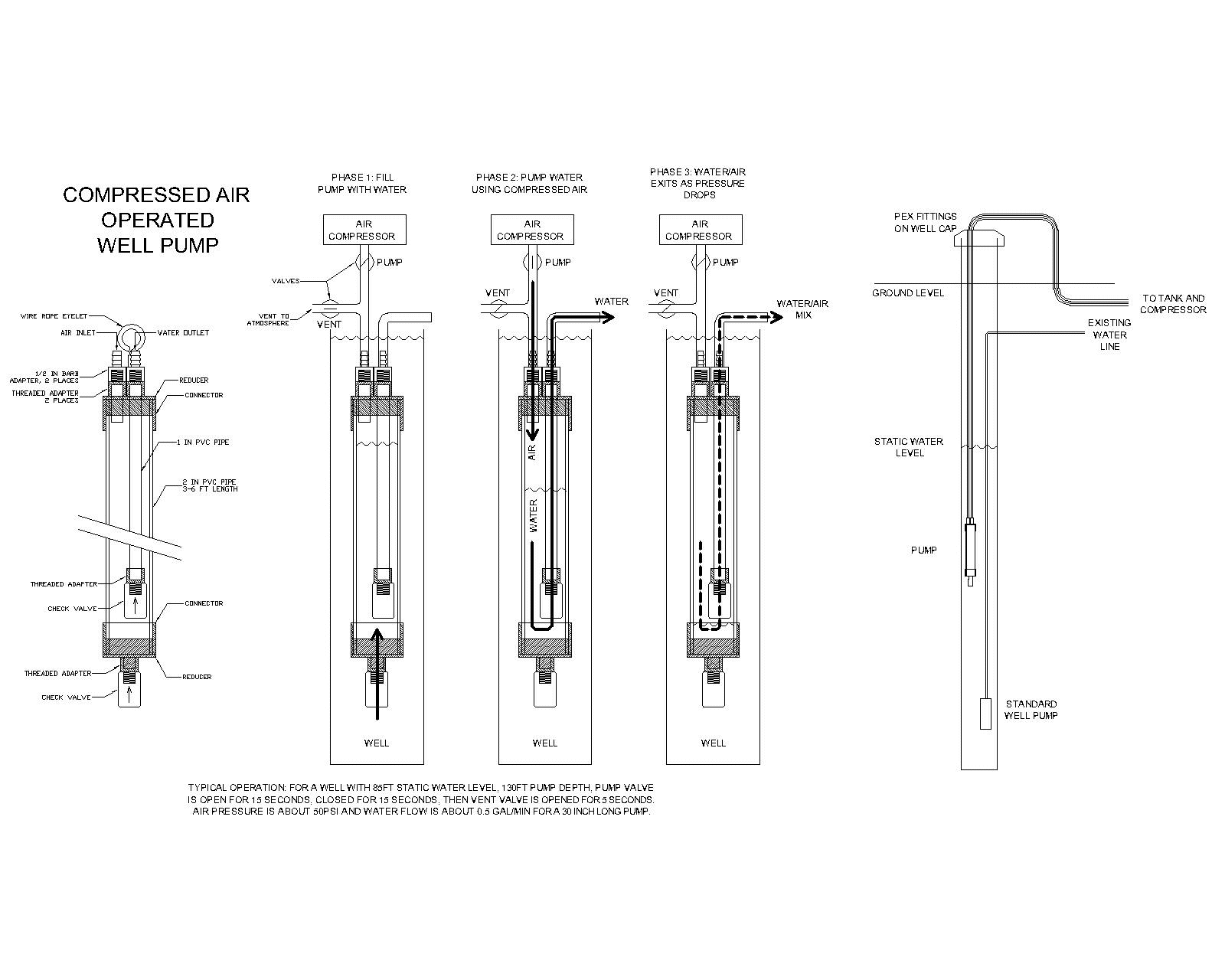
See the drawing of the well pump: wellpump
Pipe and Fitting Material

This pump is made from PVC pipe and fittings, and the lines are PEX tubing. When purchasing PVC materials for water supply applications, be sure to look for the “NSF-PW” marking, meaning the products can be used for potable water. Some PVC is marked for drain and wastewater use only. The PEX tubing should be rated for water supply applications. If you are squeamish about using PVC in your water system, you can make the pump out of copper pipe and fittings. When purchasing brass fittings for potable water use, be sure they are marked “lead free”.

Interesting Story About Toxicity

I selected a brass valve off the shelf at a big box home improvement store and took it to the checkout. The bar code would not register the price, and the clerk did some digging and told me that the part was being recalled because of high lead content! Thank you, China. At least they caught it, but what about the other 20 valves I’ve purchased over the years? At least after the crash we won’t be importing as much poison from Asia.

Pump Phases of Operation

This air operated pump produces water in bursts, and the air must be cycled on and off at regular intervals of two or three times a minute. Being an electronics guy, I built an automatic, timed controller using some 12-volt solenoid valves I purchased off of ebay, but you can easily use ball valves and cycle them manually. Filling the water tank is something that your kids can learn to do, as there’s no way to unintentionally hurt anything. Turning a couple ball valves takes a lot less sweat than pumping water from 200 feet down with your arms or feet!

There are three phases to the operation of the pump. The first phase fills the pump with water. The lower check valve opens (see diagram) and the pump and PEX lines fill with water to the static level in the well. This is the normal condition of the pump and water when it is sitting idle. To get the pump to fill, the air line is opened to atmosphere. The water line is always open to atmosphere above ground.

The second phase involves closing the atmospheric vent in the air line and then gating the compressed air into that line. The compressed air pressurizes the system, forcing water out of the pump, up the other line, and into your tank, bucket, dog dish, or long-term survival hot tub.

The third phase starts when the pump empties and some air starts coming out of the water line. The pump valve is closed, and the remainder of the water/air mix is allowed to dribble out as the system depressurizes. The check valve in the water exit pipe inside the pump prevents any remaining water in the line from draining down into the pump again, to avoid pumping the same water multiple times. This check valve could probably be eliminated, with some energy waste resulting, but I have not tried this.

The cycle then repeats.

Water Pump Speed and Durability

The amount of water pumped per burst depends on the volume of the pump body and PEX lines below the static water level. My pump is about 30 inches in length, but it could be made almost arbitrarily longer. I get about a half gallon a minute of flow.

I have dropped my two-inch diameter pump into the well beside the existing water and electrical line in the six-inch well casing. You can adjust the diameter and length of the pump to be compatible with your setup. The hexagonal plastic caps on the end of the PVC pipe make the pump about three inches in diameter.

For the air supply and water lines, I use half-inch PEX tubing. The pump is quite light, and I can install and remove it by myself at a depth of about 125 feet. The PEX tubing is pretty difficult to work with because of the coiled set it takes when rolled hot at the factory. You won’t want to be working with it on a cold day! I’ve not had much problem on warmer days, but it’s still pretty stiff. When putting the pump down the well, I use a bucket of bleach water and a rag to wipe down the tubing as it goes into the hole, to avoid introducing surface contaminants into the well water.

The compressor I use is a 20 gallon / 2HP unit from a discount tool store. It runs fine in this application. The pressure regulator is adjusted for about 50PSI. I tried a small pancake compressor, but it simply does not produce the volume of air required to pump much water. Think about it. If you want to pump 100 gallons of water, you’ll need to push at least 100 gallons of air through the pump. My solar setup consists of about 500W of panels, a charge controller, and a large truck battery; it’s nothing fancy or expensive. A 2000W inverter runs the compressor nicely.

In the drawing you will see an eye bolt on the top of the pump. The PEX tubing is plenty strong to drag the pump up out of the well, but just to be sure I attached a one-eighth-inch, plastic-covered, wire rope to the eyelet and to a matching eyelet on the underside of the well cap. If the tubes come loose for some reason, I can still fish the pump out of the hole.

My well casing is steel, and the inside of it is quite rusty. It takes some force to shove the pump and PEX tubing down the hole. You need to be careful that there are no outside parts of the pump that can wear and be damaged as you do this. A PVC well casing would not be so rough.

For water connections at the surface, I put brass fittings on the well cap, rather than digging down and cutting a hole in the side of the well casing. I bought a new well cap to use, as they are pretty inexpensive, and I kept the old one as a spare. The PEX tubing is attached to the brass barbs on the underside of the well cap, with hose clamps securing the connections. I used a torch to heat the PEX a bit before pushing it onto the barbs and tightened the hose clamps before the tubing cooled. The tubing is now conformed to the barbs and won’t be coming off any time soon.

Since the water lines come out of the top of the well cap (parallel to the ground using right angle fittings), they are subject to freezing in the winter. However, both lines are filled with air when idle. You can run the air compressor for 30-60 seconds to blow the air lines dry at the end of your pumping session. In that way, the lines do not freeze closed. The water coming out of the well runs about 50 degrees year round and warms the lines in freezing weather. Our lowest temperature in the winter is typically in the teens, so you might have to bury the lines completely if you live in a colder clime.

The PEX lines are run underground to the house through the concrete foundation wall. PEX is rated for burial, but rocky dirt might be a problem and require a sheath, which could simply be some more PVC pipe sections. The air compressor sits in the basement, alongside a water tank. You can barely hear the compressor running outside the house, as opposed to my loud 5KW generator needed to run my regular well pump.

My system is designed to just pump a few dozen gallons a day, and this is compatible with my smallish solar arrangement. However, with a larger solar capacity, a longer pump, and perhaps larger diameter water and air tubes, you could pump gallons per minute of water.

Letter Re: An Emergency Hand Pump For A Well, by C.P.

HJL,

Hi, this article sounds good, but I have a couple of questions about construction of the well pump described. Is the mentioned diagram available for the design of the 1&1/4″ assembly above the well cap? Also, I’m surprised there isn’t a seal or check valve on the bottom of the piston. Is this to simplify design, by sacrificing efficiency? Would the gpm and maximum pumping depth increase if these were included in the design? The idea fills a need for many preppers. We just need more info. – J.J.

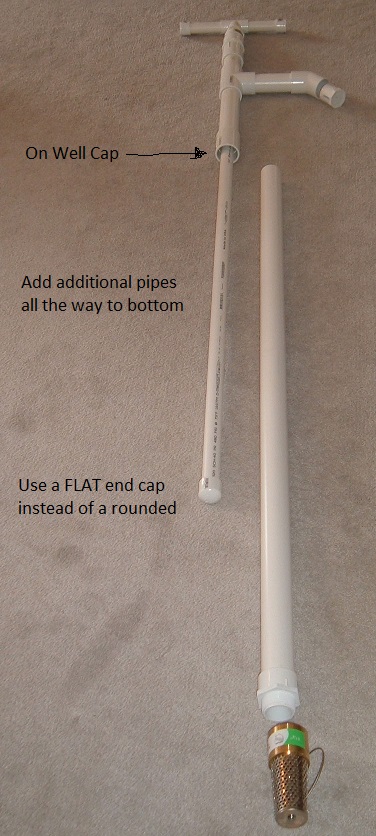
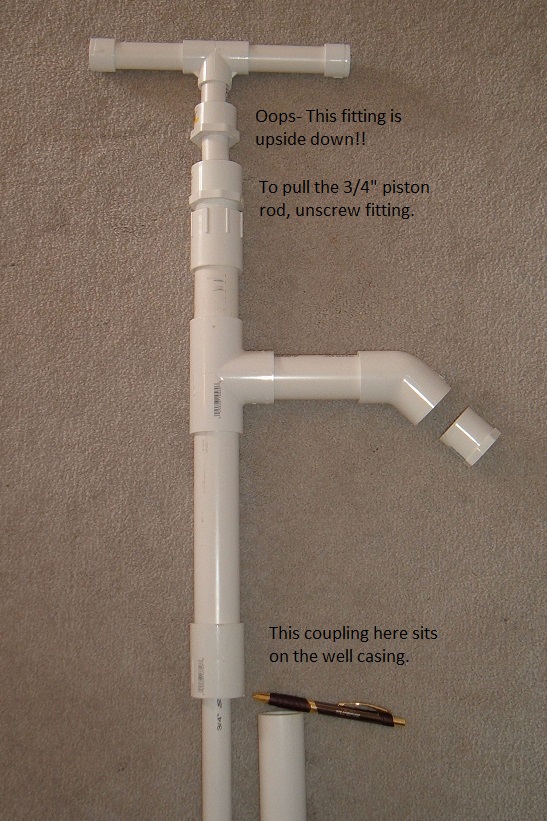
HJL Responds: We sent the request on to the author, and he sent back these pictures for you, showing the construction of the well pump and its operation along with this explanation:

WellPumppics_002bWellPumppics_010adadhandpump_009

“The bottom of the piston has a flat end cap for the “seal”, and no “check valve” is necessary for this design. There is very little clearance inside the 1-1/4 inch pipe when moving the piston up and down– maybe an eight of an inch around the end cap. So pulling up opens the foot valve; pushing down closes it and forces the water up to the outlet.”


Odds ‘n Sods:

Sephardic Jews Leave Turkey for Spain Fleeing ‘Unnerving’ Wave of Anti-Semitism. – H.L.

o o o

Over at Commander Zero’s blog: Thoughts on the PTR-91

o o o

Thanks to SurvivalBlog reader T.P. I haven’t seen anything this ridiculous since I sold my .50AE Desert Eagle, but it sure does look fun! – Video: Dual, Double bbl. .45’s….. in slow motion !

o o o

Bill Gates just described his biggest fear — and it could kill 33 million people in less than a year. – G.P.

o o o

New Media ( anti-Google, anti Collective, anti-Shills ) Web Browser. Good luck. Hope they have a really good IT security staff. – T.P.


Notes for Thursday – May 28, 2015

Michael Z. Williamson (SurvivalBlog’s Editor At Large) has had his latest science fiction novel released by Baen Books. This one is titled A Long Time Until Now. It is a time travel tale, with an interesting twist. SurvivalBlog readers should find it of particular interest, because the protagonists are thrust into an extremely austere environment with NO infrastructure, so they need to almost entirely improvise their sustenance and defenses. So this is both an exciting read, and it’s educational. Great reading! – JWR

o o o

The World’s Unraveling: Are You Ready? Don’t forget Safecastle’s Mountain House Food Sale with discounts up to 32% and survival goodies thrown in!

o o o

Today, we present another entry for Round 58 of the SurvivalBlog non-fiction writing contest. The $12,000+ worth of prizes for this round include:

First Prize:

  1. A Gunsite Academy Three Day Course Certificate, good for any one, two, or three course (a $1,195 value),
  2. A course certificate from onPoint Tactical. This certificate will be for the prize winner’s choice of three-day civilian courses. (Excluding those restricted for military or government teams.) Three day onPoint courses normally cost $795,
  3. DRD Tactical is providing a 5.56 NATO QD Billet upper with a hammer forged, chromlined barrel and a hard case to go with your own AR lower. It will allow any standard AR type rifle to have quick change barrel, which can be assembled in less than one minute without the use of any tools, and a compact carry capability in a hard case or 3-day pack (an $1,100 value),
  4. Gun Mag Warehouse is providing 20 Magpul pmags 30rd Magazines (a value of $300) and a Gun Mag Warehouse T-Shirt. (An equivalent prize will be awarded for residents in states with magazine restrictions.),
  5. Two cases of Mountain House freeze dried assorted entrees in #10 cans, courtesy of Ready Made Resources (a $350 value),
  6. A pre-selected assortment of military surplus gear from CJL Enterprize (a $300 value),
  7. A Model 120 Series Solar Generator provided by Quantum Harvest LLC (a $340 value),
  8. A $300 gift certificate from Freeze Dry Guy,
  9. A $250 gift certificate from Sunflower Ammo,
  10. KellyKettleUSA.com is donating both an AquaBrick water filtration kit and a Stainless Medium Scout Kelly Kettle Complete Kit with a combined retail value of $304,
  11. TexasgiBrass.com is providing a $300 gift certificate, and
  12. Two cases of meals, Ready to Eat (MREs), courtesy of CampingSurvival.com (a $180 value).

Second Prize:

  1. A Glock form factor SIRT laser training pistol and a SIRT AR-15/M4 Laser Training Bolt, courtesy of Next Level Training, which have a combined retail value of $589,
  2. A FloJak EarthStraw “Code Red” 100-foot well pump system (a $500 value), courtesy of FloJak.com,
  3. Acorn Supplies is donating a Deluxe Food Storage Survival Kit with a retail value of $350,
  4. The Ark Institute is donating a non-GMO, non-hybrid vegetable seed package–enough for two families of four, seed storage materials, a CD-ROM of Geri Guidetti’s book “Build Your Ark! How to Prepare for Self Reliance in Uncertain Times”, and two bottles of Potassium Iodate– a $325 retail value,
  5. A $250 gift card from Emergency Essentials,
  6. Twenty Five books, of the winners choice, of any books published by PrepperPress.com (a $270 value),
  7. TexasgiBrass.com is providing a $150 gift certificate, and
  8. RepackBox is providing a $300 gift certificate to their site.

Third Prize:

  1. A Royal Berkey water filter, courtesy of Directive 21 (a $275 value),
  2. A large handmade clothes drying rack, a washboard, and a Homesteading for Beginners DVD, all courtesy of The Homestead Store, with a combined value of $206,
  3. *Expanded sets of both washable feminine pads and liners, donated by Naturally Cozy (a $185 retail value),
  4. Two Super Survival Pack seed collections, a $150 value, courtesy of Seed for Security,
  5. Mayflower Trading is donating a $200 gift certificate for homesteading appliances,
  6. APEX Gun Parts is donating a $250 purchase credit,
  7. Montie Gear is donating a Y-Shot Slingshot and a Locking Rifle Rack (a $379 value), and
  8. Two 1,000-foot spools of full mil-spec U.S.-made 750 paracord (in-stock colors only) from www.TOUGHGRID.com (a $240 value).

Round 58 ends on May 31st, so get busy writing and e-mail us your entry. Remember that there is a 1,500-word minimum, and that articles on practical “how to” skills for survival have an advantage in the judging.