
Scot’s Product Review: Survival Skills DVD Set Sigma 3 Survival School

I was very impressed with this $49.95 two DVD set. It was well produced and the material clearly presented. There were perhaps three times I wished for captions to identify some of the gear and once a drawing would have helped me understand a point about knife blade grinds, but those are small nits to pick out of an excellent video. It even explained and showed knots so well that I could make them, which is no small task as I am knot deprived.

I am going to jump to almost the end of the two DVD’s to get a quote about the purpose of the videos from instructor Robert Allen, who talks about a “comprehensive survival ideology”. I think the DVDs effectively address that concept with a focus on what Allen calls the critical needs for survival, shelter, water, fire, and food. He notes that most people who don’t survive in the outdoors die of exposure, and being able to cope with that alone would save many lives. Unlike videos that worry about scenarios and bugging out, this presentation assumes you have found yourself in the wild and need the know how to survive. You could be lost, stranded in bad weather, or have some other problem, but what matters is staying alive and knowing techniques that will cover any event. Allen prefers to teach a few techniques that one masters rather than a potpourri of skills that are then not well learned.

While most of the content is aimed at the first three problems (shelter, water, and fire), the DVDs do cover acquiring meat, which is a key to longer-term survival. One can forage for plants, but meat offers more calories and protein than plants.

I was pleased to see the disclaimers that watching a video does not replace training. Training not only means getting instruction from a skilled teacher, it includes practicing the skills as the teacher offers guidance and corrections. While a good video can impart priceless knowledge, it isn’t the same as having a teacher work with you, which brings me to one of the more impressive points during the video. Allen takes a student (Chad Cooper, the owner of Infidel Armor and a SurvivalBlog supporter) through the process of making a bow drill fire starter kit from scratch. Allen had already shown us how to do it in the prior chapter of the video, but watching him then teach Cooper was very valuable to me, both as to picking up additional points as well as reinforcing the benefit of a corrective teacher.

Before we go further, we ought to check out the two instructors in the videos. The primary presenter is Robert Allen– the president and founder of Sigma 3 Survival School, which offers a wide array of classes, primarily in Arkansas and Virginia but also some in Costa Rica and Sweden. They mention looking for a Florida location on their website. Allen is an Army vet with Middle-East deployments and has a long resume of training, both during and after the Army. He has a direct, clear teaching style in the video that worked well for me.

The second presenter is Josh Hamlin, who has an interesting background of actually living in a primitive manner for two years without modern equipment. He speaks of things like how tasty rats are and shows how to make primitive deadfalls as well as water filters one can create from castoff plastic bottles, charcoal, and pine materials. He presents just as clearly and effectively as Allen, though he has far less camera time. He is the lead primitive skills instructor at Sigma 3.

The 3 hours and 27 minutes of video are well organized. Although they present a lot of information based on having nothing with you, they start with a chapter on suggested everyday carry (EDC) gear if one is spending time outdoors. While one can get caught empty handed, it is a wise person who has at least some gear. Allen calls it “life insurance” and discusses what he thinks you should have at all times.

The first item in his EDC is the knife. He likes Mora knives from Sweden for their cost effectiveness, but he also points out some other more expensive knives. This was one area I would have liked even more information than he gave. For example, he discusses the utility of having two knives with different grinds for better versatility, and having a little more detail and perhaps an image of the two grinds would have helped my understanding. Later, when he demonstrated the use of the knives, it became clearer, but I am not as much of a knife guy as I would like to be and Allen struck me as someone who could teach me quite a bit, so I was left wanting more. They could take this as a hint to do a knife video.

His next EDC item might surprise some; it was a folding saw with a 10-inch blade. He makes a compelling argument that it is more useful than an axe, largely because you burn fewer calories using it. It also helps you make some of the cuts used when fabricating things in the wild. Again, he recommends brands over a broad price range.

Additionally, he suggests having a good multi-tool; an oversized poncho is also high on his list of EDC gear, both to wear for protection from weather and for use making a shelter. A stainless steel water container is another must, since it can be used to boil water to make it safe for drinking or for cooking as well as carrying water.

Allen promotes the time honored concept that two is one and one is none. For key needs, you want to have two ways to do things. For fire starting, he likes ferro rods and the ubiquitous Bic lighter along with some Wetfire tinder, which is a commercial product. The lighter and Wetfire can save time and energy when you are in trouble and have no reserves. For insurance, he then teaches how to make a bow drill for fire starting.

Cordage such as paracord in another must, but he adds that Bank line is good to have too along with some picture wire that can be used for making snares.

Also, don’t forget a flashlight, particularly one with multiple light levels that can save battery life and since two is one, a headlamp is a nice addition since it allows hands-free use as well as a back up to the primary.

Some fishing gear with hooks and line is also smart to carry. He goes into pack rods and reels if you have space in your backpack and discusses Yo Yo reels that can be left unattended and will set the hook on their own. I was unfamiliar with these, and they look like a good thing to have. A minimum though would be some hooks and line.

While feeling the saw is more useful, he does discuss axes, and he notes that he likes to carry one when in the woods.

Navigation and first aid are discussed in terms of the suggested equipment, though he doesn’t really get into how to use it.

A huge point both Allen and Hamlin make is that if you have a piece of gear, then you will save the time and energy required to create it when needed. Time and energy are important in any survival scenario; if you consume energy faster than you acquire it, you are losing the battle.

After covering gear, the video moves into how to get things done. This part of the video is the real meat of the discussion. The first topic is caring for our most important tool– the knife. Allen goes over sharpening them and likes the Work Sharp Guided Field Sharpener– a tool I have been using recently and will offer my own review at the end of this article. He also mentions using diamond honing rods and strongly suggests that we wear leather belts as they are so useful for stropping knives.

From tool care, the videos move to shelter. Both cold and warm weather ones are covered using the materials one could find in the woods as well as making them with the cordage and tarp or poncho one might have brought with them. As a resident of the bug laden South, I was impressed with his inclusion of an elevated shelter and a discussion of using smoke to deter insects.

The next subject was water, and I was very intrigued by the sip well Allen and Hamlin used to purify water as well as the discussion of things to avoid, if possible. They made the important point that if you are expecting rescue, don’t worry about getting sick from bad water. Dehydration is the greater danger. You don’t want to get sick, but if the choice is dying or getting sick later, it’s better to get sick later than die now. That equation obviously changes if one expects to be in the wild for a long time. Hamlin had a trick I haven’t seen before that I found impressive; it involved using charcoal from fires and pine needles to filter water.

Fire was the next topic, and Allen showed how to build a tipi fire, which he feels is the most “bombproof method” of fire starting. One could start a fire with the Bic lighter Allen suggests we carry or even the ferro rod he also advocates, but he goes one further. He shows how to build a bow drill kit for fire starting from what you find in the woods, and then he uses it to get the fire going.

One of the big lessons I got from the video is the importance of knowing something about wood and trees when starting fires. You need to know which ones to use for what, particularly when trying to fabricate a bow drill kit from scratch. If you use the wrong materials, you get no fire. Trees vary from region to region, and one would be wise to spend some time to study what you would find in your area and what they can be used for. You get further variances as you shift from wetlands to drylands or change altitude, even within a small geographic area.

Beside the bow drill, the ferro rod was covered. The ferro rod, as most readers probably know, is a metal rod that when struck with a piece of high carbon steel makes hot sparks that can make tinder catch on fire. It is another of the “bombproof” methods Allen advocates we keep available.

Another cool trick I learned was how to build a fire to last by layering wood and dirt. Allen has built ones that lasted as long as 60 hours. As he pointed out, if you can sleep through the night rather than getting up to add wood to a fire, you will be in far better shape. Rest is critical to well-being, and you won’t get it if you get cold and wake repeatedly through the night.

After fire, Allen and Hamlin move into food and how to acquire meat using entirely primitive traps, like the Paiute deadfall trap or with snares made with the picture wire you have in your EDC kit. Allen also tells us about traps we might have been cunning enough to have brought with us. I hadn’t thought of having traps in my bugout kit, but I am now planning to add some. Hamlin, as mentioned above, enjoys rats, and Allen likes beaver, neither of which I have tried. I am a bit more reluctant to go for rat, but rats in the wild probably are a lot cleaner than the ones I used to shoot on the farm we had when I was young.

Once you have your meat, you have to process and then prepare it, both for an immediate meal as well as preserving some for future use. Allen gives us a lot of information on beaver, which is an uncommon animal in my parts. Nonetheless, he does talk about other animals, and much of what he tells us about beaver could apply to most any critter we might care to eat.

I am looking forward to showing these videos to the Scouts I work with. I was very pleased that the language was clean, so that I can use them for that purpose.

Work Sharp WSGFS221 Guided Field Sharpener

The $26.00 WSGFS221 Guided Field Sharpener is, unlike its siblings from Work Sharp, a manual tool that requires no electricity. Besides knives, it can sharpen fishhooks. It weighs slightly less than 5 ounces and measures 6.75 inches long, 1.5 inches wide, and 1 inch thick; its light weight and small size makes it easy to carry in the woods, though the one I’m testing has mainly been living in the kitchen drawer.

It has coarse and fine diamond surfaces as well as a ceramic rod with fine and coarse surfaces and one for fish hooks along with a second small ceramic rod for serrated edges and a leather strop for the final finish on a blade.

A key feature are the guides to help you start the blade at the right angle. The guides are at 20 degrees on the diamonds and 25 degrees for the ceramic. While this doesn’t cover every knife on the planet, it is possible to remove the diamond surfaces (magnets hold them one quite securely) and use them by hand if your knife doesn’t work well with the guides. While you have them off, you can clean them. Work Sharp recommends cleaning with soap and water for the tool, including the ceramic rods.

My biggest problem with the tool was finding the instructions, and it was my fault. They are inside it under one of the diamond plates. Work Sharp cunningly advised where they were in large letters on the packaging I had torn up to get it out and admire it.

The coarse diamond can rapidly shape a blade, so you don’t need to use it very much. Work Sharp advises that you shouldn’t use it unless the blade is damaged or needs to be reshaped.

The one thing I wish is that Work Sharp included a pouch for it. Replacement parts for the sharpening surfaces are available from Work Sharp, which is a very nice touch. I am enjoying using it and find it quick and easy to grab when a knife starts to lose its edge, which is a much better time to sharpen than when it has gotten dull.

– SurvivalBlog Field Gear Editor, Scot Frank Eire


Pat Cascio’s Product Review: CRKT Hootenanny Folder

One of the most prolific knife designers that I’m aware of is Ken Onion, who resides in Hawaii. Ken actually got started designing and making knives as a result of working on a motorcycle. He knew there was “something” there that he could use. It’s been many years since I interviewed Onion for an article I was doing for Knives Illustrated magazine, back when I was the West Coast Field Editor. Ken and I spoke for more than an hour via phone, and he is an absolute wildman, to put it lightly. It was great fun interviewing him about a new collaboration he was doing with a major knife company.

It seems like every time I turn around, there is a new collaboration between Ken Onion and a knife company. To be sure, when you look at an Onion-designed knife, you know that it was unmistakably designed by Onion. There is a certain flair, style, to all his folding knives. It just continues to amaze me that Onion keeps coming up with more and more new designs that are all different yet all “alike” in some manner; they all scream of the Onion style!

Ken Onion’s custom-made folding knives demand a great deal of money. We are talking thousands of dollars for one knife. Some years back, Onion was going to attend a knife show, and some of his knives were stolen, if I recall correctly, from an airline. I don’t remember the amount, but we are talking something in the neighborhood of $50,000-60,000 worth of knives. Now, one would think that would be quite a few knives. Nope! We are talking only about half a dozen knives. Does that tell you how valuable his custom-made folders are?

I’ve had a very long relationship with the nice folks at CRKT (Columbia River Knife & Tool) and have been testing and writing about their knives almost from the start of their company. CRKT was actually started by two former executives from another major knife company. At present, the company is solely owned by Rod Bremer. Rod and I go way back, and if you ever heard us talk to one another or read our e-mail exchanges, you would actually believe we are bitter enemies. Nothing could be further from the truth. We’re good friends; just don’t tell Bremer I said that, though. BTW, in the 2016 CRKT line-up, they will be featuring a fixed blade, double-edge fighting knife designed by myself and brought to fruition by custom knife maker Brian Wagner. He refined my design and made the prototype that CRKT is working from.

100_5734

To clear matters, I wanted to mention that the CRKT Hootenanny is manufactured in Taiwan. Some readers take exception to anything made in Taiwan for some reason. However, you get as good as you want. If you want a 50-cent knife, you’ll get one. If you want a thousand dollar knife, you can have one. CRKT has someone from their corporate headquarters visiting the two plants that manufacture their knives in Taiwan every six weeks. Additionally, last I heard, CRKT actually owns one of the plants where many of their knives are made. It’s to their advantage to keep a watchful eye on how their knives are being made, and this– a very watchful eye– they do keep!

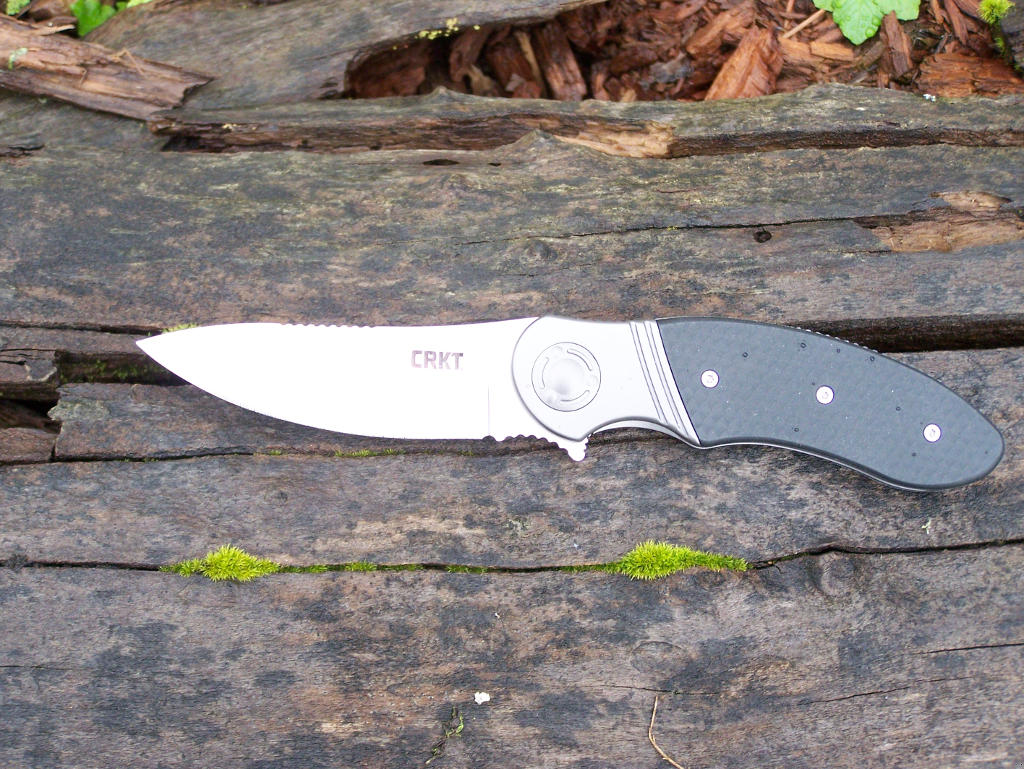
On to the Ken Onion, “Hootenanny” folder that CRKT is now producing. The Hootenanny is one of those folders that is hard to fit into one specific category. It’s an everyday carry folder, to be sure. However, one can easily mistake it for a gentleman’s folder, too. Quite honestly, the Hootenanny, can also be used in the field to dress game, too. A close look at the Hootenanny will find a 3.34-inch long blade made out of 8Cr13MoV stainless steel, and this is a blade material CRKT has been using for a while with great success. I like it! The overall length of the knife is 7.94 inches open and 4.59 inches closed, and it weighs 4.8 oz. Rockwell hardness of the steel is 58-60, and that makes it easy to re-sharpen. The blade has a nice satin finish and is described as a Drop Point; however, I’m not sure if I agree with that description or not, but it works if you want to call it that. The edge is a plain edge; it has no serrations. The handle material is glass reinforced nylon, and the lock is a liner-lock. We have a one position pocket/clothing clip, too, for easy carry in your right front pocket of your pants.

Fit and finish on the Hootenanny was perfect. I couldn’t find a single flaw. If one didn’t see the “CRKT” on the blade, one could be led to believe it was a custom-made folder; it’s “that” nicely made. There is no thumb studs for opening the blade. Instead there is a “Flipper” that rapidly deploys the blade, with the help of the IKBS ball bearing system, which makes the blade effortlessly open with no friction to speak of. We are talking butter smooth! There are friction grooves on the top, middle of the blade, and this comes in handy when doing close-up cutting. It gives you a lot more control over the blade. The entire knife design simply “flows” from the tip of the blade to the butt of the handle, and it fits the hand perfectly, and I don’t make that claim lightly. Everyone who held the knife, loved the way it felt in their hands…everyone!

For close to a month, I used the Hootenanny for many chores around the house. One of those chores was opening packages from UPS or FedEx that arrive almost daily. The Hootenanny had no problems slitting the boxes open and, in some cases, cut the strapping on cases of ammo sent for use in firearms testing. The wife used the Hootenanny for some kitchen chores, and she really loved the way it fit her hand. She is very hard to please. If a knife or firearm doesn’t feel right to her hand, she has no use for it. At the end of my testing, the Hootenanny was still sharp but not hair-popping sharp; it was hair-scraping sharp. I touched it up on a pair of croc stix, and it only took a minute to bring the edge back to hair-popping sharp, too. Nice!

I have one very hard to please knife critic. He’s a fellow who works at the local gun shop I haunt, and he can always find something to fault with just about any knife I show him. He had nothing bad to say about the Hootenanny, which said volumes to me.

I note on the CRKT website that it states the Hootenanny will also make a good bird and fish knife. While I didn’t put it to that sort of testing, I guess I could see it being used in that regard. Where the Hootenanny shines is as an everyday carry knife, as one that can handle most of the daily chores you apply it to. Also, the knife can be used as a weapon for self-defense. The way the knife fits the hand, it could make a bad buy wish he were some place else. As an outdoor folder for survival purposes, well, yeah, it could be useful to a certain extent. This isn’t a hard-core, long-term folder designed for hard survival use though. It’s a city knife, one any Gent would be more than pleased to pull out of his pocket for daily cutting chores. Everyone will believe you paid a lot for it, though full bolt retail is only $69.99, and with all CRKT products, you get a LOT for your money. If you shop around, you can find the Hootenanny deeply discounted off the retail price.

I honestly wish I could have found something to fault about the Hootenanny, but try as I could, I loved the folder, that is, until I lost it. It must have fallen out of my pocket somewhere along the line, or maybe I didn’t have it properly clipped to the inside of my cargo pants pocket and it slipped out. This is one folder I plain on replacing.

CRKT and Ken Onion have hit another home run with all bases loaded this time around. I can’t wait to see what sort of collaboration CRKT and Onion come out with next time, but it’s going to be hard to beat the Hootenanny, in my humble opinion!

– Senior Product Review Editor, Pat Cascio


Recipe of the Week: Fresh Strawberry Shortcakes And Cream

It’s strawberry season, so I am always looking for yummy things to do with our strawberries. Of course, we make jelly, fresh fruit salads, and even make homemade strawberry ice cream and strawberry-banana smoothies, but we also really love these shortcakes for dessert. They are fancy enough to serve company but easy enough for any day with the family.

Ingredients

  • 1 1/2 cups all-purpose flour
  • 2 teaspoons baking powder
  • 1/2 teaspoon baking soda
  • 3 Tbsp white sugar
  • 1 teaspoons salt
  • 1/2 cup frozen unsalted butter, grated
  • 1/2 cup cold buttermilk
  • 1 Tbsp heavy cream, divided
  • 2 Tbsp turbinado (raw) sugar
  • 4 cups sliced fresh strawberries
  • 3 Tbsp white sugar
  • 1 tsp lemon juice
  • 1 cup heavy cream
  • 3 Tbsp white sugar
  • 1 tsp vanilla extract

Directions

  1. Preheat the oven to 425 degrees F (220 degrees C).
  2. Line a baking sheet with parchment paper.
  3. Stir together the flour, baking powder, baking soda, 3 Tbsp white sugar, and salt in a mixing bowl.
  4. Grate frozen butter and stir it into the flour mixture. (Be sure to keep this mixture cold, so that the butter does not melt until baked.)
  5. Stir in cold buttermilk, until the flour mixture just until mixture is moist.
  6. Drop about 1/3 cup of the dough 2 inches apart onto the prepared baking sheet.
  7. Brush each of the biscuits with some of the 1 Tbsp of heavy cream and then sprinkle each biscuit generously with some of the turbinado sugar.
  8. Bake the sugar biscuits in the preheated oven until golden brown, about 15 minutes.
  9. While biscuits are baking, mix together the sliced strawberries, 3 Tbsp white sugar, and lemon juice in a large bowl. Allow berries to rest until juices develop, about 30 minutes.
  10. Once biscuits are cooked, let them cool completely.
  11. When ready to serve, whip the 1 cup of heavy cream with the 3 Tbsp of white sugar and 1 tsp of vanilla extract until stiff.
  12. Cut the biscuits in half and open. Serve the strawberries with juice over the biscuit halves and top with sweetened whipped cream.

o o o

Do you have a favorite recipe that would be of interest to SurvivalBlog readers? Please send it via e-mail. Thanks!


Letter Re: Air Lift Pumps

Using compressed air to lift water from a well does work as described in the previous article; however, one must insure the compressed air comes from an oil-free compressor. If the air compressor has an oil-filled crankcase, the delivered air will have oil vapor/oil mist in it, which is not something one should have suspended in their drinking water. Do not trust an oil/water separator on the compressed air unit to remove oil vapors; they will eventually saturate and become pretty much useless. To confirm what your compressor is doing, check the condensate drain on the air tank. If it is oily or looks like tan snot, you need to get a different compressor. A diaphram-type compressor, or other oil-free design, should be used. Best wishes to all. – DH somewhere in IA


Odds ‘n Sods:

Your Facebook, Twitter and blog are about to be monitored for references to the Government. – H.L.

o o o

JWR joins Prepper Recon for a podcast: Time is Short, Wake Up!

o o o

More and more, the words once shouted with such emphatic fervor, “Never Again!” are being changed and mumbled as “Never mind.” – Brazil starts counting their Jews – B.B.

o o o

Public Locked Out of Miami Biscayne National Park – No Fishing. – T.P.

o o o

5th person dies of MERS virus in South Korea. – G.P. (Warning: This page has a text article but auto starts a video as well)


Street Combat – This Ain’t No Game! – Part 9 of 9, by Pat Cascio

Chapter Seven

Threats in the Future…Today?

Some so-called “experts” believe that future threats to our safety and well-being will come from our children. In a manner of speaking, they are correct in their assumptions. However, you need only watch the evening news to see that the future has already arrived. Read on.

Los Angeles, California District Attorney, Gil Garcetti, probably best summed it up when he said, “My God, this could happen to me . . . What is going on here?” Garcetti was in a news conference describing what was being called the “Wrong Way Shooting” of an innocent, little, three year old girl whose uncle turned onto a gang-infested street in Los Angeles. The precious little girl was killed by indiscriminate (gang) gunfire.

The Wave of the Future?

Gang violence is perhaps what the future holds, according to a number of recognized authorities in the field of criminal study, sociology, and psychology. Patrick F. Fagan, a Fitzgerald Fellow with the think-tank Heritage Foundation in Washington D.C., has an insightful and thought-provoking thesis on the subject of violent crime. In his thesis, Fagan stated, “Though overall crime rates have dropped slightly (emphasis added) in America in recent years, the frightening news is that both the level and viciousness of teenage crime have been rising steadily.”

On October 1, 1997, CBS news anchor, Dan Rather, reported Department of Justice figures showing that adults committing murders has dropped by 27 percent. On the surface, this appears to be good news. However, in this same news report, Rather reported that murders committed by teens has risen 141 percent! How does this bode with Fagan’s statement about an overall drop in crime rates? You be the judge!

Professor James Fox, a North Eastern University Criminologist stated, “Thirty-nine million children, 11 years old and over don’t have full-time adult supervision between the hours of 3:00pm and dinner time.” Fox further said that this is a “recipe for a coming crime wave. By the year 2005 a blood bath of teen violence will occur.” I’ve got news for Fox, it is already happening! Fox’s solution to the problem has been to “spend more money on (social) programs.” This is clearly the view that most Liberals hold as a solution to all our problems; they say that it is necessary to spend more money! This approach hasn’t worked yet.

Adam Wolinski, a noted criminal justice “expert”, expressed his solution when he said, “We literally need 500,000 cops on the streets at a cost of 30 billion dollars.”

Neither Fox nor Wolinski have confronted the real root cause of violent crime in America. Rather, Patrick Fagan believes that the cause is “the breakdown of the family.” Statistics and history back-up Fagan’s thoughts on this all-important subject.

While many so-called “experts” in law enforcement tend to point toward poverty or racial make-up as the primary cause of teen violent crime, Fagan pointed toward failed government programs that actually encourage the break-up of the family.

Washington, DC’s Answer

The 1994 Violent Crime Control and Law Enforcement Act, which was nothing more than cleverly disguised gun control and social spending by the Clinton Administration, is just the latest example of an experiment doomed for failure. It provided for billions of dollars in new spending, and it also added at least 15 new social (or should that be “socialist”) programs, on top of the already overburdened welfare system, which has cost taxpayers over five trillion dollars since the ill-conceived War on Poverty that President Lyndon Johnson declared.

Fagan cited that “since 1965, welfare spending has increased 800 percent in real terms, while the number of major felonies per capita is roughly three times the rate prior to 1960.” Fagan continued, “Official Washington also believes that race is the second most important cause of crime.” Fagan disagrees! “However, a closer look at the data shows that the real variable is not race, but family structure and all that it implies in terms of commitment and love between adults and children. A major 1988 study of 11,000 individuals found that the percentage of single-parent households with children between the ages of 12 and 20 is significantly associated with rates of violent crime and burglary.” Taking this study at face value, it would appear that illegitimacy, not race, is the key factor in teenage violent crime.

It would indeed appear that the future holds a bleak picture for all Americans. Within the next twelve to twenty years the American illegitimacy rate is predicted to reach 50 percent.

Homicides Increase

The homicide rates of major cities have steadily increased according to Fagan. “Between 1989 and 1990, for example, the homicide rate for Boston, MA increased by over 40 percent; Denver, CO rose by 29 percent; Chicago, IL, Dallas, TX, and New Orleans, LA by more than 20 percent; Los Angeles, CA by 16 percent; New York, NY by 11 percent.” This is certainly street combat by any definition. Anyone who believes they are safer on the streets today than they were 25 years ago is sadly (and dead) wrong!

If indeed, as some “experts” claim, violent crime is a result of poverty and/or race, then why, during the Great Depression of the 1920’s, did the crime rate drop when many individuals and families were at their lowest rung on the financial ladder? Why then, during the recession of 1982, was there a dip in crime and not an increase?

Senator Phil Gramm of Texas rightly observed, “If social spending stopped crime, America would be the safest country in the world.” It is not!

The current Federal budget battle that is currently (and always) taking place in Washington, DC focuses (once again) on social(ist) spending. The Administration is determined to increase social spending rather than decrease it! Social spending buys votes! Sadly, it also buys a future of violent crime among our teens.

As Dan Rather stated, “Crime does not (emphasis added) come out of nowhere.” This was a surprising (and true) statement coming from the left-wing controlled press.

In past decades, the murder rate for young black males tripled, and it doubled for young white males. Why is it that the latest government statistics insist that violent crime is down overall? Could it be that certain crimes have been “reclassified” by the F.B.I. and the Department of Justice, and thus, are no longer classified as “violent”? Or perhaps, we’re being sold a false bill of goods, and the federal statistics are being “doctored”? You be the judge.

The Christian Broadcasting Network’s The 700 Club aired a news story that may have dispelled the myth that race and poverty are factors in teenage violent crime. Reporter Randall Brooks investigated the school system in Fairfax, VA, which has one of the highest (if not the highest) per capita income in the nation. At that time, Fairfax schools were the 11th largest in the nation, yet they were facing a steady rise in violent crime in the public schools and on the streets. Violent crime by teens was up 61 percent since 1991. Juveniles with guns in public schools was reported to be up 118 percent since 1989, and drug arrests of teens was up 208 percent. Clearly, high or increased income (or wealth) was not a factor in reducing teen violence.

CBS News correspondent, Bill Whitaker, reported that during the first three quarters of 1995 there were over 400 gang-related deaths in Los Angeles alone. This figure doesn’t take into account murders as a result of armed robberies, rapes, or other violent deaths, either. This figure only takes into account “gang-related” deaths where gang members killed gang members. How many gang members killed innocent civilians? The Los Angeles Police Department reported that more than 40 years ago, there were approximately 125 street gangs with a total membership of 25,000. Just about two decades later, Los Angeles boasted over 1,000 street gangs with a membership in excess of 150,000 members!

During all this time, social spending and social programs increased. During President Clinton’s administration, he funded (with your tax dollars) “midnight” basketball games, which promoted illegitimacy and did nothing to reduce violent crime with all his increased spending. Since then, other social programs were attempted.

Ben Kinchlow, the author’s friend and the former co-host of The 700 Club, cited a perfect example of what we’re talking about. On the program, Kinchlow presented a rich “uncle” who told all his male nephews to go out and sleep with as many young girls as they like. He said it was also okay for these young girls to get pregnant and have babies. This rich uncle said it’s all okay, don’t worry about it. The rich uncle says he will support the girls and their illegitimate children, as long as the nephews don’t marry them. The rich “uncle” in this case is “Uncle Sam”, and this is “his” policy.

By promoting illegitimacy and rewarding the participants, “Uncle Sam” is in fact promoting violent crime among our youth. This is yet another failed government “experiment,” and it’s not only a waste of tax payer dollars, but it also leads to the deaths of many honest, law-abiding tax payers.

Ora Watson is the Executive Principal of Town View Center, a public school in Dallas, Texas. This school is manned with closed circuit cameras and armed security guards. Watson stated during an interview on CNN, “We live in a ‘social’ environment where, unfortunately, security measures are necessary that were not necessary 25 years ago.” Truer words were never spoken. The failed social programs that were started by the liberal Democrats and supported by sympathetic Republicans have resulted in unprecedented security measures in our schools, homes, and on the street.

These so-called “security measures” promote the violation of our Constitutional rights, as outlined in the first, second, and fourth Amendments to the Constitution of the United States of America.

Increased social spending and the continuance of the welfare system, as it stands today, will only provide us with more violent (and deadly) crimes upon innocent Americans by our children. Indeed, the “threats of the future are here – today!”

Just remember the title of this book as you leave your home today, or next time you see a group of “children” approaching you.

Remember, this is Street Combat – This Ain’t No Game!


Letter Re: Becoming A Warrior At Gunsite Academy, by J.H.

Hugh,

There is no way a civilian can develop the proper mindset, skills, and base of knowledge required to be considered a “warrior” by attending a class for a weekend or even a week. Please do not misunderstand what I am trying to say. Classes like this can be beneficial to an individual as long as they do not leave the false impression that a warrior has been created. This false belief can lead someone to get hurt if they respond with inflated confidence during an actual life-threatening situation. There is no way to become a warrior, unless you make it your profession. The amount of training required for an action to become “muscle memory” is immense. J.H. did mention situational awareness (SA). The best high threat engagement a civilian can have is the one he or she avoids. Proper SA can save someone from having to draw a gun while unfamiliar adrenaline courses through their arteries and the targets are shooting back. If an encounter is unavoidable, then SA can place an individual in the best possible tactical position to win the engagement. The difference is that warriors have signed up to go into harm’s way for other people’s benefit, not their own. We did not accidentally bump into a bad man one night; we purposely pursue him in the darkness. We do bad things to bad people.

The military knows how to train their warriors, though funding may get in the way of bringing that know-how to the average line unit Joe. Mastering a skill takes constant repetition, reviewing the basics, and training these skills in an arena that can induce adrenaline. I have seen soldiers, who can smoothly draw a pistol and shoot paper accurately all day on the flat range, lose their minds while conducting force on force Simunitions(TM) training that promises to hurt and leave bruises, if not break the skin. I have seen competent soldiers lose their bearing in combat because none of their training prepared them for the real deal. True warriors are born with a mindset that is refined through training. It is misleading to sell someone the notion they are a warrior by attending a class. Being a warrior is a lifestyle.

HJL Responds: I believe that the definitions that we are using may not be the same. What you define as a “Warrior”, I would have defined as a “High Speed Operator”. I would have defined a “Warrior” as simply someone who is willing to escalate a conflict to violence, if necessary, to ensure that the object of their affection is afforded protection. Because we live in a culture defined by movies, we often believe that we have this capability. The reality is that few people do. J.H. was willing to take the first steps to begin to train his body and mind to accept what is necessary to become that warrior. Whether it is unarmed martial arts, weapons handling, computer hacking, or offensive/defensive driving, you have to start somewhere. Every person that I know who has taken that first class has come away with a drastically different outlook on the escalation of violence.

With deadly martial arts, the initial contact is the most dangerous to an individual. The more violent contact you survive, the higher the likelihood of your continued survival, simply because you learn to adapt, respond, and anticipate. The whole point of classes like Gunsite or any other martial art is to create an environment where that initial violent contact can be made under controlled conditions and your survival can be guaranteed, while you learn to adapt. While a man willing to protect his home and village is not necessarily a high speed operator (mostly because he has not had the thousands of hours of training required to attain that skill level), he is still a warrior just because of his willingness to place others above himself and escalate the situation to the level of violence required to guarantee the outcome. He is a mighty man of valor.

“And there came an angel of the Lord, and sat under an oak which was in Ophrah, that pertained unto Joash the Abi-ezrite: and his son Gideon threshed wheat by the winepress, to hide it from the Midianites. And the angel of the Lord appeared unto him, and said unto him, The Lord is with thee, thou mighty man of valour.” Judges 6:11-12 (KJV)


Economics and Investing:

Is The Price Of Gold Really Headed Above $19,000?

o o o

IMF has betrayed its mission in Greece, captive to EMU creditors. – JBG

o o o

Why The Fed Can’t Raise Rates. – J.B.

o o o

Canadian Silver Maple Leaf Sales Hit New Record Q1 2015

o o o

Items from Mr. Econocobas:

Investors Start To Panic As A Global Bond Market Crash Begins – Whether the trend continues and gets out of control or for the time being things turn around, I am not sure, but this is something to follow.


Hugh’s Quote of the Day:

“And one of them, when he saw that he was healed, turned back, and with a loud voice glorified God, and fell down on his face at his feet, giving him thanks: and he was a Samaritan.” Luke 17:15-16 (KJV)


Notes for Saturday – June 06, 2015

Camping Survival is moving to Sanford, North Carolina (near Raleigh) soon and has a few open positions. If you are interested in any of the positions, please send a resume per the instructions. You may also want to check out their moving clearance section. Also, June 7th-13th they are having a Mountain House sale with 25% off of #10 cans and 15% off of pouches and buckets. It’s always better to sell it than move it, so be sure to check it out.

o o o

Today, we present another entry for Round 59 of the SurvivalBlog non-fiction writing contest. The $12,000+ worth of prizes for this round include:

First Prize:

  1. A Gunsite Academy Three Day Course Certificate, good for any one, two, or three course (a $1,195 value),
  2. A course certificate from onPoint Tactical. This certificate will be for the prize winner’s choice of three-day civilian courses. (Excluding those restricted for military or government teams.) Three day onPoint courses normally cost $795,
  3. DRD Tactical is providing a 5.56 NATO QD Billet upper with a hammer forged, chromlined barrel and a hard case to go with your own AR lower. It will allow any standard AR type rifle to have quick change barrel, which can be assembled in less than one minute without the use of any tools, and a compact carry capability in a hard case or 3-day pack (an $1,100 value),
  4. Gun Mag Warehouse is providing 20 Magpul pmags 30rd Magazines (a value of $300) and a Gun Mag Warehouse T-Shirt. (An equivalent prize will be awarded for residents in states with magazine restrictions.),
  5. Two cases of Mountain House freeze dried assorted entrees in #10 cans, courtesy of Ready Made Resources (a $350 value),
  6. A pre-selected assortment of military surplus gear from CJL Enterprize (a $300 value),
  7. A Model 120 Series Solar Generator provided by Quantum Harvest LLC (a $340 value),
  8. A $300 gift certificate from Freeze Dry Guy,
  9. A $250 gift certificate from Sunflower Ammo,
  10. KellyKettleUSA.com is donating both an AquaBrick water filtration kit and a Stainless Medium Scout Kelly Kettle Complete Kit with a combined retail value of $304,
  11. TexasgiBrass.com is providing a $300 gift certificate, and
  12. Two cases of meals, Ready to Eat (MREs), courtesy of CampingSurvival.com (a $180 value).

Second Prize:

  1. A Glock form factor SIRT laser training pistol and a SIRT AR-15/M4 Laser Training Bolt, courtesy of Next Level Training, which have a combined retail value of $589,
  2. A FloJak EarthStraw “Code Red” 100-foot well pump system (a $500 value), courtesy of FloJak.com,
  3. Acorn Supplies is donating a Deluxe Food Storage Survival Kit with a retail value of $350,
  4. The Ark Institute is donating a non-GMO, non-hybrid vegetable seed package–enough for two families of four, seed storage materials, a CD-ROM of Geri Guidetti’s book “Build Your Ark! How to Prepare for Self Reliance in Uncertain Times”, and two bottles of Potassium Iodate– a $325 retail value,
  5. A $250 gift card from Emergency Essentials,
  6. Twenty Five books, of the winners choice, of any books published by PrepperPress.com (a $270 value),
  7. TexasgiBrass.com is providing a $150 gift certificate, and
  8. RepackBox is providing a $300 gift certificate to their site.

Third Prize:

  1. A Royal Berkey water filter, courtesy of Directive 21 (a $275 value),
  2. A large handmade clothes drying rack, a washboard, and a Homesteading for Beginners DVD, all courtesy of The Homestead Store, with a combined value of $206,
  3. *Expanded sets of both washable feminine pads and liners, donated by Naturally Cozy (a $185 retail value),
  4. Two Super Survival Pack seed collections, a $150 value, courtesy of Seed for Security,
  5. Mayflower Trading is donating a $200 gift certificate for homesteading appliances,
  6. APEX Gun Parts is donating a $250 purchase credit,
  7. Montie Gear is donating a Y-Shot Slingshot and a Locking Rifle Rack (a $379 value), and
  8. Two 1,000-foot spools of full mil-spec U.S.-made 750 paracord (in-stock colors only) from www.TOUGHGRID.com (a $240 value).

Round 59 ends on July 31st, so get busy writing and e-mail us your entry. Remember that there is a 1,500-word minimum, and that articles on practical “how to” skills for survival have an advantage in the judging.


Conditions for Combining Survival Groups Under Extraordinary Circumstances – Part 1, by G.R.

The following is a response addressing concerns of those to whom a proposed “Plan B” bug-out scheme had been provided by a larger, existing group to multiple smaller groups. This larger group had extended an invitation to smaller groups that are lacking the financial and over-all resources of that larger group. This is a series of responses that have been/were made to the chief “officers” of the smaller groups. The basic proposal is for a 60-day, temporary sheltering at a safe location with provision capabilities for a larger group of individuals and families beyond the recognized community/core member group. This is provided so that if your group is looking at a similar situation, you can use it as a basis to get started.

The word “exigent” is defined in criminal law as “an emergency situation requiring swift action to prevent imminent danger to life or serious damage to property.” There is no ready litmus test for determining whether such circumstances exist, and in each case the extraordinary situation must be measured based upon the facts known by officials. The circumstances are those that would cause a reasonable person to believe that entry (or other relevant prompt action) was necessary to prevent physical harm to persons. I’ve used the term “exigent” for a good reason. It is taken a bit out of the normal legal context, but it is very appropriate for what we are considering and has been proposed. We are talking about extraordinary circumstances. We are talking about preventing loss of life to those we think we might be able to save (and will do their best to aid, not detract or weaken, those who they seek assistance from).

Questions and Answers to Leaders of Various Exigent Groups

Let’s get all concerns, or as much as possible, out of the way right here right now. It goes hand-in-hand with the organizational needs of any and all groups. As the tentative leader of your group, it will be to you that your group’s individuals will (and must) direct their questions. It’s not me nor anyone who is a member of the community group in the bylaw papers who they will seek. It is the only way any such operation can or will work properly.

  • On simple matters, “…for things like…, will we have a vote, a say in how things are done there? No. You will be responsible for yourselves and follow the rules that are in place. This is the correct answer. How one governs himself and their family, or those they are in turn responsible for is what is of paramount importance.
  • “What if the crisis lasts longer than 60 days?…” It most likely will. The correct answer is that the community I’d dare say will know that is the case and will decide what to do based on resources utilized over the past two months that have gone by; in general, we’ll look at how things have evolved to that point in time. Again, if those who are temporary, “exigent” members will recall, it is and will be that they must prove themselves to the community. It’s not the other way around. If they do so, things will work out fine then.
  • “If you bring us in for 60 days with 60 days worth of food, and then after the 60 days you want us to stay, what about food?” First, it’s dependent upon the numbers involved, as all provisions always have a limit. No matter how many or for how long, nothing is limitless; everything will require resupply and re-provisioning by the group and all individuals. Second, the community does have a large quantity of what could be called “emergency” rations. This includes mostly rice, beans, and similar items. Everyone will have to be a part in the process of securing food, one way or the other, through foraging, scavenging, rationing, or something else. If it was a brutal enough world “out there” hungry people lose their preconceived concepts of right and wrong. Furthermore, the 60 day time marker is a good one. No assumption should be made that any request for a prolonged stay will be forthcoming. I must reiterate that it is not the community that must alter to fit anyone’s needs, it is the individual(s) that must. All individuals are responsible to earn their keep. No exceptions. No special privileges.

    I’ll mention “ifs” later, but you neglected the biggest “if” in your question; it’s the part about “if you want us to stay…” That is a big ‘if’, all right. Remember the word “exigent” and the circumstances surrounding this proposal– extraordinary circumstances.

    All people need to think of their futures. At 60 days, hopefully all will have some idea of what is to be done next. Your eventual goal is to have your own home, or to return to salvage, rebuild, and restore what was once yours. None of us believe in communism. None of us wish for some hippie-style communal living for our futures– at least none I know of in the community. Are we not all free Americans, able to think for ourselves, be, live, do for ourselves? I often reflect that this entire prepping process has seen the strangest of mergers of the oldschool flower-power days with a military adjunct. It isn’t. We’re trying to retain what was built upon– our rights, lives, liberties, and the pursuit of happiness. None of us embody or consider any other ideas of those four things as some universal constraints to be applied to all other Americans. However, we certainly allow for others to seek their own meanings to these.

  • “How much space for living quarters will we have?” That is the purpose of the roster and information sheet. We won’t know until the number of influx is counted and ascertained. The more people, the less room. It’s basic geometric simplicity at its finest.
  • “Suppose we run out of… (fill in the blank)?” If you’re talking about water, you won’t. If you’re referring to food, there are emergency supplies that would last a while. One job that will be needed to be done is re-procurement and replacement of what is used up.
  • “I have a special need (fill in the condition)… and will need preferential treatment… (of some kind)”. The simple answer is that you will then have to supply any special need for yourself or for the individual that requires it. There simply will no longer be a welfare state.

    Just remember, beyond a safe location, water, some basic triage medical facilities, a defense network, and a lot of jobs that will need to be filled and done, everyone will work without exception– no one is exempt, and everyone will have a task and be expected to do it (multiple tasks) to the very best of their ability.

    The democratic process does not exist on private property. I use the example that if I visit a home and am invited into the living room and then find that I need to use the head/john, I ask, “May I use the facilities?” If granted a “yes”, I then ask, “Where is it located?” Upon receiving that answer and permission, it means only that I may use the plumbing. It does not mean that I may wander around the house opening cabinets and drawers in any room I may pass or see. That same rule applies to the community site. The case where I might be denied use of the head/john means what? It means that I must leave and seek relief elsewhere. Otherwise, I may hold it and stay put, as uncomfortable as I might be. My proposal needs to be understood as it is intended and not as it is assumed to be, hoped to be, or even perhaps as anyone thinks it should be. It must be taken just as it is. It’s fairly simple, and though I personally hate the word “fair” because I do not believe there exists such a phenomena as “fair” upon this earth in this life, I do feel it could actually be just that– fair. It is an offer, a proposal, simple, direct, and up to the persons being offered what they will make of it.

  • What if I was asked to do something that conflicted with my moral convictions before God. Are there provisions for a consciousness objection?

    Sure. You would leave. You’d take what you brought with you and simply depart, and you would not be allowed to return. You’d be asked to be silent, considered maybe not an enemy but never again a part of the group in terms of any demand or assistance you may require down the road.

    “Congress shall make no law respecting an establishment of religion, or prohibiting the free exercise thereof…” , nor will the group. Regarding the freedom of speech, we as people do need to talk and to exercise the ability to speak, or so it seems. However, this situation would not be a democracy. Once again, I must repeat what I’ve said; there is and would be a strict chain of command. A private or a recruit does not address or demand an audience with an officer in the military…ever. Speech amongst yourselves is fine, but to the community it’s only to your immediate person responsible for you…only. Read the amendments.

    We are of four parts– physical, emotional, mental, and spiritual. All must act in concert. All must grow and become together, equally, as we are those.

  • What would we live in and shower in (i.e. tent, camper, etc)?

    You tell me. You will be allotted a space. You can park a camper, pitch a tent, or live in a car or truck or van. That is your responsibility. As long as you can be able to leave within a 30-minute time span. That time limit is not chosen randomly. It is for multiple reasons. That’s the best possible guess as to a maximum amount of time it would require for all to bug-out of the area if push came to shove. Never forget that nowhere is completely safe in a world like we’d be living in, if it had already necessitated such a mass of people seeking security as they had and were there at the community site at the time. In addition, permanence is not a “given” for anyone who is “exigent”. No tolerance of wrong-doing would be shown. Thirty minutes is all it should take to prepare a bug out to get to the site, and it’s all it should take to leave it.

    Showers would be communal at a central facility, unless your vehicle provides its own facility and the means to keep it running/filled. Water rationing is a must. Always remember that. Life would have changed or you would not be out there. There is no long leisurely bathing to be expected or provided for. Hark back a hundred years, say to pre-WWII days. People did not bathe daily, and when they did, often they bathed as a family. In short, you will stink at times. You learn to live with it.

  • What about sewer treatment with such an influx of people?

    There is an existing septic system, recently improved, but like any system, it can’t exist without maintenance. Any system’s operation is dependent for proper operation on the simple fact of how many are utilizing it. Gone are the days of flushing the toilet and “that’s that”; there is no more thought given. If you are there at the community site, you most likely will have as one of many chores the constant digging of the latrine ditch-works or similar facilities at some point. Think militarily. Finally, septic hygiene is an excellent question all in all. It is something that must be fully understood by all and thought of. No tolerance of relieving oneself wherever the urge pressed you to go would or could be safely allowed, especially with more people. Diseases, medieval in nature, would rapidly appear. Cholera, typhus, dysentery and so on are not good ways to die.

  • Will there be any climate-controlled facility to store our food in?

    Boy, I had to really rein myself in here on answering this one. You need to study up. You can dig a hole to gain some cooling effects. You can shade your provisions, but this is *** (a southern state)*** and it gets hot here, miserably hot and humid. All foodstuffs need to be able to endure the climate or be discarded once it’s gone bad. Read up on dry goods– rice, flour, sugar, beans, dried meat and fish, canned goods, dehydrated or freeze-dried foods, and salt. That last item will be the most crucial. Salt, vinegar, or brine will be the primary preservative for our needs, if such a calamitous event does occur to cause us all to leave our homes and seek shelter at the community. Climate control? One good and viable suggestion is to look up Zeer pots. Those would assist and do a fair job of somewhat of a climate-control mechanism for food, and they are possible. Otherwise, like the question about a shower facility, the answer is for you to bring a fridge along that you can fuel or power on your own, and be sure it doesn’t fall outside of the noise restrictions that may be in place. Then, you’ve got something cool.

  • Is a list of medical supplies required from individuals and families?

    The listing of medical supplies for exigent members is for your own familial uses, primarily. The community also needs knowledge of what medical– physical and psychological– conditions are present at the site, as a part of the make-up of all persons present. Additionally, medications would make good barter goods. They would also be a good way to contribute to the community, if they are non-essential surplus to your own medical needs. Of course, a good chemist is always being sought by the community.