Letter: Food Shortage

Dear HL and Readers of SurvivalBlog,

We all know that in a TEOTWAWKI situation, people will panic. After what I saw this week, I believe it will happen sooner and to a worse degree than I previously thought. I live outside a small town in the Midwest. We have one mom-and-pop grocery store, a “milk store”, two convenience stores, Walmart, and Kroger as our choices for local grocery shopping. I noticed the shelves at Kroger were somewhat bare the last two times I shopped. I was wondering why this was the case but just thought the employees were not doing a good job with restocking. This week I discovered the reason for the scarce supplies. When I entered Kroger for my shopping, I actually stopped dead in my tracks. The store was undergoing a major remodel/reorganization project. Nothing was where it used to be. Customers were actually in a panic over the chips on the bread aisle and the pet supplies with the prepackaged cookies. The management claims the new product placement is for the convenience of the customers, but I am keenly aware that the new organizational system makes no sense and is set up for impulse buying. (Go in for dog food. See the cookies. Grab a package of Oreos.) Sorry. Back to the subject. I was unable to walk down many aisles. I was going to get a couple of cans of baking powder, but a forklift blocked the baking aisle. Other aisles were also blocked, making shopping virtually impossible. I heard “What am I going to do?” being said by panic-stricken people. If not being able to get a can of chocolate frosting sets someone in a panic, what will a real emergency do? We need to be even more vigilant with our preparations. When TEOTWAWKI occurs, it will be worse than I thought. The overwhelming majority of the population will be, as my grandma would say, running around like chickens with their heads cut off. Thank you for your blog and helping me to be prepared. – Prepared Grammy


News From The American Redoubt:

News Video: Flash Floods Devastate Lusk, Wyoming

o o o

Feds release final plan for recovering Snake River sockeye

o o o

Over at Radio Free Redoubt, host John Jacob Schmidt recently posted links to a two-part podcast that related to the need for underground churches in the United States, in the near future:

The Coming Underground Part 1.
The Coming Underground Part 2.

o o o

In The East Oregonian: One man tasked with keeping small town of Ione operating

o o o

Magic Valley Legislators Respond to Refugee Center Concerns – RBS


Economics and Investing:

Gold At $64,000 – Bloomberg’s ‘China Gold Price’. – B.B.

o o o

103 Years Later, Wall Street Turned Out Just As One Man Predicted. – H.L.

o o o

Items from Mr. Econocobas:

U.S. Authorities Say “Uncomfortable” with Strong Currency; Dollar Drops

Experts Worry that ‘Phony Numbers’ Are Misleading Investors – This is far from the only smoke and mirrors in the room…

Stay Out Of Harm’s Way—-The Casino Is Fixing To Blow


Odds ‘n Sods:

The Maine and Texas governors are poised to sign open carry bills. The Maine law will be Vermont-style Constitutional Carry (unrestrictive–with no permit whatsoever), while the Texas law will require training and a permit. Despite a couple of recent setbacks in Montana and West Virginia (where their Democrat Party governors both recently vetoed Constitutional Carry laws) freedom is on the march, folks!

o o o

Michigan: ‘Urban’ military training exercise damages downtown building. – JBG

o o o

SWAT team destroys man’s home to capture shoplifter. – M.R.

o o o

$30 Geiger Counter for Android/IPhone – Works! (on Android) – Smart Geiger. – T.J.

o o o

Judge Napolitano: Why the NSA Loves the USA FREEDOM Act. – P.S.


Hugh’s Quote of the Day:

“Socialism, like the ancient ideas from which it springs, confuses the distinction between government and society. As a result of this, every time we object to a thing being done by government, the socialists conclude that we object to its being done at all.” – Frederic Bastiat


Notes for Monday – June 08, 2015

On June 8th, 1776, Canadian Governor Sir Guy Carleton defeated American Patriot forces under John Sullivan. After taking heavy losses and the loss of General Richard Montgomery at Quebec, the Patriots were pursued by Governor Carleton. Halfway between Quebec and Montreal, at the Trois-Rivieres, the Patriots turned to fight. The Redcoats and German mercenaries killed 25, wounded 140, and captured 236, but Carleton allowed the rest of the 2,500-man force to complete their retreat. This battle changed the priorities of the Patriots, and Arnold wrote “let us quit and secure our own country before it is too late.”


That Pesky Little First Amendment

Over the weekend, by way of the NRA some troubling news spread across the Internet: “Commonly used and unregulated Internet discussions and videos about guns and ammo could be closed down under rules proposed by the State Department, amounting to a ‘gag order on firearm-related speech,'” This stems from an Obama Regime reinterpretation of the International Traffic in Arms Regulations (ITAR). The State Department is updating the ITAR, which implements the Federal Arms Export Control Act (AECA). The net effect of this new ITAR amplification would be to reclassify gun blogs, forums, chat rooms, and firearms “how-to” web pages as “export restricted” firearms technical data. And get this: Per the proposed new rules, “Mother May I” permission must be granted before posting any such data, and failure to do so could result in fines of up to $1 million and prison sentences up to 20 years.

Well, I have a news flash for BHO‘s minions in the State Department: In this nation we have a pesky little scrap of paper that trumps all other pieces of paper, called The Constitution, and it includes the First Amendment, which guarantees our freedom of press.

I must illustrate an important point: With the exception of common law libel restrictions, there are no limits to the freedom of press in these United States. For the purpose of educating the public on that point, I’m posting this little gem of a files link. There, I did it. I’ll see you in court, Mrs. Lynch.

Please contact your congressional representatives and voice any concerns about this proposed ITAR rules change. – JWR


Scot’s Product Review: Survival Skills DVD Set Sigma 3 Survival School

I was very impressed with this $49.95 two DVD set. It was well produced and the material clearly presented. There were perhaps three times I wished for captions to identify some of the gear and once a drawing would have helped me understand a point about knife blade grinds, but those are small nits to pick out of an excellent video. It even explained and showed knots so well that I could make them, which is no small task as I am knot deprived.

I am going to jump to almost the end of the two DVD’s to get a quote about the purpose of the videos from instructor Robert Allen, who talks about a “comprehensive survival ideology”. I think the DVDs effectively address that concept with a focus on what Allen calls the critical needs for survival, shelter, water, fire, and food. He notes that most people who don’t survive in the outdoors die of exposure, and being able to cope with that alone would save many lives. Unlike videos that worry about scenarios and bugging out, this presentation assumes you have found yourself in the wild and need the know how to survive. You could be lost, stranded in bad weather, or have some other problem, but what matters is staying alive and knowing techniques that will cover any event. Allen prefers to teach a few techniques that one masters rather than a potpourri of skills that are then not well learned.

While most of the content is aimed at the first three problems (shelter, water, and fire), the DVDs do cover acquiring meat, which is a key to longer-term survival. One can forage for plants, but meat offers more calories and protein than plants.

I was pleased to see the disclaimers that watching a video does not replace training. Training not only means getting instruction from a skilled teacher, it includes practicing the skills as the teacher offers guidance and corrections. While a good video can impart priceless knowledge, it isn’t the same as having a teacher work with you, which brings me to one of the more impressive points during the video. Allen takes a student (Chad Cooper, the owner of Infidel Armor and a SurvivalBlog supporter) through the process of making a bow drill fire starter kit from scratch. Allen had already shown us how to do it in the prior chapter of the video, but watching him then teach Cooper was very valuable to me, both as to picking up additional points as well as reinforcing the benefit of a corrective teacher.

Before we go further, we ought to check out the two instructors in the videos. The primary presenter is Robert Allen– the president and founder of Sigma 3 Survival School, which offers a wide array of classes, primarily in Arkansas and Virginia but also some in Costa Rica and Sweden. They mention looking for a Florida location on their website. Allen is an Army vet with Middle-East deployments and has a long resume of training, both during and after the Army. He has a direct, clear teaching style in the video that worked well for me.

The second presenter is Josh Hamlin, who has an interesting background of actually living in a primitive manner for two years without modern equipment. He speaks of things like how tasty rats are and shows how to make primitive deadfalls as well as water filters one can create from castoff plastic bottles, charcoal, and pine materials. He presents just as clearly and effectively as Allen, though he has far less camera time. He is the lead primitive skills instructor at Sigma 3.

The 3 hours and 27 minutes of video are well organized. Although they present a lot of information based on having nothing with you, they start with a chapter on suggested everyday carry (EDC) gear if one is spending time outdoors. While one can get caught empty handed, it is a wise person who has at least some gear. Allen calls it “life insurance” and discusses what he thinks you should have at all times.

The first item in his EDC is the knife. He likes Mora knives from Sweden for their cost effectiveness, but he also points out some other more expensive knives. This was one area I would have liked even more information than he gave. For example, he discusses the utility of having two knives with different grinds for better versatility, and having a little more detail and perhaps an image of the two grinds would have helped my understanding. Later, when he demonstrated the use of the knives, it became clearer, but I am not as much of a knife guy as I would like to be and Allen struck me as someone who could teach me quite a bit, so I was left wanting more. They could take this as a hint to do a knife video.

His next EDC item might surprise some; it was a folding saw with a 10-inch blade. He makes a compelling argument that it is more useful than an axe, largely because you burn fewer calories using it. It also helps you make some of the cuts used when fabricating things in the wild. Again, he recommends brands over a broad price range.

Additionally, he suggests having a good multi-tool; an oversized poncho is also high on his list of EDC gear, both to wear for protection from weather and for use making a shelter. A stainless steel water container is another must, since it can be used to boil water to make it safe for drinking or for cooking as well as carrying water.

Allen promotes the time honored concept that two is one and one is none. For key needs, you want to have two ways to do things. For fire starting, he likes ferro rods and the ubiquitous Bic lighter along with some Wetfire tinder, which is a commercial product. The lighter and Wetfire can save time and energy when you are in trouble and have no reserves. For insurance, he then teaches how to make a bow drill for fire starting.

Cordage such as paracord in another must, but he adds that Bank line is good to have too along with some picture wire that can be used for making snares.

Also, don’t forget a flashlight, particularly one with multiple light levels that can save battery life and since two is one, a headlamp is a nice addition since it allows hands-free use as well as a back up to the primary.

Some fishing gear with hooks and line is also smart to carry. He goes into pack rods and reels if you have space in your backpack and discusses Yo Yo reels that can be left unattended and will set the hook on their own. I was unfamiliar with these, and they look like a good thing to have. A minimum though would be some hooks and line.

While feeling the saw is more useful, he does discuss axes, and he notes that he likes to carry one when in the woods.

Navigation and first aid are discussed in terms of the suggested equipment, though he doesn’t really get into how to use it.

A huge point both Allen and Hamlin make is that if you have a piece of gear, then you will save the time and energy required to create it when needed. Time and energy are important in any survival scenario; if you consume energy faster than you acquire it, you are losing the battle.

After covering gear, the video moves into how to get things done. This part of the video is the real meat of the discussion. The first topic is caring for our most important tool– the knife. Allen goes over sharpening them and likes the Work Sharp Guided Field Sharpener– a tool I have been using recently and will offer my own review at the end of this article. He also mentions using diamond honing rods and strongly suggests that we wear leather belts as they are so useful for stropping knives.

From tool care, the videos move to shelter. Both cold and warm weather ones are covered using the materials one could find in the woods as well as making them with the cordage and tarp or poncho one might have brought with them. As a resident of the bug laden South, I was impressed with his inclusion of an elevated shelter and a discussion of using smoke to deter insects.

The next subject was water, and I was very intrigued by the sip well Allen and Hamlin used to purify water as well as the discussion of things to avoid, if possible. They made the important point that if you are expecting rescue, don’t worry about getting sick from bad water. Dehydration is the greater danger. You don’t want to get sick, but if the choice is dying or getting sick later, it’s better to get sick later than die now. That equation obviously changes if one expects to be in the wild for a long time. Hamlin had a trick I haven’t seen before that I found impressive; it involved using charcoal from fires and pine needles to filter water.

Fire was the next topic, and Allen showed how to build a tipi fire, which he feels is the most “bombproof method” of fire starting. One could start a fire with the Bic lighter Allen suggests we carry or even the ferro rod he also advocates, but he goes one further. He shows how to build a bow drill kit for fire starting from what you find in the woods, and then he uses it to get the fire going.

One of the big lessons I got from the video is the importance of knowing something about wood and trees when starting fires. You need to know which ones to use for what, particularly when trying to fabricate a bow drill kit from scratch. If you use the wrong materials, you get no fire. Trees vary from region to region, and one would be wise to spend some time to study what you would find in your area and what they can be used for. You get further variances as you shift from wetlands to drylands or change altitude, even within a small geographic area.

Beside the bow drill, the ferro rod was covered. The ferro rod, as most readers probably know, is a metal rod that when struck with a piece of high carbon steel makes hot sparks that can make tinder catch on fire. It is another of the “bombproof” methods Allen advocates we keep available.

Another cool trick I learned was how to build a fire to last by layering wood and dirt. Allen has built ones that lasted as long as 60 hours. As he pointed out, if you can sleep through the night rather than getting up to add wood to a fire, you will be in far better shape. Rest is critical to well-being, and you won’t get it if you get cold and wake repeatedly through the night.

After fire, Allen and Hamlin move into food and how to acquire meat using entirely primitive traps, like the Paiute deadfall trap or with snares made with the picture wire you have in your EDC kit. Allen also tells us about traps we might have been cunning enough to have brought with us. I hadn’t thought of having traps in my bugout kit, but I am now planning to add some. Hamlin, as mentioned above, enjoys rats, and Allen likes beaver, neither of which I have tried. I am a bit more reluctant to go for rat, but rats in the wild probably are a lot cleaner than the ones I used to shoot on the farm we had when I was young.

Once you have your meat, you have to process and then prepare it, both for an immediate meal as well as preserving some for future use. Allen gives us a lot of information on beaver, which is an uncommon animal in my parts. Nonetheless, he does talk about other animals, and much of what he tells us about beaver could apply to most any critter we might care to eat.

I am looking forward to showing these videos to the Scouts I work with. I was very pleased that the language was clean, so that I can use them for that purpose.

Work Sharp WSGFS221 Guided Field Sharpener

The $26.00 WSGFS221 Guided Field Sharpener is, unlike its siblings from Work Sharp, a manual tool that requires no electricity. Besides knives, it can sharpen fishhooks. It weighs slightly less than 5 ounces and measures 6.75 inches long, 1.5 inches wide, and 1 inch thick; its light weight and small size makes it easy to carry in the woods, though the one I’m testing has mainly been living in the kitchen drawer.

It has coarse and fine diamond surfaces as well as a ceramic rod with fine and coarse surfaces and one for fish hooks along with a second small ceramic rod for serrated edges and a leather strop for the final finish on a blade.

A key feature are the guides to help you start the blade at the right angle. The guides are at 20 degrees on the diamonds and 25 degrees for the ceramic. While this doesn’t cover every knife on the planet, it is possible to remove the diamond surfaces (magnets hold them one quite securely) and use them by hand if your knife doesn’t work well with the guides. While you have them off, you can clean them. Work Sharp recommends cleaning with soap and water for the tool, including the ceramic rods.

My biggest problem with the tool was finding the instructions, and it was my fault. They are inside it under one of the diamond plates. Work Sharp cunningly advised where they were in large letters on the packaging I had torn up to get it out and admire it.

The coarse diamond can rapidly shape a blade, so you don’t need to use it very much. Work Sharp advises that you shouldn’t use it unless the blade is damaged or needs to be reshaped.

The one thing I wish is that Work Sharp included a pouch for it. Replacement parts for the sharpening surfaces are available from Work Sharp, which is a very nice touch. I am enjoying using it and find it quick and easy to grab when a knife starts to lose its edge, which is a much better time to sharpen than when it has gotten dull.

– SurvivalBlog Field Gear Editor, Scot Frank Eire



Pat Cascio’s Product Review: CRKT Hootenanny Folder

One of the most prolific knife designers that I’m aware of is Ken Onion, who resides in Hawaii. Ken actually got started designing and making knives as a result of working on a motorcycle. He knew there was “something” there that he could use. It’s been many years since I interviewed Onion for an article I was doing for Knives Illustrated magazine, back when I was the West Coast Field Editor. Ken and I spoke for more than an hour via phone, and he is an absolute wildman, to put it lightly. It was great fun interviewing him about a new collaboration he was doing with a major knife company.

It seems like every time I turn around, there is a new collaboration between Ken Onion and a knife company. To be sure, when you look at an Onion-designed knife, you know that it was unmistakably designed by Onion. There is a certain flair, style, to all his folding knives. It just continues to amaze me that Onion keeps coming up with more and more new designs that are all different yet all “alike” in some manner; they all scream of the Onion style!

Ken Onion’s custom-made folding knives demand a great deal of money. We are talking thousands of dollars for one knife. Some years back, Onion was going to attend a knife show, and some of his knives were stolen, if I recall correctly, from an airline. I don’t remember the amount, but we are talking something in the neighborhood of $50,000-60,000 worth of knives. Now, one would think that would be quite a few knives. Nope! We are talking only about half a dozen knives. Does that tell you how valuable his custom-made folders are?

I’ve had a very long relationship with the nice folks at CRKT (Columbia River Knife & Tool) and have been testing and writing about their knives almost from the start of their company. CRKT was actually started by two former executives from another major knife company. At present, the company is solely owned by Rod Bremer. Rod and I go way back, and if you ever heard us talk to one another or read our e-mail exchanges, you would actually believe we are bitter enemies. Nothing could be further from the truth. We’re good friends; just don’t tell Bremer I said that, though. BTW, in the 2016 CRKT line-up, they will be featuring a fixed blade, double-edge fighting knife designed by myself and brought to fruition by custom knife maker Brian Wagner. He refined my design and made the prototype that CRKT is working from.

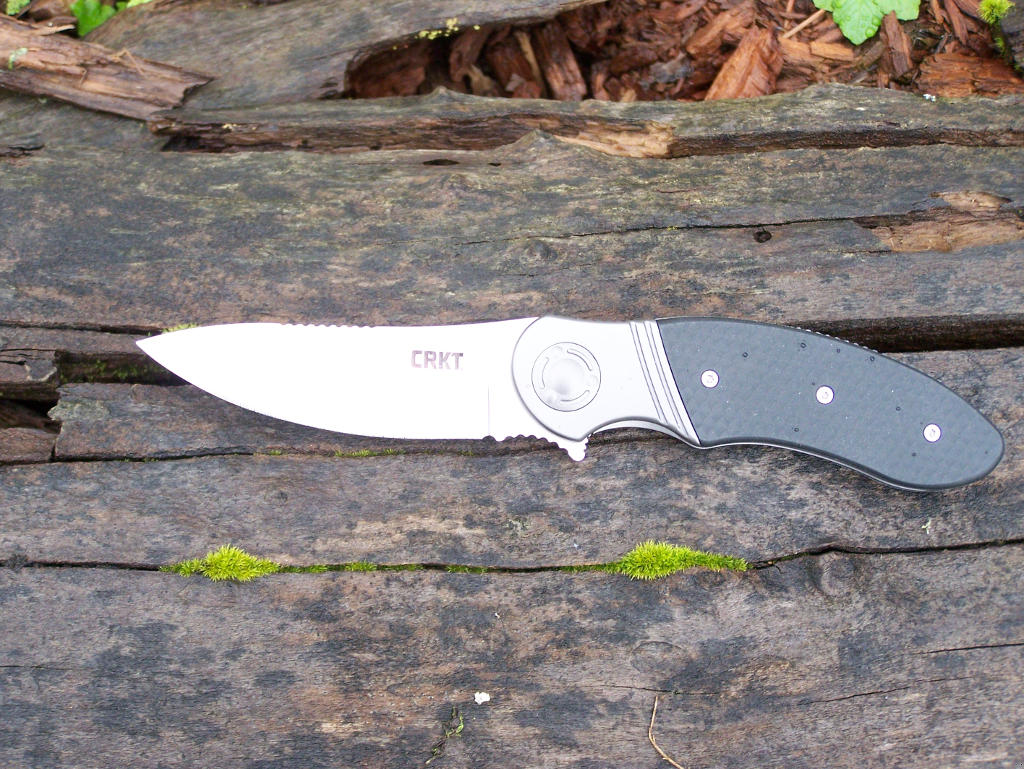
100_5734

To clear matters, I wanted to mention that the CRKT Hootenanny is manufactured in Taiwan. Some readers take exception to anything made in Taiwan for some reason. However, you get as good as you want. If you want a 50-cent knife, you’ll get one. If you want a thousand dollar knife, you can have one. CRKT has someone from their corporate headquarters visiting the two plants that manufacture their knives in Taiwan every six weeks. Additionally, last I heard, CRKT actually owns one of the plants where many of their knives are made. It’s to their advantage to keep a watchful eye on how their knives are being made, and this– a very watchful eye– they do keep!

On to the Ken Onion, “Hootenanny” folder that CRKT is now producing. The Hootenanny is one of those folders that is hard to fit into one specific category. It’s an everyday carry folder, to be sure. However, one can easily mistake it for a gentleman’s folder, too. Quite honestly, the Hootenanny, can also be used in the field to dress game, too. A close look at the Hootenanny will find a 3.34-inch long blade made out of 8Cr13MoV stainless steel, and this is a blade material CRKT has been using for a while with great success. I like it! The overall length of the knife is 7.94 inches open and 4.59 inches closed, and it weighs 4.8 oz. Rockwell hardness of the steel is 58-60, and that makes it easy to re-sharpen. The blade has a nice satin finish and is described as a Drop Point; however, I’m not sure if I agree with that description or not, but it works if you want to call it that. The edge is a plain edge; it has no serrations. The handle material is glass reinforced nylon, and the lock is a liner-lock. We have a one position pocket/clothing clip, too, for easy carry in your right front pocket of your pants.

Fit and finish on the Hootenanny was perfect. I couldn’t find a single flaw. If one didn’t see the “CRKT” on the blade, one could be led to believe it was a custom-made folder; it’s “that” nicely made. There is no thumb studs for opening the blade. Instead there is a “Flipper” that rapidly deploys the blade, with the help of the IKBS ball bearing system, which makes the blade effortlessly open with no friction to speak of. We are talking butter smooth! There are friction grooves on the top, middle of the blade, and this comes in handy when doing close-up cutting. It gives you a lot more control over the blade. The entire knife design simply “flows” from the tip of the blade to the butt of the handle, and it fits the hand perfectly, and I don’t make that claim lightly. Everyone who held the knife, loved the way it felt in their hands…everyone!

For close to a month, I used the Hootenanny for many chores around the house. One of those chores was opening packages from UPS or FedEx that arrive almost daily. The Hootenanny had no problems slitting the boxes open and, in some cases, cut the strapping on cases of ammo sent for use in firearms testing. The wife used the Hootenanny for some kitchen chores, and she really loved the way it fit her hand. She is very hard to please. If a knife or firearm doesn’t feel right to her hand, she has no use for it. At the end of my testing, the Hootenanny was still sharp but not hair-popping sharp; it was hair-scraping sharp. I touched it up on a pair of croc stix, and it only took a minute to bring the edge back to hair-popping sharp, too. Nice!

I have one very hard to please knife critic. He’s a fellow who works at the local gun shop I haunt, and he can always find something to fault with just about any knife I show him. He had nothing bad to say about the Hootenanny, which said volumes to me.

I note on the CRKT website that it states the Hootenanny will also make a good bird and fish knife. While I didn’t put it to that sort of testing, I guess I could see it being used in that regard. Where the Hootenanny shines is as an everyday carry knife, as one that can handle most of the daily chores you apply it to. Also, the knife can be used as a weapon for self-defense. The way the knife fits the hand, it could make a bad buy wish he were some place else. As an outdoor folder for survival purposes, well, yeah, it could be useful to a certain extent. This isn’t a hard-core, long-term folder designed for hard survival use though. It’s a city knife, one any Gent would be more than pleased to pull out of his pocket for daily cutting chores. Everyone will believe you paid a lot for it, though full bolt retail is only $69.99, and with all CRKT products, you get a LOT for your money. If you shop around, you can find the Hootenanny deeply discounted off the retail price.

I honestly wish I could have found something to fault about the Hootenanny, but try as I could, I loved the folder, that is, until I lost it. It must have fallen out of my pocket somewhere along the line, or maybe I didn’t have it properly clipped to the inside of my cargo pants pocket and it slipped out. This is one folder I plain on replacing.

CRKT and Ken Onion have hit another home run with all bases loaded this time around. I can’t wait to see what sort of collaboration CRKT and Onion come out with next time, but it’s going to be hard to beat the Hootenanny, in my humble opinion!

– Senior Product Review Editor, Pat Cascio


Recipe of the Week: Fresh Strawberry Shortcakes And Cream

It’s strawberry season, so I am always looking for yummy things to do with our strawberries. Of course, we make jelly, fresh fruit salads, and even make homemade strawberry ice cream and strawberry-banana smoothies, but we also really love these shortcakes for dessert. They are fancy enough to serve company but easy enough for any day with the family.

Ingredients

  • 1 1/2 cups all-purpose flour
  • 2 teaspoons baking powder
  • 1/2 teaspoon baking soda
  • 3 Tbsp white sugar
  • 1 teaspoons salt
  • 1/2 cup frozen unsalted butter, grated
  • 1/2 cup cold buttermilk
  • 1 Tbsp heavy cream, divided
  • 2 Tbsp turbinado (raw) sugar
  • 4 cups sliced fresh strawberries
  • 3 Tbsp white sugar
  • 1 tsp lemon juice
  • 1 cup heavy cream
  • 3 Tbsp white sugar
  • 1 tsp vanilla extract

Directions

  1. Preheat the oven to 425 degrees F (220 degrees C).
  2. Line a baking sheet with parchment paper.
  3. Stir together the flour, baking powder, baking soda, 3 Tbsp white sugar, and salt in a mixing bowl.
  4. Grate frozen butter and stir it into the flour mixture. (Be sure to keep this mixture cold, so that the butter does not melt until baked.)
  5. Stir in cold buttermilk, until the flour mixture just until mixture is moist.
  6. Drop about 1/3 cup of the dough 2 inches apart onto the prepared baking sheet.
  7. Brush each of the biscuits with some of the 1 Tbsp of heavy cream and then sprinkle each biscuit generously with some of the turbinado sugar.
  8. Bake the sugar biscuits in the preheated oven until golden brown, about 15 minutes.
  9. While biscuits are baking, mix together the sliced strawberries, 3 Tbsp white sugar, and lemon juice in a large bowl. Allow berries to rest until juices develop, about 30 minutes.
  10. Once biscuits are cooked, let them cool completely.
  11. When ready to serve, whip the 1 cup of heavy cream with the 3 Tbsp of white sugar and 1 tsp of vanilla extract until stiff.
  12. Cut the biscuits in half and open. Serve the strawberries with juice over the biscuit halves and top with sweetened whipped cream.

o o o

Do you have a favorite recipe that would be of interest to SurvivalBlog readers? Please send it via e-mail. Thanks!


Letter Re: Air Lift Pumps

Using compressed air to lift water from a well does work as described in the previous article; however, one must insure the compressed air comes from an oil-free compressor. If the air compressor has an oil-filled crankcase, the delivered air will have oil vapor/oil mist in it, which is not something one should have suspended in their drinking water. Do not trust an oil/water separator on the compressed air unit to remove oil vapors; they will eventually saturate and become pretty much useless. To confirm what your compressor is doing, check the condensate drain on the air tank. If it is oily or looks like tan snot, you need to get a different compressor. A diaphram-type compressor, or other oil-free design, should be used. Best wishes to all. – DH somewhere in IA


Odds ‘n Sods:

Your Facebook, Twitter and blog are about to be monitored for references to the Government. – H.L.

o o o

JWR joins Prepper Recon for a podcast: Time is Short, Wake Up!

o o o

More and more, the words once shouted with such emphatic fervor, “Never Again!” are being changed and mumbled as “Never mind.” – Brazil starts counting their Jews – B.B.

o o o

Public Locked Out of Miami Biscayne National Park – No Fishing. – T.P.

o o o

5th person dies of MERS virus in South Korea. – G.P. (Warning: This page has a text article but auto starts a video as well)