
“No statement should be believed because it is made by an authority.” – Robert Heinlein
- Ad LifeSaver 20K JerryCan Water PurifierThe best water jerrycan you can buy on the market! Mention Survivalblog for a Free Filter ($130 Value)
- Ad Ready Made Resources, Trijicon Hunter Mk2$2000 off MSRP, Brand New in the case
Notes for Monday – June 22, 2015
During World War II, the U.S. 10th Army overcame the last major pockets of Japanese resistance on Okinawa Island on June 22nd, 1945, ending one of the bloodiest battles of World War II. The same day, Japanese Lieutenant General Mitsuru Ushijima, the commander of Okinawa’s defense, committed suicide with a number of Japanese officers and troops rather than surrender.
o o o
Do you have a recipe that you would like to share with other SurvivalBlog readers? I’ve been caught with my hand in the proverbial cookie jar this week. My queue of recipes is low and while Mrs Latimer was kind enough to supply me with another one of hers, I have been married long enough to understand the “look”. She’s got a book in the works and I’m going to have to leave hers alone for a bit. Send your directions for scrumptious concoctions in via e-mail. – HJL
- Ad Don't wait - get the ultimate US-made ultra-high performance US-made SIEGE Stoves and stunning hand-crafted SIEGE belts for Christmas. For stocking-stuffers see our amazing fire-starters. Gifts that can save lives. Big Sale!Every bespoke SIEGE buckle goes through an hours-long artisanal process resulting in a belt unlike anything else, with blazing fast performance and looks and comfort to match.
- Ad USA Berkey Water Filters - Start Drinking Purified Water Today!#1 Trusted Gravity Water Purification System! Start Drinking Purified Water now with a Berkey water filtration system. Find systems, replacement filters, parts and more here.
Scot’s Product Review: Steiner 7×50 Marine Binoculars
Before I go into the review, I would like to compliment Armasight for replacing a small part on my Spark Core night vision monocular that I reviewed recently. I have been complaining about how I had been unable to get a response from either their information email address or their relations person, but when I needed a small part their service department replied promptly and sent me the part within a week of my request. I found that impressive. Since the service people are efficient, that takes away much of my reluctance to recommend their products.
Getting back to the subject, binoculars are highly useful as well as fun. Being able to see things better is always entertaining, but besides that, it can help you locate game while hunting or uncover lurking threats before they can cause you harm. The problem with binoculars is that there are so many types and brands and the costs range from trivial to astronomical. What to choose? Your needs, budget, and expected uses play a role, of course, but it is still difficult to decide what to buy.
SurvivalBlog founder J. W. Rawles offered some advice to a reader that is worth recapping. He basically divided the needs for a prepper into two categories– fixed base security and patrol. He likes 7x50mm binoculars for base use and lighter, handier binoculars with smaller objectives like 7x35mm ones for patrol, though he did note the usefulness of having more power for those in a plains area with long sight lines. I think this is excellent advice and not just because JWR is the boss. I might, however, also consider a spotting scope for distance work over higher power binoculars.
We should probably go over a few things about binoculars before we go much further, though. The first number in the 7×50 refers to the magnification. The more magnification, the further you can see, with some caveats, like whether the air is clear, how much light there is, and the quality of the lenses. More magnification, however, means the binoculars get bigger and heavier, which makes them harder to carry and tougher to hold steady.
The second number refers to the objective size in millimeters. The larger the objective, the more light the binoculars transmit to the eyes, but again, the bigger and heavier they get. The objective is the end away from your eyes, by the way.
Light transmission is pretty critical and sometimes overlooked in choosing binoculars. One of the fun things to do with binoculars is to hand someone a pair of decent 7×50’s at night when their eyes have fully dark adapted. If they aren’t familiar with using binoculars at night, they will be in for a surprise and a treat. You can see things through the binoculars that simply aren’t visible to the naked eye. It is almost as if someone were magnifying the light. If my eyes are well adapted to the dark and there is good moonlight, I think I can do as well with the right binoculars as I can with most night vision gear that uses light intensification methods. Thermal is a different matter, of course. The point on which I have concern is in the shadows. Sometimes looking into shadows after watching the bright areas is difficult. Night vision, particularly when aided with infrared illumination, can see into shadows. Smart threats will use the shadows as will many animals, so it is important to see what is in them.
While there are many factors in binocular performance, there are two key ones that affect how well they work at night. The first can be computed by the purchaser, and that is how much light can potentially make it through the binoculars to the eyes, assuming all else is good. There are two methods of determining this, the first of which is the twilight factor. This involves square roots, which is something I have tried to avoid since high school math, but here it is. You multiply the objective size in millimeters by the magnification of the binoculars and then divine the square root of the product. Thanks to the calculators that come on computers these days, this is easier than it was in high school during my distant youth. In other words, if you have 7x50mm binoculars, you multiply 50×7 and get 350, and then you compute the square root which is 18.7. Binoculars with a twilight factor greater than 17 are usually considered good to go for night time use.
A second method, and the one I prefer since it avoids the dreaded square root, is to compute the exit pupil, which is done by dividing the objective diameter by the magnification. For example, when you divide 50 by 7 you get slightly more than 7. That number turns out to match the average pupil diameter in millimeters of a human whose eye is dilated for low light. The concept of how this works seems to me to be something like the idea of matching two holes up. If one is smaller than the other, the flow of light would be restricted by the smaller one. Since the maximum size of the hole in the eye that lets light through is seven for most people, if the hole in the binoculars– the exit pupil– is seven or larger, you will see as much as you can see, assuming you are young. Unfortunately, as we age, the pupil can dilate less, and by the time we are in our 60’s, we might be doing well to take full advantage of an exit pupil of 5. During the day, since the pupil is smaller, we don’t need as much light to pass through the binoculars, so smaller objectives will give you all you can use, hence there is no need for the big objectives during the day.
The second big factor in low light performance is how well the lenses and the anti-reflection coatings allow light to pass through. This is often expressed in a percentage. The higher the quality of the glass and how well the lenses are ground make a big difference, and the increasingly effective coatings developed by the optical industry are critical. Reflections on the lenses play hob with how well you can see through binoculars, and poor coatings cut down on how much light gets through. Unfortunately, the only way to know about these points for sure is to look through binoculars. Some makers do give figures on light transmission, which is helpful, and of course some companies have reputations for quality that you can rely on. Other brands may be a cipher, unless you can actually try them.
All this works for rifle and spotting scopes too.
Incidentally, you sometimes see the term “night glasses” applied to binoculars with a high twilight factor or large exit pupil. As well as 7×50’s, these include 8×56, 9×63, or 10×70 binoculars. The 7×50’s are often encountered in marine use as avoiding things in the dark is beneficial while afloat. Anything more powerful than 7×50’s are usually not used on boats, as they begin getting too heavy to hold steady and have limited fields of view, both of which make them hard to use aboard a boat, which is probably moving in multiple directions at once. Hunters in low light, however, often like more power and are willing to deal with the weight to see a bit further, so they often use 8×56 or more powerful binoculars. They are also generally on solid ground.
This brings up another number that is nice to consider, field of view. The more area you can see, the better off you are. If your view through the binoculars is too tight, it will be hard to obtain and maintain situational awareness and to quickly locate a subject. You often only get a fleeting moment to locate game, for example, and if your binoculars have a limited field of view, you may not have enough time. Field of view varies from binocular to binocular and is affected by many factors, but if all else is the same, more is better.
Besides the thoughts on magnification and objective size, JWR discussed the idea of how to spend our money. He felt it is better to have several pairs of decent binoculars than one pair of great ones. This also makes good sense. I subscribe to the one is none and two is one strategy for a number of reasons. First, I might smash a pair by accident. Second, there are three members of my immediate family and a few more in the next circle out. Being able to put more eyes on the problem is a good idea, which means needing more binoculars. Finally, it allows me to have an assortment of types of binoculars to cover different needs.
Alas, I also subscribe to a contradictory strategy– buy once, cry once. That means get the best and be done with it. The problem with this strategy, however, is that you may wind up with nothing at crunch time having waited until you could afford the best. There is also the question of needing more than one of something. Perhaps in that case, you buy something decent now and upgrade later with the earlier purchase then serving the second tier needs. This is often my strategy these days, as I worry that the pursuit of perfection is the enemy of the attainment of the good.
With all that overthinking in place, I hit a point where I had three decent pairs of binoculars on hand but no 7×50 night glasses when I spotted the $250 Steiner 7x50mm Marine models and decided it was time to push the budget and buy the German-made binoculars I have always wanted. I actually caught them on sale for a bit less than the current price, and if you shop, you might be able to as well.
The 7x50mm Marines are the entry level Steiner 7×50’s. They sell several more expensive models– the Police, the Navigator, the Military, and the Commander– ranging all the way up to $1050. They all have very similar form factors and are hard to tell apart without a close look. The difference between the Police and Marine models is apparently the color of the rubberized coating. The Police model is grey, and the Marine is black. While the Marine and Police are called waterproof, the Navigator and Military can survive 16 feet of submersion and the Commander 33 feet. The more expensive models also offer better optical quality. The Commander and Military provide a wider field of view with the Commander being even better than the Military. The Commander is the most costly and is two ounces heavier than its siblings and slightly larger due to the more ergonomic eyecups. The Military model has a range finding reticle.
While I, of course, wanted one of the top of the line pairs, reality settled in firmly, and I got the Marines. I have been very happy with them. They are heavy and bulky at 36.3 ounces and 8.1×5.5×3.0 inches. They aren’t, however, something you will want to carry all day on a hunt unless you expect to need low light capability.
Optically, they offer a sharp and clear view with good color rendition and great contrast. I have, alas, been spoiled by better binoculars in my life, but those cost far, far more. I still think back to a pair of NATO issue Zeiss glasses I got to spend a day with along with some Bosch & Lomb U.S. Navy-issue binoculars I used during a 5-day visit to a carrier. The B&L’s were pretty old, but the Navy has shops that kept them in excellent condition, and they were wonderful. They were also amazingly big and heavy. I will also note that the performance difference between my Steiners and those binoculars was very slight in comparison to the price differences.
One issue that the Steiners have no problem with is collimation– the alignment of the pair of lenses you look through. If they aren’t pointed the same, you will get a bad image and eye strain at best. At worst, the binoculars aren’t usable. One of the advantages of buying a name brand is that they will go through rigorous quality control, which largely includes accurate collimation.
They are made of a strong polycarbonate material and covered with a layer of rubber for protection. The optics are mounted to withstand 11 G’s. The waterproofing on the Marine and Police models “will resist rain, ocean spray, and potentially brief, shallow submersions.” The Steiner website advises, “If submersion is a serious concern, I would highly recommend the Navigator’s.”
The ergonomics are quite good, as they fit my hands well. I do miss center focusing, however. Steiner has what they call “Sports-Auto-Focus” that they claim gives you a good image from 20 yards to infinity. You get it by focusing each eyepiece to your own eyesight and then leaving them alone once you get it set to your tastes. My problem is that I wear glasses and sometimes like to use the binoculars with them on and sometimes with them off. That means two focus setting that can be easily accomplished with center focus, which adjusts both sides at the same time without having to adjust each eyepiece separately. There are also times you might want to focus on something closer than 20 yards, such as a bird or butterfly, which once again means twisting both eyepieces. The lack of center focus is pretty common with 7×50’s though. The 20 yards to infinity usually works quite well at sea, which is one of the primary locations for use of these binoculars. Truthfully, it works well on land too unless you need to look at something up close.
You get a neck strap and padded case. I found the strap a bit narrow for comfort and somewhat slippery for over the shoulder use, so I wound up replacing it with an OP/TECH one made of a stretchy wetsuit-like material. It will stick better to clothing and is wider to spread out the weight. The case isn’t to my liking either. You have to unzip it all the way around to get the binoculars out. I have other binocular cases that close from the top and are held shut with magnets or Velcro, which make it faster and easier to get the binoculars out.
I have really enjoyed these binoculars, particularly in the dark. It is amazing what you can see through them that you can’t see unaided. I have been curious, however, if I really am seeing more with them than I might with a pair of equal quality 8×42 binoculars. The 8×42’s have an exit pupil slightly greater than 5, so they pass less light, but I’m at the stage of life where my eyes just don’t work as well at night. I recently had a chance to use a pair of very nice Nikon Monarch 7 8×42’s, which are very well rated in the bird watching community. I was surprised to discover they came from China, but it did give me a chance to compare night vision with the two roughly comparable quality binoculars. I was sad to discover that the extra light gathering ability of the 7×50’s might be wasted on me. I think I see very slightly better with them, but I’m not sure. The Nikons cost almost twice what the Steiners do, and that might be a factor. I am sure, however, that my son will be able to see more using the 7×50’s with his much younger eyes, but for me the lighter 8×42’s might be all I can take advantage of.
– SurvivalBlog Field Gear Editor, Scot Frank Eire
- Ad California Legal Rifles & Pistols!WBT makes all popular rifles compliant for your restrictive state. Choose from a wide range of top brands made compliant for your state.
- Ad USA Berkey Water Filters - Start Drinking Purified Water Today!#1 Trusted Gravity Water Purification System! Start Drinking Purified Water now with a Berkey water filtration system. Find systems, replacement filters, parts and more here.
Pat Cascio’s Product Review: Zero Tolerance 0630 Folder
Not bragging, not in the least, but when I was in high school and beyond, everyone used to say I was the coolest guy they knew. Just about everyone who signed my high school year book said I was “cool”. Go figure? I guess that puts me in the same camp with “Fonzie” from the TV show “Happy Days”. Fonzie, from the show, and I had a couple of things in common, and one of the major things was that we both hated admitting we were wr…….., er, um, wro…..ohhhh, wron…..ok, ok, we hated admitting when we were wrong!! I guess that’s why we were always careful, so as to not make mistakes, so we wouldn’t have to admit we were wrong. I thought I was wrong, once, but I was mistaken!
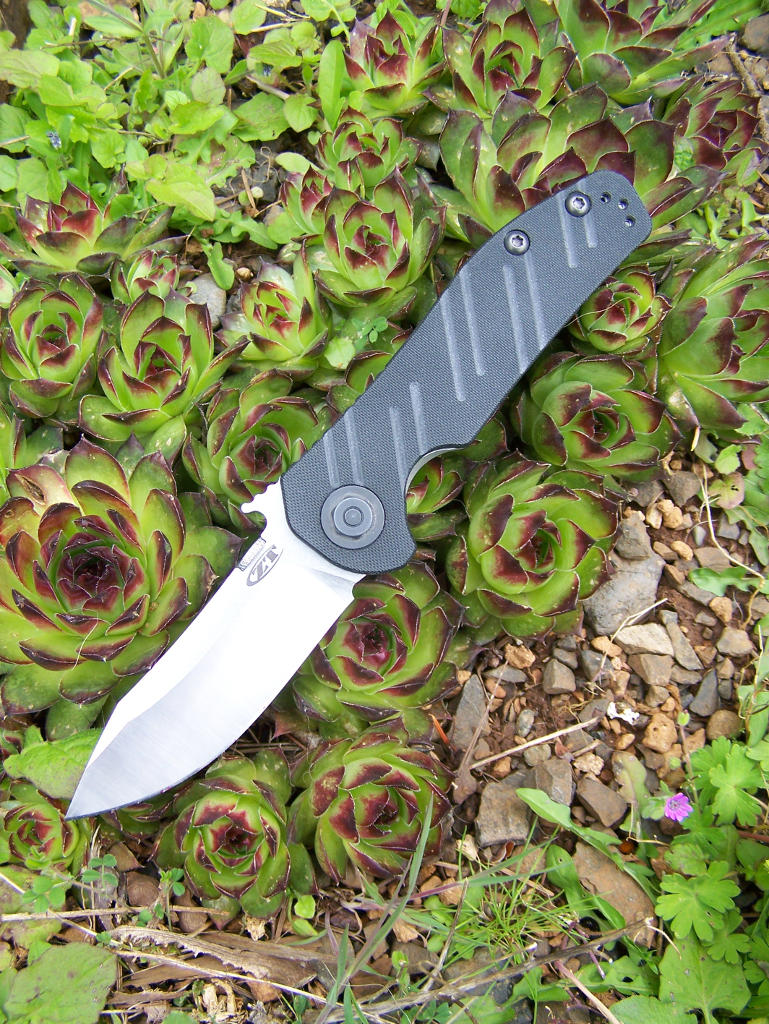
I have a keen eye when it comes to knife designs, and several major knife companies have caught on to this and asked me to keep my eye peeled for a new knife design that they might be interested in producing in collaboration with custom knife makers. Many of the knife designs I’ve turned some big knife companies on to have been now factory produced. I guess it comes from testing and reviewing knives for a lot of years. I was the West Coast Field Editor for Knives Illustrated magazine for quite a few years, and prior to that I was just a writer for them. I believe its safe to say that, I’ve probably tested thousands of knives over the years, so I have a good handle on what constitutes a good knife design.

When I got the press release for the new Zero Tolerance 0630 folder, I was kind of “ho-hum” about it for some reason. I couldn’t put my finger on it, but there wasn’t a “wow” factor there to my way of thinking. I was determined that I didn’t like the blade design for starters, and well there was just something there that didn’t rattle my cage. However, I ordered the 0630 for testing just the same.
First of all, all Zero Tolerance knives are made in the USA, right at the Kershaw Knives plant. Many don’t realize that ZT is a division of Kershaw Knives. However, ZT knives are designed and meant for hard use, as in military and law enforcement work. ZT knives aren’t your everyday Gent’s folder, far from it. I guess one thing that drew me to the 0630 is the fact that it is designed by Ernest Emerson, who is like the father of tactical folders. In the past, probably 20 years ago, I tested quite a few of Emerson’s folders for Knives Illustrated magazine, and Ernie and I spent many hours on the phone talking about his knives. Needless to say, we are both martial artists, so there was plenty of talk about that, too. Emerson used to make his knives one at a time, and they were always in demand. He couldn’t keep up with demand, so some years ago Emerson started his own knife company, which is turning out some fantastic “factory” folders. However, as is the case, Ernie still couldn’t keep up with demand. So, he searched around for a big knife company to work in collaboration with him to produce some of his knife designs to his strict guidelines and to his quality. Zero Tolerance was that company. Kershaw Knives is also producing many of Emerson’s designs, however, they are light-use folders. If you want hard use folders, you need to pick up the ZT designs by Emerson.

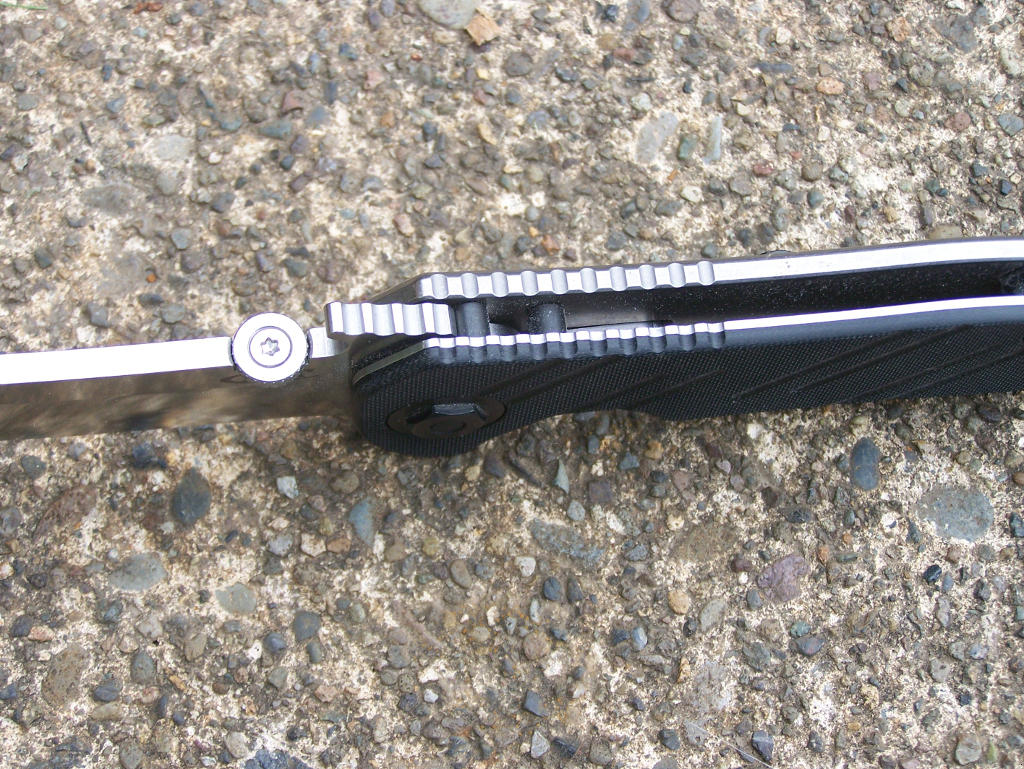
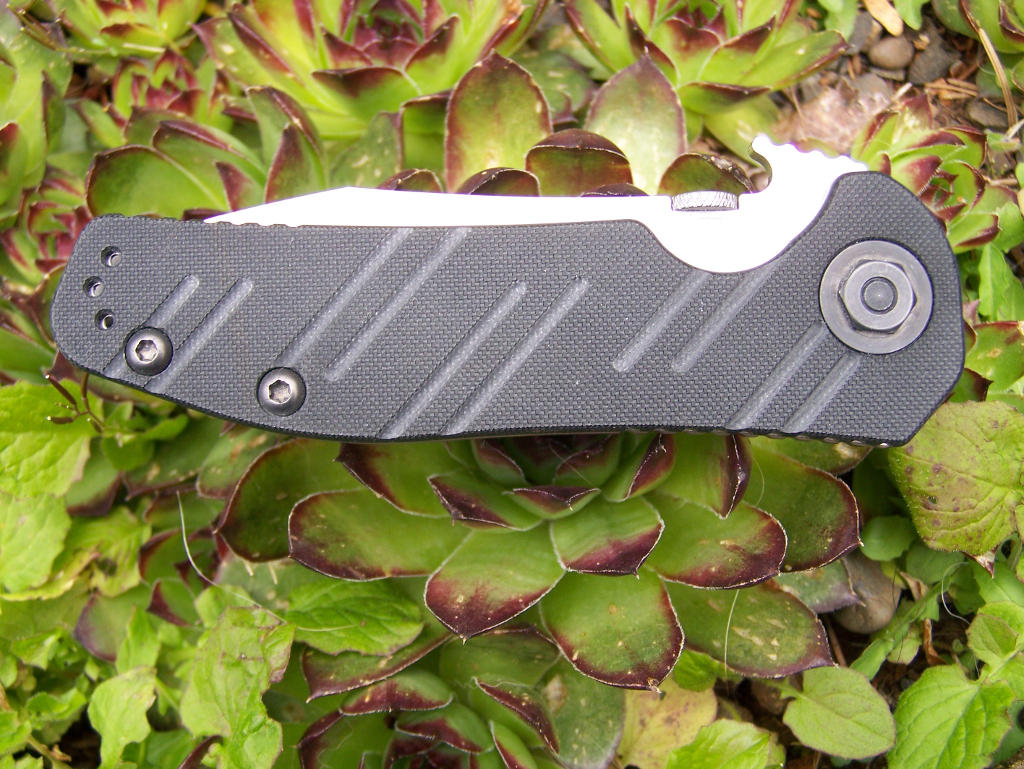
The 0630 is manufactured out of S35VN– a super tough and chip-resistant stainless steel– that allows ZT to bring this blade to hair-popping sharp, and it’s also easy to re-sharpen, which is something that matters to me. One thing you will notice is the Emerson patented “wave” feature. It kind of looks like an ocean wave on the back, top of the blade. This little device allows you to open the knife faster than any automatic folder; as soon as you have pulled the knife out of your pocket, the blade is open. (I have more on this later.) The front handle scale is textured and groove black G10 material that is almost bullet proof. The rear handle scale is made out of titanium, which is very expensive stuff to be sure. The titanium scale is also the frame lock. We are talking a very thick frame lock, not some skinny little frame lock that can bend and give way, causing the blade to close when you don’t want it to. There is also some added protection in the form or a hardened steel lockbar insert to ensure a tight lock-up when the blade is opened.
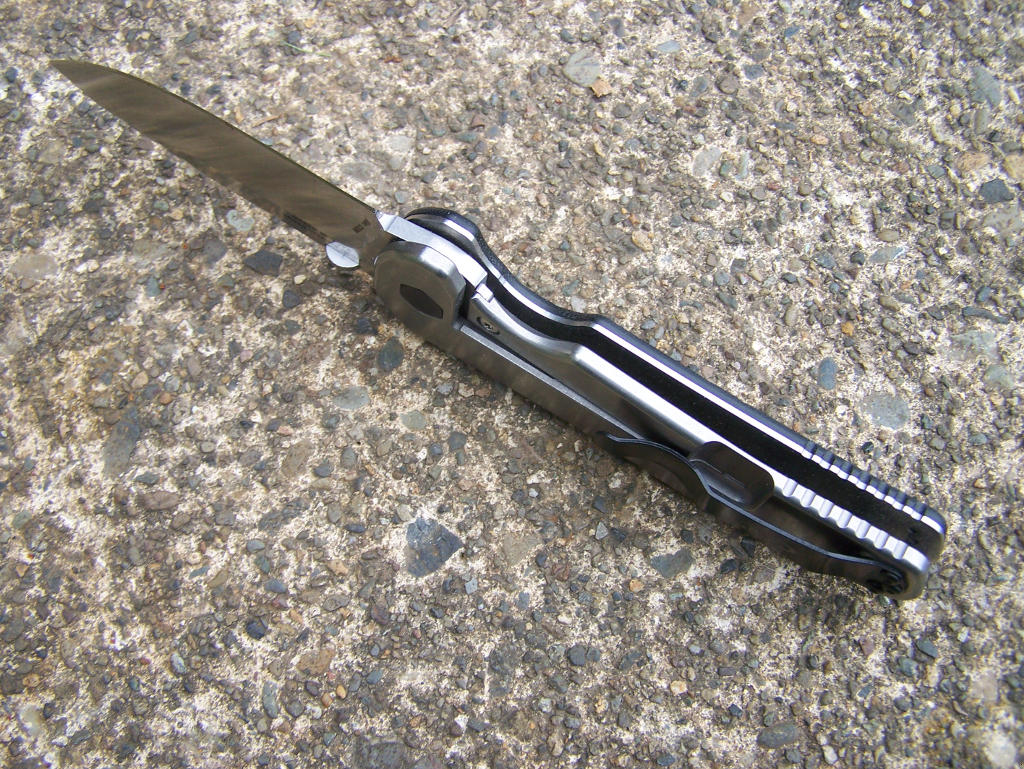
We have a reversible pocket clip, for right- or left-handed uses, which is nice! The knife is carried in the pocket, tip up, too! The titanium rear handle scale is stone washed for a subdued look, while the blade itself has a stone washed look too. You will also find an ambi thumb disk on the blade, so you can open the blade in that manner, if you don’t use the wave feature. The blade is 3.6 inches long, and the knife weights in at 6.3 oz, so we have some heft to this knife. It’s made for hard use. Remember that.
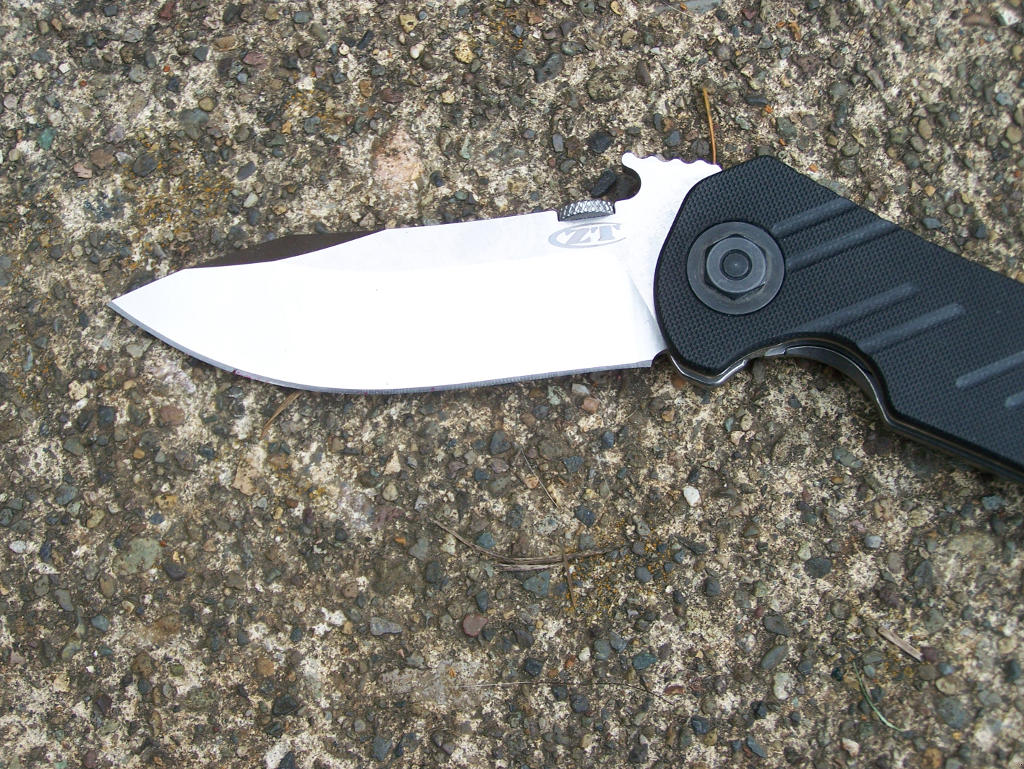
On the top of the wave feature, we find some friction grooves, and down the top of the handle we have more of the same for a sure grip when using the knife in the fencing grip. On the bottom rear of the handle we have more friction grooves, which also aid in securing this folder in your hand.
As to the blade shape itself, it is upswept, and I think that’s one of the things that wasn’t very eye appealing to my mind. Why? I have no idea! However, when you stop and think about this upswept blade design, it is outstanding for slicing cuts in self-defense use. I shouldn’t have tried to out-think Emerson on this feature of the blade; the man knows his stuff. ZT also uses a massive pivot pin on the blade. We are talking super-strong, so that there are no worries about this blade’s pivot pin breaking.
The 0630 came super-sharp right out of the box, as to be expected from ZT. I did test the knife around the kitchen just a bit. However, it was not designed for kitchen work. Still it sliced veggies and steaks extremely well. One test I do to test a knife’s sharpness is to see how easily it will cut through the wicked blackberry vines that are all over Oregon and my property. Many knives will simply bend these vines. It takes a sharp, real sharp, knife to cut these vines with one slice! The 0630 had no problems cutting these vines.
Poly rope is a really tough material to cut, even with serrated blades, and the 0630 is NOT serrated. Many knives simply slide right off poly rope, but the 0603 easily cut right through this material. I placed some old clothing over some stacked cardboard and proceeded to attack it with slicing motions. The knife easily cut right through the clothing and deeply into the stacked cardboard, and I mean deeply! If this had been an arm or a leg, it would have cut right down to the bone, I have no doubts!
Now, as to the wave feature, the thing is so simple to operate, yet some people make more out of it. Plus, Emerson’s brain was really working overtime when he thought of this way of opening a folding knife. What the wave does is catch on the top/rear edge of your pocket, as you are drawing the knife out of your pocket, and when the knife is fully out of your pocket the blade is open. It takes about five minutes of practice to master this opening technique. Just don’t make more out of it than it is. As you start to draw the knife out of your front pants pocket, apply pressure to the rear, and draw the knife upwards; the blade springs open, just that simply. No other folders are as fast to open. The wave catches on the pocket, pulling the blade open. An automatic knife requires that you draw the knife, search for the button, and then press it to open the blade. The wave feature is almost automatic itself. It just takes a little practice to master this technique. The wave featured is patented too!
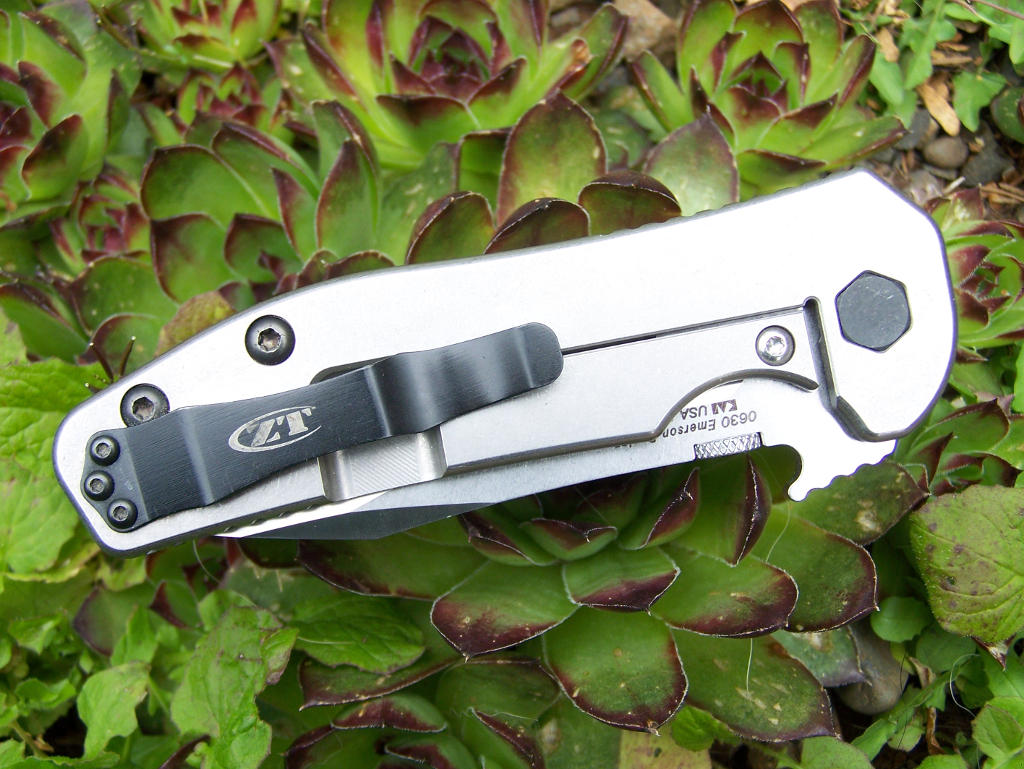
Okay, so I admit it. I was wrong when I looked at the press release and pictures of the knife. I like it, a lot! One has to remember that, first and foremost, a knife is a tool, and it has many uses as a tool. I look at many pocket knives and their design and materials to see if the knife is meant as an everyday carry folder, a Gent’s folder, or a hard use folder. Having spent so many years in the martial arts, I look at a knife as a weapon of self defense, too, since many areas simply don’t allow the carry of firearms, concealed or open carried, and many folks carry a folding knife for self defense. The ZT 0630 shines in this respect. It will get the job done on the mean streets of Big City USA or on the battlefields overseas, if it came down to hand-to-hand combat. The knife is robust, extremely well made, and only the finest materials are used to produce this folder. Add in the fact that Ernest Emerson designed this folder and it’s a no-brainer in my book. Full retail is only $250, which is quite a bargain for so much knife! Get one!
– Senior Product Review Editor, Pat Cascio
- Ad Trekker Water Station 1Gal Per MinuteCall us if you have Questions 800-627-3809
- Ad Civil Defense ManualClick Here --> The Civil Defense Manual... The A to Z of survival. Looks what's in it... https://civildefensemanual.com/whats-in-the-civil-defense-manual/
Recipe of the Week: Chicken Enchilada Casserole, by Mrs. Hugh Latimer
This is a very easy recipe and one of our family’s long-time favorites. However, I also have a camping (or emergency/SHTF) version of it that is almost as good. I’m going to give you both versions, as a sneak peak for recipes I’m assembling to share in an upcoming food preparation cookbook, which has not yet been titled. (We produce and store most of the food we consume, including spices and even some medicines and teas, so stay tuned. It’s in “the works”. We also enjoy scrumptious meals regardless of where we find ourselves (at home, on the road, on the trail, or in one of our bug out locations), as it is my belief that God blessed us with the senses for a reason…to enjoy them. So, I like my kitchen to resonate with pleasant flavors and aromas from around the world for diversity as well as the hearty, comfort foods that Mr. Latimer and I grew up with in various parts of the good ‘ole U.S.A. Like the nation, our friends and family are comprised of people with various heritages, all bringing tasty flavors that eventually become somewhat Americanized. We enjoy most all of these in some form or fashion on our dining table and have them ready their ingredients ready for when times get a LOT more difficult. I hope to share recipes, resources, and ideas for how you can enjoy these nutritious, tasty, and easy-to-prepare foods, beverages, and basic remedies, too.
Fresh At Home Version:
Ingredients
- 4 chicken breasts
- 2 tablespoons olive oil
- Lawry’s seasoned salt, to taste
- 1/2 yellow onion, finely chopped
- 6 ounces roasted New Mexican green chili, skinned, seeded, and chopped
- 3 cups sour cream
- 1 cup green chili sauce (or a simmered mixture of 4 ounces extra chopped green chili plus 1/2 cup of chicken broth and 1 roma tomato, finely diced)
- 2 cups Monterrey Jack cheese,
- 15-18 corn tortillas
- 1/2 tsp cayenne pepper (for added heat) or paprika (for no added heat)
Directions
- Sprinkle chicken breasts with seasoned salt and saute in skillet with olive oil over medium high heat for about 15 minutes, until cooked through and golden browned on both sides. Remove from pan and chop into small bite-size pieces or shred.
- In a bowl, combine chopped onion, chopped green chili, sour cream, and green chili sauce; mix thoroughly.
- Spray or coat a large 9×13 casserole dish with oil.
- Spread 1/2 cup of the sour cream mixture on the bottom of the casserole dish.
- Add a layer of corn tortillas, covering the bottom of the dish and overlapping the tortillas as needed.
- Sprinkle half of chicken on top of the tortillas and spread 1 cup of sour cream mixture on top. Sprinkle 1/4 cup of cheese over sour cream mixture.
- Repeat tortilla, chicken, sour cream, and cheese layers.
- Top with a lay of tortillas and spread the remaining sour cream mixture (approximately 1/2 cup) over them.
- Top with remaining 1 cup of cheese and then sprinkle cheese with either cayenne pepper or paprika, depending upon whether you like a hot heat taste (cayenne) or not (paprika).
- Bake at 350 degrees F for about 35-45 minutes, until bubbly, and cheese is melted throughout and beginning to brown on edges.
- Suggestions: Serve with tortilla chips, pinto beans, a green salad, and sopapillas with honey for dessert.
Camping Version (Individual Chicken Enchiladas):
Ingredients
- 2 cups freeze-dried Monterrey Jack cheese
- 1/4 cup chicken broth
- 2 cans of cooked, cubed or shredded chicken, drained (broth reserved for reconstituting freeze-dried items, as needed)
- 1/2 yellow onion, finely chopped (or 2 Tbsp of dried onion, rehydrated in chicken broth from canned chicken)
- 3 Tbsp of vegetable oil
- 3 small cans of chopped green chili, drained (liquid reserved for use in reconstituting freeze-dried items, as needed)
- 1 cup sour cream (or reconstituted freeze-dried sour cream)
- 1 can cream of chicken soup
- 15 corn tortillas
- 1/2 tsp cayenne pepper (for added heat) or paprika (for no added heat)
Directions
- Combine freeze-dried cheese with 1/4 cup of tepid temperature broth (not hot or you’ll melt cheese). Cover and set aside.
- If using dried onion, in a small container or plastic bag combine onion and broth from canned chicken to rehydrate. Let sit at least 15 minutes, until onion is soft. Can speed this up by warming.
- In a large, heavy pan or skillet, combine canned chicken, onion, green chili, sour cream, and cream of chicken soup. Heat over medium temperature, stirring constantly, until bubbly. Remove from heat.
- In a cast iron skillet, add 1Tbsp of oil to coat it well, and heat over medium-high heat. Add a corn tortilla and heat for 10-15 seconds, flipping and heating for another 10 seconds. Remove from the skillet. Place on a serving plate with about 2 Tbsp of the chicken-sour cream mixture in the middle. Roll up. Spoon a bit (1 Tbsp) of the sour cream mixture over the outside of the filled tortilla and top with 1-2 Tbsp of Monterrey Jack cheese and a tiny splash of cayenne pepper or paprika.
- Repeat step 4, adding more oil as necessary to keep tortillas from sticking, until all of the contents have been used.
- Suggestion: Serve with Refried Beans, fried corn tortilla triangles, and Foraged Spring Dandelion Salad.
Links
o o o
Do you have a favorite recipe that would be of interest to SurvivalBlog readers? Please send it via e-mail. Thanks!
- Ad STRATEGIC RELOCATION REALTYFOR SALE: Self-sustaining Rural Property situated meticulously in serene locales distant from densely populated sanctuary cities. Remember…HISTORY Favors the PREPARED!
- Ad Survival RealtyFind your secure and sustainable home. The leading marketplace for rural, remote, and off-grid properties worldwide. Affordable ads. No commissions are charged!
Letter Re: The Lack of Police and Fire Training
Hugh,
This comment is in regards to the Letter: The Lack of Police and Fire Training or Preparation for the Aftermath of an EMP.
I have had the pleasure of working for one of the Northeast’s largest cities in their Emergency Management Department, and I am currently the Director for a County EMA in the Midwest. I agree with your comments that the risk is not high on the list that we prepare for, but we do have conversations regarding this quite a bit. Part of the problem is that the run of the mill police officer or fire fighter does not think along these lines, so we have taken the opportunity to educate them whenever possible as to what an EMP would do to our infrastructure and our ability to respond.
The simple truth is that you typically have a very small group of first responders (police, fire, EMS, and EMA) trying to keep some semblance of control over a much larger population. If we lose the ability to communicate through an EMP we will not be effective at supporting the general population’s needs, and chaos will be the end result.
Now that we have a general awareness, we are starting to put injects into our exercises that would simulate a loss of power to the grid (and communications) so we can think through and react to that scenario. This includes including our local ARES group (Ham radio), as they would be our last best hope of maintaining any semblance of communications and control if we were to lose these robust radio networks. – S.G.
- Ad Click Here --> Civil Defense ManualNOW BACK IN STOCK How to protect, you, your family, friends and neighborhood in coming times of civil unrest… and much more!
- Add Your Link Here
Economics and Investing:
Jim Rogers: Turmoil Is Coming. – G.G.
o o o
The Next Great European Financial Crisis Has Begun. – B.B.
o o o
Tens of thousands march against austerity in London. What will happen in our inner cities when America is similarly really BROKE????? Those in better neighborhoods will be struggling, BUT will be in more danger from those feeling “deprived”! – H.L.
o o o
Odds ‘n Sods:
Bartering in a Post-Collapse Society. – H.L.
o o o
Paul Craig Roberts: “Washington Is Impotent To Prevent Armageddon”. – D.C.
o o o
How resilient is the United States’ food system to pandemics? . – I.R.
o o o
Video: Building a primitive wattle and daub hut from scratch. – J.C.
o o o
Video: Gunpowder From Urine. – A.R.
Hugh’s Quote of the Day:
Government-to-government foreign aid promotes statism, centralized planning, socialism, dependence, pauperization, inefficiency, and waste. It prolongs the poverty it is designed to cure. Voluntary private investment in private enterprise, on the other hand, promotes capitalism, production, independence, and self-reliance. – Henry Hazlitt
Notes for Sunday – June 21, 2015
June 21st is the birthday of Rex Applegate (June 21, 1914 – July 14, 1998). He was the friend and mentor of SurvivalBlog’s Senior Field Gear Editor, Pat Cascio.
o o o
Today, we present another entry for Round 59 of the SurvivalBlog non-fiction writing contest. The $12,000+ worth of prizes for this round include:
First Prize:
- A Gunsite Academy Three Day Course Certificate, good for any one, two, or three day course (a $1,195 value),
- A course certificate from onPoint Tactical. This certificate will be for the prize winner’s choice of three-day civilian courses. (Excluding those restricted for military or government teams.) Three day onPoint courses normally cost $795,
- DRD Tactical is providing a 5.56 NATO QD Billet upper with a hammer forged, chromlined barrel and a hard case to go with your own AR lower. It will allow any standard AR type rifle to have quick change barrel, which can be assembled in less than one minute without the use of any tools, and a compact carry capability in a hard case or 3-day pack (an $1,100 value),
- Gun Mag Warehouse is providing 20 Magpul pmags 30rd Magazines (a value of $300) and a Gun Mag Warehouse T-Shirt. (An equivalent prize will be awarded for residents in states with magazine restrictions.),
- Two cases of Mountain House freeze dried assorted entrees in #10 cans, courtesy of Ready Made Resources (a $350 value),
- A pre-selected assortment of military surplus gear from CJL Enterprize (a $300 value),
- A Model 120 Series Solar Generator provided by Quantum Harvest LLC (a $340 value),
- A $300 gift certificate from Freeze Dry Guy,
- A $250 gift certificate from Sunflower Ammo,
- KellyKettleUSA.com is donating both an AquaBrick water filtration kit and a Stainless Medium Scout Kelly Kettle Complete Kit with a combined retail value of $304,
- TexasgiBrass.com is providing a $300 gift certificate, and
- Two cases of meals, Ready to Eat (MREs), courtesy of CampingSurvival.com (a $180 value).
Second Prize:
- A Glock form factor SIRT laser training pistol and a SIRT AR-15/M4 Laser Training Bolt, courtesy of Next Level Training, which have a combined retail value of $589,
- A FloJak EarthStraw “Code Red” 100-foot well pump system (a $500 value), courtesy of FloJak.com,
- Acorn Supplies is donating a Deluxe Food Storage Survival Kit with a retail value of $350,
- The Ark Institute is donating a non-GMO, non-hybrid vegetable seed package–enough for two families of four, seed storage materials, a CD-ROM of Geri Guidetti’s book “Build Your Ark! How to Prepare for Self Reliance in Uncertain Times”, and two bottles of Potassium Iodate– a $325 retail value,
- A $250 gift card from Emergency Essentials,
- Twenty Five books, of the winners choice, of any books published by PrepperPress.com (a $270 value),
- TexasgiBrass.com is providing a $150 gift certificate, and
- RepackBox is providing a $300 gift certificate to their site.
Third Prize:
- A Royal Berkey water filter, courtesy of Directive 21 (a $275 value),
- A large handmade clothes drying rack, a washboard, and a Homesteading for Beginners DVD, all courtesy of The Homestead Store, with a combined value of $206,
- Expanded sets of both washable feminine pads and liners, donated by Naturally Cozy (a $185 retail value),
- Two Super Survival Pack seed collections, a $150 value, courtesy of Seed for Security, LLC,
- Mayflower Trading is donating a $200 gift certificate for homesteading appliances,
- APEX Gun Parts is donating a $250 purchase credit,
- Montie Gear is donating a Precision Rest (a $249 value), and
- Two 1,000-foot spools of full mil-spec U.S.-made 750 paracord (in-stock colors only) from www.TOUGHGRID.com (a $240 value).
Round 59 ends on July 31st, so get busy writing and e-mail us your entry. Remember that there is a 1,500-word minimum, and that articles on practical “how to” skills for survival have an advantage in the judging.
One Yukon Learning Event, by S.H.
On a mid-November day years ago, I set out to walk over a high, broad, timbered ridge through some apparently uninhabited spruce, poplar, and birch woods in the Yukon Territory, Canada. I was headed over and down to the lower part of a long creek about seven direct miles away. I carried metal tags that I’d received from the Mining Recorder’s Office for nailing to two sets of placer claim posts that I had cut, labeled, signed, and recorded a few weeks before, one set done by Power of Attorney. Daylight hours were now becoming seriously short at that subarctic latitude, and direct sunlight would be blocked by surrounding ridges, even at midday.
The recent weather had been mild for the season, with daytime temperatures often a little above freezing. The pleasant weather had rendered me complacent, and I was about to experience a Yukon learning event. The sky had become rapidly overcast, and a few snowflakes began to fall. The time was about 10:00am, which was too late to begin my hike with any expectation of reaching the claim posts before late in the evening. I felt prepared to spend the night in the open by a fire and planned to be back at my camp by the next evening at the latest. I had made the trip out and back in about fourteen hours in warmer, sunnier weather. I knew that this time the hike would take longer, but I didn’t realize how much more.
I was dressed and equipped for seriously cold weather, if need be. I wore sturdy, felt-lined shoepacs that were almost as warm as native mukluks, and carried a pair of extra felts. Likewise, I wore and carried thick wool socks. I had on navy blue polypro underwear shirt and trousers; a heavy, long, grey Woolrich wool shirt, military surplus O.D. wool trousers, a combination grey wool/Thinsulate jacket, and over everything a set of baggy, white milsurp poplin trousers and smock. I had an excellent brown sheepskin trooper cap with earflaps, and grey milsurp woolen gloves inside heavy woolen mittens, that in turn were covered by leather chopper mitts.
I wore a Load Bearing Equipment (LBE) patrol harness under the smock, with two canteens optimistically filled with water, although I knew the water would freeze shortly if the air temp dropped much more.. The LBE kit included a metal canteen cup and two ammo pouches filled with compasses, matches, candle stubs, and other paraphernalia. I brought a large, light blue camp coffeepot for thawing snow to make more drinking water. I had six bacon-and-cheese sandwiches packed in the buttpack on the LBE. I carried a very sharp Estwing axe with a blue, 26-inch, plastic-covered metal handle. I had a brown leather sheath for the axe that attached around the yoke on the LBE harness so that the axe rode on the middle of my back. I had a standard, stainless Buck Woodsman knife in a black leather sheath. I toted a permitted, push-feed Winchester Model 70 bolt-action rifle in .375 H & H caliber with a 20-inch barrel with three rounds in the magazine, one round up the spout with the bolt closed and un-cocked, and twelve spare rounds in my pack. I carried the rifle inside a canvas sheath that I had made and that was open at the buttstock to make the weapon quickly accessible but protected the action from getting too wet or soiled.
I was prepared to carry a battery-powered flashlight in one hand and the rifle in the other, often switching the hands. I wore a pair of black plastic, prescription military glasses that served somewhat as goggles. I had a nose band that I had made from a strip of cloth cut out of a beautifully warm, white wool blanket. The nose band served well to keep my nose and cheeks from freezing in severely cold weather. I really didn’t anticipate severe cold to set in for some time yet but did want to be prepared for eventualities. It’s a good thing I had been a Boy Scout and took the “Be Prepared” motto seriously, an attitude strongly reinforced by practical experience.
I was beginning my hike by walking up an established creek trail to a cross-country jumping-off point from which I planned to head directly for several miles over the high ridge and down to the claim posts. Dark fell amazingly fast, as the overcast quickly grew very dense, and the falling snow continued to increase in thickness to about half a foot. I was startled to see a varying hare dart past me uphill to the left side of the trail, followed by several very large wolves. I flipped on the flashlight, cocked the rifle bolt, and fired a 300-grain bullet into the ground at as harmless an angle as possible. I did not necessarily feel directly threatened by the wolves but wanted to discourage them from getting so close to me. They kill daily as a group for a living, sometimes taking moose big enough to challenge an elephant. The farther away from me that the wolves stayed, the more comfortable I remained. No doubt the falling snow had kept the wolves from detecting me in the first place. I hoped. Anyway, the wolves instantly disappeared from my view. My ears rang from firing the heavy .375 round, but I felt some comfort in the feeling that the shot would be heard by potentially dangerous animals for miles around, hopefully making me at least not less safe during my solitary errand to the claim posts and back.
I reached my planned turning-off point, used the flashlight to read a compass heading, and took off up the high ridge. The higher I went, the deeper the snow was already getting, some of it almost knee-deep. I took off the Army wool trousers and the jacket and tied them to my butt-pack. I stayed warm inside the poplin white camo outfit through exertion, although the poplin itself iced up like a tent. Every couple of hours I ate a sandwich, so it didn’t take long to devour all six. The air became continuously colder, and my flashlight batteries became apparently useless. I reached the claim posts some time during the night, built quick fires from downed spruce limbs to supply light near each post as I went along driving nails through the holes in the metal tags, using the blunt head of the Estwing axe for a hammer.
I had drunk most of my water fairly soon into the hike, and what was left in one canteen had frozen. I was operating in near-total darkness most of the time, now. What little ambient light that I had between sunset and sunrise was likely just scanty moonlight or starlight that managed to filter through the overcast and falling snow. I was alright, though, when I could find deadfall spruce, and there was plenty to be found, even in the deepening snow. I found several very long, good-sized, seasoned spruce trunks that I knew had been pushed over by a Caterpillar some years before. I got a fire going and crossed the logs over the fire. I had a nice bit of heat from that fire for several hours, crossing and re-crossing the dwindling logs, as I rested for the return hike back to my camp. I put on my jacket and Army trousers to keep warm while resting, although it was an annoying necessity to remove and re-don the white camo poplin clothes. Sparks from the spruce logs would jump on me and burn small holes in the poplin if I got too close to the fire, so I had to be careful to maintain a proper distance. I eagerly looked forward to seeing daylight again on Day 2 of my hike.
I discovered when I went to trim green spruce boughs to put down on the snow for a mattress that an axe was not the proper tool for the job. The Buck Woodsman knife that I carried was the best kind of blade for making “fuzz-sticks” for fire starting, but it was even more useless than the axe for trimming boughs. I longed deeply for a Bowie-type knife and the efficiency it would have provided. Never, never again will I go without one in a wintry spruce forest.
With the arrival of an overcast, snowy dawn, I was compelled to realize that I had better make straight tracks for camp and not make any foolish navigational errors, or I would too likely fall asleep from exhaustion and not wake up. I was burning fat now like there was no tomorrow, tightening my belt a notch every few hours. An estimate of metabolizing 500 calories an hour might not be too far off. As I traveled upslope towards the high ridge along what I estimated to be my previous route, the snow began to get seriously deeper, first knee-high, then up to my hips, then higher. Walking began to seem more like swimming, one step at a time. The snow was so powdery that my feet would hit the ground with each step. Snowshoes would have been useless, and I was glad that I had not brought mine.
Every hundred yards to be marched in the sometimes shoulder-deep snow started looking like a mile, and daylight quickly passed into near pitch-darkness again. I was consumed with the urge to press on and didn’t even consider trying to look at a compass in the dark, but I put my confidence in God and navigated by the seat of my pants. I had in mind a particular spot to arrive at on the creek trail I had first headed out on at the beginning of the hike. I melted snow continuously in my mouth for moisture and could feel that I was getting some frostbite in the roof of my mouth. Unbelievably, daylight came and went again as I labored up the back side of the high ridge. Exhaustion really began to set in, and I began to wonder if I was actually going to make it back to my camp at all. I’d had a fair amount of experience in wilderness country, though, and never really panicked, but I did my best to maintain a reverent and rational mental approach to the situation. Believe me, though, if I ever was in a continual state of prayer, it was then.
I picked a spot to stop and make a fire. I gained an energy boost when I ate a vitamin pill that I found in my kit. I managed to get a fire going and set in to melt snow in the coffeepot so I could rehydrate. I made a serious error in using a spruce stick for a pole to suspend the pot over the fire. Some spruce sap dripped into the pot and when I drank the water, and the sap attacked the frostbitten roof of my mouth, as well as making me feel very ill. I eventually managed to gather some energy and stepped uphill again.
I finally stopped to rest again, by necessity, and realized that I had crossed back over the ridge. I had instinctively found the almost exact spot on the creek trail that I was looking for, after many miles of sheer dead reckoning through deep snow and often-thick timber. It was a miracle, really.
By now the air was getting seriously cold. By experience I felt that -55 below or lower had found me, which is very dangerous and has killed many. I knew I absolutely had to have a fire. With luck I found a stand of small black spruce that had been scorched by lightning some summer. The tree roots did not go deep in the permafrost, so I was able to push a dozen or so small trees over in the snow to make a platform for starting a fire. The Estwing camp axe did great work, splitting the spruce trunks rapidly to make dry splinters appear. I maybe panicked a little when I found that my windproof matches that I had been saving for last would not ignite. I was down to my second-to-last stick match when I got a fire blazing. The heat from the burning tree trunks had no difficulty in driving away the snow beneath them. I had an earth berm at my back and was able to get really warm from efficiently reflected heat for probably the first time in 72 hours.
As my fire died down from a declining wood supply, I began to get a bad feeling about meeting an undefinable threat and thought about firing a shot from the rifle again as a general precaution. There was definitely a bear den close by, and that bear may not have gone into what used to be called “hibernation” yet. I had been carrying the rifle in a canvas sheath, and I had previously cleaned any oil out of the bolt. Nonetheless, when I went to work the bolt I found that the safety was broken, fortunately in the “Fire” position. I feel that water vapor from my hands or the air had gotten into the works and frozen things up. I held the rifle close enough to the fire to thaw the bolt and enable a shot. The cartridge did not sound normally loud to me. I wonder if the powder hadn’t been cooled enough by the cold air to take quite a bit of the power out of it. Just a guess.
I dozed off a little and woke up to find a clear sky with a bright crescent moon. The brilliance of the snow was like broad daylight. And then the air really began to turn cold. I only had a couple of miles to hike down the creek trail to camp, though, and I barely made it to my canvas tent and sheet-metal stove in time to keep my toes from freezing solid.
Reflecting upon thoughts I had as I trudged through the endless Yukon wilderness snow:
- How uniquely quiet it is, when all the noise you can hear is from falling snow.
- How precious is a good axe, although some axes are said to be subject to shattering. All I can say is that the Estwing camp axe stood my torture test, in deep cold, too.
- The axe could be a useful weapon in a chance encounter with predators and wouldn’t freeze up or jam like a more complicated weapon could.
- Difficulties with a bolt action rifle versus the virtues of a rifle with an external hammer that you can manipulate, to give you confidence that the weapon is not frozen up, or maybe a hand cannon carried in the properly-designed covered holster, maybe even a fur-equipped holster, would be preferred.
- There is the question of ability of surviving the unlikely-but-too-possible attack from cougar, wolverine, wolf, moose, or even insomniac bear, when you can barely see your hand in front of your face in the pitch dark. Yes, cougar live surprisingly far north.
- Silk underwear under woolen clothes might be a best option.
- Taking the trouble to find a weather forecast before setting out on any hike might be a good idea.
- Without the poplin white camo outfit that I wore, or any of the other clothes for that matter, I would have either frozen or dropped from exhaustion. The poplin camo was just like wearing a tent.
Letter Re: Android Geiger Counter
Thanks for the reference to the $30 android counter; I bought one!
Also, note that Radioactivity Counter is an Android ap that I have used that detects gamma radiation just using the app; there’s no external devices needed!
You’re wondering how? You tape over the camera lens and the camera itself detects gamma radiation sensitivity depending on phone models. I’ve used it, and it works. – M.R.
Economics and Investing:
‘It’s time to hold physical cash,’ says one of Britain’s most senior fund managers. – G.P.
o o o
Citi forecasts Greek devastation, unstoppable debt spirals in Italy and Portugal. – JBG
o o o
‘Last Days of Pompeii’ in Greece as crunch time approaches. – JBG
o o o
“Bank Holiday” Preparations Begin In Greece, Lines Form At Athens ATMs
Odds ‘n Sods:
An interesting perspective of a movie: What preppers can learn from the movie San Andreas. – J.M.
o o o
Thirty minutes of your time that will be well spent: Brigitte Gabriel Speaks at 2015 Watchmen on the Wall Conference . – J.T.
o o o
Every Mass Shooting Shares One Thing In Common & It’s NOT Weapons. – H.L.
o o o
An automated chicken coop! Because collecting eggs is work enough!. – T.H.
o o o
Belgian Doctors Are Euthanizing Patients Without Their Consent. – H.L.
Hugh’s Quote of the Day:
“And Jesus stood, and commanded him to be brought unto him: and when he was come near, he asked him, saying, What wilt thou that I shall do unto thee? And he said, Lord, that I may receive my sight. And Jesus said unto him, Receive thy sight: thy faith hath saved thee. And immediately he received his sight, and followed him, glorifying God: and all the people, when they saw it, gave praise unto God.” Luke 18:40-43 (KJV)