Notes for Wednesday – July 15, 2015

There are only two weeks left in round 59 of the writing contest. Be sure to get your entries wrapped up and sent in as soon as possible. Don’t forget that we will now publish pictures!

o o o

Seed for Security, LLC is having a special sale. Their Colossal Security Pack is 15% off. This pack is a total of seven pounds of vegetable, grain, and herb seeds and all are open-pollinated and non GMO. Included are their three most popular collections: the Super Survival Pack, the four Grain Collection, and the Heirloom Herb Collection. This offer is for a limited time.


Timeless World War 2 Lessons, by T.W.

After recently reading a number of books on intelligence, subterfuge, spying, and survival in World War 2, I have been led to compile a list of lessons that we can draw on today.

Preparation is Key

The best spy masters and espionage groups built up networks of contacts around strategic areas before the invasion or war. This allowed one to gain information without being seen as suspicious. If your spy doesn’t know the language thoroughly, errors in translation lead to disaster. A few weeks in language school is rarely enough, but that’s what many operatives received during World War 2 because there were too few people fluent in critical languages to avoid sending poorly trained people out. World War 2 exploded in part because the British waited for an expected internal coup to kill Hitler, many of which failed, instead of building up their defenses in the interim. This added to the severity and duration of the war. Today, we should learn the lesson to prepare for the worst while hoping for the best, instead of putting all our faith in someone else taking the risks to solve the problem. Those who stocked up on supplies before the war were in a stronger position than those who relied on markets day to day. They were less desperate for essentials and able to barter for what they needed, as long as they weren’t condemned for hoarding and saw their supplies confiscated. Having a hiding place for the stored goods well before shortages begin is far more secure than being seen stocking up during the frenzy.

Who to Choose, Who to Trust

Never use a politician in a spy or espionage ring. It risks the politicization of information, such as targeted leaks to improve one’s situation or suppressing details of failure to make oneself look good but hurting the overall objective. The people forced to retire early are the ultimate insiders to the organization’s current members and may be financially strained or angry enough to work with a rival group to gain information by leveraging those contacts. A proactive group identifies those who have valuable knowledge and disaffection with the government and lures them into spying before the other side does. Anyone who brags that they are a spy cannot be trusted to be one, though there is the remote chance the person is doing so to improve their cover by seeming to boast idly. Applying strict standards of ideological or national purity can drive out many who can support your movement but aren’t radicals. The Jewish espionage groups in World War 2 formed by kids who weren’t allowed in variation national resistance groups come to mind. Applying strict moral standards to your crew, especially at the lowest level, can hurt information gathering and espionage. For example, rules that say you can’t talk to smugglers and former convicts for information can prevent you from learning what is going on in the underground or black market.

On Human Nature and Human Resources

Reward sources and supporters, and where possible protect them. The U.S. made a major mistake after pulling out of Iraq and Afghanistan by giving refugee status to Muslim Syrian refugees while neglecting to give refuge to Iraqis and Afghanis who risked their lives to be translators for American troops. Likewise, the neglect of the Pakistani doctor who found Osama Bin Laden and silence by the federal government as to his imprisonment and torture has destroyed potential information sources in the entire Middle East (and the unspoken reason why Western polio workers started to be killed en masse after Bin Laden’s death). However, people who became spies for the money are prone to becoming double agents for even more money. It is the little details that can get someone captured. For example, many criminals on the run today are found through their girlfriends or wives who make contact with friends and family to let people they know hear that they are safe; her contact with them then leads the authorities to him. Many events occurred because someone received intelligence warning of an event and didn’t believe it. Per the book Burn After Reading: The Espionage History of World War 2 by Ladislas Farago, Colonel Oster informed Norway of the impending Nazi invasion, which the Norwegian military attaché refused to believe; this is one case in point. The invasion of Norway, though, occurred on the day Colonel Oster said it would. Spy networks are as often filled with unwitting dupes as willing friends and mercenaries who act for money. Be careful of people who would join a movement so they can use it for revenge or abuse of people they don’t like. Spy rings in place too long become lazy and complacent. Those created in the 1920s were often incapable of acting with speed and effectiveness during the invasions of the late 1930s and 1940s. Sun Tzu pointed out that one could scheme with women, and World War 2 certainly saw prostitutes used as information sources, with the Germans even taking over a brothel and having specially trained girls sent to entertain high ranking men and elicit information from them. This is why people who used such sexual services were seen as having a strike against them after World War 2 when applying for security clearances. On a side note, the sexual promiscuity of homosexuals was another reason for disqualifying them, and the lowering of these standards in the name of political correctness is why Bradley Manning (Chelsea Manning) was in a position to leak the information he did. The lesson to learn from this is that those who bed hop with either gender generally cannot be trusted with secrets, but they can be used to get information by those willing to exploit pillow talk.

Propaganda and Getting the Word Out

The appearance of strength can be as important to defense as the actual defenses. It is more important if it deters an attack that the defenses might not stand against. Here’s a quote from Burn After Reading– “All secret services have special branches whose war time job is to concoct lies and to spread useful rumors.” Spreading useful rumors is easier and often safer than coming up with new lies that can be traced back to you. Under slander laws in many jurisdictions, you can be prosecuted for lying to officials or intentionally spreading negative lies about others, but repeating rumors is neither a lie nor slander since you’re not the source. In the same book, Burn After Reading, the best propaganda was often a variation of what the enemy already used. For example, when the German soldiers received pamphlets with a list of French whorehouses, a pass good for one free service per day and locations where they could get condoms and treatment for STDs, the pamphlets were copied exactly and distributed through Germany with a note to women that this is how well their men were treated.

The Importance of Leadership

The British have kept the identity of their head of MI5 secret for years, even in the person’s obituary. The secrecy of the organization is iron clad and strictly maintained. Any effort you want to keep secret needs that secrecy strictly maintained from the top down to have a good chance of succeeding. The quality of an espionage group depends on the quality of the people in charge of them. Bureaucratization of intelligence services in World War 2 hurt efforts that needed secrecy as much as they needed creativity. Underlings afraid to report bad news to a superior are as likely a cause of misinformation at the top as deliberate feeding of bad information by spies. This is due to a leadership problem.

Know How to Know Someone Is On Your Side

World War 2 included a large number of wireless transmitters and mobile operators. The British learned who a number of German wireless operators were and trained their own people to imitate the German’s style of tapping out Morse Code, so that the Germans receiving the broadcasts thought they were talking to the real German operatives in England. This can be seen as a precursor to someone hacking your Facebook page or getting your phone and sending messages while pretending to be you; as long as they are a good enough imitation, they pass as you until they make a mistake or fail to show up for an in-person meeting. Relying entirely on digital communications to talk to someone makes it both easier for the communications to be monitored and someone to impersonate your contact, if not be a fake one altogether. Don’t assume that the person on the other end is who they say they are, much less trust them unconditionally without verification. Agent provocateurs may lead rebellions to identify the partisans for roundup and execution. An entire OSS team was caught by the Nazis in Slovakia and killed this way. Mao’s Hundred Flowers Campaign to let people air their grievances against the Communists publicly in a show of tolerance before arresting them and killing them was another. It can be difficult to identify provocateurs, but if the era of openness is too good to be true, it is. Likewise, a plainly visible website and invitation-only forum as the perfect place to start discussing grandiose plans with people who you’ve never met is also a mistake. Some people play both sides to stay safe. For example, some people cozened up to the Nazis to stay safe while hiding Jews or feeding intelligence to the resistance. That can make it hard to know who to trust, but it should be understood so that you don’t rule out someone who plays nice with a rival in order to protect family or hide illegal activities.

Hiding in Plain Sight

Those who have a legitimate excuse for their activities have the best cover. For example, during World War 2, Japanese spies were designated junior diplomats to have an excuse for their radio transmitters. However, the spies didn’t socialize like the higher ranking ones. Looking like you are no one can get you farther than pretending to be someone. Many spies have gotten far by pretending to be dullards, like Mary Bowser in the Confederate President’s house. The best way for a group to meet is somewhere they are inconspicuous. People in uniform meeting at an alma mater, younger people at a social venue, and so forth avoid suspicion. According to the book Masquerade by Seymour Reit, gun emplacements were hidden in old wooden shacks, bridge abutments, tool sheds, innocent shops, and one as a marble war monument. Try to hide things in plain sight by building around them or integrating them into the landscape. Otherwise, use the unused spaces that might otherwise be neglected, like the newly dug subway line in London turned into an assembly line for war manufacturing during World War 2.

Intelligence and Analysis

Recommended courses of action on what to do per intelligence reports tends to be vague as a compromise between various conflicting sources of information. That is unless the reports are used as an excuse to take a desired course of action, which fits an existing plan or agenda. In that regard, detailed recommendations in response to an intelligence report where other recommendations were vague are like the standard liberal response to a mass shooting to outlaw the types of guns and registration of owners that they have always wanted. Beware of recommended actions that they’ve always insisted upon. During World War 2, people who escaped a raid were often caught because a calendar with a doctor’s appointment was discovered or notes with the next time and place of meeting. The little details could give them away. Information gathering doesn’t have to be a cloak and dagger affair. Hair dressers at an Italian salon frequented by officers’ and officials’ wives were trained to ask leading questions to get information for the Allies. Code breaking and cryptography didn’t negate the need for observations on the ground and information not in the reports. Code breaking can yield tactical information in advance of an attack like the location of the fleet, but it doesn’t yield much strategic information. Code breaking may be done by people who don’t know the language, when it is a matter of piecing together the puzzle. Human archeology is based on the idea that people have left behind a lot of trash throughout their history. You can find useful information in documents and other items thrown away. However, it is even better to pay the janitor to save papers from destruction and deliver them to you. People like to talk. The skill intelligence needs is how to ask questions to gather useful information without arousing suspicion. Intelligence will be faulty and full of mistakes, both due to misinterpretation and deliberate misinformation. Balance sacking your best people for mistakes that aren’t their fault and tolerating faulty sources with lots of excuses or good connections.

Technical Details

The best way to undermine a monitoring or analysis group is with a deluge of information. This is why businesses that want to hide incriminating information send thousands of pages of documentation, to be seen as complying with discovery orders while minimizing the risk that incriminating information is found in time to be used. Data in the modern age is easily modified or corrupted. True information comes from those on the ground or in the know. You cannot simply rely on databases to find the truth, when it is so easily altered or destroyed. During World War 2, a simpler version of this was creating false paper trails for fake identities. If you need to disarm a bomb and have little else at hand, douse it in water. You have a good chance of shorting out something electrical and stopping it. Due to the extensive monitoring via many nations’ intelligence organizations, the old fashioned methods of sending messages are again the most private. A letter is unlikely to be opened and scanned and read by a government official, though such orders can still be used by the Post Office. Written messages sent within harmless packages are unlikely to be read or reviewed. It isn’t as fast as a text message or phone call, but it is far more secure.

Summary

While technology and science have advanced, basic human nature hasn’t changed, and techniques and problems from earlier eras are just as workable today. Learn from the lessons of the past so that the mistakes aren’t repeated.


Letter Re: Church Incorporation

HJL,

I think you will find the case of Morey vs Riddell, 205, Federal Supplement 918 highly relevant and incredibly interesting as it relates to Church Incorporation and 501(c)3s. This case was tried in the Southern District of California, Central Division before the Hon. Alfonso J. Zirpoli, a judge. This case is from the 60’s and has a book about it titled A Federal Court Acknowledges Christ’s True Church. The Library of Congress Catalogue Card No. is 66-3171. Information can be found here, or it can be purchased at Amazon. I’d love to know your thoughts on this case.


Economics and Investing:

Greek safety deposit boxes – S.M.

The telling quote: “The only reason to put access to safe deposit boxes under capital controls – measures which were agreed between the government and the banks – is because the banks and governments wish to retain the option of confiscating the contents of those boxes should the crisis deepen.”

o o o

Food Stamp Beneficiaries Have Exceeded 45 Million For 48 Straight Months – G.G.

o o o

Items from Mr. Econocobas:

Snow In The Summer Confirmed – Retail Sales Tumble Most Since February

It Starts: Greeks Rebel Against Bailout, Risk Collapse


Odds ‘n Sods:

Now, it’s illegal to be a punk rocker | Belt with fake bullets leads to arrest in Boston

o o o

This is the kind of abuse of public trust that gives law enforcement and the justice system a black eye. Sheriff’s Department Takes Family’s Home and Contents Using a Fake Eviction – T.P.

o o o

Are You Ready for Remote Concealed Carry Detection Devices? – B.B.

o o o

Interestingly, if you want your very own mobile missile launcher for an ICBM, you can pick it up at auction right now from Government Liquidation. Of course, it must be demilitarized. – C.M.

o o o

Maine Governor Signs Constitutional Carry Bill Legalizing Concealed Carry Without Permit – D.S.


Hugh’s Quote of the Day:

“Taxation of earnings from labor is on a par with forced labor. Seizing the results of someone’s labor is equivalent to seizing hours from him and directing him to carry on various activities.” – Robert Nozick


Notes for Tuesday – July 14, 2015

July 14th is the birthday of Colonel Einar A. Malmstrom. He was born in 1907 and died August 21, 1954 near Great Falls, Montana, in the crash of a T-33 jet. He was a decorated Air Force pilot, a Luft Stalag POW survivor, and test pilot. Malmstrom AFB was one of the settings for JWR’s novel Founders. (The base was named in his honor.)

o o o

Today, we present another entry for Round 59 of the SurvivalBlog non-fiction writing contest. The $12,000+ worth of prizes for this round include:

First Prize:

  1. A Gunsite Academy Three Day Course Certificate, good for any one, two, or three day course (a $1,195 value),
  2. A course certificate from onPoint Tactical. This certificate will be for the prize winner’s choice of three-day civilian courses. (Excluding those restricted for military or government teams.) Three day onPoint courses normally cost $795,
  3. DRD Tactical is providing a 5.56 NATO QD Billet upper with a hammer forged, chromlined barrel and a hard case to go with your own AR lower. It will allow any standard AR type rifle to have quick change barrel, which can be assembled in less than one minute without the use of any tools, and a compact carry capability in a hard case or 3-day pack (an $1,100 value),
  4. Gun Mag Warehouse is providing 20 Magpul pmags 30rd Magazines (a value of $300) and a Gun Mag Warehouse T-Shirt. (An equivalent prize will be awarded for residents in states with magazine restrictions.),
  5. Two cases of Mountain House freeze dried assorted entrees in #10 cans, courtesy of Ready Made Resources (a $350 value),
  6. A pre-selected assortment of military surplus gear from CJL Enterprize (a $300 value),
  7. A Model 120 Series Solar Generator provided by Quantum Harvest LLC (a $340 value),
  8. A $300 gift certificate from Freeze Dry Guy,
  9. A $250 gift certificate from Sunflower Ammo,
  10. KellyKettleUSA.com is donating both an AquaBrick water filtration kit and a Stainless Medium Scout Kelly Kettle Complete Kit with a combined retail value of $304,
  11. TexasgiBrass.com is providing a $300 gift certificate, and
  12. Two cases of meals, Ready to Eat (MREs), courtesy of CampingSurvival.com (a $180 value).

Second Prize:

  1. A Glock form factor SIRT laser training pistol and a SIRT AR-15/M4 Laser Training Bolt, courtesy of Next Level Training, which have a combined retail value of $589,
  2. A FloJak EarthStraw “Code Red” 100-foot well pump system (a $500 value), courtesy of FloJak.com,
  3. The Ark Institute is donating a non-GMO, non-hybrid vegetable seed package–enough for two families of four, seed storage materials, a CD-ROM of Geri Guidetti’s book “Build Your Ark! How to Prepare for Self Reliance in Uncertain Times”, and two bottles of Potassium Iodate– a $325 retail value,
  4. A $250 gift card from Emergency Essentials,
  5. Twenty Five books, of the winners choice, of any books published by PrepperPress.com (a $270 value),
  6. TexasgiBrass.com is providing a $150 gift certificate, and
  7. RepackBox is providing a $300 gift certificate to their site.

Third Prize:

  1. A Royal Berkey water filter, courtesy of Directive 21 (a $275 value),
  2. A large handmade clothes drying rack, a washboard, and a Homesteading for Beginners DVD, all courtesy of The Homestead Store, with a combined value of $206,
  3. Expanded sets of both washable feminine pads and liners, donated by Naturally Cozy (a $185 retail value),
  4. Two Super Survival Pack seed collections, a $150 value, courtesy of Seed for Security, LLC,
  5. Mayflower Trading is donating a $200 gift certificate for homesteading appliances,
  6. APEX Gun Parts is donating a $250 purchase credit,
  7. Montie Gear is donating a Precision Rest (a $249 value), and
  8. Two 1,000-foot spools of full mil-spec U.S.-made 750 paracord (in-stock colors only) from www.TOUGHGRID.com (a $240 value).

Round 59 ends on July 31st, so get busy writing and e-mail us your entry. Remember that there is a 1,500-word minimum, and that articles on practical “how to” skills for survival have an advantage in the judging.


A Year’s Supply of Food on a Budget, by J.H.

Without enough food, all other preparations you do are worthless. In a SHTF (grid-down) scenario if you are out of food, there may not be any way to obtain more. This article represents my own research on how to get a year’s supply of food on a budget. By the end of this article, you will see how I can feed a family of four for under $2,000 for an entire year.

Initial Criteria and Plan

First off, let me tell you why my focus is on inexpensive instead of nutrition or other criteria. The short answer is I don’t have a ton of extra money laying around, and when I do have some extra money to spend I prefer to get something that could last as long as possible. Lastly, and this is probably the most important reason to me, the more I research I do the more convinced I am that something really bad could happen at any time. I hope I am wrong, but if I’m not I need to be prepared, and I need to be prepared quickly. The only way to prepare quickly, without having a lot of money, is to focus on the basics first while keeping the costs as low as possible.

Therefore, the phases of my food storage plan are the following:

  1. Get enough food that will keep my family and me alive for a year.
  2. Get additional items that will add more variety and better nutrition.
  3. Add comfort items that would make the emergency food supplies more enjoyable to live on but are higher cost and/or have a short shelf life.

The most important principles for phase one food storage is to have a long shelf life (20+ years). I personally don’t have the time, energy, or inclination to focus on keeping an elaborate food rotation schedule. If you do, good job on being awesome. I want food that I could buy and let sit for 20+ years without having to worry about it or rotate but that I can still know is there for me if needed.

Once I have a year’s supply of food and the peace of mind that comes with knowing that my family could survive for a year, then I will start to work on the second and third phases of my food storage plan. Those phases could very well include canned and freeze-dried foods with shorter expiration dates that need to be rotated.

My Journey

I decided that I needed to start moving quickly towards having a year supply of food, so I went to Google and searched for “food storage”. I found all sorts of sites, and most of them offered food storage packages. These appealed to me at first because they are easy, but I quickly realized that in order to get a pre-planned package for a year for four people (the size of my family) I would probably have to spend at least $4,000 and probably closer to $6,000-10,000. Yikes!

One warning about these food storage packages is that they like to sell you on servings instead of calories. For example, I found one food storage package that sold under the title of Month Packages. It included 84 servings of breakfast and entrées. It said, “How long will 84 servings last? 1 Month at 3 servings / day”. This implied that one person could live off this food for a month. I had to manually add up the total calories from six different entrees and servings (a lot of companies like to obscure this information), and I discovered that it only equaled out to 444 calories a day. No one can survive on that! Then I changed my math and calculated the calories I was getting per dollar spent. It equaled out to a grand total of 66 calories per dollar. That’s not a very good bargain for the money.

I don’t want to completely trash these food storage packages. Yes, they are expensive and not very forthcoming on how long they would really last you or your family. However, they have their place. Most of them are just add water, and they have a good balance of nutrition. They are quick, easy, and overall have a good balance of nutrition. So if you have more money to spend then these might still be a good option. In fact, after I complete phase one of my food storage plan, I will probably add some of these packaged foods to my food storage.

After going through this exercise, I decided to go back to Google and search “Food Storage Calories per dollar”. I found an article right here on SurvivalBlog called “Let’s Talk About Calories Per Dollar”, by Mississippi Girl. In this article I found out what foods get you the biggest calorie bang per buck. It basically comes down to this: Rice, Potatoes, Beans, Wheat, and Oats. These foods can range anywhere from 600 calories per dollar to 5,000 per dollar! That is a big difference from the 66 calories per dollar I saw in the example above.

One other thing I had to consider is that my wife is gluten intolerant (meaning she doesn’t eat wheat), it won’t kill her, but she functions much better without it, which could be crucial to a survival/stressful situation. Unfortunately for our family situation, wheat is one of the least expensive foods out there for calories per dollar. Luckily, the other foods listed by Mississippi Girl are gluten free, and I know from firsthand experience that rice and beans can keep people alive for a long time. I served as a missionary for two years in Venezuela, so I saw firsthand that people can live off of rice and beans for a major portion of their daily calories.

After reading the list above from Mississippi Girl and fact checking it with some research of my own, I realized that for my situation the least expensive way for me to get a year supply of food was to load up on the items listed by Mississippi Girl, going heavy on the rice and beans and lighter on the wheat.

Having decided that my food storage is mostly going to consist of beans, rice, potatoes, and oats (at least for phase one), I started looking for the best deals. Being a member of the LDS church, I knew that the church has Storehouses or Home Storage Centers. You do not have to be a member of the church to use them though they may require that you be accompanied by a member. [Editors note: I have used the Bishop’s Storehouses, and they are indeed a great place to buy a limited selection of important long-term storage foods at awesome prices, however, recent FDA rule enforcement has limited much of their bulk sales at many locations. The #10 cans the author talks about are available at nearly every Bishop’s Storehouse location. Also, every time I have visited one, I was subjected to a hard sell on the LDS church before I was allowed to purchase any items.] They basically take all the work out of preparing food storage and can sell it to you pre-packaged in #10 cans or the big 5-gallon buckets at cost. That being said, other places like WinCo, Sam’s Club, and Costco are other great places to buy food in bulk. There are articles on the net that tell about places to buy in bulk.

Phase I

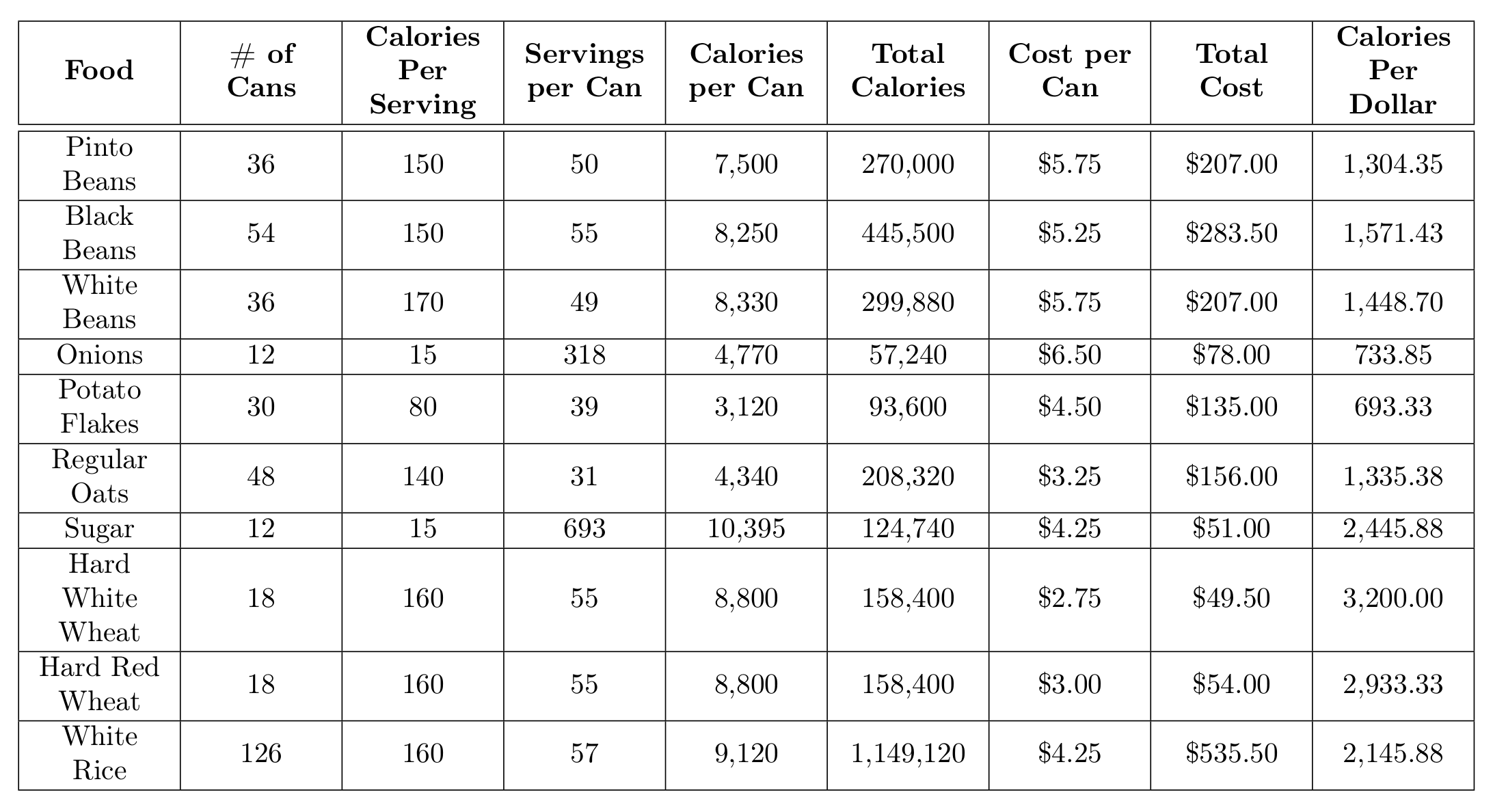
So here is my phase 1 plan broken down for you. This is for a family of four, all in #10 cans.
phase-1

Total #10 Cans: 390

Total Boxes (6 cans per box): 65

Total Cost: $1,756.50

Total Calories: 2,965,200

Average Calories per dollar spent: 1,688

Calories per Person (4 people) per year: 741,300

Calories per person (4 people) per day: 2,030

Now, is this an ideal diet by any stretch of imagination? No way. Would you be so sick of beans and rice that you would be ready to eat worms? Well, maybe it wouldn’t be that bad. The point is you would be alive. With this diet alone you would NOT be in optimal health, but the hope is that you would be doing other things to augment this diet, like hunting, fishing, gardening, or bartering. You would have enough calories and a “balanced enough” meal to keep you alive. Even better, after you have this base of food from completing phase 1, you can then start working on improving it with other things that are much lower in calories per dollar but will help make you feel more normal and be in better overall health (e.g. freeze-dried fruit, canned meat, nuts, eggs, pre-made freeze-dried meals, MREs, et cetera).

A Few More Things To Consider

There are a few more things I want to mention about this basic diet.

First, rice and beans makes a complete protein, which is part of why so many people in central/south America can live on a diet of mostly rice and beans.

I think everyone should have a good variety of heirloom seeds stored away for safe keeping, but just in case you don’t or you want to augment your garden, most of the time you can actually plant the beans from your food storage. Although this seems extremely obvious now, this didn’t dawn on me until I was writing this article.

If you are not getting anything green in your diet and your garden isn’t ready yet, you can sprout your wheat for some extra nutritional value. Here is a quick article on how to sprout wheat.

As with any food storage you might have a hard time trying to figure out where to put it all. There are a total of 65 boxes with my setup here, so it does take up a fair amount of space, but the beauty of this first phase is that there is no rotation. This food storage is easy to buy, store, and forget about it. For that reason I don’t need to have ready access to it. My plan is to store the boxes underneath my beds and then put a bed skirt around the bases, hiding the food storage. Just make sure you get a bed frame that can clear the 7-inch boxes underneath. One person posted that they can fit between 20-25 boxes under one king bed!

Keep temperatures in mind. It basically works out that the colder you store your food, the longer it keeps. However, as long as you keep it inside an air conditioned house you should be okay. Don’t leave it in the garage or attic where temperatures can get up to 115° F during the summer.

One other thing to note with a setup like this is that you will need a supply of water, the ability to cook, and possibly the ability to grind (for the wheat) without electricity. So plan accordingly.

How many calories do you actually need to live on? That completely depends on your situation, but for an easy number to use I choose 2,000 calories per person per day. In many cases, especially when a lot of physical activity is required, it will be much higher than that. Check out this article for a more in-depth discussion on this topic.

Lastly, don’t underestimate the caloric needs of kids. Check this page out for a brief overview of caloric needs per age and gender. My youngest is four years old and lives an active lifestyle (what kid doesn’t?); her caloric needs are 1,400-1,800 per day. Plus, that doesn’t even consider that by the time I need this food storage, she might be a teenager. So the long story short is that you should not skimp on calories for kids.

In conclusion, this plan is really powerful because for $1,756.50, I can buy food that will last for 30+ years that will keep a family of four alive for an entire year! I can buy it, store it, and forget it. Plus, after you complete phase one of this plan, it is my hope that you won’t completely forget about food storage, but that you will continue improving upon your supply. Like I said in the beginning, if you don’t have enough food, all other preparations you make will be worthless. I hope this article gave you some other ideas around food storage. Good luck everyone. Now go and stock up on some food!


Letter Re: Steel Buildings

Hugh,

The key is the galvanized steel used in metal building construction (galvanized to prevent rust). Galvanized steel with the difference in electrical conductivity between zinc and iron makes a primitive capacitor but more importantly exhibits dielectric properties. From Wikipedia (to make it a simple explanation): A dielectric material (dielectric for short) is an electrical insulator that can be polarized by an applied electric field. When a dielectric is placed in an electric field, electric charges do not flow through the material as they do in a conductor, but only slightly shift from their average equilibrium positions causing dielectric polarization. Because of dielectric polarization, positive charges are displaced toward the field and negative charges shift in the opposite direction.

As a result it tends to retain a charge rather than allowing it to flow to ground. This can create a catastrophic electrostatic discharge.

The addition of a woven copper mesh to the interior surface of the steel building makes a decent rfi protected building or faraday cage. Many U.S. government buildings are constructed using this method, though they tend to hang it inside the sheetrock walls. To prevent snooping they will run a low voltage DC current through the copper mesh, which actually improves its performance as a faraday cage.

If the building is to be built as a faraday cage then layering copper mesh into the cement floor (with an exposed edge for grounding the copper mesh) should be specified at the time of construction. Without the exposed edge to earth ground the floor can build up a floating charge, which has been the bane of many a data center operator.

Finally, the building has to be properly grounded using a copper grounding rod buried deep enough that it is down into constantly moist soils.


Odds ‘n Sods:

Our friend Commander Zero had a link to a fascinating article by a Montana journalist Michael Finkel: The Strange & Curious Tale of the Last True Hermit

o o o

An excellent article on the mentality of homesteading: There’s Nothing You Can Do?

o o o

The liberal-progressives are at it again: Don’t make a success out of life – ( It’s simply too rough on your health ) – T.P.

HJL adds: Contrast that article with the one just above it!

o o o

Are Private Companies Color Coding Your House For Law Enforcement? In other words, if the guy delivering your pizza has ANY type of previous involvement with the criminal justice system, your home just made the fusion center “red list” even if you don’t know the man personally. His cell number is now linked with yours on metadata. It’s comforting, isn’t it? – T.P.

o o o

When the Trucks Stop Delivering, ‘The System’ Will Collapse Of course, you already knew that. – B.B.


Hugh’s Quote of the Day:

“When politicians say ‘I’m in politics,’ it may or may not be possible to trust them, but when they say, ‘I’m in public service,’ you know you should flee.” – Albert Jay Nock


Notes for Monday – July 13, 2015

On this day in 1787, Congress enacted the Northwest Ordinance, structuring settlement of the Northwest Territory and creating a policy for the addition of new states to the nation. The members of Congress knew that, if their new confederation were to survive intact, it had to resolve the states’ competing claims to western territory.