
To Bee, or Not to Bee – Part 1, by Prepared Grammy

About Me

When I was a small child, I know I was a bit odd. I loved bees. I played with bees and tried to get them to crawl on my hands. I caught them, put them in a jar, and wanted to keep them as pets. I wanted my own beehives, so I could harvest my own honey. I told you, I was odd. Yes, I was occasionally stung, but my love for bees did not waiver. I never got over the desire to have bees.

My husband and I have three grown children, and our third grandchild is due this year. We occasionally have extra time on our hands and a little extra income, now that the kids are all out of the house. So, I am experiencing my mid-life crisis. I didn’t get a sports car; I got bees! My husband calls it a middle-aged person’s adrenaline rush. He may be right.

What This Article Is and What It Is Not

  • This article will give you some basic beekeeping information.
  • It will help you to decide if beekeeping is something you wish to pursue as part of your TEOTWAWKI preparations.
  • It will give you lists of basic equipment needed for beekeeping.
  • It will give you some basic information you will need to begin beekeeping.
  • It will give you information on harvesting honey.
  • It will not tell you what kind of hive to get or the type of frames to use. This is completely up to your personal preferences. Research it for yourself, and choose what you think fits your needs.
  • It will not give you information about all of the problems you may incur while beekeeping. It is impossible to cover that in one article.
  • It will not give you information about winterizing your beehives. This varies among climates, and I would advise getting information from other local beekeepers regarding this.

Are Bees for You?

Should you get bees? They are not for everyone, but I think it is worth considering.

  • Are you or a family member allergic to bee stings? How severe is the reaction? If anaphylactic shock is possible, maybe you should not pursue beekeeping. Regardless of the precautions you take, you will eventually get stung.
  • Can you afford the start-up costs? Although bees aren’t the most expensive homesteading endeavor or hobby out there, they aren’t cheap. The equipment needed, which I’ll talk about later, varies in price and is an investment, but it’s one that I feel is worth it. I believe you should buy new hive boxes. Used ones may contain harmful chemicals or disease-causing organisms.
  • Do you have the time to care for bees? Getting started will take more of your time than after your hives are established and you are more experienced.
  • Will you have the help you need? Do you have someone to give you guidance and advice? Will there be someone to help when you need it? Not everyone likes bees as much as I do. That makes it difficult to leave at certain stages of your hive’s development. I was recently out of town for a mission trip and had to find someone to feed my newly-established hive. Getting people to care for the animals we have is relatively easy. Finding someone who is not afraid of bees is somewhat of a problem. Fortunately, I have a friend who has always wanted bees. Taking care of mine gave him the opportunity to give beekeeping a try. I think he’s been bitten (or stung, as the case may be) by the beekeeping bug. He’s now looking into getting his own beehive.
  • Are there zoning issues that prevent you from having a beehive on your property? I live in a rural area, as many of you do, and am not bound by zoning regulations that prevent me from beekeeping. Check to see if you are restricted from having bees.
  • Will bees survive in your environment? Do they have adequate habitat? Will your neighbors cause problems for your bees? The latter has been my greatest challenge. We live in mining and farming country. The chemicals from our farming neighbors could kill our bees. One of our neighbors is supportive of our endeavor, while the other is less than enthusiastic. We will continue to work with the uncooperative farmer and hope he is more careful with chemicals in the future.

How Bee Colonies Work

As the name indicates, bees are social beings and live in groups. The queen, drones, and workers each have specific jobs that keep the colony functioning. Simply put, the queen’s main function is to lay eggs. The drones mate with the queen, and the workers do what their name indicates; they do the work in the hive.

Getting Started with Beekeeping

If you decide that beekeeping is for you, gather all of the information you can.

  • Talk to any beekeepers you know. If you don’t know any, you can check with local beekeeping clubs or associations. Your state agriculture department or home extension office may also be of assistance. Any of these can get you started and keep you successful with beekeeping. Club members are also good about “splitting their hives” to share with other members who are trying to reestablish hives after having lost bees.
  • Read, read, read. There are many books and blogs devoted to beekeeping. I have my favorites, and soon you will too. I would recommend sampling a few books on Amazon and ordering one or two of your favorites. Some beekeeping electronic books are free to download. Check out a few blogs, and bookmark your favorites. Blogs are a good way of asking any questions you may have. Most beekeeping bloggers are eager to help.
  • Watch YouTube videos. This will give a close-up view of beekeeping without leaving your home. This is especially helpful for those of you who live in remote areas. One of my favorites is Backwards Beekeepers. He is a down-to-earth, no-nonsense beekeeper who uses simple equipment.

Habitat

Before you even think about getting equipment or bees, ask yourself if you have a good habitat for them. Honeybees travel as far as four miles to collect nectar and pollen from flowers. If you do not have habitat, establish it. I live in a rural area with clover fields, crops, pastures, and wildflowers. In addition to the clover, honeysuckle, and wildflowers, my bees are currently enjoying the blooms in my garden. It’s no surprise that thanks to the bees’ pollination of my plants, I have such an overabundance of vegetables that I have been sharing with family and friends.

If you need to establish bee habitat, I would suggest planting a few fruit trees and a garden. These will benefit you as well as the bees. I would also advise planting flowers. Native wildflowers are my first choice.

Bees also need water. If you do not have a natural water source, you must create one. I have a pond on my property, and so do all of my neighbors. A birdbath, child’s wading pool, and a small fishpond are good water sources for your bees.

Beginning Equipment

Now that you have habitat, it is time to think about getting your equipment. I would suggest getting good, high quality, hive components. This will save you money in the long run, as you will not have to replace your hive boxes as often. Good boxes just last longer. You can order your equipment online or from a catalog, or possibly shop locally. (Everything is available on Amazon.) I was surprised to find a “mom and pop” bee equipment business only about 45 miles from my home. They were also a great help when I was getting started.

To start out you’ll need the following equipment:

Many companies offer beginner kits and other hive kits that include all or most of the above listed items. Some kits also include a jacket or coveralls. In order to keep costs down, I choose to wear long pants and long sleeves at times that I am working with the bees. Most of the time, I do not wear any protective equipment at all. Contrary to what most people believe, bees are not typically aggressive. They don’t bother you, if you don’t bother them. I just stay calm and move slowly when I work with my bees.

Getting Ready

There are a few things you need to do before you get any bees for your hive boxes.

  • You will need to paint the wood on the hive boxes. This will protect your equipment and extend the time before you have to replace it.
  • For ease of beekeeping and to help with moisture issues, I would advise raising the hive off of the ground. I used a few concrete blocks to achieve this.
  • Make sure the ground is relatively flat, with only the slightest degree of slope toward the east. This slope will help with drainage, if you ever have any water issues.
  • The hive boxes need to have some protection from the wind, and they should face east. Facing east gives the bees the opportunity to get early morning sunshine. The sun will wake them, and they will start gathering nectar earlier in the day. The more they gather, the more honey they produce.
  • Do not put the beehives near where children will be playing or where adults will be congregating. Bees will not attack you for no good reason, but if you intrude on their home they may protect it. The area around the hive boxes is very active when the bees are coming and going to collect nectar.
  • Set up your hive box super with the frames inside (and foundations, if you have frames that need them), and place the inner and outer covers on top.
  • Mix, by weight, one part sugar to one part water. I mix four pounds of granulated sugar with eight cups of very hot water. Mix well, until the sugar dissolves. This is what you will feed your bees when you get them.
  • There may be regulations regarding registering your beehives with your state. Check on your particular state.
  • In order to protect my bees from chemicals being used by my neighbors, I have registered my hives with driftwatch.org. I did not give permission for the site to publish my name or the address of my beehives to the general public. Driftwatch is available for anyone who applies chemicals to consult, making them aware of the location of beehives so they may take special care to protect the bees. This is by no means a guarantee that your bees are protected. Consulting the site is strictly voluntary. Also, your bees may be gathering nectar on a plant being sprayed. Bees do gather nectar during the day when spraying is also being done during this time.

Letter Re: Radio Basics Presentation

Hugh,

This was a great, quick “down and dirty” presentation on “Radio”. I would like to offer a few additions to his list.

Section 3 Tactical Radios

CB – Citizens Band

  • CB actually can have 120 channels; if you include upper and lower “sidebands” in SSB radios, there are 120 total.
  • Channels from 26.965 to 27.405 MHz are not the only ones used. There are also “free band” frequencies above and below these that “pirate” operators use.
  • During a solar maximum, I have talked all over the world on CB SSB, but yes, the normal range is 4-5 miles.
  • “Channel 9 is used only for emergencies or traveler assistance.” True, but I have never had ANY luck raising someone on CH9; also remember that 19 is the “Trucker Channel”, so you can most always contact someone there.
  • “Generally limited to 4 watts” That’s on AM mode; it’s 12 watts PEP (peak envelope power) on SSB, but there are guys out there on the “Super bowl” (CH6) running up to 50,000 watts. Yes, you read that right! [Editors Note: They’re not legally doing this, and your neighbors generally dislike you due to the interference.]

GMRS – General Mobile Radio Service

  • Channels from 462.5625 to 467.900 MHz (just above the 70cm Ham band) in the UHF band.
  • “Range is normally 2-5 miles.” This is so true, NOT The “36 miles” you see on the package; this is “line of sight” type of communication. If you were on top of a very tall mountain, you might get 20 miles out of them.
  • “Requires a license ($85 / 5 years) but no exam.” Yes, GMRS requires an FCC license. Yes, even the little “throw away” handheld radios. You can also run a “repeater” on GMRS frequencies with up to 50 watts ERP; this along with mobile radios can get you up to a 50 mile range RELIABLY.

FRS – Family Radio Service Total of 14 channels.

  • Don’t bother. There is no power here. Also with all the radio systems listed, ANYONE can listen in.

MARINE

  • Limited to “on the water.” (But in TSHTF who cares)

Section 4 Ham Radio

Why Ham Radio?

  • Can’t be controlled by government despite government involvement (FCC licensing, et cetera). Can’t be shut down (during WW2 ALL Ham radios stations were ordered closed. With that much quiet, it would be very easy, with the equipment the FCC has now, to find a rouge transmission.)

HF

  • Night time communications work best on the lower frequencies (75-80 meters and 160 meters). Day time can use 40 meters and up, 20 meters is the “world band”, and it works night and day. Up from there is very dependent on conditions.

Antenna Modification

  • Part of the fun of HF radio is building your own antennas. All you need is some wire and coax/window line.

Thanks for posting the article. – W.A.


Economics and Investing:

Missing Gold, Unpayable Debts, Financial Crises, Bail-Outs and Bail-Ins… There Must Be a Better Way

o o o

Now that the Fed will raise rates, can it? – G.P.

o o o

12 Reasons Why The U.S. Economy Is In Big Trouble

Items from Mr. Econocobas:

More Children Living in Poverty Now Than During Recession

Greek Prime Minister Asked Putin For $10 Billion To “Print Drachmas”, Greek Media Reports – This is an interesting thought…


Odds ‘n Sods:

Driver Pulled Over for Hanging an Air Freshener in His Car The police can stop you for really arbitrary reasons, and once they have their way in court, the damage can be irreversible. – H.L.

o o o

Meet the newest enemy of your financial privacy: George Clooney

o o o

Hackers Remotely Kill a Jeep on the Highway-With Me in It – T.P.

o o o

Venezuelan Government Forces Companies To Hand Over Food As Shortages Intensify – G.P.

o o o

Mystery of dead man and his 1,200 guns deepens – F.S.

It is noteworthy that if this had happened in the American Redoubt, then the police would simply track down the man’s heirs and ask them to “Please come and pick up your father’s nice gun collection.” The modern day “arsenal” perception that is often used in the mainstream media is simply a construct of the Nanny State. Traditional societies respect private property rights, and that includes a family’s gun collection. But the Nanny Statists look for any pretext to seize private property. – JWR


Notes for Tuesday – July 21, 2015

July 21st is the birthday of Ernest Hemingway. He was born in 1899 in Oak Park, Illinois. He committed suicide in July 2, 1961 in Ketchum, Idaho, after being diagnosed with haemochromatosis, and after electroshock treatments failed to lift him from chronic alcoholic depression. He lived a sad life but was a great writer.

o o o

Today, we present another entry for Round 59 of the SurvivalBlog non-fiction writing contest. The $12,000+ worth of prizes for this round include:

First Prize:

  1. A Gunsite Academy Three Day Course Certificate, good for any one, two, or three day course (a $1,195 value),
  2. A course certificate from onPoint Tactical. This certificate will be for the prize winner’s choice of three-day civilian courses. (Excluding those restricted for military or government teams.) Three day onPoint courses normally cost $795,
  3. DRD Tactical is providing a 5.56 NATO QD Billet upper with a hammer forged, chromlined barrel and a hard case to go with your own AR lower. It will allow any standard AR type rifle to have quick change barrel, which can be assembled in less than one minute without the use of any tools, and a compact carry capability in a hard case or 3-day pack (an $1,100 value),
  4. Gun Mag Warehouse is providing 20 Magpul pmags 30rd Magazines (a value of $300) and a Gun Mag Warehouse T-Shirt. (An equivalent prize will be awarded for residents in states with magazine restrictions.),
  5. Two cases of Mountain House freeze dried assorted entrees in #10 cans, courtesy of Ready Made Resources (a $350 value),
  6. A pre-selected assortment of military surplus gear from CJL Enterprize (a $300 value),
  7. A Model 120 Series Solar Generator provided by Quantum Harvest LLC (a $340 value),
  8. A $300 gift certificate from Freeze Dry Guy,
  9. A $250 gift certificate from Sunflower Ammo,
  10. KellyKettleUSA.com is donating both an AquaBrick water filtration kit and a Stainless Medium Scout Kelly Kettle Complete Kit with a combined retail value of $304,
  11. TexasgiBrass.com is providing a $300 gift certificate, and
  12. Two cases of meals, Ready to Eat (MREs), courtesy of CampingSurvival.com (a $180 value).

Second Prize:

  1. A Glock form factor SIRT laser training pistol and a SIRT AR-15/M4 Laser Training Bolt, courtesy of Next Level Training, which have a combined retail value of $589,
  2. A FloJak EarthStraw “Code Red” 100-foot well pump system (a $500 value), courtesy of FloJak.com,
  3. The Ark Institute is donating a non-GMO, non-hybrid vegetable seed package–enough for two families of four, seed storage materials, a CD-ROM of Geri Guidetti’s book “Build Your Ark! How to Prepare for Self Reliance in Uncertain Times”, and two bottles of Potassium Iodate– a $325 retail value,
  4. A $250 gift card from Emergency Essentials,
  5. Twenty Five books, of the winners choice, of any books published by PrepperPress.com (a $270 value),
  6. TexasgiBrass.com is providing a $150 gift certificate, and
  7. RepackBox is providing a $300 gift certificate to their site.

Third Prize:

  1. A Royal Berkey water filter, courtesy of Directive 21 (a $275 value),
  2. A large handmade clothes drying rack, a washboard, and a Homesteading for Beginners DVD, all courtesy of The Homestead Store, with a combined value of $206,
  3. Expanded sets of both washable feminine pads and liners, donated by Naturally Cozy (a $185 retail value),
  4. Two Super Survival Pack seed collections, a $150 value, courtesy of Seed for Security, LLC,
  5. Mayflower Trading is donating a $200 gift certificate for homesteading appliances,
  6. APEX Gun Parts is donating a $250 purchase credit,
  7. Montie Gear is donating a Precision Rest (a $249 value), and
  8. Two 1,000-foot spools of full mil-spec U.S.-made 750 paracord (in-stock colors only) from www.TOUGHGRID.com (a $240 value).

Round 59 ends on July 31st, so get busy writing and e-mail us your entry. Remember that there is a 1,500-word minimum, and that articles on practical “how to” skills for survival have an advantage in the judging.


Radio Basics Presentation, by Saratoga

My purpose in writing this article is to focus attention on an area that is lacking for too many people. Having been in a group that did a lot of training, it became clear that this was an area that needed attention. We used email and cell phones to coordinate training location and times, but the thought was always in the back of my mind; what if there was no Internet or cell phones? How would we form up as a group? I have compiled the information into a simple, bullet-point scenario to make it easier to grasp and to focus on key areas. Also, there are exceptions to specific parts of this information, but for the majority of people it will apply.

Section 1 Radio Fundamentals

Radio Basics

  • Radio waves are all around us.
  • They transmit data, conversations, pictures, and music invisibly through the air over thousands of miles.
  • It happens every day, and they have changed society.
  • They control everything from cell phones to satellites.
  • A few of the everyday items:
    1. Garage door openers
    2. Radio-controlled toys
    3. GPS receivers
    4. Baby monitors
    5. Microwave ovens
    6. Airplanes depend on a dozen different radio waves

Radio Spectrum

  • Frequency chart
  • If I want to get this chart on one page, I can’t read many of the sections!
  • There are hundreds of frequency categories.

Section 2 RF Basics, Spectrum Ranges & Bands

RF Basics

  • Electromagnetic waves start at a source and picked up at a destination.
  • Travel near the speed of light.
  • The higher the frequency, the shorter the wavelength.
  • Frequency is measured in Hertz (cycles per second).
  • Radio frequencies measured in;
    1. kilohertz (KHz) – thousands of cycles per second
    2. megahertz (MHz) – millions of cycles per second
    3. gigahertz (GHz) – billions of cycles per second
  • Designing a system requires several categories to be checked off;
    1. Must operate over a certain distance = range
    2. Transfer a certain amount of info within a time frame = data rate
    3. Must do it economically = price
    4. Need to get government agency approvals (FCC) = regulations & licensing
  • Range determined by;
    1. Transmit power; amount of RF power that comes out of the antenna port.
    2. Receiver sensitivity; the minimum signal the radio can receive.Example using sound;

      transmit power = how loud someone can yell

      receiver sensitivity = how soft a voice someone can hear

RF Spectrum Ranges

  • Radio Frequency spectrum ranges from;
    • VLF (Very Low Frequency) – 3kHz to EHF (Extremely High Frequency) – 300GHz
    • All of the frequencies we are concerned with are in the HF, VHF and UHF bands.

Bands & Typical Distances

  • Nearby: VHF & UHF either direct or through repeaters
  • Regional: VHF & UHF through repeaters
  • Country-wide: HF direct, VHF & UHF via internet (unless it is down)
  • World-wide: HF direct, VHF & UHF via internet (unless it is down)

Section 3 Tactical Radios

CB – Citizens Band

  • Total of 40 channels.
  • Channels from 26.965 to 27.405 MHz (11 meter HF band).
  • Reliable range is 5-10 miles but can be much farther with the right conditions.
  • For use in personal and business activities of the general public.
  • There is no age, citizenship, or license requirements.
  • Can use any of the 40 channels, but channel 9 is used only for emergencies or traveler assistance.
  • Usage of all channels is on a shared basis.
  • Generally limited to 4 watts.

GMRS – General Mobile Radio Service

  • Total of 15 channels.
  • Channels 1-7 shared with FRS.
  • Channels from 462.5625 to 467.900 MHz (just above the 70cm Ham band) in the UHF band.
  • Range is normally 2-5 miles.
  • Requires a license ($85 / 5 years) but no exam.
  • Can transmit up to 50 watts but 1 – 5 watts is more common.

FRS – Family Radio Service Total of 14 channels.

  • Channels 1-7 shared with GMRS.
  • Channels from 462.5625 to 467.7125 MHz (just above the 70cm Ham band) in the UHF band.
  • Range is about 1-2 miles.
  • Initially proposed by Radio Shack in 1994 for use by families, authorized in the US since 1996.
  • Limited to 500 milliwatts (0.5 watts).
  • Must use permanently attached antennas.

MURS – Multi-Use Radio Service

  • Total of 5 channels.
  • Channels from 151.820 to 154.600 MHz (just above the 2m Ham band) in the VHF band.
  • Range is 2-5 miles.

MARINE

  • Total of 50 channels.
  • Channels from 156.000 to 157.025 MHz (just above the 2m Ham band) in the VHF band.
  • Limited to “on the water.”
  • Range is about 20 miles.

Scanners

  • Receiver used to monitor police, fire and emergency medical services on VHF and UHF.
  • Sequentially monitor multiple programmed channels or search between frequency limits.
  • Stops on an active frequency and resumes scanning other frequencies when that activity ceases.

Conclusion

Type Channels Range Power
CB 40 about 10 miles 4 watts
GMRS 15 about 2 miles 1-5 watts
FRS 14 about 2 miles 0.5 watts
MURS 5 about 5 miles 2 watts
Marine 50 about 20 miles 1-25 watts
Total: 132

Section 4 Ham Radio

Why Ham Radio?

  • It is the only form of communication when nothing else works.
  • Can’t be controlled by government despite government involvement (FCC licensing, etc.).
  • Can’t be shut down.
  • Might be able to disrupt one frequency for a limited time in a limited area.
  • Hams are routinely on air when there is no power.
  • Have to practice. You won’t be able to just pick up a radio and be proficient. (If you’ve never fired a gun, you aren’t a sniper with the first round).
  • Amateur radio has a tradition of “Elmers” – people who are willing to help.

How Ham Works

VHF & UHF

  • Radio to radio direct, known as “simplex.” Transmitting & receiving on the same frequency.
  • Most VHF and UHF communication uses “duplex,” using two different frequencies “offset” for transmitting and receiving and often activated by subaudible “tones” through repeaters.
  • Repeaters are powerful radios that, because of their prominent placement on mountaintops or tall buildings, facilitate wider range communication.
  • Technician license covers both VHF & UHF.
  • Both VHF & UHF are line-of-sight, short-range.

HF

  • General or Amateur Extra license needed.
  • HF communications use simplex, not repeaters.
  • HF doesn’t use channels (generally).
  • HF has skip zone (dead spot) at roughly 75-300 miles.
  • Military developed NVIS (Near Vertical Incidence Skywave) to communicate in the skip zone.

Radio Info

  • 3 Types of Radios
    • Handheld
    • Mobile
    • Base Station

Licensing

  • Ham classes are often free, and run by volunteers.
  • There are multiple websites to practice. (See below)
  • Ham exams cost $15 (fee for the Ham examiner) and can often be taken more than once on the same day if you don’t pass.
  • Technician exams are 35 questions out of a pool of 350 possible questions.
  • Get a (the ARRL Ham Radio License Manual) manual for the Technician license. Ham Radio Outlet has them as do numerous websites.

Ham Bands Chart

http://www.arrl.org/graphical-frequency-allocations

Short Wave

  • Generally 11 meters to 120 meters in the HF spectrum.
  • Travels more reliably for longer distances.
  • Often government broadcasts.
  • Listen only.

Antenna Modification

  • Known as a Tiger Tail
  • Use on handheld radios to increase range
  • YouTube Videos
  • Wire: 19.5″ for 2 meter, 6.5″ for 70 centimeter

Section 5 Wrap-up

Conclusion

  • Three Main Types of Radio Communication
    1. Short range – under 50 miles.
    2. Long range – state, country, and even worldwide.
    3. Scanning – keep tabs on what is going on around you.
  • Power (watts) and number of channels are key.
  • Ham radio is far superior to all other radio types.

Radio Comparison Service

comparison

Radio Websites

Exams

ARRL – American Radio Relay league

Manufacturers


Letter Re: Steel Buildings

HJL,

The writer of this letter has a few things wrong with regards the electrical properties of materials.

  1. Dielectric is a property of insulators, and there is no insulator between the zinc coating and the steel base of galvanized steel. Therefore, all the resulting claims that assume that the zinc and steel form a capacitor are false.
  2. The biggest problem with the shell of a metal building acting as a Faraday cage is the gaps between the panels that make up the surface. To act correctly as a Faraday cage the conductive surfaces need to make good electrical connection between the panels along all the seams. Ordinary construction techniques can’t be counted on to provide good electrical connection between the panels at the seams.

    Copper mesh can be used to make a good Faraday cage because copper can be soldered to, and the seams can be soldered or welded to provide reliable electrical connection between the panels.

    Trying to rely on mechanical connection instead of soldering or welding between panels may work as first but with time will degrade as the overlapped joints corrode.

  3. Concrete is slightly conductive, and concrete in contact with the earth such as a foundation or slab on grade with conductive materials embedded in it (think rebar) makes an excellent ground. Embed copper mesh in a concrete floor that is poured on grade, and the copper will be effectively grounded through the concrete. Bringing the mesh up above the concrete around the perimeter of the floor is important to allow it to be coupled without gaps to the conductive walls (and ceiling) that make up the rest of the Faraday cage.
  4. Grounding a Faraday cage never hurts, but is totally unnecessary for the functioning of the Faraday cage. The reason we ground electrical service entrances to buildings is to divert lightning strikes to the power lines to earth ground and greatly reduce the chances of lightning induced building fires. – RR


News From The American Redoubt:

Oregon allowing 15-year-olds to get state-subsidized sex-change operations – MtH

o o o

I recently attended a gun show in Bozeman, Montana, where I met a very skilled AK gunsmith, named Hector E. Bennet. He operates Elk River Tool and Die, in Belgrade, Montana. (He originally ran his business in Houston, Texas, before buying out all of Armory USA/Global Trades’ tooling, equipment, and stock on hand.) I highly recommend his work. He does fantastic quality AK builds. Phone: (406) 404-4227 or e-mail – JWR

o o o

Dollar value in each US state revealed with $100’s relative worth – JBG

Once again, the Redoubt region sizes up well. (Note that costs in Eastern Oregon and Eastern Washington are substantially lower than west of the Cascades.


Economics and Investing:

6 Signs The Great Crash Is Upon Us

o o o

In speaking to the liquidity crisis in Greece, the head of the Greek Banking Council, opines: “If that (cash) had not been removed, the Greek banks would not have had a liquidity problem,” she said…Katseli noted that since 2008, 124 billion euros worth of deposits has been withdrawn from Greek banks and that 40 billion of that money has been removed in the last few months.

You have to wonder how this would play out in a nation likely more leveraged than Greece. – T.K.

o o o

Items from Mr. Econocobas:

Greeks Get First Look At Their Future: Long Bank Lines And Punishing Taxes

Next Up On Europe’s Default Block——-Why Portugal’s Debts Are Unsustainable

China Announces 5th Largest Gold Holdings in World


Odds ‘n Sods:

Army Chief of Staff Gen. Odierno doesn’t want our soldiers to be “over-armed” – T.P.

o o o

Electromagnetic attack could claim 9 of 10 American lives – K.K.

o o o

Video (12min): Why Europe is lost to God – P.M. [Warning: Contains offensive material about genderism ideology]

o o o

?Sure we’re ready for TEOTWAWKI – California Bridge Collapse – F.G.

o o o

Lessons in History continued: ‘Production Versus Plunder’ ~ Part 16


Notes for Monday – July 20, 2015

On July 20th, 1969, at 10:56 p.m. EDT, American astronaut Neil Armstrong, 240,000 miles from Earth, spoke these words to more than a billion people listening at home: “That’s one small step for man, one giant leap for mankind.” Stepping off the lunar landing module Eagle, Armstrong became the first human to walk on the surface of the moon.


Scot’s Product Review: Winchester Ammunition

Winchester was kind enough to furnish some ammunition for me to review in both .223 Remington, 5.56x45mm NATO and 7.62x39mm Russian. The .223 load was their 69 grain Match round while the 77 grain one was the 5.56mm Match load. All of the rounds were tested for accuracy, and it was a very pleasing experience.

I should point out that while .223 and 5.56 look like the same round, the military 5.56 chamber is slightly different and can handle more pressure, so 5.56 ammunition should not be used in .223 chambers. It is acceptable, however, to use the lower pressure .223 rounds in a chamber marked for 5.56. This means, of course, that 5.56 ammunition generally offers more velocity and hits harder than .223 ammo.

The 7.62 loads were the 123 grain PowerPoint , a hunting round Winchester recommends for deer-sized game and the 123 grain full metal jacket (FMJ) that they suggest for target or plinking use.

The .223 and 5.56 ammo was tested in two AR’s. The first is a Lewis Machine and Tool (LMT) Defender. LMT is a brand usually considered in the top tier of AR quality. It has a standard M4 barrel profile, which means it is .750 inches in diameter from the gas port to the muzzle and reduced to .650 inches under the handguards to save weight. This one also has the cut for the M203 Grenade Launcher, which isn’t of much use to most of us. It is chrome lined and has a 1:7 twist rate to stabilize heavy bullets, like the 77 grain one being tested. The barrel is 16 inches long, however, unlike the M4 which has a 14.5 inch barrel. This is to meet federal regulations on short-barreled rifles without having to pin or solder the muzzle device on. You also get slightly more velocity.

The other AR is a home-built with a Bravo Company upper receiver and bolt carrier group and a Daniel Defense 16-inch Light Weight barrel that is .650 inches in diameter for its full length. It is also chrome lined and has a 1:7 twist rate. The thinner barrel is cold hammer forged, which many consider a superior method of barrel making, though there is much argument over the issue. LMT didn’t specify how their barrels were made at the time this carbine was manufactured.

I have grown to really like lighter barrels as they are far handier than the heavier ones. The difference is only a few ounces, but it feels like more. The only drawback to the lighter barrel would be if you are shooting a lot in a short time frame, as you might with an automatic weapon in a firefight. Since very few of us have automatic AR’s, that’s not likely to be an issue unless we work hard at it.

Neither AR has a free floated barrel, which usually but not always improves accuracy. The biggest advantage of free floating the AR barrel may be the fact that you can use a tight sling or rest the handguard on a support without causing barrel deflection.

Both carbines are capable of reliably shooting close to 1 minute of angle (MOA) groups using the right ammunition and a Leupold Vari-X 3.5-10x50mm scope. This is not, of course, going to win a bullseye match, but it is very respectable accuracy from short-barreled defensive weapons.

The 7.62×39 was used in a Century Arms C39V2, a U.S.-made AK-47 I reviewed recently, and a CMMG Mutant, which is a U.S.-made rifle I will be reviewing shortly. The Mutant is a very fascinating design based on the AR platform upsized for the Russian cartridge and using AK magazines. Both weapons have 16-inch barrels.

The .223 cartridge started life with bullets in the 55 grain range, but as shooters tweaked it for accuracy they experimented with heavier bullets with higher ballistic coefficients (BC). The higher the BC, the less a bullet is slowed by drag from air as well as the less it is affected by wind. A light bullet with a low BC may start fast; however, like the tortoise and hare fable, the heavy bullet with a high BC can win the race by retaining velocity and not being pushed off course by a cross wind.

Competitors still like the light bullets for shorter range matches, but as they go past 300 yards or so they began to see big advantages with 69 grain bullets. The Sierra MatchKing 69 grain bullet has turned out to be something of a gold standard for accuracy in rifles with the right barrel, which means having a 1:9 or faster twist rate.

Dabbling further, past 500 yards, shooters began trying 77 grain and heavier bullets with excellent results. The 77’s, however, are the heaviest that they have been able to get to work in AR magazines. Heavier ones are simply too long to fit, so they are used for hand fed single shots in slow fire or in bolt guns with longer magazines.

The Winchester Match 69 grain load uses the storied Sierra MatchKing bullet, while the 77 grain one uses the well regarded Nosler Custom Competition bullet. The 77 grain load appears to have the primers sealed with lacquer, while the 69 grain does not. The primers on both appear to have a slight circular crimp applied but nothing like the heavily-staked crimp found on most military ammo. That makes the brass better for reloading, but AR’s sometime have issues with primers popping out, hence the staking on military ammo.

When I pulled the bullets, I found the cartridge case is heavily crimped into the 77 grain bullet, while there is just a hint of a crimp on the 69 grain one. The 77 grain bullet has what appears to be a black asphalt sealant on it, so the 77 grain load should be far more weather resistant, and weather resistance is a feature that should be of interest to preppers.

I had 40 rounds of each load, and all functioned perfectly with no failures. Muzzle blast and flash were typical of .223 ammunition fired from this sort of rifle. The testing was done in an indoor range, and flash was well contained by the Yankee Hill flash suppressors mounted on both weapons. I would have liked to try a few rounds in total darkness, but I don’t have access to a range at night at the moment.

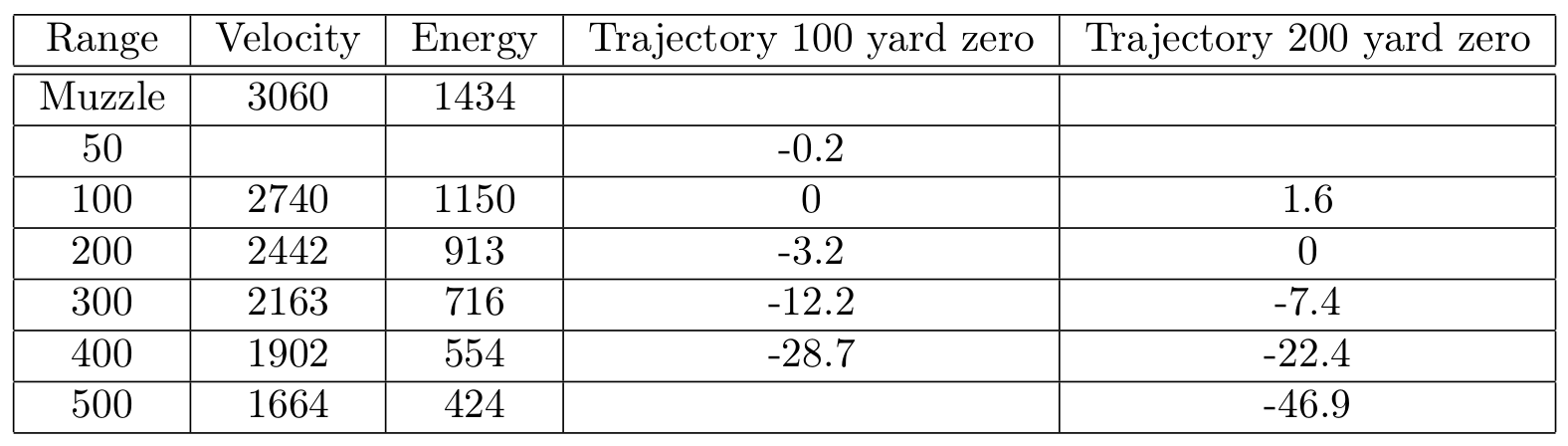
The 69 grain load has the following ballistics, according to Winchester:

Sfig1

I got an average of 2,735 feet per second at the muzzle out of the 16-inch barreled AR’s, which makes me think Winchester used a longer barrel for their figures.

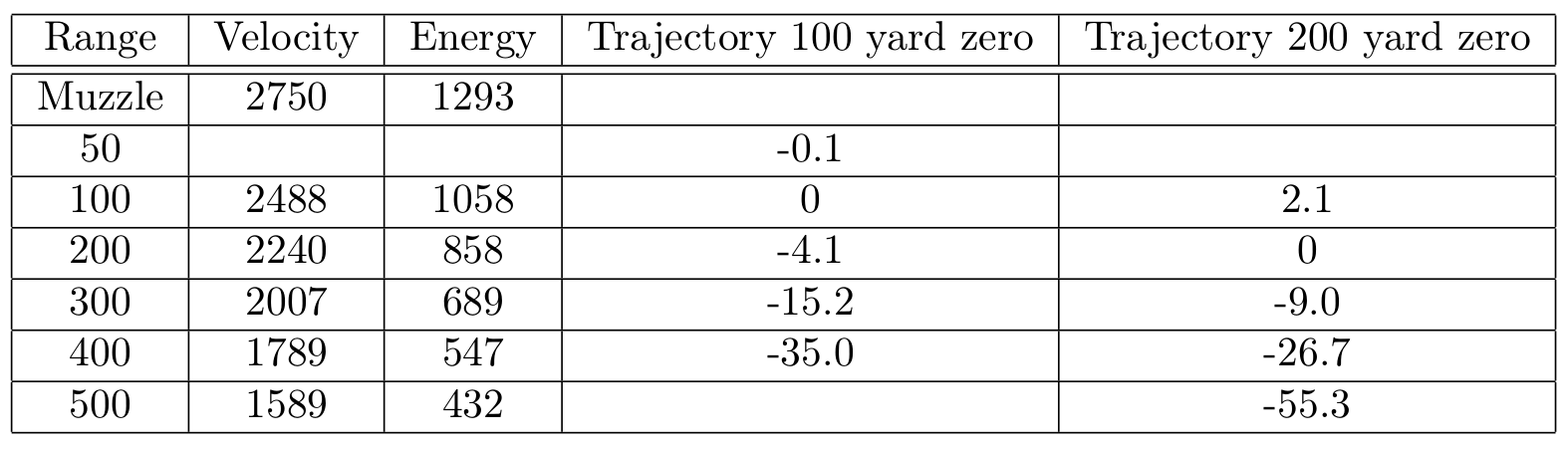
The 77 grain load ballistics from Winchester are:

Sfig2

With this load, I got a 2,732 feet per second average, which impressed me. A Winchester spokesperson said they measured these with 16-inch barrels, and that jives with what I got. That makes this a much hotter load than the 69 grain one.

Accuracy with both loads was good, though I was a bit frustrated with the LMT. It has yet to like a 77 grain bullet, though it has always done well with anything with a 69 grain MatchKing. The homebuilt AR with the Daniel Defense barrel, on the other hand, seems less finicky and shoots well with both bullets, though not as well with either as the LMT does with a 69 grain bullet.

The groups were shot at 100 yards at an indoor range, and the targets were analyzed with OnTarget, a $12 program that allows you to scan targets, input the bullet holes, and let it compute a very useful array of data. This is far easier than playing with a ruler and calculator, and it allows easy archiving of information.

The center to center (CTC) figure is what most of us traditionally measure as group size. It is the distance from the center of the two holes that are the farthest apart.

The average to center of group (ATC) figure may be more useful, however, as it gives us the average distance from the aiming point that a bullet will hit. This is actually what we want to know, how close our shot will come to the aiming point, but the problem with this measurement is that you could have a load and weapon combination that produces a flyer in every group. In other words, you could have several shots go through one hole but one that hits 10 inches out. The average might look okay, but if there are consistent fliers you will have trouble.

I like looking at both CTC and ATC as CTC will warn you about fliers while ATC lets you predict how close your shot will likely fall. The group width and height can give you an idea of which way the groups spread. I often find patterns, and if you know what they are it might help get a hit someday.

Sfig3
Sfig4

I shot five shot groups and used the data from the worst group with each rifle and load. While I’m not the best shot, sometimes I get lucky. I figure it is better to assume worst case than run with the best case. With these loads, the groups were pretty consistent. Ten shot groups are a better idea, but I usually am more consistent with shorter strings, and I like to let barrels cool a bit between groups.

Some of you may be wondering why I am interested in match loads, since this is a prepper site and not a match one. One reason is that I think it is important to have a known, consistent load for each rifle. This would be one that tells us all something is wrong if it won’t shoot well. The sights or action screws could be loose or something else has gone wrong. It also might be that we are just having a bad day. I have spent a fair amount of time testing things only to discover there was a problem I would have caught if I had only started and finished with my known good load.

The next thing is that we may need to make a precise shot at long distance, and having some primo high-grade ammo can help us make it.

A final reason is that the 77 grain match loads have turned out to be very effective rounds for self-defense use. All the work by competitors with them paid off when the US Special Ops troops wanted something capable of greater range and accuracy than their standard AR’s and developed the AR-based MK 12 Special Purpose Rifle. Black Hills Ammunition came up with the Mk 262 match grade round, using 77 grain open tip match (OTM) bullets, that allowed troops to make the best of the new rifle.

The rifle and round came in very handy as troops deployed to the open terrain of Iraq and Afghanistan and discovered that their lighter bullets weren’t delivering the desired performance in accuracy or stopping power. Soldiers equipped with the MK 12 rifle and MK 262 ammunition, however, had much better results. As well as superb accuracy, the 77 grain match bullets also delivered excellent wound ballistics– far better than the standard M855 round. Not only did it work better in the 18-inch barreled MK 12 rifle, but it also worked better in the 14.5 inch barrel M4, making it a very popular item on the front lines.

The one deficiency that I’ve seen noted with it is when there are intermediate barriers, such as auto glass between the shooter and target. Dr. Gary Roberts is a Navy reserve lieutenant commander who studied at the Army Wound Ballistics Research Laboratory and serves on the staff of Stanford University Medical Center. He also consults with federal, military, and law enforcement on wound ballistics and has done extensive research on .223 ammunition. He feels that the 77 grain bullet is not the best choice for getting through barriers in front of the target, even though it performs very well otherwise. It is, on the other hand, a great choice when one is concerned about over penetration.

The end point of this discussion on the MK 262 is that the Winchester 77 grain Match load should be very close to the same round. While the current version of the MK 262 uses a Sierra bullet, there were versions that used the Nosler found in the Winchester round. The velocity is essentially the same as the MK 262, thus the Winchester should make an excellent defensive round.

The 69 grain bullet, however, according to Roberts, does not match its heavier sibling in regard to wound ballistics, so it isn’t a good choice for defensive use. It should be relegated for accuracy testing.

The 7.62x39mm ammunition also worked flawlessly in both rifles. I had 60 rounds of the PowerPoint and 100 rounds of the FMJ. I followed the same procedures as I did with the .223 ammo with the Mutant, but since I did not have a mount to use optics on the C39V2, I had to use its open sights; its groups were not as good as they could have been.

Sfig5

The PowerPoint was clearly the winner in the accuracy category and would be the choice for self-defense as well. Roberts has tested this cartridge, and it is one of the loads he picks for 7.62×39. He notes that it also performs well through auto glass and should make an excellent round for hunting. I was especially impressed with PowerPoint in the Mutant. Many of us have discounted 7.62×39 as being inaccurate, but it is clear that you can get good accuracy with it in the right gun using the right load.

I didn’t find any information on how the Winchester FMJ round might work for defensive use, but Roberts notes a lot of variation in the performance of FMJ loads. Some yaw quickly in flesh and cause a lot of damage, while others simply sail through leaving a small wound. It is clearly a decent round for practice and plinking and, unlike the cheap imported stuff, it offers the advantage of quality reloadable brass, if you want to reload your ammunition.

I didn’t see any evidence of primer sealing on either load, nor did I find any sealant on the bullets. The bullets were both crimped into the case, but the primers didn’t have any noticeable crimping.

Personally, if I were using a 7.62×39 for defense, I would lay in a stock of the PowerPoints for serious use and use the FMJ for practice. One nice thing I noted is that the two rounds shot pretty close to the same point in both guns.

The PowerPoint and Mutant combination have made me think far better of this cartridge. Watch for the Mutant review, which should be up next.

– SurvivalBlog Field Gear Editor, Scot Frank Eire


