o o o
SILVER DOCTORS: Wholesale Silver Shortage…. CONFIRMED
o o o
Comex On The Edge? Paper Gold “Dilution” Hits A Record 124 For Every Ounce Of Physical
o o o
U.S. oil inventories at levels not seen in at least 80 years!
o o o

How High Are Property Taxes in Your State? – PLC
o o o
Church Builds Gun Range, Launches Range Ministry ‘In The Name Of Jesus Christ’ – Pat Cascio, SurvivalBlog’s Product Review Editor
o o o
Your Guide to Building a Disaster Kit – H.A.
o o o
The FDA Just Approved OxyContin to Be Prescribed to Children – D.S.
o o o
Global eavesdroppers:In World War II, dozens of radio operators in Scituate dialed into enemy conversations worldwide – RBS
“And he went a little further, and fell on his face, and prayed, saying, O my Father, if it be possible, let this cup pass from me: nevertheless not as I will, but as thou wilt.” Matthew 26:39 (KJV)
On August 15, 1961, two days after sealing off free passage between East and West Berlin with barbed wire, East German authorities began building a wall–the Berlin Wall–to permanently close off access to the West. For the next 28 years, the heavily fortified Berlin Wall stood as the most tangible symbol of the Cold War–a literal “iron curtain” dividing Europe. The wall has now been torn down for longer than it stood, but the scars in memory are still there.
Welcome to SurvivalBlog’s Precious Metals Month in Review, by Steven Cochran of Gainsesville Coins. Every month we take a look at “the month that was” in precious metals, covering the price action of gold and examine the “what” and “why” behind those numbers.
So much for the “summer doldrums.” July was a wild roller coaster ride, no matter which market you looked at, and gold was no exception. If it wasn’t stress over whether the Fed would raise interest rates next month, it was the meltdown in the Chinese stock market, or the fate of Greece and its economy.
Remember that “not for profit” sell-off in gold futures (a.k.a. “manipulation”) two years ago, in July 2013? Someone thought it was time to do it again this month. The first attack was on July 7, as millions of investors in the Chinese stock market were hit with margin calls to cover stocks they’d borrowed money to buy. The resulting explosion of physical gold and silver demand caught the bullion market by surprise, and the U.S. Mint ran out of Silver Eagles that same day.
There were two more attacks in July, on the 17th and the 20th, and premiums climbed as retailers scrambled to find merchandise. Gold ended the month on a high note, as the worst labor costs report on record sent the dollar tumbling amid fears that the Fed would delay the upcoming rate hike.
For the second year in a row, a crisis in Eastern Europe disrupted the normally quiet summer cycle for gold (and stocks and bonds). Last year, it was Ukraine, and this year it was Greece. The leftist government in Greece started the month by defaulting on a payment on an IMF loan, becoming the first European nation to do so. The ruling Syriza party (whose name means “Coalition of the Radical Left”) later admitted that this was a ploy to try and force the hand of its creditors.
When this didn’t work, prime minister Tsipras called a sudden national referendum to let the people decide whether to accept demands of more austerity from the EU nation who were paying for the bailout. The result was a resounding NO and put Greece’s future in the Eurozone in doubt. As talks broke down, the European Central Bank stopped pumping emergency funds into Greek banks, forcing the government in Athens to close all banks and implement capital controls.
We have warned many times that you need to hold physical gold outside the banking system, and Greece shows why. Banks were closed from June 28 to July 20, three weeks. During this time, no one could get to their safety deposit boxes.
Incendiary Greek Finance Minister Yanis Varoufakis was forced to resign after the austerity referendum, as his antagonistic relationship with the rest of the EU finance ministers had become too high a hurdle for Tsipras to ignore. The six months of brinksmanship and bluster was all for naught, as Greece was forced to accept austerity measures even harsher than those rejected by the national referendum on the 5th. The Greek parliament voted to pass the first round of austerity laws demanded by its creditors on July 15, against a background of street riots and protests. This show of commitment to reforms opened the way for talks about a third bailout to begin, and the ECB resumed emergency injections of cash into the Greek banking system, which was close to collapse.
The fall of the Chinese stock market, which began in mid-June, accelerated in July. By July 8th, the Shanghai Composite index had lost 30%, and over 1300 companies had requested that their shares not be traded. The total market loss at the time was over $3.2 trillion, and it only got worse as the month went on. The Chinese government ordered state-owned companies not to sell stock, and forbid the issuance of IPOs. Western analysts began telling investors to forget about Greece – China was the real danger to the global economy.
Finally, in a move that would have been impossible in the West, the Chinese government started directing state-owned enterprises to buy stock, and began lending money to stock brokers to buy stock, in a direct intervention in the market. This spending of $800 billion of government money did little to halt the slide at first, but sent the signal that the rulers in Beijing would not let the market collapse. Things stabilized for a while, but then on July 27th, the Shanghai market fell by 8.5%.
After the worst was over, the hunt for a scapegoat began. (There always has to be a scapegoat, to direct blame away from the ones in power.) This resulted in Chinese authorities going after (mostly foreign) HFT spoofers and manipulators. High Frequency Trading and spoofing (placing fake orders to make the market move to where you can make a profit) is rampant in the U.S. stock market, but the large Too Big To Fail banks and hedge funds have bought enough political influence that they have not been stopped. Could Shanghai become safer for humans than the NYSE?
When asked what caused such a huge run-up and crash in the stock market, Chinese experts pointed to two reasons: greed and lack of knowledge among Chinese individual investors. Unlike Western markets, which are dominated by big institutions, such as hedge funds and mutual funds, 80%-85% of the Chinese stock market is made up of individuals—200 million of them. The scary part is that two-thirds of them don’t even have a high school education, and they want to believe that the Communist government will protect them from losses. Beijing doesn’t help matters when the official press exhorts people to buy into the stock market, which leads people to borrow heavily to buy stocks, confident that it is a “sure thing” because the government encourages it.
But, as big as 200 million people sounds to Americans, this is a tiny fraction of the nearly 1.4 billion people in China. The big danger to the global economy isn’t the Chinese stock market, it’s the Chinese economy.
By July 7, the Chinese stock market had fallen over 25%, and margin calls were forcing investors to liquidate whatever they could. Copper has been a popular collateral item in China, and the sudden liquidation of copper on July 7 drove prices to six-year lows. The sell-off also caught gold and silver in the downdraft. Gold dropped 1.5% to lows not seen since March.
After this, the Wall St. sharks smelled blood in the water, and they waited for the moment to strike. The excuse for the take-down came on July 17, when China updated its official gold reserves for the first time since 2009. The 1,658 metric tonnes reported was a 57% jump from 2009 levels but only a fraction of what analysts have estimated China’s gold reserves really are. *Someone* used that disappointment to crash the gold market, by dumping $1.4 billion in gold futures (AKA “paper gold”) onto the market. This smashed the gold price to a five-year low and caused a stampede for the coin shops and gold dealers as physical buyers took advantage of the price drop.
The manipulators weren’t quite done, though, and picked the most illiquid time possible to crash the gold price for their big finish. In a move calculated to drive gold prices down as much as possible, the manipulators waited until the Japanese markets were closed for a holiday, and the New York and London markets hadn’t opened yet. Right as the Chinese market opened, 57 metric tonnes of gold futures were sold into the market at once. Gold prices fell as much as $25 an ounce, and even the mainstream media could not ignore such blatant manipulation. The financial press was soon filled with speculation as to the identity of the perpetrators, with no one willing to take the blame.
No matter how the Communist Party intervenes in the Chinese economy, it can’t deny the realities of the gradual slowdown of its real economy. Another round of stimulus measures helped Q2 growth appear better than it actually was. Weakness in manufacturing was even more telling, as the country’s factory production sank to a 15-month low.
An ongoing trend in July was the daily rumors about the timing of the Fed’s initial move to raise the federal funds rate, the country’s benchmark interest rate. It will be the first rate hike in nearly a decade, and the markets have obsessively watched for any signs from the central bank about when the rate increase will occur.
Virtually every time that some rumor breaks about the Fed’s plan for raising rates, the dollar spikes. This has had serious implications for commodities, which are essentially experiencing deflation due to the stronger currency. Despite the attention paid to gold, oil has been hit far harder by the downturn in the commodities cycle: crude oil prices matched yearly lows just above $40 per barrel in July after a modest recovery during the spring months. This has coincided with outright oil wars between OPEC members (especially Saudi Arabia) and shale oil producers in the U.S. As OPEC refused to stop pumping oil, hoping to squeeze out unprofitable shale operations by driving crude prices ever-lower, the oil cartels hold on global prices seemed to be broken, as many American oil producers remained profitable even at such low resource prices.
The entire summer has been like a horror movie for those heavily invested in commodities, as prices have plunged largely across the board, tracking with falling energy costs. Russia, whose economy is almost wholly dependent upon commodity exports, has certainly felt the pain. The country’s central bank yet again purchased gold to shore up its position, adding 25 metric tonnes of gold to its reserves.
The soap opera surrounding when the Fed will raise rates was also a story unto itself. Two of the Federal Open Market Committee (FOMC) voting members exchanged entirely contradictory views on the rate hike outlook on successive days during July: Federal Reserve governor Jerome Powell hurried to get in front of a camera and state that the FOMC’s view remains uncertain only a day after Atlanta Fed President Dennis Lockhart blew the whistle on the high likelihood of a September rate hike. Powell was doing damage control on Lockhart’s slip, as the Fed always avoids making definitive statements one way or the other in order to keep markets perpetually guessing.
With the drop in precious metal prices amid the broader rout in commodities during July, sales of bullion coins and bars were robust over the month. The U.S. Mint actually ran out of its allocation of American Silver Eagles, leading to a two-week delay where no distributors were receiving the silver coins from the mint. Premiums on the flagship U.S. silver bullion coin skyrocketed as ASEs became increasingly difficult to find on the market. Similarly, the Royal Canadian Mint had to ration the availability of its Silver Maple Leafs.
Amid the price dip frenzy, gold bullion sales in the U.S. were their highest in 2 years. Total bullion sales through the U.S. Mint notched a 17-month high in July. The mint waited until the last day of the month to introduce its new High Relief Liberty gold coin for sale. Within hours of initially being offered, the .9999 fine gold coin sold out of its maximum mintage of 50,000 coins.
With the precious metals falling for much of July, the preeminent market analysts had their hands full with the establishment media, which jumps on any opportunity to bash gold and precious metals. The MSM was busy with headlines about the end of gold as an asset, how it had “lost its luster” or gone the way of past trends. To call gold’s value a mere trend is laughable, and reveals the insane bias of the media regarding honest money.
Peter Schiff rightly pointed out that today’s fiat currencies depend entirely on a system of faith, while hard money like gold does not. It’s again laughable that Schiff even has to argue this point, as supposedly respectable pundits compared gold to bell-bottom jeans and pet rocks. Last time I checked, those items only held the intrinsic value of their denim or mineral composition, and fell by the wayside as trends because of changing tastes. Though fashions and tastes are always changing, the understanding that tangible precious metals hold real value is not.
Elsewhere, Casey Research astutely shows that the conventional “wisdom” about how gold prices will react to the imminent rate hike from the Fed is completely misguided. The prevailing thought among analysts is that an interest rate increase will drive the dollar higher, thus pushing gold prices lower in real terms. Yet, the research shows that each of the last four times a rate increase cycle began, gold actually gained. This trend was apparent in 2004, the last time that the Federal Reserve began a round of rate increases, as spot gold tracked higher with each rate hike.
While speaking on why the Greek debt crisis would drag on rather than choosing the most reasonable solution (i.e. an exit from the euro area), Eric Sprott reiterated his conviction that gold and silver are still viable investments, and cannot be invalidated simply by fickle market trends.
Apparently the fight is not over between the U.S. government, which claims that 10 privately-owned 1933 gold double eagle coins were stolen, and the Langbord family, who found the rare coins in a safe deposit box belonging to the late family patriarch. Although a judge awarded the coins to the Langbords, that decision has been overturned, and the case is dragging on.
U.S. gold coins like double eagles ($20 gold pieces) were confiscated by executive order in 1933 and were deemed illegal to own until the country officially ditched the gold standard during the 1970s. While nearly all 1933 gold coins, including double eagles, were melted down at the time, a few scarce examples escaped. The only 1933 double eagle to ever have its monetary status (and therefore legality) reinstated was a single example once owned by Egypt’s King Farouk, which sold for more than $7 million at auction nearly 15 years ago.
Dear SurvivalBlog,
After searching every nook and cranny of the Internet I have had no luck in finding a decent (in quality and price) pair of needle nose “fishing specific’ pliers. How about taking on the challenge? – JLN
Pat Cascio responds: I love to fish, and there is a pond just 50 yards from my front door on my neighbor’s property, and I can fish there all I want. I’m a sport angler; I catch and release most of the time. I’ve been fishing since I was about 10 years old. I started out using a bamboo fishing pole.
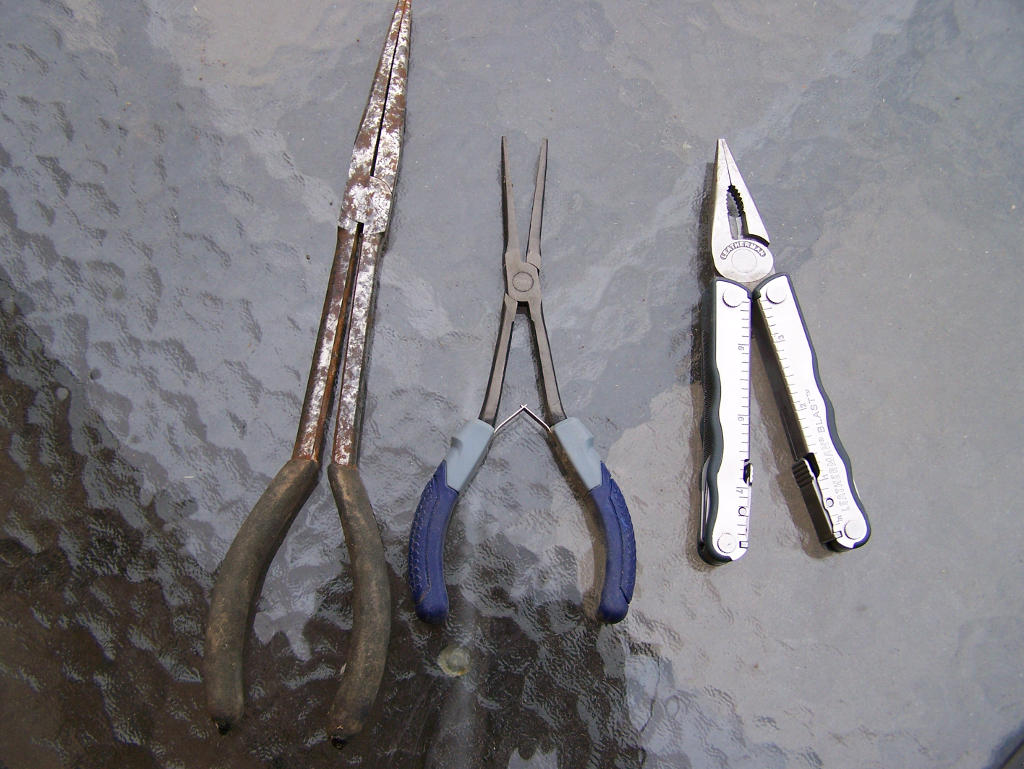
Attached is a picture with a few of my pliers. The first, long pair of fishing specific pliers were purchased at K-Mart many years ago for under ten bucks if I recall. The middle pliers are from a set of various pliers given to me by my local gun shop. The last is my Leatherman Blast multi-tool with needle nose pliers. As you can see, the fishing specific pliers are rusted. They spend most of the time in the bottom of my fishing tackle box and rarely get used. The middle pliers are just an example of what is out there. You don’t have to purchase fishing specific needle nose pliers. The Leatherman multi-tool is what I use 98% of the time to dislodge a hook from my fish. It works wonderfully for me, and my wife and daughters also use multi-tools to dislodge a hook.
In the past, I have used surgical forceps to remove hooks. They are convenient in that you can lock them onto the hook, and they come in different sizes and lengths. They work quite well, and you can find them for under five bucks. However, when it is all said and done, the Leatherman multi-tool works best for me. It’s always in the pouch on my belt and it only takes a few seconds to get it out and put it to work. Yes, you can go to any sporting goods or big box store and find fishing specific long needle nose pliers, and they work well. However, for my money, it is hard to beat a multi-tool with needle nose pliers for dislodging a hook.
Even more reason to home school. Public schools are GOVERNMENT schools and we know what kind of government– federal, state, and local– we NOW have! It’s our own fault for being asleep for DECADES! School Officials Used Young Girl as “Bait” in Rape Sting, She Was Raped and they Covered it Up – H.L.
o o o
Pistol-whipped detective says he didn’t shoot attacker because of headlines – T.P.
o o o
Want ‘sustained happiness’? Get religion, study suggests – D.S.
o o o
Before the death panels…limb panels? – Mike Williamson, SurvivalBlog’s Editor At Large
o o o
Reciprocity Alert – Minnesota No Longer Honoring Utah CCW Permits – K.C.
“Therefore thou shalt love the Lord thy God, and keep his charge, and his statutes, and his judgments, and his commandments, alway.” Deuteronomy 11:1 (KJV)
14 August 1945 V-J Day
o o o
Today, we present another entry for Round 60 of the SurvivalBlog non-fiction writing contest. The $10,000 worth of prizes for this round include:
First Prize:
Second Prize:
Third Prize:
Round 60 ends on September 30th, so get busy writing and e-mail us your entry. Remember that there is a 1,500-word minimum, and that articles on practical “how to” skills for survival have an advantage in the judging.
It will be extremely difficult to cross this region while avoiding some major cities. For example, Cedar Rapids and Iowa City are very close together. You all know as well as I do what happens when people get desperate. How far away from the cities this will effect the countryside, I don’t know. Cities to avoid specifically are the ones with major prisons, like Fort Madison or Anamosa. There are several prisons or minimum security facilities across the region, and someone coming through Iowa needs to do their research and avoid them, if possible.
I have spent the last 35 years, until recently, living in Marshalltown. I believe this town was also mentioned in one of JWR’s books. During the time I lived there, I watched the dynamics change. The packing house closed then reopened, and it renamed itself to get the union out; at least, that is my opinion. It then expanded and started hiring migrant workers, and dare I say, illegals. The crime rate went up and the neighborhood where I lived went downhill. Marshalltown was and may still be considered the meth capital of the Midwest. I have heard that they had at least two members of every major gang in the country represented there, including MS13. There have been several murders in the last couple of years, including one drug deal gone bad involving mutilation of the body. All I am saying is that if I was traversing the countryside, I would avoid Marshalltown by a big margin.
There is also the Meskwaki Indian settlement close to Marshalltown. Whether that is good or bad depends on them and you. Other than their annual Pow-Wow, they have mostly abandoned their traditional ways of living. There is also a large casino there.
Other bloggers have mentioned the Amish or Mennonites. There are several communities of them in Iowa. The biggest is called the Amana Colonies near Iowa City, although they aren‘t necessarily Amish. I believe they will be the most prepared and able to survive, but I don’t know how they will react to strangers after the SHTF. Is it just a coincidence that they have chosen a way of life that will be ideal in a TEOTWAWKI situation?
The people of Iowa are a good and kind people, for the most part, especially in the small towns and the farming community. Growing up on a farm you see the best come out in people. Especially in the days before a lot of the processes became mechanized, we helped each other. In the past, it was thrashing, and more recently I remember the days we shelled corn. All the area farmers would get together for the day to help. For lunch, the women would throw a huge meal together for the men. Sexist or not, that’s the way it was, and nobody complained. Everyone did their part to bring in the harvest. When I was too young or in school, my mother was driving the tractor in the fields right along with my dad. As soon as I was able to carry a bucket of oats, I helped with the chores. My sisters would gather the eggs. We would all pitch in weeding the garden. Was it child abuse? No, it was life lessons. When a farmer was sick or somehow laid up, the neighborhood farmers will come to help with the field work and chores. Our neighbors still plow us out with their tractors from the snow without being asked. Many of us all go to the same schools, churches, stores, and bars and have known each other all our lives. My own example was that I went to church in one town, went to school in another, and had relatives I pretty much grew up with in a different town. We had friends and relatives in each town. All these towns were less than ten miles apart. Everybody knowing everybody’s business can be bad and good. Having people around a 10 mile square area of the countryside that have known you and your family for literally generations has to be an advantage. I am certainly counting on this when the SHTF.
Obviously, the further west you go, there will be fewer towns, roads, and wooded areas. Northwest Iowa is probably the least populated. If you get well into Iowa, I would head northwest. It isn’t long after you cross the Missouri river that the vegetation gets scarce. Half way across South Dakota or Nebraska, and you’re in pretty much desert. Watch your maps for lakes and rivers and plan accordingly. If you are angling for the Redoubt, you will be crossing huge regions of nothing but desert. The Badlands are in this region and are easily seen from space. The Black Hills are also on the way. Some of these same areas were traveled by the Mormons. I can’t imagine how they did it with just a wagon train. You can still see the ruts their wheels left in some places. I know of one bowl-shaped area in Wyoming that is 100 miles in diameter with no water. Consider how long it took to cross that area when a wagon train only progressed about 14 miles a day. Even if you have a vehicle, the distances between towns are great. You don’t realize how big this country is until you have traveled it, and I don’t mean by flying. Once you get to the foothills approaching the Jackson hole area, you will have more food and water available as well as shelter. Here, it is going to be difficult to avoid the major highways, because there are only so many places to get through the mountains. The roads between Rock Springs and Jackson, Wyoming, for example, travel through steep valleys and/or ravines with cold rivers. Unless you want to get deep into the mountains to avoid the roads, you can’t help but be visible at some points. Taking a short cut through a random valley may lead to a dead end.
I know of several places in Iowa where people are getting together and doing what they can to get ready. There are also people forming groups and small “Redoubts”, and I may join one, depending on circumstances with my parents. Just about all farmers are hunters and/or have guns, but are they truly prepared for the worst? Only with the varied skills of the local farmers as a whole can a few of us here survive a true TEOTWAWKI. We are used to being miles away from a city and having to “make do“, but a full scale collapse is another story.
I have read the first 20 or so of The Survivalist
I hope this was helpful to people. I wish I could go with you. I cannot afford to move to the Redoubt, and I have my elderly parents to take care of here. I will probably try to “bug out in place”. Although I live within ten miles of one of the major cities in Iowa, I’m hoping it is just hidden enough that it will be passed by. Most of my neighbors are relatives and friends, and we may be able to secure the area enough to protect ourselves, depending on the severity of the collapse. Even though I grew up on a farm and worked in my parents’ garden, I know very little. This year is my third year of gardening, and it is a steep learning curve. If your parents gardened and canned and are still around, they may be able to help you with little tidbits of knowledge. My mother has been helping me learn to garden and can. She is 85. Otherwise, I am stockpiling what I can afford and doing what I can to be self-sustainable. Even if I can hide here, and hopefully let the worst wash over us, I know that I tried. If I don’t survive, nobody can ever say I did nothing or didn’t somehow prepare.
I wish to thank Mr. Rawles for your website, although there is no way I can read it all. It feels like drinking water from a fire hose. I’m all by myself, because my sisters are in far away towns, and even if they agreed with me, they would never get here in time. I’ve known all of my life that I was going to be around for what’s coming but only the last few years have I been preparing. Good luck to all. BTW, not all farmers think an AR-15 is a space gun. 😉 I have one other critique of books and prepper info.– let’s not forget our sense of humor. I realize we are talking about some drastic events, but if we don’t keep humor in our lives and smile and laugh, we will certainly lose our humanity.
Dear Survival Blog:
I share Tennessean’s love of pole beans (and second the nomination of Rattlesnake as a wonderful variety), but up here in NY, where you have to wait for the soil to warm up before planting, bush beans will produce something edible 7-10 days faster than pole beans. So, in a must-eat situation, that may be important. The fastest maturing pole bean variety I have grown is Golden Gate.
If using horse fence as a trellis is out of your price range, take a look at Herrick Kimball’s bicycle tire trellis. Go to his Gardening Ideas Book page and scroll down for a picture on the right hand side. – E.F.
HJL Adds: Another low cost alternative that we like to use here is often called “the three sisters”. It is simply planting pole beans and corn together so that the beans have something to climb and then a third, low-growing vegetable, like squash as a ground cover. This works especially well in areas like the Southwest where water conservation is important. This method does require some timing in your planting though as the beans will sprout long before the corn does. There are several SurvivalBlog advertisers that have prepared packages of seeds ready to go for this method of planting, and the best part is that it is completely bio-degradable.
American knife collector “Stilletto” just posted a very positive video review of the Rawles XL Voyager Knife. He compares the knife to the earlier-generation extra large Voyagers, and shows some nice close up views. He also mentions that this limited edition knife with the SurvivalBlog logotype will probably never make it to Cold Steel’s regular catalog or to any stocking dealers. These will probably sell out quickly, so don’t hesitate. As I’ve mentioned before, all profits are going to two Christian charities. – JWR
o o o
Federal Agencies Fight for Warrantless Access to Emails – G.P.
o o o
Because the Dance Must Begin Well Before Midnight…
Large troop contingents being redeployed to Russia’s western regions
And my salute, to all whose sons have opted to join ranks and shoulder rucks, knowing full well that none of this regime have any of their sons anywhere among them – GJM
o o o
Special Ops Soldiers Use Rental Trucks to Infiltrate & Occupy California Town – B.B.
HJL Adds: This is the kind of action I expected to see from JADE HELM 15, though I’m surprised the people bragged about it afterward. The thing to remember about an exercise like this (and the advice goes not just for military/police exercises but all the time) is do not let anyone talk you into doing something that you know is morally wrong or illegal. The alphabet agencies excel at setting up and supplying “terrorists” and then arresting them, claiming to have stopped a dangerous plot (that they probably concocted themselves). You don’t want or need to be that person who was set up because you trusted the wrong person and let them talk you into something you wouldn’t normally do.
o o o
‘Act and kill’: ISIS just released 1,400 Americans’ private info online – D.S.
o o o
Flamethrowers, given up by military, are now being sold to the public – JBG
“Freedom is dangerous; tyranny is worse. Helpless dependence upon humanity is bondage. Helpless dependence upon Christ is freedom, for He is our source of ability.” C.F.