Economics and Investing:

Understanding Why Budgets Fail May Help Us Succeed: 5 Big Reasons Budgets Fail – A.L.

o o o

Could the Fed Implement a “Carry” Tax on Physical Cash? by Phoenix Capital – D.S.

o o o

Items from Mr. Econocobas:

USA Drops to 16th on ‘Economic Freedom’ List… – While it may be a stretch to say the U.K. has more economic freedom than some of these other countries, it is definitely indicative to the direction we have been heading for quite some time.

US Interest Rate Rise Could Trigger Global Debt Crisis – We are all aware of this fact, but what is always most interesting to me is the supposed warning from the BIS. Almost like they are setting up to take credit and pose as the savior.


Odds ‘n Sods:

I generally shy away from conspiracy theory videos, but I found this one fascinating, for several reasons:

9/11 Experiments: The Great Thermate Debate– JWR

o o o

Perhaps a bit off-topic, but SurvivalBlog readers should be alerted that via the U.S. Fish and Wildlife Service, a ban on the interstate transfer of elephant ivory–even so-called “old ivory” –will be going into effect in the States on September 29th. Buy any Ivory pieces that you want for your guns or knives, NOW! – JWR

o o o

Video: Food riots turn deadly in Somalia – C.L.

o o o

California’s Sierra Nevada snowpack estimated at 500-year low – G.P.

o o o

Great, more rioters; they’ll fit right in… Baltimore Prepares To Accept More Syrian Refugees


Hugh’s Quote of the Day:

“It’s no accident that capitalism has brought with it progress, not merely in production but also in knowledge. Egoism and competition are, alas, stronger forces than public spirit and sense of duty.” – Albert Einstein


Notes for Monday – September 14, 2015

On this day in 1944, the U.S. 1st Marine Division lands on the island of Peleliu, one of the Palau Islands in the Pacific, as part of a larger operation to provide support for Gen. Douglas MacArthur, who was preparing to invade the Philippines. Within one week of the invasion, the Marines lost 4,000 men. By the time it was all over, that number would surpass 9,000. The Japanese lost more than 13,000 men. Flamethrowers and bombs finally subdued the island for the Americans, but it all proved pointless. MacArthur invaded the Philippines without need of Army or Marine protection from either Peleliu or Morotai.


Pat Cascio’s Product Review – SIG Sauer P320 .45ACP

It’s hard not to like any handgun chambered in .45ACP, with a few exceptions. I cut my teeth on a 1911 .45ACP and have owned hundreds over the years. There are some I really regret selling or trading, too. While on the Illinois National Guard Rifle and Pistol Team, back in the early 1970s, I was issued a match grade M-14, as well as a match grade 1911with all the ammo I wanted. (You’d better believe I took full advantage of that, too.) I had .50 caliber ammo cans stacked high in my bedroom. However, most of the matches we competed in were only high-powered rifle matches. Very few were handgun matches. I’m the first to admit that back then I wasn’t the best pistol shot, but I still loved the grand ol’ 1911.

One thing that surprises me is that many gun companies come out with new handgun designs in 9mm and .40S&W long before they do one in .45ACP, and everyone I talk to wants a new handgun design in .45ACP. Then again, none of the gun companies consulted me. Additionally, many gun companies come out with full-sized guns when the buying public wants smaller, more concealable handguns. Once again, none of the gun companies asked for my input on this.

When the new SIG Sauer new P320 came out, the first model was a full-sized version, and it was in 9mm. I sat back and waited and waited for one to come out in .45ACP. All the printed gun magazines featured the 9mm P320 on the front cover of their publications. It helps sell guns when your new product is on the front of a magazine. Boy, does it ever sell guns! Still, I waited….

100_6178

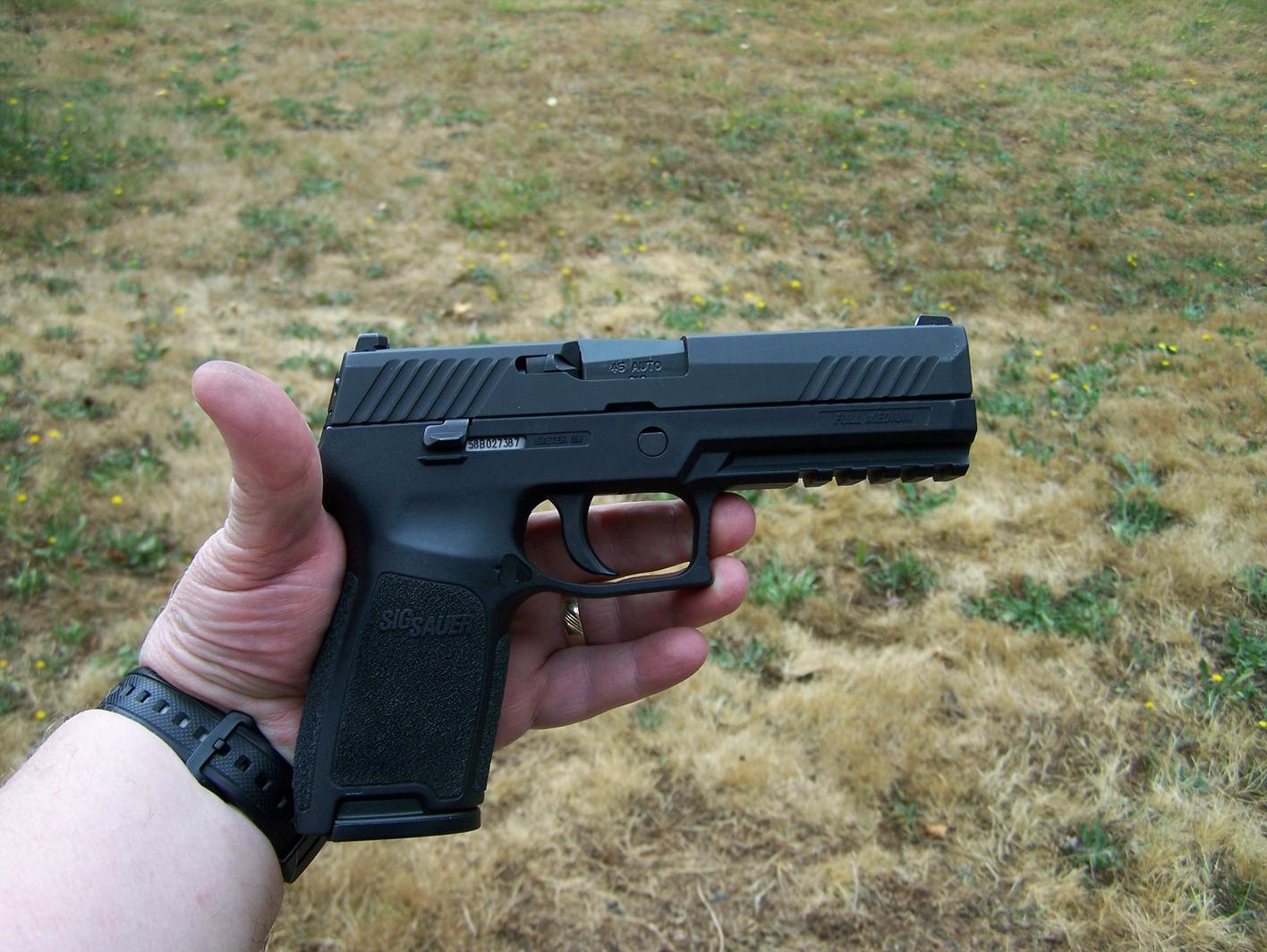
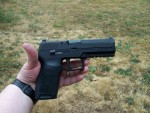
I placed an order for the SIG P320 in .45ACP, and I wanted the “Carry” model. What I received was the full-sized gun. (Sigh!) Still, I was happy that it was in .45ACP! The SIG Sauer P320 is the company’s first try at a striker-fired handgun. SIG seems to be late to the game with a striker-fired pistol. However, they aren’t about to be outdone. A quick look at the P320 in .45ACP is in order. The gun weighs 29.4 ounces because of the polymer frame, so it is fairly light weight for a full-sized, duty handgun. The barrel is 4.7 inches long. The overall length is 8.0 inches and height is 5.5 inches. The slide is stainless steel; however it has the SIG Nitro coating on it in flat black, which is very tactical looking. My model had the contrast sights instead of night sights. Night sights can be ordered, if you want them. Two 10-rd magazines came with the gun, and they were easy to load, too. That is nice! The trigger pull is 5.5-lbs to 6.5-lbs, and it is double action only (DAO). (I’ll talk more on this in a moment.) There is also a Picatinny rail on the frame for attaching lights or lasers. I would like to see SIG offer the P320 without this option, for those of us who don’t attach things to our handguns.

100_6181

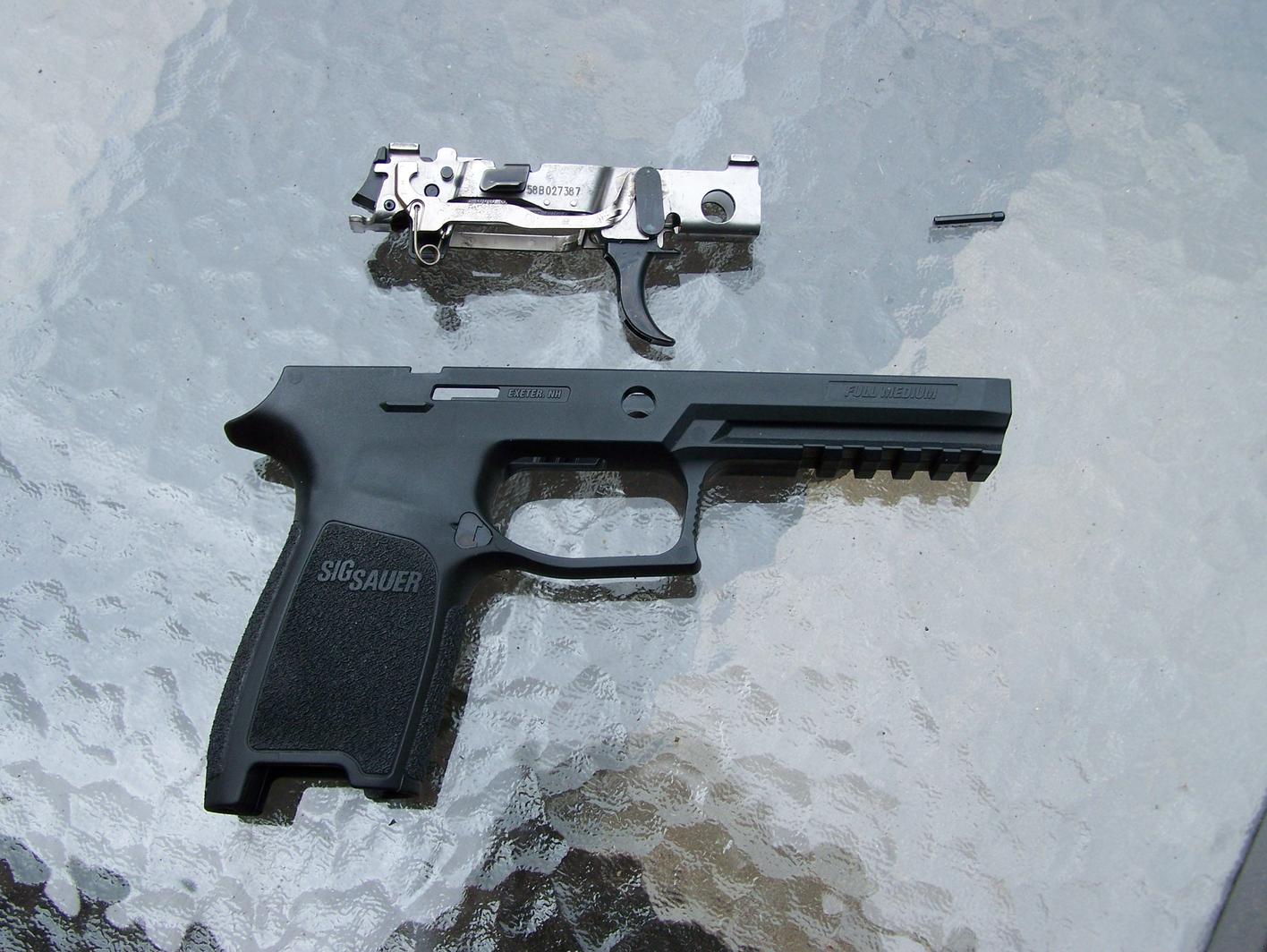
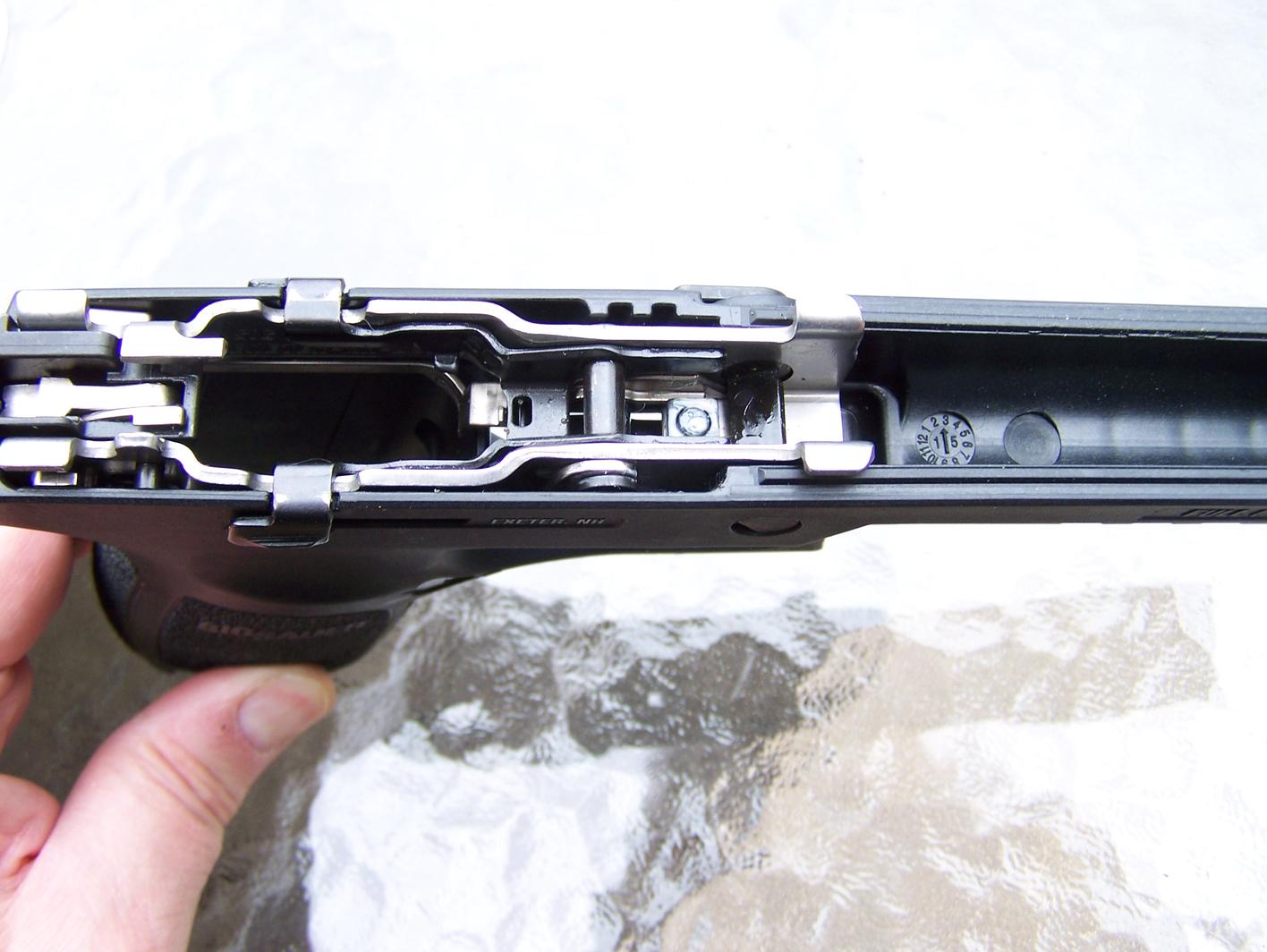
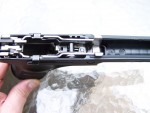
The grip frame is polymer with a great feel to it. My sample came with the medium grip frame that fit my hand perfectly. However, you can order a larger grip frame or a smaller one to fit your hand, and you do not have to go through an FFL dealer to order a new grip frame. Here’s the thing with the P320 line-up; the trigger control group is easily removed from the grip frame. Simply field-strip the gun and then push out the take-down lever. You pull the trigger control group out of the grip frame, and it is this stainless steel trigger control group that is the actual “firearm”. It has the serial number on it. So, if you want to convert your P320 to a smaller version– the Carry or Subcompact– all you have to do is order the grip frame you want directly from SIG for $40. You put the trigger control group into the new grip frame, and it is a drop-in affair with no fitting required!
100_6182

You can also order a shorter slide and barrel. Again, you can order directly from SIG without going through an FFL dealer for this. The combinations would seem to be endless. From one trigger control group you can convert your P320 to fit your needs, whether it’s a full-sized duty gun, carry gun, sub-compact, and different sized grip frames to fit your hand; it all seemed too easy to my way of thinking, but it works. I read several articles on the removal of the trigger control group, and many writers said that everything stayed together. It was not so with my sample. The first time I removed the trigger control group, a pin fell out. I figured out where it went; it is the trigger stop pin that stops over-travel of the trigger. The pin just kind of “floats” in the hole where it goes. I did some checking on the ‘net and found that many P320 owners had the same problem; the trigger stop pin fell out. That’s not good! I found a very easy solution. I installed the trigger stop pin, and then I placed an “E” clip on it; the pin no longer fell out. I don’t know how SIG missed this problem, and I understand the trigger stop pin doesn’t fall out of all the guns. It’s just some of them. Plus, the gun will function just fine without the trigger stop pin, but you will have some trigger over-travel.
100_6183

The DAO trigger pull is probably the best on the market today. If it’s not the best, it is very close to being the best. The trigger pull is short and crisp. It’s hard to describe, but you have to experience it to appreciate it. My trigger pull came in right at 5.5 lbs. Many DAO handguns have a long and/or mushy trigger pull, and you can’t get the best accuracy out of a pistol no matter how hard you might try. SIG might be a little late coming to the DAO game, but they didn’t follow everyone else. Yes, I’m aware that SIG came out with their P250, which was a double action only handgun. However, it was hammer-fired, and the P320 is striker-fired. I’m not at all sure how the magicians at SIG managed to come up with this trigger pull on the P320, but they did. I closely examined the trigger control group outside of the gun, and it just appears very simple in the way it operates. In my experience, simple is always better. I ran the P320 side-by-side with some other handguns, in particular, a couple of 1911s, and the SIG held its own in the accuracy department, even beating one of my favorite 1911s in the accuracy department. I was more than a little impressed.

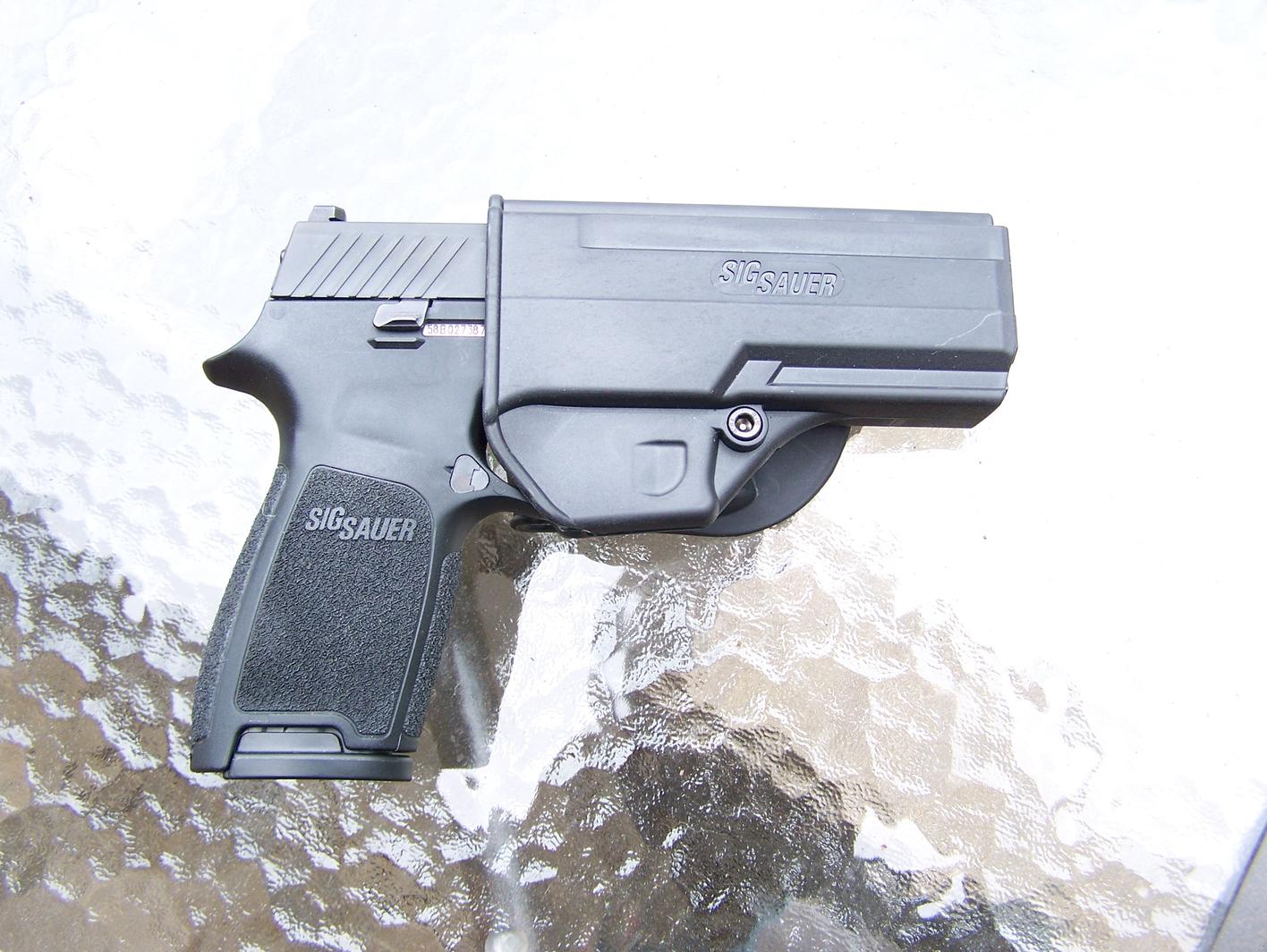
I also wanted to comment on the sights. They are large enough, with the white dots, that my aged eyes had no problems seeing the sights; that is great! SIG also provides a polymer hip holster that comes in the nice plastic carrying case the P320 comes in. One thing that really irks me is having a new gun come on the market and then not being able to find a proper fitted holster. In that case, you have to resort to using a generic ballistic nylon holster that doesn’t fit properly. Way to go, SIG!

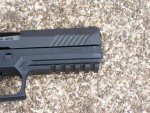
The only operating controls on the P320 is the slide stop, trigger, and take-down lever. There are no external safeties, so you have to rely on the one between your ears. The front of the slide is tapered for easier re-holstering, too. There are grasping grooves on the front and rear of the slide on either side of it for easy chambering of rounds, too. Overall, the gun is slick. There’s nothing to catch or snag on anything.

100_6189

Seeing that the P320 was a new design, I really gave it a work out. I don’t normally compare one gun to another in my articles, as there will always be one I like better than the others; it’s just human nature. I mentioned that I shot the P320 against some of my 1911s just to see how the SIG would hold up in the accuracy department against a single-action semiauto handgun, and that’s as far as I went. I really shouldn’t have been concerned about this aspect. SIG is famous for making extremely accurate handguns and rifles.

Over the course of a couple of weeks, I gave the P320 a good work out. We’ve had several heat waves in our part of Oregon with temps rising above 100 degrees, and I don’t tolerate that kind of heat. So, I was out numerous times, early in the morning to do my shooting. In all, I fired over 600 rds through the SIG, and there was not a single malfunction of any type. From Black Hills Ammunition I had their 230-g FMJ, 185-gr Barnes all-copper hollow point TAC-XP +P , 230-gr JHP, 185-gr JHP, and their 200-gr Match Semi-Wad Cutter loads. From Buffalo Bore Ammunition I had their 185-gr FMJ FN low recoil load, 255-gr Hard Cast +P load, 230-gr FMJ FN +P, 160 and 186-gr Barnes all-copper hollow point +P loads. The P320 gobbled up everything without a hint of a malfunction. What’s not to like about this on any out-of-the-box handgun?
100_6187

For my accuracy testing, I rested the SIG on a sleeping bag over the hood of my pick-up, and the target was 25 yards down range. Not a single load exceeded three inches, so long as I did my part. I had a couple called flyers. It was my bad, not the gun’s fault. The Buffalo Bore 255-gr Hard Cast +P Outdoorsman load was pretty consist with groups hovering slightly over two inches. The overall winner though was the Black Hills 200-gr Match Semi Wad Cutter load. As long as I was on my game, I was getting groups of 1 3/4 inches. I couldn’t do it all the time, though. Again, it was my fault and not the gun or the ammo. All other loads were in the two to three inch group, and that is nothing to complain about at all. The Buffalo Bore 185-gr Barnes all-copper hollow point +P load would be a great self-defense load, as would the same load from Black Hills. For hiking in the boonies, where you might encounter dangerous game, the Buffalo Bore 255-gr Hard Cast +P Outdoorsman load is the way to go. For everyday paper punching, the Black Hills 230-gr FMJ load is a great round to use; it never has let me down. It can shoot better than I can hold the gun.

I usually try to quote full retail prices on guns and knives, however, since the P320 is so new, prices are all over the place. I think you can probably find one in the $500 – $550 price range, if you shop around. Some places are charging a lot more, though, because it is a new model and samples are few and far between.

I honestly couldn’t find anything to complain about with my P320 sample, other than the trigger stop pin incident, and it was an easy fix with an “E” clip. Other than that, the P320 in .45ACP is a real winner in my humble opinion. I may, just may, get a P320 in 9mm, just because!

– Senior Product Review Editor, Pat Cascio



Recipe of the Week: Challah Braided Bread, by Mrs. Latimer

This is a wonderful and easy recipe for bread that is traditionally braided, often using three braids but sometimes as many as six braids and can even be made into round braids. (The rounds are often made for the Jewish New Year, Rosh Hashanah, using dried fruit inside the bread braids to represent the sweetness of God’s gift of new beginnings. For those who are believers in the Messiah (Yeshua/Jesus), we already know the sweetness of a spiritual new beginning and look forward to the sweet day when we will be physically restored to a new beginning in the New Jerusalem where we will dwell with our Lord forever.) This is a bread that our family regularly enjoys and for which we most often “gives thanks”, with various members getting involved in the making, braiding, and toppings. It’s fun. (It also can be wrapped and stored in the freezer, but only if cooled completely, then wrapped tightly and very well in plastic wrap, and then stored inside a ziploc freezer bag in the freezer, as it can easily dry out.) Also, I separate the eggs and store the eggs whites in a ziploc bag in the freezer to accumulate until I have enough for an angel food cake. Yummy! (Guess you’ll need to wait for the cookbook for my quite unusual and survival-minded angel food cake recipe. I’m still slowly working on the cookbook, so please be patient!)

Ingredients:

  • 4 tsp dry yeast
  • 1 1/4 c warm water, divided (approximately bath temperature or 110 degrees Fahrenheit)
  • 3 generous Tbsp honey
  • 1 tsp salt
  • 5 Tbsp olive oil
  • 3 egg yolks
  • 4 1/4 – 4 1/2 c bread flour or very finely, freshly ground whole wheat flour (I usually use 3 cups powder fine whole wheat plus 1 1/4 bread flour, but it’s okay just to use bread flour)
  • 1 egg yolk, beaten, plus 1 Tbsp water
  • Kosher salt (optional)
  • Sesame seeds and/or poppy seeds (optional)

Directions:

  1. Combine the yeast, honey, and approximately 1/2 cup of the warm water in your mixer’s bowl. Allow to stand 10-15 minutes while the yeast activates and you measure and mix the other ingredients.
  2. Generously oil the interior bottom and sides of a large glass bowl with extra virgin olive oil and set aside.
  3. In a separate bowl, combine the remaining water, oil, and 3 egg yolks; mix together with a whisk.
  4. In a separate bowl, combine 4 1/4 cups of flour(s) and salt; stir together.
  5. Before turning the mixer on (or mixing by hand), add layers of a small amount of the water/oil mixture and the a small amount of the flour mixture to the yeast water with repeated layering until all have been added to the mixer bowl. Once all of the ingredients have been added, turn the machine on low speed (or mix by hand). Dough will form a ball. Scrape down sides if necessary while ingredients are combining. If dough is well mixed but sticks to the bottom of the bowl, stop mixer, add 1/4 cup of flour, and then turn the mixer back on and let it run again for several minutes to combine well and see if this time the dough will form a ball and lift out of the bowl easily. If not, add a few more tablespoons of flour and mix thoroughly again, until the dough can be handled. It shouldn’t be very sticky at all.
  6. Place the dough in the well oiled bowl and turn the dough over so that the dough is covered in oil. Cover the bowl with a clean, dry cloth and place it in a warm (not hot; must be less than 120 degrees Fahrenheit) place to rise for about an hour, until doubled in size.
  7. Punch down the dough. The dough can be punched down and allowed to rise two or three times until you are ready to shape it.
  8. This recipe makes two very generous size loaves or four smaller loaves. A kitchen scale is handy for weighing the dough to get each loaf about the same size. (I usually make four smallish loaves, which each make about six generous servings.)
  9. Once ready to shape, preheat oven to 375 degrees and remove the dough from the bowl onto a floured kneading/work board. Cut dough into either two or four portions (whatever number of loaves you’re making). Then, cut each portion into the appropriate number of braid portions and role the braids. Braid/shape the loaves as desired.
  10. Place braided/shaped loaves on parchment lined baking sheets (or lightly greased baking sheet). Gently, use a basting/pastry brush to brush tops and sides of dough portions with the egg yolk-water wash. Sprinkle with kosher salt and/or your choice of seeds; cover the dough lightly, and let it rise again until it doubles in size (about an hour).
  11. Preheat oven to 375 degrees Fahrenheit. (A convection oven set on 365 degrees is ideal.) Bake for 18-25 minutes, depending on the size of the loaves and your oven. It takes some practice to tell when the bread is done, but usually the top and the bottom are a light gold color.

NOTE: To modify for Jewish New Year, roll dough strips out flat and lay dried applies and/or raisins and then close up the dough ropes so that the apples/raisins are inside the dough ropes that are then braided into shapes (usually into a round for Rosh Hashanah– the new year/new beginning of the cycle of life). You may also choose to add a touch of cinnamon to your dough and/or cinnamon sugar on your apple/raisin filling and then sprinkle powdered sugar, cinnamon sugar, or frosting on the top after it has baked, or dip pieces in honey. This is a very yummy, versatile recipe and has been time-tested again and again in our household and among many of our friends and their families.

o o o

Do you have a favorite recipe that would be of interest to SurvivalBlog readers? Please send it via e-mail. Thanks!


Letter Re: Living in Small Town America

Hello,

Since we moved from Front Range Colorado to Western Slope Colorado in 2010, it has been a learning experience. Even though I was raised in rural New Mexico and my husband in rural New York, we had forgotten that city folk were mistrusted in rural areas.

Some of our neighbors that we share irrigation with were great. But others equally close in the neighborhood were wary and did not respond to my gifts of fresh produce. Of course, people are busy. We took care of our property. Maybe they were worried we would be noisy, collect junk, or let our dog run. We complained to the sheriff’s office about a neighbor’s dog that barked all night most nights. They denied it was their dog though we went out at night and recorded the dog. (We learned on the front range that people do not respond favorably when their door is knocked on the next day about their dog; some come to the door with a gun.) We complained to a neighbor about his kid riding his ATV up and down our fence line at bedtime, creating clouds of dust and noise. I am talking about a semi-rural area where your neighbors are 50-100 yards away. When you talk to your neighbor 50 yards away about the rooster who goes off all day, he says “This is the country.”

Then they all found out who we were. We hunted, fished, camped, gardened, and canned just like they did. They noticed my anti-Obama bumper stickers. They learned that I did veteran’s disability exams at the local VA and began to notice that they or their kids were getting fair evaluations and subsequent benefits. A neighbor came to talk to me and offered ATV and horse rides. He is a coal miner as are many neighbors. We got invited to retirement parties. Many have been laid off here with the war on coal. People started waving to us and talking to us as we walked our Golden Retriever on a leash (the consummate yuppie city dog). The rooster must have gone to the pot. I don’t know if my attending one of the many churches in our small town even mattered. When people know who you are, then they respect you and your space.

So I would say, be yourself and friendly, but don’t be a doormat or uppity, and things will come along when you move to your retreat type property. Don’t delay. – Colorado retreat


Odds ‘n Sods:

AMAZING PHOTOS- “Time Capsule” C-47 Crash – Don’t miss this one – T.P.

o o o

David Cameron under fire over EU army stance – G.P.

o o o

Some light reading…or not: United Nations Infantry Battalion Manual for Peacekeepers – Part 1 – T.P.

o o o

‘Production Versus Plunder’ Part 24 – The Centuries of Reset

o o o

Wow, I’m really caught off guard that this would happen. I’m sure Iran will only use this for creating electricity. You know the “electric” feeling you get when you realize you screwed up big time and you’re about to pay for it. Iran finds ‘unexpectedly high’ uranium reserve after Dems seal nuke deal for Obama – M.B.


Hugh’s Quote of the Day:

“No man can put a chain about the ankle of his fellow man without at last finding the other end fastened about his own neck.” – Frederick Douglass


Notes for Sunday – September 13, 2015

13 September 1951 was the birthday of President Salva Kiir Mayardit of South Sudan.

o o o

Today, we present another entry for Round 60 of the SurvivalBlog non-fiction writing contest. The $10,000 worth of prizes for this round include:

First Prize:

  1. A Gunsite Academy Three Day Course Certificate, good for any one, two, or three day course (a $1,195 value),
  2. A course certificate from onPoint Tactical. This certificate will be for the prize winner’s choice of three-day civilian courses. (Excluding those restricted for military or government teams.) Three day onPoint courses normally cost $795,
  3. DRD Tactical is providing a 5.56 NATO QD Billet upper with a hammer forged, chromlined barrel and a hard case to go with your own AR lower. It will allow any standard AR type rifle to have quick change barrel, which can be assembled in less than one minute without the use of any tools, and a compact carry capability in a hard case or 3-day pack (an $1,100 value),
  4. Gun Mag Warehouse is providing 20 Magpul pmags 30rd Magazines (a value of $300) and a Gun Mag Warehouse T-Shirt. (An equivalent prize will be awarded for residents in states with magazine restrictions.),
  5. Two cases of Mountain House freeze dried assorted entrees in #10 cans, courtesy of Ready Made Resources (a $350 value),
  6. A Model 120 Series Solar Generator provided by Quantum Harvest LLC (a $340 value),
  7. A $250 gift certificate from Sunflower Ammo,
  8. KellyKettleUSA.com is donating both an AquaBrick water filtration kit and a Stainless Medium Scout Kelly Kettle Complete Kit with a combined retail value of $304,
  9. TexasgiBrass.com is providing a $300 gift certificate, and
  10. Two cases of meals, Ready to Eat (MREs), courtesy of CampingSurvival.com (a $180 value).

Second Prize:

  1. A Glock form factor SIRT laser training pistol and a SIRT AR-15/M4 Laser Training Bolt, courtesy of Next Level Training, which have a combined retail value of $589,
  2. A FloJak EarthStraw “Code Red” 100-foot well pump system (a $500 value), courtesy of FloJak.com,
  3. The Ark Institute is donating a non-GMO, non-hybrid vegetable seed package–enough for two families of four, seed storage materials, a CD-ROM of Geri Guidetti’s book “Build Your Ark! How to Prepare for Self Reliance in Uncertain Times”, and two bottles of Potassium Iodate– a $325 retail value,
  4. A $300 gift certificate from Freeze Dry Guy,
  5. A $250 gift card from Emergency Essentials,
  6. Twenty Five books, of the winners choice, of any books published by PrepperPress.com (a $270 value),
  7. A pre-selected assortment of military surplus gear from CJL Enterprize (a $300 value),
  8. TexasgiBrass.com is providing a $150 gift certificate,
  9. RepackBox is providing a $300 gift certificate to their site, and
  10. Safecastle is providing a package of 10 Lifestraws (a $200 value).

Third Prize:

  1. A Royal Berkey water filter, courtesy of Directive 21 (a $275 value),
  2. A large handmade clothes drying rack, a washboard, and a Homesteading for Beginners DVD, all courtesy of The Homestead Store, with a combined value of $206,
  3. Expanded sets of both washable feminine pads and liners, donated by Naturally Cozy (a $185 retail value),
  4. Two Super Survival Pack seed collections, a $150 value, courtesy of Seed for Security, LLC,
  5. Mayflower Trading is donating a $200 gift certificate for homesteading appliances,
  6. APEX Gun Parts is donating a $250 purchase credit,
  7. Montie Gear is donating a Precision Rest (a $249 value), and
  8. Two 1,000-foot spools of full mil-spec U.S.-made 750 paracord (in-stock colors only) from www.TOUGHGRID.com (a $240 value).

Round 60 ends on September 30th, so get busy writing and e-mail us your entry. Remember that there is a 1,500-word minimum, and that articles on practical “how to” skills for survival have an advantage in the judging.


Hidden Groundwater Sources in Urban/Suburban Settings, by ALP

If you are ever find yourself in an urban or suburban setting and need water badly, there is a source of water you probably never thought of as accessible: groundwater. In my day job as an environmental technician, I frequently have to supervise contractors who are drilling observation wells in all sorts of urban and suburban settings. Sometime after drilling, I take samples from the wells and submit them to labs to test if they are contaminated. Basically, almost every transaction of a commercial or industrial property, and many residential properties also, will have several surface groundwater wells; so, you can imagine the number. I’ve taken samples from every sort of property, including gas stations, dry cleaners, factories, malls, strip malls, warehouses, apartment blocks, and more. The wells are frequently left in the ground for years at a time and often forgotten about, instead of decommissioned. There will be countless wells all over the urban and suburban landscape when the SHTF.

Groundwater Observation Wells

The observation wells I am speaking about are 1-2″ (2.5 – 5.0 cm) diameter PVC pipes sunk into the ground around a sand filter, which have slots at the bottom to allow the passage of groundwater. The top of the well is a 6″ (15 cm) diameter metal casing of steel or aluminum that can either be flush with the ground, or raised by about 3 ft (1 m) in a rectangular steel case. The flush wells are usually secured with two 1/2″ or 9/16″ bolts, but there are other variations. The wells can be anywhere from 7 to 60 ft deep (2 to 20 m), although usually around 15-20 ft (3 – 4 m) in the areas I have worked (southern Ontario and around Vancouver, Canada). The wells will be whatever the depth of the surface aquifer is in your area.

The purpose of the wells is to obtain samples for laboratory analysis to find out if the groundwater is contaminated around the well. When the industry picks a spot to drill, they usually don’t know if we are going to find contamination. They usually only know if there could be. So, the industry inadvertently drills a lot of clean observation wells along with the contaminated ones.

Is It Contaminated?

How can you know which are contaminated? Even after six years of testing groundwater on all sorts of sites, I cannot always tell if well water is contaminated simply by looking at it. However, there are many warning signs that indicate that it is unsafe to drink. In a bad situation, you may not have any other choice. Ultimately, the purpose of this article is to give you a sense of when it may be worth the risk to drink, and when it is absolutely not.

First of all, the industry drills wells in clusters around areas that have contaminated groundwater, so you shouldn’t bother opening the wells in the center of clusters. The wells at the periphery are best. Once the industry finds the edge of the contamination, we don’t usually keep drilling more wells, since the “edge” of the contamination is inferred to be somewhere between the center and the periphery. However, just because a well is at the periphery is no guarantee that it will be clean. Contaminants continue to migrate slowly with the flow of groundwater.

Secondly, I wouldn’t drink any wells that had dissolved metals as the potential source of contamination, because your senses may be unable to detect dissolved metals (lead, chromium, et cetera) that are very poisonous. So, I would stay away from wells that were around metalworks, foundries, and especially metal electroplating facilities.

Thirdly, the most likely case where you are going to find these wells is at gas stations. At a gas station, you know that the primary source of contamination is hydrocarbons (gas, diesel), so if your well doesn’t smell like gas or diesel, you’re probably going to be okay. The human sense of smell for these products is very sensitive, so you’re normally going to be able to tell almost immediately if it is bad to drink. That being said, the more protection you have the better. If you have a filter, be it sand, activated carbon, or ceramic, use it. If you have chlorination or UV treatment, use it. Hydrocarbons are immiscible and barely dissolvable in water, so if you pass them through an activated carbon filter it will remove almost all of them. However, you don’t want to try and filter very heavily contaminated water. Not only will you wreck your filter, the water may also contain poisonous dissolved metals that will not filter out. The metals come from soils exposed to reducing conditions (low oxygen environments). These conditions are caused by underground bacteria that consume the hydrocarbons and generate acidic wastes.

To access the groundwater wells, follow these steps:

  1. First of all, open the case, take a look, and take a whiff. It’s best if it looks clean and dry, but sometimes it will be flooded and muddy. This might still be okay, as the mud might be bentonite clay that is used in the construction of the well.
  2. Next take off the yellow or green plastic cap that can be twisted off or pulled off. Safety warning here: it is possible for the contents to be under pressure, so don’t open it right into your face. This is because the plug forms an air-tight seal, and the water table might have moved up since the last time it was open, causing the column of air in the PVC pipe to become pressurized.
  3. Look down the well. If you are lucky, there will be a plastic tube in the well with an inertial valve at the bottom. You might need a piece of wire to pull out the tubing because it is folded.
  4. Next, inspect the tubing for stains and smell. If all good, start jerking the tube up and down, which is how the pumping works. Have a bucket at this point to collect the water. At first it’s going to come out clear and then probably transition to cloudy/muddy. This mud is the sediment at the bottom of the well, and it is composed of fine particles of clay or silt. It won’t hurt you, but it will make the water taste really bad. It may also have bits of sand, depending on the well geology. The sediment will be grey or brown but most will settle down to the bottom of your container in fifteen to twenty minutes of sitting still. When clear, run through your filter and drink.

    I usually leave the tubing/inertial pump in the wells, because I don’t want to waste time cutting up the tubing and throwing it away. In my experience opening up wells drilled by other companies, there is often tubing left behind. Once you have some clean tubing, you can coil it up and use it later in another well.

The amount of water extractable from the well will heavily depend on the soils and the amount of penetration of the well into the water table. Sandy soils will allow water to pass easily, and therefore you will get water as fast as you can pump it, while wells sunk into clay soils may offer you just a few litres and then take hours or days to recharge. There may also be wells that have no water, which means the technician made a mistake and/or the groundwater table has fallen below the depth of the well.

Hopefully, you will never have to drink suspect water from an urban/suburban observation well, but maybe a forgotten observation well could save your life, if surface water sources are unavailable or are contaminated with disease vectors (groundwater tends not to have any microbial contamination).

Do not drink groundwater if:

  • there are bad smells (gasoline, diesel, chemical, basically any)
  • there are strange colours (purple, yellow, whatever)
  • there is more than one phase (indicating the presence of hydrocarbons, oils)
  • there are black stains on the pipe, pipe cap, or plastic tubing
  • there are wells around the well you are at
  • there are bad tastes, especially metallic tastes
  • near foundries, metalworks, or electroplating facilities

Groundwater is less risky to drink if:

  • there are no stains and smells
  • the water is clear (not cloudy) and has no colour
  • the sediment settles in 15-20 minutes
  • if you can pass it through a ceramic and carbon filter
  • if you know what the potential source of contamination was and can detect with your senses that it is not present in the water (as in, you are at a gas station with nothing else around, and you smell no hydrocarbons in the water).


Letter Re: Freezers

Hugh,

One advantage of freeze drying is you pay for the electricity once, and have something light which you can store on a shelf. But while reading the reply about EMPs and freezers at a local restaurant, I happened to notice an old Zenith (yes, Zenith) freezer. It might be older than me. My immediate thought was that I could probably offer to buy them a new freezer and take this antique (it might be older than I am) off their hands.

One other caution, the older freezers use Freon – R12 – which is more expensive and harder to obtain (ChloroFlouroCarbons – CFCs). R134 is the typical refrigerant used currently. One leak and you might have big problems.

If it is a cache, remember that high altitudes in the shade (maybe some of the nearby mountains with accessible roads) have snow through at least June, and that is merely shade, not insulated. Also my rather old house has a “basement” which was originally a root cellar. I’m not sure if it could be converted to an ice house – but I do remember they had ways of keeping ice for the summer. Water has a high “latent heat of fusion”, so it requires the same heat to melt ice that it does to raise water a few degrees in temperature. – R.T.


Odds ‘n Sods:

Disaster Psychology – A.L.

o o o

Innocence Destroyed: Case Against Texas Homeschool Family Dismissed as Traumatized Children try to Rebuild Their Lives – D.S.

o o o

Obama Has An Answer To The American Redoubt: make it no longer American – GJM

o o o

Girl survives 6 days without food This girl broke all the so called “survival rules” and still survived! By all rights she should have died…shows it’s your attitude and will to live that counts and not the fancy gear! – A.S.

o o o

Poll finds almost a third of Americans would support a military coup – T.P.