News From The American Redoubt:

From The East Oregonian: LaGrande man pushing for secession to Idaho. Does that map look vaguely familiar?

o o o

John Jacob Schmidt of Radio Free Redoubt wrote to mention that “Sparks-31” will be conducting oneof his last comms classes, in November, and in occupied territory – western Washington State. Great training! Sign up while there are still slots!

o o o

Officerpays for Idaho man’s fuel, gets snubbed trying to get paid back.Update: Ontario Police Chief Mark Alexander says the officer has been reimbursed by the motorist. He says a check for $60 had been mailed but was sent to an incorrect address. Chalk up another one for the old-fashioned “Good Guys” in The American Redoubt.

o o o

Idaho governor sues feds over sage grouse restrictions


Economics and Investing:

Simon Black at Sovereign Man: The global financial system is now resting on a margin of 1.3%

o o o

Chart of the Day: Shanghai Stock Exchange Composite Index.

o o o

MarcFaber Warns Americans of Economic Collapse

o o o

Reader D.S.V. recommended this piece: Taxing Churches Would Marry Church And State

Items from The Economics Team:

The Next U.S. Recession Will Surprise Investors

Give Your Grocery Shopping List an Extreme Makeover

Glencore in Freefall as Analysts See Tougher Restructuring

Glencore shares are getting obliterated and analysts say shareholders could lose everything


Odds ‘n Sods:

What do the words “Self-Sufficiency” mean to you? Well, according to one leftist think tank in the People’s Republic of Colorado, the words “Self-Sufficiency” now apparently mean: establishing guidelines for obtaining welfare handouts, tax credits, government grants, an increased “minimum wage”, “affordable (read: taxpayer subsidized) housing”, “economic justice”, and other assorted socialist claptrap. Their calculated annual “Self-Sufficiency wage” is a whopping $68,182 per year in Denver. That would be considered rock star uber wealthiness, to 98% of the world’s population. But in Denver, it apparently means just getting by. In classic Orwellian Newspeak, what used to be called “Dependency” isnow called “Self-Sufficiency”. But no matter how they want to twist words, the statist-collectivists clearly only have one goal: extracting money out of my wallet, by force and under color of law, and then handing it to someone else, to buy their vote in the next election. As I’ve mentioned before, we need to guard our language from those who would pervert it for their own political gain. – JWR

o o o

Reader James W. suggested fascinating hour-long lecture (video): 3D Printing and the Future(or Demise) of Intellectual Property” by John Hornick

o o o

Some seasonal wisdom from Commander Zero’s Notes From The Bunker
blog: Gas Can Fillup.

o o o

I often have seen consulting clients confuse their needs versus their wants, in selecting survival gear. Please be dispassionate and prioritize, folks! Do you really need a $3,000 Valmet M76 .308 rifle, when a $900 PTR-91 will do the same job? People (and governments) often make poor choices of gear with dubious utility. (“Shoot! A fella could have a pretty good weekend in Vegas with all that stuff.”) – JWR


Notes for Monday – September 28, 2015

The current sale on Mountain House long term storage canned foods at Safecastle ends on Wednesday, September 30, 2015. Despite the recent rush of orders, they are offering 35% to 38% discounts. And, unlike many other Mountain House sellers, Safecastle actually keeps most varieties in stock and ready for immediate delivery. (Many of these other sellers are now building a multi-month backorder list. As of September 24, the Mountain House factory was reportedly 95% sold out of their canned foods due to the recent high demand.)

o o o

Today we present another product review.


Pat Cascio’s Product Review: Day One Response Water Filter

Depending on which survival expert you talk to, they all have a slightly different list of things you need in an emergency, and what order you should do things. Some say shelter is the first thing on your list, followed by fire, then water, and lastly food. While all of these things are important, and I have no argument with them, one of the first things I would recommend is that, whatever brought on your emergency should be looked at closely. If a tornado is headed your way, the first thing to do is get to safety – whatever the danger is that you are facing, let’s get away from that danger.

My lovely wife is the one in our family who is really into water purification. She loves testing the various methods of getting a clean and safe source of drinking water. We live in a rural area, and have our own well, that provides 29-gallons per minute of water. However, the water is full of iron, bacteria, and the water is brown – without being treated. We have a large filter in our pump house, that is filled with Calcite, and that cleans up the iron and bacteria before it reaches our faucets in the house – every other year we have to have it serviced and re-charged. And, while it is safe to drink, it has a bit of a “taste” to it, and we filter our drinking water using several different methods, usually the main one is a water filter pitcher, that removes the funny taste from the Calcite. And, I don’t wash our vehicles at home – the Calcite leaves white water marks on the rigs, unless I take the time to either bypass the water before it gets to the filter in the pump house. Instead, I take our rigs to the car wash in town.

Make no mistake, without water – a source of safe drinking water, you will die in a matter of days. Depending on the emergency, you could die in as little as a couple of days, and in some circumstances, you could last as long as a week -but don’t count on it. Survival without safe drinking water is paramount to living. My wife enjoys watching the television show “Fat Guys In the Woods”with survival instructor Creek Stewart – and I often watch the show with her.Creek states that survival is simple: “just don’t die” and he’s right – but there’s a lot more to it than just that. A positive mental outlook is needed in any survival situation. Stewart has four survival techniques that he teaches to the fat guys, he has in the woods – or desert – with him for several days.Number one is shelter, and I agree with that – you must find shelter first, and in inclement weather, this is extremely important. Secondly, make a fire, and Ia gree with this, too – my friend, Chris Janowsky, now deceased, ran the Wilderness Survival Institute, in Tok, Alaska for years, and was recognized as one of the best survival instructors in the world – he was so well known, that the US Marine Corps, sent their winter survival instructors to Chris, to learn winter survival skills and they then went on to teach our Marines. Chris used to say “fire is magic” and it is – it will keep you warm, help you cook a meal,and give you a sense that things are going to be okay. Then we have finding a source of water, and making it safe to drink – and NO surface water is to be considered safe to drink, without first purifying it – and there are a number of ways to do this in the wilderness. Lastly, finding a source of food is on the list.

As an aside: I have a small problem with the “Fat Guys In The Woods” show,in that, Creek Stewart, on each different episode, only teaches, one method of making a fire – while I applaud him for teaching wilderness fire-making, he needs to show the fat guys more than one method of making a fire – just in case the one he is teaching doesn’t work. Learn to make wilderness fires using several different methods – just in case one doesn’t work. And, Stewart also only looks at one and sometimes, just two sources of food – try as many different methods as you can think of, to procure food in the wilderness. Other than that, I think Creek Stewart does an outstanding job on his television show, and I’ve read some of his books. They are outstanding!

Once again, I’d like to repeat myself, “no surface water source, should be considered safe to drink” without purifying it first. To drink water without making it safe, is only asking for trouble – you could get any number of diseases, that can kill you very slowly – just as any other ways of dying in the wilderness can kill you. 100_6312
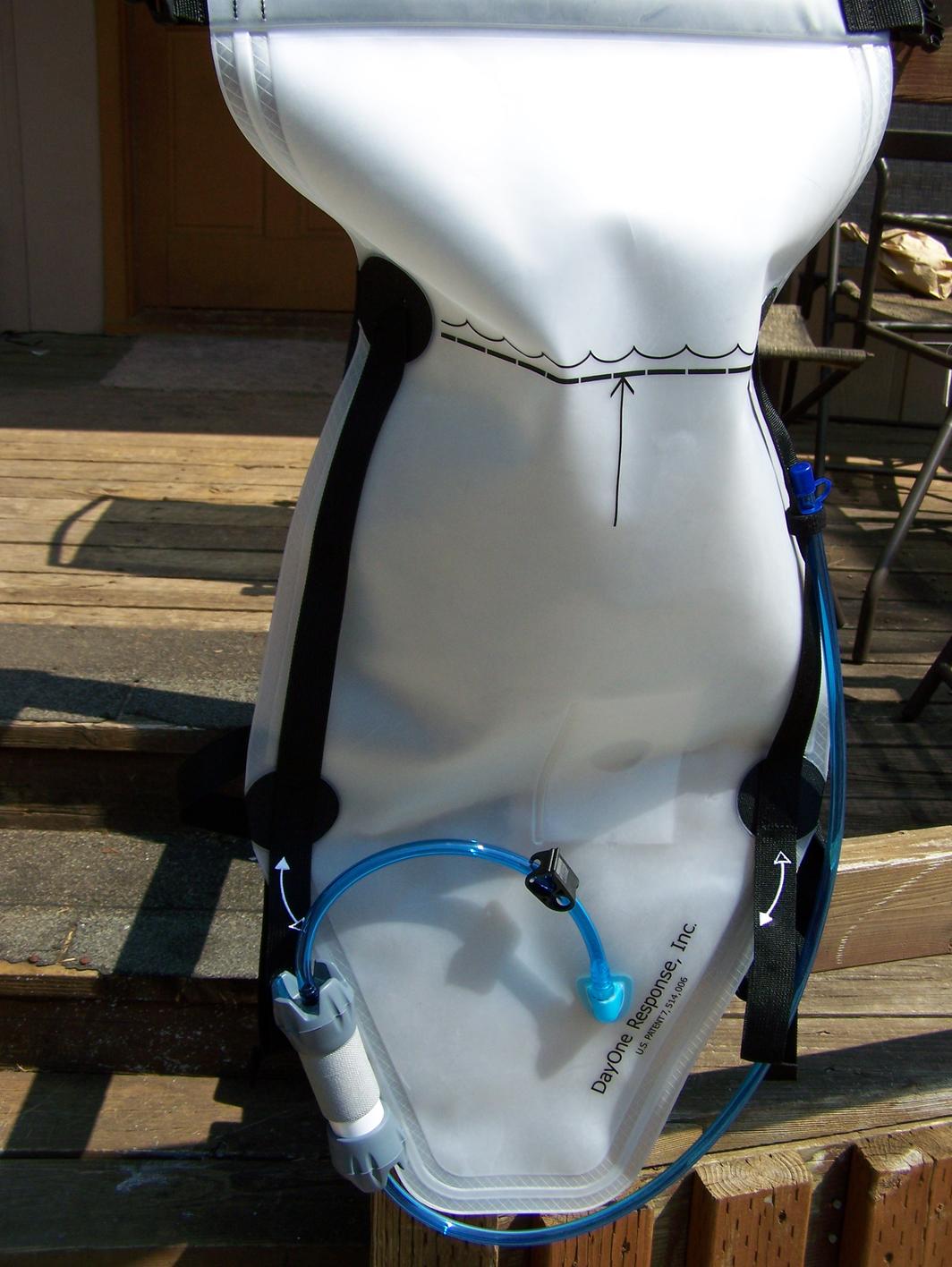
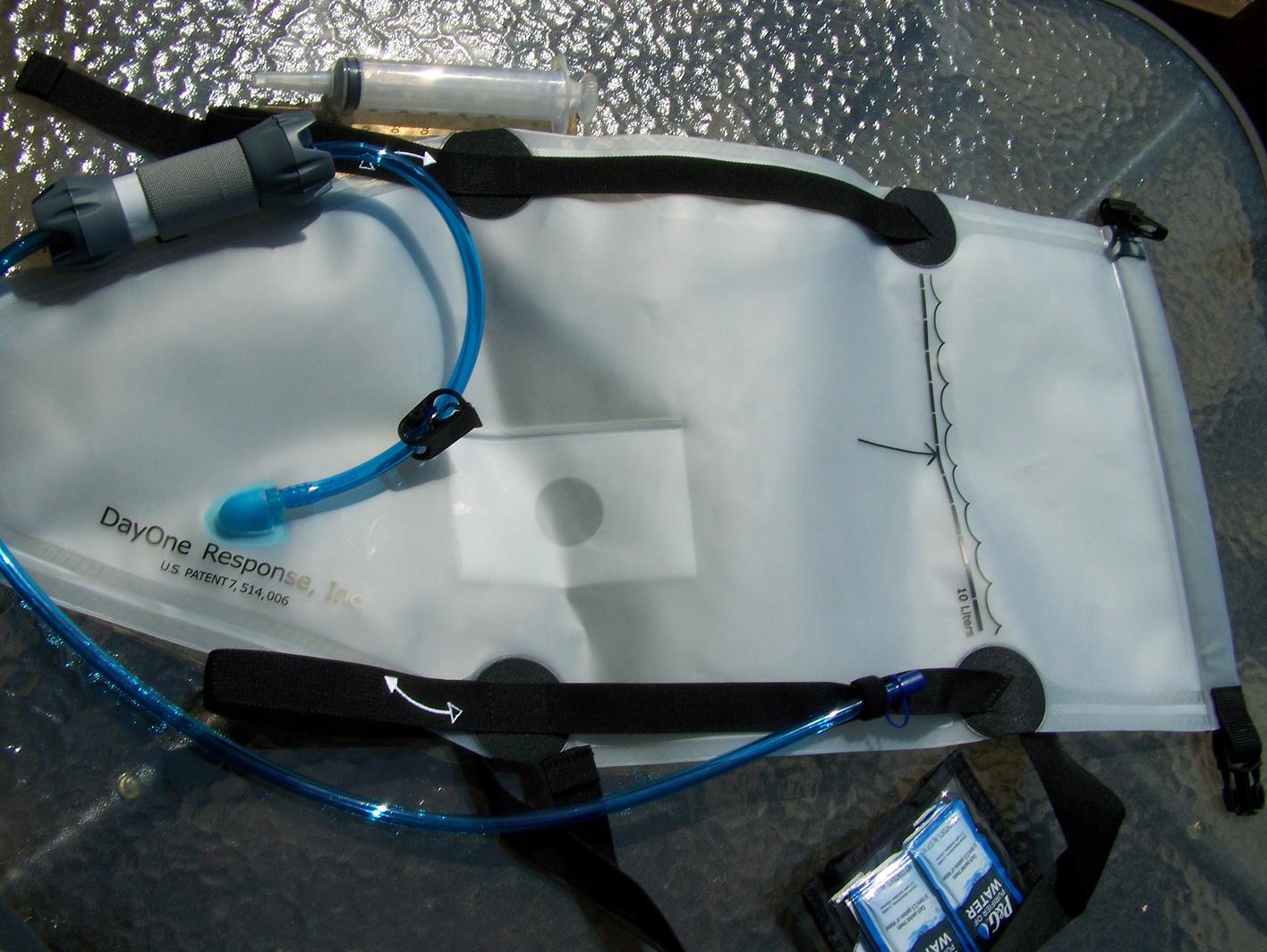
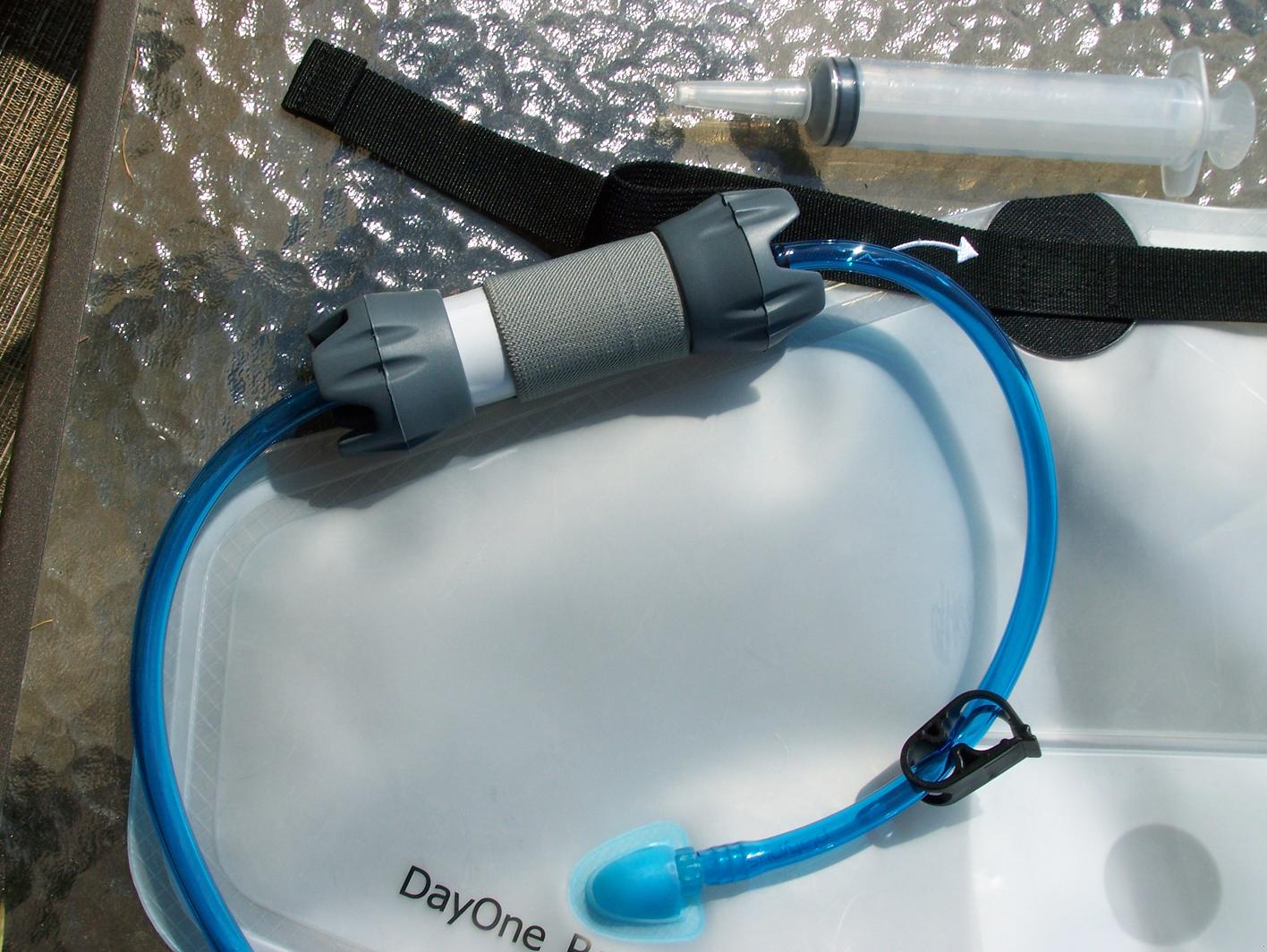
Today we are looking at the Day One Response water bag, that treats water safely, effectively and quickly. The US Marines ranked this water purification treatment #1 in performance and user operation – it’s simply to do. The Day One Response water bag is also easy to transport A quick look at what this system treats for is: sediment, arsenic,bacteria, lead, viruses, humic acid, protozoan cysts and DDT. Another really nice thing is that the directions that come with the water bag, are written as well as a pictograph – for use in countries where folks don’t really know how to read English that well. The Day One Response water treatment bag, has also been used all over the world – with great success. It meets WHO and US EPA emergency drinking water guidelines. 100_6313
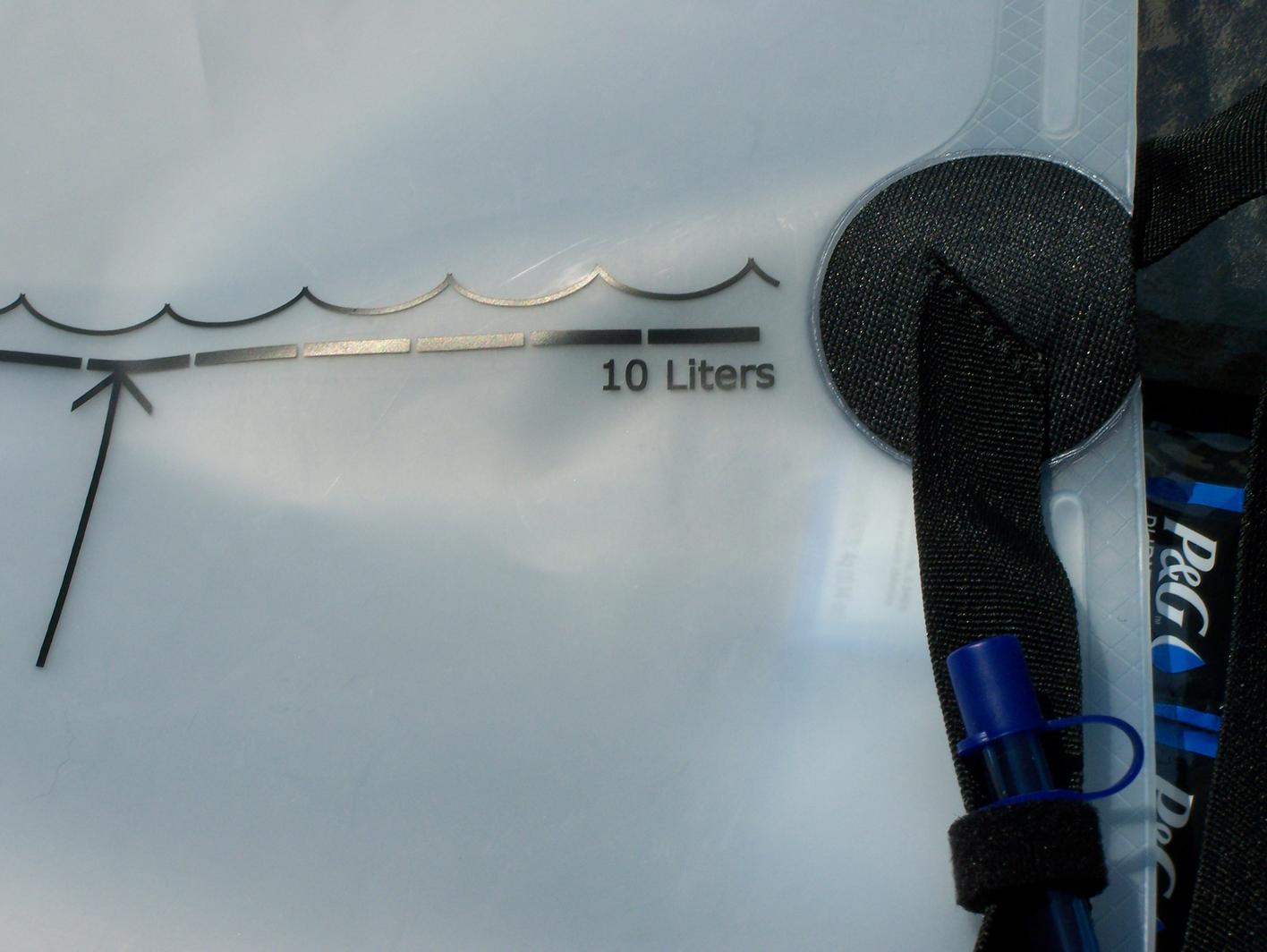
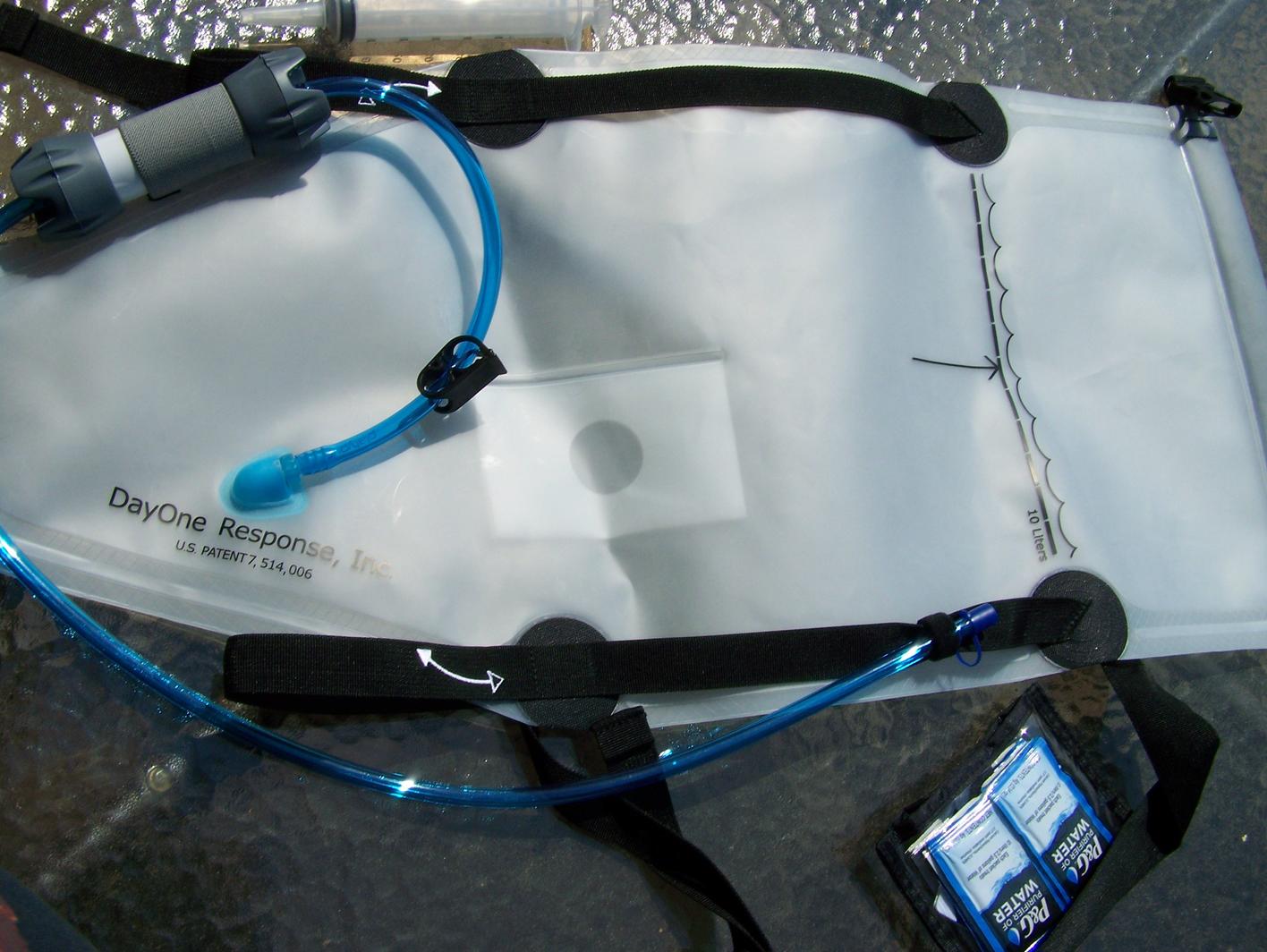
The water bag is a translucent polymer bag that holds 10-liters of water -or 2 1/2 gallons. The water bag comes with enough P&G (Proctor &Gamble) Purifier of Water packets to fill the bag up to 60 times. The P&G packets contain iron sulphate, calcium hypochlorite and other ingredients to purify the water. There is also a very fine filter – down to 2-microns, that removes many of the nasty bugs in the water. The water bag can be used up to 60times, and then needs replacing. The bag has a 10 year shelf life if not used,and the P&G packets have a three year shelf life.

Okay, how simple is the Day One Response water bag to use? It is extremely easy to use. I want to direct you to thisYouTube video, that can shows just how easy it is to use. The video is only a little longer than 4 minutes, and during my testing, I found that the product worked just that easily. 100_6314
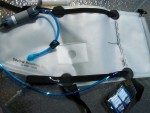
I did like the straps on the Day One Response water bag. They worked well infilling the bag from a stream – I did from our small creek that was still running through our property this summer, and closed the bag per directions,and carried it to my driveway – just 50 yards away – and it sure beats carryinga water container in my hand. I added the packet of the P&G Purifier of Water to the water – although the water was crystal clear, as I stated before,no surface water should be considered safe to drink, without treating it. I closed the top of the water bag, and hung it from a tree branch and wiggled it back and forth for 5 minutes and then let the water sit for another 25 minutes.It was clear and there was a very little sediment in the bottom of the bag.

Any water that you don’t drink within 24-hours should be either discarded,or used for washing clothes–things like that. And the sediment in the bottom of the bag – pour it out and bury it. You don’t want your pets getting into it and drinking it since it is full of all those “nasty” things that were taken out of the water. 100_6315
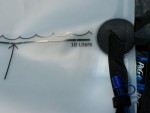
The water outlet attached to the bag is above a certain line, and below that line is water with sediment in it – don’t drink any water below that line. Also, you get a small syringe that you can use for back flushing the filter. This will extend the life of the water bag a little longer. Actual lifespan of the bag depends on how much sediment is in the water your are filtering. (A simple cotton T-shirt pre-filter can be used to help minimize sediment.)

The Day One Response water bag seems almost too simple to use. Collect water in the bag, add the packet of P&G Purifier, close the top of the bag, hang it, and wiggle the bag back and forth for 5-minutes, and let it sit for25-minutes. Then you can drink the water. However, don’t drink the water if it is still yellowish after 25 minutes. (Start all over again.) The system seems pretty fool-proof and easy to use. I do like the straps on the bag for transporting the water. (Water weighs 8.345 pounds per gallon, so 2-1/2 gallons would weigh more than 20 pounds. It is easier to carry on my back, than in my hands for any distance. 100_6316
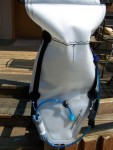
If you’re serious about prepping–and you should be–then you should have more than one method of purifying water in your emergency supplies – just in case one fails you. We have quite a few methods of making water safe to drink in our gear, and the Day One Response water bag, is one more method to help us when we need to make water safe for drinking. Full retail for the water bag and enough packets of P&G to purify about 150-gallons of water is only $79.99.I would recommend, getting a couple of these neat water bags, get one or two for yourself and another to give as a gifts to family. The recipient may not appreciate it now, but when they don’t have safe drinking water, they will surely thank you for the gift! It’s simple, inexpensive and easy to use. What more can you ask for? – Senior Product Review Editor, Pat Cascio

Letter Re: Traditional Hand Tools

Dear Editor:

Here are some observations on non-power tools: Get lots of can openers because they all fail. Older US-made ones from yard sales will last longer. Also stock US-made government issue “P38” openers as backups because they always they always work. Egg beaters and hand drills with an idler gear on the back side are more durable, not just from the support but because they are better quality to begin with. Antique shops are high $ place to shop for hand tools, estate sales are best, next generation often has no clue about grandpa’s “junk”. I found a quality hand drill missing the back cap (where drills were stored) tossed on a workbench with junk, no price, bought for 25 cent offer, pressed a PVC cap on it. Yankee screwdrivers can still be bought new and are worth their weight in gold if you have to build or repair something with that large stock of drywall screws you wisely stocked. Without a power driver you will quickly figure out why grandpa drilled a pilot hole. As with all preps, start using non-power tools so you’re familiar with operation.

I’d also like to share some thoughts on strenuous outdoor work when water is precious: Be sure to stock talcum powder, no-rinse washes, Lubriderm (or generic) hand lotion, and lip balm. Regards, – Susan R.


Letter: Drought in Western Retreat Areas

JWR:

Has the recent drought in the western United States caused you to change any
of your “Recommended Retreat Areas”? – T.I.A.

JWR Responds: No, it hasn’t. There is an old saying: “Climate is what you expect, and weather is what you get.”

I do not believe that the current drought in the northwest is any evidence of any long term climate change. We are simply in an El Niño weather pattern that most likely will last only another year or two. The El Niño weather pattern has temporarily shifted the jet stream, disrupting seasonal rains, particularly in California, where the the drought has been quite severe and protracted.


Recipe of the Week: Butternut Squash Soup, by C.S.

This a recipe for a soup made from cooked and then pureed butternut squash.

Ingredients:

  • 4 ½ pounds butternut squash, halved lengthwise, remove seeds
  • 1/3 cup butter
  • 2 large leeks
  • ¾ tsp. dried thyme
  • 5 cups chicken stock or broth
  • ¼ tsp. salt
  • 2 Tbs. brown sugar
  • ½ cup sour cream
  • 2 ½ Tbs. chives, chopped
  • 8 slices bacon, fried crisp-crumbled

Directions:

  1. Preheat oven to 350 degree F. Place the squash, cut side down on a baking sheet and bake until tender, about 40 minutes. Cool slightly. Using a spoon, scoop out the squash from the skin and set aside.
  2. Meanwhile, in a large, heavy sauce pan, melt the butter over low heat. Add the leeks and thyme, cook, stirring occasionally until soft and golden.
  3. Stir in the stock and squash. Simmer over a moderate heat for 20 minutes.
  4. Carefully transfer the soup into a food processor or blender and blend it into a thin paste. (You will have to do this in batches).

Note: If you are going to freeze this soup (and it does freeze well) then do not add the last three ingredients.

To serve: Pour soup back into pan, add salt and pepper to taste and reheat the soup.

Garnish each bowl of soup with 1 Tbs. sour cream, a sprinkle of chives, and bacon.

o o o

Useful Recipe and Cooking Links:

Hearty Blender Soup Recipes

Blendtec Soup Recipes

Do you have a favorite recipe that would be of interest to SurvivalBlog
readers? Please send it via e-mail. Thanks!


Odds ‘n Sods:

Questions raised after shock belt used at Texas murder trial. Incredible! I expect to next see defendants held in courtroom cages (as already seen in many European capital crimes trials.)

o o o

Here is a headline from the Middle East Forum that sounds like something straight out of my upcoming novel: Obama Throws Christian Refugees to the Lions

o o o

Regulated out of Existence: Off-Gridders Forced back on the Grid, Camping on own land Illegal


Notes for Sunday – September 27, 2015

There are rumblings from social media in the Middle East that the current flow of “refugees” into Europe through the Balkans will increase before winter sets in, and then resume next spring, in a veritable torrent. It appears that many young Muslim men in more than a half dozen nations have been so emboldened by the success of others that they’ve indicated: “I’m going too.” Watch out folks. Next spring and summer we may witness a human wave of Golden Horde proportions.

o o o

Today, we present another entry for Round 60 of the SurvivalBlog non-fiction writing contest. The $10,000 worth of prizes for this round include:

First Prize:

  1. A Gunsite Academy Three Day Course Certificate, good for any one, two, or three day course (a $1,195 value),
  2. A course certificate from onPoint Tactical. This certificate will be for the prize winner’s choice of three-day civilian courses. (Excluding those restricted for military or government teams. Three day onPoint courses normally cost $795,
  3. DRD Tactical is providing a 5.56 NATO QD Billet upper with a hammer forged, chrome-lined barrel and a hard case to go with your own AR lower. It will allow any standard AR type rifle to have quick change barrel, which can be assembled in less than one minute without the use of any tools, and a compact carry capability in a hard case or 3-day pack (an $1,100 value),
  4. Gun Mag Warehouse is providing 20 MagPul PMAG 30rd Magazines (a value of $300) and a Gun Mag Warehouse T-Shirt. (An equivalent prize will be awarded for residents in states with magazine restrictions.),
  5. Two cases of Mountain House freeze dried assorted entrees in #10 cans, courtesy of Ready Made Resources (a $350 value),
  6. A Model 120 Series Solar Generator provided by Quantum Harvest LLC (a $340 value),
  7. A $250 gift certificate from Sunflower Ammo,
  8. KellyKettleUSA.com is donating both an AquaBrick water filtration kit and a Stainless Medium Scout Kelly Kettle Complete Kit with a combined retail value of $304,
  9. TexasGIBrass.com is providing a $300 gift certificate, and
  10. Two cases of meals, Ready to Eat (MREs), courtesy of CampingSurvival.com (a $180 value).

Second Prize:

  1. A Glock form factor SIRT laser training pistol and a SIRT AR-15/M4 Laser Training Bolt, courtesy of Next Level Training, which have a combined retail value of $589,
  2. A FloJak EarthStraw “Code Red” 100-foot well pump system (a $500 value), courtesy of FloJak.com,
  3. The Ark Institute is donating a non-GMO, non-hybrid vegetable seed package–enough for two families of four, seed storage materials, a CD-ROM of Geri Guidetti’s book “Build Your Ark! How to Prepare for Self Reliance in Uncertain Times”, and two bottles of Potassium Iodate– a $325 retail value,
  4. A $300 gift certificate from Freeze Dry Guy,
  5. A $250 gift card from Emergency Essentials,
  6. Twenty Five books, of the winners choice, of any books published by PrepperPress.com (a $270 value),
  7. A pre-selected assortment of military surplus gear from CJL Enterprize (a $300 value),
  8. TexasGIBrass.com is providing a $150 gift certificate,
  9. RepackBox isproviding a $300 gift certificate to their site, and
  10. Safecastle is providing a package of 10 Lifestraws (a $200 value).

Third Prize:

  1. A Royal Berkey water filter, courtesy of Directive 21 (a $275 value),
  2. A large handmade clothes drying rack, a washboard, and a Homesteading for Beginners DVD, all courtesy of The Homestead Store, with a combined value of $206,
  3. Expanded sets of both washable feminine pads and liners, donated by Naturally Cozy (a $185 retail value),
  4. Two Super Survival Pack seed collections, a $150 value, courtesy of Seed for Security, LLC,
  5. Mayflower Trading is donating a $200 gift certificate for homesteading appliances,
  6. APEX Gun Parts is donating a $250 purchase credit,
  7. Montie Gear is donating a Precision Rest (a $249 value), and
  8. Two 1,000-foot spools of full mil-spec U.S.-made 750 paracord (in-stock colors only) from www.TOUGHGRID.com (a $240 value).

Round 60 ends on September 30th, so get busy writing and e-mail us your entry. Remember that there is a 1,500-word minimum, and that articles on practical “how to” skillsfor survival have an advantage in the judging.


Case Preparation: A Building Block for High Quality Reloads, by T.L.W.

Author’s Introductory Disclaimer: I am not a professional reloader. College degrees have only taken me so far into reloading for personal use and formal education cannot replace personal study, experience and common sense–probably true of just about everything these days. Reloading can be dangerous and expose you to toxic metals and chemicals, so please take precautions when dealing with them. The steps below are for informational purposes and are meant to add to the growing conversation on loading your own ammunition in good times and bad. Please use caution at all times!

This discussion will center on case preparation to turn out quality ammo for hunting or self-defense with or without electricity. I certainly prefer all-new components when hand loading for this purpose, but new brass may not always be available. As a result I have attempted to produce reloaded ammunition that meets or exceeds the standards of factory ammo. In years of trials and tinkering I have realized that starting with a good case is crucial to overall end performance. Standard cases ensure uniform bullet-seating depth with an even crimp resulting in a more consistent pressure needed for bullet expulsion. It will also produce a close tolerance in maximum length overall. These factors will improve consistency in bullet velocity and also result in reliable feeding. Notice I did not use the word “accuracy” to describe these improvements. Accuracy involves multiple factors including the shooter, the environment, the gun and the cartridge so even if all of us had the same perfectly loaded ammo your accuracy may vary.

I wrote this for the casual reloader who has a basic understanding and rudimentary tools. If you don’t have those things, they once you have them please revisit this article and hopefully everything will make sense. Having electrical power and access to new material will speed up the process and allow you to learn how to reload while your life does not necessarily depend on it so learn now!

I will use .45 ACP when referencing specifics, as that is the round I recently tested for consistency and reliability. However the techniques described below have been used successfully with both pistol and rifle calibers in semi-auto and bolt-action firearms. With over one thousand of my own rounds down range this past year and some trials of varying techniques I have found that starting with a shell casing that meets tight tolerances can overcome many issues that arise at the range such as failure to feed or failure to eject. Quality control throughout the rest of the process such as using good primers seated to the correct depth, an accurate (ideally digital) scale for measuring individual powder loads, and quality bullets will maximize reliability. While “plinking” ammo can afford to have some variance and a high-end progressive press can churn out thousands of rounds per day that is not the focus of this discussion. I would like to share specifically what I do with some basic tools, a single-stage press and a bit of time on my hands:

1) Tumble: I start with a mixed bag of spent shells and put it all in a vibrating tumbler with a coarse, untreated media (meaning no brass polish).  Tumble for about 30 minutes to accomplish an initial cleaning.

Without electricity tumbling becomes quite a chore, so here is one solution that I have tried with some success: I have a media separator that came with the vibrating tumbler. It’s a plastic ball strainer with a bucket, mounting clips for the bucket and a handle to spin the strainer. I lined the entire inside with aluminum foil and crimped the ends so it stayed in place. I filled half the ball with media then dumped in some spent shells. I then sealed it up and had my 6-year-old start turning while I enjoyed a cold beverage. After 20 minutes of her getting bored and tired and another 40 minutes for me
we opened it up. The brass was starting to get clean! Sand and dirt was gone, spent powder in the bottom of the case was starting to come out and the outside of the case was getting clean enough to see small scratches and dents clearly. While not ideal and obviously labor intensive this was a good-enough solution using what we already had sitting around the garage. A more abrasive media would probably be better for this manual method. We also had another batch where we tried putting the media and shells in a one-gallon plastic bag vice using foil, but that didn’t seem to work as well. Maybe with a little more time it would be okay. I would be interested to hear of other cleaning methods sans electricity.

2) Filter: Dump media through a strainer, sort by caliber and inspect for damage like hairline cracks, large dents, etc. I typically reject about 5% of recovered rounds after this process. For hunting or defense reloads I use only Winchester, Hornady, Federal or Remington brass. This is a personal preference as these manufacturers have good reputations. Remove as much media from the case as possible. There may be small amounts of media stuck in the primer and that is okay for now. [JWR Adds: My habit when reloading is that whenever I discover a split neck or other serious case flaw, I immediately squash the case in my workbench vise. This eliminates any risk of accidentally later reloading the same rejected case.]

3) Sort and lube: I sort brass into piles by manufacturer. This helps ensure uniformity in the case based on the manufacturing process such as case thickness and initial case sizing – something that is difficult to determine for your average reloader. Spread out 50 or so rounds on an old towel and spray down with resizing lube being sure to coat the outside vertical wall of the shell.  The lube works either wet or once dry so there’s no rush to resize. [JWR Adds: If you use case lube that comes from a squirt tube, rather than a spray can, you can buy and un-inked inkpad from any large office supply store. One good squirt of lube on this pad will give you the most efficient use of the lube for dozens of cases. And snapping the lid of the pad shut when your are finished eliminates the risk of contamination by sawdust or any other foreign matter.]

4) Resize and decap the brass:  This is usually done with a single die. For ammo going into a semi-auto gun use a full-length sizing die.  If it’s a bolt-action rifle, a collet die that only resizes the neck is just fine. I use a single stage press and it is certainly slow. That is why most reloaders dobatch processes and keep bags or plastic tubs of cases in different phases of production. I do not do more than 100 at a time when loading for hunting or defense. The repetitive nature of doing much more than 100 can lead to lost mental focus and mistakes that could have serious consequences.

5) Measure: This is a critical step in selecting cases for hunting or self-defense. If re-purposing brass from spent shells understand the case expands in the chamber from the pressure of powder ignition and the only place for that material to go is down the barrel. Your cases will get longer over time and require trimming to get them back in specifications (your reloading dies will come with documentation on precise measurements for case length and overall length). Be careful here as after multiple reloads eventually case wall thickness decreases to the point where the case will split. The mitigation for this failure limits the number of times you reload a single case, Always inspect your cases prior to starting the reloading process. Because of this I only use once-fired brass for critical (self-defense) use. After use the spent shell for a second reload goes to the practice pile. I use a digital micrometer to measure my cases (for .45 ACP my tolerance is +0/-.03mm of maximum case length following resizing; you may choose something different based on your firearm or preference.) Cases that are too long are trimmed to within tolerance. Brass that is too short goes into my plinking can and will only be used for practice. Rotate the case to measure across multiple points, since case mouths or rims may be un-even.

5a) Trim: Use the full length sizing gage that came with the die set with a carbide cutter attached to it. For convenience I use a drill to lock the case in a shell holder then insert the brass for cutting, but this can be done by hand.  You can also clean the primer pocket with a special tool at this time.  I typically do a quality check of a single point measurement with a micrometer to ensure the case is in spec following trimming. If there is a burr from cutting, it should be removed with a chamfer tool.

6) (Optional) Tumble: back in for about an hour in the vibrating tumbler.  This time use a medium grit media with brass polish.  This will remove most of the residue from resizing, however quality resizing lube has no effect on primers or powder so a second tumble is not required. Note: If you used any resizing lube then you must remove any lubricant that you used for resizing. I realize here that some progressive presses [with carbide dies] do not require the use of resizing lubricant.

Back to my manual tumbler: I found the brass polish slightly tarnished the foil I used to line the filter. I have not done research into the exact cause and it may very well be spent powder grit that is electrostatically attracted to the foil, but given there are undisclosed mild solvents in the brass polish and the long-term effect on powder and primer function is unknown I will not be using brass polish with this method in the future. A tumble without polish should be fine to soak up any excess lubricants.

6a) Optional ultrasonic sink cleaning: If you have the inclination and equipment, a quick turn in an ultrasonic sink will make your brass look like new. Make sure to use a brass cleaning solvent and not a steel one iny our sink and never substitute one for the other when cleaning brass. This will remove all oils and polish from the cleaning and resizing process.  You have to rinse with distilled water and dry the brass thoroughly before moving on.

The results of this tedious process have been measureable. I tested 200 rounds of .45 ACP ammo from a SIG-Sauer Model 1911 Scorpion at 20 yards. I used 50 Federal and 50 Hornady factory loads, but chose as a benchmark the 50 rounds of Winchester “white box” factory ball ammo (230 grain) as it was the most accurate. My own 50 rounds used once-fired Winchester brass, CCI primers, Magtech 230 grain ball bullets and Accurate #5 powder. I do not own a chronograph, so I chose group size as my standard. At 20 yards I saw a 21%improvement in accuracy using handloads (meaning reduction of shot group diameter using a gun rest for a 5-shot group was 4.2” for factory ammo down to a 3.3” group for handloads). I had one failure to eject from the Federal factory ammo, but no other failures. Anecdotally, I have seen similar performance from my own 185-grain JHP, but I have not measured the differences.

While there are more variables than simply case preparation I believe that my trials demonstrate that reloads can be a viable option for critical applications in any scenario where factory ammunition or new brass is not available. Reloading will also save you a little money in the near term, and much more over the long term. Keep reloading, and stay safe!


Letter Re: Trail Shelters and the Hantavirus Threat by Zac T.

Hello All,

In an effort to remove oneself from the vectors in a trail shelter I’d suggest never going in to a trail shelter… Carry and bring your own solution with you. After hiking for 10 hours, nobody is going to break out their N95 mask and wet mop down a shelter to remove the virus risk. The best someone can hope for is to remove themselves from the now known threat and avoid the pests causing it.

Hennessy hammocks come complete with a rain fly and mosquito netting that you zip yourself in for the night. No bugs, and no mice. However, some people can’t comfortably sleep in them, some can. It is best to figure this out before shelling out the cash. Once you borrow and try one, carrying a complete solution for camping out replacing your tent for a hammock is a good bet. What I found personally is that tighter ropes make a more horizontal sleeping area, I don’t like having my feet above my head. Everyone is different so you have to find what works best for you.

Yes, you still could sleep on the ground using a tarp lean-to, but when it only takes a few minutes to find trees 15 feet apart and wrap a nylon strap using carabiners around it. In under 10 minutes you can have your sleeping area set up. And tear down using snake skins is just as quick. You can break down your sleeping area in the same amount of time, under your rain fly, keeping dry… (Video.)

You can even get an under bag and winter camp using a hammock. (Video.)

(This Shug Emery guy [in the video] is a bit crazy, but you gotta respect camping at -40 Fahrenheit in a hammock.)

This year I got my hammock and have made a few trips to places that didn’t have good level ground for a tent or tarp -like in a swamp. Yep- the mosquito netting is a great thing! The hammock opens up your mobility, and it is noteworthy that Hennessy sells green and camouflage hammocks.

You can get a cheaper hammock to try sleeping in it, before you commit to buying a more expensive Hennessy.

One warning that I’ve read is worth repeating: If you put up a hammock in a trail shelter you risk causing the load bearing supports to shift causing a shelter to collapse. Aside from that, thigh-diameter trees work fine.

I hope this is helpful. – Fitzy in Pennsylvania