

“To compel a man to furnish contributions of money for the propagation of opinions which he disbelieves and abhors, is sinful and tyrannical.” – Thomas Jefferson
- Ad Trekker Water Station 1Gal Per MinuteCall us if you have Questions 800-627-3809
- Ad Ready Made Resources, Trijicon Hunter Mk2$2000 off MSRP, Brand New in the case
Notes for Tuesday – September 29, 2015
September 29, 1881 was the birthday of Ludwig von Mises. (He died on October 10, 1973.)
o o o
Today, we present another entry for Round 60 of the SurvivalBlog non-fiction writing contest. The $10,000 worth of prizes for this round include:
First Prize:
- A Gunsite Academy Three Day Course Certificate, good for any one, two, or three day course (a $1,195 value),
- A course certificate from onPoint Tactical. This certificate will be for the prize winner’s choice of three-day civilian courses. (Excluding those restricted for military or government teams. Three day onPoint courses normally cost $795,
- DRD Tactical is providing a 5.56 NATO QD Billet upper with a hammer forged, chrome-lined barrel and a hard case to go with your own AR lower. It will allow any standard AR type rifle to have quick change barrel, which can be assembled in less than one minute without the use of any tools, and a compact carry capability in a hard case or 3-day pack (an $1,100 value),
- Gun Mag Warehouse is providing 20 MagPul PMAG 30 rd magazines (a value of $300) and a Gun Mag Warehouse T-Shirt. (An equivalent prize will be awarded for residents in states with magazine restrictions.),
- Two cases of Mountain House freeze dried assorted entrees in #10 cans, courtesy of Ready Made Resources (a $350 value),
- A Model 120 Series Solar Generator provided by Quantum Harvest LLC (a $340 value),
- A $250 gift certificate from Sunflower Ammo,
- KellyKettleUSA.com is donating both an AquaBrick water filtration kit and a Stainless Medium Scout Kelly Kettle Complete Kit with a combined retail value of $304,
- TexasGIBrass.com is providing a $300 gift certificate, and
- Two cases of meals, Ready to Eat (MREs), courtesy of CampingSurvival.com (a $180 value).
Second Prize:
- A Glock form factor SIRT laser training pistol and a SIRT AR-15/M4 Laser Training Bolt, courtesy of Next Level Training, which have a combined retail value of $589,
- A FloJak EarthStraw “Code Red” 100-foot well pump system (a $500 value), courtesy of FloJak.com,
- The Ark Institute is donating a non-GMO, non-hybrid vegetable seed package–enough for two families of four, seed storage materials, a CD-ROM of Geri Guidetti’s book “Build Your Ark! How to Prepare for Self Reliance in Uncertain Times”, and two bottles of Potassium Iodate– a $325 retail value,
- A $300 gift certificate from Freeze Dry Guy,
- A $250 gift card from Emergency Essentials,
- Twenty Five books, of the winners choice, of any books published by PrepperPress.com (a $270 value),
- A pre-selected assortment of military surplus gear from CJL Enterprize (a $300 value),
- TexasGIBrass.com is providing a $150 gift certificate,
- RepackBox is providing a $300 gift certificate to their site, and
- Safecastle is providing a package of 10 Lifestraws (a $200 value).
Third Prize:
- A Royal Berkey water filter, courtesy of Directive 21 (a $275 value),
- A large handmade clothes drying rack, a washboard, and a Homesteading for Beginners DVD, all courtesy of The Homestead Store, with a combined value of $206,
- Expanded sets of both washable feminine pads and liners, donated by Naturally Cozy (a $185 retail value),
- Two Super Survival Pack seed collections, a $150 value, courtesy of Seed for Security, LLC,
- Mayflower Trading is donating a $200 gift certificate for homesteading appliances,
- APEX Gun Parts is donating a $250 purchase credit,
- Montie Gear is donating a Precision Rest (a $249 value), and
- Two 1,000-foot spools of full mil-spec U.S.-made 750 paracord (in-stock colors only) from www.TOUGHGRID.com (a $240 value).
Round 60 ends on September 30th, so get busy writing and e-mail us your entry. Remember that there is a1,500-word minimum, and that articles on practical “how to” skills for survival have an advantage in the judging. Note that if we don’t have space for some of the most-recently received entries, then they will be posted and judged in Round 61.
- Ad LifeSaver 20K JerryCan Water PurifierThe best water jerrycan you can buy on the market! Mention Survivalblog for a Free Filter ($130 Value)
- Ad California Legal Rifles & Pistols!WBT makes all popular rifles compliant for your restrictive state. Choose from a wide range of top brands made compliant for your state.
A SHTF Guide to Mass Casualty Incidents, by W.G. Curry, NRP, TP-C
I’ve written this article with a hypothetical situation interspersed between
some factual text:
Your eyelids peel apart and allow dust to fall onto your eyes as you force them open and shut while rubbing them with filthy fists in an effort to washout some of the debris. The ringing noise is loud in your ears. “I wish it would stop,” you declare to yourself. A terrible ache forms in the depth of your skull. You ache all over. “What happened, where am I,” you ask? As your blurry vision begins to brighten and sharpen, you can see ash in the air,you can taste the metallic tinge of blood at your tongue as it parts your lips to feed your burning lungs with their much needed meal of fresh air. The ringing in your ear is fading in and out as you begin to make out different pitches of rings. Focusing even more, you begin to separate a new sound completely from the ringing. Screams. Those are screams. Everything rushes back to you now in one cinematic recollection. You were at the United States Holocaust Museum when a thunder of ear-shattering noise collapsed the roof of the exhibit…
That “thunder” that you recalled was the sound of an explosive device that was detonated a mere 100 feet away. Making your way to your feet, you see that the sharp pain in your back was large piece of concrete. Frustrated with it, you kick it away and it reveals a sign that had previously been on a wall.Through the dust you read “Hope is like peace. It is not a gift from God. It is a gift only we can give one another.” A quote by Elie Wiesel, a holocaust survivor. Reading this eases the brewing anxiety growing in your abdomen.Realizing that perhaps you are better off than some of your fellow Americans nearby, you decide to take action and help. You rush the ten feet to the first victim and curse the museum rules, realizing that your EDC bag is in your car;a 20 minute train ride away. It had bandages and a tourniquet. You drop to your knees and look down on a woman in her mid-twenties covered in ash and breathing hard, but she is unconscious. Her body is all grey except for the bright red blood spurting out from her smashed and mangled arm pinned beneath the concrete. As you think to yourself what to do first you are suddenly halted internally by a flash of adrenaline. Everything in the room gets a bit brighter, you notice you are breathing heavier and faster. Your fingers tremble. You don’t know what to do. Where do you start?
******
The Simple Acronym to Guide Your Aid: S-A-L-T
SALT is a form of systematic mass casualty triage that has been endorsed nationally by most medical associations and emergency organizations. My aim here, is to provide a simple way to understand and remember the importance of sorting and treating casualties in the event of horrible incident.
Although many emergency organizations are implementing new ways to coordinate and handle mass casualty incidents, the best first-line protection for the wounded may be the not-so-wounded.
The original and official acronym stands for Sort, Assess, Life-Saving Interventions, and Treatment/Transport.
For a mass casualty scenario before each person is assessed, we are only concerned with providing two types of aid:
1) Bleeding, and
2) Breathing.
SALT will help you determine how to start and stop your aid to others. Here is how SALT can be interpreted for those of you with no first responder training:
Sort – Sort out yourself and others by telling everyone to get up and starting helping others. What this does is immediately identify those that DON OT need immediate help.
Assess – Start vigilantly looking around to see if the environment is still unsafe. Check for hazards like fires, active shooters, or whatever is relevant and/or obviously dangerous. If you have concluded that the worst is over, begin to assess those in need of help.
Life Saving – The most important thing you can do is control severe bleeding. I am not referring to dark-red blood that oozes from an ear, but blood that is spurting each time the victim’s heart beats. We will discuss methods later. Next, if the patient is unconscious, open their airway and see if they begin breathing. If they are already breathing you need to lay them on their side, in the fetal position, and move on to the next victim. If they are not breathing after you have opened their airway, then move on to the next victim and realize that helping everyone is not always feasible. Bleeding or not, and breathing or not, it is very easy to allow yourself to become consumed and distracted by other injuries, which means less people get your help. As bad as a broken shin may look with bone sticking out and dried blood everywhere added to a victim screaming in pain, that patient doesn’t need you like the unconscious person 10 feet away who needs to have their airway opened.
Treat/Transport – The best things to do at this phase of SALT is to get people to safety or to places that first responders can more easily access.Once all of the people that can easily be moved have been, then begin treating what injuries you can on the patients that are still trapped, unable to easily move, or difficult to get to. Know and remember that a victim’s stability can change at any moment so each time they are moved, and periodically while stationary, you need to always continue to check for heavy bleeding and the presence of breathing.
Bleeding Control Techniques:
Plain and simple, if the bleeding is massive and coming out fast from a limb while spurting from the heart’s beat, then it needs a tourniquet.Commercially made tourniquets are produced and for sale, but typically aren’t available when citizens need them most and may present some legal issues when used by non-healthcare or non-trained personnel. One can fashion a tourniquet quite easily with common items. What is important is what not to use more so than what to use. Do not use anything that will cut into the skin when tightened. Examples would be: electrical wire or cordage, shoe strings, etc.Using things thin in width will not adequately cut off blood flow in an artery and will usually slice into the skin. Anything wide like a belt, a tee shirt,or a cutoff strap from a book bag should work so long as you can get it tight enough. The only two other things that are extremely important are how tight to tighten it and where to put it. You should already know, or should learn how,to check for a pulse at the wrist and at the ankle. This is crucial, because tourniquets need to be tightened tight enough to stop the pulse. This means finding and feeling a pulse as you are tightening it, or having someone else feel it. Most EMT and First Aid courses and textbooks recommend that you place a tourniquet two to three inches above the wound. However, what if the foot or hand is amputated? The shin and forearm are not the best places for tourniquet placement because the arteries run between the bones and require much more pressure on tightening them to actually stop blood flow, whereas the upper leg and arm has only one bone and the artery can be clamped against it. After all,the point isn’t to slow blood flow, but to stop blood flow. So, my recommendation is that regardless of where the wound is, place the tourniquet as high on the groin or armpit as possible. Always remember to continue to check tourniquets periodically, especially when using an improvised tourniquet as they could loosen, causing the victim to bleed out even faster than before.
******
…You drop to your knees and look down on a woman in her mid-twenties covered in ash and breathing hard, but she is unconscious. Her body is all grey except for the bright red blood spurting out from her smashed and mangled arm pinned beneath the concrete. Remembering the SALT acronym, you quickly remember to shout out for people to get up and help if they can and that next is the Life-Saving phase. “Bleeding first, then breathing, bleeding then breathing,” you think. You pull off your leather belt and wrap it around her upper arm near the shoulder and loop it through the buckle, pulling it backwards towards you to get it snug. You reach down to put two fingers on the wrist to feel a pulse but see that it is pinned beneath a massive piece of concrete. As you start cranking down on the belt to pull it as tight as you can, you notice the gaping hole no longer has blood spraying from it and is only dripping from being so saturated with blood. Securing the belt so that it tays tight, you begin to look around and see several other people rushing to the aid of others. You stand and move quickly to the next victim and point at two people standing, looking terrified at the scene in front of them. “You two, start trying to find us an exit, there is no way to bring stretchers inhere for these people and we need to get them outside!” They take off in a frantic hurry. Kneeling beside the next casualty, you see that his stomach and chest are both still, motionless and lifeless. As he lay lifeless on his back,you fight back the fear building inside of you as you lift his chin towards the sky, lifting his tongue off the back of his throat. Knowing that this would have allowed for him to take a breath if he was capable of doing so, and that he didn’t, you say a quiet “sorry” and promptly move on to the next person. The next person that no one is helping is an elderly woman who does not appear to be bleeding anywhere but has bruises all over her limbs. As you look to see if she is breathing, you see that she is, in fact she is breathing so hard that she is snoring, but she is unconscious. Unsure of how to proceed, you think of SALT again…
******
Breathing Assistance:
Most people are able to ascertain whether a person is breathing or not by looking at their stomach or chest. Following the SALT method, you either see that they are breathing and move on, or you notice they are not breathing and make an attempt to open their airway. Most of the time, the airway is shut off by the tongue falling back slightly and not allowing air to enter the lungs.The easiest way to help this is by turning someone on their side. This keeps the tongue out of the way and allows air to move freely, plus it allows fluids like vomit and blood to drain out rather than into the lungs. When turning someone on their side, lay their head against the inside of their upper arm and whatever leg is higher, bend it and lay it on the ground if it is uninjured.This will help stabilize them and prevent them from rolling back onto their back.
******
…The next person that no one is helping is an elderly woman who does not appear to be bleeding anywhere but has bruises all over her limbs. As you look to see if she is breathing, you see that she is, in fact she is breathing so hard that she is snoring, but she is unconscious. You roll her to her rights ide placing her head on her bicep and you move her left leg off of the right leg and on the ground. To your astonishment, her snoring stops and she lets outa hard cough that jettisons vomit onto her arm and the dust covered ground.Standing up, the two people that you instructed to find an exit come jogging up to you reporting that the main entrance is mostly open. Just as you shout to everyone to let them know, you are interrupted by the sound of not just one,but many sirens in the distance.
******
My purpose in writing this article is to empower the prepper community with some basic knowledge of how to help during a disaster as well as to advocate that if you have not sought out medical training, that you should. Learn the basics and practice them. Many areas have volunteer positions where you can practice skills like CPR and most companies can spare the money to put an employee through First Aid training.
Although I mentioned CPR, I do find it necessary to provide an opinion about its use in a SHTF scenario. Each day, thousands of people go into sudden cardiac arrest and desperately need Cardiopulmonary Resuscitation to survive.No one can deny that. However, in the prepping community, I see a lot of folks advocating CPR training, to my surprise. On one hand, CPR is a skill that I believe should at the beginning of any medical training, and is a course that I believe should be taught at every middle and high school in the nation, but CPR does not have much place in a SHTF or TEOTWAWAKI situation. Cardiac arrest victims who are successfully resuscitated by CPR typically had an underlying condition that caused it and often require several days to weeks in an Intensive Care Unit to make any level of recovery. Please do not think that I mean CPR has no place in a bad situation, it very well may. Rather, what I am saying is that there are many situations where it does not as well, and I hope that individuals consider this when faced with the situation. Start with a CPR class that includes First Aid and AED training. Then challenge yourself to attend alternative first aid courses like wilderness first aid, or even volunteer as an EMT at a rescue squad. Whatever you do, never stop preparing.
About The Author: I am W.G. Curry, a Nationally Registered Paramedic and EMT, a Certified Tactical Paramedic, Tactical Combat Casualty Care Provider, and CPR instructor that has seven years of Combat Arms experience from the U.S. Army as well as an advocate that we all be vigilant,prepared, and loyal to those that we cherish. Be safe!
- Ad USA Berkey Water Filters - Start Drinking Purified Water Today!#1 Trusted Gravity Water Purification System! Start Drinking Purified Water now with a Berkey water filtration system. Find systems, replacement filters, parts and more here.
- Ad USA Berkey Water Filters - Start Drinking Purified Water Today!#1 Trusted Gravity Water Purification System! Start Drinking Purified Water now with a Berkey water filtration system. Find systems, replacement filters, parts and more here.
Letter: Buying Land Inside a National Forest
Hugh and Jim,
I have been reading SurvivalBlog for several years now. I’m retiring next year and am currently looking for our retirement “farm”. I never refer to it as my survival retreat. I have seen several properties for sale, apparently, inside national forests. Some have even been working farms. We have several national forests here in Michigan and many people live and apparently own land inside of these forests.
My questions are: What are the ramifications of owning land within a National Forest? Do I own the trees on the land, do I own the ponds, streams, etc.? What are the normal deed restrictions that I am likely to run into? Also, I am curious about mineral rights. Does the FedGov generally keep the mineral rights, or is that something that I would be negotiating for at purchase? I’m sure there are questions I haven’t asked that I could use the answers to as well.
If owning land in a national forest is viable, it would greatly expand my opportunities. If it is a liability, I don’t want to waste my time.
Thanks to JWR and HJL for your wonderful and informative site. – Charles, in Michigan
JWR Replies: This topic has been discussed several times in the 10 years that SurvivalBlog has been posted.
As a Westerner, my perspective might be slightly skewed, but here is the way I see it: In essence, the three key deciding issues in buying an in-holding of any sort of public land (Forest Service, State Forest, BLM, et cetera) are: A.)deeded year-round access, B.) the nature of the title to the land, and C.) freedom from regulatory or bureaucratic meddling. Unless you have a high level of confidence about those three issues, then I would not recommend buying an in-holding.
The first issue is easy to identify: Deeded year-round access. Unless you have guaranteed access in perpetuity, and in writing, then you don’t really have it. Yes, I know there are centuries of case precedents in Common Law about prescriptive right-of-ways that can be established by a certain number of years of “open and notorious” private use of a road. But a prescriptive right-of-way may have to be proven in court, at great expense. In the absence of a deeded year-round access easement, your ability to access your property in a motor vehicle could be severely restricted. And that restriction could be subject to the whims of just one individual: A BLM Field Supervisor, a Forest Service Supervisor, or a District Ranger. If he or she decides that the road to your “recreational cabin on a patented claim” is only fit for “seasonal use”, then you may end up being locked out of your own property. But in contrast if you have deeded year-round access, then your access is not up to any bureaucrat’s discretion.
The second issue is also easy to identify: The nature of the title to the land. Is the land held by a standard land title deed, by a patented (permanent)mining claim, by a 99-year lease, or is it just a renewable Federal mining claim? The first three of these are fairly straightforward, but the last one is a veritable bucket of worms that can lead to disputes that can spiral out of control. My general advice is to never buy a mining claim unless it is an undisputed and indisputable patented claim. You and your heirs never have to lift a shovel to keep a patented claim, forever.But regardless of the nature of your deed you will of course need to carefully research any other right-of-ways or easements attached to the property. These can include easements granted in the past to adjoining land owners, to power companies, to phone companies, to back-country lease cattle grazers, et cetera. And, as with any other rural land purchase, you should not neglect researching the water, timber, mining, and oil/gas rights to your property. These vary widely, so do your homework.
The third issue is harder to pin-down: Freedom from regulatory or bureaucratic meddling. To determine how well land-owners are treated by the”host” government agency, you really need to sit down and talk with other in-holding land owners in the region. Ask them what has gone on, over the course of successive presidential administrations and changes of local bureau administrators. Have there been any disputes? How amicably have road work expenses been covered or shared? Has the “host” government agency been politely” or have they been meddlesome and nosy? Have they had a “hands off” mentality or have they been meddlesome and nosy? Have employees of the agency or agencies tromped through private properties unannounced? Do they (or anyone else) have their own deeded right-of-way through your property? (And if so, does that mean vehicular or strictly on foot?) Has the government paid to fence out livestock,or have they forced land owners to construct fences at their own expense? And lastly, what is the general attitude of the government employees? Do they lord over the in-holding land owners, or do they respectfully carry put their business as humble public servants?
In closing: Do your due diligence before buying any piece of land.And the level of scrutiny must be even higher when buying an in-holding. Just like buying land that is inside of the boundaries of an Indian reservation, and in-holding that is within public land means that you will be dealing with an additional layer of authority. Do the requisite research, or you may regret it!
- Ad Click Here --> Civil Defense ManualNOW BACK IN STOCK How to protect, you, your family, friends and neighborhood in coming times of civil unrest… and much more!
- Ad STRATEGIC RELOCATION REALTYFOR SALE: Self-sustaining Rural Property situated meticulously in serene locales distant from densely populated sanctuary cities. Remember…HISTORY Favors the PREPARED!
News From The American Redoubt:
From The East Oregonian: LaGrande man pushing for secession to Idaho. Does that map look vaguely familiar?
o o o
John Jacob Schmidt of Radio Free Redoubt wrote to mention that “Sparks-31” will be conducting oneof his last comms classes, in November, and in occupied territory – western Washington State. Great training! Sign up while there are still slots!
o o o
Officerpays for Idaho man’s fuel, gets snubbed trying to get paid back.Update: Ontario Police Chief Mark Alexander says the officer has been reimbursed by the motorist. He says a check for $60 had been mailed but was sent to an incorrect address. Chalk up another one for the old-fashioned “Good Guys” in The American Redoubt.
o o o
- Ad Survival RealtyFind your secure and sustainable home. The leading marketplace for rural, remote, and off-grid properties worldwide. Affordable ads. No commissions are charged!
- Ad Civil Defense ManualClick Here --> The Civil Defense Manual... The A to Z of survival. Looks what's in it... https://civildefensemanual.com/whats-in-the-civil-defense-manual/
Economics and Investing:
Simon Black at Sovereign Man: The global financial system is now resting on a margin of 1.3%
o o o
Chart of the Day: Shanghai Stock Exchange Composite Index.
o o o
MarcFaber Warns Americans of Economic Collapse
o o o
Reader D.S.V. recommended this piece: Taxing Churches Would Marry Church And State
Items from The Economics Team:
The Next U.S. Recession Will Surprise Investors
Give Your Grocery Shopping List an Extreme Makeover
Glencore in Freefall as Analysts See Tougher Restructuring
Glencore shares are getting obliterated and analysts say shareholders could lose everything
- Ad Don't wait - get the ultimate US-made ultra-high performance US-made SIEGE Stoves and stunning hand-crafted SIEGE belts for Christmas. For stocking-stuffers see our amazing fire-starters. Gifts that can save lives. Big Sale!Every bespoke SIEGE buckle goes through an hours-long artisanal process resulting in a belt unlike anything else, with blazing fast performance and looks and comfort to match.
- Add Your Link Here
Odds ‘n Sods:
What do the words “Self-Sufficiency” mean to you? Well, according to one leftist think tank in the People’s Republic of Colorado, the words “Self-Sufficiency” now apparently mean: establishing guidelines for obtaining welfare handouts, tax credits, government grants, an increased “minimum wage”, “affordable (read: taxpayer subsidized) housing”, “economic justice”, and other assorted socialist claptrap. Their calculated annual “Self-Sufficiency wage” is a whopping $68,182 per year in Denver. That would be considered rock star uber wealthiness, to 98% of the world’s population. But in Denver, it apparently means just getting by. In classic Orwellian Newspeak, what used to be called “Dependency” isnow called “Self-Sufficiency”. But no matter how they want to twist words, the statist-collectivists clearly only have one goal: extracting money out of my wallet, by force and under color of law, and then handing it to someone else, to buy their vote in the next election.
o o o
Reader James W. suggested fascinating hour-long lecture (video): 3D Printing and the Future(or Demise) of Intellectual Property” by John Hornick
o o o
Some seasonal wisdom from Commander Zero’s Notes From The Bunker
blog: Gas Can Fillup.
o o o
I often have seen consulting clients confuse their needs versus their wants, in selecting survival gear. Please be dispassionate and prioritize, folks! Do you really need a $3,000 Valmet M76 .308 rifle, when a $900 PTR-91 will do the same job? People (and governments) often make poor choices of gear with dubious utility. (“Shoot! A fella could have a pretty good weekend in Vegas with all that stuff.”) – JWR
Hugh’s Quote of the Day:
“If you are not free to choose wrongly and irresponsibly, you are not free at all.” – Jacob Hornberger
Notes for Monday – September 28, 2015
The current sale on Mountain House long term storage canned foods at Safecastle ends on Wednesday, September 30, 2015. Despite the recent rush of orders, they are offering 35% to 38% discounts. And, unlike many other Mountain House sellers, Safecastle actually keeps most varieties in stock and ready for immediate delivery. (Many of these other sellers are now building a multi-month backorder list. As of September 24, the Mountain House factory was reportedly 95% sold out of their canned foods due to the recent high demand.)
o o o
Today we present another product review.
Pat Cascio’s Product Review: Day One Response Water Filter
Depending on which survival expert you talk to, they all have a slightly different list of things you need in an emergency, and what order you should do things. Some say shelter is the first thing on your list, followed by fire, then water, and lastly food. While all of these things are important, and I have no argument with them, one of the first things I would recommend is that, whatever brought on your emergency should be looked at closely. If a tornado is headed your way, the first thing to do is get to safety – whatever the danger is that you are facing, let’s get away from that danger.
My lovely wife is the one in our family who is really into water purification. She loves testing the various methods of getting a clean and safe source of drinking water. We live in a rural area, and have our own well, that provides 29-gallons per minute of water. However, the water is full of iron, bacteria, and the water is brown – without being treated. We have a large filter in our pump house, that is filled with Calcite, and that cleans up the iron and bacteria before it reaches our faucets in the house – every other year we have to have it serviced and re-charged. And, while it is safe to drink, it has a bit of a “taste” to it, and we filter our drinking water using several different methods, usually the main one is a water filter pitcher, that removes the funny taste from the Calcite. And, I don’t wash our vehicles at home – the Calcite leaves white water marks on the rigs, unless I take the time to either bypass the water before it gets to the filter in the pump house. Instead, I take our rigs to the car wash in town.
Make no mistake, without water – a source of safe drinking water, you will die in a matter of days. Depending on the emergency, you could die in as little as a couple of days, and in some circumstances, you could last as long as a week -but don’t count on it. Survival without safe drinking water is paramount to living. My wife enjoys watching the television show “Fat Guys In the Woods”with survival instructor Creek Stewart – and I often watch the show with her.Creek states that survival is simple: “just don’t die” and he’s right – but there’s a lot more to it than just that. A positive mental outlook is needed in any survival situation. Stewart has four survival techniques that he teaches to the fat guys, he has in the woods – or desert – with him for several days.Number one is shelter, and I agree with that – you must find shelter first, and in inclement weather, this is extremely important. Secondly, make a fire, and Ia gree with this, too – my friend, Chris Janowsky, now deceased, ran the Wilderness Survival Institute, in Tok, Alaska for years, and was recognized as one of the best survival instructors in the world – he was so well known, that the US Marine Corps, sent their winter survival instructors to Chris, to learn winter survival skills and they then went on to teach our Marines. Chris used to say “fire is magic” and it is – it will keep you warm, help you cook a meal,and give you a sense that things are going to be okay. Then we have finding a source of water, and making it safe to drink – and NO surface water is to be considered safe to drink, without first purifying it – and there are a number of ways to do this in the wilderness. Lastly, finding a source of food is on the list.
As an aside: I have a small problem with the “Fat Guys In The Woods” show,in that, Creek Stewart, on each different episode, only teaches, one method of making a fire – while I applaud him for teaching wilderness fire-making, he needs to show the fat guys more than one method of making a fire – just in case the one he is teaching doesn’t work. Learn to make wilderness fires using several different methods – just in case one doesn’t work. And, Stewart also only looks at one and sometimes, just two sources of food – try as many different methods as you can think of, to procure food in the wilderness. Other than that, I think Creek Stewart does an outstanding job on his television show, and I’ve read some of his books. They are outstanding!
Once again, I’d like to repeat myself, “no surface water source, should be considered safe to drink” without purifying it first. To drink water without making it safe, is only asking for trouble – you could get any number of diseases, that can kill you very slowly – just as any other ways of dying in the wilderness can kill you. 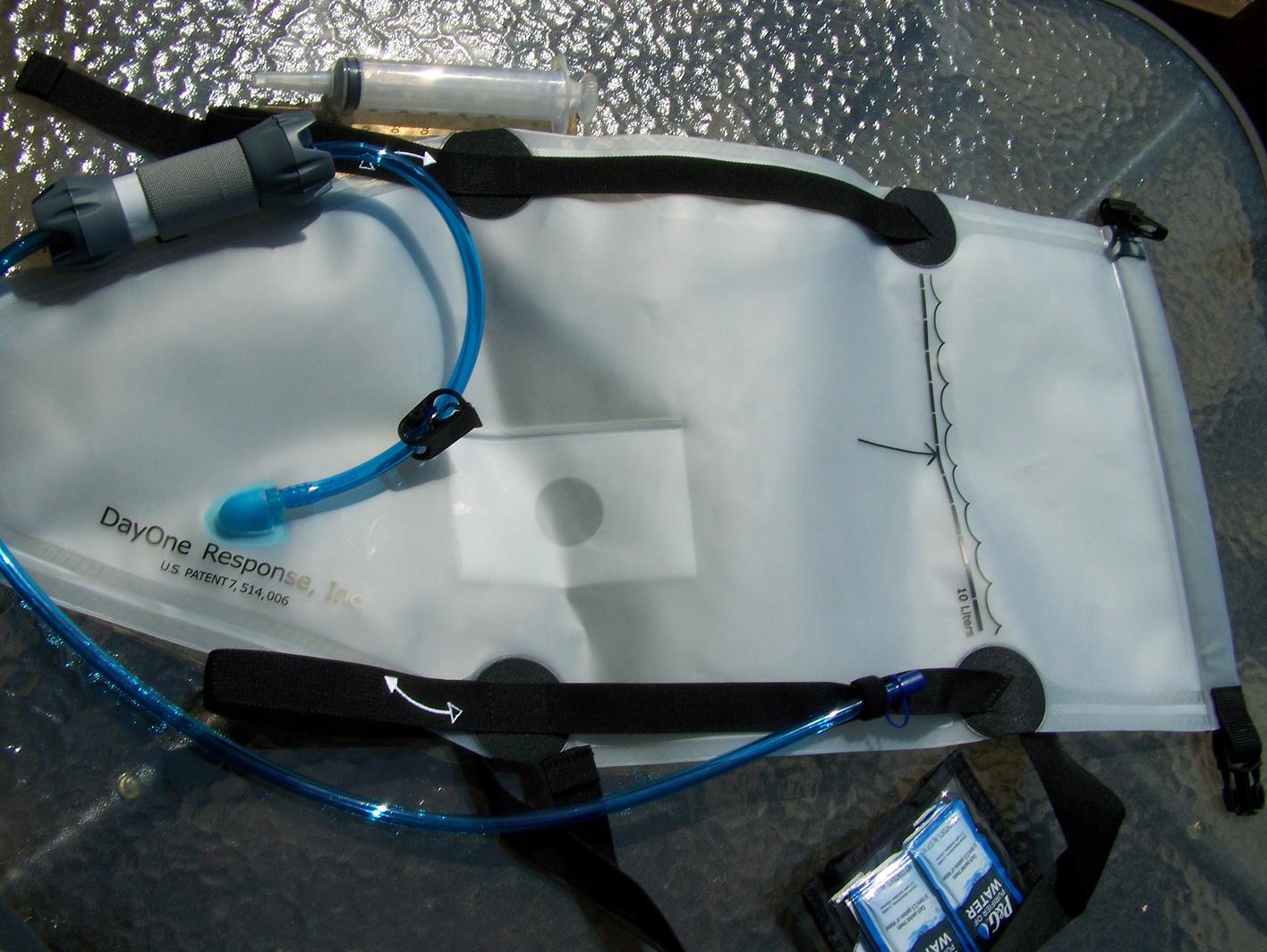
Today we are looking at the Day One Response water bag, that treats water safely, effectively and quickly. The US Marines ranked this water purification treatment #1 in performance and user operation – it’s simply to do. The Day One Response water bag is also easy to transport A quick look at what this system treats for is: sediment, arsenic,bacteria, lead, viruses, humic acid, protozoan cysts and DDT. Another really nice thing is that the directions that come with the water bag, are written as well as a pictograph – for use in countries where folks don’t really know how to read English that well. The Day One Response water treatment bag, has also been used all over the world – with great success. It meets WHO and US EPA emergency drinking water guidelines. 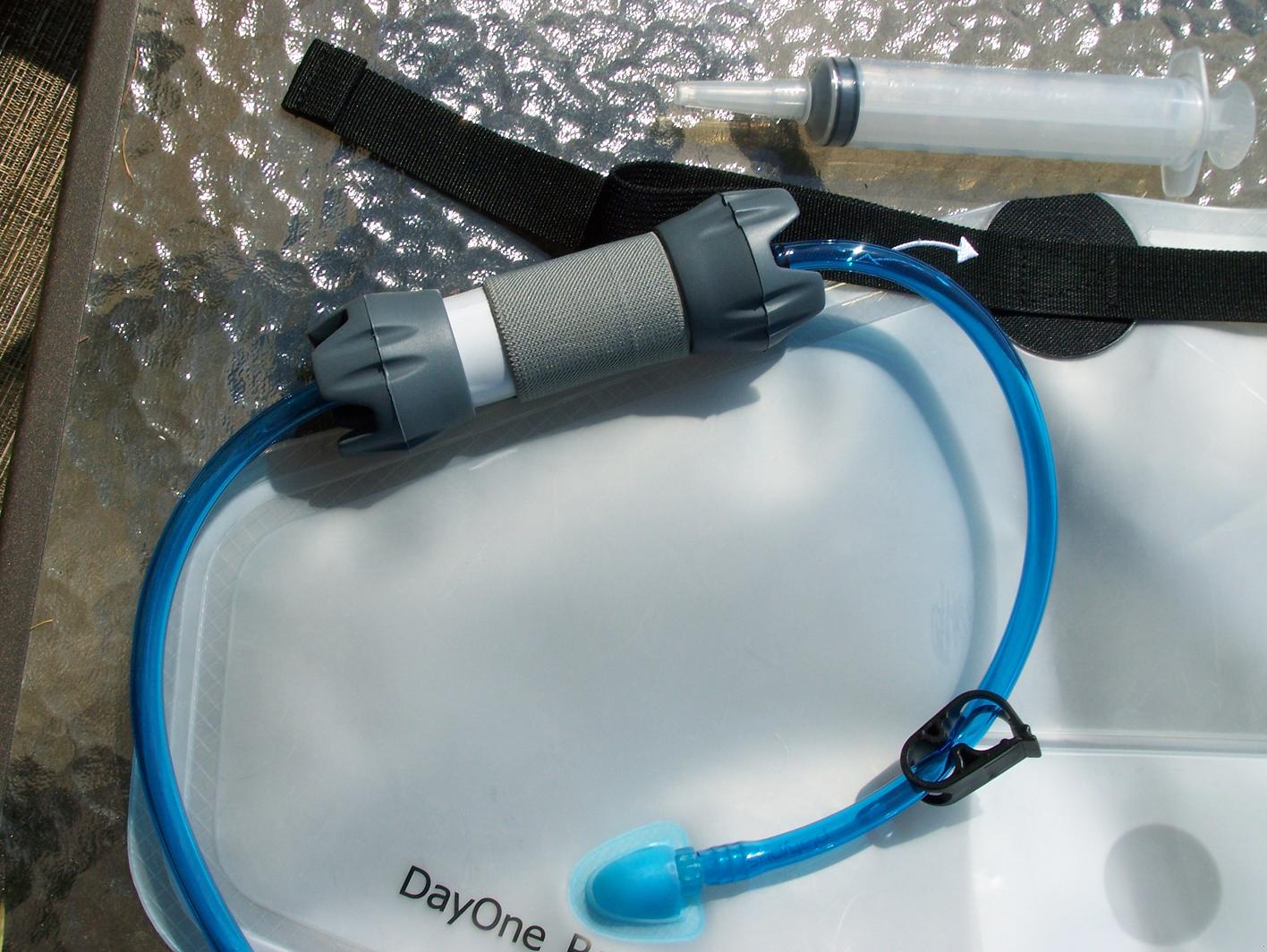
The water bag is a translucent polymer bag that holds 10-liters of water -or 2 1/2 gallons. The water bag comes with enough P&G (Proctor &Gamble) Purifier of Water packets to fill the bag up to 60 times. The P&G packets contain iron sulphate, calcium hypochlorite and other ingredients to purify the water. There is also a very fine filter – down to 2-microns, that removes many of the nasty bugs in the water. The water bag can be used up to 60times, and then needs replacing. The bag has a 10 year shelf life if not used,and the P&G packets have a three year shelf life.
Okay, how simple is the Day One Response water bag to use? It is extremely easy to use. I want to direct you to 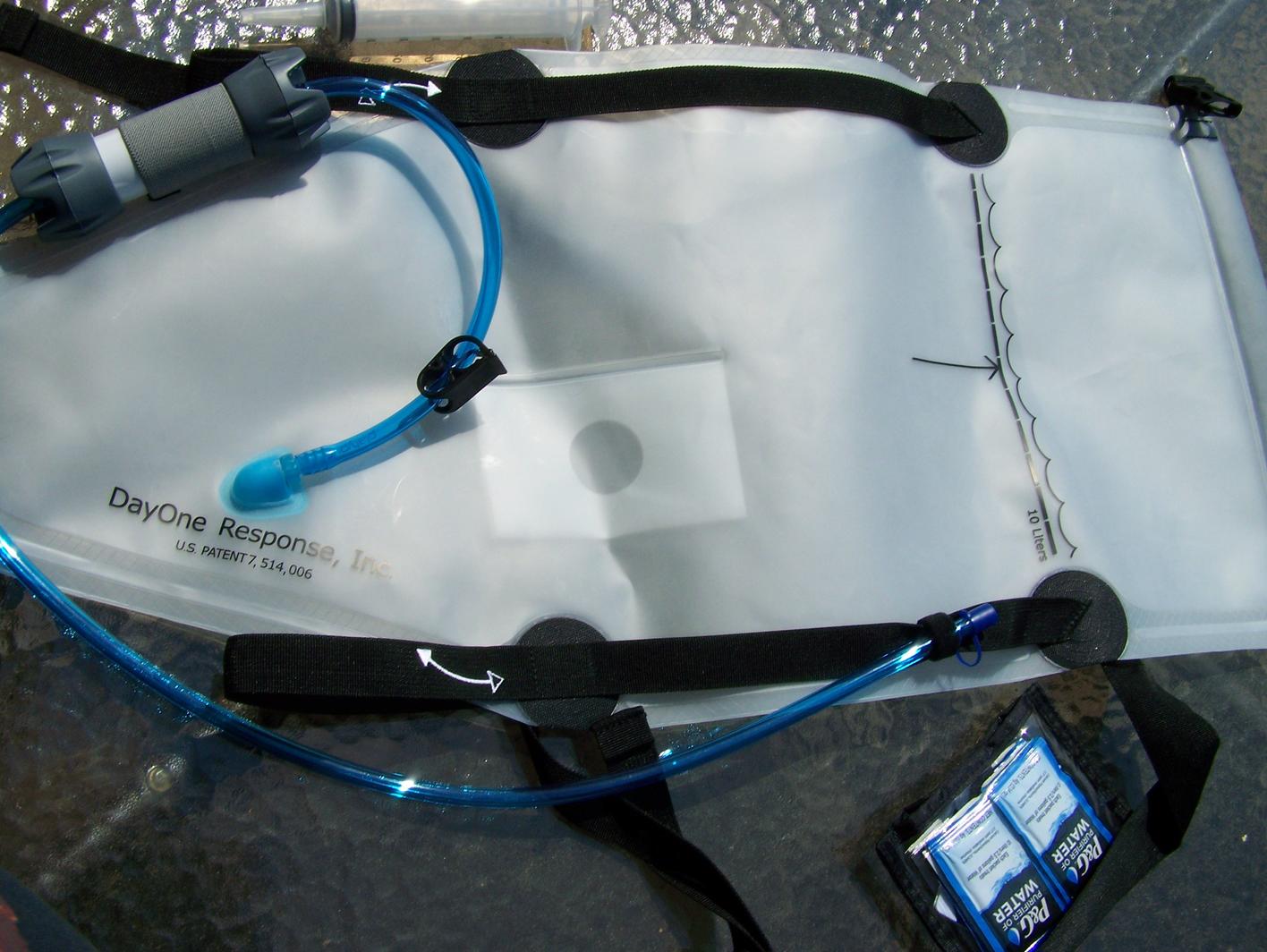
I did like the straps on the Day One Response water bag. They worked well infilling the bag from a stream – I did from our small creek that was still running through our property this summer, and closed the bag per directions,and carried it to my driveway – just 50 yards away – and it sure beats carryinga water container in my hand. I added the packet of the P&G Purifier of Water to the water – although the water was crystal clear, as I stated before,no surface water should be considered safe to drink, without treating it. I closed the top of the water bag, and hung it from a tree branch and wiggled it back and forth for 5 minutes and then let the water sit for another 25 minutes.It was clear and there was a very little sediment in the bottom of the bag.
Any water that you don’t drink within 24-hours should be either discarded,or used for washing clothes–things like that. And the sediment in the bottom of the bag – pour it out and bury it. You don’t want your pets getting into it and drinking it since it is full of all those “nasty” things that were taken out of the water. 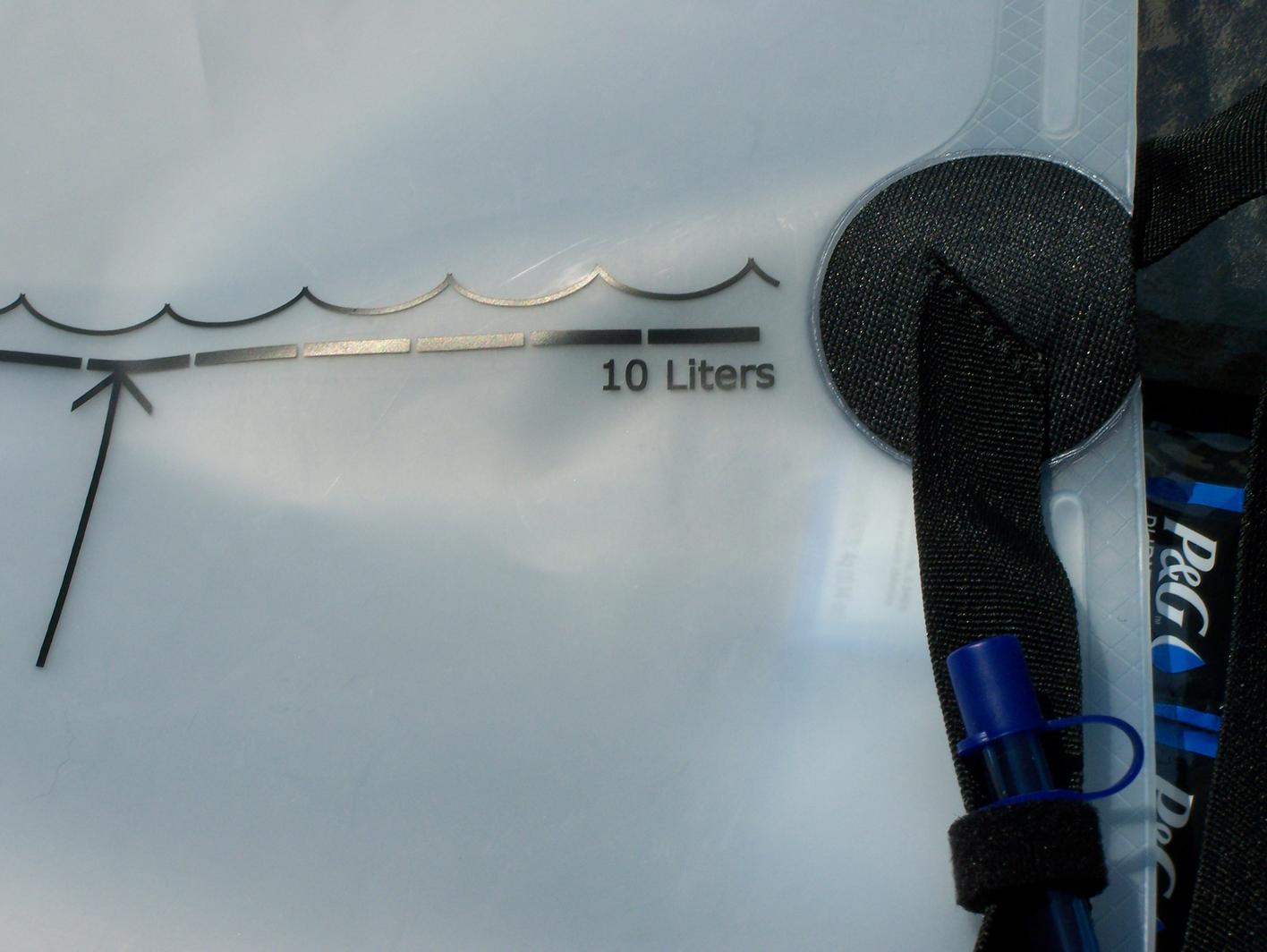
The water outlet attached to the bag is above a certain line, and below that line is water with sediment in it – don’t drink any water below that line. Also, you get a small syringe that you can use for back flushing the filter. This will extend the life of the water bag a little longer. Actual lifespan of the bag depends on how much sediment is in the water your are filtering. (A simple cotton T-shirt pre-filter can be used to help minimize sediment.)
The Day One Response water bag seems almost too simple to use. Collect water in the bag, add the packet of P&G Purifier, close the top of the bag, hang it, and wiggle the bag back and forth for 5-minutes, and let it sit for25-minutes. Then you can drink the water. However, don’t drink the water if it is still yellowish after 25 minutes. (Start all over again.) The system seems pretty fool-proof and easy to use. I do like the straps on the bag for transporting the water. (Water weighs 8.345 pounds per gallon, so 2-1/2 gallons would weigh more than 20 pounds. It is easier to carry on my back, than in my hands for any distance. 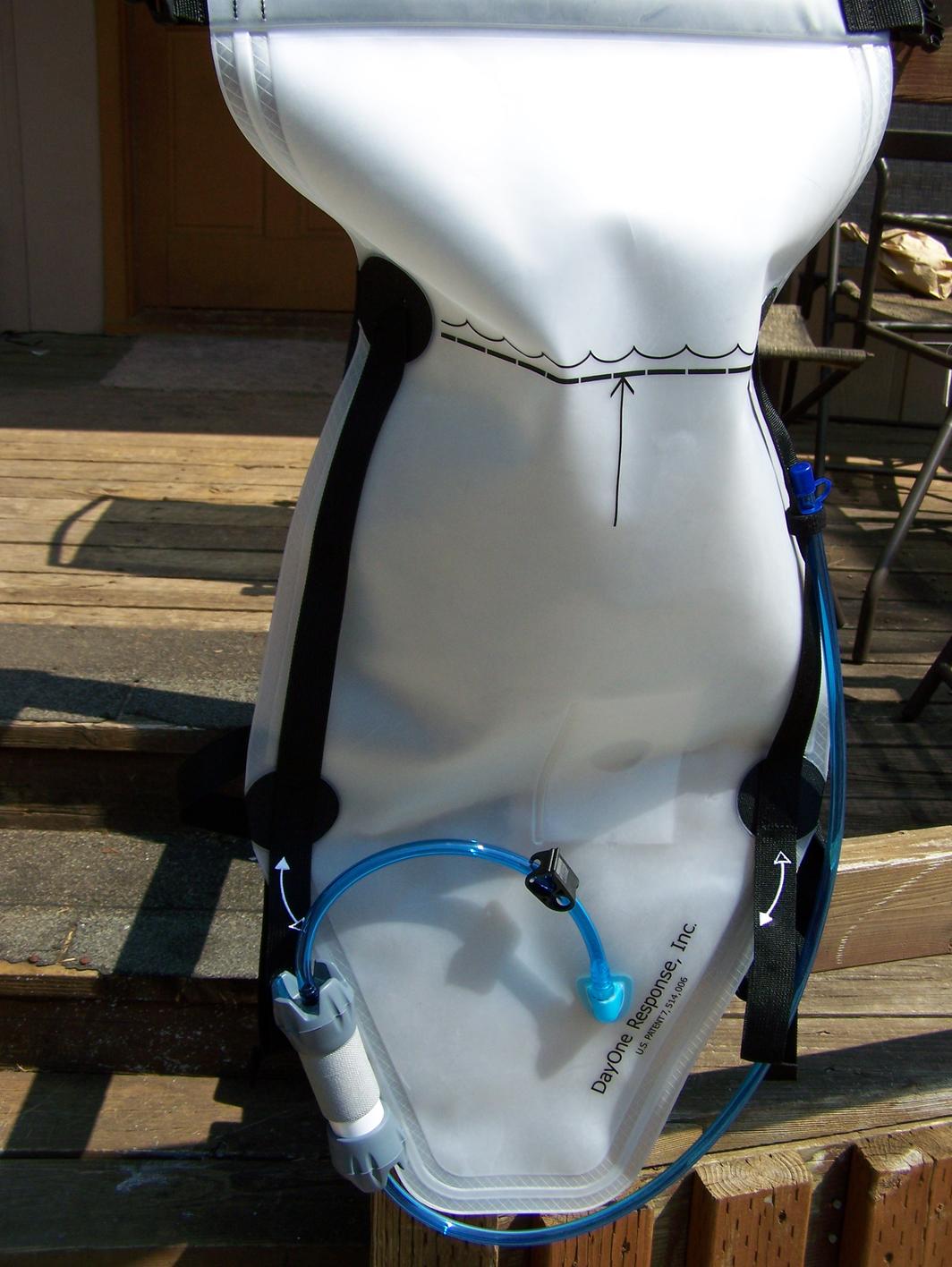
If you’re serious about prepping–and you should be–then you should have more than one method of purifying water in your emergency supplies – just in case one fails you. We have quite a few methods of making water safe to drink in our gear, and the Day One Response water bag, is one more method to help us when we need to make water safe for drinking. Full retail for the water bag and enough packets of P&G to purify about 150-gallons of water is only $79.99.I would recommend, getting a couple of these neat water bags, get one or two for yourself and another to give as a gifts to family. The recipient may not appreciate it now, but when they don’t have safe drinking water, they will surely thank you for the gift! It’s simple, inexpensive and easy to use. What more can you ask for? – Senior Product Review Editor, Pat Cascio
Letter Re: Traditional Hand Tools
Dear Editor:
Here are some observations on non-power tools: Get lots of can openers because they all fail. Older US-made ones from yard sales will last longer. Also stock US-made government issue “P38” openers as backups because they always they always work. Egg beaters and hand drills with an idler gear on the back side are more durable, not just from the support but because they are better quality to begin with. Antique shops are high $ place to shop for hand tools, estate sales are best, next generation often has no clue about grandpa’s “junk”. I found a quality hand drill missing the back cap (where drills were stored) tossed on a workbench with junk, no price, bought for 25 cent offer, pressed a PVC cap on it. Yankee screwdrivers can still be bought new and are worth their weight in gold if you have to build or repair something with that large stock of drywall screws you wisely stocked. Without a power driver you will quickly figure out why grandpa drilled a pilot hole. As with all preps, start using non-power tools so you’re familiar with operation.
I’d also like to share some thoughts on strenuous outdoor work when water is precious: Be sure to stock talcum powder, no-rinse washes, Lubriderm (or generic) hand lotion, and lip balm. Regards, – Susan R.
Letter: Drought in Western Retreat Areas
JWR:
Has the recent drought in the western United States caused you to change any
of your “Recommended Retreat Areas”? – T.I.A.
JWR Responds: No, it hasn’t. There is an old saying: “Climate is what you expect, and weather is what you get.”
I do not believe that the current drought in the northwest is any evidence of any long term climate change. We are simply in an El Niño weather pattern that most likely will last only another year or two. The El Niño weather pattern has temporarily shifted the jet stream, disrupting seasonal rains, particularly in California, where the the drought has been quite severe and protracted.
Recipe of the Week: Butternut Squash Soup, by C.S.
This a recipe for a soup made from cooked and then pureed butternut squash.
Ingredients:
- 4 ½ pounds butternut squash, halved lengthwise, remove seeds
- 1/3 cup butter
- 2 large leeks
- ¾ tsp. dried thyme
- 5 cups chicken stock or broth
- ¼ tsp. salt
- 2 Tbs. brown sugar
- ½ cup sour cream
- 2 ½ Tbs. chives, chopped
- 8 slices bacon, fried crisp-crumbled
Directions:
- Preheat oven to 350 degree F. Place the squash, cut side down on a baking sheet and bake until tender, about 40 minutes. Cool slightly. Using a spoon, scoop out the squash from the skin and set aside.
- Meanwhile, in a large, heavy sauce pan, melt the butter over low heat. Add the leeks and thyme, cook, stirring occasionally until soft and golden.
- Stir in the stock and squash. Simmer over a moderate heat for 20 minutes.
- Carefully transfer the soup into a food processor or blender and blend it into a thin paste. (You will have to do this in batches).
Note: If you are going to freeze this soup (and it does freeze well) then do not add the last three ingredients.
To serve: Pour soup back into pan, add salt and pepper to taste and reheat the soup.
Garnish each bowl of soup with 1 Tbs. sour cream, a sprinkle of chives, and bacon.
o o o
Useful Recipe and Cooking Links:
Do you have a favorite recipe that would be of interest to SurvivalBlog
readers? Please send it via e-mail. Thanks!
Economics and Investing:
Peter Schiff visits CNBC: The Whole World Has Been Fooled By The Fed’s Con
o o o
The Stock Market has become the U.S. Economy
Items from The Economics Team:
1 in 5 Americans Supported by Social Security
Odds ‘n Sods:
Questions raised after shock belt used at Texas murder trial. Incredible! I expect to next see defendants held in courtroom cages (as already seen in many European capital crimes trials.)
o o o
Here is a headline from the Middle East Forum that sounds like something straight out of my upcoming novel: Obama Throws Christian Refugees to the Lions
Regulated out of Existence: Off-Gridders Forced back on the Grid, Camping on own land Illegal