
“Profit is a signal that valuable services are being rendered to people on a voluntary basis.” – Lew Rockwell
- Ad Click Here --> Civil Defense ManualNOW BACK IN STOCK How to protect, you, your family, friends and neighborhood in coming times of civil unrest… and much more!
- Ad STRATEGIC RELOCATION REALTYFOR SALE: Self-sustaining Rural Property situated meticulously in serene locales distant from densely populated sanctuary cities. Remember…HISTORY Favors the PREPARED!
Notes for Thursday – November 05, 2015
I’ve heard from several folks who have mentioned that they’ve accidentally nicked themselves when handling their Cold Steel Rawles Voyager XL knives. So I must repeat this caution statement: These knives come from the factory extremely sharp. If you are accustomed to handling standard kitchen or pocket knives, then you might not expect a knife to be quite so razor sharp! Handle them with great care.
Also note that since this is a limited edition knife, they will likely sell out by the end of 2015. Once they are gone, they are gone, so order yours before the holiday ordering rush. – JWR
o o o
Today, we present another entry for Round 61 of the SurvivalBlog non-fiction writing contest. The nearly $12,000 worth of prizes for this round include:
First Prize:
- A Tactical Self-Contained 2-Series Solar Power Generator system from Always Empowered. This compact starter power system is packaged in a wheeled O.D. green EMP-shielded Pelican hard case (a $1,700 value),
- A Gunsite Academy Three Day Course Certificate that is good for any one, two, or three day course (a $1,195 value),
- A course certificate from onPoint Tactical for the prize winner’s choice of three-day civilian courses, excluding those restricted for military or government teams. Three day onPoint courses normally cost $795,
- DRD Tactical is providing a 5.56 NATO QD Billet upper with a hammer forged, chromlined barrel and a hard case to go with your own AR lower. It will allow any standard AR type rifle to have quick change barrel, which can be assembled in less than one minute without the use of any tools and a compact carry capability in a hard case or 3-day pack (an $1,100 value),
- Gun Mag Warehouse is providing 20 Magpul pmags 30-rd Magazines (a value of $300) and a Gun Mag Warehouse T-Shirt; (an equivalent prize will be awarded for residents in states with magazine restrictions),
- Two cases of Mountain House freeze dried assorted entrees in #10 cans, courtesy of Ready Made Resources (a $350 value),
- The Ark Institute is donating a non-GMO, non-hybrid vegetable seed package (enough for two families of four) plus seed storage materials, a CD-ROM of Geri Guidetti’s book “Build Your Ark! How to Prepare for Self Reliance in Uncertain Times”, and two bottles of Potassium Iodate (a $325 retail value),
- A $250 gift certificate from Sunflower Ammo,
- KellyKettleUSA.com is donating both an AquaBrick water filtration kit and a Stainless Medium Scout Kelly Kettle Complete Kit with a combined retail value of $304, and
- Two cases of meals, Ready to Eat (MREs), courtesy of CampingSurvival.com (a $180 value).
Second Prize:
- A Glock form factor SIRT laser training pistol and a SIRT AR-15/M4 Laser Training Bolt, courtesy of Next Level Training, which have a combined retail value of $589,
- A FloJak EarthStraw “Code Red” 100-foot well pump system (a $500 value), courtesy of FloJak.com,
- A transferable certificate for a two-day Ultimate Bug Out Course from Florida Firearms Training (a $400 value),
- A Model 120 Series Solar Generator provided by Quantum Harvest LLC (a $340 value),
- A $300 gift certificate from Freeze Dry Guy,
- A Trekker IV™ Four-Person Emergency Kit from Emergency Essentials (a $250 value),
- Twenty-five books, of the winners choice, of any books published by PrepperPress.com (a $270 value),
- A pre-selected assortment of military surplus gear from CJL Enterprize (a $300 value),
- RepackBox is providing a $300 gift certificate to their site, and
- Safecastle is providing a package of 10 LifeStraws (a $200 value)
Third Prize:
- A Royal Berkey water filter, courtesy of Directive 21 (a $275 value),
- A $245 gift certificate from custom knifemaker Jon Kelly Designs, of Eureka, Montana,
- A large handmade clothes drying rack, a washboard, and a Homesteading for Beginners DVD, all courtesy of The Homestead Store, with a combined value of $206,
- Expanded sets of both washable feminine pads and liners, donated by Naturally Cozy (a $185 retail value),
- Two Super Survival Pack seed collections, a $150 value, courtesy of Seed for Security, LLC,
- Mayflower Trading is donating a $200 gift certificate for homesteading appliances,
- APEX Gun Parts is donating a $250 purchase credit,
- Montie Gear is donating a Precision Rest (a $249 value), and
- Two 1,000-foot spools of full mil-spec U.S.-made 750 paracord (in-stock colors only) from www.TOUGHGRID.com (a $240 value).
Round 61 ends on November 30th, so get busy writing and e-mail us your entry. Remember that there is a 1,500-word minimum, and that articles on practical “how to” skills for survival have an advantage in the judging.
- Ad USA Berkey Water Filters - Start Drinking Purified Water Today!#1 Trusted Gravity Water Purification System! Start Drinking Purified Water now with a Berkey water filtration system. Find systems, replacement filters, parts and more here.
- Ad Survival RealtyFind your secure and sustainable home. The leading marketplace for rural, remote, and off-grid properties worldwide. Affordable ads. No commissions are charged!
Feeding The Vulnerable At TEOTWAWKI: Infant Nutrition- Part 1, by P.G.
In the event of an EMP or other worst-case scenario, it is feared that as many as 90 percent of the population will not survive. The elderly and the ill, who are dependent on soon-to-be nonexistent medicines, will be the first to succumb. Another extremely vulnerable group consists of infants in the first year of life. They are toothless, wholly dependent on adult providers, and limited to breastmilk or infant formula for the first few months of life. Babies do not have the immunologic capacity to defend themselves against the myriad of microbes that will arise in an environment that is devoid of clean water, modern sanitation, antibiotics, and vaccines.
The objectives of this essay are to describe the nutritional problems that parents with very young infants will encounter at TEOTWAWKI and how they can take steps now that will minimize those risks. Thoughtful preparation will make survival more likely at TEOTWAWKI for our most defenseless loved ones.
The Post-TEOTWAWKI Picture
Survivalblog readers are well aware that nearly everything that we take for granted in our infrastructure, especially supplies of food and water, will vanish or be greatly compromised in the kind of collapse that has been described in James Rawles’ Patriots series and in William Fortschen’s One Second After. There will be no infant formula or any kind of milk, including vegetable milks. Foods that are specifically designed for infants’ nutritional needs will disappear from supermarket shelves within days, if not sooner.
Assessing Infants’ Nutritional Requirements
For the sake of discussion we will use the term “infant” to represent all children below the age of 12 months. By that time most children can sit upright, control the swallowing mechanism, and manage to put food into their mouths, however messily. Tooth eruption is incomplete at one year, and foods that require little or no chewing may be necessary for some time into the second year.
We all require foods that yield energy, usually in the form of carbohydrates, and building materials that consist mainly of protein. Certain types of fat as well as micronutrients, such as vitamins and minerals are indispensable. All will be in short supply and of varying quality during a collapse. Adults can manage in marginal conditions, but infants cannot. That’s because, starting at birth, a baby’s body changes daily, tripling in size within the first year. Less evident is the enormous complexity of the process so that the absence of a key ingredient makes normal development impossible.
Childhood rickets is a good illustration of how a deficiency of a single nutrient can change the trajectory of a life and sometimes shorten it dramatically. In early history, humans lived at latitudes where greater daily exposure of their bodies to sunlight produced adequate levels of vitamin D. When we migrated toward higher latitudes, where the proper wavelength of light is absent for half the year, childhood rickets became common because vitamin D is necessary to absorb calcium and for the proper formation of bone. Without vitamin D, rapidly growing skeletons become severely deformed and low levels of calcium may lead to convulsions and death. In addition to its critical importance in calcium metabolism, vitamin D is needed for normal immune function and affected children sometimes die from pneumonia or other infections. A female who survives childhood rickets may reach maturity with a deformed pelvis that makes it impossible to deliver a baby naturally. The consequences in a primitive or post-collapse situation are disastrous.
Since the government mandated fortification of dairy products with vitamin D, the incidence of rickets has fallen dramatically. Such foods will not be available at TEOTWAWKI. Even if milk is available in rural communities, it will not have been fortified with vitamin D, as commercial dairy products are currently. Populations at higher latitudes, where the proper wavelength of the sun’s radiation does not reach the earth’s surface for much of the year (including the upper half of the United States), will be most affected. Few foods contain natural vitamin D. Cod liver oil is one, but it will be unavailable at TEOTWAWKI. Eggs and fish contain natural vitamin D, but the former will be in high demand, and the latter may be depleted in a relatively short time.
The Role of Breastfeeding
In our two-part essay on breastfeeding (SurvivalBlog: Feeding Infants at TEOTWAWKI: The Critical Advantages of Breastfeeding), which was posted on May 16, 2014, we discussed not only the overall advantages of mother’s milk but how it could be critical to an infant’s survival. Modern infant formula is a marginal substitute for breastmilk. It will not be available at TEOTWAWKI.
The human breast is the best source of nutrition for the human infant. Anything else is a distant second. The most sophisticated recipes for infant formula do not contain the live maternal cells, beneficial bacteria, immune factors, and many other nutrients that are unique to the mother/infant dyad.
It is not unusual for a woman who has recently weaned a child from the breast to resume breastfeeding. In the extreme situation it can be done by women who are now grandmothers, but it is difficult and requires time.
Modern mothers are at a serious disadvantage, if they do not have experienced women available who can teach them the basics of breastfeeding, to offer advice and support and to help them solve problems such as breast congestion, inflammation (mastitis), sore and cracked nipples, or apparent low milk volume. None of these is a reason to stop breastfeeding, but they make it easy to do so when an unlimited supply of infant formula is no further away than the local supermarket.
It’s possible to freeze a supply of breastmilk, and all breastfeeding mothers should be encouraged to do so, even in the best of times in case of an emergency, such as a maternal illness. It cannot be stored indefinitely, and freezing is not an option when the grid goes down. Some mothers are quite good at expressing milk by hand, but for most a breast pump is indispensable. A manual pump isn’t difficult to use, but it does take some practice. It will be the only device available when there is no electricity.
Beyond Breastmilk
It’s possible to sustain a child’s life with the milk of other mammals, but that’s a poor second choice. Lactating cows, goats, sheep, and horses may be present in rural areas at TEOTWAWKI, but the vast majority of Americans will not have access to them. Even in ordinary circumstances, unprocessed milk from cows or other animals should not be given to infants below the age of one year. It is less digestible for very young children, and in a TEOTWAWKI situation without pasteurization it may be dangerous. In spite of dairy farmers’ best precautions, it is not possible to avoid bacterial contamination of milk. This is a greater risk for infants than for older children. Specifically, infants are much more likely to develop disease from Salmonella or other harmful bacteria in milk than older children or adults.
The spectrum of diseases transmitted by unpasteurized milk and other dairy products is wide, as is well-documented in developing countries. The longer a TEOTWAWKI situation lasts the more likely that herds will become infected with disease-causing bacteria. Antibiotics will be scarce soon after the collapse begins, and they will not be available at all in a prolonged scenario. Before commercial infant formula came into wide use, the alternative to breastmilk was a homemade version using evaporated milk and Karo® syrup. These products have other culinary uses and it makes sense to have a store of both in anticipation of a growing family. They do, however, have expiration dates and should be rotated like other stored foods. A Google search for evaporated milk formula will yield several recipes. Note: Honey is not a substitute for sugar or Karo® syrup. Never give honey in any form to a child less than 12 months old because of the risk of infant botulism, which can be fatal.
Powdered and concentrated liquid formulas require safe water for reconstitution. The lack of contaminant-free water is the single most important reason for the devastating diarrhea that is the leading cause of death of infants in developing countries. We will have similar problems here in the U.S. at TEOTWAWKI.
Several articles in SurvivalBlog have described the advantages of raising goats, but their milk is not appropriate for infant feeding unless it has been considerably modified as infant formula. Its protein is more digestible than that of cow’s milk, but it has a low content of folate and vitamin B12 as well as iron and vitamin D. Goats are susceptible to a disease called brucellosis and infants are especially vulnerable. (Although the agent of brucellosis is no longer present in domestic cattle, sheep, and goats in the United States, there will always be a reservoir among wild animals.)
There is no safe, nutritious substitute for breastmilk or infant formula for children below the age of about six months. Meat broth can provide protein, minerals, and some vitamins. It is totally inadequate as a sole source of nutrients for infants, and homemade brews would vary greatly. An infusion made from grain is another possibility, but some grains, such as corn, are lacking in certain amino acids– the building blocks of protein. Most, if not all, cereal grains contain antinutrients, which are chemicals that bind to iron and calcium and keep them from being absorbed. Without supplementation from other plant products or animal foods, the result could be disastrous. A broth made from beans or other legumes might work for a short time, but it would not be adequate as the only source of protein and carbohydrate. I mention these only to make readers aware of their shortcomings.
Babies who are only a few days or weeks old can suck, but they can’t sip. Their needs include bottles and nipples, and preppers should include them in their stores. Rubber nipples have a very long shelf life in their original packaging, but they will eventually deteriorate in heat and should be stored carefully.
What about the infant that is too small or too sick to suckle either from the breast or bottle? Nurses who care for these vulnerable children feed them very slowly with an ordinary hypodermic syringe. Prudent prepping should include a supply of these in the unfortunate event of a premature delivery or the presence of a cleft lip or palate. Glass syringes are more practical in a TEOTWAWKI situation, even though they cost considerably more than plastic syringes. The latter cannot be reused indefinitely.
- Ad Civil Defense ManualClick Here --> The Civil Defense Manual... The A to Z of survival. Looks what's in it... https://civildefensemanual.com/whats-in-the-civil-defense-manual/
- Ad USA Berkey Water Filters - Start Drinking Purified Water Today!#1 Trusted Gravity Water Purification System! Start Drinking Purified Water now with a Berkey water filtration system. Find systems, replacement filters, parts and more here.
Letter Re: Digital Communications Capabilities for Prepared Families, by Prairie Dweller
I would like to add a small bit of information to the fine work Prairie Dweller provided about digital modes in Amateur Radio.
One of the things that has kept me from exploring digital modes has been the requirement for a laptop or desktop system, generally running Windows. Firstly, I don’t do Windows. Secondly, two is one, one is none. How will you repair your laptop after TSHTF? How many laptops can you inventory? Do you have large enough Faraday cages?
Given the above, I would like to suggest creating your digital mode hardware setup, using a Raspberry Pi B+ (aka Pi 2). This quad core system is more than capable of running the FLDIGI software, where the original Pi struggled. Add a USB sound card, a 5V power supply, a connector cable for your specific Ham radio, and a few other minor parts… and you should be good to go. Googling search terms “raspberry pi 2 fldigi” will get you going. 73s and Happy DXing – RDG
HJL adds: You might also look at Raspberry Pi’s 7” touch screen and case, which gives a really nice complete solution. I’ve been playing around with this setup, and it has some very interesting possibilities for the experimenter.
- Ad LifeSaver 20K JerryCan Water PurifierThe best water jerrycan you can buy on the market! Mention Survivalblog for a Free Filter ($130 Value)
- Ad Ready Made Resources, Trijicon Hunter Mk2$2000 off MSRP, Brand New in the case
Economics and Investing:
SurvivalBlog reader D.S. sent in this link about crossing the borders with precious metals. It’s not just cash anymore that arouses suspicion. Crossing Borders with Gold and Silver Coins – a Glimpse of Things to Come
o o o
The disinformation campaign in full swing about the U.S. economy. The economy is on an unsustainable debt path. The Most Devious Liars In The Room. Sent in by J.Q.
o o o
Items from Professor Preponomics:
National Security Lines Blurred via Business Relationships Between China and U.S. Tech Giants: IBM, Cisco Systems and Microsoft (New York Times)
Glencore Watch: The Search for $1B… (Motley Fool) …but what if Silver Wheaton doesn’t “do the deal”?
HUD Backs $9.5M on Property Valued at $3.8M (Colorado Watchdog)
Anadarko Says Aggressive Growth Strategies Not Likely Rewarded: Focuses Instead on Building and Preserving Value (Business Insider)
Energy Sector May Rain on the S&P’s Earnings Parade: Sector Expected to Post Earnings Decline of 65% YOY (Market Watch)
As Night Follows Day: Bust Inevitably Follows Booms and It’s The Test Most Will Fail (Zero Hedge)
- Ad California Legal Rifles & Pistols!WBT makes all popular rifles compliant for your restrictive state. Choose from a wide range of top brands made compliant for your state.
- Ad Trekker Water Station 1Gal Per MinuteCall us if you have Questions 800-627-3809
Odds ‘n Sods:
We have come full circle: GLOBAL COOLING: Decade long ice age predicted as sun ‘hibernates’ Those who were around in the 70s will understand. Sent in by KFF.
o o o
From GJM: Good, solid, short article about rail; it’s not Erwin Rommel, but there’s nothing stupid in all of it.
The author’s point about graffiti highlights something about which I should have reflected but haven’t: wherever one observes it, a probably-young person of no particularly high fitness level or seriousness of intent, utilizing quantities of energy associated with mere whim, has successfully traversed: thus, hard men with seriousness of intent can, too. And if there’s any value in that terrain, they’re already there first. Trolls Live Under Bridges
o o o
From Krayton Kerns, DVM – The Death of the American Spirit. Sent in by Avalanche Lily
o o o
SurvivalBlog reader T.H. sent in this video showing a one horse woodsplitter. Really! It’s only one horse, though to be fair, it is a rather large horse. The splitter is very effective.
o o o
This is disturbing on so many levels: Verizon Begins CENSORING Customer E-mails. Yes, they may only be trying to help, but that is an incredibly slippery slope, and the decision shows an incredible lack of understanding of how modern business is transacted. – Sent in by G.P.
- Ad Don't wait - get the ultimate US-made ultra-high performance US-made SIEGE Stoves and stunning hand-crafted SIEGE belts for Christmas. For stocking-stuffers see our amazing fire-starters. Gifts that can save lives. Big Sale!Every bespoke SIEGE buckle goes through an hours-long artisanal process resulting in a belt unlike anything else, with blazing fast performance and looks and comfort to match.
- Add Your Link Here
Hugh’s Quote of the Day:
“There’s no way to rule innocent men. The only power any government has is the power to crack down on criminals. Well, when there aren’t enough criminals, one makes them. One declares so many things to be a crime that it becomes impossible to live without breaking laws.” – Ann Rand
Notes for Wednesday – November 04, 2015
November 4th is the birthday of Medal of Honor recipient John Basilone. He was born in 1916 in Buffalo, New York.
o o o
SurvivalBlog is introducing a new advertiser to our readership today and would like to welcome Heirloom Organics, a company specializing in Non-Hybrid and Non-GMO seeds. You can find their ad in the ad stack to the right on desktop computers (or at the bottom on mobile devices).
o o o
SurvivalBlog would also like to remind our readers that while we work hard at keeping advertisers that offer high quality products and treat our readers right, we do not recommend any one advertiser over the next. We like them all, or they wouldn’t be advertisers. If you are looking for preps, check them out.
o o o
Today, we present another entry for Round 61 of the SurvivalBlog non-fiction writing contest. The nearly $12,000 worth of prizes for this round include:
First Prize:
- A Tactical Self-Contained 2-Series Solar Power Generator system from Always Empowered. This compact starter power system is packaged in a wheeled O.D. green EMP-shielded Pelican hard case (a $1,700 value),
- A Gunsite Academy Three Day Course Certificate that is good for any one, two, or three day course (a $1,195 value),
- A course certificate from onPoint Tactical for the prize winner’s choice of three-day civilian courses, excluding those restricted for military or government teams. Three day onPoint courses normally cost $795,
- DRD Tactical is providing a 5.56 NATO QD Billet upper with a hammer forged, chromlined barrel and a hard case to go with your own AR lower. It will allow any standard AR type rifle to have quick change barrel, which can be assembled in less than one minute without the use of any tools and a compact carry capability in a hard case or 3-day pack (an $1,100 value),
- Gun Mag Warehouse is providing 20 Magpul pmags 30-rd Magazines (a value of $300) and a Gun Mag Warehouse T-Shirt; (an equivalent prize will be awarded for residents in states with magazine restrictions),
- Two cases of Mountain House freeze dried assorted entrees in #10 cans, courtesy of Ready Made Resources (a $350 value),
- The Ark Institute is donating a non-GMO, non-hybrid vegetable seed package (enough for two families of four) plus seed storage materials, a CD-ROM of Geri Guidetti’s book “Build Your Ark! How to Prepare for Self Reliance in Uncertain Times”, and two bottles of Potassium Iodate (a $325 retail value),
- A $250 gift certificate from Sunflower Ammo,
- KellyKettleUSA.com is donating both an AquaBrick water filtration kit and a Stainless Medium Scout Kelly Kettle Complete Kit with a combined retail value of $304, and
- Two cases of meals, Ready to Eat (MREs), courtesy of CampingSurvival.com (a $180 value).
Second Prize:
- A Glock form factor SIRT laser training pistol and a SIRT AR-15/M4 Laser Training Bolt, courtesy of Next Level Training, which have a combined retail value of $589,
- A FloJak EarthStraw “Code Red” 100-foot well pump system (a $500 value), courtesy of FloJak.com,
- A transferable certificate for a two-day Ultimate Bug Out Course from Florida Firearms Training (a $400 value),
- A Model 120 Series Solar Generator provided by Quantum Harvest LLC (a $340 value),
- A $300 gift certificate from Freeze Dry Guy,
- A Trekker IV™ Four-Person Emergency Kit from Emergency Essentials (a $250 value),
- Twenty-five books, of the winners choice, of any books published by PrepperPress.com (a $270 value),
- A pre-selected assortment of military surplus gear from CJL Enterprize (a $300 value),
- RepackBox is providing a $300 gift certificate to their site, and
- Safecastle is providing a package of 10 LifeStraws (a $200 value)
Third Prize:
- A Royal Berkey water filter, courtesy of Directive 21 (a $275 value),
- A $245 gift certificate from custom knifemaker Jon Kelly Designs, of Eureka, Montana,
- A large handmade clothes drying rack, a washboard, and a Homesteading for Beginners DVD, all courtesy of The Homestead Store, with a combined value of $206,
- Expanded sets of both washable feminine pads and liners, donated by Naturally Cozy (a $185 retail value),
- Two Super Survival Pack seed collections, a $150 value, courtesy of Seed for Security, LLC,
- Mayflower Trading is donating a $200 gift certificate for homesteading appliances,
- APEX Gun Parts is donating a $250 purchase credit,
- Montie Gear is donating a Precision Rest (a $249 value), and
- Two 1,000-foot spools of full mil-spec U.S.-made 750 paracord (in-stock colors only) from www.TOUGHGRID.com (a $240 value).
Round 61 ends on November 30th, so get busy writing and e-mail us your entry. Remember that there is a 1,500-word minimum, and that articles on practical “how to” skills for survival have an advantage in the judging.
Six Prepping Principles Derived from One Year as an Expat- Part 2, by G.L.
Fourth Principle: Prepare for Where You Are
I can think of no greater irony than for someone who is a “prepper” moving somewhere and not doing some of the basic analysis required to adjust the preps for where you are. Still, I have talked to several like-minded expats who basically suspended their preps while on assignment. In researching the assignment country, we noted that there are particular risks for which we have never specifically prepped in our part of the U.S. These are risks for which our preps would contribute to the preparedness required for those events.
This can be complicated because the local flora and fauna may vary or climate and growing seasons may be different. Legal restrictions may limit your ability to do things the way you did at home. While this last issue is perhaps less relevant to those bugging out to a retreat, even that may offer some challenges depending on the degree of law enforcement capabilities in jurisdictions you may have to cross to get to your bug out location. In the end, having redundancy for water, bug out bags, first aid supplies, et cetera were all important issues in the assignment country but not sufficient. Some things we did:
- Even though I work in a large metropolitan area, we chose a home in a more rural area on the outskirts where we had a river in our back yard.
- The leased home had a pool that could be accessed for gray water, and it also had a backup diesel generator. [Alas, we just had the misfortune of having our landlord return to this country from the U.S. He wants his house back, and we have to move. We are staying in the area, but we will be investing in a generator and in some water storage to make sure we are secure in the new home.]
- We brought about five cases of freeze-dried food in #10 cans in suitcases under the guise, although true, that we would use it for backpacking. This was accomplished through various trips, bringing a little at a time. [International moves generally prohibit food and liquids.]
- We immediately bought a chest freezer, filled with a locally-sourced side of beef and lamb. We stocked our pantry with rice, beans, and other goods that would allow us to make it for three to four months minimum without resupply. We also began canning soups, stocks, and seasonal fruits and vegetables.
- Due to legal limitations/complications, we did not acquire firearms here; however, we did bring archery gear and obtain a powerful air rifle for varmint deterrence or hunting small game. [If we placed a higher probability on scenario three, we would probably go ahead with a purchase or two. The cost and the loss we would incur on them along with the legal hoops to jump through seem too onerous, given our expectations.]
- We have two off-road capable vehicles and one that is a simple diesel, which would serve as a bug out vehicle in an extreme scenario 3. The natural barriers between us and the U.S. are such that driving home is not an option. However, if we need to get out of dodge, we have the capability.
Fifth Principle: Quality First
For the fifth principle, I am indicating a need to keep the highest quality gear at hand. Where we have multiples of particular preps, a decision had to be made about what level of quality we would take with us. One of the temptations was to leave some of the best gear in the U.S. so it would be available for us at the homestead property. In the end, my decision was to take the highest quality stuff with us for the following reasons:
- Leaving it in the U.S. meant leaving it in storage or with friends, where different issues can come up like maintenance, misuse, theft, other damage.
- Not having it in the assignment country meant two to three years of aging with no benefit to us.
- The assignment country has risks for which we need to be prepared; not having it in the assignment country meant it was not available in case of emergency there.
- I want the highest quality stuff that I can carry with me at all times, like a large get home bag.
- We need to use our gear constantly and become familiar with it. One example is the Berkey water filter. It is not complicated, but familiarity will pay off, based on my experience.
This seems obvious when written down, but I assure you, dear reader, that it was not at all that easy when sorting through what would stay and what would go. One big reason for that was—and I think this is an instinct of many of us—we want to keep the best gear unused, perhaps, or only for “special” or emergency occasions. This is a grave error. You need to use your gear. If you have a retreat location of your own or are part of a group that will bug out to a retreat, it is important to think through what should stay and what should be pre-positioned. I approached it by thinking through the probability that an item would be used, depending on its location. The closer gear is to me, the more likely it is to be used.
Another reason this was difficult was that some of our early preps were not the same quality as what we now are acquiring. We made a lot of the beginner mistakes of just buying gear without knowing how to use it. Some of that turned out not to be what we wanted or needed, and some of that was not the right quality. When the things we didn’t want or need had been replaced or we had acquired a higher quality item, we didn’t just toss them. When the move came up, we decided to keep those items near our homestead property. It might not be exactly what we would buy today, but it is useful gear and would perhaps help us if we were suddenly sent back, or it could be useful to someone else or for barter.
Even though we expect to need our preps in the U.S. as our baseline scenario, we felt that the most important thing was to use our good stuff and become accustomed to it while also having it with us and usable in case the worst happened (scenario three). In the case of some of the gear, it would perhaps be a key part of what we would carry in an evacuation or what we would need locally, if we couldn’t leave. I imagined having to tell my son to try to perform some task using an inferior knife or something just because I had left the good stuff where we knew we wouldn’t have it handy unless we were able to travel back to where it was cached.
Sixth Principle: We Prep To Live; We Don’t Live To Prep
One of the most striking things about being an expatriate is that you have an opportunity to see a completely new part of the world. It would be easy to have a bunker mentality out of fear of the unknown while in a different country with a different language. I fear that many preppers do have such a mentality, even though they are at home. This assignment has taught me to look for the good in the situation and to value the time we do have, while travel is relatively worry free and our children can be exposed to cultural, natural, and other phenomena that they may never see again, whatever the reason. Additionally, our mental preparation is enhanced by creating memories of good and beautiful things and building strong relationships.
Away from some longstanding friendships, we turn to each other and spend more time as a family. My wife and daughter are taking classes, like sewing, knitting, and crocheting. Our sons are involved in Cub and Boy Scouts, and I am an assistant Scout Master.
Some things we are doing as a family:
- Enjoying the natural bounty here by hiking and camping, using our gear!
- Traveling to different parts of the region
- Studying music
- Continuing our rigorous homeschooling regimen
- Staying involved with our church and serving others
None of these things necessarily detract from our prepping, and some even contribute, but I am not always going to say to my kids that we can’t join a sports club or take a music class just because we need another can of mac-n-cheese. Balance is important. It is important that our children maintain some cautious optimism about the future of the world and about their chance to contribute to it. We are preparing with a sense of urgency but not out of fear. My preparations instill a sense of calm, peace, and confidence. Keeping that balance for my children is extremely important.
Mistakes
I think the above principles would be incomplete without talking about a few things we would do differently.
I mentioned our beginner mistakes above, so I will just elaborate on things I would do differently over the last year:
- We brought some fishing gear and all of our archery gear. As it turns out, we haven’t really been able to use it. It will probably serve us well at the homestead and would be nice to have there for our occasional visits. I would probably split those in two and leave half in the U.S.
- We thought we had a year supply of soap, but it only lasted a little more than half that. This discovery was another good thing about our experience and about using our preps.
- We should camp and hike more.
- A lot of good intentions have not been realized. Off the top of my head: getting general class Ham radio license, wilderness first aid class, setting up a small garden, and more. The demands of life sometimes get in the way.
- I brought our bug out bags as they were. When I got them out here, I realized that they suffered from some of the beginning mistakes. A lot of the stuff in there is not that useful or is too heavy. I would have redone those before we left.
- Organization of preps in the U.S. is not up to standards. We took a storage unit near our homestead (relatively speaking), and we were in such a hurry with the move that we did not organize it well.
- I was near panic when we dismantled our preps in the U.S. to take them to storage. In retrospect, it was helpful to be less dependent emotionally on the fact that they were there and to recognize that most of the preparation that will pay off is mental.
Conclusion
While the above principles are derived from our experience on an international assignment for work, they apply to the suburban and urban prepper with plans to relocate to a retreat if the SHTF. For all such preppers, prepositioning caches of preps will be important, and determining what to preposition and what to keep where they are will possibly determine success or failure, either prior to or during the bug out or when they arrive at the retreat. The above principles have been very helpful to our family over the last year plus and our experience has confirmed each of them. The sixth is purely the result of experience, as I did not start out with that mindset. I am hopeful that the information presented here will provide a framework with sufficient nuance and context to make this information actionable. Godspeed!
Letter Re: Question About the Transfer of a Pre-1899 Antique Gun
Dear Mr. Rawles,
Thank you for your work on the excellent antique gun FAQ page. I have a question regarding a recent purchase.
I recently acquired an all matching 1897 dated (barrel and receiver tang, both dated 1897) Tula M1891 Mosin Nagant, Finnish capture marked, from my local Cabelas. I would estimate it at 85%+ condition, and it was Finnish Arsenal re-blued and has no importer markings, shiny sharp rifling and not counter bored. The Finns re-worked the Russian stock into the two piece grooved configuration.
The gun was clearly marked “97r” under a T, which makes it an antique dated on the receiver, but the manager and the Cabelas refused to sell the gun as an antique, stating that I had no documented “proof” it was manufactured before the 1898 cutoff, and it had been logged as a modern firearm in their bound book. I reluctantly filled out the 4473 and walked out with the rifle at $399. It would not have lasted another minute on the shelf at current Mosin prices.
Purely from the standpoint of the ATF definition of an antique firearm, it is still an antique.
However, since it was sold as a modern firearm, does this change the classification if I were to re-sell the rifle as antique? (I don’t plan to.) Is the serial now ‘tainted’ to where it will show up as being a modern firearm, if traced? Would there be any way to undo the 4473 record? Or is this just a complete non-issue? Thank you very much for your response. – J.H.
JWR Responds: Just because a FFL dealer fouls up does not change the legal status of the gun itself. He merely created some erroneous paperwork. With that rifle marked as it is on its tang, under Federal law you may now sell it across state lines with NO paperwork. (Although the state laws differ widely, MOST states also exempt pre-1899s.)
The gun itself has not been tainted by the erroneous paperwork. If the status of an antique gun ever comes into question in court, then the burden of proof is on the government to prove that a gun’s receiver was manufactured after December 31st, 1898. Even if it had been re-barreled with a 1940s-dated barrel (as many Mosin-Nagant rifles were, by the Finns), it would STILL be considered an antique. There are many published standard references (including my own pre-1899 FAQ) that would make a laughingstock out of any attempt to prosecute someone for possession of a “firearm” that is in fact a pre-1899 antique.
By the way, there is one important exception to the 1898-cutoff rule: Short-barreled cartridge rifles and shotguns. Even if a cartridge gun was made before 1899, if a rifle is shortened to have a less than a 16″ barrel, or a shotgun is shortened to have a less than a 18″ barrel, then it falls under the National Firearms Act (NFA), and a $200 tax is required before making that modification. There are also some “exceptions to the exception”, which are some “Trapper” model lever action rifles that were shipped from the factory with barrels less than 16 inches long.
Also by the way, I often get e-mails from people who had felony convictions many years ago asking me if they can own pre-1899 guns. That is a sticky legal situation, because Federal law also prohibits them from possessing commercially-loaded ammunition that has crossed state lines. Circumventing that restriction would presumably entail hand loading ammunition inside of one’s own state and somehow documenting that process so that it could be proven in court.
Economics and Investing:
SurvivalBlog reader P.S. sent in this screen shot from the latest 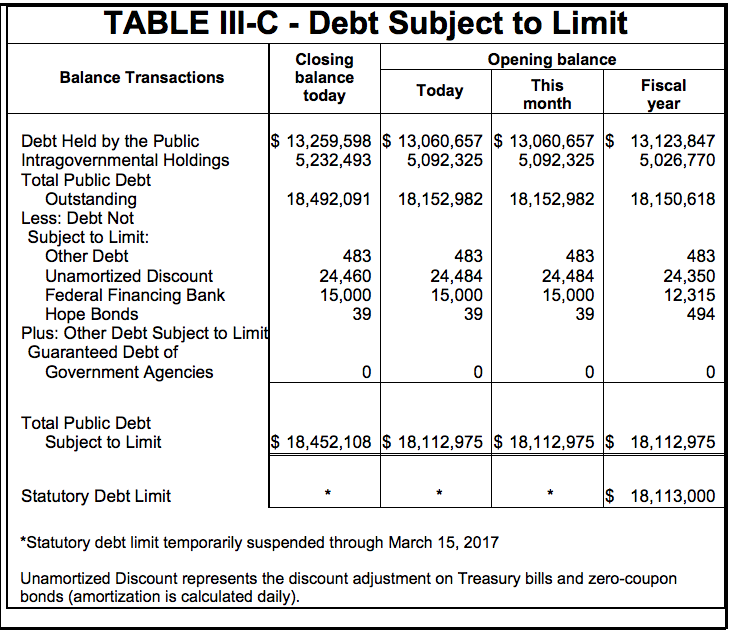 November 2 US Treasury daily statement. Congress and Obama also agreed to suspend the debt limit until March, 2017. That’s right, there are no limits on the Feds checking account for almost a year and a half. Whee… fools.
o o o
In Sweden Cash Is Becoming Radioactive Sent in by G.G.
o o o
Items from Professor Preponomics:
600 Ways to Cut Government Spending and Save $640B (The Fiscal Times)
$70M for Michelle Obama’s Program to Empower Girls in Pakistan (Judicial Watch)
Master Your Budget: 8 Steps and 20 Minutes a Day (Christian Science Monitor)
Understanding Government Spending: Federal Budget 101 (National Priorities Project)
Oregonians Anticipating Increases to Health Insurance Rates (Washington Times)
10 Simple Ways to Create a Happy Minimalist Holiday (Smart Living 365) Note: This article was published to the Internet a couple of years ago, but the suggestions remain very, very good!
Save Money on Your Grocery Shopping: Eat Healthy for Less Money (WebMD)
Odds ‘n Sods:
I just noticed that KeepShooting.com (one of our advertisers) has a sale on for Swedish Army surplus M90 Winter Parkas, in olive drab. You will have to do your homework on getting the right size, with the metric sizing, but what a bargain! They also have many other items on sale. (See their Sale Page.) – JWR
o o o
Safecastle, one of our other advertisers has a blowout sale on the Montague folding bike underway.
o o o
Reader S.F. sent in this link to a Nova special on the CyberWar Threat. While the entire episode is worth mentioning, starting at the 38:00 minute mark is a demonstration that is particularly alarming. Even more alarming than the demonstration though is the fact that the DHS released a public report with a map showing how the entire electrical grid of the U.S. could be taken down by performing that sort of cyber attack on as few as nine substations.
o o o
Quoting W.B. Yeats’ poem “The Second Coming”, GJL sent in this: “Things fall apart; the centre cannot hold; mere anarchy is loosed upon the world” Migrant crisis pushing Germany towards ‘anarchy and civil war’
o o o
Reader RBS sent in this link. Gender Identity Gone Wild: Male Cross Dressers to Begin Showering With Girls. One more reason to homeschool your children…More taxpayer-funded insanity.
o o o
In an incredibly disturbing expose, The Intercept exposes a program that used Evangelical Christian NGOs as a front for North Korea Espionage. Of all the colossally stupid things a government can do, endangering the lives of every humanitarian worker and missionary has to rank as one of the worst. Now every humanitarian aid program will be suspect and even expats may be in danger.
Hugh’s Quote of the Day:
“At the simplest level, only people who know they do not know everything will be curious enough to find things out.” – Virginia Postrel
Notes for Tuesday – November 03, 2015
On November 3, 1903, Walker Evans, the American photographer best known for his portrayal of America during the Great Depression, was born.
o o o
Today, we present another entry for Round 61 of the SurvivalBlog non-fiction writing contest. The nearly $12,000 worth of prizes for this round include:
First Prize:
- A Tactical Self-Contained 2-Series Solar Power Generator system from Always Empowered. This compact starter power system is packaged in a wheeled O.D. green EMP-shielded Pelican hard case (a $1,700 value),
- A Gunsite Academy Three Day Course Certificate that is good for any one, two, or three day course (a $1,195 value),
- A course certificate from onPoint Tactical for the prize winner’s choice of three-day civilian courses, excluding those restricted for military or government teams. Three day onPoint courses normally cost $795,
- DRD Tactical is providing a 5.56 NATO QD Billet upper with a hammer forged, chromlined barrel and a hard case to go with your own AR lower. It will allow any standard AR type rifle to have quick change barrel, which can be assembled in less than one minute without the use of any tools and a compact carry capability in a hard case or 3-day pack (an $1,100 value),
- Gun Mag Warehouse is providing 20 Magpul pmags 30-rd Magazines (a value of $300) and a Gun Mag Warehouse T-Shirt; (an equivalent prize will be awarded for residents in states with magazine restrictions),
- Two cases of Mountain House freeze dried assorted entrees in #10 cans, courtesy of Ready Made Resources (a $350 value),
- The Ark Institute is donating a non-GMO, non-hybrid vegetable seed package (enough for two families of four) plus seed storage materials, a CD-ROM of Geri Guidetti’s book “Build Your Ark! How to Prepare for Self Reliance in Uncertain Times”, and two bottles of Potassium Iodate (a $325 retail value),
- A $250 gift certificate from Sunflower Ammo,
- KellyKettleUSA.com is donating both an AquaBrick water filtration kit and a Stainless Medium Scout Kelly Kettle Complete Kit with a combined retail value of $304, and
- Two cases of meals, Ready to Eat (MREs), courtesy of CampingSurvival.com (a $180 value).
Second Prize:
- A Glock form factor SIRT laser training pistol and a SIRT AR-15/M4 Laser Training Bolt, courtesy of Next Level Training, which have a combined retail value of $589,
- A FloJak EarthStraw “Code Red” 100-foot well pump system (a $500 value), courtesy of FloJak.com,
- A transferable certificate for a two-day Ultimate Bug Out Course from Florida Firearms Training (a $400 value),
- A Model 120 Series Solar Generator provided by Quantum Harvest LLC (a $340 value),
- A $300 gift certificate from Freeze Dry Guy,
- A Trekker IV™ Four-Person Emergency Kit from Emergency Essentials (a $250 value),
- Twenty-five books, of the winners choice, of any books published by PrepperPress.com (a $270 value),
- A pre-selected assortment of military surplus gear from CJL Enterprize (a $300 value),
- RepackBox is providing a $300 gift certificate to their site, and
- Safecastle is providing a package of 10 Lifestraws (a $200 value)
Third Prize:
- A Royal Berkey water filter, courtesy of Directive 21 (a $275 value),
- A $245 gift certificate from custom knifemaker Jon Kelly Designs, of Eureka, Montana,
- A large handmade clothes drying rack, a washboard, and a Homesteading for Beginners DVD, all courtesy of The Homestead Store, with a combined value of $206,
- Expanded sets of both washable feminine pads and liners, donated by Naturally Cozy (a $185 retail value),
- Two Super Survival Pack seed collections, a $150 value, courtesy of Seed for Security, LLC,
- Mayflower Trading is donating a $200 gift certificate for homesteading appliances,
- APEX Gun Parts is donating a $250 purchase credit,
- Montie Gear is donating a Precision Rest (a $249 value), and
- Two 1,000-foot spools of full mil-spec U.S.-made 750 paracord (in-stock colors only) from www.TOUGHGRID.com (a $240 value).
Round 61 ends on November 30th, so get busy writing and e-mail us your entry. Remember that there is a 1,500-word minimum, and that articles on practical “how to” skills for survival have an advantage in the judging.
Six Prepping Principles Derived from One Year as an Expat- Part 1, by G.L.
About a year and a half ago, my company offered an expatriate assignment for a period of between two and three years. For those who don’t know, an expatriate assignment is where an employee and his or her family is relocated to another country (from now on referred to as the “assignment country”). In large corporations, this generally includes certain benefits to make the transition easier and “worth it” to the employee. For our family, this news came at a great time from a career point of view and for the age or our kids and what an international move would mean to them. It was really bad timing from the point of view of our preps. We had just signed a contract on a homestead property, and we were looking forward to building out some infrastructure and starting plans for a house.
I began writing this soon after we moved, one year ago. I thought I had something to say then. After a year, the good intentions have been tempered by some reality and a little experience. On the other hand, the lessons learned have been important in a more profound way. I want to present here the six basic principles we used as we planned the move, thought about our preps, and how those principles impacted and were formed by what we have done while on the expat assignment. I think these will be useful to many of you, especially those of you living in an urban or suburban home with an expectation of bugging out to a retreat. So, when you see “assignment country”, you may benefit more by substituting “suburban/urban home”.
Background
First of all, I am a mid-forties, mid-to-high-level executive in the company for which I work. I have a family with homeschooled kids, ages ranging from pre-teen to mid-teen. We have been prepping actively since 2011 but had been involved in prepping activities for longer than that. Our preps have been focused on a homestead based approach, mostly thinking in terms of economic collapse as a trigger for the end times and preparation for the second coming of the Lord. Based on our understanding of Biblical prophecy, we expect violence, natural disaster, pandemic, and other trials as part of the tribulation building up to the coming of our Savior.
First Principle: Right or Wrong, Commit!
When we decided to accept the expat assignment, we had to go through the preparations we were making to see how we would adapt to the new situation. We considered what the scenarios would be in terms of what would happen if things started to unwind while we were in the assignment country. We considered the timing of possible events in the context of the short timeframe of our assignment. In order of likelihood we ranked them as follows:
- We are moved back to the U.S. in an orderly way, and our things arrive as expected.
- We are evacuated from the assignment country and arrive in the U.S. with only what we are carrying.
- We are stuck in country with no conventional way to return to the U.S.
Obviously, when the balloon goes up, any of the above or a combination thereof could happen, and such discrete scenarios are unlikely if for no other reason than the discreteness of them. For each scenario, one could think of 1,000 possible permutations. These many possible eventualities can become a distraction. In order to optimally commit resources, one must focus. I had a basketball coach who said, “Right or wrong, commit.” Some of us may use our best judgement and end up making a less than optimal decision. This will be better than no decision. No decision will mean we are collecting gear with no clarity about why. This seems to be a common issue for those just starting out: overwhelmed by the possibilities, they fail to focus on building and executing a plan.
Of course, in our situation, I am limiting my conversation to scenarios related to how we get home. In the larger context of preparing, there are many more scenarios to take into account. For example, if you are preparing primarily for EMP, your priorities would dictate that you accumulate the skills and stuff that will support that scenario first. You probably have not left out having a stash of basic stuff and skills that would be needed in a pandemic; you have focused first on your faraday cage or tools that don’t require electricity. You also recognize that many scenarios could be chain reactions where, after an EMP, a pandemic breaks out. Prepping is like peeling an onion; the more you do, the more you realize you need to do. In my view and experience, failing to prioritize leads to a shotgun approach that is doomed to serious flaws. You may eventually get there, but you will spend more, and it will take longer.
That said, prioritizing does not mean that less likely scenarios are excluded. Our preparations are still focused on the homestead in the U.S. However, even though we believe that we will be able to return to the U.S. with our belongings, we have some preps in place for the other two scenarios. We decided that the expense of fully preparing for the least probable scenario did not warrant special focus because those resources would be better used elsewhere. When we consider these, we cannot ignore any of the possible situations we could find ourselves in; we have to prioritize or commit to something. As I go through the rest of the principles, I will show how each action supports preparation for one of the three scenarios.
Second Principle: Two is One, One is None
This common saying among preppers has special meaning when you have two locations to think about, especially when one is thousands of miles away from the other.
First of all, based on our scenario analysis, we wanted to have preps set aside for the homestead location and continue to invest in that. Looking at this in the long-term view meant that any investment we made would most likely end up back at the homestead after our assignment ended. Taken to an extreme, we could assume that leaving preps in the U.S. was not necessary, since we would most likely be back with our things. However, this would have left us with nothing at the homestead should scenario two play out. We decided to approach this move as an opportunity to double up some key preps, leaving one set near the homestead and taking one set with us. When we began planning the move, one of the main considerations was making sure we had one of the basics for each location. Our view is that when we move back to the U.S., assuming that happens, we will have two of the basics. Some examples:
- Berkey water filter
- Pressure canner and supplies for canning (the movers weren’t happy about those glass jars!)
- Sewing machine
- Grain grinder
- Tents and camping gear
- First aid supplies
- Kitchen basics, like knives, et cetera
- Tools (basic home tool set, some woodworking tools, and very basic mechanics tools)
- Survival library (Here, we did not double up on titles but on subject matter, having now two or more books on each major topic.)
For scenario one, we have two of almost all key preps. For scenario two, we have at least one of every key prep pre-positioned near our retreat. This also assured that we would have the basics in the assignment country in case of a scenario like scenario three.
While this investment will hopefully allow us to develop redundancy in these key preps when we are living on our retreat property, in the meantime we have redundancy in most categories in both locations by having multiple ways to accomplish the same thing. For example, we have several different water filters. We also have a fairly deep supply of consumables in both locations, first aid being the most relevant example in this case.
Third Principle: Only What You Can Carry
The above needed to be balanced by the possibility of scenario two. If we were to receive a call from the embassy telling us to pack quickly and meet for evacuation, what would we be able to carry with us? It is imperative to be able to carry the bulk of the preps with us in the assignment country back to the U.S. in all but the most extreme scenarios. My thinking was that the items that are included in the general household goods shipment (shipped by sea and takes about two or three months to arrive) cannot be considered essential preps for the homestead location.
Especially important was the possibility that we would be affected by the lack of those things that we might have to leave behind in a rushed exit. So, even though we believe scenario one is most likely, we did not want to cavalierly take everything with us to the assignment country and then not have key preps in the U.S., especially considering that the homestead property would be more likely to require certain preps that we really could not use adequately in the assignment country.
The criteria we followed went something like this:
The item went with us if:
- It was essential to have in the assignment country (scenario two or three), regardless of the impact to the preps in the U.S. and regardless of the ability to carry it back.
- It could be used in the assignment country but would not impact preps in the U.S.
- It could be used in the assignment country and could be carried back.
The item stayed near the homestead if:
- It was illegal or prohibited either for travel or in the assignment country.
- It could not be used fully in the assignment country.
- It would seriously impact preps in the U.S. and was not able to return with us under scenario two.
Some examples of things we left stored near the homestead:
- Firearms and ammunition
- Farming and gardening tools, equipment
- Storage food
- Bench or floor-mounted power tools (non-hand tools)
- Mechanics tools for automotive repair
When we think through this, our baggage in an evacuation scenario would be similar to a bug-out bag with essential camping gear, some freeze-dried food, et cetera. If additional baggage were permitted, we would work down the list included in the “Two is one, one is none” section until our baggage limitation was reached. Of course, some duplicates from above, might end up being sacrificed in certain scenarios. The alternate backups for each task are still in place meaning there is no loss in duplication of function, just loss of duplication of the items.