How To Title Retreat Property, An Overlooked Item in Your Planning, by John in the Ozarks

I have spent the last eight years building and stocking my full-time retreat. Our family has had a terrific timing putting this together. One thing has happened beyond our control. The area we are located in has grown substantially. Our population has increased substantially, and we have also been slotted to receive Syrian refugees. I have come to the realization that It is simply going to be too hard to depend on this location as my only retreat. So after due diligence and the help of Survival Realty, I have purchased a secondary retreat in a totally different region of the U.S. I decided on a property that was extremely remote and was already built. I really didn’t have the time or fortitude to start all over. It makes you really feel for those who must completely start over due to a disaster. After I found the property and we agreed on a price and set a date to close, I realized something that I totally overlooked on my first property, which was how to title the property correctly. This is extremely important and probably greatly overlooked by most people.

First of all, what is property title? Wikipedia defines property title as:

In property law, a title is a bundle of rights in a piece of property in which a party may own either a legal interest or equitable interest. The rights in the bundle may be separated and held by different parties. It may also refer to a formal document, such as a deed, that serves as evidence of ownership. Conveyance of the document may be required in order to transfer ownership in the property to another person. Title is distinct from possession, a right that often accompanies ownership but is not necessarily sufficient to prove it. In many cases, both possession and title may be transferred independently of each other. For real property, land registration and recording provide public notice of ownership information.

Why does it matter how you title your property? Traditionally, when you buy a piece of property, you have a closing. This is the sit down meeting where everyone attends, contracts are signed, and money is exchanged. Then this transaction gets recorded at the county level. For example, John and Jane Doe buy a farm; after the transaction is complete it gets recorded that John and Jane Doe purchased 45 acres at such and such address for a certain sum of money. Since it is recorded, it has now become public record. This is important for many reasons. This can be detrimental to John and Jane Doe. Think of all the work and time you have put in your property, the purchase, the improvements you have made only to have them taken away due to a variety of different reasons, which follow:

Lawsuits– This is probably the most common risk right now. Let’s say you are involved in a car crash or medical malpractice situation or any other litigation. When the person who is suing you goes to an attorney, the first thing the attorney does is pull your records from the state you reside. They are looking for any property you own, perhaps what you paid, maybe what you owe, and if you are worth suing. If you look like you have nothing, the chances you will get sued drop dramatically, The adage holds true that “you can’t squeeze blood out of a turnip”.

Taxes- As confusing as the tax code is and who is interpreting it or enforcing it at any given time, we are all in danger of having liens placed on our property. However, if they can’t find the property to place a lean on, you have partially neutralized this threat.

Nosiness- For lack of a better term, nosiness can be a problem, too. We live in an extremely transparent time. There are people who have tons of time on their hands and Internet access to dig into people’s personal affairs. If someone has the slightest inkling you are a survivalist, they might be able to pinpoint your retreat and either show up uninvited WTSHTF, or even beat you there, or tell someone your weaknesses. Either way, wouldn’t it be nice to not have to worry about these things?

Nelson Rockefeller summed it up best: “The secret to success is to own nothing but control everything.”

So now that I have your attention on why this is important, what is the solution? In a sense how do you own property but not let the world know it? After looking at several possibilities I have found that the best option for me is the LLC, or Limited Liability Corporation. An LLC allows the corporation to own the property, however you own the LLC. When someone searches the property, it shows up under the corporate name rather than yours. The only person that will show up is the registered agent, and this is who you appoint, generally the attorney or accountant who set up the LLC. Anonymity is not the only thing the LLC offers. They also provide the members of the LLC protection from the liability that can arise from owning property, hence the name. That is why LLC’s are so popular for owning rental property and can also provide another level of security. When people see that a corporation owns a farm, they will assume that it is a money-making venture and not a “tin foil hat wearing doomsday” homestead. A couple of additional things I would like to point out for survival retreat scenario if you choose to use an LLC include:

  • Place only one property under one LLC name, I know this sounds ridiculous but let me an offer an example of why you should do this. Let’s say you own a couple pieces of real estate and decide to put them under one LLC. You need a roof repaired and the person doing the repairs gets hurt and sues you. Under this circumstance all properties titled under the LLC are vulnerable to this lawsuit.
  • Where you file the LLC can add another layer of anonymity. You don’t have to the file the LLC in the state where the property is located or where you reside. I would actually advise you not to, since corporations are filed at the state level and very few records are shared state to state. I understand that New Mexico LLC’s provide the most privacy, so this is the one I would recommend.
  • It also is imperative you pay all your taxes and utilities out of the LLC checking account, or if you don’t want to open a checking account under the corporate name, pay everything with money orders. Do not get lazy and pay out of your personal account. Make it as hard as possible to track it back to you.
  • Also, do not name the LLC with your name in it. This is a very common mistake. Be creative and have fun with it. Schumer Independence Foundation LLC perhaps.

In closing, here are a couple of things I would like to add. An LLC option is what was best for my situation. Some people would recommend a land trust. Land trusts, like LLCs, have many benefits, more so in the anonymity department, but they have many draw backs as well. In fact some states do not allow land trusts, so do your homework. In some states, the homesteading laws are so broad you may not have to do anything to protect yourself, except simply having the property titled in your name. Talk to your accountant and attorney about different options. Title companies are also a great resource, as they are very familiar with state laws. They can probably put you in touch with an attorney who is very fluent in these manners. You can have an attorney or accountant file the corporation for you. There are also a number of Internet websites who can do this for you. It generally runs around $350.

The point of this article is to get you thinking about an item that had slipped by my preparedness list. Even if you already own your retreat, it is not too late to change the titling of your property. In some states, it costs a little more to do an LLC over a land trust after you already own the property, due to the collection of tax stamps.

It is also very easy to say to yourself, none of this stuff matters if something big happens. It won’t matter how my property is titled when the lights go out. At this point in time, the lights are on and there is a danger lurking outside the walls of your retreat. The plundering horde you should be most concerned about right now is either a group of lawyers or the tax man. They come armed with pens and papers that are just as dangerous to your liberty as a band of thieves with rifles. Consider the LLC as a shield or armor to prevent these thieves from taking what is rightfully yours. I think it should be noted that when a business incorporates as an LLC, it is considered hiding behind a corporate shield. The irony wasn’t lost on me.

How you title your property is similar to the reason we buy insurance for our house. We aren’t buying the insurance thinking our house will burn. We buy insurance in case our house does burn. So consider carefully how you title your property. It might be the most important thing you ever do to keep your retreat safe.


Letter: Federal Watch Lists

Good afternoon Hugh/JWR,

With the recent fervor arising over federal lists (airline travel, passport revocations, gun purchases, et cetera), I thought I would share a short story with the readership…

I am a professional pilot for a U.S. airline. I began flying in the 1980’s and have been feeding my family with my airman certificate for thirty years. Obviously, pilots are subject to rigorous background checks (more so since 9/11), but screening was in place in the 80’s when I began flying. In 2008 I received a letter from the Airport Police Office that has jurisdiction at the airport I fly out of (a major U.S. airport with major airline service), advising me that I had 14 days to appear in person at Airport Security and bring proof of both my identity and my U.S. citizenship, or my airport credentials would be revoked!

I called Airport Security, made an appointment, and dutifully appeared (in my Captain’s Uniform, nonetheless) with both originals and color copies of my U.S. birth certificate, State Driver’s License, State ID Card, State CHL, FAA Airman Certificate, FAA Medical Certificate, FCC Restricted Radiotelephone Operator’s Certificate, US Passport, FBI Criminal History Records Certification, Airline Employee Credentials, and my Airport Security Badge that their office had issued five years earlier (and renewed annually since then), which gives me access to the “secured” portion of the airport.

I asked to speak with the supervisor on duty and asked the supervisor how is it possible, with 30 years of flying history and all of the vetting I have been through over the years, that your office doesn’t know that I am a U.S. citizen? He had no answer, other than to say there must have been a mix-up on a DHS watch list somewhere.

Governor Malloy (of Connecticut) may think it is “Just Good Sense” to prevent anyone on the TSA no-fly list from buying a firearm, but when our government won’t tell the people who they are watching and why they are being watched, I think he is leading his state into dangerous waters. By threatening to revoke my airport credentials because I was possibly on “a list somewhere”, I was presumably guilty of “something” worth denying me my livelihood, and I haven’t had so much as a traffic ticket in over 20 years. The no-fly list was never designed to be used in this manner. – Captain B.


Economics and Investing:

The American Dream Is Over

o o o

G.G. sent in a link showing what happens when you keep kicking the can down the road: Stocks are more overvalued now than at 2000 and 2007 peaks

o o o

Items from Professor Preponomics:

U.S. News

The Dreary Utopia of the Socialists (Mises Institute)

Report: Government Wastes Billions as National Debt Approaches $19T (Judicial Watch) Excerpt: “The federal government spent more than $65,000 to study what happens if someone turns on a light at night in a rural area. Anyone raised in a rural area can attest that one way to attract insects is to turn on a light. This type of ridiculous spending is why American taxpayers have been saddled with a debt of approximately $19 trillion. NPS* needs to put down the national credit card and walk away.” *NPS is the National Park Service

International News

Chinese Admit to Faking Economic Data (Business Insider)

Saudis to Set Strategy for Era of Cheap Oil as Red Ink Flows (Reuters)

The Fed and Emerging Markets: The Secular Sulk (The Economist) Article Quote: “The fear is that a golden era of growth, fueled by China’s ravenous appetite for commodities, has come to a close, exposing deep cracks in their economic foundations.”

Personal Economics and Household Finance

Scammers Targeting Amazon Customers Passwords (ID Theft Center) What it is… What they are after… How you can avoid it!


Odds ‘n Sods:

Elon Musk launches $1 Billion fund to save world from Artificial Intelligence

o o o

The water crisis worsens… California in Overdraft: Dry Wells and Sinking Ground as State Struggles with Ground Water Crisis. …and California is not alone. It’s happening in Kansas too. Pumped Beyond Limits, Many U.S. Aquifers in Decline. – Sent in by T.A.

o o o

Self Defense Prep interviewed JWR over his new book Land of Promise and has the link posted. Survival skills and the learning curve for those skills are also a topic of discussion.

o o o

D.S. sent in this link: The DHS continues to act as though it is more fearful of American citizens than foreign threats. DHS Monitors American’s Social Media Accounts, But Not Visa Applicants

o o o

Good advice in the event of nuclear attack in Great Britain. This Is What BBC Radio Would Broadcast In Case Of A Nuclear War – Sent in by M.S.


Notes for Monday – December 14, 2015

December 14th is the birthday of the late John Warren Wadleigh (born 1927, died September 24, 2013). Wadleigh was better known to many SurvivalBlog readers by his pen name– Oliver Lange. He was the author of the best-selling resistance warfare novel Vandenberg.

This is also the birthday of Air Force General James H. “Jimmy” Doolittle, who died September 27, 1993.


Sig Sauer P226 Scorpion, by Pat Cascio

My first exposure to any Sig Sauer firearm came in 1980, shortly after I was married and I opened a gun shop in my home. Later, I moved to a regular store front location. A customer asked me to order him a Browning BDA .45 ACP handgun. I readily admit, that back then, I had no idea what the BDA was. I knew the Browning name but wasn’t familiar with the BDA (Browning Double Action) model. After some research, I found out that the “Browning” BDA was manufactured by Sig and imported into the USA by Browning. I was impressed with the BDA, for the most part, other than the heel mounted magazine release, which is popular in Europe though not so much here in the USA. I remember the BDA being a bit blocky to my way of thinking; however, it felt good in the hand, real good. It wasn’t until that customer went out shooting and invited me along that I fired that Browning BDA, and I fell in love with the Sig line of handguns. I’ve been a big fan ever since.

100_6318

Sig Sauer now manufactures most of their firearms in the USA these days, instead of in Europe. For some reason, there was thinking back in “those” days that firearms made in Europe were better than those made in the USA. I totally disagree with that line of thought, then and now! Given a free hand, we can build just about anything better in the USA than can be built in other countries. I’m unashamedly pro-USA!

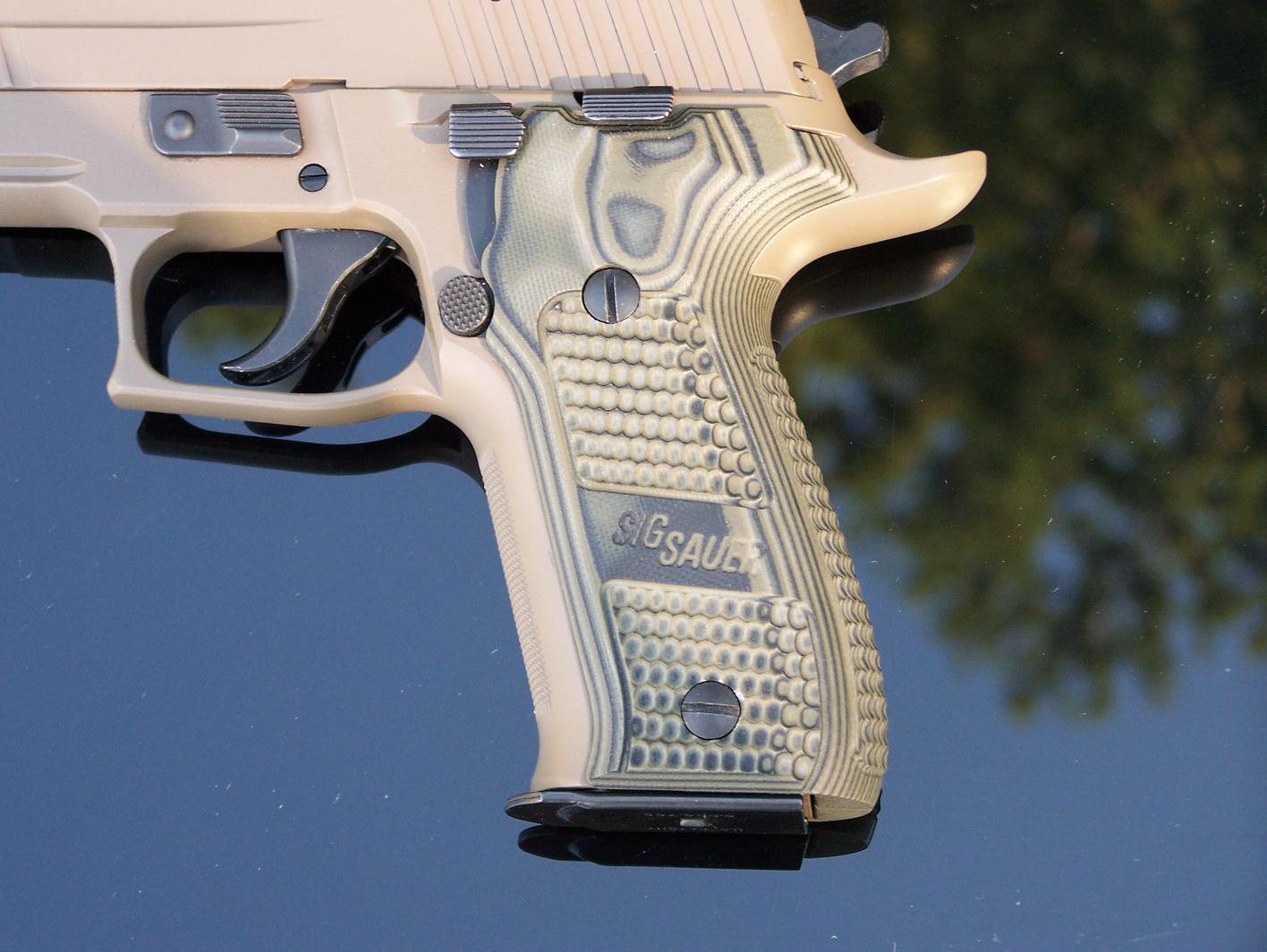
Over the years, I’ve owned many different Sig Sauer firearms– long guns as well as handguns. One thing that has always stood out is the superb accuracy of Sig firearms. I never had one that couldn’t really group, if I did my part. I’ve always liked the Sig P226 line and have owned many different variations over the years. This newest P226 that is under review here is the “Scorpion”, and I’m here to tell you that it has some well thought-out features.

100_6325

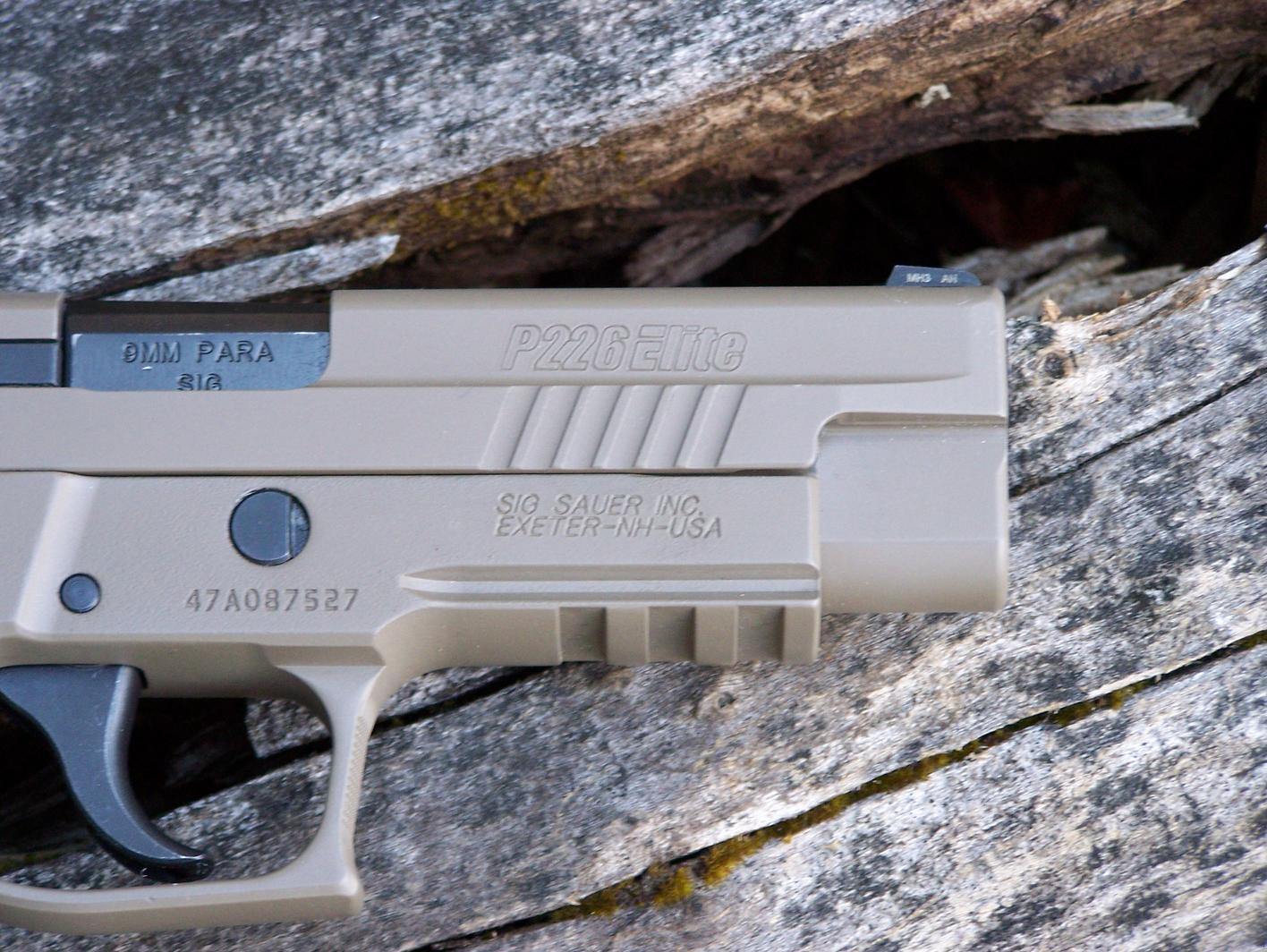
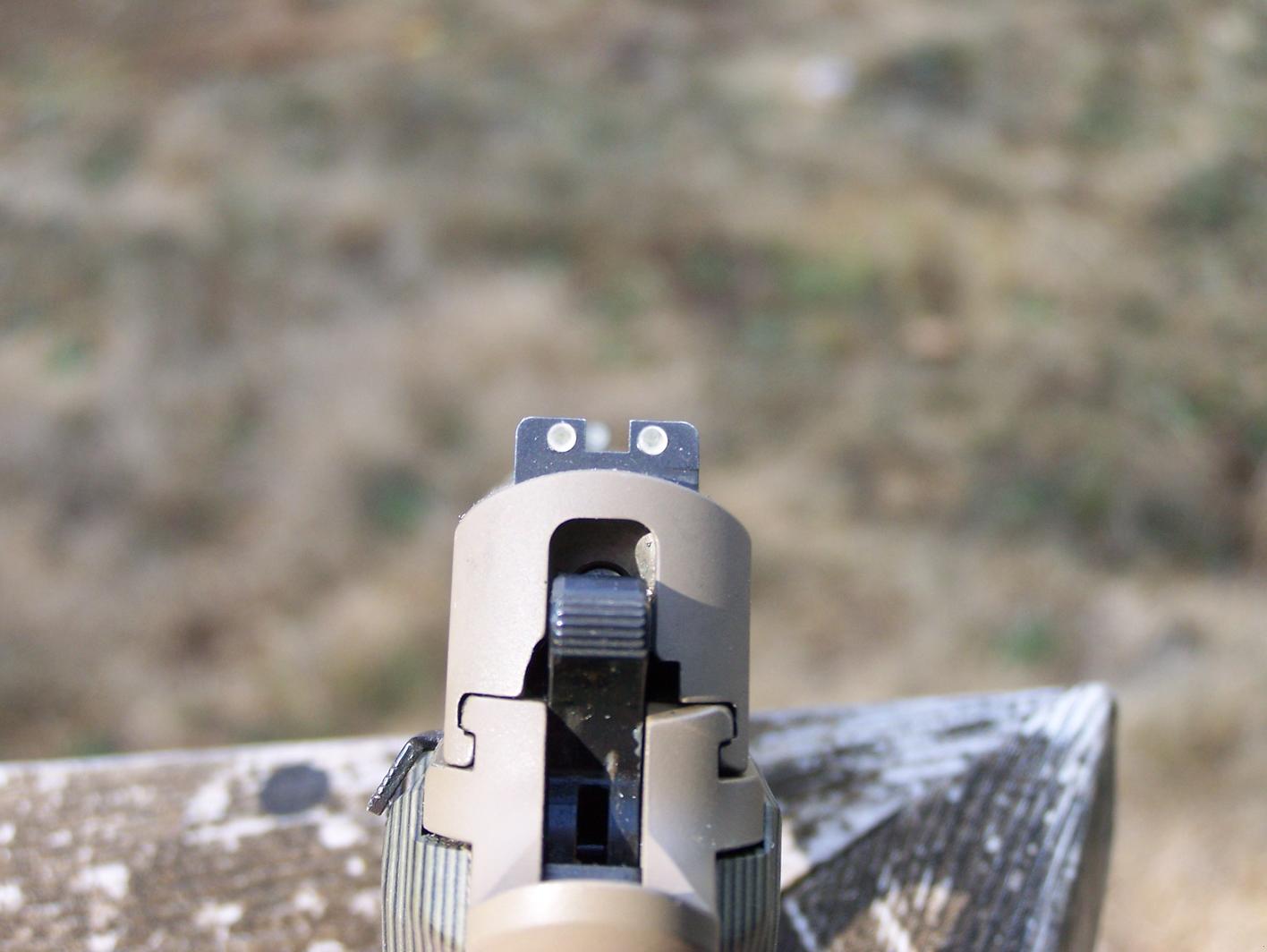
The Scorpion is available in 9mm and .40S&W. My sample, as requested, is the 9mm version. The gun comes with a 4.4-inch barrel. However, there is a treaded version for suppressors that is 4.9 inches long. The overall height of the Scorpion is 5.5 inches. It is 1.5 inches wide and has an overall length of 7.7 inches. SIGLITE night sights are standard issue. The gun weighs 34 ounces with the aluminum frame and stainless steel slide. The finish on the Scorpion is Flat Dark Earth in color Cerakote. Standard magazine capacity is 15 rounds; however, I use 18-rd Mec-Gar magazines in my sample. The trigger pull is typical DA/SA– double action/single action. The first shot is fired double action, when the trigger is at rest, and the trigger pull is 10 lbs, and it’s VERY smooth. Single action trigger pull is 4.4 lbs; however, you can fire the first shot single action by simply cocking the hammer back.

100_6326

Some of the features on the Scorpion, that aren’t on the standard P226, are:

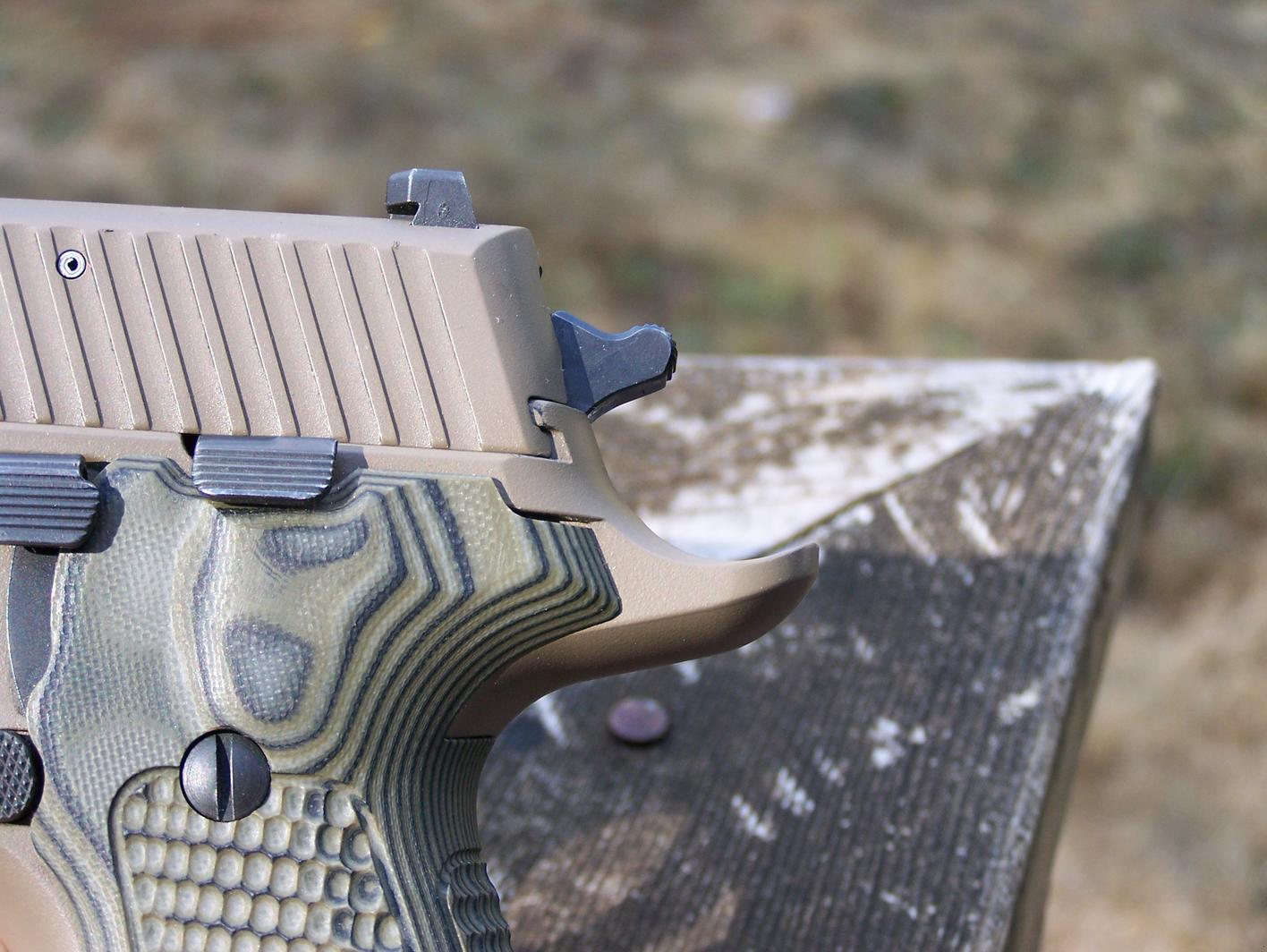
  • cocking serrations on the slide,
  • Elite beavertail on the frame,
  • integral Picatinny rail for lasers or lights,
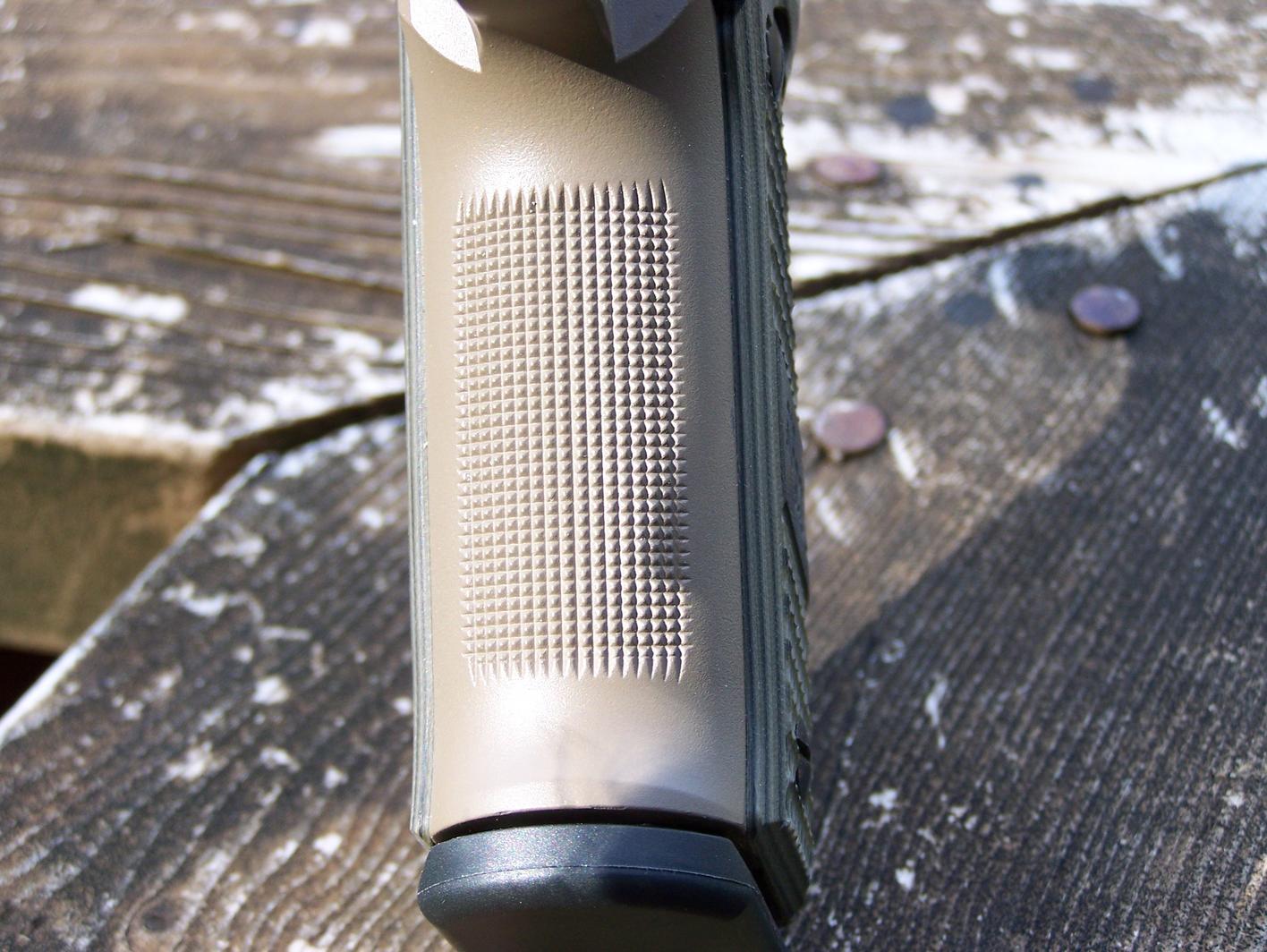
  • front strap checkering, and
  • Hogue G10 Extreme Piranna grips, that I love.

100_6327

The trigger is the SRT– Short Reset Trigger– that you don’t have to allow it to travel so far forward to reset after each shot. This makes for faster follow-up shots. And, as already mentioned, the special Flat Dark Earth coating on the gun that is really eye-catching also helps protect the gun from the elements. The Scorpion has the Sig decocking lever on the left side of the frame and the slide lock/release. The magazine release button is checkered and angled, too.

100_6329

The gun comes with two 15-rd magazines, and spare magazines are readily found just about every place. I have a good supply of genuine Sig 15-rd mags in my supply, and as mentioned I also have some of the Mec-Gar 18-rd mags that don’t extend very much below the frame of the gun. For my money, these are the mags to use. They provide you with three more rounds with very little more length added to the gun. The Scorpion also has a massive external extractor. I don’t know if this is on all Sig 226 handguns or not, but I don’t see a shell refusing to extract from the chamber with this hummer. It is big!

100_6330

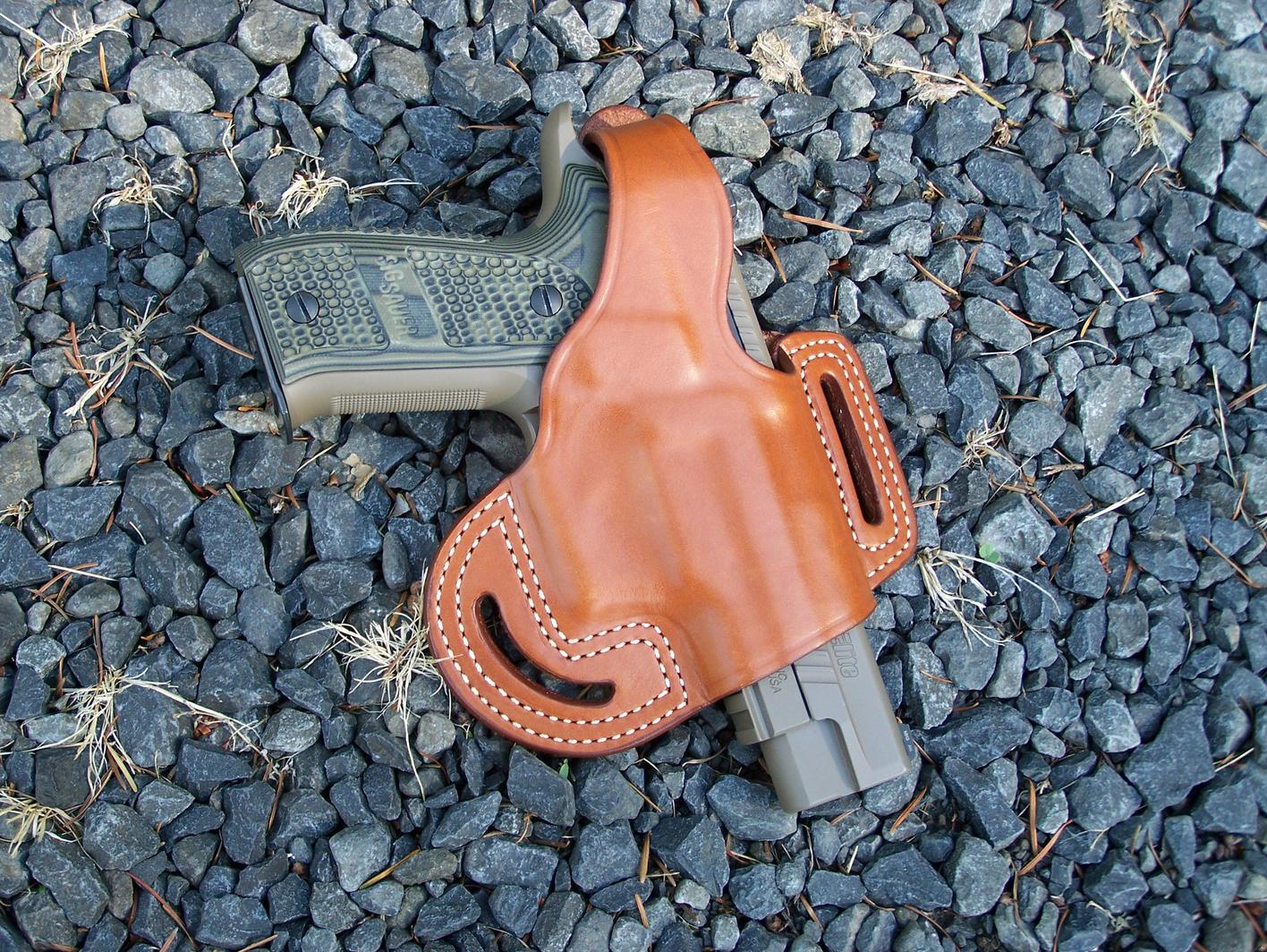
For a full-sized, duty-style handgun, the Scorpion can be concealed, with the right holsters and covering garments. I carried the Scorpion for two weeks, in a Blackhawk Products www.blackhawk.com CQC thumb break holster on my right hip. The gun rode nice and tight against my body in the heat of the summer. For law enforcement or military use, I would carry the Scorpion in the Blackhawk Tactical Thigh holster, which is one of my favorite rigs. It allows the gun to ride below the waist, in the event you are carrying a long gun, and it won’t interfere with the long gun. I added two Blackhawk mag pouches to the thigh rig, with two more 18-rd Mec-Gar magazines. Once properly adjusted, this setup is fantastic. For survival, this would be a great rig and handgun in my humble opinion. I carry either +P or +P+ hollow point rounds for self-defense. Of course, no gun maker warrants their firearms for +P+ ammo, but the P226 Scorpion can handle higher pressured ammo, in my opinion. For practice, I shoot standard pressure FMJ ammo, when blasting paper targets.

I ran more than 500 rounds of various 9mm ammo through the Scorpion, and there were zero failures of any sort. The gun just kept right on perking along. I also mixed different types and brands of ammo in the magazines, and there were no failures to feed or fire. This is always a good test. Many guns, if you mix different brands and types of ammo in a magazine, will stutter and not feed the next round. The Sig sailed through this test several times.

100_6331

From Black Hills Ammunition I had their 115-gr JHP +P load, 124-gr JHP +P, 115-gr Barnes TAC-XP all-copper hollow point +P load, 124-gr JHP, and their 115-gr FMJ loading. From the folks at Buffalo Bore Ammunition, I had their 147-gr JHP Subsonic load, 147-gr FMJ FN Subsonic load, 147-gr Hard Cast FN Outdoorsman load, 115-gr Barnes TAC-XP +P+ fodder, and their 124-gr +P+ FMJ FN “Penetrator” ammo. So, I had a great selection of ammo to run through the Scorpion.

100_6332

I did some draw and fire exercises, using both the Blackhawk hip holster, and the tactical thigh holster. I do this from time-to-time, to stay on my game and get a feel for different holsters. The hip holster allowed me a slightly faster draw than did the tactical thigh holster. However, I’m not kidding myself, if someone has the drop on me, I’m probably gonna lose if I have to draw against a gun that is already out. However, faced with a life or death situation like that, I’d draw, because only 25% of people who are shot with handgun rounds actually die. So that means, a person has a 75% chance of living. So, go for it, I say. I put a small piece of skate board friction tape on the release button on the tactical thigh holster, and it made it much easier for my trigger finger to find the button under stress. It’s a quick and easy fix that only cost a penny or two. All of my Blackhawk Tactical Thigh holsters now have this small piece of friction tape on the holster’s button for releasing the handgun. (Even old dogs can learn new tricks.)

As I mentioned early on, Sig firearms are known for outstanding accuracy, and the Scorpion didn’t let me down, if I did my part. I tested all of the above ammo, firing over a sleeping bag, over the hood of my pick-up truck, with the paper target 25 yards down range. Again, if I did my part, the Sig and the ammo did what it was supposed to do. I only had a few groups that were over three inches, and I think those groups were my fault, not the gun and ammo. Doing my part, I got several groups down there in the 2 1/4 inch range, and I think the Scorpion can do even better. My shooting was done over the super hot summer we had in the western part of Oregon, and I don’t tolerate that kind of heat. So, I know I wasn’t at my best. I can see the Scorpion, with the right ammo, and me on my game doing a little better– shooting inch and a half groups. The overall winner was the Black Hills 124-gr JHP load, followed by the Buffalo Bore 147-gr Hard Cast +P Outdoorsman load, and tied for third place is the Black Hills 115-gr JHP +P and the Buffalo Bore 147-gr FMJ FN Subsonic loads. Honestly, there were no bad groups or bad ammo. The gun can shoot, and it shot very well with any of the ammo I put through it. On a good day, as mentioned, I can see the Scorpion with the ammo it likes best, shooting inch and a half groups, single action.

I like the extended beavertail on the frame, as it allows me to get a higher grip on the gun and it helps prevent the gun from rolling “up” during recoil, not that the 9mm round is punishing; even the +P+ loads weren’t a problem for the Scorpion in the recoil department. The SIGLITE night sights are outstanding, and I did a little bit of low-light shooting, too. They really stand out. I should mention that the front of the squared-off trigger guard is checkered, for those who place the index finger of their off-hand in this position. It used to be all the rage, however I don’t know of anyone who uses this grip any longer on a handgun.

100_6333

If you’re not familiar with the decocking lever on many of the Sig handguns, this will take a little training to get used to. Muscle memory is just all it is. When you are done firing and you are ready to re-holster, you press down on the decocking lever with your thumb, and it safely drops the hammer, making the gun safe to re-holster. Don’t ever holster with the hammer cocked!!!

I liked the Hogue G10 Extreme Piranna grips so much that I got a pair for my Sig P229. These grips grip your hand back. There’s no chance of dropping the gun under any weather conditions. These grips just feel fantastic. I passed the gun around to quite a few people, and the first thing every one commented on was how great the grips felt in their hand.

The Flat Dark Earth Cerakote finish is something I really liked the look of. It’s very “tactical” to my mind, and of course it provides added protection against the elements. The slide is stainless steel and the frame is aluminum to help fight the elements, but the Cerakote just adds another layer of protection.

Sig Sauer quality never comes cheap. Full retail on the P226 Scorpion is $1,313. Then again, you ARE getting a Sig, and I don’t know that I’ve ever been disappointed in any way with any Sig Sauer handgun I’ve owned or tested. The Scorpion is no different. Is the Scorpion worth this kind of money? You betcha, it is! Save your pennies, if you have to, but this one is worth every red cent, even at full retail! If you’re looking for an “End Of The World” handgun that won’t fail you, then look no further, and if the Scorpion model isn’t to your liking, then check out one of the many different P226 models that Sig offers. I’m sure you’ll find one that suits your taste perfectly. The only “problem” I have now is that this sample isn’t going back to Sig; so, I’ll have to save my own pennies now and buy it.


Recipe of the Week: Stuffed Green Peppers

Ingredients:

  • 5 to 6 green peppers
  • 1/2 lb. lean ground beef
  • 1/4 cup finely chopped onion
  • 1 Tbsp. chopped pimiento
  • 1 tsp. salt
  • 1 (12 oz) can whole kernel corn, drained
  • 1 Tbsp. Worcestershire sauce
  • 1 tsp. prepared mustard
  • 1 (10 3/4 oz) can condensed cream of tomato soup

Directions:

  1. Cut a slice off the top of each pepper and remove the core seeds and white membrane.
  2. In a small bowl, combine beef, onion, pimiento, salt, and corn.
  3. Spoon beef mixture into hollowed out peppers.
  4. Stand peppers up in a slow-cooking pot.
  5. Add Worcestershire sauce and mustard to soup. Pour over peppers.
  6. Cover pot, and cook on low 8 to 10 hours.

Makes 5 to 6 servings.

o o o

Useful Recipe and Cooking Links:

Reader J.C. wrote to mention that Enola Gay posted a Dublin Coddle recipe in the excellent Paratus Familia blog. She made it one evening, and she and her husband thought it was delicious. She baked it at 400 degrees F for 50 minutes, and it turned out perfect.

Do you have a favorite recipe that would be of interest to SurvivalBlog readers? Please send it via e-mail. Thanks!


Two Letters Re: The 9mm Parabellum vs the .40 Smith and Wesson vs the .45 ACP, by B.F.

Hugh,

I enjoyed BF’s “The 9mm Parabellum vs the .40 Smith and Wesson vs the .45 ACP”. It brought back some great memories of my police days and the El Presidente drill we conducted at the end of our range sessions every year. I can attest to his results. When I came on the job in the 1980s, we were issued Ruger .357 Magnum handguns and carried .38 +P rounds. In the early 90s, we went to 9mm because “the criminals are outgunning us with their semi-autos”! In the early 2000s, we went to S&W .40 because “the 9mm doesn’t have enough stopping power!” Within the last year (I’m retired for a few years now), my old job went to .45. I don’t know why, but “everyone else is doing it” so it must be the thing to do! Me, I’m back to a 3” Ruger GP100 .357 with .38+P ammo. Old habits die hard, I guess. Anyway, regardless of what I was carrying that particular year, I consistently shot the same times with any of the three guns I used over the years. Our drill was slightly modified from the original, requiring two reloads and a total of at least 10 rounds, more if you had any misses, and we only scored by time. We loaded up with four rounds each in our gun and first mag, then six in the last mag. We shot a total of five steel targets from roughly six yards out: two hits on each of the targets to your right, reload, two on each of the targets on your left, reload and fire until you hit the center target one time. I never considered myself a great shot, but I have good hand/eye coordination for fast reloads, and my bad habit of slapping the trigger didn’t hurt me in those close distances so one other officer and I traded 1st and 2nd place in the department back and forth over ensuing years. On our best days, we were coming in just under 10 seconds with no misses and the two reloads, working out of Safariland Level III duty holsters and covered mag pouches. Ah, the good old days! – Spolight

o o o

Team,

It’s not the kinetic energy of a bullet that drops an assailant, ever. It’s stopping the heart from pumping blood, stopping the brain from giving instructions, or causing so much pain that they quit. Shot placement does that, even with a 22LR. – G. Guy

HJL Adds: This is always a good reminder, but we should also remember that the margin of acceptable error with larger calibers is also larger. The trick is to find the balance where you are using the largest caliber that you can while reliably hitting exactly where you aim.


Economics and Investing:

Peter Schiff Exposes The Real Problem Facing The Fed – Link sent in by B.B.

o o o

Millennials will not save the housing market: 50 percent of Millennials have less than $1,000 in savings. A large number are mired in student debt.

o o o

Items from Professor Preponomics:

U.S. News

High Impact Market Possibilities After First Federal Reserve Rate Hike (24/7 Wall Street) Article Quote: “One very good thing about history is it is always there when you need to review how an economic event could play out against the existing landscape for investing.”

A Top JP Morgan Strategist Thinks the Fed “Misunderstood a Rate Hike’s Effect on Markets” (Business Insider) Hint: Although the U.S. economy may be able to adjust to a rate hike (and some will even benefit), the results of a rate hike may be non-linear. Article Quote: “If you hike rates, this slows the rate of lending and spending, helping to cool an economy that may be running too hot and approaching bubble territory. It’s not that simple…”

December 16th: When the End of the Bubble Begins (Contra Corner) Article Quote: “Yellen and her posse better pray for a monetary Tonto because they are riding headlong into an ambush in the canyons of Wall Street.”

Mises Institute’s Week in Review (Mises Institute) Article Quote: “Can the economy survive whatever small bump the Fed deals out? Perhaps, but any temporary stability doesn’t change the inherent instability of our current monetary regime.”

One Economist Thinks the Fed Shouldn’t Hike Rates (Business Insider) Commentary: Certainly among the myriad challenges in trying to understand “what comes next” are the following: 1) that the underlying assumptions of existing models may no longer apply (or may require adjustment); and 2) that the data on which decision makers rely has been corrupted by policies which result in market distortions for which there is no accounting. The bottom line is that no one knows for sure, but we’re all about to find out and there are likely to be a whole host of unintended consequences and market complications. Some of these effects may be felt immediately. Other effects may ripple through the system over the course of time. This is what happens when markets are engineered.

International News

Russia Plans $40 a Barrel Oil for the Next Seven Years as the Saudi Showdown Intensifies (The Telegraph) Article Quote: “Russia is battening down the hatches for a Biblical collapse in oil revenues, warning that crude prices could stay as low as $40 a barrel for another seven years.”

Personal Economics and Household Finance

Porch Pirates Stealing Holiday Deliveries (CNBC) Article Quote: “…a nasty practice that’s become common enough to warrant a new term: porch pirates.” …and a suggestion in follow up for SB readers: Consider a post office box for secured delivery of all your mail. Beyond Christmas deliveries, protection for your bank or other financial statements, bills, and other correspondence is important throughout the year.


Odds ‘n Sods:

Our SurvivalRealty spin-off site gets some very unusual retreat property listings, but this new one on Hawaii’s Big Island is incredible: Private Cave Bordering Forest Reserve in Tropical Paradise

o o o

SurvivalBlog reader R.H. wrote in response to Five Intelligence Essentials for Preparedness and Community Security, by Samuel Culper with a link to an article describing how to turn a computer and a TV tuning dongle into a police scanner capable of receiving trunked radio traffic.

o o o

J.N. writes in: “Gun haters point to recent mass shooting and froth at the mouth demanding new anti-gun legislation to stop such future massacres.

But, the Washington Post– that monument to antigun agenda journalism– has admitted in print, in detail through its “fact checkers”, that NONE of Obama’s proposed gun control initiatives would have stopped those mass shootings!”

o o o

Google Files Patent for “Needle-Free” Glucose Testing Technology – What could possible go wrong here?! – Sent in by D.S.

o o o

Flu Flop: Another Year of Dangerous CDC Lies


Guest Article: Five Intelligence Essentials for Preparedness and Community Security, by Samuel Culper

Intelligence is a poorly covered topic in our the preparedness community, largely because there just aren’t enough former intel guys willing to teach on the topic. Although the work of intelligence can consume your life while preparing for SHTF, there are several small things you can do today in order to become more prepared. If you’re spending hundreds, thousands, or tens of thousands of dollars on things but aren’t studying the threats in your area, then there’s a good chance that you will suffer from strategic shock; in other words, you may be exploited in a way that you hadn’t anticipated.

Here are five ways that you can better prepare for community security through intelligence.

  1. Maps – You simply must have maps of your area of operations (AO).  In order to understand the mission of community security, you’ll need to identify just what your AO is. In other words, you need to know the boundaries of what you’re going to protect.  Identifying the AO is the first step in a line of several steps that we’ll cover later in the article.

    Step into any tactical operations center, or TOC, in Iraq or Afghanistan and you’re likely to see several types of maps of the AO.  The first map we’ll need is a topographical map at 1:24,000 scale available from the USGS.  Printing off a map at your home or office printer is better than nothing; however, what’s best is having a large map hung up on the wall.  You’re going to need at least a 24″x36″ map, if you want to be the best prepared.  You’ll also be interested in having plenty of street maps and imagery of the AO, too.

  2. Police Scanner – Scanning local emergency services frequencies is the absolute best way to get up-to-the-second intelligence information during an emergency.  Unless you live in an area where this traffic is encrypted, you’ll have access to some of the same information that law enforcement does.  When it comes to making informed, time-sensitive decisions, a police scanner will be your best friend.  They’re expensive, however, I highly recommend the Uniden Home Patrol 2.  It’s my police scanner of choice for several reasons, one of which is because, unlike other scanners, its screen shows me what agency is transmitting.  That goes a long way in my ability to determine the area of transmission.
  3. Intelligence Preparation of the Community – I modified the Army’s Intelligence Preparation of the Battlefield for civilian use in my book, SHTF Intelligence, and designed Intelligence Preparation of the Community (IPC).  Once we have our maps and map overlays set up, we need to identify and mark on our maps any critical infrastructure in the area, along with what’s called the human terrain.  Critical infrastructure includes police and fire stations, government buildings, power plants, and fuel depots (among many others), and the human terrain includes community leaders and demographics (among many others).  We need to pay attention to the people, places, and things that keep life-as-we-know-it up and running, and we need to not only know exactly where they are in relation to our AO, but also how they’ll affect our AO.  Doing the legwork now in order to understand the community is a top priority for the S2, and this step never ends.
  4. Threat Analysis – We need to begin identifying threats in our AO, which includes threats from outside the area that have the potential to migrate into the AO.  Threats are broken down into four categories:  conventional, irregular, catastrophic, and disruptive.  Once identified, we begin developing intelligence requirements so we can learn more about each threat and provide better analysis.  If you don’t know the threat, then you can’t defend against it, and if you can’t defend against it, then it’s going to eat your lunch.  In other words, understand each threat as he understands himself.  In the Military Intelligence Creed, that would be “find, know, and never lose the enemy.”
  5. Early Warning Intelligence – Once we’ve identified and analyzed current and potential threats, it’s imperative for us to find ways to provide early warning for them.  For current threats, our greatest early warning, in general, will be the effects of the SHTF event, which are likely to cause criminal behavior.  But beyond that, how can we develop tactical early warning intelligence?  Having “eyes on” our community’s avenues of approach is one of the best ways.  Through our threat analysis, we should know from what direction these threats will migrate and, therefore, we need to identify these threats as they’re migrating as quickly as possible.  For potential threats – that is, threats that have yet to arise – we need to begin looking for “indicators” of their activity.  We might begin looking for tagging on signs and walls, gang-related clothing and hand signs among the populace, noticeable surveillance of potential targets– anything you’d expect to happen before an attack occurs.  If we can identify these indicators soon enough, then we’ll be a leg up on the competition and know they pose a threat to us before it’s too late.

Samuel Culper is a former Military Intelligence NCO and contract intelligence analyst who spent three years in Iraq and Afghanistan.  He’s the director of Forward Observer and the author of SHTF Intelligence: An Intelligence Analyst’s Approach to Community Security.