
“Then said they unto him, Who art thou? that we may give an answer to them that sent us. What sayest thou of thyself? He said, I am the voice of one crying in the wilderness, Make straight the way of the Lord, as said the prophet Esaias.” John 1:22-23 (KJV)
- Ad California Legal Rifles & Pistols!WBT makes all popular rifles compliant for your restrictive state. Choose from a wide range of top brands made compliant for your state.
- Ad STRATEGIC RELOCATION REALTYFOR SALE: Self-sustaining Rural Property situated meticulously in serene locales distant from densely populated sanctuary cities. Remember…HISTORY Favors the PREPARED!
Notes for Saturday – November 28, 2015
Three more days ’til the release of “Land of Promise”! Amazon has already listed the paperback version of the novel, but JWR would prefer it if everyone waited until December 1st to place their orders. If you are one of those who have read a draft copy of it, please go ahead and write a review on Amazon. Don’t forget: If you have Amazon Prime, then you’ll get free shipping on your copies of the book.
o o o
MD Arms is offering 40% off everything and $10 Flat Rate shipping from now through January 15th for the Christmas season! Merry Christmas!
o o o
Today, we present another entry for Round 61 of the SurvivalBlog non-fiction writing contest. The nearly $12,000 worth of prizes for this round include:
First Prize:
- A Tactical Self-Contained 2-Series Solar Power Generator system from Always Empowered. This compact starter power system is packaged in a wheeled O.D. green EMP-shielded Pelican hard case (a $1,700 value),
- A Gunsite Academy Three Day Course Certificate that is good for any one, two, or three day course (a $1,195 value),
- A course certificate from onPoint Tactical for the prize winner’s choice of three-day civilian courses, excluding those restricted for military or government teams. Three day onPoint courses normally cost $795,
- DRD Tactical is providing a 5.56 NATO QD Billet upper with a hammer forged, chromlined barrel and a hard case to go with your own AR lower. It will allow any standard AR type rifle to have quick change barrel, which can be assembled in less than one minute without the use of any tools and a compact carry capability in a hard case or 3-day pack (an $1,100 value),
- Gun Mag Warehouse is providing 20 Magpul pmags 30-rd Magazines (a value of $300) and a Gun Mag Warehouse T-Shirt; (an equivalent prize will be awarded for residents in states with magazine restrictions),
- Two cases of Mountain House freeze dried assorted entrees in #10 cans, courtesy of Ready Made Resources (a $350 value),
- The Ark Institute is donating a non-GMO, non-hybrid vegetable seed package (enough for two families of four) plus seed storage materials, a CD-ROM of Geri Guidetti’s book “Build Your Ark! How to Prepare for Self Reliance in Uncertain Times”, and two bottles of Potassium Iodate (a $325 retail value),
- A $250 gift certificate from Sunflower Ammo,
- KellyKettleUSA.com is donating both an AquaBrick water filtration kit and a Stainless Medium Scout Kelly Kettle Complete Kit with a combined retail value of $304, and
- Two cases of meals, Ready to Eat (MREs), courtesy of CampingSurvival.com (a $180 value).
Second Prize:
- A Glock form factor SIRT laser training pistol and a SIRT AR-15/M4 Laser Training Bolt, courtesy of Next Level Training, which have a combined retail value of $589,
- A FloJak EarthStraw “Code Red” 100-foot well pump system (a $500 value), courtesy of FloJak.com,
- A transferable certificate for a two-day Ultimate Bug Out Course from Florida Firearms Training (a $400 value),
- A Model 175 Series Solar Generator provided by Quantum Harvest LLC (a $439 value),
- A $300 gift certificate from Freeze Dry Guy,
- A Trekker IV™ Four-Person Emergency Kit from Emergency Essentials (a $250 value),
- Twenty-five books, of the winners choice, of any books published by PrepperPress.com (a $270 value),
- A pre-selected assortment of military surplus gear from CJL Enterprize (a $300 value),
- RepackBox is providing a $300 gift certificate to their site, and
- Safecastle is providing a package of 10 LifeStraws (a $200 value)
Third Prize:
- A Royal Berkey water filter, courtesy of Directive 21 (a $275 value),
- A $245 gift certificate from custom knifemaker Jon Kelly Designs, of Eureka, Montana,
- A large handmade clothes drying rack, a washboard, and a Homesteading for Beginners DVD, all courtesy of The Homestead Store, with a combined value of $206,
- Expanded sets of both washable feminine pads and liners, donated by Naturally Cozy (a $185 retail value),
- Two Super Survival Pack seed collections, a $150 value, courtesy of Seed for Security, LLC,
- Mayflower Trading is donating a $200 gift certificate for homesteading appliances,
- APEX Gun Parts is donating a $250 purchase credit,
- Montie Gear is donating a Precision Rest (a $249 value), and
- Two 1,000-foot spools of full mil-spec U.S.-made 750 paracord (in-stock colors only) from www.TOUGHGRID.com (a $240 value).
Round 61 ends on November 30th, so get busy writing and e-mail us your entry. Remember that there is a 1,500-word minimum, and that articles on practical “how to” skills for survival have an advantage in the judging.
- Ad Civil Defense ManualClick Here --> The Civil Defense Manual... The A to Z of survival. Looks what's in it... https://civildefensemanual.com/whats-in-the-civil-defense-manual/
- Ad USA Berkey Water Filters - Start Drinking Purified Water Today!#1 Trusted Gravity Water Purification System! Start Drinking Purified Water now with a Berkey water filtration system. Find systems, replacement filters, parts and more here.
What’s a Dime Worth? Bartering with Junk Silver, by H. North
“Brother, can you spare a dime?” is one of the best-known American songs of the Great Depression. The question was commonly asked by drifters hoping to be able to use the dime to buy a meal or two as they wandered the country looking for work. However, that was the 1930’s. Thus, it begs the question: in today’s economy, what’s a dime really worth? Is it still worth just a meal or two? Up until 1965, most American coinage was comprised of 90% silver, which is commonly referred to today as “junk” silver. Starting in 1965, the U.S. Mint diluted our coinage with lower value metals, with our nickel being the only current exception.
Imagine a world where the fiat dollar has collapsed. As John Lennon would tell us, it’s easy if you try. The excrement has made contact with the oscillation device. Things are tough all over. Fortunately, your neighborhood has managed to maintain or regain some semblance of peace and security and has announced an open market for barter, where it’s highly doubtful that now worthless fiat paper currency would be accepted.
Some neighbors have advertised that they have eggs from their chickens. Some have ammo in various calibers. A number have baked loaves of bread they hope to exchange for something of like value. There’s even one neighbor who has a dairy cow and some milk. From reading SurvivalBlog.com, you wisely chose to stash away a few rolls of pre-65 silver dimes when times were still relatively good, along with a few other silver coins and even a little gold, and you are merrily on your way to the market, hoping to stock up on a few fresh commodities and other supplies. What would be considered fair market value in exchange for one of those pre-1965 90% silver dimes? In short, what’s a dime worth?
Preppers everywhere are encouraged to have some precious metals as insurance against currency collapse. Gold and silver have been money and a store of value for at least 3,000 years. That status will return after the “paper” era has collapsed. For Americans, pre-1965 coins (a.k.a. “junk” silver) are probably the most common. They are affordable, widely recognized, and trusted.
When the current fiat dollar eventually does collapse, people will quickly resort to barter. In a post-SHTF situation, the most valuable commodity will most likely be food, followed next by ammunition. Some people may make the mistake of stockpiling large amounts of precious metals at the expense of a deep larder or other commodities, thinking that they can buy all the food and anything else they may need, but they may be in for a very rude awakening. As the saying goes, you can’t eat gold. When people say to me, “I have a year’s supply of food, now what’s the next best thing to stock up on?” I recommend another year of food.
Nevertheless, having a supply of precious metals stashed away is only prudent insurance. It is safe to presume that many people would use “junk” silver for barter. But to do so effectively, one must first ask the question: What’s a dime worth?
To answer this question, one must first determine a realistic value of gold and silver– the most common precious metals one can expect to encounter in a barter situation. First, we must understand that the actual value of precious metals doesn’t really change, but what is really happening is the fluctuation in the value of the fiat dollar. For example, a gentleman was able to buy a well-made, tailored, business suit with a one-ounce gold coin throughout the 1800s. The same can be said today, demonstrating that gold holds about the same value as it has for hundreds of years.
Starting with gold, we see that it peaked in July 2013 at almost $1,400 per Troy ounce, and for the last year it has roughly hovered between $1,100 and $1,200 per ounce. So, for the purpose of establishing relative value with other commodities in our current market, we will use a conservatively rounded estimate of $1,200 by today’s prices.
Next, for silver, it gets a bit trickier (or easier, depending upon one’s perspective). Those familiar with the precious metals markets understand that their actual values are being suppressed by manipulative banksters to continue to prop up the failing fiat dollar for as long as possible, to serve their own purposes. The Gold/Silver ratio is currently being manipulated at an unrealistic 75-to-1. Many have cited that the Gold/Silver ratio should be roughly 16-to-1. This was an historic level that existed largely prior to 1900, during periods when both gold and silver were routinely fixed prices. The ratio as a result was largely fixed as well.
Thus, we can see that the true value of silver is being heavily suppressed. Precious metals and commodities brokers have spoken of this suppressed value for years and have been anticipating that at some point in the future the ratio will re-balance itself back to a more believable ratio. When the fiat dollar does collapse, it is expected that precious metals will “increase” in value—or more accurately, the value of the fiat dollar will plummet. When this happens, it is expected that silver will rise proportionally higher than gold, in order to re-establish its historic ratio in value. Thus, some investors advise placing a heavier emphasis on silver than gold, as a greater return is more likely. If we accept, for the purposes of our example here, a value of $1,200 per ounce for gold and a relatively conservative gold-to-silver value ratio of 20-to-1, then a more reliable value for silver based on its historical ratio would be closer to $60 per ounce, as opposed to its currently suppressed $16 per ounce.
A pre-65 dime contains .07234 Troy ounces of silver. If we calculate its value based upon the more historically accepted ratio, this dime would represent approximately $4.34 in today’s dollar value. For simplicity’s sake, let us round this conservatively to $4. Now, we ask, when we walk down the aisles of our local grocery store, what’s currently priced for about $4? Let’s start with the staples:
- Two gallons of milk
- Two or three loaves of bread
- Two or three dozen eggs
Walking down the aisles of the local supermarket, I saw that most average-sized canned food items and bags of dried pasta were being sold for about $1 each. Expect that fresh produce from your local farms will, of course, be priced seasonally. Naturally, as with all things, prices and values will fluctuate based upon local supply and demand, as well as the quality of the merchandise. For example, if you happen to live in the dairy land capital of Wisconsin, then you may be able to get three or four gallons of milk for your dime.
What about ammunition? For ammo, I stick to U.S.-made only, and I encourage all to do likewise. We need to support our own indigenous ammo producers. Here are some common American brands and popular calibers from Sportsmansguide.com:

So now, if we want to barter using ammunition, we have an idea of the different values compared to a pre-65 dime. This can now be cross-referenced with food, and we know now, for example, that four rounds of 5.56mm ammo are about the same value as a gallon of milk.
Okay, so now we have an idea of what a dime’s worth. But what about other junk silver coins? Well, in this particular case, the U.S. Mint seems to have done us a favor, because the amount of silver in a pre-65 quarter is precisely 2.5 times the amount in a dime. What about a pre-65 half dollar? You guessed it. It’s five times, and for those of us that still occasionally struggle with math, yes, two pre-65 quarters equal a pre-65 half dollar. Thus, these three coins can easily be added, combined, and divided as needed to create different transaction values, with no fractional losses or drawn-out calculations!
Now, with the Morgan and Peace Silver Dollar coins from 1878 to 1935, we unfortunately must delve into fractional accounting. Likewise, I realize that the “Silver” Eisenhower Dollars dated 1971-76 contain 40% silver, but I have personally chosen to trade these in to avoid any possible mix-ups.
With Silver Eagles and Standing Liberty one-ounce coins, these likewise do not divide evenly into our junk silver coinage. But this chart will help you get close, and then haggle from there.
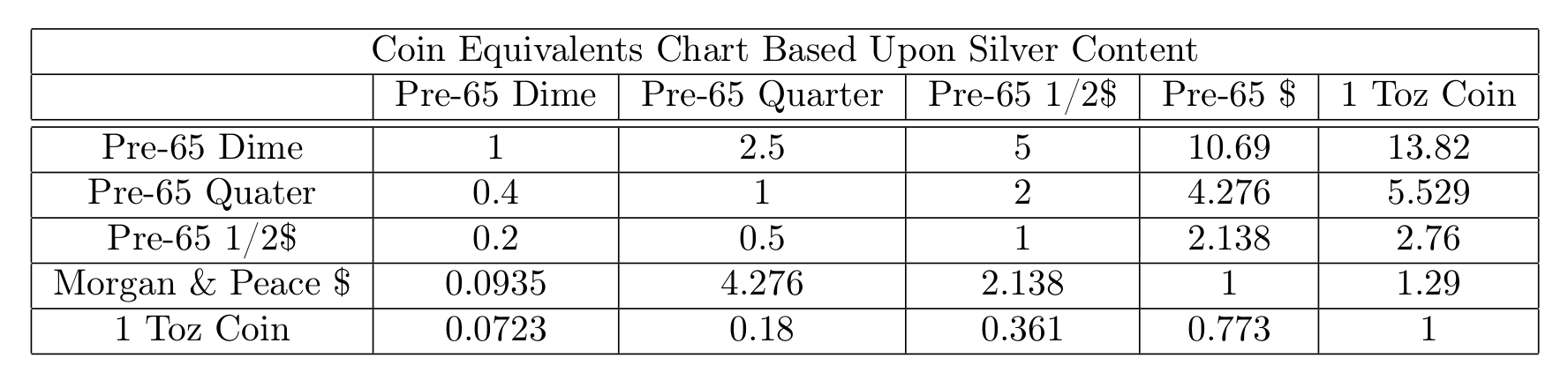
For those holding gold but little in the way of silver, hopefully this demonstrates the need for lower value coinage, as it will be tough to find enough “change” to purchase a loaf of bread with even a 1/10th-ounce gold Eagle, which would be valued at about $120 in this example. Keep in mind that when bartering at an open-air market, there will be no banks or exchanges to break down denominations—unless someone has a sufficient supply of coinage and chooses to open their own booth for just such a purpose, for a small fee of course.
So, for all of us who have ever collected junk silver coins and wondered, “How will I use these? What are they worth?”, now we hopefully have a better idea of comparative values and a foundation to start from. This way, you’ll know when someone is trying to sell you a loaf of bread for a one-ounce silver coin that it may be an opportunity to practice your haggling skills! Good luck and happy bartering!
- Ad Ready Made Resources, Trijicon Hunter Mk2$2000 off MSRP, Brand New in the case
- Ad Survival RealtyFind your secure and sustainable home. The leading marketplace for rural, remote, and off-grid properties worldwide. Affordable ads. No commissions are charged!
Letter: Of Batteries and Jumpers
HJL,
My truck’s battery was discharged (forgot to unplug something), it was COLD, and I couldn’t find anyone to give me a jump, at least not quickly, and it was about a half mile away. I have 2-gauge jumper cables in the truck. Over a half dozen times these would start other cars being jumped that would barely turn over when the thinner “economy” cables didn’t. I literally just swapped cables and it would start right up. And these, which aren’t that much more expensive, can carry 600 cold-cranking amps over the distance. The typical thin ones make 13.5 volts at the running car about 6 volts at the dead battery, due to IIR losses; that’s not enough for the starter. I also have two big 8A8D AGM batteries for my solar, but I wasn’t about to try to drag them the distance. For my Harley, I happened to have a 540 CCA lithium battery, which I had at home. These are small and light weight, so I just carried it to the truck, used my 2-gauge jumper cables, and started my truck. I’m not sure about those smaller battery boxes that “can even start a bus”, but I just started my truck with my compact, lightweight lithium motorcycle battery. These batteries are also useful to put near your devices when your generator or inverter drops voltage or there is inductance (like a noise suppressor) in the long cables when something demands a surge (like a Ham radio transmitting 100w). – T.Z.
- Ad Don't wait - get the ultimate US-made ultra-high performance US-made SIEGE Stoves and stunning hand-crafted SIEGE belts for Christmas. For stocking-stuffers see our amazing fire-starters. Gifts that can save lives. Big Sale!Every bespoke SIEGE buckle goes through an hours-long artisanal process resulting in a belt unlike anything else, with blazing fast performance and looks and comfort to match.
- Ad LifeSaver 20K JerryCan Water PurifierThe best water jerrycan you can buy on the market! Mention Survivalblog for a Free Filter ($130 Value)
Economics and Investing:
o o o
Fourth Turning – Social & Cultural Distress Dividing The Nation – Sent in by J.Q.
o o o
Items from Professor Preponomics:
Britain Sets 2018 Deadline for Claims in Country’s Costliest Bank Scandal (Reuters)
European Banks Sitting on $1T in Bad Debt (Contra Corner)
Switzerland is about to Launch a HUGE Experiment in the “War on Cash” (Business Insider) Commentary: The Swiss and the Swedes make for a very interesting contrast in the view of cash vs. electronic funds.
Oil Prices Drop on Supply Glut Worries (Market Watch)
7 Money Saving, Stress-Less Holiday Shopping Tips (Real Simple)
U.S. Debt Spikes $578B in Three Weeks (Washington Examiner) Note: This is what happens when spending in Washington is wholly unrestrained.
Tight Inventories & Rising Prices Hurt U.S. Home Sales (Reuters)
HSBC to Begin 2,000 Commercial Banking Unit Layoffs (Bloomberg)
The Good Ol’ Days: When Tax Rates Were 90% (Mises Institute)
Goldman: Stocks Going Nowhere in 2016 (Business Insider)
- Ad USA Berkey Water Filters - Start Drinking Purified Water Today!#1 Trusted Gravity Water Purification System! Start Drinking Purified Water now with a Berkey water filtration system. Find systems, replacement filters, parts and more here.
- Ad Click Here --> Civil Defense ManualNOW BACK IN STOCK How to protect, you, your family, friends and neighborhood in coming times of civil unrest… and much more!
Odds ‘n Sods:
SurvivalBlog reader T.Z. has an excellent idea on where to send the ISIS infiltrators refugees bound for the American Redoubt. Let’s take up a collection and send them to his Mansion. Michael Moore Launches #MyHomeIsOpen Website to encourage Americans to House Refugees
o o o
Since we’re all thinking of a yummy Thanksgiving dinner and leftovers this holiday weekend, Mr. and Mrs. Frank and Fern Feral wrote a very appropriate article which asks ourselves probing questions of our abilities to obtain food in a long-term TEOTWAWKI situation. Would you be able to grow and store food for your family? Please also check out the comment sections for further insights. – Avalanche Lily.
o o o
Crimea off grid, Ukraine next – Someone destroyed the pylons holding the electric lines up, and forces are preventing repair. Meanwhile Russia has threatened to cut off natural gas to the Ukraine (and Europe)? Ask them if prepping is crazy.
o o o
Abandoned Cars: Survival Salvage Ideas – Sent in by G.P.
o o o
Drones have now made their way into Agriculture: DJI Agras MG-1 Agriculture Drone – P.S.
- Ad Trekker Water Station 1Gal Per MinuteCall us if you have Questions 800-627-3809
- Add Your Link Here
Hugh’s Quote of the Day:
“And he said unto him, What is thy name? And he said, Jacob. And he said, Thy name shall be called no more Jacob, but Israel: for as a prince hast thou power with God and with men, and hast prevailed.” – Gen 32:27-28 (KJV)
Notes for Friday – November 27, 2015
November 27th is the birthday of both SurvivalBlog’s Field Gear Editor, Pat Cascio, and sci-fi novelist L. Sprague de Camp (1907 – 2000).
o o o
Black Friday Sales:
- JRH Enterprises is offering New Third Gen Pinnacle Autogated PVS14 Night vision devices all ITT/Exelis tubes and complete with all accessories and a real 10 year warranty from the manufacturer. In addition to the sale price, JRH is giving the higher specification P+ tube units for the Black Friday sale price of $2799.
- Smart Living Shopper is having the best prices they’ve ever offered on the Survival Still.
- Apex Gun Parts has some great deals on everything from AK47 mags to Ballistic Vests.
o o o
Today, we present another entry for Round 61 of the SurvivalBlog non-fiction writing contest. The nearly $12,000 worth of prizes for this round include:
First Prize:
- A Tactical Self-Contained 2-Series Solar Power Generator system from Always Empowered. This compact starter power system is packaged in a wheeled O.D. green EMP-shielded Pelican hard case (a $1,700 value),
- A Gunsite Academy Three Day Course Certificate that is good for any one, two, or three day course (a $1,195 value),
- A course certificate from onPoint Tactical for the prize winner’s choice of three-day civilian courses, excluding those restricted for military or government teams. Three day onPoint courses normally cost $795,
- DRD Tactical is providing a 5.56 NATO QD Billet upper with a hammer forged, chromlined barrel and a hard case to go with your own AR lower. It will allow any standard AR type rifle to have quick change barrel, which can be assembled in less than one minute without the use of any tools and a compact carry capability in a hard case or 3-day pack (an $1,100 value),
- Gun Mag Warehouse is providing 20 Magpul pmags 30-rd Magazines (a value of $300) and a Gun Mag Warehouse T-Shirt; (an equivalent prize will be awarded for residents in states with magazine restrictions),
- Two cases of Mountain House freeze dried assorted entrees in #10 cans, courtesy of Ready Made Resources (a $350 value),
- The Ark Institute is donating a non-GMO, non-hybrid vegetable seed package (enough for two families of four) plus seed storage materials, a CD-ROM of Geri Guidetti’s book “Build Your Ark! How to Prepare for Self Reliance in Uncertain Times”, and two bottles of Potassium Iodate (a $325 retail value),
- A $250 gift certificate from Sunflower Ammo,
- KellyKettleUSA.com is donating both an AquaBrick water filtration kit and a Stainless Medium Scout Kelly Kettle Complete Kit with a combined retail value of $304, and
- Two cases of meals, Ready to Eat (MREs), courtesy of CampingSurvival.com (a $180 value).
Second Prize:
- A Glock form factor SIRT laser training pistol and a SIRT AR-15/M4 Laser Training Bolt, courtesy of Next Level Training, which have a combined retail value of $589,
- A FloJak EarthStraw “Code Red” 100-foot well pump system (a $500 value), courtesy of FloJak.com,
- A transferable certificate for a two-day Ultimate Bug Out Course from Florida Firearms Training (a $400 value),
- A Model 120 Series Solar Generator provided by Quantum Harvest LLC (a $340 value),
- A $300 gift certificate from Freeze Dry Guy,
- A Trekker IV™ Four-Person Emergency Kit from Emergency Essentials (a $250 value),
- Twenty-five books, of the winners choice, of any books published by PrepperPress.com (a $270 value),
- A pre-selected assortment of military surplus gear from CJL Enterprize (a $300 value),
- RepackBox is providing a $300 gift certificate to their site, and
- Safecastle is providing a package of 10 LifeStraws (a $200 value)
Third Prize:
- A Royal Berkey water filter, courtesy of Directive 21 (a $275 value),
- A $245 gift certificate from custom knifemaker Jon Kelly Designs, of Eureka, Montana,
- A large handmade clothes drying rack, a washboard, and a Homesteading for Beginners DVD, all courtesy of The Homestead Store, with a combined value of $206,
- Expanded sets of both washable feminine pads and liners, donated by Naturally Cozy (a $185 retail value),
- Two Super Survival Pack seed collections, a $150 value, courtesy of Seed for Security, LLC,
- Mayflower Trading is donating a $200 gift certificate for homesteading appliances,
- APEX Gun Parts is donating a $250 purchase credit,
- Montie Gear is donating a Precision Rest (a $249 value), and
- Two 1,000-foot spools of full mil-spec U.S.-made 750 paracord (in-stock colors only) from www.TOUGHGRID.com (a $240 value).
Round 61 ends on November 30th, so get busy writing and e-mail us your entry. Remember that there is a 1,500-word minimum, and that articles on practical “how to” skills for survival have an advantage in the judging.
Start Growing Your Own Food Now, by Piper in Virginia
It’s now been six years since I heard JWR on one of the big talk radio shows plugging one of his books, How to Survive the End of the World As We Know It. I had never been exposed to this type of rationale before. The more he spoke, the more it made sense to me. Since I’ve been known to get too much forward progress before my mind engages, I took a look at the website you are now reading and asked my consigliore (aka: beloved wife) if I was missing something. She undertook a few days of research and after much talking between us, we then asked another relative to look at the same SurvivalBlog site. That relative agreed with us that “prepping” made a lot of sense to the three of us. As suburbanites, we were limited to stocking up on the three B’s– beans, bullets, and bandages. We also started to look at property out in the country. We purchased a five-acre piece of property and immediately started planting fruit trees, since the time for our local fruit trees to mature is about three to five years. We started building in 2012 and finally moved full time the next year.
I mention the fruit trees because it takes time for them to mature and produce fruit. If you are thinking you will just run out to the local big box store and toss the tree in the ground and next summer you have big perfect fruit, uh, I don’t think so. Even now, four years later, the deer and the bugs have conspired to eat our fruit, and while we have joined in battle we did lose some fruit. I haven’t even mentioned fruit tree diseases.
We have some friends a little south of us who had started a full-time commercial farm utilizing high tunnels. This type of plastic covered structure has been mentioned before on this site. Our friends have constructed three high tunnels; their three tunnels are 30’ X 100’ in size. Using this type of structure, properly designed and constructed, will allow you to grow produce almost year round. With something of that size, you may want to use a professionally designed steel framed structure to be able to withstand the snow load and wind load. However, if you want to do something a bit smaller and are looking to save some money, do a search on Eliot Coleman at Four Season Farm, and you will see several ways to save money on your high tunnel construction. He also has been mentioned before here. His website, books, and Youtube videos are priceless. I used the structure that utilized metal conduit with a rebar insert. You probably won’t be able to grow tomatoes and cucumbers in January, but you will be able to grow many kinds of leafy greens, carrots, turnips, and beets during the winter months. My wife makes a collard and greens salad during winter that people fight over. Yeah, turn your nose if you will. We did too, but now we can’t get enough of it. Having said that, the weather will conspire to ruin your best laid plans. The first winter we were here we didn’t realize a snow forecast for six inches would turn into a crushing 20 inches. When we woke up the next morning, that first high tunnel was squashed. AARRGGHH! So I went out and pushed and pulled and got it to where the wife could work it, if she could work an area three feet high. I now have a 16’ snow rake, and I might have to go out every few hours if there is a heavy snow. Then the voles found out there was a warm area in the winter where they could get lots of leafy vegetables from below. The little guys ate my crops, and I didn’t even get a kiss goodnight. AARRGGHH!
I built a second high tunnel nearby, and this time I put a 3” layer of gravel below our topsoil mix, which was 12-16” deep. I thought I could save more money by using plastic sheeting from the big box store. Yeah, it was looking good. The wife grew some serious leafy greens during the winter. Alas, the plastic wore out in less than a year due to the sun and wind, and I had to replace it a few weeks ago. AARRGGHH! This time I used the good plastic sheeting designed just for high tunnels and cut to the dimensions I requested. I found it on Amazon.
So next I had to rebuild the first squashed high tunnel utilizing a gravel base, with the good plastic on a stronger grid, and using the proper drip tape for irrigation. Search Berry Hill Irrigation for more about drip tape. When these are constructed right and the sun is out, the temperature can get up as high as 90 degrees during the day, even during the winter. You will also need ventilation in case the temperature gets too high. We’ll start the seeds for our summer crop on January 1st and transplant them in late February. This way we will able to harvest some crops by June 1st. Some of our summer crops will produce until Thanksgiving. Start with heirloom seeds and make your own starter soil mix. Place your mix into a hand-held soil blocker. Place the blocks into a plastic tray that holds 50 blocks at a time. Place a seed into each block and keep it moist under sunlight. Hopefully, all of the seeds will germinate, but sometimes they don’t. The blocks that do germinate will then get transplanted into the high tunnel. Many of our gardening supplies come from Johnnie’s Seeds, but if you are on the computer, you already know how to shop for deals. You will also need to start making your own compost in large quantity. Do you have access to manure? Are the animals making the manure eating from a field that is treated with herbicide that kills the weeds? If the treated vegetation goes through the animal to your compost, that may endanger your new plantings.
The wife is now taking a Master Gardener class. She wants to become even more knowledgeable at growing food. We have been to several different farming conferences during the past few years, because we wanted to learn sustainable farming and use very little corporately-made fertilizers and pesticides. This means we must constantly learn from experienced people. I’m a city boy, but I’m studying hard to be a redneck. So we moved from a 60% failure rate the first year to a 40% failure rate this last year. So, when the wife asked her teachers about growing failures, they said they regularly had a 10% to 40% failure rate every year. This goes wrong, that goes wrong, you get a late frost, the worms or beetles or whatever goes crazy, and that’s just the way it is. Welcome to farming. I suppose we could use a Monsanto product that may or may not help with the success rate, but we have chosen not to go that route. Now she has learned that we also have to consider different micro-climates within our five acres. What? What’s a micro-climate? I finally figured out the drip tape thing, and now I have to worry about micro-climates? I’ll get back to you on that.
I am also experimenting with hydroponics and aquaponics, using solar power to run the pumps. Both experiments grow produce without using soil. I have fewer bugs to deal with, but I can’t grow just anything. Again, there are many examples on Youtube. We are also trying IBCs (300-gallon bulk containers) by making sure they are clean, cutting them in half, and using them in areas where it would not be useful or prudent to plant in the ground. By filling the IBCs with soil up to 24” deep, we basically had a dozen 40” X 48” raised pots with drainage. We had success in the IBCs with sweet potatoes and cabbage but not with the white potatoes. We found the IBCs in the local Craigslist ads but needed to be sure they had not been filled with something nasty, like anti-freeze or plutonium.
Our property is fortunate to have abundant wild blackberries, and we have canned or bottled (wink-wink) many different blackberry products. We also recently turned the end of season vegetables into chow-chow. Next year, we’ll look at adding chickens, goats, or sheep to the mix, along with more high tunnels. We completely understand that we will not be able to thrive with just vegetables. We also have the aforementioned ton of beans to go along with the bullets and bandages. We are using electric dehydrators to dry and preserve many foods. One project for this winter is to build a solar dehydrator.
For those of you who read this blog daily, you know there are a hundred details to work on every day, and if you still have your daily job, like I do, there simply aren’t enough hours in the day. By the way, if you need more time in your day, I think you would be wise to cancel your cable/satellite subscription. Half of each program is taken up by ads. You’ll save $100 a month; think what you can purchase with that. YMMV. You’ll also have more time to plan/dig/plant, especially during daylight savings time. We haven’t had cable for six years and haven’t missed it yet. Yeah, I know you miss your sports. I’ve been there, done that. I get on the computer at the end of the day and watch the highlights. If you aren’t already growing produce, you will not survive just by throwing the seeds in the ground. I’m sure there are many farming conferences that will be conducting classes during the winter months. Please start now, if the SHTF and you have not started; otherwise, your failures will doom your family to a cold and hungry death. If you are a part of a group that will locate out of town, start your plans to start your own produce by next spring. If you aren’t part of a group, find a group, and be prepared to work your butt off to learn how to feed yourself. There is usually room in a group for someone with the right mindset and talents. I know it can be daunting to find someone with which to share your tin-foil hat ideas. I found a great mentor in the area about general location set-up and firearms. I found another to help us with growing. I now have another to help with Ham radio. You can’t do it all yourself. There are many of this community that would love to show you how things work. They might not show you everything, but they will help you with some things. You won’t find them sitting at home. You will need to get involved with other groups of people. Try the church you are hopefully already going to. Try a local Master Gardener’s class. Try the local shooting range.
I remember that when we started out in 2009, the end looked so far away, but we bought the first pound of beans and the first box of .22 ammo and just kept at it. Now we know we will never be done; we will never have everything we need. We’re merely better prepared than we were six years ago. If you are just starting out on your prepping journey now, you are a little behind. However, if you will start right now and start networking with others right now, you will feel way better about the future. Now, unplug the TV and get to work.
Letter Re: Eating after TEOTWAWKI
HJL,
I get excited to read each daily posting. I think how I could make it better and more applicable to my “plan”. I read another very thought provoking article, Eating after TEOTWAWKI, where the author talks about growing a garden and some environmental issues he has run into. What to grow and how much of each is certainly a question all of us have. JWR and many others in this blog have addressed sweat equity and the idea that one knows more not by reading but through experience. In my ten years of gardening, I’ve also experienced my fair share of environmental disasters during this time. For those of you just getting started prepping or have done it their whole lives, I wish to add two thoughts. First, think about a time in the near future where all you eat comes from a garden, storage food, MRE’s, or hunting. This sudden change in diet will, for most of us, cause all kinds of Gastrointestinal (GI) issues. One thing that’s easy to grow are leafy greens: spinach, lettuces, kale, arugula, dandelions, collard greens, and mustard greens. By consuming more salads or roughage, many GI issues can be mitigated. If we all ate a few more salads currently, most of us will find that those “extra pounds” will “fall right off”. Make sure your gardening plans include eating more greens. They grow well in all months, except the heat of summer. The second thought is how/where to grow. Many people enjoy growing a traditional garden outside, with the use of a tiller and some hand tools. In my opinion, there is nothing wrong with that, and some bountiful harvests can be had. Most of the food is ready for harvest around the same time, and people put up what they’ve harvested. Very few people succeed on a year-to-year basis. I measure “success” by their ability to put away enough food for a year, save seeds, and avoid all that nature has to throw at them– drought, wet conditions, storms, wind, heat, early fall, late springs, pests, and animals. After I’d had enough of nature a few summers ago, I began my studies of commercial farming, specifically using greenhouses, and how those commercial farmers have crops year around. By using a green house, one has more control over nature. Pest control, humidity control, cooler summers, warmer winters, pest control, and rodent control can all be factors that allow a farmer the ability to consistently produce fresh food all year long. When the balloon goes up, you should have all of this in place, seeds stocked up, and production underway. A good place to start learning is on YouTube; search “geothermal greenhouse” to learn many different ways to grow. Go visit and learn from commercial farmers in your area. I hope that my thoughts allow you to harvest more food, give you new ideas, and that you use any extra for charity! Proverbs 3:5 – A.M. In N.C.
Economics and Investing:
Reader P.M. notes: Premera Blue Cross may have laid off over 300 people, and yet won’t talk about it. They are also rumored to be losing money on the individual line of business. The fallout from the poor design of Obamacare continues.
o o o
Items from Professor Preponomics:
A Shocking Number of Americans Don’t Have a Toilet (The Week)
When Financial Bubbles Burst: Real Estate Values are Plunging in Canadian Heavy Oil Patch (Contra Corner)
Interest Rates to Stay Low Longer, Household Debt Remains a Concern – Says the Bank of England (The Telegraph)
Glencore’s Oil Deal in Libya Branded Worthless by Rival Government (The Guardian)
Brazil’s Economic Meltdown: Stagflation Ahead, Goldman Unreservedly Disappointed (Zero Hedge)
5 Steps to Help You Get Started Paying Off Debt (About.com)
7 Ways to Avoid Identity Theft Over the Holiday Season (Washington Post)
The Best Things in Life are Free (Clark Howard)
Simple Christmas Links (Becoming Minimalist)
7 Money Saving, Stress-Less Holiday Shopping Tips (Real Simple)
Banking’s Uber Moment (Business Insider)
Big Banks Accused of Interest Rate-Swap Fixing in U.S. Class Action Suit (Reuters) Hint: Be sure to take note of “who” brought the suit.
Once Ratified the TPP Could Encompass 40% of World GDP (Canadian Progressive)
Odds ‘n Sods:
World’s first 3D printed self-loading revolver revealed: Washbear can fire eight .22 bullets and be made on ANY home 3D printer – Sent in by JBG
o o o
While willfully ignoring current immigration law, the White House has sent a stern warning to states about the refugee battle: You don’t have power to stop refugees. Sent in by T.P.
o o o
R.C. sent in this link: As the immoral drone war continues in the Middle East, Drone Pilots have Bank Accounts and Credit Cards Frozen by Feds for Exposing US Murder.
o o o
According to Bill Whittle, we should have had the shiny modern future dreamed up in the space age… so why don’t we? Because of liberals!
Reclaiming the Lost Future: Unlimited Clean Energy
Reclaiming the Lost Future: Ethical Happy People
o o o
D.S. sent in this video from Bearing Arms: Are You An Armed Citizen Or Just A Gun Owner?
Hugh’s Quote of the Day:
“It is hard to imagine a more stupid or more dangerous way of making decisions than by putting those decisions in the hands of people who pay no price for being wrong.” – Thomas Sowell
Notes for Thursday – November 26, 2015
From the SurvivalBlog Family to yours, we wish you a happy Thanksgiving. Despite the crises in this world and the mounting pressures, we give thanks to our LORD that you are are still here, you are still prepping, and that He will never forsake us.
November 26th is the birthday of both gun inventor Eugene Reising (born 1884, died February 21, 1967) and the late Barton Biggs (born 1932, died July 14, 2012). Biggs was a money manager known for his pro-preparedness stance.
o o o
Today, we present another entry for Round 61 of the SurvivalBlog non-fiction writing contest. The nearly $12,000 worth of prizes for this round include:
First Prize:
- A Tactical Self-Contained 2-Series Solar Power Generator system from Always Empowered. This compact starter power system is packaged in a wheeled O.D. green EMP-shielded Pelican hard case (a $1,700 value),
- A Gunsite Academy Three Day Course Certificate that is good for any one, two, or three day course (a $1,195 value),
- A course certificate from onPoint Tactical for the prize winner’s choice of three-day civilian courses, excluding those restricted for military or government teams. Three day onPoint courses normally cost $795,
- DRD Tactical is providing a 5.56 NATO QD Billet upper with a hammer forged, chromlined barrel and a hard case to go with your own AR lower. It will allow any standard AR type rifle to have quick change barrel, which can be assembled in less than one minute without the use of any tools and a compact carry capability in a hard case or 3-day pack (an $1,100 value),
- Gun Mag Warehouse is providing 20 Magpul pmags 30-rd Magazines (a value of $300) and a Gun Mag Warehouse T-Shirt; (an equivalent prize will be awarded for residents in states with magazine restrictions),
- Two cases of Mountain House freeze dried assorted entrees in #10 cans, courtesy of Ready Made Resources (a $350 value),
- The Ark Institute is donating a non-GMO, non-hybrid vegetable seed package (enough for two families of four) plus seed storage materials, a CD-ROM of Geri Guidetti’s book “Build Your Ark! How to Prepare for Self Reliance in Uncertain Times”, and two bottles of Potassium Iodate (a $325 retail value),
- A $250 gift certificate from Sunflower Ammo,
- KellyKettleUSA.com is donating both an AquaBrick water filtration kit and a Stainless Medium Scout Kelly Kettle Complete Kit with a combined retail value of $304, and
- Two cases of meals, Ready to Eat (MREs), courtesy of CampingSurvival.com (a $180 value).
Second Prize:
- A Glock form factor SIRT laser training pistol and a SIRT AR-15/M4 Laser Training Bolt, courtesy of Next Level Training, which have a combined retail value of $589,
- A FloJak EarthStraw “Code Red” 100-foot well pump system (a $500 value), courtesy of FloJak.com,
- A transferable certificate for a two-day Ultimate Bug Out Course from Florida Firearms Training (a $400 value),
- A Model 120 Series Solar Generator provided by Quantum Harvest LLC (a $340 value),
- A $300 gift certificate from Freeze Dry Guy,
- A Trekker IV™ Four-Person Emergency Kit from Emergency Essentials (a $250 value),
- Twenty-five books, of the winners choice, of any books published by PrepperPress.com (a $270 value),
- A pre-selected assortment of military surplus gear from CJL Enterprize (a $300 value),
- RepackBox is providing a $300 gift certificate to their site, and
- Safecastle is providing a package of 10 LifeStraws (a $200 value)
Third Prize:
- A Royal Berkey water filter, courtesy of Directive 21 (a $275 value),
- A $245 gift certificate from custom knifemaker Jon Kelly Designs, of Eureka, Montana,
- A large handmade clothes drying rack, a washboard, and a Homesteading for Beginners DVD, all courtesy of The Homestead Store, with a combined value of $206,
- Expanded sets of both washable feminine pads and liners, donated by Naturally Cozy (a $185 retail value),
- Two Super Survival Pack seed collections, a $150 value, courtesy of Seed for Security, LLC,
- Mayflower Trading is donating a $200 gift certificate for homesteading appliances,
- APEX Gun Parts is donating a $250 purchase credit,
- Montie Gear is donating a Precision Rest (a $249 value), and
- Two 1,000-foot spools of full mil-spec U.S.-made 750 paracord (in-stock colors only) from www.TOUGHGRID.com (a $240 value).
Round 61 ends on November 30th, so get busy writing and e-mail us your entry. Remember that there is a 1,500-word minimum, and that articles on practical “how to” skills for survival have an advantage in the judging.
Eating after TEOTWAWKI, by Midwest Prepper
I just want to say upfront, this article is not all inclusive by any means. I am not a master gardener, and there is so much information out there that can be gathered and much of it is at your fingertips right now, so use the time we have left wisely. I realize that everybody’s definition of how much you are going to eat is different. I am just using examples here.
When you were in school and found out about a test coming up, did you start studying as soon as you could or did you just cram the night before? I would hope that you started studying as soon as you could, instead of waiting until the last moment. That is what this posting is all about: not studying for a test but about you feeding your family when the curtain goes down or the flag goes up, whichever analogy you choose to use. So, how do you plan on feeding yourself and your family? If you are a crammer, then you will be behind the proverbial eight ball when it comes to feeding your family after everything falls apart. If you’re the one that started long before it was necessary then kudos to you. When it comes to feeding your family after the fact, you don’t want to be trying to figure it out; you want to already be ahead of the game.
This article’s main concern is gardening long term. Do you know how much to grow? Do you know what grows best in your area and what doesn’t? I live in zone 5a, according to the USDA Plant Hardiness Zone Map. Go to the website and figure out which zone you are in, if you don’t know already. Do you know how to preserve what you grow? How do you plan on getting protein, if you have no animals?
Do you have seeds? I use heirloom seeds, but there are arguments both ways. This is my personal preference. How will you get a garden going if you can’t till up the ground? Do you know how to turn a yard into a garden?
If you don’t have a roto tiller or the gas for it, how will you turn that spot into a garden bed? You can do it by taking a shovel and digging the sod off. You can do this by watering the area well for several days to make it a little easier to work, but be careful not to water so much that it is soggy because the soil will compact and be difficult for plant root growth. Then you will need to dig the area you want plant and remove the top layer along with grass and weeds. You may have to replace the top soil or add amendments to the soil to insure good growth of your garden. This takes a lot of physical work. Will you be able to do it? Remember some things are easier said than done. You can also use newspaper, cardboard, or plastic to get your area ready to plant. Just place layers of newspaper (something most people just throw away and can be found in large amounts if you look around). Just use the black and white print copy though, or place the cardboard or the plastic over the area. Then you will need to cover the first two with biodegradable material to hold in place. The plastic you can place any material on to hold it in place. These options take several months to kill the grass and weeds by keeping sunlight out. When you remove the covering, you are ready to plant. In the case of the newspaper you will be able to leave it in place and plant through it as it decomposes. Now that you have a garden plot, you have to plant your seeds or your plants that you started. Do you know what you will plant? Do you know how much you need to grow to feed your family?
Do you know how to start your own plants from seed? Can you make your own seed pots? I have been making my own seed pots for several years now and will not go back to buying them. The only cost of making my own seed pots I have is the cost of buying my PotMaker. (You can search these by just typing in The PotMaker or use this link for wholesale prices). You can make your own seed pots using the newspaper that so many people just throw away. Over this last winter I cut enough material to last me for the rest of my life and still have some left over for my children to use once I am gone. So it doesn’t take a terrible amount of time to cut the material. You can do it while watching a movie. After you master this one, you can look around your house and figure out how you might make a little larger one to transplant into so that you can have an even bigger plant when it comes time to plant in the garden. I have done this and had full size tomato plants to plant in the garden when planting time came. I had my first tomato that year a full six weeks earlier than I have ever before. It takes a lot of work to do this.
Do you use soil or seed starting medium? I have found a local company near me that makes a great seed starter that hasn’t failed me yet and it goes a long way. I wouldn’t use soil because it will compact down during watering and your plant will die off. If you use just soil I suggest adding some kind of medium to it so that it isn’t susceptible to that compacting.
Plant what you and your family will eat. When the TEOTWAWKI, you won’t be able to waste all that energy growing something that nobody wants to eat. You need to know now what your family will eat. It will do no good to have 50 pounds of some vegetable that the family will not eat. Now that you know what your family will eat, how much do you need to grow to get through to the next season? Figure out how much each person will eat of each vegetable and fruit. Let’s use carrots as an example. How many will you need to grow to feed your family? The way I figure out what I need is to figure out how many I will eat each week, then multiply that by 52. This is only an example of the amount I plan on eating. Let’s say I plan on eating three carrots per week, and then I will need to grow and harvest 156 of them (3×52 weeks). Just because I need to harvest 156 carrots, that doesn’t mean I will only plant 156 seeds or 160 or even 170 seeds. I will plan on planting at least 300. I will do this because not every seed planted will grow. Let’s say I plant 300 seeds and get an 80% germination rate. That will give me 240 carrots. Of those, if I lose 10% for some reason, I will lose another 24, which brings me to 216 carrots. That gives me an extra 50 carrots to use early or use for barter. Now you have to sit down and figure out what your family will eat, and how much of each fruit or vegetable they will eat. That is how much you will need to grow. You may find it difficult to grow all that you think you will need, but if you have like-minded neighbors, maybe you can get together and each grow different crops and then swap for what each other needs.
Now with that said, my suggestion is for you to plant twice as much as you think you will need. The reason I say this is because of the season we had here this year. If I did not have a larder already and things went south this fall, I would be in deep trouble real soon. What happens when you only plant what you think you will need and the weather turns cooler sooner than usual, or you get an early or late frost? Maybe a storm wreaks havoc on your garden, you have a particular harsh pest problem, or maybe the crop doesn’t produce as you planned. Maybe you have a wetter season than normal. The reason I use these examples is because all of these happened to me this year.
We had a heavy late frost, so I was a week behind getting the garden started. My potatoes hardly produced at all, and the potato bugs were the worst I have seen in years. Right now I don’t use any chemicals in my garden, but I will use whatever I need to use to make sure my family is fed after TEOTWAWKI. The tomato worms were horrible this year also, but I was able to keep ahead of those so the tomato crop was doing fine, until we had a storm that was so severe that it knocked power out for almost a week in some areas. It knocked down over 1000 power lines in our area, so you can imagine the affect the winds had on the garden. Then about three weeks after this storm, we had three days of late fall weather, which many of my plants decided was the sign to go dormant a full four weeks early.
So why do I say grow twice as much as you think you will need? What will you eat through the winter, if you lost big portions of your crops one season and there is no store that you can shop to get what you need? If you grow twice as much as you need, put it up. Then, if any of these things or a combination of these things happen, you will have a backup to supplement what you can salvage from your garden. If you have a great growing season and you put up enough for your family, then you can use the extras to barter with to get things you might need or want.
If you don’t have animals, how will you get your protein? You say you will just go hunting or fishing. Well, that would be a great idea if you were the only one thinking like that, but there will be millions of people with the same mindset. Game may well be hunted into extinction if the trouble goes on for too long. People will be hungry real quick, considering that the average home only has three days of food on hand. I’m not too sure I want to be in the woods with so many people carrying guns, with many of them not even sure what to do or how to do it safely. You can grow beans to substitute for protein until you can get some meat. You should be storing meat in some fashion right now so that you are able to still have some meat protein. Dry beans, such as great northern, kidney, navy beans, et cetera are great for protein and will also give you plenty of fiber.
Okay, so you’ve grown your garden. Now what? Do you know how to save seed from your harvest for the next year? Do you know that it takes two years to get carrot seed? I know that, but I have yet to harvest a single seed. I am still practicing that while I have the time. Do you know how to store your produce? Do you know how to can or dehydrate? Do you know how to make a root cellar to keep it fresh longer into winter? There are many good books out there on all of these subjects. Check them out at the library, and then buy the ones that you like or think will help you the most.
- Ball Blue Book
- Seed to Seed by Suzanne Ashworth
- Root Cellaring by Mike and Nancy Bubel
- Dehydrating Bible by Jennifer MacKenzie
These are just a few of the books I have in my library. There are many books out there. So, like I said before, check them out at your local library before you buy them. I have researched many books this way. I would not have been able to afford buying all of them just to find out I won’t use them. There are also many great articles in the archives on this blog. Don’t be afraid to search them out and read them.
Here are some seed companies that you can use to get stocked up. I have personally used all of these in the past and can say I am happy with their service. DISCLAIMER: I receive no compensation of any kind from any of these companies. I share these to help others find what they are looking for.
- Seed Savers Exchange
- Tomato Growers
- Territorial Seed
- Vermont Bean Company
- Main Street Seed and Supply
- Baker Creek Heirloom Seed Company
- Burpee Seeds
There are others. Just do a search on the Internet and find the ones you want to do business with. You can also go to your local garden center, local hardware, or one of the big box stores to get your seed.
Start stocking up on seeds, pest control items, fertilizers, tools, and knowledge now before it is too late. Practice these things now, while you can still eat if things don’t work out for you. You don’t want to be in a disaster situation and have to learn all these things while under pressure. I have been gardening for a while and I am still learning things each year of what works and what doesn’t. Gardening is not easy now, and it will not be any easier after TEOTWAWKI, but like anything else in this life, it will get easier the more you do it. Gardening can be fun and also relaxing. So get started now, while you can.