Odds ‘n Sods:

The “Instant Background Check” managed to pass because it was illegal for the government to keep and maintain a database derived from these background checks. In a recent Washington Post article, the GAO announced that at least 2233 times, suspected terrorists attempted to buy firearms and succeeded in 2043 of those times. How would they know this if the data is not kept? Either the GAO is lying about the numbers or they are illegally keeping the data! My bet is on the illegal data retention. – Thanks to T.Z. for the link.

o o o

Point Deer, Make Horse A profound article that offers an insightful analysis of what’s gone wrong with the Liberal thinking process. I have often wondered why they are immune to logic or evidence and hostile to truth, and Wright’s article has shed some useful light. Sent in by ShepherdFarmerGeek

o o o

Reader RDG writes in regarding the “No Fly List” referenced in Odds ‘n Sods: It appears that the “no fly list” is morphing into something much more dangerous, as indicated in this article. Also as the TSA moves out of airports into bus and train stations, all we need are roadway check points to become, oh I don’t know, East Germany? China? N. Korea? So now, BHO is proposing even further mission creep, making the NF list into a no firearms list. Great, just perfect.

o o o

From the desk of Mike Williamson, SurvivalBlog Editor At Large: Learn Survival Skills from the 340-Page Tokyo Disaster Preparedness Guide

o o o

Reader B.B. sent in this link to a news video where a couple of Islamic men tried to purchase 60 prepaid phones: Large quantity of cellphones bought raises red flags


Hugh’s Quote of the Day:

“Government is merely a servant – merely a temporary servant; it cannot be its prerogative to determine what is right and what is wrong, and decide who is a patriot and who isn’t. Its function is to obey orders, not originate them.” – Mark Twain


Notes for Wednesday – December 09, 2015

December 9th, 1914 is the birthday of Maximo Guillermo “Max” Manus. He was one of the few Norwegians who had the testicular fortitude to put his life on the line, fighting the Nazi occupiers. (There surely would have been more active resistance fighters, but fearing widespread reprisal executions by the Germans, King H7 asked the civilian populace to stand down.) Max Manus passed away in 1996. I would have liked to have met him. His exploits are fairly accurately shown in the movie Max Manus: Man of War.

o o o

Today, we present another entry for Round 62 of the SurvivalBlog non-fiction writing contest. The nearly $12,000 worth of prizes for this round include:

First Prize:

  1. A Tactical Self-Contained 2-Series Solar Power Generator system from Always Empowered. This compact starter power system is packaged in a wheeled O.D. green EMP-shielded Pelican hard case (a $1,700 value),
  2. A Gunsite Academy Three Day Course Certificate that is good for any one, two, or three day course (a $1,195 value),
  3. A course certificate from onPoint Tactical for the prize winner’s choice of three-day civilian courses, excluding those restricted for military or government teams. Three day onPoint courses normally cost $795,
  4. DRD Tactical is providing a 5.56 NATO QD Billet upper with a hammer forged, chromlined barrel and a hard case to go with your own AR lower. It will allow any standard AR type rifle to have quick change barrel, which can be assembled in less than one minute without the use of any tools and a compact carry capability in a hard case or 3-day pack (an $1,100 value),
  5. Gun Mag Warehouse is providing 20 Magpul pmags 30-rd Magazines (a value of $300) and a Gun Mag Warehouse T-Shirt; (an equivalent prize will be awarded for residents in states with magazine restrictions),
  6. Two cases of Mountain House freeze dried assorted entrees in #10 cans, courtesy of Ready Made Resources (a $350 value),
  7. The Ark Institute is donating a non-GMO, non-hybrid vegetable seed package (enough for two families of four) plus seed storage materials, a CD-ROM of Geri Guidetti’s book “Build Your Ark! How to Prepare for Self Reliance in Uncertain Times”, and two bottles of Potassium Iodate (a $325 retail value),
  8. A $250 gift certificate from Sunflower Ammo,
  9. KellyKettleUSA.com is donating both an AquaBrick water filtration kit and a Stainless Medium Scout Kelly Kettle Complete Kit with a combined retail value of $304, and
  10. Two cases of meals, Ready to Eat (MREs), courtesy of CampingSurvival.com (a $180 value).

Second Prize:

  1. A Glock form factor SIRT laser training pistol and a SIRT AR-15/M4 Laser Training Bolt, courtesy of Next Level Training, which have a combined retail value of $589,
  2. A FloJak EarthStraw “Code Red” 100-foot well pump system (a $500 value), courtesy of FloJak.com,
  3. A transferable certificate for a two-day Ultimate Bug Out Course from Florida Firearms Training (a $400 value),
  4. A Model 175 Series Solar Generator provided by Quantum Harvest LLC (a $439 value),
  5. A Trekker IV™ Four-Person Emergency Kit from Emergency Essentials (a $250 value),
  6. Twenty-five books, of the winners choice, of any books published by PrepperPress.com (a $270 value),
  7. A pre-selected assortment of military surplus gear from CJL Enterprize (a $300 value),
  8. RepackBox is providing a $300 gift certificate to their site, and
  9. Safecastle is providing a package of 10 LifeStraws (a $200 value)

Third Prize:

  1. A Royal Berkey water filter, courtesy of Directive 21 (a $275 value),
  2. A $245 gift certificate from custom knifemaker Jon Kelly Designs, of Eureka, Montana,
  3. A large handmade clothes drying rack, a washboard, and a Homesteading for Beginners DVD, all courtesy of The Homestead Store, with a combined value of $206,
  4. Expanded sets of both washable feminine pads and liners, donated by Naturally Cozy (a $185 retail value),
  5. Two Super Survival Pack seed collections, a $150 value, courtesy of Seed for Security, LLC,
  6. Mayflower Trading is donating a $200 gift certificate for homesteading appliances,
  7. APEX Gun Parts is donating a $250 purchase credit,
  8. Montie Gear is donating a Precision Rest (a $249 value), and
  9. Two 1,000-foot spools of full mil-spec U.S.-made 750 paracord (in-stock colors only) from www.TOUGHGRID.com (a $240 value).

Round 61 ends on January 31st, so get busy writing and e-mail us your entry. Remember that there is a 1,500-word minimum, and that articles on practical “how to” skills for survival have an advantage in the judging.


The 9mm Parabellum vs the .40 Smith and Wesson vs the .45 ACP, by B.F.

I recently wrote a letter to SurvivalBlog suggesting that preppers who were looking to upgrade their handguns consider some of the bargains currently available in .40 S&W. In recent weeks, I have seen police trade-ins dropping even more in price with Sig Sauer P226s and P229s selling for as low as $305 and Glock 22s selling for $279. Hugh asked me about my experience with the .40, and I sent him back a note that covered a bit of ground on that topic. I’ve been shooting and reloading for the .40 S&W since Glock introduced the G35 in 1998. That got me to thinking about some of the passionate discussions you hear, whenever gun guys and girls get together, about 9mm vs .40 vs .45. Usually it goes something like Big Heavy Bullet vs Light Fast Bullet and higher capacity vs something in the middle that either is the best of both worlds or is the worst compromise ever. The armchair experts talk a lot of theory, comparing the knock down power of the .45 vs velocity and hydrostatic shock for the 9mm, and the .40 having both depending on load.

Which of the three service cartridges is the best pistol cartridge for a prepper? That is a topic for a discussion without end. There are many different bullets available for each caliber today, and ballistics experts are constantly designing new ones that are increasingly effective. If you were to consider revolvers, the list of cartridges gets even longer, including the .327 Federal, 38 S&W Special, .357 S&W Magnum, the .41 Remington Magnum, the .44 S&W Special, 44 Remington Magnum, and .45 Colt, not to mention those chambered in pistol calibers, like the 9mm, the 40 S&W, the 10mm, and the .45 ACP. Revolvers have their place, but that is a different article.

The FBI recently decided to switch from the .40 S&W to the 9mm. It had adopted the 10mm in 1989 following what was considered poor performance of the .38 special and the 9mm in the Miami Shootout where two agents were killed and five wounded. It then found out that some agents could not effectively shoot the more powerful 10mm and reduced the load, which led to Smith and Wesson shortening the 10mm to the .40 S&W, matching the reduced power load in a cartridge that would fit into standard frame pistols. Now the FBI is satisfied that improvements in projectile design mean that the 9mm is again an effective man stopper.

There are a couple of schools of thought, when it comes to trying to determine handgun cartridge effectiveness.

One school represented by some folks, like Dr. Martin Fackler, tend to use data and calculations to try to show the theoretical effectiveness of various cartridges.

Others, like Evan Marshall and Edwin Sanow, look at actual shootings and are based on the facts they are able to identify or impute, drawing conclusions about the shooting.

I am not an expert on either of these methods, and although I have read articles and papers by both camps, I am far from any point where I can draw meaningful conclusions from them.

I am not looking to get into a discussion of terminal or wound ballistics. To my thinking, the 9mm, .40S&W, and .45ACP are all about equally effective or ineffective. All three depend on bullet design and more importantly on shot placement to neutralize a threat. If you have been shot with all three, please feel free to share your first-hand knowledge. I will instead go with the belief that while handguns are much less effective stoppers than rifles, the handgun on your hip is way more effective than the rifle in your closet or back in your truck.

The other thing that is mentioned regarding which one to select is price. Using the website slickguns.com, I can find 9mm ammunition for $0.17 per round, .40 for $0.21 per round, and .45 ammo for $0.24 per round. Compared to the price of 9mm, it comes to $40 per case more for .40 S&W and $70 more per case for .45 ACP. To me, the difference is not that significant.

So other than opinion, can I add anything to the debate? First, let me share a little about me. I have been a gun nut all my life and was raised on WWII and cowboy movies back in the 1960s. I got my first gun, a .410 shotgun, handed down from my great uncle to my father to me when I was nine years old and my first .22 when I was 11. I shot competitively in ROTC in college and later in the Army. I spent three years as a 45 Bravo Small Arms Repairman. Stationed in Germany in the mid 70’s, I got to spend a lot of time at the ranges in Hohenfels and Grafenwoehr, supporting everything from 1911’s to 4 deuce mortars. I also shot on various Army and Army Reserve shooting teams over the course of 20 years. I have continued shooting competitively since I got out of the Army, and I currently shoot various action pistol disciplines as well as three gun competitions. I am also an NRA instructor and NRA range safety officer.

After thinking through what I could to compare the calibers that would be relevant and repeatable, I thought I’d try some timed shooting drills using a Competitive Dynamics shot timer with similar guns, holsters, and mag pouches in all three calibers. I also wanted to try a couple of different gun designs to see how that affected the results, as well as cartridges at the extreme ends of the pistol power range.

The guns I selected for the test were three Glocks– a Glock 34 in 9mm, a Glock 35 in .40 S&W, and a Glock 21 in .45 ACP. For fun, I thought I’d mix in a compact Glock 27 in .40 S&W and a Glock 20 in 10mm (using full power loads).

For a bit of variety, I also ran the drill using a Ruger 22/45 in .22 LR, a 1911 in .45acp, a Browning Hi-power in 9mm, a Sig p220 in 10mm, a Sig P228 in 9mm, and two Sig P229s in .40 S&W and .357 Sig, and the least practical a Desert Eagle in .50 AE. I was going to throw in some revolvers for variety but decided to save that for another article, if there is interest.

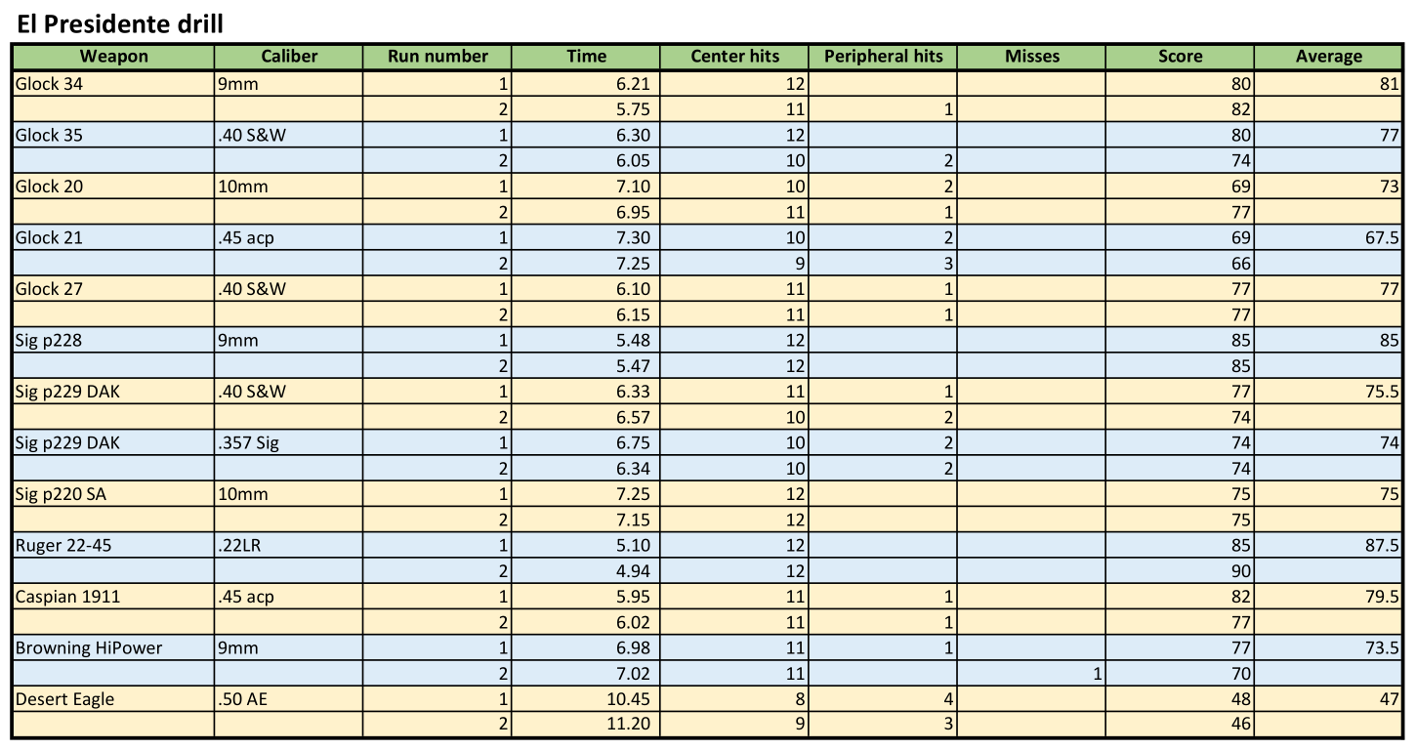
El Presidente scores

The holsters used for all of the guns were “Avenger” type open top leather belt holsters made by a local retired sheriff’s deputy with matching open top mag pouches. With so many similar guns, some of which could chamber the wrong cartridge from another gun, I took special care to only have one gun uncased at a time, and I put away all of the ammunition and accessories for it before I took out the next one.

The drill I decided on was one of the more common drills called the El Presidente. This drill was introduced by Col Jeff Cooper back in 1970 to provide a basis for evaluating shooter proficiency, requiring both speed and accuracy. Later it was adopted by the USPSA as a standard competition course of fire. It consists of three standard silhouette targets placed 10 yards down range with one yard between them. The shooter stands with arms at the side, back towards target, handgun loaded and holstered. On the signal, the shooter faces the target, draws, and engages each target with two rounds, performs a reload and engages each target again with two rounds. The original version of the drill used Par time to score it. Modern versions use a combination of score and elapsed time. Top shooters can do this in under three seconds. I am definitely not a top shooter. For the purpose of this article, I will use the original scoring system as follows: To score this drill, five points are awarded for every hit in the 8-inch center ring and two points for all other hits on the target, for a possible score of 60. Five points are added to the score for every full second under 10 and five points deducted for every full second over 10. Because of the time factor, the potential exists to score more than 60. Revolver par time is 12 seconds instead of 10.

The results are shown on the attached .PDF file. I know we try to avoid photos and illustrations on SurvivalBlog, but I could not think of a better way of displaying the results.

As you can see, not surprisingly the guns that recoiled least performed the best in this drill. The emphasis is on the word “drill”. This is not combat, where adrenaline overwhelms fine motor control and where the shooting is done on a two-way range. I think that the conclusions you can draw from this is that there is little if any significant distinction between the calibers in the real world and that all three of them make an adequate defensive cartridge, the main purpose of which is to allow you to get to your rifle.

Please feel free to ignore the armchair quarterbacks who will vehemently argue the effectiveness of one cartridge vs the other and buy a gun or two that work for you. So to answer the question from earlier, “Which of the three service cartridges is the best pistol cartridge for a prepper?”, the best one is the one you can afford and the one that works for you that you can shoot well.


Two Letters Re: Developing a Communications Plan for Your Group, by NM

HJL,

Good article. I have chosen to organize my FT-60 memory along paths home from destinations that are frequently visited. The ARRL repeater directory makes it easy. It goes hand in hand with thinking through where we might be at a given moment and the path we might take. I-95 sounds like a terrible path, until you identify the state prison along the alternate route. Many things must be considered. – RV

o o o

Good morning, Hugh,

The item Developing a Communications Plan for Your Group, by N.M. is an excellent treatise on “group comm”. I’d like to add one thing, though, regarding voice communications.

It is very beneficial to conduct training on how to communicate via voice; experience with “push to talk” cellular has taught me that while some people understand the concept of concise messages, the great majority using voice comm will engage in rambling “once upon a time and they lived happily ever after” style communications.

A few seconds spent mentally composing the message before pressing the talk button or dialing the number is very helpful; this is where training can help. The philosopher Karl Popper wrote: “It is impossible to speak in such a way that you cannot be misunderstood” and that should be the watchword for voice comm. Clear, simple, accurate, concise messages are imperative, as is keeping the message short. In PTT (push-to-talk) systems, holding the send key down to deliver a long, rambling message locks up the comm channel for everyone else. If your brief message is thin on content the recipient can PTT to request additional info or clarification; they cannot do that while you’re engaging in verbal diarrhea.

Additionally, very brief messages also increase the difficulty of direction finding the transmitter. – N.K.


Economics and Investing:

Greeks Must Declare Non-Bank, Personal Assets – Who’s Next? I fully expect a high level of noncompliance with this edict, but being caught in violation of it can have serious consequences. It is also disturbing to note that we have watched this crises unfold in Greece and then watched our legislators prep the legislation for the same sort of governmental action here.

o o o

Items from Mr. Econocobas:

Canada Just Warned That Negative Interest Rates Are Coming

Morgan Stanley’s Christmas Present To 1,200 Of Its Best-Paid Employees: Pink Slips

Items from Professor Preponomics:

U.S. News

Global Joblessness, the Real Number. (Gallup) One Word Sums It Up: Catastrophic.

BCBS of Michigan to Slash $300M in Expenses by 2018 (Beckers Hospital Review) Spoiler Alert and an Article Quote: It’s no surprise given all the recent reports related to the health care industry in the new world of the ACA. “A BCBS document said the insurer has ‘experienced faster admin cost growth and lower membership gains than national, for-profit plans’ since 2010.”

Texas Fails to Protect Property Owners from Civil Forfeiture (Houston Chronicle) Commentary: When civil forfeiture sees a big boom in business (and law enforcement agencies are allowed to convert their collections to profit), we have big problems. This article reports an average annual Texas super-sized “take” of $41.5M.

International News

Here’s How Venezuela’s Economy Has Tanked Under President Maduro (Bloomberg)

Revising the Findings: Japan’s Economy Wasn’t in Recession in the 3rd Quarter (Bloomberg) Question: Another recession or a fragile recovery? The next moves from the Bank of Japan may be revealing.

Anglo American to Cut Work Force by 85,000 in Restructuring (BBC) Commentary: The article reports that some of these jobs may be absorbed by other companies as they sell off assets, although it’s also true that other companies in the same industry arena may be making similar restructuring moves. Time will tell to what degree employees will be able to accomplish “transferability”. In the interim at least, this is a significant dislocation for many.

Personal Economics and Household Finance

Saving Money: Stay Warm Stay Frugal Money Saving Tips to Winterize Your Home (Christian Science Monitor)

Sneaky Ways to Cut Your Home Heating Bills (Popular Mechanics)


Odds ‘n Sods:

Several readers sent this: video link to a Fox News story: Over 100 MILLION Guns Sold in US Since Obama Became President of United States

JWR’s Comment: That is a stunning figure. I’d say that is roughly one firearm for every adult in the United States. Thanks Obama, you are the Gun Salesman of the Century!

o o o

“We Just Can’t Seem to Pinpoint the Problem”, says Obama so let’s bring in 180,000 more. Are we crazy?

o o o

This smart car seems to have tattled on its driver While it’s difficult to be upset with how the car’s software interpreted the situation and responded, it is almost scary to think how much information we willingly give to “smart devices” with so little thought on how it can be used.

o o o

SurvivalBlog reader SDS sent in a link to an interesting interactive map showing where the violent gun related crime occurs. (OPSEC Warning: it does require you to enter a location to view the map. However, any location will do, then you can pan and zoom the map to your area.

o o o

Reader T.P. sent in the link to this fascinating 7 minute video showing AK-47 steel mags being built in Bosnia and Herzgovina.


Notes for Tuesday – December 08, 2015

Today, we present another entry for Round 62 of the SurvivalBlog non-fiction writing contest. The nearly $12,000 worth of prizes for this round include:

First Prize:

  1. A Tactical Self-Contained 2-Series Solar Power Generator system from Always Empowered. This compact starter power system is packaged in a wheeled O.D. green EMP-shielded Pelican hard case (a $1,700 value),
  2. A Gunsite Academy Three Day Course Certificate that is good for any one, two, or three day course (a $1,195 value),
  3. A course certificate from onPoint Tactical for the prize winner’s choice of three-day civilian courses, excluding those restricted for military or government teams. Three day onPoint courses normally cost $795,
  4. DRD Tactical is providing a 5.56 NATO QD Billet upper with a hammer forged, chromlined barrel and a hard case to go with your own AR lower. It will allow any standard AR type rifle to have quick change barrel, which can be assembled in less than one minute without the use of any tools and a compact carry capability in a hard case or 3-day pack (an $1,100 value),
  5. Gun Mag Warehouse is providing 20 Magpul pmags 30-rd Magazines (a value of $300) and a Gun Mag Warehouse T-Shirt; (an equivalent prize will be awarded for residents in states with magazine restrictions),
  6. Two cases of Mountain House freeze dried assorted entrees in #10 cans, courtesy of Ready Made Resources (a $350 value),
  7. The Ark Institute is donating a non-GMO, non-hybrid vegetable seed package (enough for two families of four) plus seed storage materials, a CD-ROM of Geri Guidetti’s book “Build Your Ark! How to Prepare for Self Reliance in Uncertain Times”, and two bottles of Potassium Iodate (a $325 retail value),
  8. A $250 gift certificate from Sunflower Ammo,
  9. KellyKettleUSA.com is donating both an AquaBrick water filtration kit and a Stainless Medium Scout Kelly Kettle Complete Kit with a combined retail value of $304, and
  10. Two cases of meals, Ready to Eat (MREs), courtesy of CampingSurvival.com (a $180 value).

Second Prize:

  1. A Glock form factor SIRT laser training pistol and a SIRT AR-15/M4 Laser Training Bolt, courtesy of Next Level Training, which have a combined retail value of $589,
  2. A FloJak EarthStraw “Code Red” 100-foot well pump system (a $500 value), courtesy of FloJak.com,
  3. A transferable certificate for a two-day Ultimate Bug Out Course from Florida Firearms Training (a $400 value),
  4. A Model 175 Series Solar Generator provided by Quantum Harvest LLC (a $439 value),
  5. A Trekker IV™ Four-Person Emergency Kit from Emergency Essentials (a $250 value),
  6. Twenty-five books, of the winners choice, of any books published by PrepperPress.com (a $270 value),
  7. A pre-selected assortment of military surplus gear from CJL Enterprize (a $300 value),
  8. RepackBox is providing a $300 gift certificate to their site, and
  9. Safecastle is providing a package of 10 LifeStraws (a $200 value)

Third Prize:

  1. A Royal Berkey water filter, courtesy of Directive 21 (a $275 value),
  2. A $245 gift certificate from custom knifemaker Jon Kelly Designs, of Eureka, Montana,
  3. A large handmade clothes drying rack, a washboard, and a Homesteading for Beginners DVD, all courtesy of The Homestead Store, with a combined value of $206,
  4. Expanded sets of both washable feminine pads and liners, donated by Naturally Cozy (a $185 retail value),
  5. Two Super Survival Pack seed collections, a $150 value, courtesy of Seed for Security, LLC,
  6. Mayflower Trading is donating a $200 gift certificate for homesteading appliances,
  7. APEX Gun Parts is donating a $250 purchase credit,
  8. Montie Gear is donating a Precision Rest (a $249 value), and
  9. Two 1,000-foot spools of full mil-spec U.S.-made 750 paracord (in-stock colors only) from www.TOUGHGRID.com (a $240 value).

Round 61 ends on January 31st, so get busy writing and e-mail us your entry. Remember that there is a 1,500-word minimum, and that articles on practical “how to” skills for survival have an advantage in the judging.


Developing a Communications Plan for Your Group, by N.M.

I’ve been a Ham for almost 20 years and held an Extra class for about the last 15 years. I’ve been involved in public safety communications for over 10 years and developed communications plans for a large number of public safety as well as public service events. I’ve developed numerous emergency response exercises, including exercises specifically designed to test and evaluate communications procedures, plans, and systems. I’ve written prior articles for SurvivalBlog on the different communications systems that are available and how to obtain your Amateur Radio license. This article will step you through developing and exercising a communications plan for your preparedness group.

Trigger Points

First, your group should identify “trigger points”, which are events that will cause you to start moving personnel and equipment to a predetermined location or checking equipment, like generators, topping off rechargeable batteries, et cetera. Most SHTF events will have some warning signs. You should identify levels, such as perhaps a “prepare” level at which time you:

  • begin to assemble any items that may need to be moved to your group’s primary location, making sure your vehicles and any spare cans are full of fuel,
  • pull all the cash you can out of your bank account,
  • test various communications methods, and so forth.

There could be a secondary level before you go into full blown activation. The best way to list/show these is a simple table with three columns, headed with a level name. Underneath each, provide a description of the trigger events and actions that need to be taken. You can add an additional column that would include a code word or phrase to indicate the level. A phrase that could be passed in a normal conversation is much better than a single code word, i.e., “We’re having a cookout at Bill’s tonight” can be part of a conversation and is less likely to be understood as a “secret message” than a code word like “wolverine”.

Assessment

You need to make an assessment of all the communications means available to you. While most people work on the assumption that cell phones and land lines will not be available when SHTF, they may be available in the early stages of an event. Cell phones and land lines should be your first line of communication; you do not want to communicate your preparedness “alert” over a radio. Remember that you cannot legally pass any type of communication over Amateur Radio (Ham) frequencies that is intended to disguise the meaning; so you can’t call each other and say “wolverine”. Land line and cell phones, and particularly text messaging, are a more secure way to pass a code word or phrase. In most emergency/disaster situations, cell towers may be flooded with people trying to make a call, but text messages will usually get through. Your plan should include a method to confirm that the message has been received. An “old” technology but very useful one is a pager, but cost and availability may be an issue.

Phone Tree

Develop a phone tree, where one person calls two people, who then call two more. Develop the tree so there is overlap, so in the event that one person can’t be reached the people who they would normally call are called by someone else. Develop a priority order based on things such as the distance someone might need to travel, so the further away they are the earlier they get called. With texting, it is possible for one person to send a text to multiple people. Again, make sure your plan calls for an acknowledgement that the message was received.

Another “technology” tool is some of the push-to-talk applications for cell phones, such as Zello. You can create a group channel in many of these applications that is password protected, so you only let in members of your group. These applications use the digital channel side of the cell phones so may work even if you cannot make a cell call. This should probably be next in your communications plan (CommsPlan), as it is more secure than Amateur Radio frequencies.

Repeaters

Your next line of communications, once cell service is no longer available, is the radio. Develop a list of frequencies that are available to you, and make sure you consider the limitations of each. Assuming that most members of your group are local, say within 50 miles, you should list all Amateur Repeaters that may be available. One way to do this is create a spreadsheet of repeaters in your area. Use resources such as www.repeaterdirectory.com or www.artscripub.com, and publications such as the ARRL Repeater Directory. Bear in mind that those resources are as only as accurate as people who supply and update the information. Some Amateur Radio frequency coordination groups also maintain a list of repeaters they have coordinated. Also, search for local clubs’ web sites, as they will list any repeaters they maintain. Consider repeaters that have less traffic on them, especially 220mHz repeaters; these tend to have very few Hams on them. Next, determine which ones you can reach with your home radio and external antenna, with your hand held from both home and work, and with your mobile radio from likely places that you might be. Make a column in your spreadsheet for each location and radio (hand held and/or mobile, et cetera). Have each person complete the spreadsheet and then combine the results. While wide-area coverage repeaters and linked repeater systems will allow you to keep in touch, remember that you are allowing a large number of people to possibly hear your plan or activities, and that’s something you don’t want to do especially in the early stages of an event.

If you can locate a copy of any local Amateur Radio Emergency Services (ARES) plan you will be able to determine which repeaters they have identified for emergency events. You should, if possible, avoid using those repeaters.

In addition to Amateur repeaters, you may also have GMRS repeaters in your area. Sometimes they are listed on http://www.mygmrs.com/ and/or www.artscripub.com. However, there are many that are not listed. You can set your scanner or radio up to scan the GMRS repeater frequencies in your area to see if there is any activity. If you have GMRS licenses, you could contact the repeater owner and obtain permission for your group to use the repeater. This might entail a small contribution, but there may be very few people on the repeater, certainly less than on an Amateur repeater. If you have a suitable site and you have the money and expertise, you may consider setting up your own GMRS repeater. Even if you do, remember that it is not secure; anyone can listen in to what you are saying. The rules about disguising your message that apply to the Amateur Radio service also apply to the GMRS service. GMRS rules can be found in Part 95, Subpart A at https://www.fcc.gov/encyclopedia/rules-regulations-title-47

Simplex

You should also identify any simplex frequencies that may reach between various locations. This should include MURS, FRS, and GMRS frequencies. (For a full explanation of these services, see the article https://survivalblog.com/communications-for-when-shtf-by-n-m/ .) Remember that you do need a license to transmit on the GMRS frequencies. (Note: the FCC has reduced the license fee for GMRS to $65 for five years.) Also remember that if you use FRS frequencies the power limit is ½ watt, which will not travel far but are ideal for local, “tactical” comms. However, a lot of people have FRS radios, and there could be a lot of people listening or interference.

Create a spread sheet with your group’s members in the left column, starting in row two. Copy and paste these names into row 1, starting at column B. You should then have a matrix. Create a duplicate matrix for each band and/or frequency that you plan to test. Don’t forget 6-meters and 10-meters FM (a General class license is required for the FM portion of 10-meters), as well as any SSB frequencies you have privileges on (another very good reason to at least get a General class license). Each member then sees who they can contact on the different simplex frequencies, placing an “X” in the appropriate row that corresponds to their name and column of the person they contact. You then collect these sheets and merge the results.

There are now several quad band radios on the market for under $300 that, in addition to amateur 2 meter (VHF) and 70cm (UHF) capabilities, also have 10 meter and 6 meter FM capabilities (such as the mobile TYT TH-9800. The only current hand held with 6 meters is the Yaesu VX-8DR (2 meter, 70cm, 1¼ meter & 6 meter).

This opens up the possibility of using simplex frequencies on these bands, and there is a high degree of probability that there will be very few people on those frequencies. Search for your local Ham frequency coordination group, and they usually publish a list of agreed FM simplex frequencies for their region. Note: Make sure that you are operating within the restrictions of your Ham license; a Technician can use 6-meters but not 10-meter voice. This is another reason why you should encourage everyone in your group to obtain at least a General class license. I will hazard to guess that you find that you would be the only people using 6 meter and certainly 10-meter, FM simplex in your area.

Another band that has very few Hams on is the 1¼ meter (220mHz) band. Even 1¼ meter repeaters have very few users on, especially if it is not linked to a 2 meter or 70cm repeater. There are several radios that are dual or tri-band with 220mHz in. Those are the the tri-band Kenwood TH-F6A with full power on 220mHz, the Yaesu VX-6R and VX-8DR (but only 1 or 1½ watts on 220mHz), and the dual band Baofeng UV-82X (2-meter and 220mHz). Alinco makes the DR-V47T which is single band 220mHz.

There are a couple of considerations, when you are purchasing radios. If you have a lot of repeaters or frequencies you plan to have in your radio, look at the memory capacity of the radios. Many of the entry level radios, such as Baofeng, only have about 128 memories, so other brands, such as Wouxun, have some nice models, such as the UV8D, with 999 memories for a reasonable price. You can quickly fill these with repeaters, FRS, MURS and GMRS frequencies. Ideally you don’t want to have to try and program a repeater or simplex frequency into your radio from the keypad in an emergency situation. The Yaesu FT-60 (http://www.universal-radio.com/catalog/ht/0060.html) has over 1,000 memories and is a very sturdy radio.

Another consideration is mobile versus portable (hand held). I understand that most new Hams buy a hand held as their first radio. However, a mobile is going to give you more power (usually 50 watts) and a better antenna. Most dual band (2m/70cm) mobile radios are going to run you around $300-$350. The TYT TH-9800 referenced above gives you four bands and 800 memory channels. A good site to compare radios and features at is Universal Radio.

Once you combine the results of your tests, you will be able to determine which repeaters will reach most or all members of your groups most of the time. List several repeaters in your plan based on priority. You should list at least four or five as well as any simplex frequencies that will reach between various locations and for tactical comms. List the frequencies as primary, secondary, tertiary, et cetera. If you have the memory space in your radio, you might add all the repeaters and simplex frequencies into your radio.

Create a “cheat sheet” with the frequencies that are programmed in your radio and their memory location for quick selection. You should also create a cheat sheet of any other frequencies, such as FRS/GMRS, et cetera, that you could use. Make these pocket sized, and laminate them.

Your comms plan should include authentication code words as well as identify the frequencies by different designators, such as a name or number. These would only be used when in a SHTF situation. An excellent manual on authentication and some sample formats is the Signals Handbook found at http://citizenmilitem.com/.

Exercise Your Plan

It is important that you practice. Practice adding frequencies from the keypad of your radio; become familiar with your radio(s). Practice talking on your radio!!! Get on repeaters and have regular conversations with not only the people in your group but other Hams too. Get on regular nets, and learn how they operate. Practice with written traffic, find a local traffic net, and practice receiving and sending written messages, this is invaluable if you have to relay messages. Help with public service events. Probably most important is to practice with your group. Have a regular time you get on a simplex, if you can all reach each other, or on a repeater and have an informal net with everyone.

By regularly practicing your plan, you will discover any problems with it, such as a repeater being off the air. Revise your plan as needed so it is always current. A good group practice is to have a primary and secondary person responsible for your comms. These people should be able to provide training to the others in your group; ideally, at least one has an Extra class license but at least General. In the event that SHTF, you should add codewords and an authentication procedure to your plan and change these on a regular basis but at least every 30 days.

References

Beal, Ronald. “Signals Handbook for Small Teams.” 2015. http://citizenmilitem.com/. June 2015.

Culper, Samuel. Security; A Primer for Freedom Fighters. Forward ObserverPress, 2013.

Federal Communications Commission, General Mobile Radio Service (GMRS) Rules. https://www.fcc.gov/encyclopedia/general-mobile-radio-service-gmrs. n.d. September 2015.

Hogwood, Charley. The Survival Group Handbook; How To Plan, Organize and Lead People In A Short Or Long Term Survival Situation. Personal Readiness Education Programs, LLC, 2014.


Letter Re: Pat Cascio’s VP-9 review

Pat,

While most of us who have had some experience with the VP9 agree that it is a reliable and affordable pistol we also have found that the trigger guard has a groove in it that will really mess up your finger from friction if you shoot it a lot. One guy I know loves the gun so much he has altered the trigger guard a bit to mitigate this problem. – M.


News From The American Redoubt:

Police ID person of interest in murders of mom, son who found 25-pound gold bar – RBS

o o o

Billings Montana: Avalanche course offered on Thursday – Covers topics like companion recover, travel protocols and trip planning. Requires preregistration at BillingsParks.org.

o o o

Idaho: More than 20 cars crash on Highway 44

o o o

12 states from Wyoming to Michigan are under a winter weather alert this evening. Check your preps and if you have to travel, make sure your preps include your vehicles. Stay safe!


Economics and Investing:

Peter Schiff Warns: “The Whole Economy Has Imploded… Collapse Is Coming” – Link sent in by B.B.

o o o

First GM China-Made Import to U.S. Scheduled to Begin Sale in 2016 – RBS

o o o

Items from Professor Preponomics:

U.S. News

Beleagured Wal-Mart Sues Broke Puerto Rico (Zero Hedge) Article Quote: “It’s always amusing when unforeseen circumstances conspire to bring two previously disparate stories together in one hilarious boondoggle.”

No, “Big Data” Can’t Predict the Future (Mises Institute) Article Quote and a Thought: “In the social sciences we’re dealing with complex phenomena. Action and, especially, its outcome is the result of a complex system of social interaction, psychology, and much more.” …and hence the reason that economics is, at once, so important and so challenging.

GE Terminates Deal with Electrolux After Anti-Trust Hurdles(Market Watch) Notes: Given all the recent news of mergers and acquisitions, we may see a lot more conversation as well about antitrust economics. Reader Resource: Antitrust: The Concise Encyclopedia of Economics (Fred McChesney)

It’s Time for the Federal Reserve to Give Back Taxpayer Dollars (New York Post) Article Quote: “In addition to the Fed’s surplus account, it has been lining the pockets of banks by paying above-market dividends to them each year.”

Fed Made Choices Designed to Keep Employment Low (Washington Examiner) Commentary: An interesting statement by the outgoing president of the Federal Reserve Bank of Minneapolis. It calls on us to engage more deeply in conversation about the degree to which our economy should be controlled by policymakers (no matter how well-intentioned) rather than by free market capitalism.

International News

Finland Wants to Give All Citizens, Rich or Poor, a Monthly Payment (Christian Science Monitor)

The Middle East’s Two Great Powers are Heading for a Showdown Over Oil Prices (Business Insider) Spoiler Alert: This is a story of economic rivalry, the pursuit of power and oil.

ECB Lowered Stimulus Ambitions After Hitting Opposition Sources Say (Reuters) Article Quote: “Draghi raised expectations too high, on purpose, and attempted to paint the Governing Council into a corner,” the source said.”

Italy’s Economy Slows Making Return to Sustainable Growth Harder (Bloomberg)

Personal Economics and Household Finance

Why the Holidays Make Us Dumb About Spending (Reuters)

FTC: Financial Readiness is as Critical as Fully Charged Batteries (FTC) Suggestions: From a household inventory to a fireproof file box, this resource provides excellent suggestions for ways to prepare and organize financial records in case of emergency.


Odds ‘n Sods:

President BHO gave a speech on December 6th in which he, among other things, urged enactment of controls on civilian-owned battle rifles. He also mentioned expanding the National “No-Fly” List into a “No-Buy” list for firearms purchases. Since the DHS administrative secret persona non grata list has no proper remedy, redress, or recourse under law, and because it is chronically plagued by thousands of “wrongly matched” false positive names that have already cost tremendous undue suffering, this is an exceptionally bad idea. Thusfar, the expected torrent of new Executive Orders implementing BHO’s plans has not yet been unleashed. Perhaps this was because he didn’t want to issue them on Pearl Harbor Day. That might prove embarrassing. – JWR

o o o

This sheriff has the right idea, though the phrase “legally licensed to carry a firearm” is troubling. Perhaps Florida residents should get that pesky “open carry” situation resolved so that phrase can be stricken from conversation. ‘Let There Be No Mistake in What I’m About to Say’: Watch Sheriff’s Blunt Message to Gun Owners Amid Terror Threat

o o o

A translation of a sobering message from an Egyptian woman: A Warning To The West: A Voice From The Heart Of The Islamic World – Sent in by B.B.

o o o

An interesting discovery on disposal of plastics – Mealworms Can Happily And Safely Eat Styrofoam (Chickens love mealworms!)

o o o

Congress Orders IRS To Use Private Debt Collection Companies – Sent in by PLC


Hugh’s Quote of the Day:

“Freedom is never more than one generation away from extinction. We didn’t pass it to our children in the bloodstream. It must be fought for, protected, and handed on for them to do the same.” –Ronald Reagan